
If you’re looking for a list of large language models, this guide compares the top LLMs in 2026 based on their capabilities, performance, and ideal use cases. Whether you’re building AI assistants or enterprise applications, it helps you choose the right model. At FPT AI Factory, organizations can integrate leading LLMs and accelerate AI development with enterprise-grade infrastructure and services.
|
Key Takeaways With dozens of LLMs available today, comparing their capabilities can be challenging. This guide breaks down the top large language models in 2026 and the key factors businesses should consider before selecting and deploying an AI model.
|
Choosing the right LLM is only the first step toward building successful AI applications. FPT AI Factory offers the infrastructure and AI development services businesses need to integrate leading language models, streamline deployment, and scale AI solutions with confidence. Contact FPT AI Factory to accelerate your enterprise AI journey.
1. What Are Large Language Models (LLMs)?
Large language models (LLMs) are the foundation of modern generative AI, enabling machines to understand, generate, and interact with human language at an unprecedented scale. From conversational assistants and coding copilots to enterprise search and intelligent automation, LLMs have transformed how organizations build AI-powered applications. Understanding how these models work and where they are applied is essential before comparing today’s leading LLMs.
1.1. Definition
A large language model (LLM) is an advanced deep learning model trained on massive datasets of text, such as books, websites, research papers, and source code, to understand context, process, and generate human language. By learning complex language patterns, LLMs can perform various tasks, including question answering, content generation, translation, summarization, and code generation.
Unlike traditional AI models designed for specific tasks, LLMs are general-purpose models that can adapt to different applications with minimal customization. Built on the Transformer architecture and powered by high-performance computing infrastructure such as GPUs, LLMs serve as a foundation for modern generative AI solutions, including conversational assistants, enterprise automation, and intelligent knowledge systems.
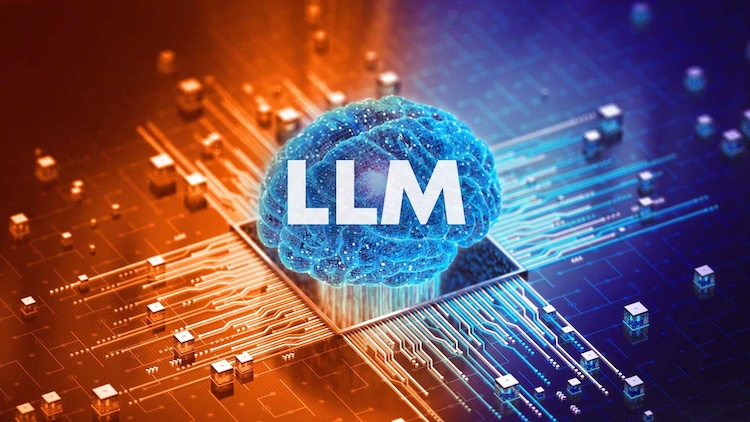
LLMs power intelligent applications by processing and generating human-like language
1.2. How LLMs Work
LLMs are trained through a multi-stage process that allows them to learn language patterns and generate contextually relevant outputs. During the pre-training phase, the model processes massive amounts of text data and learns by predicting the next token in a sequence. Rather than storing information directly, it learns statistical relationships between tokens, enabling it to understand language structure and context.
At the core of this process, the Transformer architecture uses mechanisms such as tokenization, embeddings, and attention to identify relationships between different parts of the input. This allows LLMs to analyze context more effectively and generate more coherent responses while processing large-scale data efficiently.
After pre-training, many LLMs undergo alignment techniques, including instruction tuning and reinforcement learning, to improve accuracy, safety, and instruction-following capabilities. When a user submits a prompt, the model performs inference by generating a response based on the patterns and knowledge acquired during training.
1.3. Common LLM Applications
Large language models are transforming how individuals and businesses interact with information, automate workflows, and develop AI tools. Their ability to understand context, generate natural language, and perform reasoning makes them suitable for a wide range of use cases across industries.
Some of the most common LLM applications include:
- Conversational AI: Powering chatbots, virtual assistants, and customer support systems that deliver more natural, context-aware interactions.
- Content generation: Creating articles, reports, emails, product descriptions, translations, and other written content to improve productivity.
- Software development: Assisting developers with code generation, debugging, documentation, and code completion to accelerate software delivery.
- Enterprise search and knowledge retrieval: Searching internal documents and knowledge bases to provide accurate, context-aware answers for employees and customers.
- Document analysis and summarization: Extracting key information from contracts, invoices, meeting transcripts, and other business documents to streamline workflows.
- Industry-specific AI solutions: Supporting applications such as financial fraud detection, healthcare research, scientific discovery, and intelligent business automation.
As LLM capabilities continue to advance, different models are optimized for different tasks. Some excel at complex reasoning, while others prioritize coding, conversational AI, or lightweight deployment. The next section compares the top large language models in 2026 to help you choose the right model for your specific use case.
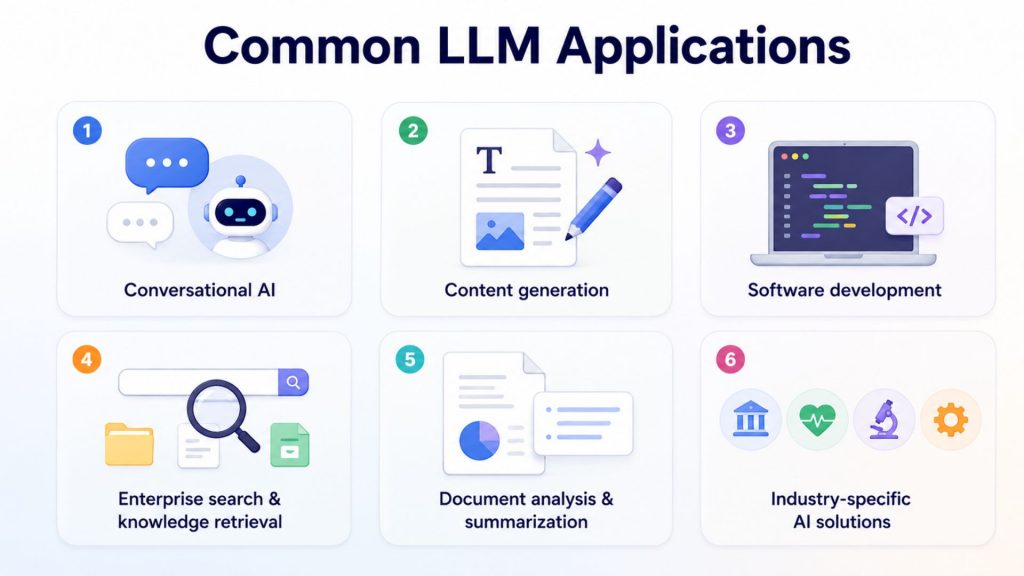
From chatbots to enterprise search, LLMs power diverse AI solutions
2. The 5 Best Large Language Models
The LLM ecosystem has evolved with models optimized for different needs, including reasoning, conversational AI, coding, and open-source development. Organizations should evaluate LLMs based on their strengths, use cases, and deployment requirements rather than looking for a single “best” model.
2.1. Best Reasoning LLMs
Reasoning-focused LLMs are designed to solve complex problems through logical thinking, multi-step planning, and analytical decision-making. They are commonly used for scientific research, software development, mathematics, and enterprise workflows that require high accuracy and reliable reasoning.
2.1.1. OpenAI o3
OpenAI o3 is OpenAI’s flagship reasoning model built for complex tasks that require logical, multi-step analysis. By allocating additional compute to reasoning before generating a response, it achieves high accuracy in mathematics, coding, scientific reasoning, and complex decision-making. This makes it a strong choice for research, advanced software development, and agentic AI applications.
Core Capabilities
- Advanced multi-step reasoning for complex analytical tasks
- Excellent performance in mathematics, coding, and scientific reasoning
- Strong code generation, debugging, and software engineering capabilities
- Supports tool use and agentic workflows for complex tasks
- High accuracy on challenging reasoning and analytical problems
Best for: Research, advanced software development, mathematics, and AI agent workflows that require highly accurate reasoning, logical analysis, and complex decision-making.
2.1.2. Gemini 2.5 Pro
Gemini 2.5 Pro is Google’s flagship reasoning model, designed to solve complex problems with advanced reasoning, multimodal capabilities, and a large context window. It supports text, image, audio, video, and code processing, making it suitable for research, software development, and enterprise applications.
Core Capabilities
- Advanced reasoning for complex, multi-step problem solving
- Native multimodal understanding across text, images, audio, and video
- Large context window for analyzing lengthy documents and code repositories
- Excellent coding capabilities, including code generation, transformation, and debugging
- Strong performance in mathematics, science, and analytical reasoning
Best for: Software development, long-context knowledge analysis, multimodal enterprise applications, scientific research, and complex reasoning tasks.
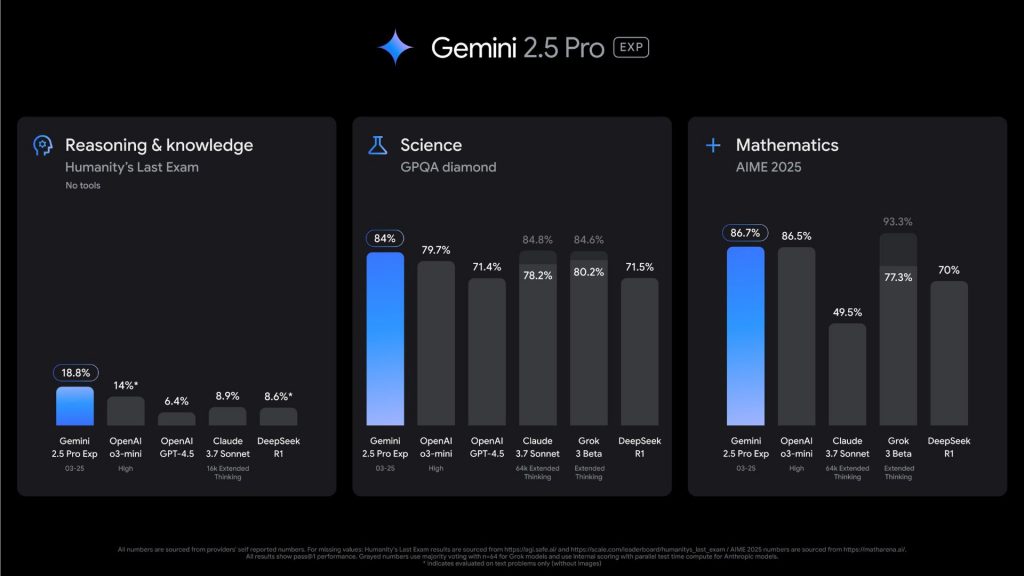
Built for advanced reasoning, multimodal intelligence, and large-scale knowledge analysis
2.1.3. Claude 4 Opus
Claude 4 Opus is Anthropic’s flagship reasoning model, designed for complex tasks that require deep analysis, careful planning, and sustained execution. It combines advanced reasoning with excellent coding capabilities, allowing it to understand large codebases, maintain context across long documents and workflows, and complete sophisticated tasks with minimal oversight. These capabilities make Claude 4 Opus particularly well suited for software engineering, agentic AI applications, and enterprise knowledge work.
Core Capabilities
- Advanced reasoning for complex, multi-step problem solving
- Excellent coding capabilities, including code generation, debugging, and refactoring
- Strong long-context processing for large documents and code repositories
- Reliable support for agentic and tool-based workflows
- Consistent performance on long-running and professional knowledge tasks
Best for: Software development, AI agent automation, technical research, enterprise knowledge management, and complex planning.
2.1.4. DeepSeek R1
DeepSeek R1 is an open-weight reasoning model developed to solve complex problems through logical, multi-step analysis. Built using a combination of supervised fine-tuning and reinforcement learning, it delivers strong performance in mathematics, coding, and scientific reasoning while maintaining coherent and well-structured responses. Its open-weight architecture also allows developers and enterprises to customize and deploy the model within their own infrastructure.
Core Capabilities
- Advanced reasoning for complex, multi-step problem solving
- Strong performance in mathematics, coding, and scientific reasoning
- Excellent code generation, debugging, and analytical capabilities
- Open-weight model that supports self-hosted and customized deployments
- Supports flexible customization and private deployment for enterprise AI
Best for: Scientific research, software engineering, mathematical reasoning, private AI deployments, and domain-specific enterprise applications.
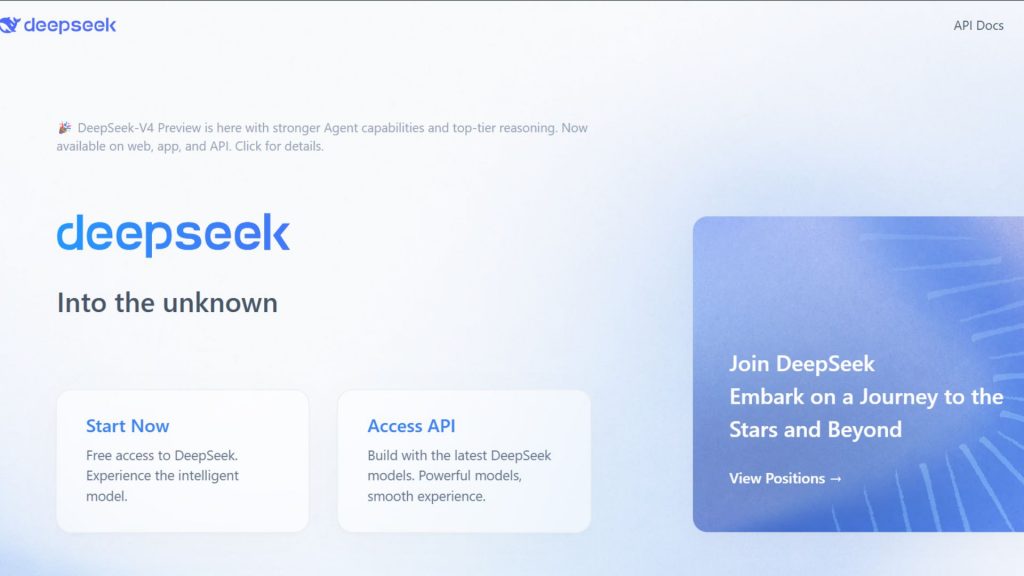
DeepSeek R1 combines advanced reasoning with open-weight flexibility for enterprise AI and software development
2.2. Best Conversational LLMs
Conversational LLMs are optimized to generate natural, engaging, and context-aware responses. These models are widely used for virtual assistants, AI chatbots, customer support, and productivity applications where fast, human-like interactions are essential.
2.2.1. GPT-4o
GPT-4o is OpenAI’s flagship conversational model built to deliver fast, natural, and multimodal interactions. Unlike earlier GPT-4 models that relied on separate systems for different modalities, GPT-4o natively understands and generates text, images, audio, and video within a single model. This unified architecture enables more fluid conversations, lower latency, and stronger contextual awareness across a wide range of personal and enterprise applications.
Core Capabilities
- Supports native multimodal interactions across text, images, audio, and video.
- Delivers low-latency responses, enabling natural real-time conversations and voice assistants.
- Handles complex documents and long conversations with a 128K-token context window.
- Offers strong multilingual capabilities and can be fine-tuned for domain-specific applications.
Best for: Conversational AI, customer support, productivity applications, and multimodal user experiences.
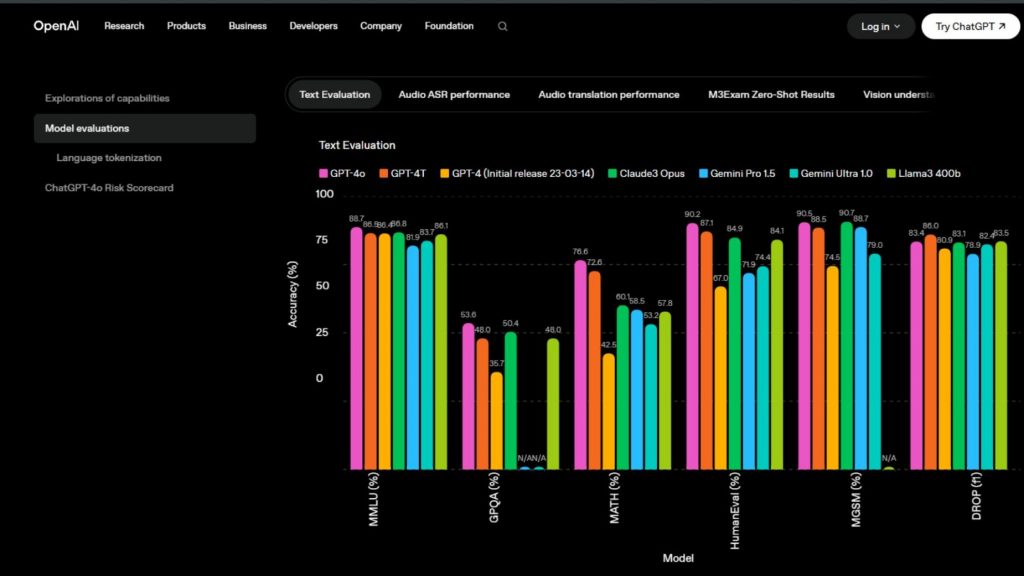
GPT-4o enables seamless multimodal interactions with low-latency responses
2.2.2. Claude 4 Sonnet
Claude 4 Sonnet is Anthropic’s flagship conversational model designed to deliver natural dialogue while maintaining strong reasoning, coding, and tool-use capabilities. It strikes an effective balance between response quality, speed, and cost, making it a popular choice for AI assistants, enterprise chatbots, and agent-based workflows that require reliable performance across diverse tasks.
Core Capabilities
- Produces natural, context-aware conversations with strong instruction-following and long-context understanding (up to a 200K-token context window).
- Supports hybrid reasoning, enabling either fast responses or deeper analytical thinking based on task complexity.
- Excels at tool use, function calling, and coding assistance for AI agents and developer workflows.
- Generates reliable content and knowledge-based responses with strong safety, factual accuracy, and enterprise readiness.
Best for: Enterprise AI assistants, customer support, AI agent automation, software development, and knowledge management.
2.2.3. Grok 3 (xAI)
Grok 3 is xAI’s flagship conversational model, built to combine natural dialogue with advanced reasoning and real-time knowledge retrieval. Designed for both everyday conversations and complex analytical tasks, it delivers fast responses while offering optional reasoning modes for problems that require deeper thinking.
Core Capabilities
- Combines natural conversational AI with optional reasoning modes for both fast responses and complex problem-solving.
- Integrates real-time web search to deliver up-to-date answers on current events and rapidly changing information.
- Processes extensive documents and long conversations with a 1-million-token context window.
- Supports coding, mathematics, scientific reasoning, and agentic workflows through integrated tool use and code execution.
Best for: Real-time web research, conversational AI, software development, knowledge retrieval, and AI agents with web search.
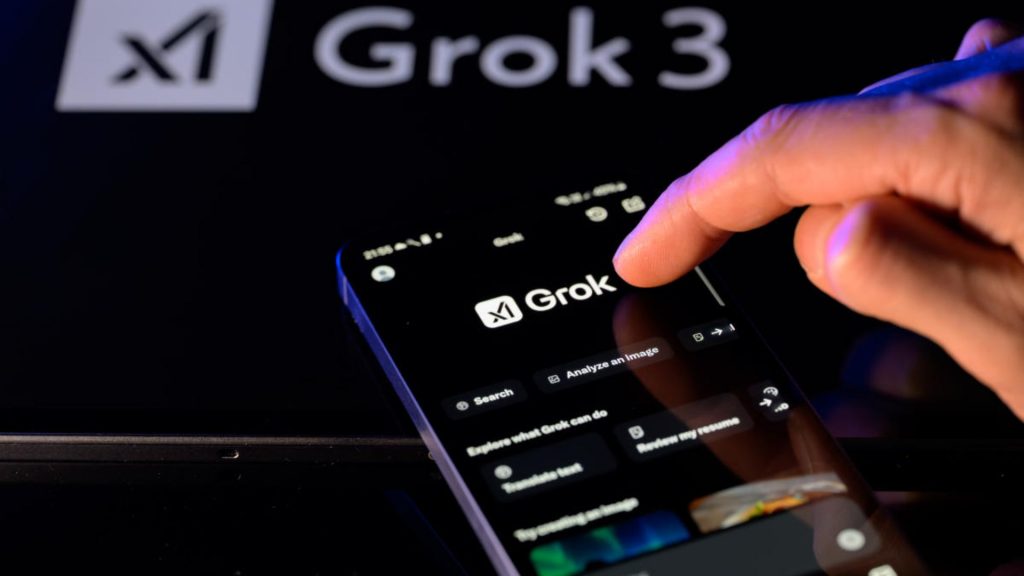
Grok 3 delivers real-time knowledge retrieval and advanced reasoning in one AI model
2.3. Best Lightweight LLMs
Lightweight LLMs are designed to deliver efficient AI performance while requiring fewer computing resources. They are well suited for Edge AI applications, local deployment, and environments where latency and infrastructure costs are important considerations.
2.3.1. Gemma 3 (4B)
Gemma 3 (4B) is Google’s lightweight open-weight language model that delivers strong performance while remaining efficient enough to run on consumer hardware. Supporting multimodal inputs, a long 128K context window, and more than 140 languages, it provides an excellent balance between capability and deployment efficiency for developers building local or resource-constrained AI applications.
Core Capabilities
- Lightweight architecture optimized for fast local inference
- Native multimodal support for text and image understanding
- 128K context window for processing long documents and conversations
- Multilingual support across more than 140 languages
- Open-weight model for flexible customization and deployment
Best for: Edge AI, local AI assistants, multilingual applications, visual understanding, and resource-constrained deployments.
2.3.2. Qwen 3 (4B)
Qwen 3 (4B) is a lightweight open-weight LLM from Alibaba Cloud that combines strong reasoning, coding, and multilingual capabilities with efficient local deployment. Supporting 119 languages and hybrid thinking modes, it balances fast responses with deeper reasoning for complex tasks. The model is compatible with popular deployment frameworks, including Ollama, LM Studio, llama.cpp, and vLLM.
Core Capabilities
- Hybrid Thinking and Non-Thinking modes for balancing reasoning quality and inference speed
- Strong reasoning, coding, and multilingual capabilities in a compact 4B model
- Open-weight model released under the Apache 2.0 license for flexible commercial use
- Compatible with popular local deployment and inference frameworks
Best for: Local AI development, edge AI applications, multilingual assistants, coding tools, and lightweight enterprise deployments.
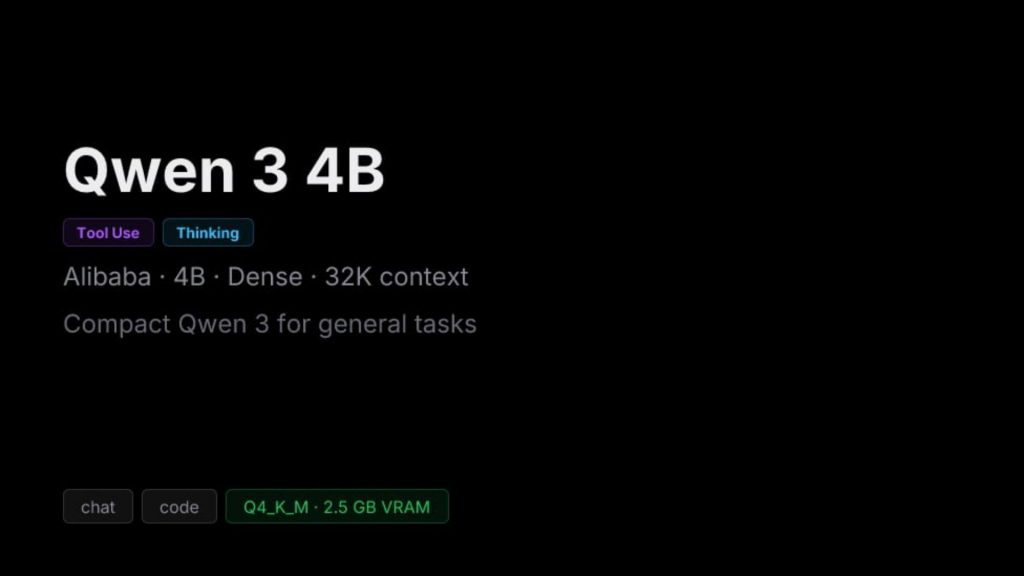
Qwen 3 (4B) combines multilingual intelligence, reasoning, and efficient local deployment in a compact model
2.3.3. Mistral Small 3.1
Mistral Small 3.1 is an open-weight lightweight language model developed by Mistral AI under the Apache 2.0 license. It is designed to deliver a strong balance between capability, speed, and hardware efficiency, making advanced AI accessible on both consumer devices and enterprise infrastructure. The model supports a broad range of AI workloads, from conversational assistants to document processing and domain-specific applications, while remaining cost-effective to deploy.
Core Capabilities
- Combines text generation, image understanding, multilingual support, and function calling within a single lightweight model.
- Supports a 128K-token context window, enabling long-document analysis and multi-step workflows.
- Delivers low-latency inference, making it suitable for real-time AI applications and interactive assistants.
- Can be fine-tuned for specialized domains such as healthcare, legal services, customer support, and technical documentation.
Best for: Real-time AI assistants, resource-constrained edge deployments, multimodal applications, and open-weight enterprise AI.
Mistral Small 3.1 enables fast, multimodal AI applications with efficient open-weight deployment
2.4. Best Coding LLMs
Coding-focused LLMs are trained to understand programming languages, generate code, explain technical concepts, and assist developers throughout the software development lifecycle.
2.4.1. Kimi K2.5
Kimi K2.5 is a coding-oriented LLM by Moonshot AI, built for software engineering tasks, agentic workflows, and complex code generation. With strong reasoning and long-context capabilities, it supports coding, debugging, repository understanding, and tool-assisted development.
Core Capabilities
- Delivers strong performance in code generation, debugging, and large codebase understanding.
- Supports long-context processing for analyzing extensive repositories and technical documentation.
- Combines reasoning with tool use to power agentic coding workflows, including planning and code execution.
- Enables open-weight deployment, allowing organizations to fine-tune and customize the model for private development environments.
Best for: AI coding assistants, software engineering, repository-level development, autonomous coding agents, and customizable enterprise deployments.
2.4.2. MiniMax M2.5
MiniMax M2.5 is a coding-focused LLM designed for software engineering tasks that require strong reasoning, long-context processing, and efficient code generation. Supporting both natural language and programming workflows, it helps developers understand large codebases, generate high-quality code, debug applications, and automate complex development tasks while maintaining fast inference performance.
Core Capabilities
- Delivers strong performance in code generation, debugging, and software engineering tasks across multiple programming languages.
- Supports an ultra-long context window for analyzing large code repositories, technical documentation, and multi-file projects.
- Combines advanced reasoning with coding capabilities to solve complex programming problems and generate structured implementation plans.
- Enables cost-efficient deployment of AI coding assistants, balancing high performance with scalable infrastructure requirements.
Best for: AI coding assistants, enterprise software engineering, codebase analysis, debugging, and developer productivity tools.
2.4.3. GLM-5
GLM-5 is Z.AI’s latest coding-focused foundation model built for agentic software engineering. Beyond code generation, it is designed to understand complex development tasks, plan multi-step solutions, and assist throughout the software development lifecycle. These capabilities make it a strong choice for AI-powered coding assistants and enterprise development teams.
Core Capabilities
- Delivers state-of-the-art performance in code generation, debugging, and repository-level software engineering tasks.
- Combines advanced reasoning with agentic coding to support implementation planning, refactoring, and complex development workflows.
- Supports a 200K-token context window for understanding large codebases, technical documentation, and multi-file projects.
- Provides enterprise-ready features, including function calling, structured outputs, streaming, and context caching for scalable AI coding applications.
Best for: AI coding assistants, software engineering, code review and debugging, repository-level development, and agentic coding workflows with tool integration.
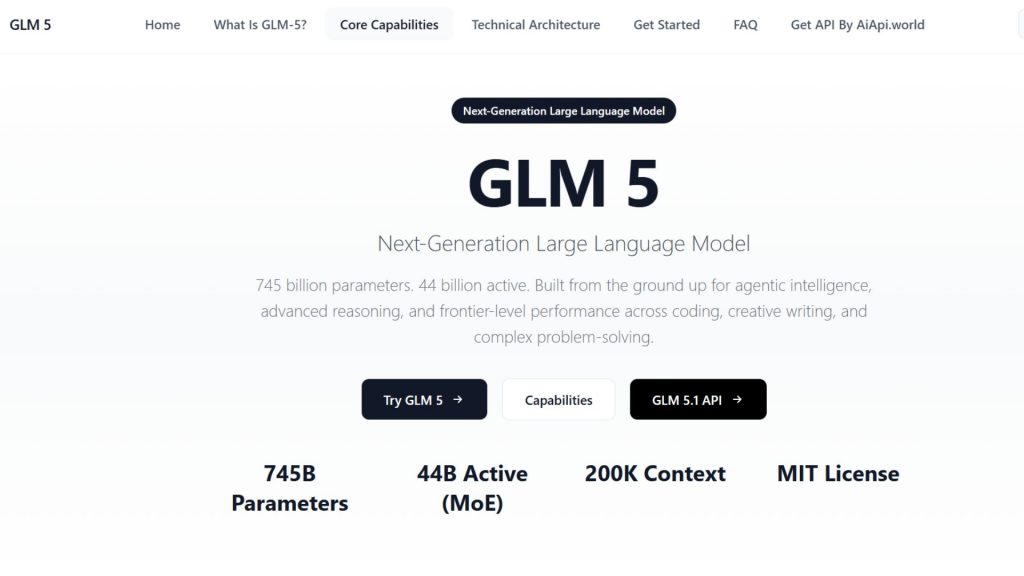
GLM-5 delivers intelligent code generation and agentic software engineering with enterprise-ready capabilities
2.5. Best Open-Source LLMs
Open-source LLMs provide greater flexibility for customization, fine-tuning, and self-hosting. Organizations can adapt these models for specific business requirements through fine-tuning, allowing them to improve performance on domain-specific tasks while maintaining greater control over their AI systems.
2.5.1. GLM-5
GLM-5 is one of the leading open-weight foundation models for organizations seeking greater control over AI deployment and customization. Its open architecture enables enterprises to fine-tune the model using techniques such as LoRA, deploy it on private infrastructure, and integrate advanced reasoning and agent capabilities into production environments while maintaining data privacy and operational flexibility.
Core Capabilities
- Released as an open-weight foundation model, enabling organizations to customize and fine-tune the model for domain-specific AI applications.
- Supports private, on-premises, and hybrid-cloud deployments, giving enterprises greater control over security, compliance, and data governance.
- Combines reasoning, coding, and agent capabilities in a unified model, making it suitable for a wide range of enterprise AI workloads.
- Includes enterprise-ready features such as long-context processing, function calling, structured outputs, and context caching for seamless application integration.
Best for: Organizations requiring self-hosted and privacy-focused AI deployments, enterprise applications with strict data governance, industry-specific model customization through fine-tuning, and research or development teams building open-source AI solutions.
2.5.2. DeepSeek V3.2
DeepSeek V3.2 is a high-performance open-source LLM designed for general AI workloads, with strengths in coding, reasoning, multilingual understanding, and agent-based applications. Its efficient inference and strong performance make it a suitable self-hosted alternative to proprietary models.
Core capabilities
- Delivers strong performance in code generation, debugging, software engineering, and complex reasoning tasks, making it suitable for both developer assistants and general-purpose AI applications.
- Supports long-context processing, enabling accurate analysis of large codebases, technical documents, research papers, and enterprise knowledge repositories.
- Provides robust multilingual capabilities for conversational AI, content generation, translation, and cross-language business applications.
- As an open-source model, it supports private deployment, domain-specific fine-tuning, and seamless integration into enterprise AI systems while maintaining greater control over data security and customization.
Best for
DeepSeek V3.2 is best suited for organizations and developers seeking a powerful open-source LLM for coding assistants, enterprise knowledge systems, multilingual AI applications, document processing, and private on-premises deployments where customization, transparency, and data governance are key priorities.
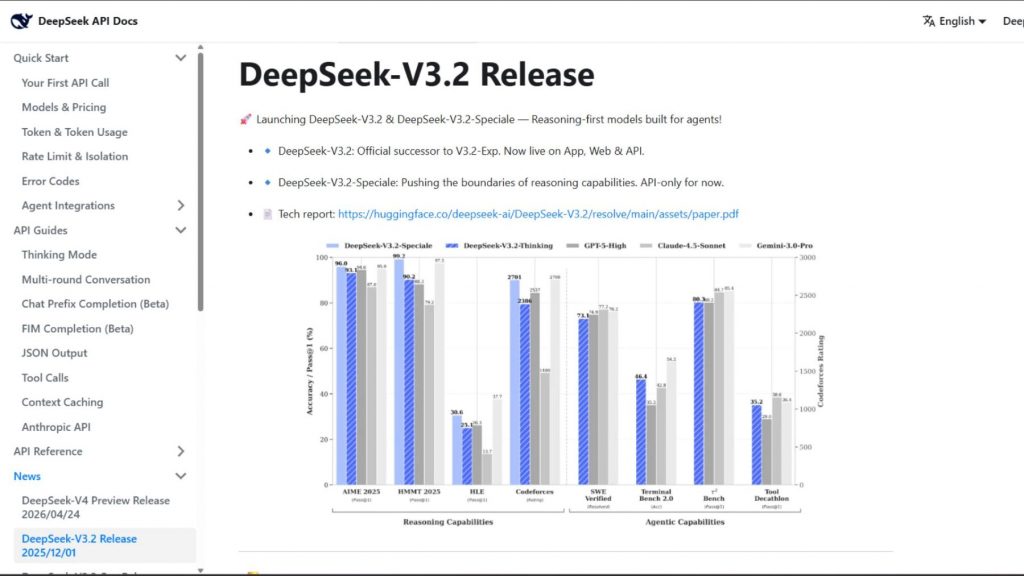
DeepSeek V3.2 powers enterprise AI with high-performance reasoning, coding, and multilingual capabilities
2.5.3. Step-3.5-Flash
Step-3.5-Flash is a lightweight open-source LLM developed by StepFun that delivers fast inference, strong reasoning, and cost-efficient deployment. With multilingual and coding capabilities, it enables developers to build responsive AI applications while reducing infrastructure requirements, making it well suited for scalable production environments.
Core capabilities
- Optimized for low-latency inference, making it ideal for real-time AI assistants, chatbots, and customer service applications that require fast responses.
- Delivers reliable reasoning, instruction following, and multilingual conversational capabilities for everyday business and productivity tasks.
- Supports code generation, debugging, and developer workflows across multiple programming languages, making it well suited for coding assistants and IDE integrations.
- As an open-source model, it enables cost-efficient private deployment, domain-specific customization, and seamless integration into enterprise AI platforms.
Best for
Step-3.5-Flash is best suited for organizations seeking a lightweight open-source LLM for AI chatbots, developer assistants, multilingual applications, enterprise automation, and other latency-sensitive workloads where fast inference, deployment efficiency, and infrastructure cost are primary considerations.
While each of these LLMs excels in different areas, choosing the right model depends on more than individual capabilities. Organizations should also evaluate practical factors such as performance, cost, deployment flexibility, and long-term scalability before making a decision.
3. How to Choose the Right LLM
Choosing the right LLM requires evaluating business goals, technical needs, and deployment environments. Beyond benchmarks, organizations should consider cost, context window, licensing, and infrastructure to select a model that fits their AI strategy.
3.1. Performance
Performance is often the primary factor when comparing LLMs, but it should be measured against your intended use case rather than benchmark scores alone. While public evaluations provide useful insights into reasoning, coding, and language understanding, they cannot fully represent how a model will perform in production.
When assessing an LLM, consider capabilities such as reasoning accuracy, instruction following, multilingual support, coding performance, response quality, and latency. Running pilot tests with your own datasets and workflows is one of the most effective ways to determine whether a model meets your business requirements.
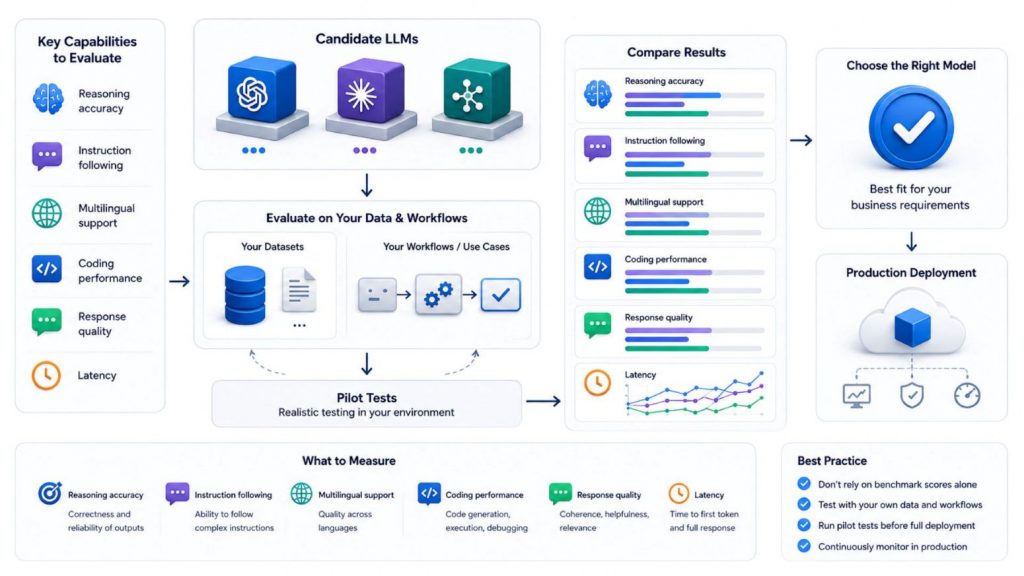
Selecting the right LLM based on real-world performance
3.2. Cost
The cost of deploying an LLM extends beyond API pricing. Organizations should evaluate the total cost of ownership (TCO), including AI inference costs, GPU infrastructure, storage, maintenance, and engineering resources required to operate AI applications over time.
Closed-source models typically provide predictable usage-based pricing and managed services, while open-source models offer greater flexibility and lower licensing costs but often require additional infrastructure and operational expertise. Understanding these trade-offs helps businesses balance performance with long-term operating costs.
3.3. Context Window
The context window defines how much information an LLM can process in a single interaction. Models with larger context windows can analyze lengthy documents, retain conversation history, and reason across multiple information sources without losing context.
This capability is particularly valuable for enterprise applications such as document analysis, retrieval-augmented generation (RAG), enterprise search, and software development. However, a larger context window may also increase computational requirements and inference costs, making it important to choose a model that aligns with your workload.
3.4. Open vs Closed Source
Another important consideration is whether to use an open-source or closed-source LLM. Open-source models allow organizations to customize, fine-tune, and self-host their AI solutions, making them suitable for businesses with strict privacy, compliance, or data governance requirements.
Closed-source models generally offer stronger out-of-the-box performance, continuous updates, and managed services that simplify adoption. The right choice depends on factors such as security requirements, customization needs, available technical expertise, and long-term AI strategy.
3.5. Deployment Requirements
Selecting an LLM also requires evaluating how it will fit into your existing technology stack. Factors such as API compatibility, scalability, latency, security, monitoring, and model serving capabilities all influence how effectively a model can support production workloads.
Organizations should also consider whether the model can scale with future business growth and support their preferred deployment approach, whether through cloud services, AI infrastructure, on-premises infrastructure, or hybrid environments. Planning these requirements early helps reduce implementation challenges and ensures a smoother transition from experimentation to production AI applications.
Once you’ve identified the right LLM, the next step is turning it into a production-ready AI application. This involves integrating the model with enterprise data, workflows, and deployment infrastructure to build an AI agent that delivers real business value.

Scalable AI deployment infrastructure for production environments
4. How to Build an AI Agent with Your Preferred LLM?
As enterprises increasingly adopt generative AI, the focus is shifting from using standalone LLMs to building AI agents that can solve business problems autonomously. By combining the right language model with enterprise knowledge, external tools, and a scalable deployment strategy, organizations can create AI applications that deliver measurable business value.
Step 1: Define the Agent’s Role and Scope
Start by defining the agent’s purpose, target users, expected outcomes, and operational boundaries. Unlike traditional chatbots, AI agents can reason through tasks, make decisions, and interact with external tools to achieve specific goals.
Organizations should determine what data the agent can access, which systems it can connect to, and what actions it is allowed to perform. A clear scope improves accuracy, security, and alignment with business objectives.
Step 2: Build the Base Agent
Once the scope is established, the next step is building the agent’s core capabilities. This typically includes designing prompt engineering strategies and system prompts, defining conversation flows, and enabling the agent to reason through complex tasks. Depending on the use case, the agent may also need function calling, API integration, or workflow automation to interact with external applications and complete multi-step processes.
During development, organizations should test the agent with real-world scenarios and evaluate key factors such as accuracy, reliability, latency, and task completion performance.
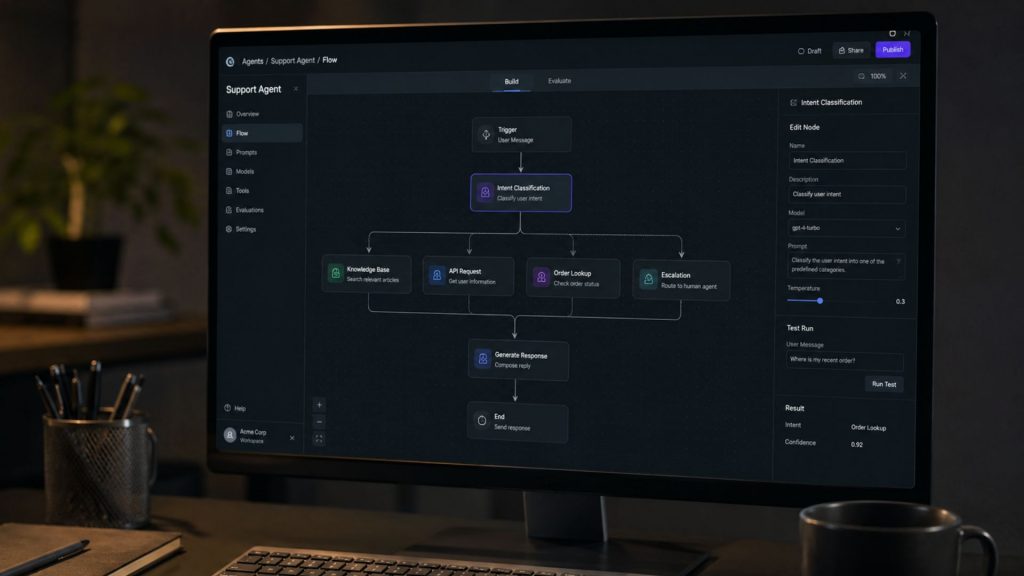
Building an AI agent with API integration and automation
Step 3: Connect Knowledge Sources
LLMs provide broad general knowledge but lack access to an organization’s private and up-to-date information. Connecting AI agents to enterprise data sources, including documents, databases, APIs, and business applications, enables more accurate and context-aware responses.
Many organizations use Retrieval-Augmented Generation (RAG) to retrieve relevant information before generating responses. Combined with LLM orchestration and tool calling, this approach enables AI agents to access real-time enterprise data, execute business workflows, and significantly reduce hallucinations.
Step 4: Select Your Preferred LLM
The LLM acts as the reasoning engine of an AI agent, so model selection should be based on business requirements rather than benchmark rankings alone. Organizations should consider factors such as reasoning ability, multimodal support, coding capabilities, latency, cost, and deployment needs.
Platforms like FPT AI Studio help enterprises integrate and customize LLMs through capabilities such as AI Notebook, Data Hub, and Model Hub. After selecting a model, Serverless Inference enables scalable deployment of chat, coding, and multimodal AI applications without requiring organizations to manage GPU infrastructure.
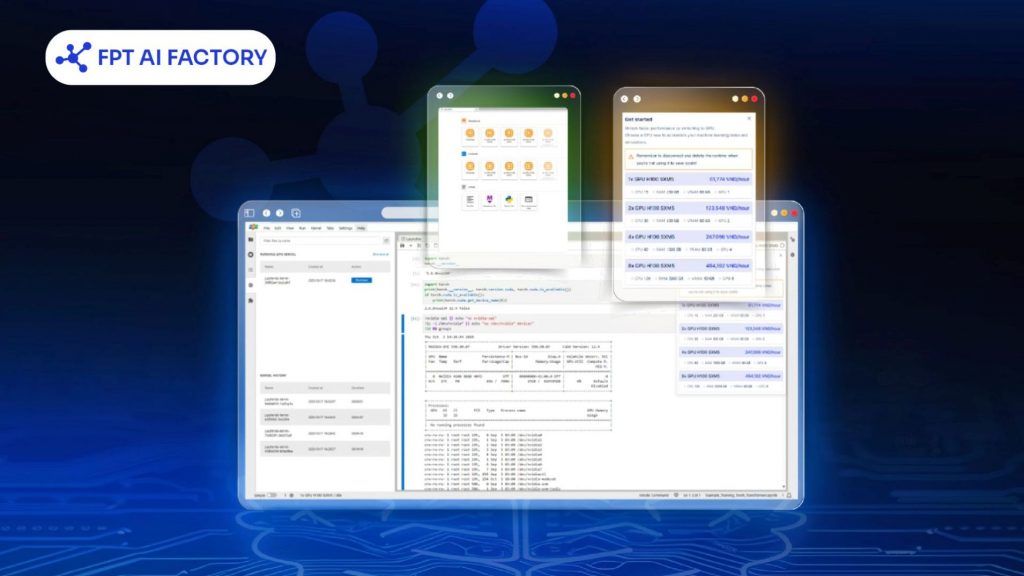
FPT AI Studio and Serverless Inference simplify LLM customization, deployment, and scalable AI application delivery
Step 5: Deploy to Your Preferred Channel
AI agents can be deployed across websites, mobile applications, messaging platforms, enterprise portals, and internal business systems. To ensure reliable performance, organizations should optimize LLM inference for low latency and efficient resource usage.
Continuous monitoring, user feedback, and MLOps practices help improve prompts, workflows, and knowledge sources over time, ensuring AI agents remain accurate, scalable, and aligned with evolving business needs.
Building and deploying an AI agent often raises additional questions about model selection, deployment strategies, and enterprise adoption. The following FAQs address some of the most common questions organizations have when evaluating and implementing LLMs.
5. FAQs
5.1. What is the most popular large language model?
There is no single most popular LLM, as different models are designed for different use cases. Models such as GPT-4o, Gemini 2.5 Pro, Claude 4 Sonnet, and DeepSeek R1 are widely used for conversational AI, reasoning, coding, and enterprise applications. The best choice depends on your business goals, technical requirements, and deployment strategy.
5.2. Which LLM is best for enterprise use?
The best LLM for enterprise use depends on factors such as performance, security, scalability, cost, and integration requirements. Organizations should evaluate models based on their intended workloads, compliance needs, and deployment environment rather than relying solely on benchmark rankings or popularity.
5.3. What is the difference between open-source and closed-source LLM?
Open-source LLMs allow organizations to customize, fine-tune, and self-host models for greater flexibility and control, while closed-source LLMs provide managed services, regular updates, and simpler deployment. The right choice depends on your organization’s technical expertise, security requirements, and long-term AI strategy.
5.4. How do businesses deploy LLM applications?
Businesses typically deploy LLM applications by integrating language models with enterprise data, business systems, and user-facing applications. Platforms such as FPT AI Studio help streamline AI development, while Serverless Inference enables organizations to deploy and scale LLM-powered applications without managing GPU infrastructure.
This list of large language models highlights some of the leading LLMs available in 2026, each offering unique strengths for reasoning, conversational AI, coding, lightweight deployment, and enterprise applications. Rather than focusing solely on benchmark rankings, organizations should evaluate models based on their business objectives, technical requirements, scalability, and deployment strategy to identify the best fit for their AI initiatives.
For organizations seeking enterprise AI solutions, FPT AI Factory provides AI infrastructure in Vietnam and Japan, with Malaysia coming soon, alongside competitively priced hourly GPU services for flexible AI development and deployment. A dedicated AI consulting team also helps businesses select suitable models, optimize deployment, and build AI solutions aligned with their objectives. Contact FPT AI Factory through the official contact form to discuss your AI requirements.
Contact information:
- Hotline: 1900 638 399
- Email: support@fptcloud.com
Explore related articles:
Top 5 AI Chatbot Examples From Real Use Cases 2026
What is AI governance? Principles framework and practices
Top Cloud Service Providers with GPU for AI Workloads
GPU Virtual Machine: Benefits, Use Cases, and How It Works
Best Vector Database Comparison: Choosing the Right Solution