
What is reinforcement learning? Reinforcement learning is a machine learning approach where an AI system learns by taking actions, receiving feedback and improving its behavior over time. It is used in robotics, autonomous systems, recommendation engines, operations optimization and generative AI alignment. This guide explains how reinforcement learning works, where it creates business value and what teams should consider when scaling RL workflows with FPT AI Factory.
|
Key takeaways Reinforcement learning helps AI systems learn through actions, feedback and rewards instead of relying only on labeled data. It is especially useful for complex decision-making tasks, autonomous systems and dynamic environments, but it also requires careful reward design, scalable infrastructure and strong evaluation before production deployment.
|
FPT AI Factory helps teams build, evaluate and deploy reinforcement learning workflows from experimentation to production. With GPU infrastructure, AI Notebook, Model Testing and Serverless Inference, teams can run simulations, validate model behavior, test performance and streamline deployment more efficiently. Organizations with custom AI requirements or large-scale infrastructure needs can contact FPT AI Factory team for tailored solutions.
1. What is Reinforcement Learning?
Reinforcement learning is a machine learning method in which an AI agent learns by interacting with an environment. The agent observes the current state, chooses an action, receives a reward or penalty, and updates its strategy based on the result. Over many interactions, the system learns which actions are more likely to achieve the desired goal.
Unlike one-step prediction tasks, reinforcement learning focuses on decisions that affect future outcomes. For example, a robot that learns to pick up objects must evaluate how each movement changes the next state. A recommendation system may need to balance short-term clicks with long-term user engagement. This makes RL useful for sequential decision-making problems where actions, feedback and future rewards are connected.
For AI teams, reinforcement learning is closely connected to the broader AI development lifecycle. Teams need training data, simulation environments, evaluation tools and scalable compute before an RL model can become reliable enough for production.
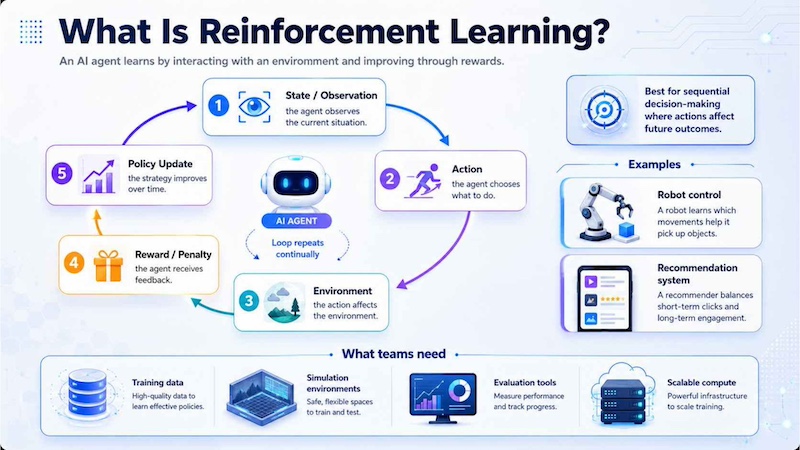
Reinforcement learning trains an AI agent through repeated actions, feedback and rewards, helping it improve decisions over time in sequential workflows.
2. How Reinforcement Learning works
Reinforcement learning works through a feedback loop. An agent takes an action in an environment, receives a reward signal and uses that feedback to improve its policy. The goal is not only to make a correct prediction, but to learn a strategy that performs well over time.
2.1. Core components
Most reinforcement learning systems include several core components that define how learning happens. Each component affects how the agent explores, learns and improves its decisions.
- Agent: The AI system that makes decisions and learns from outcomes.
- Environment: The world, system or simulation where the agent acts.
- State: The current situation observed by the agent.
- Action: A decision or movement selected by the agent.
- Reward: Feedback that tells the agent whether the action was useful.
- Policy: The strategy the agent follows when choosing actions.
In real projects, these components may be implemented in a simulator, enterprise workflow or live application. For compute-heavy experiments, teams may use GPU Container or GPU Virtual Machine to run training jobs, simulation workloads and parallel experiments with more control over the environment.
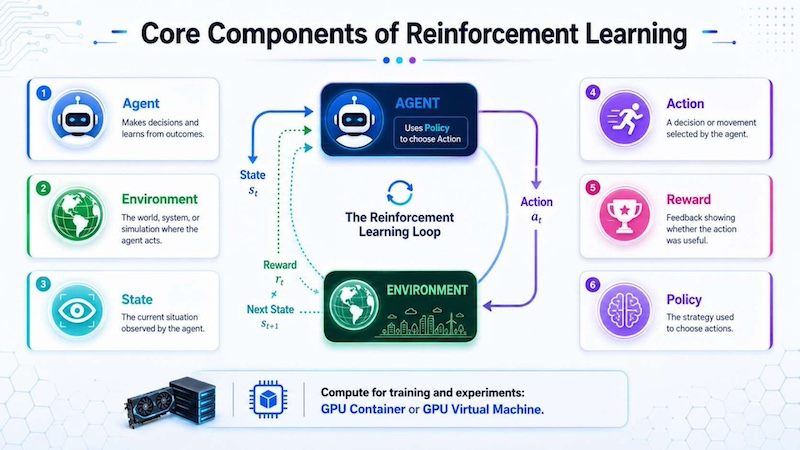
Reinforcement learning uses core components such as agent, environment, state, action, reward and policy to help AI learn better decisions through repeated feedback.
2.2. Algorithm basics
Reinforcement learning algorithms help the agent improve its policy. Some methods estimate the long-term value of each action, while others directly optimize the policy that selects actions. In deep reinforcement learning, neural networks are often used to handle complex inputs such as images, sensor data, text or large state spaces.
Common algorithm families include Q-learning, policy gradient methods, actor-critic methods and deep RL approaches. The right algorithm depends on whether the environment can be simulated, how expensive each action is, how large the state space is and how quickly the system needs to learn.
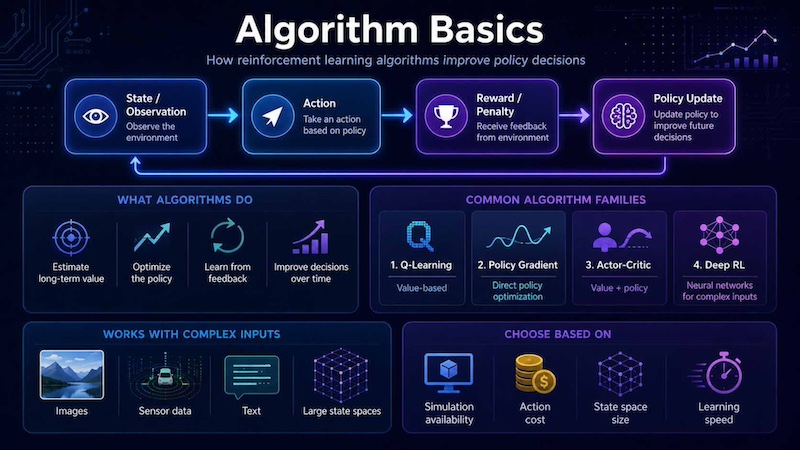
Reinforcement learning algorithms help agents improve decisions over time by learning from actions, rewards and feedback across different environments.
3. Key Concepts in Reinforcement Learning
3.1 Reward Functions
A reward function defines what the agent should optimize. In a robotics task, the reward may increase when the robot completes a movement correctly. In a recommendation system, the reward may reflect user engagement, retention or satisfaction. A well-designed reward function helps the agent learn useful behavior, while a poorly designed reward can push the model toward unwanted shortcuts.
Reward design is one of the most important parts of RL because the agent will optimize what it is measured on. Before moving toward deployment, teams should validate whether the reward aligns with business goals, safety requirements and user expectations.
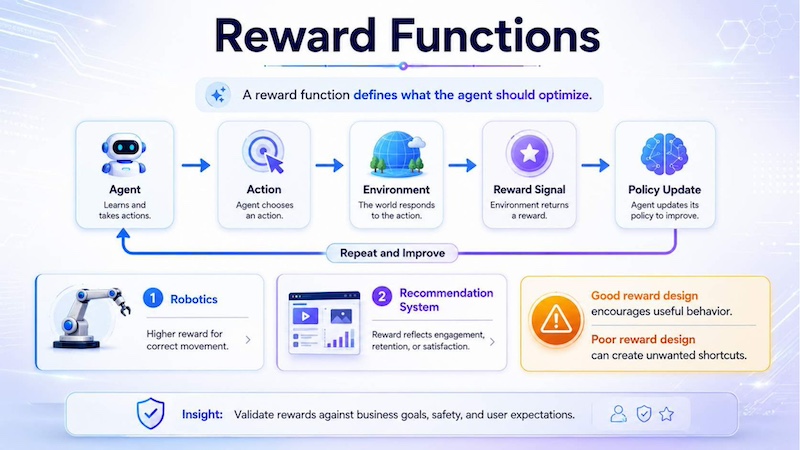
Reward functions guide what an AI agent should optimize, helping it learn useful behavior through feedback while avoiding unwanted shortcuts.
3.2 Exploration vs Exploitation
Exploration means trying new actions to discover better strategies. Exploitation means using actions that are already known to work. A reinforcement learning system must balance both. If the agent explores too much, it may behave unpredictably. If it exploits too early, it may miss better strategies.
This trade-off is important in business environments. For example, a recommendation system may test a new item to learn user preferences, but it should not damage the user experience by showing too many irrelevant suggestions. Careful experimentation and monitoring are needed before RL-driven decisions affect real users.
3.3 State and Action Spaces
The state space includes all information the agent can observe, while the action space includes all decisions it can make. Small state and action spaces are easier to manage. Large spaces, such as robot motion, traffic scenes or personalized recommendations, usually require more training data, better simulation and stronger compute resources.
For teams working with large datasets or complex model inputs, understanding training data quality is essential. RL systems may fail if the environment does not represent real conditions or if the agent cannot observe the information needed to make good decisions.
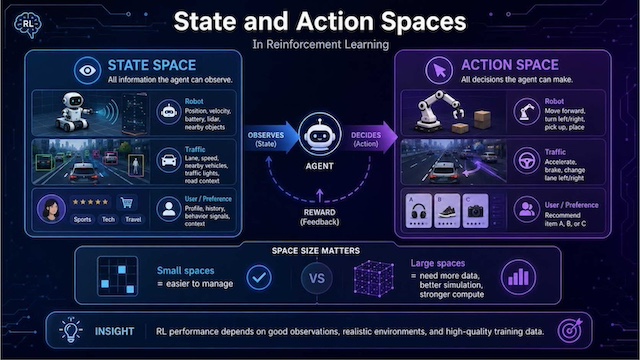
State and action spaces define what an RL agent can observe and decide, shaping how well it learns from feedback in complex environments.
3.4 Policy Optimization
Policy optimization is the process of improving the agent’s decision strategy. The policy tells the agent what action to take in a given state. During training, the policy is updated to increase expected rewards over time.
In enterprise AI, policy optimization should be paired with testing and governance. A policy that performs well in simulation may behave differently in production. This is why teams need evaluation metrics, controlled rollout plans and monitoring before using RL in high-impact workflows.
4. Types of Reinforcement Learning
Reinforcement learning includes several approaches. The right type depends on whether the system has a model of the environment, how complex the task is and how much data or computation is available.
4.1 Model-Based Reinforcement Learning
Model-based reinforcement learning uses a model of the environment to predict what may happen after an action. This allows the agent to plan before acting. It can be useful when real-world actions are costly, risky or slow, such as robotics, industrial control or autonomous driving simulations.
4.2 Model-Free Reinforcement Learning
Model-free reinforcement learning learns directly from experience without building an explicit model of the environment. The agent tries actions, observes rewards and gradually improves. This approach can be flexible, but it may require many interactions before reaching strong performance.
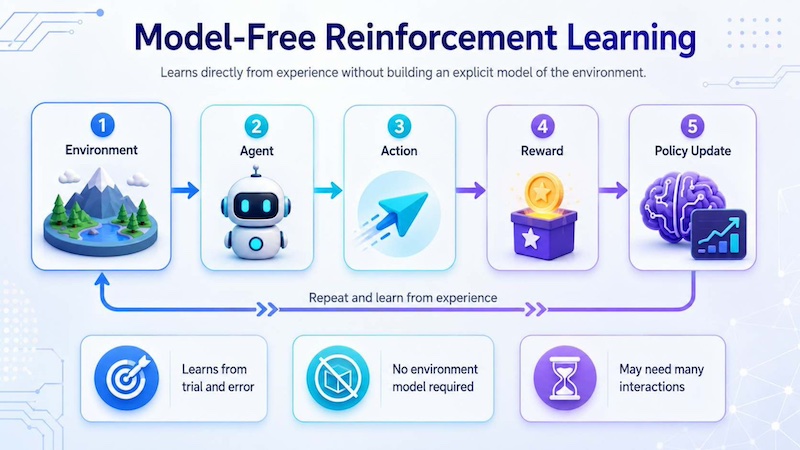
Model-free reinforcement learning helps an agent improve through trial, action, reward and repeated feedback without building a separate model of the environment.
4.3 Deep Reinforcement Learning
Deep reinforcement learning combines reinforcement learning with deep neural networks. It is useful for complex inputs such as images, sensor streams or large-scale simulations. AlphaGo is a well-known example: the Nature paper describing AlphaGo explains that it combined supervised learning with reinforcement learning from self-play to improve its policy and value networks. Because deep RL can be compute-intensive, teams often need scalable infrastructure.
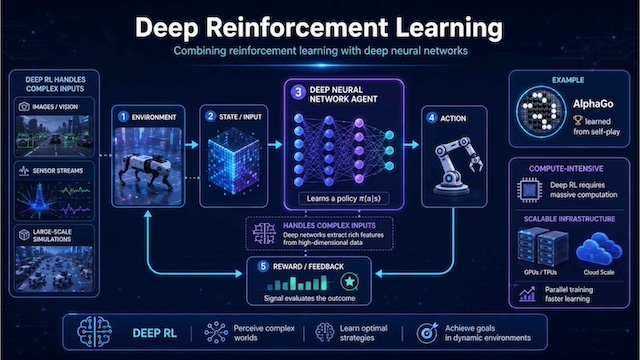
Deep reinforcement learning combines reinforcement learning with neural networks to help AI agents learn from complex inputs such as images, sensor data.
4.4 Offline Reinforcement Learning
Offline reinforcement learning trains an agent using previously collected data instead of allowing it to interact with the environment in real time. The agent learns from historical logs, simulations or expert demonstrations. This approach is useful when live experimentation is costly, risky or impractical, such as in healthcare, finance, robotics or autonomous systems. However, its performance depends heavily on the quality and diversity of the available dataset.
4.5 Multi-Agent Reinforcement Learning
Multi-agent reinforcement learning involves multiple agents learning and making decisions in the same environment. These agents may cooperate, compete or combine both behaviors depending on the task. This approach is useful for complex systems such as traffic control, game AI, supply chain optimization, autonomous vehicles and distributed robotics. It is more challenging than single-agent reinforcement learning because each agent must adapt not only to the environment, but also to the changing behavior of other agents.
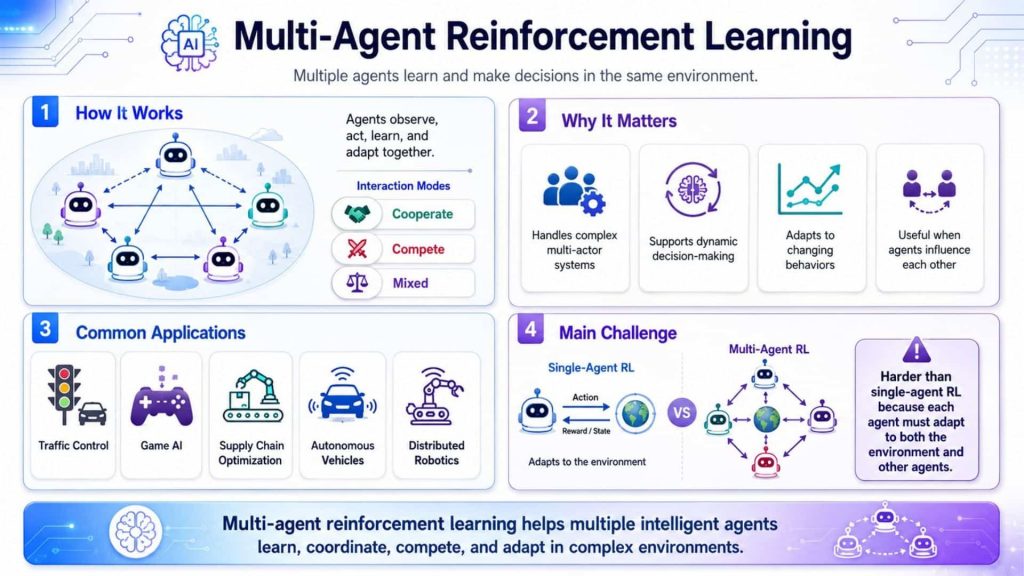
Multi-agent reinforcement learning enables multiple AI agents to cooperate, compete, and adapt together in complex environments.
5. Popular Reinforcement Learning Algorithms
In practice, reinforcement learning systems are built using specific algorithms. Each algorithm has different strengths depending on the action space, environment complexity, training stability and available computation. The table below summarizes several popular reinforcement learning algorithms.
| Algorithm | How it works | Best suited for | Key strengths | Main limitations |
| Q-Learning | Learns the expected value of actions in each state and chooses actions that maximize long-term reward. | Simple environments with discrete states and actions. | Easy to understand, useful for basic decision-making problems. | Does not scale well to large or continuous environments without approximation methods. |
| DQN | Uses deep neural networks to estimate Q-values instead of storing them in a table. | Games, simulations and tasks with high-dimensional inputs but discrete actions. | Handles more complex environments than traditional Q-Learning. | Can require many training samples and may be unstable without careful tuning. |
| Actor-Critic | Combines two models: an actor that selects actions and a critic that evaluates them. | Robotics, control systems, recommendation systems and complex decision tasks. | Balances policy learning and value estimation for more flexible training. | More complex to implement and tune than basic value-based methods. |
| PPO | Improves policies through controlled updates to avoid sudden performance drops. | Robotics, game AI, simulations and AI policy optimization. | Stable, widely used and effective across many reinforcement learning tasks. | May still require significant data and compute for strong performance. |
| SAC | Uses an off-policy actor-critic method with entropy-based exploration to encourage diverse actions. | Continuous control tasks, robotics and autonomous systems. | Strong exploration, good sample efficiency and stable performance in many continuous environments. | More computationally complex than simpler RL algorithms. |
These algorithms help turn reinforcement learning principles into practical systems. For example, Q-Learning and DQN are often used for discrete decision problems, while PPO, Actor-Critic and SAC are more suitable for complex control tasks that require continuous learning and adaptation.
6. Benefits of Reinforcement Learning
6.1 Learns Through Experience
Reinforcement learning allows an AI system to improve through interaction instead of relying only on static labeled data. This is useful when the best decision is not obvious at the beginning or when the system must discover better strategies through trial and error.
6.2 Adapts to Dynamic Environments
Many real-world environments change over time. User behavior, traffic conditions, supply chain constraints and system demand can shift quickly. RL can help systems adapt when the goal depends on changing conditions and sequential decisions.
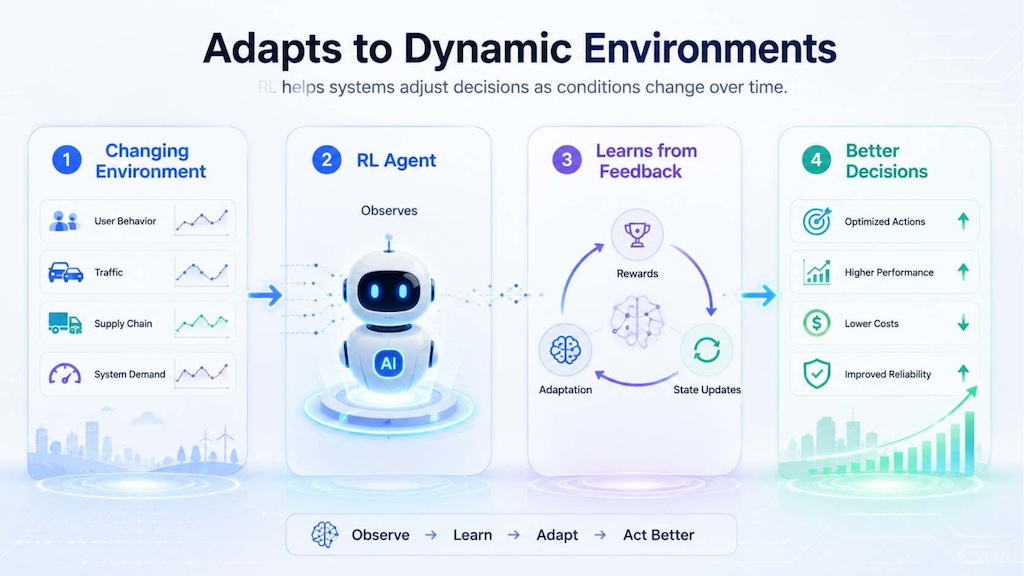
Reinforcement learning helps AI systems adapt to changing environments by observing new conditions, learning from feedback and improving decisions over time.
6.3 Supports Complex Decision-Making
Reinforcement learning is valuable when decisions have delayed consequences. For example, a warehouse robot may need to choose a path that avoids congestion, while an operations system may allocate resources based on future demand. RL helps optimize for long-term outcomes rather than only immediate results.
6.4 Enables Autonomous Systems
RL is one of the foundations of autonomous systems because it helps agents learn how to act in an environment. It is relevant to robotics, physical AI, autonomous driving, industrial control and AI agents that need to plan actions across multiple steps. For a broader view of AI systems that interact with the physical world, teams can also explore Physical AI and how GPU infrastructure supports training and simulation at scale.
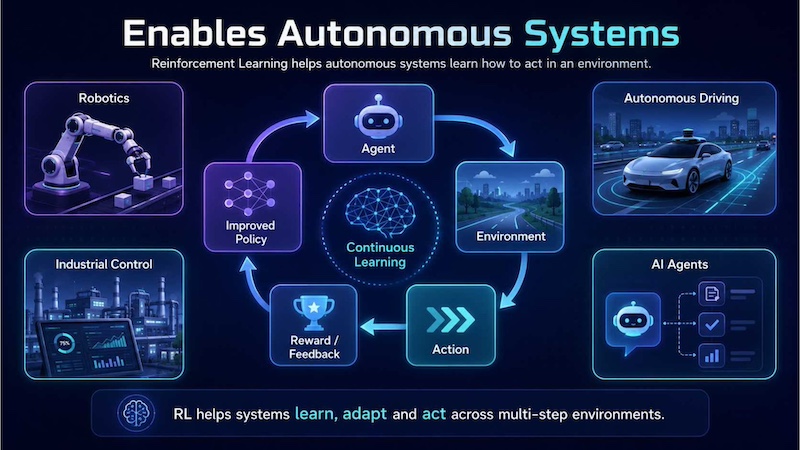
Reinforcement learning helps autonomous systems learn how to act, adapt and make sequential decisions in dynamic environments such as robotics, autonomous driving.
7. Real-World Applications of Reinforcement Learning
Reinforcement learning is most useful when the task involves repeated decisions, delayed rewards and changing environments. The following examples show where RL can create value in enterprise and advanced AI workflows.
7.1 Robotics
Robotics is one of the clearest use cases for reinforcement learning because robots must learn how actions affect the physical world. In 2019, OpenAI trained neural networks in simulation to control a human-like robot hand and solve a Rubik’s Cube. The system used reinforcement learning together with Automatic Domain Randomization to improve transfer from simulation to the real robot.
For enterprises, the same idea applies to warehouse automation, manufacturing inspection, robotic picking and autonomous machines. Before robots act in production, teams often train policies in simulation and test them under many scenarios. This creates demand for GPU-powered simulation, data pipelines and controlled validation.
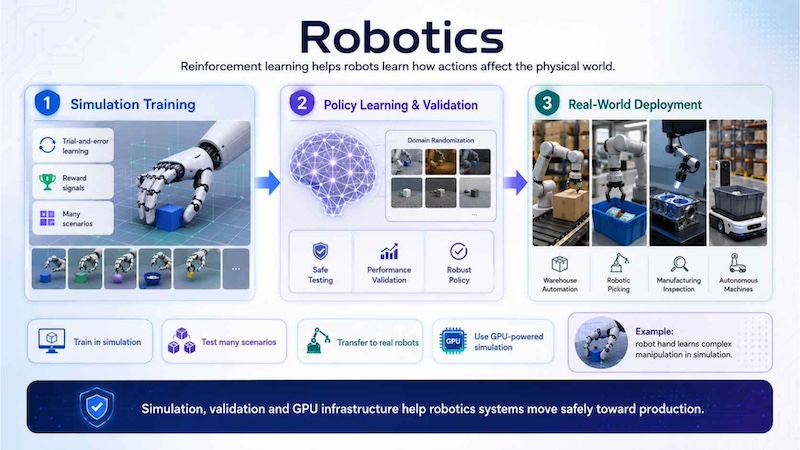
Reinforcement learning helps robots learn through simulation and feedback, enabling safer training, and more reliable performance in real-world automation tasks.
7.2 Autonomous Vehicles
Autonomous vehicles use AI to make decisions in dynamic environments, including lane changes, intersections, parking and motion planning. Reinforcement learning is widely studied for these scenarios because the vehicle must evaluate actions based on both current safety and future outcomes.
In practice, RL for autonomous driving usually requires high-quality simulation, safety constraints and extensive testing before any real-world deployment. Teams should combine RL with rule-based safety systems, supervised learning, sensor fusion and rigorous evaluation because production traffic environments are too complex for trial-and-error learning alone.
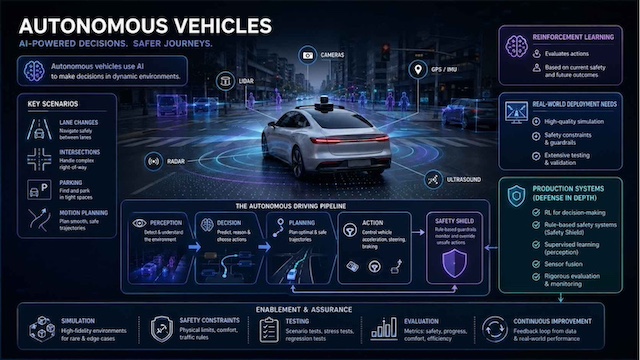
Reinforcement learning helps autonomous vehicles evaluate driving decisions in dynamic environments, supporting safer planning, and safety systems.
7.3 Recommendation Systems
Recommendation systems can use reinforcement learning when the goal is to optimize long-term engagement rather than one immediate click. Instead of treating each recommendation as an isolated prediction, RL can model the user journey as a sequence of interactions.
This is relevant for media, e-commerce, education and content platforms. A system may learn when to recommend familiar items, when to introduce new options and how to balance short-term conversion with long-term satisfaction. However, RL-based recommendation systems require careful offline evaluation because poor exploration can quickly harm user experience.
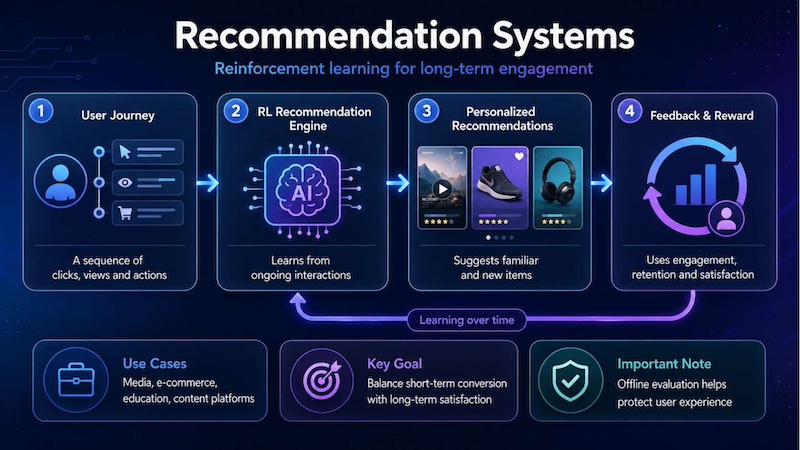
Reinforcement learning can improve recommendation systems by learning from user interactions, balancing short-term engagement with long-term satisfaction.
7.4 Resource and Operations Optimization
Reinforcement learning can support operations optimization when systems need to allocate resources under changing constraints. Examples include energy management, scheduling, routing, pricing, inventory decisions and data center operations.
A well-known example is Google DeepMind’s work on data center cooling. DeepMind reported that its machine learning system achieved a 40% reduction in cooling energy and a 15% reduction in overall power usage effectiveness overhead after accounting for non-cooling inefficiencies. This shows how AI optimization can create measurable operational impact when the reward function is tied to efficiency and system constraints.
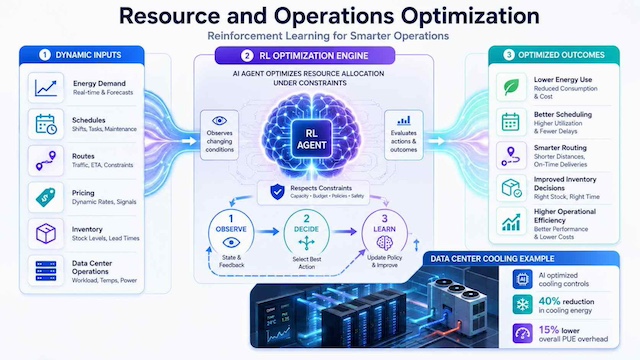
Optimize resources and operations by learning from changing conditions, improving decisions and reducing costs across energy, scheduling and inventory workflows.
7.5 Generative AI and LLM Alignment
Reinforcement learning is also important in generative AI and large language model alignment. Techniques such as reinforcement learning from human feedback help models produce responses that are more helpful, relevant and aligned with user expectations. This is especially useful for instruction-following models, enterprise assistants and AI agents that need to respond safely and consistently in business contexts.
For enterprises, alignment is not only about improving general model quality. It also helps adapt model behavior to specific requirements, such as domain terminology, brand voice, compliance rules and task-specific outputs. In this process, Model Fine-Tuning can support teams in adapting foundation models to business needs and improving how models respond in specialized use cases.
After improving model behavior, teams also need to consider deployment. Aligned or fine-tuned models still require reliable serving infrastructure, scalable inference endpoints and monitoring to perform well in production applications such as chatbots, copilots, document workflows and AI agents.
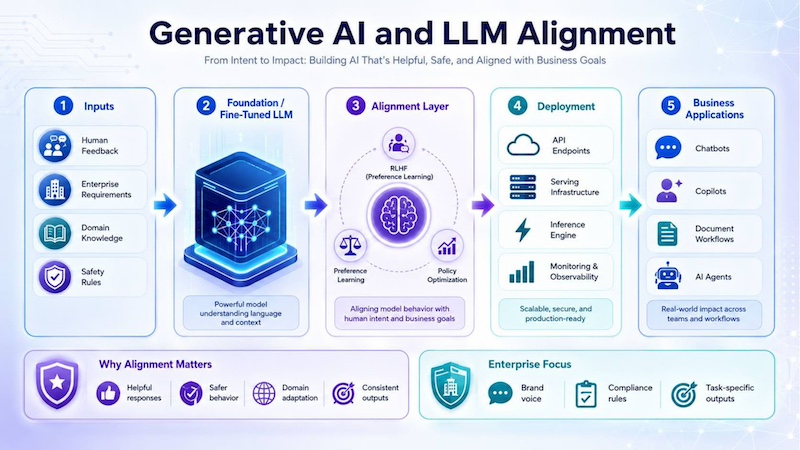
Generative AI alignment helps models deliver safer, more helpful and business-ready responses.
8. Reinforcement Learning vs Other Machine Learning Approaches
Reinforcement learning is not always the best choice. Many business problems can be solved more efficiently with supervised or unsupervised learning. The table below compares when each approach is most suitable.
| Criteria | Reinforcement Learning | Supervised Learning | Unsupervised Learning |
| Best Used For | Sequential decisions with delayed rewards | Prediction or classification with labeled data | Finding patterns or groups without labels |
| Business Objective | Optimize actions over time | Predict known outcomes accurately | Discover segments, anomalies or structures |
| Data Requirement | Environment feedback, rewards or simulations | Labeled input-output examples | Unlabeled datasets |
| Implementation Complexity | High, especially for real-world environments | Moderate, depending on data quality | Moderate, depending on interpretation needs |
| Infrastructure Requirement | Often high due to simulations and repeated training | Varies by model size and dataset | Varies by dataset size and algorithm |
In many cases, teams start with supervised learning or unsupervised analysis before moving to reinforcement learning. When the project grows into simulation, policy optimization or autonomous decision-making, stronger AI infrastructure and evaluation processes become more important.
9. Reinforcement Learning in Generative AI
Reinforcement learning also plays an important role in generative AI, especially in improving how large language models respond to human instructions. After a model is pretrained on large datasets, reinforcement learning can help refine its behavior so that its outputs become more helpful, relevant and aligned with human preferences.
One common approach is Reinforcement Learning from Human Feedback (RLHF). Instead of relying only on static training data, RLHF uses human evaluations to guide the model toward better responses. Human reviewers compare or rate model outputs, and this feedback is used to train a reward model. The language model is then optimized to generate answers that receive higher reward scores.
A typical RLHF workflow includes:
| Step | What happens | Purpose |
| Human Feedback | People review, rank or compare different model responses. | Identify which outputs are more helpful, accurate or appropriate. |
| Reward Model | A separate model learns to predict which responses humans are likely to prefer. | Convert human preferences into a measurable reward signal. |
| Policy Optimization | The language model is fine-tuned using reinforcement learning techniques such as PPO. | Improve response quality while reducing undesirable behavior. |
| Improved LLM | The optimized model generates more aligned and useful outputs. | Support safer, clearer and more human-preferred interactions. |
Simplified process:
Human Feedback → Reward Model → Policy Optimization → Improved LLM
In generative AI, reinforcement learning is especially useful for instruction-following, conversational AI, content generation and AI assistant development. It helps models move beyond predicting the next word and toward producing responses that better match user intent, context and quality expectations.
10. Challenges of Reinforcement Learning
10.1 High Training Costs
Reinforcement learning can be expensive because agents often need many interactions before they learn useful behavior. Deep RL may require large simulations, repeated experiments and GPU-intensive training. This can increase compute cost, especially when teams run many policy versions or test complex environments.
To manage this challenge, teams should start with smaller experiments, reuse simulation environments and monitor GPU usage carefully. For large workloads, FPT AI Factory’s GPU Virtual Machine provides dedicated GPU options, including NVIDIA HGX B300 GPU Cloud availability for complex training and inference workloads.
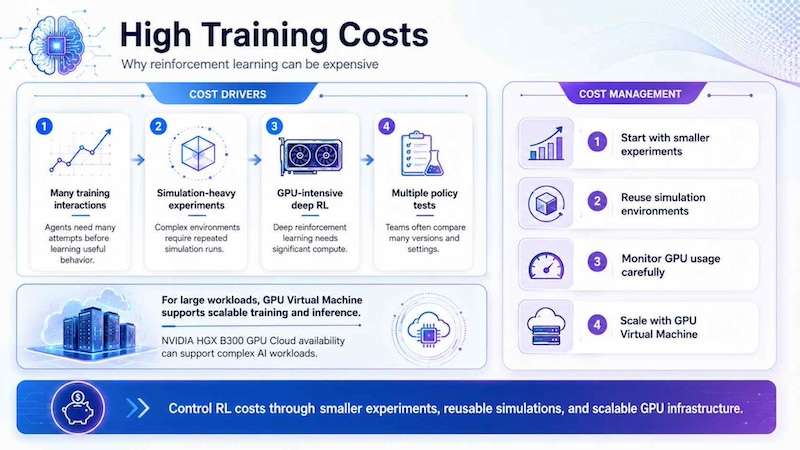
High training costs in reinforcement learning can be managed by starting small, reusing simulations, monitoring GPU usage.
10.2 Sample Inefficiency
Sample inefficiency means the agent needs a large number of interactions to learn. This is a major issue when real-world actions are costly or risky. A robot cannot safely make thousands of random mistakes in a factory, and an online platform should not expose users to poor recommendations just to collect feedback.
To reduce this risk, teams often use simulation, offline datasets, imitation learning or human feedback. They should also test whether the learned policy transfers from the training environment to real production conditions.
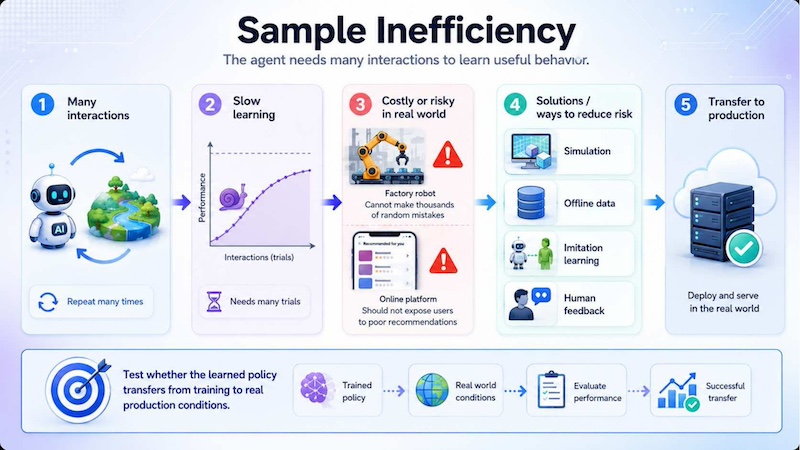
Sample inefficiency makes RL costly, so teams use simulation, offline data and human feedback before deployment.
10.3 Reward Design Challenges
Reward design is difficult because the agent may exploit weaknesses in the reward function. If the reward is too narrow, the agent may optimize for the metric while ignoring broader business or safety goals. This can lead to behavior that looks successful in testing but fails in real use.
For enterprise use cases, rewards should reflect business outcomes, user trust, safety and compliance. Teams should review reward functions with domain experts and monitor behavior continuously after deployment.
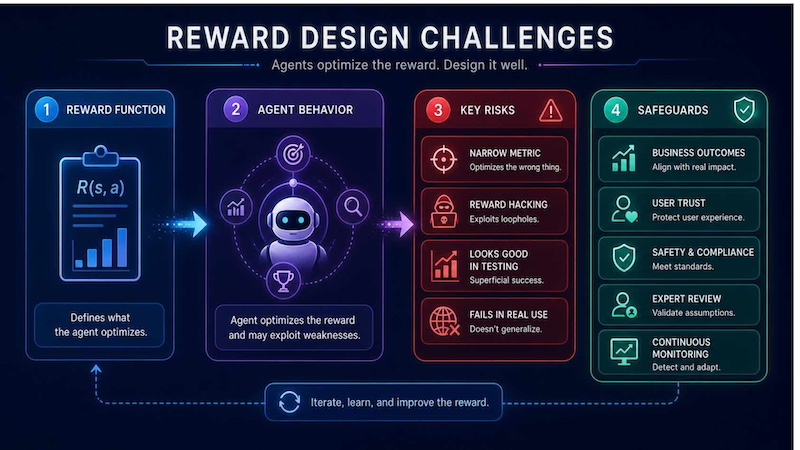
Reward design helps RL agents avoid shortcuts and align actions with business goals, safety and user trust.
10.4 Scalability and Deployment
Moving reinforcement learning from research to production can be difficult. Teams need to package models, manage infrastructure, monitor performance, run evaluations and control rollout. They also need to decide whether the policy should update continuously or remain fixed after validation.
A practical production plan should include testing, version control, rollback, cost monitoring and serving architecture. Serverless Inference can support API-based model serving for AI applications, while Model Testing helps teams evaluate model behavior before deployment. For a broader deployment checklist, teams can review how to move from model experimentation to AI model deployment in production.
Reinforcement learning is powerful because it helps AI systems learn from actions, feedback and long-term outcomes. It is valuable for robotics, autonomous systems, recommendation engines, operations optimization and LLM alignment. However, it also introduces challenges around compute cost, reward design, sample efficiency and production reliability.
For teams exploring reinforcement learning, the best starting point is to define the business goal, design a meaningful reward signal, validate the environment and test model behavior carefully. With GPU infrastructure, AI Notebook, Model Testing and Serverless Inference, FPT AI Factory can help organizations build, evaluate and scale AI workflows more efficiently. For customized AI solutions or large-scale deployment, contact FPT AI Factory through the official contact form.
Contact information
- Hotline: 1900 638 399
- Email: support@fptcloud.com
Explore more articles
How to Deploy AI Model: A Step-by-Step Guide 2026
What is an AI Data Platform and How Does It Work?