
What is embedding? Embeddings are one of the core technologies behind modern artificial intelligence, enabling machines to understand relationships between words, images, audio, and other forms of data. At FPT AI Factory, organizations can build AI workflows that leverage embeddings for semantic search, Retrieval-Augmented Generation (RAG), recommendation engines, and many other real-world AI applications through the AI development ecosystem available.
|
Key Takeaways
|
FPT AI Factory provides powerful GPU infrastructure, including Containers, VMs, and Clusters, alongside advanced tools to build, fine-tune, and deploy production-ready LLM applications. Whether you need to integrate enterprise knowledge or scale distributed AI workloads, we have you covered. For custom requirements or large-scale projects, contact us for a tailored consultation.
1. What Is Embedding?
1.1. Definition
An embedding is a numerical representation of data that captures its semantic meaning in a multi-dimensional vector space. Instead of treating words, images, or audio files as isolated pieces of information, embeddings encode their relationships so that similar items are positioned closer together mathematically.
For example, traditional keyword matching considers the words “car” and “automobile” as different terms. An embedding model, however, recognizes that they share similar meanings and generates vectors that are located close to one another. This allows AI systems to understand meaning and context instead of relying solely on exact keyword matches.
Today, embeddings serve as a foundational component for many AI applications, including semantic search, recommendation systems, chatbots, Retrieval-Augmented Generation (RAG), and enterprise knowledge assistants.
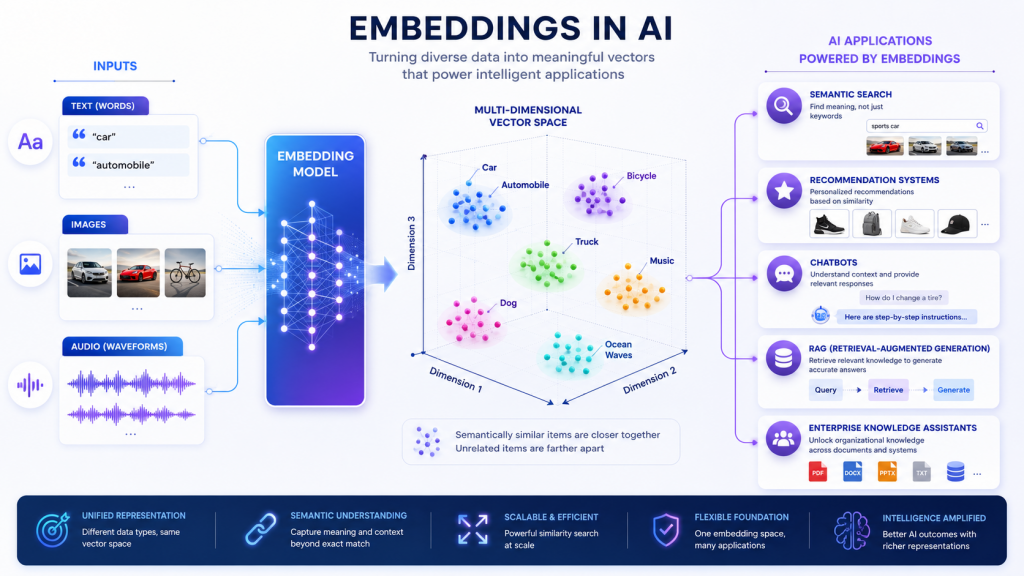
Embeddings transform different types of data into numerical vectors that preserve semantic meaning.
1.2 Why AI Needs Embeddings
Artificial intelligence processes numbers rather than raw text, images, or speech. Embeddings convert unstructured data into vectors while preserving semantic relationships, enabling AI to understand meaning instead of relying on keyword matching. They also make large-scale retrieval faster by comparing vector similarity, allowing AI systems to find relevant information in milliseconds.
Main benefits
- Understanding semantic meaning: recognize similar concepts even when different words are used.
- Converting data into numerical vectors: transform unstructured information into machine-readable representations.
- Measuring similarity: calculate how closely related two pieces of information are using vector distance metrics such as cosine similarity.
Now that we’ve explored what embeddings are and why they matter, let’s look at the different types of embeddings and the AI applications they support.
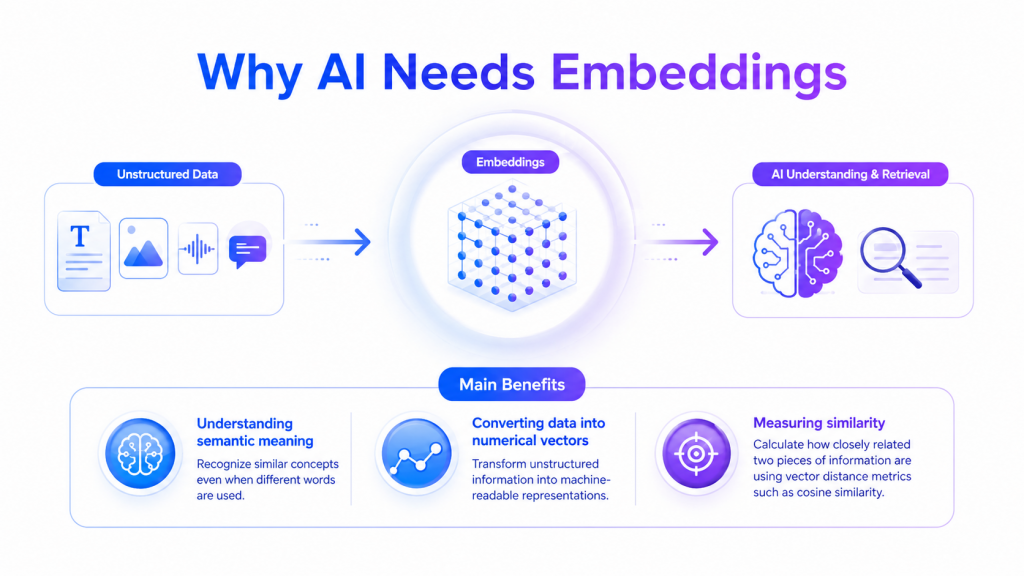
Embeddings enable AI models to understand semantic relationships between different types of data
2. Types of Embeddings
Different types of data require different embedding models to capture their unique characteristics. Although all embeddings convert information into dense numerical vectors, each type is designed to represent specific forms of data, such as text, images, audio, or multiple modalities. Selecting the appropriate embedding type is essential for improving retrieval accuracy, recommendation quality, and the performance of AI applications.
The table below provides an overview of the different types of embeddings, comparing the data they represent, what information they capture, their common applications, and representative models.
| Embedding Type | Data Type | What It Represents | Common Applications | Example Models |
| Text Embeddings | Words, sentences, documents | Semantic meaning and contextual relationships between text | Semantic search, Retrieval-Augmented Generation (RAG), enterprise search, document retrieval, chatbots | OpenAI Embeddings, BAAI BGE, E5, Sentence Transformers |
| Image Embeddings | Images | Visual features such as shapes, colors, textures, and objects | Visual search, image classification, product recommendation, facial recognition | CLIP, Vision Transformer (ViT) |
| Audio Embeddings | Speech, music, sound | Acoustic and semantic characteristics of audio | Speech recognition, voice assistants, speaker verification, call center analytics, audio search | Wav2Vec 2.0, Whisper, HuBERT |
| Multimodal Embeddings | Text, images, audio, video | Relationships between multiple data types in a shared vector space | Cross-modal search, image captioning, visual question answering, multimodal RAG, AI assistants | CLIP, ImageBind, Gemini Embeddings |
Each embedding type is optimized for a specific data format, but they share the same objective: transforming complex information into vector representations that preserve meaningful relationships. These vectors enable AI systems to efficiently measure similarity, retrieve relevant information, and support downstream tasks such as search, recommendation, and content generation.
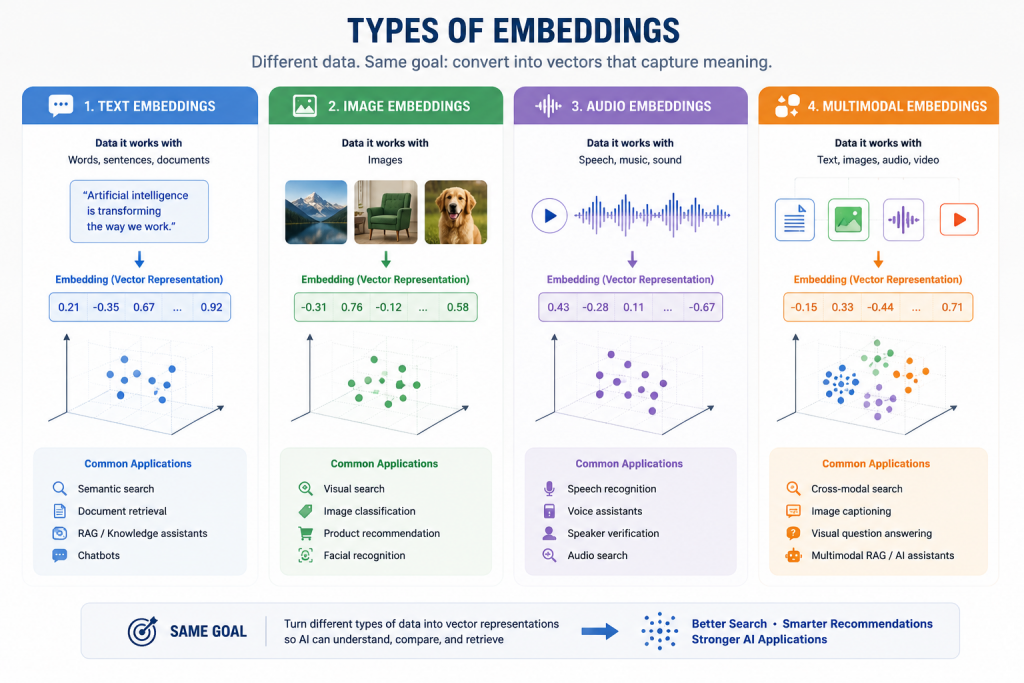
Overview of the four main types of embeddings, illustrating the data they represent, vector representations, and common AI applications.
The next section explains how embedding models transform raw data into vectors and use similarity measurements to identify semantically related information.
3. How Embeddings Work
Although embedding models vary depending on the type of data they process, they generally follow the same workflow. The process begins with selecting an appropriate embedding model, converting input data into vectors, and comparing those vectors to identify semantic relationships. This enables AI systems to retrieve relevant information quickly and accurately, even when exact keywords are not present.
3.1. Choose a Suitable Embedding Model
The first step is choosing an embedding model that fits the data type and use case. Different models are optimized for tasks such as semantic search or image understanding. Key factors include accuracy, speed, vector dimensions, language support, and deployment cost to ensure high retrieval quality and scalability.
3.2. Input Data Processing
Before generating embeddings, the input data is preprocessed into a format the model can understand. For text, this typically involves tokenization, where sentences are broken into smaller units called tokens. Images may be resized and normalized, while audio is converted into numerical features such as spectrograms. Consistent preprocessing ensures that the model receives clean, standardized input, leading to more reliable vector representations and better downstream performance.
3.3. Vector Representation
After preprocessing, the embedding model transforms the input into a dense numerical vector. Each vector consists of hundreds or even thousands of dimensions, where each value contributes to representing the semantic characteristics of the original data. Rather than storing explicit meanings in individual dimensions, the model captures relationships across the entire vector space. As a result, data with similar meanings tends to be located closer together, even if the original content differs significantly in wording or format.
3.4. Similarity Comparison
Once vectors are generated, AI systems compare them using similarity metrics such as cosine similarity to measure semantic relatedness. Instead of matching exact keywords, vector databases retrieve content with embeddings closest to the user’s query, improving semantic search, recommendation systems, and Retrieval-Augmented Generation (RAG).
Once embeddings are generated and compared, they become the foundation for many real-world AI use cases. The following examples show how businesses apply embeddings in practice.
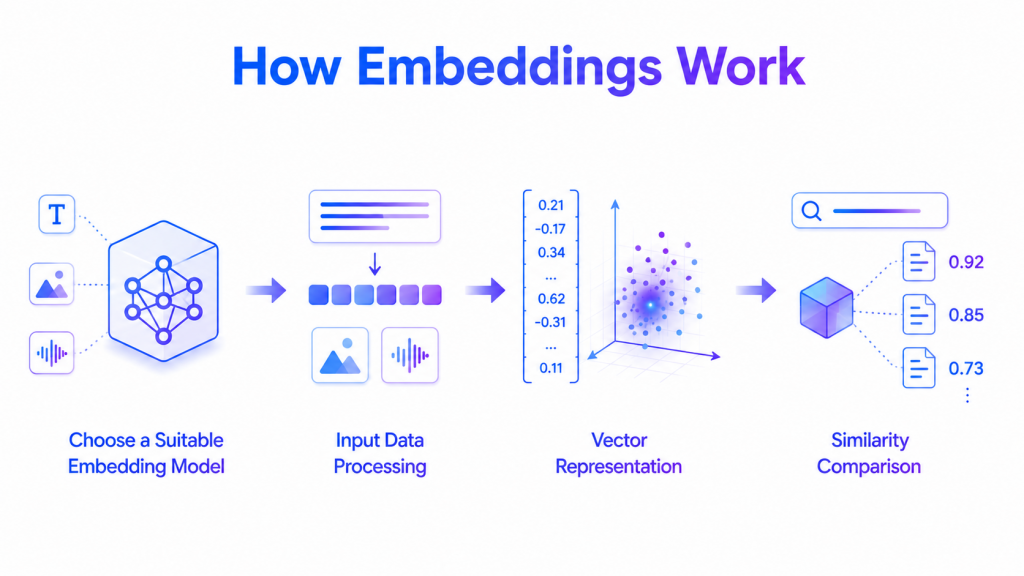
Embeddings transform data into vectors for semantic similarity search.
4. Embeddings vs. Vectors
The terms embedding and vector are often used interchangeably, but they are not the same. A vector is simply a mathematical representation of numbers arranged in a fixed number of dimensions. An embedding is a specialized type of vector that is learned by a machine learning model to capture meaningful relationships and semantic information from data.
For example, the vector [2, 5, 8] is simply a collection of numbers without inherent meaning. In contrast, an embedding vector such as [-0.42, 0.81, 0.15, …] is generated by an embedding model so that semantically similar items are located close together in the vector space. This property enables AI systems to compare meanings rather than relying on exact keyword matches.
The table below summarizes the key differences between vectors and embeddings.
| Aspect | Vector | Embedding |
| Definition | A mathematical array of numbers representing data in a multidimensional space. | A learned vector representation that captures semantic or contextual meaning. |
| How it is created | Can be manually defined or generated using mathematical operations. | Learned automatically by an embedding model trained on large datasets. |
| Meaning | May or may not contain semantic information. | Encodes semantic relationships between data points. |
| Similarity | Distance between vectors does not necessarily reflect meaning. | Similar items are positioned close together in the embedding space. |
| Example | [2, 5, 8] | [-0.42, 0.81, 0.15, …] generated by an embedding model |
| Typical Uses | Mathematics, physics, computer graphics, machine learning. | Semantic search, Retrieval-Augmented Generation (RAG), recommendation systems, clustering, and AI assistants. |
An easy way to think about the relationship is that vectors are the data structure, while embeddings are vectors that have learned meaningful representations from data. In other words, every embedding is a vector, but not every vector is an embedding.
5. Why Embeddings Matter in AI Applications
Embeddings are a core building block of modern AI, enabling machines to understand meaning rather than exact matches. By representing data as vectors, they improve semantic search, pattern recognition, recommendations, and the accuracy and efficiency of AI-powered applications.
5.1. Semantic Search
Semantic search uses embeddings to retrieve information based on meaning rather than keywords. Queries and documents are converted into vectors, allowing a vector database to find semantically similar results even when the wording differs. This improves search relevance in enterprise knowledge bases.
Example: An employee searches for “remote work policy,” while the document is titled “hybrid workplace guidelines.” Semantic search still retrieves the correct document because the embeddings capture their similar meaning.
5.2 Recommendation Systems
Recommendation systems use embeddings to identify similarities between users, products, or content based on historical interactions and behavioral patterns. Instead of relying solely on predefined categories, embedding models learn hidden relationships that enable more personalized recommendations. This technology powers many digital services, including e-commerce platforms, streaming services, and online learning systems.
Example: An online retailer can recommend products with similar styles or features, even when they belong to different categories, because their embeddings are located close together in the vector space.
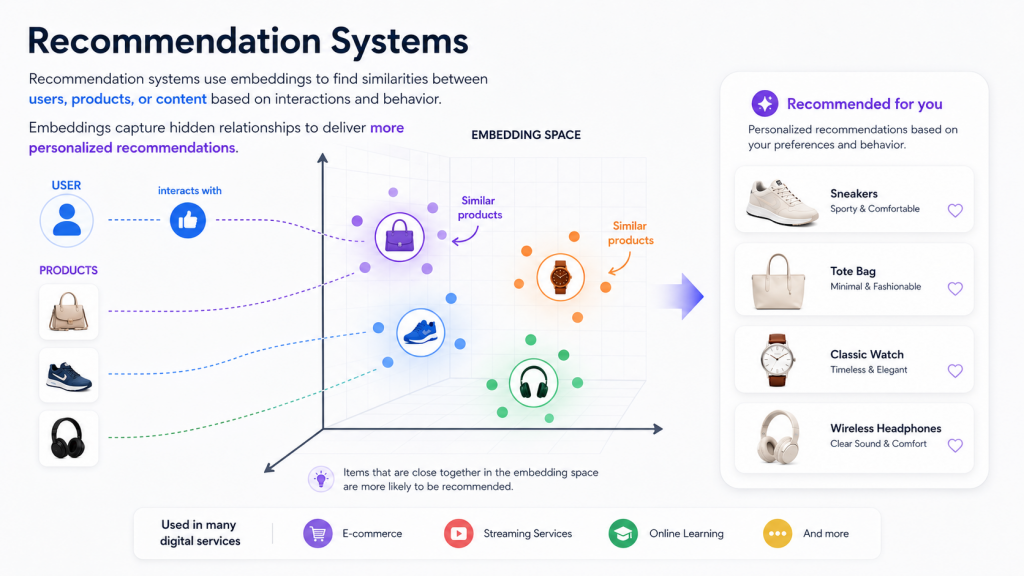
Embeddings help recommendation systems identify related products and personalized content
5.3 Retrieval-Augmented Generation (RAG)
Retrieval-Augmented Generation (RAG) combines embeddings, vector databases, and LLMs to generate responses grounded in trusted knowledge. It retrieves relevant documents before generating an answer, reducing hallucinations and improving accuracy with up-to-date enterprise information.
Example: A financial institution can build an AI assistant that retrieves the latest compliance policies from its internal knowledge base before answering employee questions.
5.4. Classification
Embeddings improve classification by representing similar data points close together, helping models distinguish categories more accurately. They are widely used for spam detection, customer feedback analysis, medical document categorization, and legal document management, while handling synonyms, context, and multilingual content more effectively.
5.5. Clustering
Clustering uses embeddings to group similar data without predefined labels by placing semantically related items close together in vector space. Businesses apply it to customer segmentation, product organization, anomaly detection, and document management.
Example: Support tickets about similar issues can be automatically grouped, helping teams identify recurring problems and prioritize resolutions.
These AI applications all rely on embeddings to understand and retrieve information. One of the most impactful use cases today is integrating embeddings with Large Language Models (LLMs).
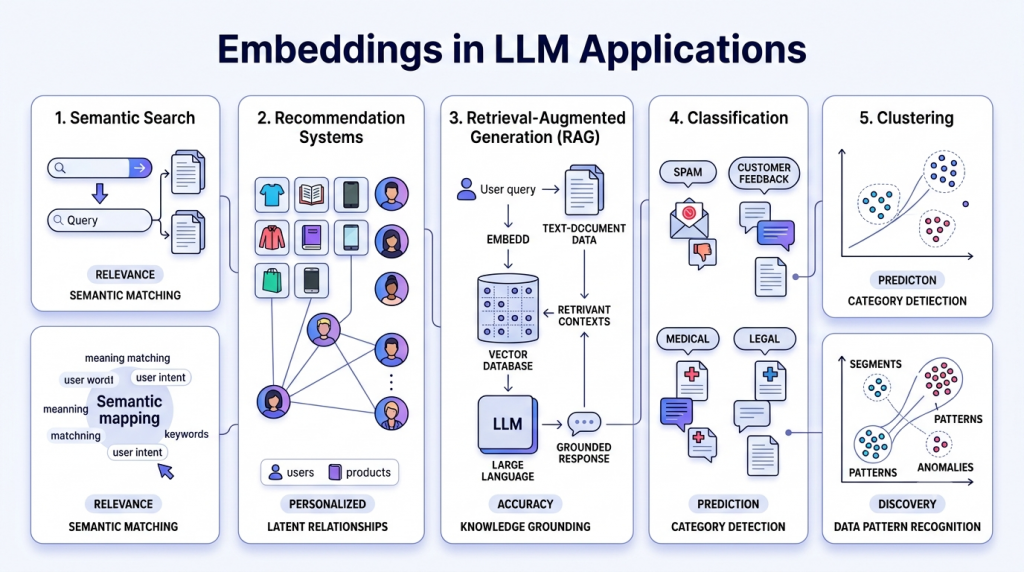
Embeddings power semantic search, recommendations, RAG, classification, and clustering.
6. Embeddings in LLM Applications
Embeddings are a core component of modern Large Language Model (LLM) applications, enabling models to retrieve relevant information from enterprise knowledge sources rather than relying solely on pre-trained parameters. This Retrieval-Augmented Generation (RAG) approach provides LLMs with up-to-date, domain-specific context, resulting in more accurate and reliable responses.
The workflow begins by converting enterprise data, such as product manuals, FAQs, or internal documents, into vector embeddings using an embedding model. In the FPT AI Factory ecosystem, this step can be performed in AI Studio, where embedding models are developed or deployed. The generated embeddings are stored in a vector database for efficient retrieval.
When a user submits a query, it is converted into an embedding and compared against the stored vectors through similarity search. For large-scale workloads, GPU Container provides the GPU resources needed to accelerate embedding generation and retrieval. The most relevant documents are then passed to an LLM running on Serverless Inference, which automatically scales compute resources to deliver low-latency, context-aware responses.
Together, these services form an end-to-end RAG pipeline, where embeddings connect enterprise knowledge with LLM reasoning to enable scalable, production-ready AI applications.
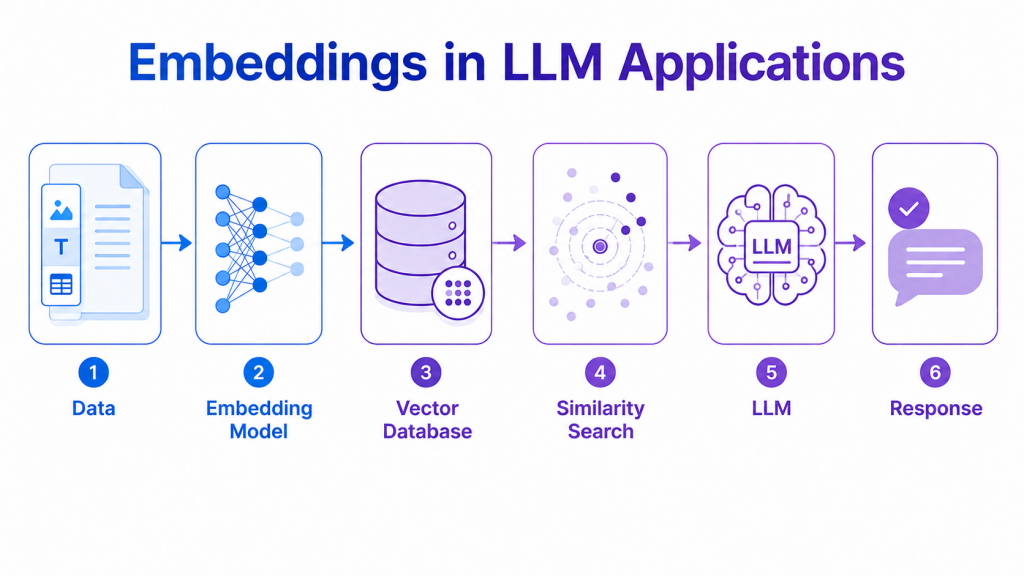
Embeddings Process in LLM Applications
7. FAQs
7.1. How are embeddings created?
Embeddings are generated by AI models trained on large datasets to learn semantic relationships between different types of data. When new input is processed, the model converts it into dense numerical vectors that preserve its meaning, allowing AI systems to compare information based on semantic similarity rather than exact matches.
7.2. What are embedding models?
Embedding models convert text, images, audio, or multimodal data into vector representations that capture semantic meaning. Different models are optimized for different tasks, such as semantic search, recommendation systems, Retrieval-Augmented Generation (RAG), or multimodal understanding.
7.3. What is the best embedding model for semantic search?
There is no single “best” embedding model—the right choice depends on the application, performance requirements, and deployment environment. Some of the most widely used models include:
- OpenAI text-embedding-3-large – High retrieval accuracy for semantic search and RAG.
- BAAI BGE – Strong open-source model for multilingual retrieval and enterprise search.
- E5 – Optimized for retrieval tasks using query-document matching.
- Sentence Transformers – Popular for clustering, semantic similarity, and search applications.
- Cohere Embed – Designed for enterprise search and Retrieval-Augmented Generation.
- CLIP – Specialized for multimodal retrieval by embedding text and images into a shared vector space.
7.4. What is an example of embeddings?
Semantic search is one of the most common applications of embeddings. Instead of matching exact keywords, the system converts both the user’s query and documents into embeddings, retrieves the most semantically similar results from a vector database, and provides more relevant answers even when different wording is used.
Embeddings power modern AI by enabling accurate search, recommendations, and knowledge retrieval. With FPT AI Factory, organizations can build and scale AI applications using FPT AI Studio, backed by GPU cloud infrastructure in Vietnam and Japan (with Malaysia coming soon), competitive hourly GPU pricing, and a dedicated AI consulting team to accelerate enterprise AI adoption. For customized solutions or enterprise-scale projects, please connect with FPT AI Factory via the official contact form.
Contact FPT AI Factory:
- Hotline: 1900 638 399
- Email: support@fptcloud.com
Explore Related Articles:
What Are Vector Databases? How Does It Work and Use Cases.
Key Evaluation Metrics in Machine Learning: Complete Guide