
Multi-tenant architecture allows one platform to serve multiple users, teams or customers while keeping data, access and workloads separated. For AI platforms, this architecture is important because multiple applications may need to share compute, storage, models and inference services without affecting each other. FPT AI Factory helps teams plan scalable AI environments with flexible infrastructure, GPU services and deployment-ready inference options.
|
Key Takeaways Multi-tenant architecture helps AI platforms scale across teams, applications and customers by sharing infrastructure while maintaining tenant isolation. Here are the key points to remember:
|
FPT AI Factory helps teams build, manage and scale AI platform infrastructure across different workloads and business units. With GPU Container, GPU Virtual Machine, GPU Cluster and Serverless Inference, teams can allocate compute resources, support model development and streamline deployment more efficiently. Organizations with custom AI requirements or large-scale infrastructure needs can contact the FPT AI Factory team for tailored support
1. What Is Multi-Tenant Architecture?
Multi-tenant architecture is a software and infrastructure design where one platform serves multiple tenants. A tenant may be a customer, department, application, project team or user group. Each tenant shares part of the platform, but the architecture keeps tenant data, access permissions, configurations and usage boundaries separated.
This model is common in cloud services, SaaS applications and enterprise platforms because it helps reduce duplicated infrastructure and simplify operations. Instead of deploying a separate system for every customer or team, the provider can manage one platform that supports many tenants with shared services and controlled isolation.
For AI platforms, multi-tenancy becomes more complex because tenants may share expensive resources such as GPU compute, model serving endpoints, vector databases and monitoring systems. After understanding the general concept, it is useful to compare multi-tenant architecture with single-tenant architecture to see where each model fits.
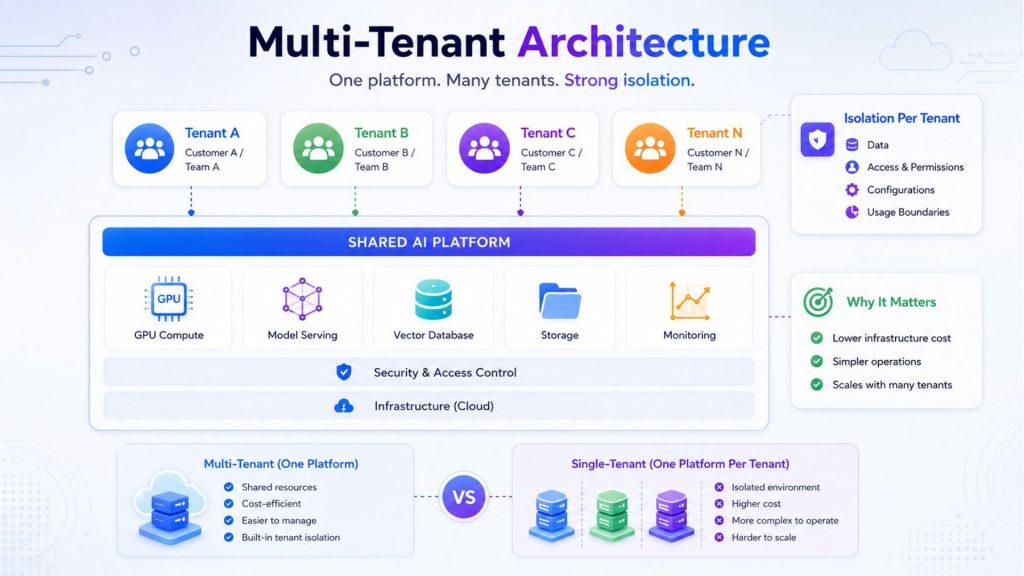
Multi-tenant architecture lets many tenants share one AI platform with isolated data, controlled access, and efficient resource use.
2. Multi-Tenant vs Single-Tenant Architecture Comparison
Single-tenant and multi-tenant architectures solve different business and technical needs. Single-tenancy provides stronger separation by giving each tenant a dedicated environment, while multi-tenancy focuses on shared infrastructure, higher resource efficiency and easier platform-wide maintenance.
| Criteria | Single-Tenant Architecture | Multi-Tenant Architecture |
| Architecture | Each tenant has a dedicated application instance, database or infrastructure environment. | Multiple tenants share the same application or infrastructure layer with logical separation. |
| Data isolation | Strong physical or instance-level isolation. | Logical or policy-based isolation through schemas, tenant IDs, access controls or separate storage layers. |
| Customization | Higher customization because each tenant can have a dedicated setup. | Customization is possible but usually controlled through configuration, tenant rules or feature flags. |
| Cost | Higher cost due to duplicated compute, storage and operations. | Lower cost per tenant because infrastructure and maintenance are shared. |
| Scalability | Scaling often happens per tenant, which can increase operational overhead. | Scaling can happen across the shared platform, making it easier to support many tenants. |
| Maintenance | Updates may need to be managed across many separate environments. | Platform updates can be applied centrally, reducing maintenance complexity. |
| Security | Strong isolation, suitable for highly regulated or dedicated environments. | Requires careful tenant isolation, access control, monitoring and security governance. |
In practice, the right choice depends on cost, compliance, customization and workload sensitivity. For AI teams comparing workload isolation options, the FPT AI Factory article on container vs virtual machine can also help clarify how different compute environments affect isolation, startup speed and resource efficiency.
3. Types of Multi-Tenancy Architectures
Multi-tenancy is not a single architecture pattern. Teams can choose different models depending on how much isolation, customization and cost efficiency they need. The following models are commonly used in SaaS, cloud and AI platform design.
The table below summarizes the main differences between common multi-tenancy architecture models across isolation, cost, scalability and enterprise deployment suitability.
| Multi-Tenancy Architecture | Isolation Level | Cost Efficiency | Scalability | Suitable Enterprise Deployment |
| Isolated Tenancy | Very high | Low | Moderate | Large enterprises, regulated industries, financial services, healthcare, or customers with strict compliance and customization requirements |
| Shared Application with Separate Databases | High | Medium | High | SaaS platforms that need strong data separation while keeping one shared application layer |
| Shared Application and Shared Database with Separate Schemas | Medium to high | High | High | Mid-sized SaaS products that want lower infrastructure cost but still need organized tenant-level data separation |
| Shared Everything | Low to medium | Very high | Very high | High-volume SaaS platforms, startups, or standardized products with limited tenant-specific customization |
| Hybrid Multi-Tenancy | Flexible | Medium to high | High | Enterprise SaaS or AI platforms serving different customer segments, from standard users to large enterprise tenants needing dedicated resources |
3.1. Isolated Tenancy
Isolated tenancy gives each tenant a dedicated environment, such as a separate application instance, database or infrastructure stack. This model provides strong isolation and is useful for tenants with strict compliance, security or customization needs. However, it is usually more expensive and harder to operate at scale because each tenant environment must be maintained separately.
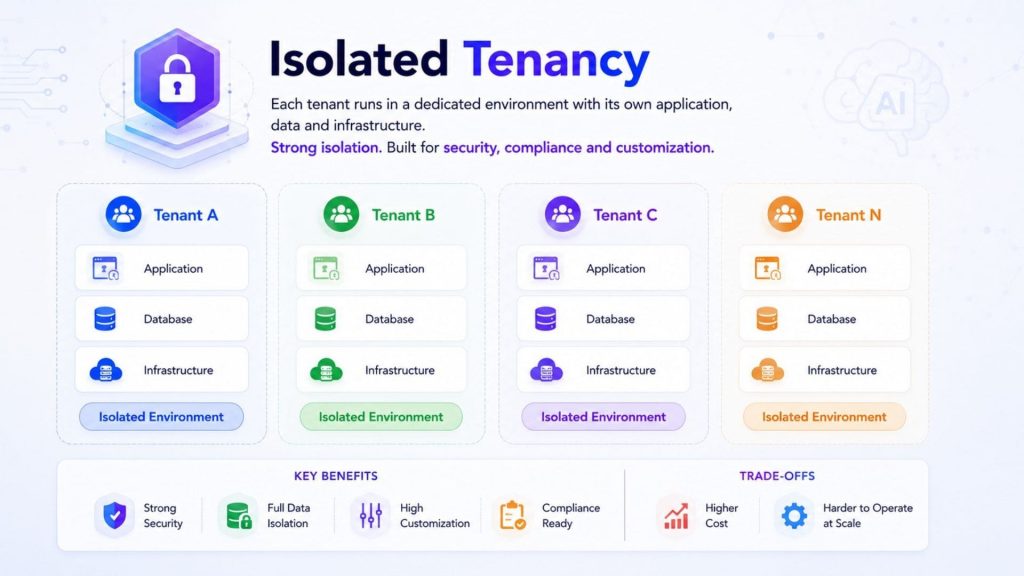
Isolated tenancy provides dedicated environments for stronger security, data isolation, and customization.
3.2. Shared Application with Separate Databases
In this model, tenants share the same application layer but store data in separate databases. It offers a balance between operational efficiency and data isolation. The platform team can update one application layer while keeping tenant data separated at the database level, which is useful for SaaS products that need stronger customer separation without duplicating every component.
3.3. Shared Application and Shared Database with Separate Schemas
This model uses one application and one database, but each tenant has a separate schema or namespace. It can reduce infrastructure cost while keeping data organized by tenant. However, teams must design schema management, migrations, backup policies and access controls carefully to prevent tenant data from being mixed or exposed.
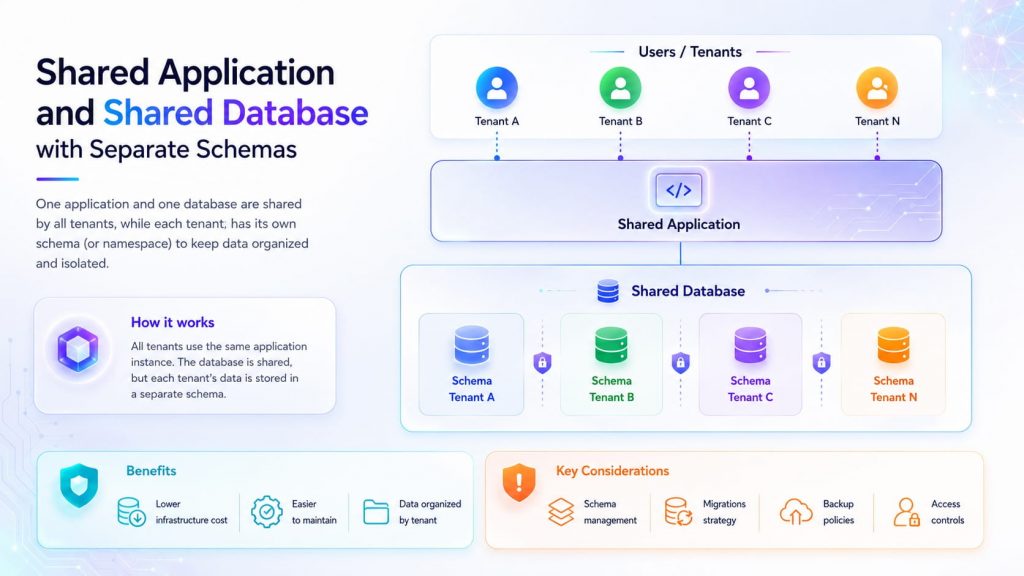
Shared application and shared database architecture reduces infrastructure cost while separating tenant data through individual schemas.
3.4. Shared Everything
The shared-everything model uses one application, one database and shared tables, often with a tenant ID to separate records. This is usually the most cost-efficient model, but it also requires the strongest application-level controls. Every query, API call and data operation must be tenant-aware to avoid accidental cross-tenant access.
3.5. Hybrid Multi-Tenancy
Hybrid multi-tenancy combines multiple models in one platform. For example, most tenants may use shared infrastructure, while large enterprise tenants may receive dedicated databases or isolated compute environments. This approach is common when a platform needs to balance standardization, enterprise customization, performance and compliance.
After choosing a tenancy model, teams need to understand how the system works across shared infrastructure, isolation controls and resource allocation. This is where multi-tenant architecture becomes an operational design, not only a database decision.
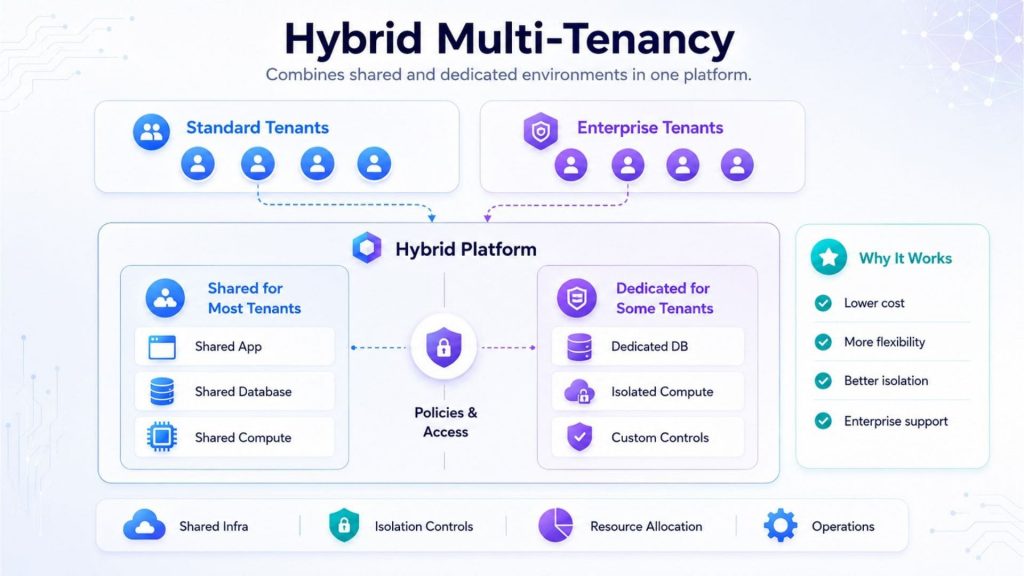
Hybrid multi-tenancy combines shared infrastructure for most tenants with dedicated resources for selected enterprise tenants, helping platforms balance cost, flexibility.
4. How Multi-Tenant Architecture Works
A multi-tenant architecture works by combining shared infrastructure with tenant-aware controls. The platform must identify which tenant is making a request, route that request to the right application logic, apply the correct security policies and allocate resources based on workload needs.
4.1 Shared infrastructure layer
The shared infrastructure layer includes compute resources, storage and networking. Compute resources may include CPUs, GPUs, containers or virtual machines. Storage may include databases, object storage, vector databases or distributed file systems. Networking connects tenants, applications, data services and internal platform components.
For AI platforms, shared infrastructure is especially valuable because GPU resources are costly and demand can change quickly. A tenant-aware design helps teams allocate compute capacity to different workloads while avoiding unnecessary duplication. To understand the broader foundation behind this layer, teams can also review how AI infrastructure supports model training, deployment and operations.
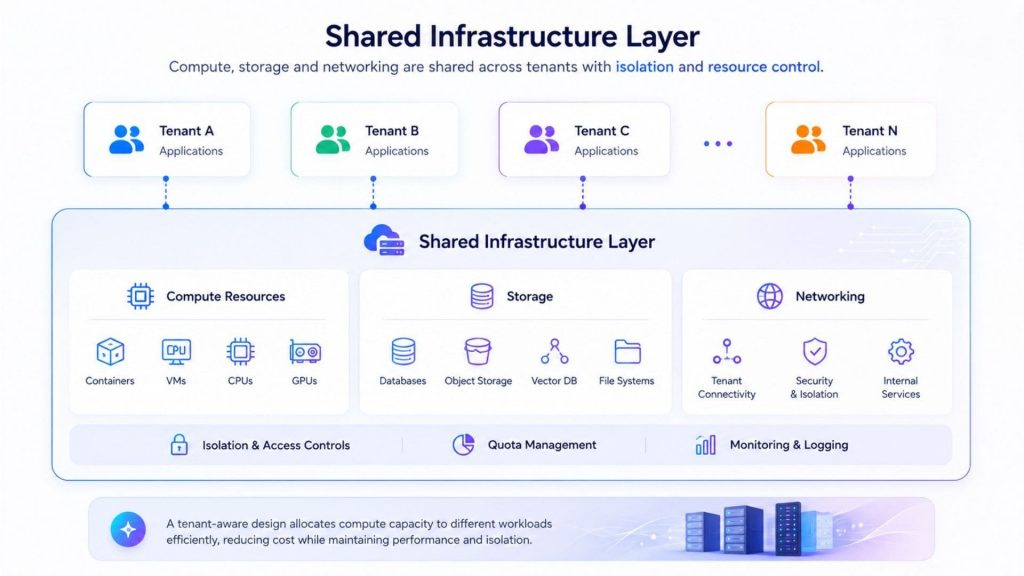
Shared infrastructure helps multi-tenant AI platforms use compute, storage, and networking efficiently while keeping tenants isolated and controlled.
4.2 Tenant isolation
Tenant isolation ensures that one tenant cannot access another tenant’s data, settings or resources. This can be implemented through database separation, schema boundaries, tenant IDs, access policies, encryption, network segmentation and workload isolation. Strong isolation is essential for security, compliance and customer trust.
Google Cloud describes multi-tenant Kubernetes clusters as shared by multiple users or workloads, while emphasizing that operators must isolate tenants and fairly allocate resources. This shows why tenant isolation is not just an application concern; it also needs to be designed at the infrastructure and orchestration layers.
4.3 Resource allocation
Resource allocation defines how compute, storage, network bandwidth and model serving capacity are assigned to each tenant. In a basic SaaS product, this may mean limiting API calls or storage space. In an AI platform, it may also mean controlling GPU usage, inference request limits, training job priority and storage throughput.
Resource quotas help prevent one tenant from consuming too much capacity and affecting others. They also make cost tracking easier because teams can understand which tenant, application or project is using each resource.
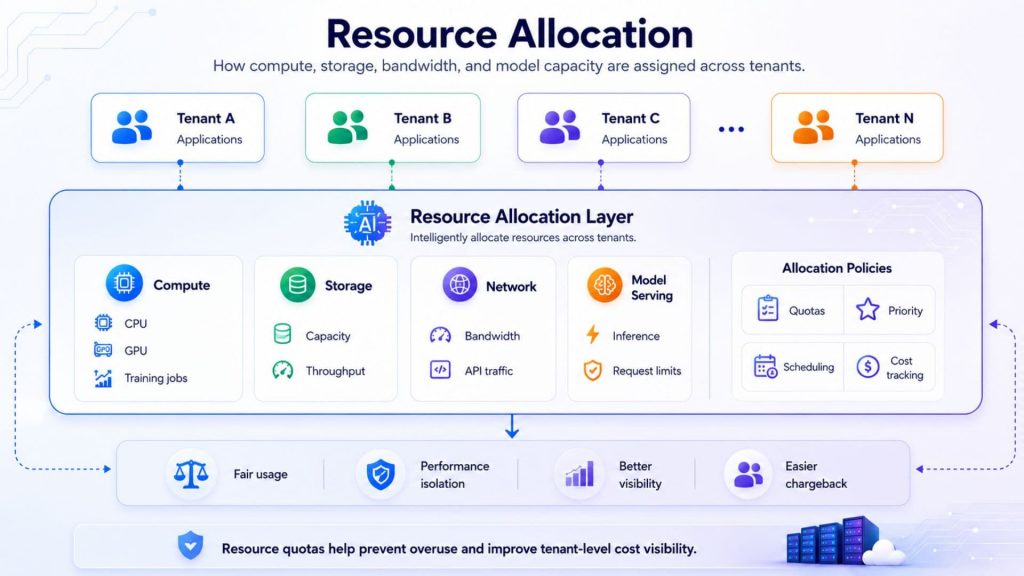
Resource allocation keeps multi-tenant AI platforms fair, efficient, and cost-transparent by controlling how resources are used across tenants.
5. Why Multi-Tenant Architecture Matters for AI Platforms
AI platforms often serve multiple teams, models and applications at the same time. A single enterprise may use one platform for research experiments, internal chatbots, document processing, recommendation systems and customer-facing AI applications. Multi-tenant architecture helps these workloads share infrastructure while maintaining control, security and performance.
5.1. Challenges
- Tenant isolation becomes more complex when tenants share models, vector databases, inference endpoints or GPU clusters.
- Noisy-neighbor problems can occur when one workload consumes too much compute, memory or network bandwidth.
- Cost visibility is harder when many teams share the same infrastructure and model serving layer.
- Security and compliance requirements may differ across tenants, industries or regions.
- Monitoring must track usage, performance and errors at both platform and tenant levels.
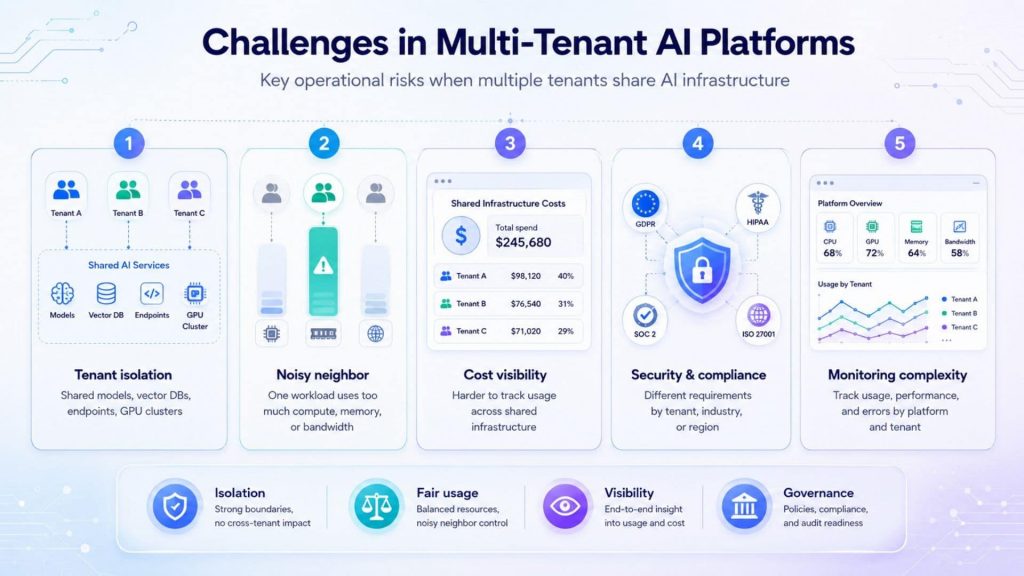
Multi-tenant AI platforms need strong isolation, fair resource usage, cost visibility, security, and monitoring across tenants.
5.2. Benefits
- Better resource efficiency because tenants can share common compute, storage and platform services.
- Faster onboarding for new teams, applications or customers because the core platform is already available.
- Centralized maintenance, monitoring and security policies across the shared platform.
- Flexible scaling as tenant demand changes across training, inference and application workloads.
- Lower operational overhead compared with managing many separate environments.
For enterprises working across public, private or mixed environments, multi-tenancy may also connect with hybrid cloud strategy. Sensitive workloads can stay in a more controlled environment, while scalable or variable AI workloads use shared cloud infrastructure.
6. Multi Tenant Architecture in AI Applications
Multi-tenant architecture appears in many digital products, but it becomes especially important when AI workloads need shared compute, high-throughput storage and reliable serving layers. The following examples show how multi-tenancy supports common application categories.
6.1. Cloud Services
Cloud services commonly use multi-tenant design to share infrastructure across many customers while applying isolation at the account, network, cluster or workload level. For example, Google Kubernetes Engine documentation explains that tenants in a multi-tenant cluster may be multiple users or workloads, and that operators must isolate tenants to reduce security risk and allocate resources fairly.
In AI cloud environments, this pattern helps providers support many development teams, training jobs and inference services on shared infrastructure. It also allows capacity to scale based on demand instead of requiring every customer to manage separate physical hardware.
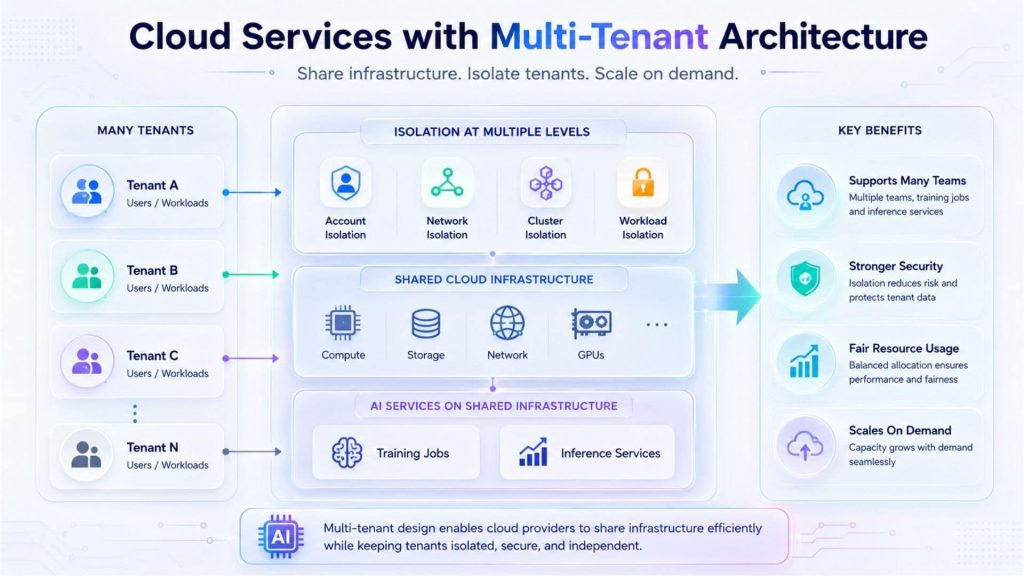
Multi-tenant cloud services share infrastructure efficiently while keeping tenants isolated, secure, and scalable.
6.2. Software-as-a-Service (SaaS) Applications
SaaS applications often use multi-tenancy to serve many customers from one platform. Each customer may have separate accounts, settings, data and permissions, but the provider can operate a shared application layer. This helps reduce maintenance effort because product updates, security patches and new features can be managed centrally.
For AI-powered SaaS, multi-tenancy can support shared AI assistants, recommendation engines, analytics modules or document processing features. The architecture must make every model call, retrieval query and database request tenant-aware so that each customer receives only its own data and results.
6.3. Email Hosting Providers
Email hosting providers are a familiar example of multi-tenancy. Many organizations may use the same email service, but each tenant has its own domains, mailboxes, permissions and administrative policies. The provider manages the shared platform, while tenants manage their users and settings.
The same concept applies to AI platforms. Multiple teams can use a shared AI infrastructure layer while still having separate projects, access controls, usage quotas and data boundaries. This allows platform teams to serve many internal groups without building a separate environment for each one.
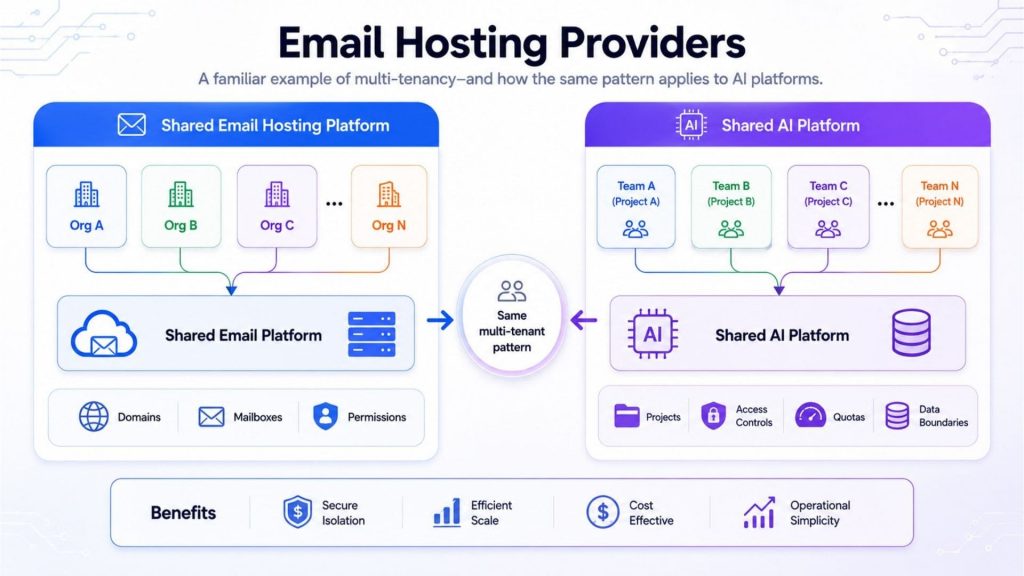
Email hosting providers illustrate multi-tenancy by sharing one platform while keeping each organization’s data, users, and settings separate.
6.4. Enterprise AI Platforms
Enterprise AI platforms often need to support many teams or applications at the same time. A customer service team may run chatbots, a finance team may process documents, a data science team may train models and a product team may serve recommendation features. When these workloads share AI infrastructure, the enterprise needs architecture that can allocate resources flexibly while maintaining performance.
FPT AI Factory supports AI infrastructure environments that can serve different workloads, helping businesses optimize compute resources and scale AI applications based on demand. Teams can use GPU Container for containerized experiments and development, GPU Virtual Machine for dedicated GPU environments and GPU Cluster for distributed AI, HPC and ML workloads.
For applications that need API-based model serving, Serverless Inference can help teams integrate models into agents, chatbots and applications without managing the full serving layer manually. As AI applications move from experimentation to production, teams should also consider how AI inference performance, monitoring and scaling will be handled for each tenant.
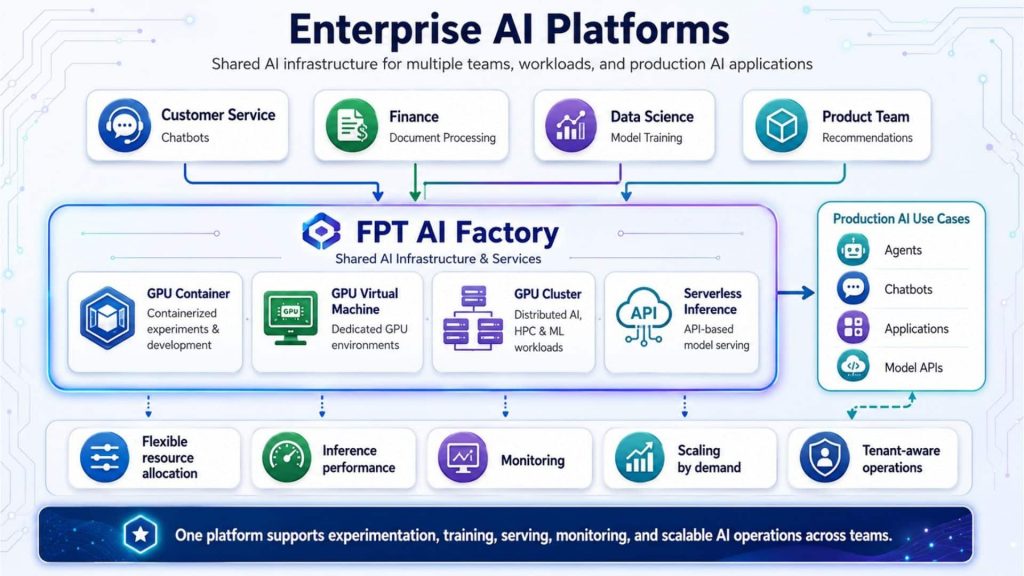
Enterprise AI platforms enable teams to share AI infrastructure for scalable development, serving, and operations across different workloads.
7. Best Practices for Multi-Tenant Architecture
A multi-tenant platform should be designed carefully from the beginning. Once tenants, data and workloads are mixed into the same environment, weak isolation or unclear resource policies can create security, performance and cost problems.
7.1. Design for Tenant Isolation
Start with a clear tenant model. Define what a tenant means, how tenant identity is passed through APIs, how data is separated and how permissions are enforced. Every service, database query and background job should understand tenant context.
7.2. Implement Resource Quotas
Resource quotas help prevent one tenant from consuming too much capacity. Quotas may apply to API calls, storage, training jobs, inference requests, GPU time or concurrent workloads. This is especially important for AI platforms because compute-intensive jobs can affect other tenants if limits are not enforced.
7.3. Monitor Resource Usage
Monitoring should track platform health and tenant-level usage. Teams need visibility into latency, errors, GPU utilization, storage growth, request volume and cost patterns. This makes it easier to detect noisy-neighbor issues, plan capacity and improve the user experience for each tenant.
For large-scale AI environments, a strong monitoring layer often connects to the broader AI data center architecture, where compute, storage, networking and operations must work together to support reliable workloads.
7.4. Secure Tenant Data
Tenant data should be protected with access control, encryption, audit logging and secure development practices. Teams should also test failure cases, such as missing tenant IDs, incorrect access rules or misconfigured databases. In regulated industries, tenant isolation must align with compliance and governance requirements.
8. FAQs
8.1. What are the key considerations for multi-tenancy?
The key considerations are tenant isolation, data separation, resource allocation, security controls, monitoring and compliance. Teams should decide how much infrastructure is shared, how tenant identity is managed and how the platform prevents cross-tenant data access.
8.2. How does multi-tenancy improve efficiency?
Multi-tenancy improves efficiency by allowing many tenants to share one platform, common infrastructure and centralized operations. This reduces duplicated systems, simplifies maintenance and helps teams scale workloads more cost-effectively.
8.3. How to secure Multi-Tenant Architecture?
Secure multi-tenant architecture requires strong authentication, authorization, tenant-aware data access, encryption, audit logging, resource quotas and continuous monitoring. Teams should also test isolation rules regularly to ensure one tenant cannot access another tenant’s data or resources.
FPT AI Factory provides AI infrastructure in Japan and Vietnam, with Malaysia coming soon, helping enterprises reduce latency across Asia. With competitive hourly GPU pricing, flexible services such as GPU Container, GPU Virtual Machine, GPU Cluster and Serverless Inference, plus dedicated technical consulting, organizations can scale AI workloads more efficiently. Businesses with custom or large-scale requirements can contact the team through the official contact form.
Contact information
- Hotline: 1900 638 399
- Email: support@fptcloud.com
Explore more articles
Benefits of cloud computing: When is the right time to move?