
As businesses continue generating massive volumes of real-time data from IoT devices, sensors, cameras, and connected systems, many organizations are asking: “What is Edge AI and why is it becoming increasingly important for modern digital infrastructure?”. In this article, FPT AI Factory explains clearly about Edge AI, how it works, and why it is transforming analytics, automation, and intelligent decision-making across industries.
1. What Is Edge AI?
Edge AI refers to the deployment of artificial intelligence models directly on edge devices such as smartphones, IoT sensors, cameras, robots, and industrial machines. Instead of relying entirely on centralized cloud servers, these devices can process and analyze data locally at the edge of the network in real time.
Edge AI enables devices to process AI workloads locally instead of relying entirely on cloud servers. This helps reduce latency, improve efficiency, strengthen data privacy, and support real-time decision-making across industries such as manufacturing, healthcare, autonomous vehicles, and smart surveillance.
For example, a smart security camera can detect suspicious activity instantly without sending video data to the cloud for analysis.
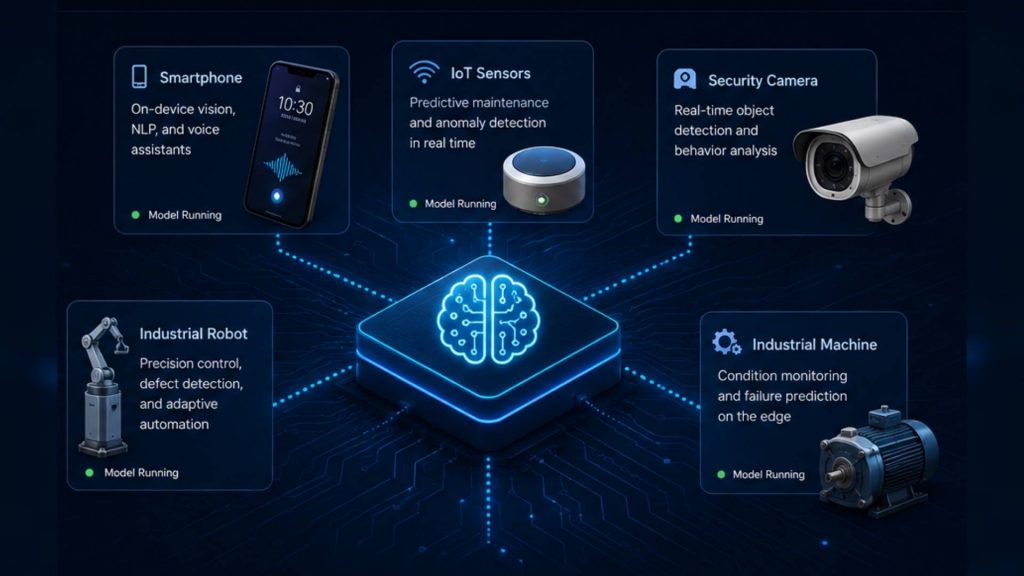
Edge AI processes data directly on local devices for faster real-time decisions
2. How Does Edge AI Work?
Edge AI works by combining local computing hardware, AI models, and connected devices to process data directly at the edge of the network. This enables faster responses, lower latency, and more efficient real-time decision-making.
Edge AI follows a step-by-step process to collect, analyze, and act on data directly at the edge of the network:
- Step 1: Cloud Training – AI models are trained in the cloud using large datasets to learn patterns and improve accuracy.
- Step 2: Edge Deployment – The trained model is optimized and deployed onto edge devices such as cameras, sensors, smartphones, or industrial equipment.
- Step 3: Data Collection – Edge devices continuously collect real-time data from the surrounding environment.
- Step 4: Local AI Inference – The collected data is processed directly on the device using the embedded AI model to generate predictions or insights.
- Step 5: Real-Time Decision-Making – The device instantly converts inference results into actions, such as sending alerts, adjusting operations, or automating tasks.
- Step 6: Cloud Connectivity (Optional) – Devices may communicate with the cloud for additional analytics, data synchronization, or accessing more complex computing resources.
- Step 7: Model Monitoring & OTA Updates – Performance is tracked continuously, and improved AI models can be delivered remotely through over-the-air updates.
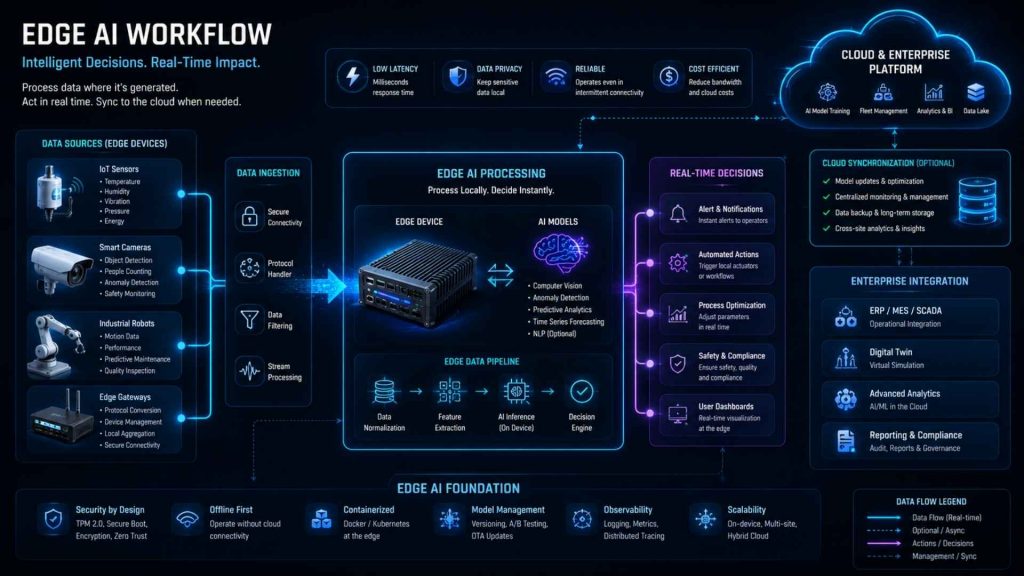
Edge AI processes data locally on connected devices for faster and lower-latency decisions
2.1. Data collection from edge devices
Edge AI systems first collect data from edge devices such as sensors, cameras, smartphones, drones, or industrial machines. These devices continuously generate large volumes of operational or environmental data that can be analyzed locally. Efficient data collection helps organizations support faster analytics and improve responsiveness in real-time environments.
For example, smart traffic cameras used in Singapore’s Traffic Monitoring Camera System continuously collect vehicle flow and road condition data to support real-time traffic monitoring and congestion management (LTA | Intelligent Transport Systems, n.d.).
2.2. Local AI model inference
After data is collected, AI models deployed on edge devices process the information locally without sending it to cloud servers. This process is called inference, where the trained AI model identifies patterns, classifications, or predictions directly on the device. Local inference significantly reduces latency and improves operational efficiency.
For instance, Hikvision AI-powered security cameras can locally perform facial recognition and object detection directly on edge devices without relying entirely on centralized cloud processing.
2.3. Real-time decision-making
Edge AI enables devices to make decisions immediately after processing data locally. Real-time decision-making is critical in environments where delays could impact safety, operational efficiency, or user experience. By reducing dependency on remote cloud systems, Edge AI supports faster and more reliable automated responses.
For example, Tesla vehicles use onboard AI systems to process camera and sensor data in real time for obstacle detection, lane navigation, and driving assistance without relying entirely on cloud connectivity.
2.4. Optional cloud connection and model updates
Although Edge AI processes data locally, many systems still connect to cloud platforms for additional storage, analytics, or synchronization. Cloud connectivity also allows organizations to distribute updated AI models to edge devices. This hybrid approach combines the speed of edge computing with the scalability of cloud infrastructure.
For instance, Walmart retail stores can locally analyze customer movement patterns and shelf interactions while uploading summarized analytics data to centralized reporting platforms (Perez, 2019).
2.5. Cloud training and edge deployment
AI models are often trained in cloud environments using large datasets and powerful computing resources. After training is completed, optimized models are deployed to edge devices for local inference and decision-making. This process helps organizations balance computational efficiency with scalable AI development workflows.
For example, Siemens Healthcare may train AI diagnostic models in cloud environments before deploying them to portable medical imaging systems used in hospitals and remote healthcare facilities (AI-Rad Companion, n.d.).
2.6. Model monitoring and over-the-air updates
Edge AI systems require continuous monitoring to ensure models maintain accuracy and performance over time. Organizations can remotely deliver over-the-air updates to improve AI capabilities, fix issues, or adapt models to changing environments. This helps maintain long-term reliability across distributed edge networks.
For instance, Samsung smart manufacturing facilities can remotely deploy updated AI defect-detection models to factory equipment without requiring technicians to manually reconfigure production systems (Factory Solutions | Smart Factory | Samsung SDS, n.d.).
3. Edge AI vs Cloud AI vs Edge Computing
Edge AI, Cloud AI, and Edge Computing are closely related technologies but serve different purposes in data processing and analytics. The table below compares their key differences across performance, connectivity, scalability, and real-time processing capabilities.
| Criteria | Edge AI | Cloud AI | Edge Computing |
| Definition | Edge AI refers to running AI models directly on local edge devices to process and analyze data in real time. | Cloud AI uses centralized cloud servers and large-scale infrastructure to process and analyze AI workloads remotely. | Edge computing processes data near the data source to reduce latency and network dependency, even without AI models. |
| Where data is processed | Data is processed locally on edge devices such as cameras, IoT sensors, robots, or smartphones. | Data is processed inside centralized cloud data centers and remote servers. | Data is processed near the network edge through local gateways, edge servers, or nearby infrastructure. |
| Latency | Very low latency because processing happens directly on the local device in real time. | Higher latency due to internet transmission and communication with cloud servers. | Lower latency than cloud computing because processing occurs closer to the data source. |
| Connectivity requirement | Can operate with limited or unstable internet connectivity in many environments. | Requires stable and continuous internet connectivity for most operations. | Usually supports partial or intermittent internet connectivity depending on deployment architecture. |
| Bandwidth usage | Uses lower bandwidth because only selected or summarized data may be sent to the cloud. | Consumes higher bandwidth since large volumes of raw data are transmitted continuously. | Helps reduce bandwidth usage by processing some data locally before transmission. |
| Offline capability | Strong offline capability because AI inference runs locally on edge devices. | Limited offline capability because cloud access is generally required for processing. | Moderate offline support depending on local computing resources and architecture. |
| Computing resources | Uses distributed computing resources across multiple edge devices and embedded systems. | Relies on centralized high-performance servers and scalable cloud infrastructure. | Uses local edge servers, gateways, or nearby computing infrastructure for processing tasks. |
| Data privacy | Provides stronger privacy because sensitive data can remain on local devices instead of being uploaded. | May increase privacy concerns because data is transmitted and stored in cloud environments. | Improves privacy by minimizing unnecessary data transfer to centralized systems. |
| Scalability | Scalability depends on the number and capability of deployed edge devices. | Highly scalable due to elastic cloud infrastructure and centralized resource management. | Moderately scalable depending on network architecture and edge infrastructure deployment. |
| Best use case | Best for real-time AI applications such as autonomous vehicles, smart surveillance, and industrial automation. | Best for large-scale AI training, advanced analytics, and centralized data processing workloads. | Best for reducing latency and improving responsiveness in distributed computing environments. |
| Example | Smart cameras with facial recognition and autonomous industrial robots. | Cloud-based chatbots, recommendation systems, and large AI analytics platforms. | Content delivery networks, local edge servers, and industrial edge gateways. |
Edge AI focuses on enabling intelligent real-time decision-making directly on local devices, while Cloud AI provides large-scale centralized computing power for advanced AI workloads. Edge computing mainly improves processing speed and network efficiency by bringing computation closer to the data source.
>> Explore more: Top Cloud Service Providers with GPU for AI Workloads
4. Key components of Edge AI
Edge AI systems rely on several key components that enable devices to process data locally and make real-time decisions. These components work together to improve operational efficiency, reduce latency, and support intelligent automation across connected environments.
4.1. Edge devices
Edge devices are physical devices that collect and process data directly at the edge of the network. These devices can include smartphones, IoT sensors, cameras, drones, industrial robots, and autonomous vehicles operating in real-time environments.
By processing data locally, edge devices reduce latency and minimize continuous data transfers to cloud servers. This improves operational efficiency and supports faster decision-making in environments that require real-time responses and lower network dependency.
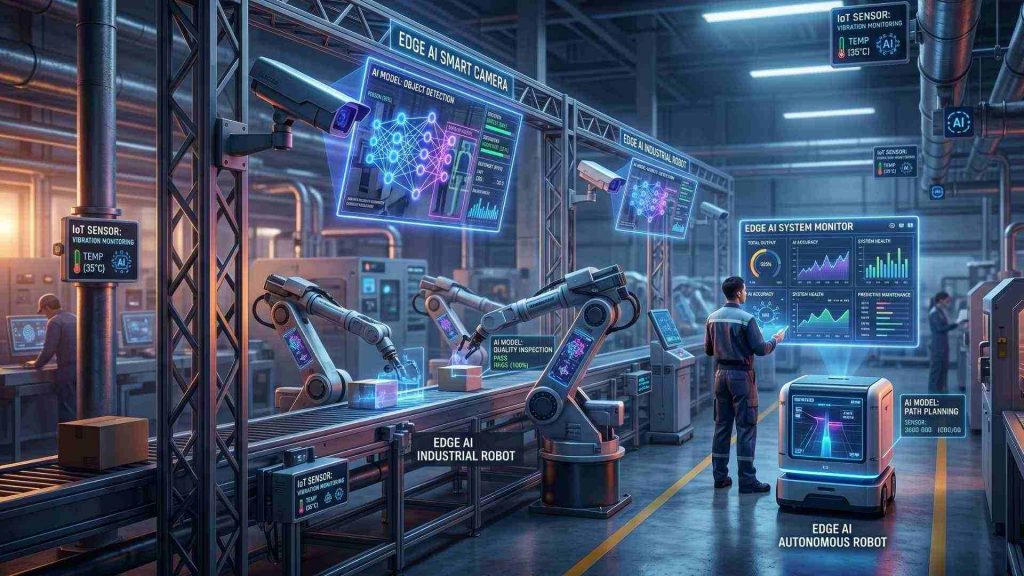
AI models process and analyze data locally on edge devices in real time
4.2. AI Models
AI models are responsible for analyzing data, identifying patterns, and generating predictions directly on edge devices. These models are typically trained in cloud environments before being deployed to edge systems for local inference and real-time processing.
Optimized AI models help improve processing speed, reduce latency, and support efficient decision-making across Edge AI environments. They also enable devices to operate more independently while minimizing reliance on centralized cloud infrastructure.
>> Explore more: How to Deploy AI Model: A Step-by-Step Guide 2026
4.3. Communication
Communication networks connect edge devices with cloud platforms, local servers, and other connected systems to support synchronization and data exchange. These networks may use technologies such as Wi-Fi, 5G, Ethernet, or IoT communication protocols.
Reliable communication infrastructure helps organizations support remote monitoring, cloud synchronization, and AI model updates more efficiently. It also improves connectivity across distributed Edge AI systems and intelligent environments.
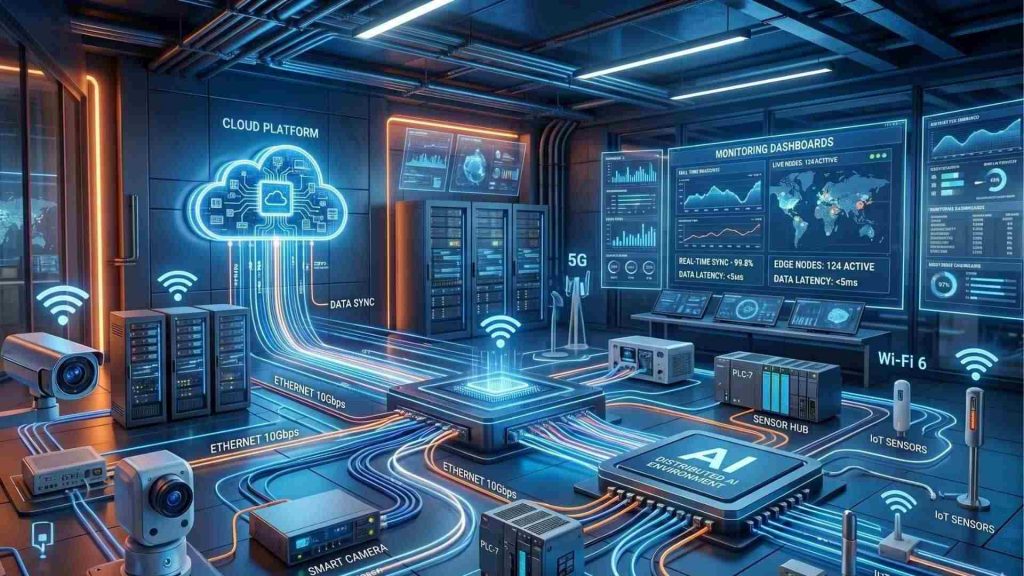
Communication networks connect edge devices with cloud platforms and intelligent systems
Explore more: InfiniBand vs Ethernet: Best Network for AI Workloads
5. Common Edge AI Examples
Edge AI is widely used across industries that require real-time processing and intelligent automation. By analyzing data locally on connected devices, Edge AI enables faster responses, lower latency, and more efficient operations in modern digital environments.
5.1. Smart cameras and video analytics
Smart cameras use Edge AI to process and analyze video data locally in real time without relying entirely on cloud servers. These systems can perform facial recognition, object detection, traffic monitoring, and security analysis with lower latency and improved privacy protection.
For example, Hikvision AI-powered surveillance cameras can locally perform facial recognition and suspicious activity detection while instantly sending alerts to security teams without depending entirely on centralized cloud processing.
5.2. Autonomous vehicles
Autonomous vehicles rely on Edge AI to process sensor, camera, and radar data directly inside the vehicle. Real-time local processing allows vehicles to recognize obstacles, monitor road conditions, and make driving decisions immediately without depending on remote cloud infrastructure.
For instance, Tesla vehicles use onboard AI systems to process camera and sensor data in real time for obstacle detection, lane navigation, and driving assistance without relying entirely on cloud connectivity.
5.3. Industrial IoT and predictive maintenance
Industrial IoT systems use Edge AI to monitor equipment performance and analyze machine data locally within factories or industrial facilities. This helps organizations identify anomalies, predict failures, and reduce operational downtime through predictive maintenance strategies.
For example, Siemens industrial monitoring systems can analyze machine vibration and equipment sensor data locally to detect abnormal operating conditions before hardware failures occur.
5.4. Smart healthcare devices
Healthcare devices use Edge AI to analyze medical and patient data directly on local devices in real time. This improves response speed, reduces dependency on internet connectivity, and strengthens patient data privacy across healthcare environments.
For instance, Apple Watch can locally analyze heart rate patterns and detect irregular heart rhythms before sending health alerts to users or healthcare providers (Apple, n.d.).
5.5. Retail and smart stores
Retail businesses use Edge AI to improve customer experiences, inventory tracking, and store operations through real-time analytics. Smart retail systems can analyze customer behavior, automate checkout processes, and optimize product placement more efficiently.
For example, Walmart Intelligent Retail Lab uses AI cameras and sensors to monitor shelf inventory and improve real-time store operations through automated analytics systems.
5.6. Smartphones and personal devices
Smartphones and personal devices increasingly use Edge AI for features such as voice assistants, facial recognition, image enhancement, and predictive recommendations. Local AI processing improves speed, privacy, and device responsiveness without constantly sending user data to cloud servers.
For example, Apple iPhones use on-device AI through Face ID to perform facial recognition and securely unlock devices without requiring continuous cloud connectivity (About Face ID Advanced Technology – Apple Support, 2024).
6. Benefits of Edge AI
Edge AI provides several important advantages for organizations that require real-time processing, intelligent automation, and faster operational responses. By processing data directly on local devices instead of relying entirely on centralized cloud systems, businesses can improve performance, efficiency, and scalability across modern digital environments.
- Lower latency: Edge AI processes data locally on devices, helping reduce delays and improve response speed for real-time operations and automation.
- Real-time data processing: Devices can analyze and respond to data instantly without depending entirely on centralized cloud processing systems.
- Better data privacy: Sensitive data can remain on local devices, helping organizations improve privacy protection and reduce security risks.
- Lower bandwidth usage: Local data processing reduces the amount of raw data transferred to cloud servers, saving network bandwidth resources.
- More reliable offline performance: Edge AI systems can continue operating with limited internet connectivity because AI inference runs directly on devices.
- Faster AI deployment for real-world applications: Businesses can deploy AI solutions faster and improve integration across modern applications and connected systems.
As AI adoption continues to grow, many organizations face challenges in deploying AI models quickly while also managing complex inference infrastructure and scalability requirements. Platforms such as Serverless Inference help businesses simplify AI deployment through API-based integration, reduce infrastructure management effort, and accelerate the integration of AI models into real-world applications.
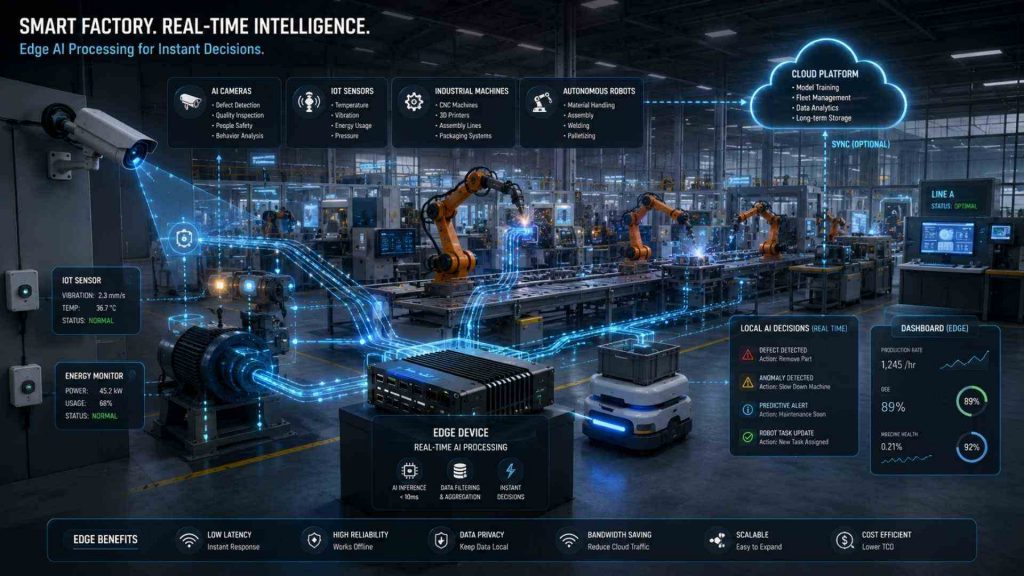
Edge AI improves real-time processing, privacy, and operational efficiency across connected environments
7. Edge AI in Modern AI Infrastructure
Modern AI infrastructure increasingly combines edge computing, cloud platforms, and distributed AI systems to support faster processing, scalable deployment, and real-time intelligent operations across enterprise environments.
7.1. Hybrid Edge-Cloud AI Architectures
Modern enterprises often combine edge devices with cloud infrastructure to create hybrid AI architectures that balance performance, scalability, and operational efficiency. Edge devices handle real-time local processing, while cloud platforms support centralized analytics, model training, storage, and large-scale workload management across distributed environments.
This hybrid approach helps organizations reduce latency, optimize bandwidth usage, and lower operational costs while still benefiting from the scalability of cloud computing. It also improves system flexibility by allowing AI workloads to be distributed intelligently between local edge systems and centralized cloud infrastructure.
>> Read more: Benefits of cloud computing: When is the right time to move?
7.2. Edge AI Inference Pipelines
Edge AI inference pipelines process AI predictions and analytical tasks directly near the data source instead of relying entirely on centralized cloud systems. This enables devices to respond to incoming data faster and supports low-latency decision-making in environments requiring real-time intelligence and automation.
By moving inference closer to edge devices, organizations can reduce cloud dependency, improve operational responsiveness, and minimize network delays. Edge inference pipelines are widely used in autonomous systems, smart surveillance, industrial IoT, and intelligent monitoring applications.
7.3. Containerized Edge AI Deployments
Container technologies such as Docker and Kubernetes help organizations deploy and manage Edge AI workloads more efficiently across distributed environments. Containers package AI applications and dependencies into lightweight, portable units that can run consistently across multiple edge devices and infrastructure systems.
This approach improves scalability, deployment flexibility, and operational consistency for Edge AI environments. Organizations can update, monitor, and orchestrate AI workloads more effectively while simplifying infrastructure management across geographically distributed edge networks.
7.4. Real-Time AI Applications
Edge AI plays a critical role in applications that require immediate processing and low-latency decision-making. Industries such as autonomous transportation, smart manufacturing, IoT, video analytics, and intelligent monitoring increasingly rely on Edge AI to support real-time operations and automated system responses.
By processing data locally, Edge AI enables systems to react faster to changing conditions without waiting for cloud-based instructions. This improves operational efficiency, enhances automation capabilities, and supports more reliable performance in mission-critical environments.
8. When Should Businesses Use Edge AI?
Edge AI is most valuable in environments that require real-time processing, low latency, reliable offline performance, and efficient data handling. Businesses often adopt Edge AI when centralized cloud processing alone cannot meet operational, scalability, or privacy requirements.
8.1. When applications need instant response
Businesses should use Edge AI when applications require immediate responses and real-time decision-making. Processing data locally helps reduce latency and improves system responsiveness in environments where delays may affect operations, safety, or customer experiences.
For example, autonomous transportation systems can process sensor and camera data locally to support real-time obstacle detection, navigation assistance, and automated operational decisions without relying entirely on cloud connectivity.
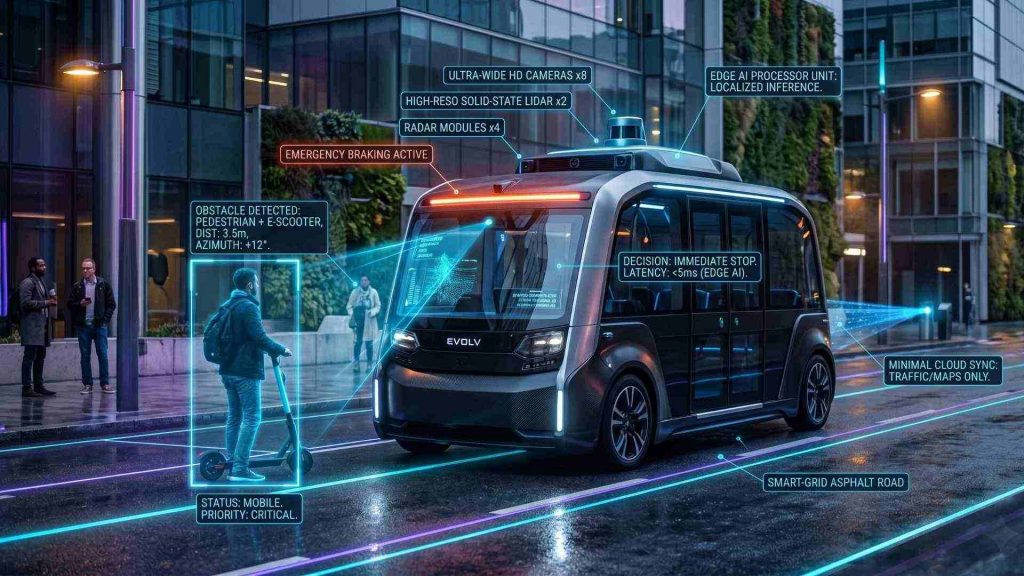
Edge AI enables real-time responses for applications that require instant decision-making
8.2. When internet connectivity is unstable
Edge AI is useful in environments where internet connectivity is limited, unstable, or unavailable. Since AI models can run locally on devices, systems can continue operating without depending entirely on centralized cloud infrastructure or constant network access.
For instance, remote industrial facilities can locally monitor equipment performance and process AI workloads even in locations with limited or unstable internet connectivity.
8.3. When data privacy is critical
Organizations handling sensitive or regulated data may use Edge AI to minimize unnecessary data transfers to external cloud environments. Local processing helps improve privacy protection and supports compliance with data security and governance requirements.
For example, smart healthcare monitoring systems can locally process patient and diagnostic data to help reduce exposure of sensitive medical information across external networks.
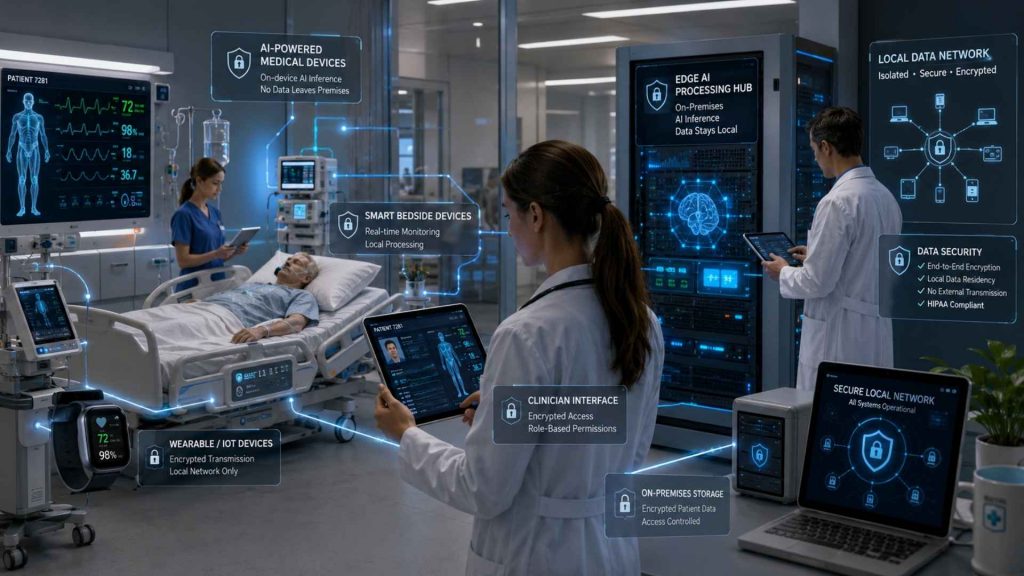
Edge AI helps organizations process sensitive data locally for stronger privacy and security protection
8.4. When devices generate large amounts of data
Businesses should consider Edge AI when connected devices continuously generate massive volumes of data that would be expensive or inefficient to transmit entirely to the cloud. Local processing helps reduce bandwidth usage and improves operational efficiency.
For instance, intelligent video analytics systems can locally analyze surveillance video streams and only send important alerts or detected events to centralized monitoring platforms.
8.5. When AI workloads need cloud support for training or scaling
Businesses should use hybrid Edge AI and cloud infrastructure when AI workloads require large-scale model training, fine-tuning, or scalable inference capabilities. While edge devices process data locally in real time, cloud GPU environments provide the high-performance computing resources needed for more complex AI operations.
For example, autonomous driving platforms can process sensor data locally on vehicles while using cloud GPU infrastructure to train and optimize AI driving models at large scale.
As Edge AI adoption grows, many businesses may face challenges related to AI scalability, infrastructure management, and high-performance workload deployment across distributed environments. In these situations, organizations may consider the following solutions to improve operational flexibility and AI infrastructure efficiency:
- GPU Container: Suitable for businesses deploying containerized AI workloads that require more flexible orchestration, scalable GPU environments, and simplified infrastructure management across cloud and edge systems.
- GPU Virtual Machine: Suitable for enterprises handling large-scale AI training, fine-tuning, or high-performance inference workloads that require scalable GPU compute resources and greater infrastructure control.
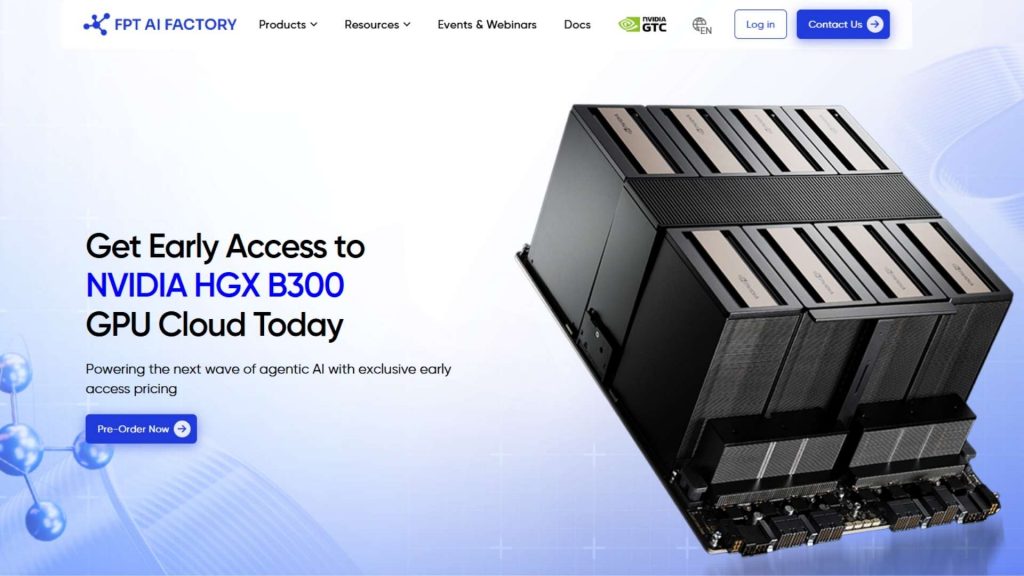
Containerized GPU environments improve scalability and orchestration for distributed AI workloads (Source: FPT AI Factory)
9. Future of Edge AI
Edge AI is becoming an important part of modern digital infrastructure as businesses increasingly adopt IoT devices, autonomous systems, and intelligent connected environments. The following trends highlight how Edge AI is expected to evolve across real-time processing, intelligent automation, and distributed AI deployment in the future.
- Growing adoption of real-time AI applications across industries: More businesses are using Edge AI to support instant decision-making and automation in manufacturing, healthcare, transportation, and smart city environments.
- Smaller and more optimized AI models for edge devices: AI models are becoming lighter and more efficient, allowing edge devices with limited resources to perform advanced AI processing locally.
- Expansion of hybrid edge-cloud AI architectures: Organizations increasingly combine edge computing and cloud infrastructure to balance scalability, real-time processing, and operational efficiency.
- Increased focus on privacy-first and secure AI processing: Businesses are prioritizing local AI processing to reduce unnecessary data transfers and improve compliance with privacy and security regulations.
- Wider use of Edge AI in healthcare, manufacturing, and autonomous systems: Edge AI adoption continues expanding across industries that require low latency, intelligent automation, and reliable real-time operations.
Edge AI is expected to become a key part of future digital infrastructure as businesses increasingly adopt real-time, intelligent, and automated AI systems across industries such as healthcare, manufacturing, transportation, and smart cities.
10. FAQs
10.1 What does edge AI do?
Edge AI allows devices to process and analyze data locally using AI models instead of relying entirely on cloud servers. This helps improve response speed, reduce latency, and support real-time decision-making.
10.2 What is the difference between AI and edge AI?
Traditional AI often processes data in centralized cloud systems, while Edge AI performs AI processing directly on local devices such as cameras, sensors, or smartphones for faster real-time responses.
10.3. What is an example of edge AI?
One common example of Edge AI is smart surveillance cameras that use local AI models for facial recognition, motion detection, and security monitoring without depending entirely on cloud connectivity.
10.4. How much does edge AI cost?
The cost of Edge AI depends on hardware, AI models, infrastructure complexity, deployment scale, and cloud integration requirements. Small deployments cost less than enterprise-scale AI environments.
In summary, Edge AI helps organizations improve real-time processing, operational efficiency, data privacy, and intelligent automation across modern digital environments. By enabling AI models to run directly on edge devices, businesses can reduce latency, optimize bandwidth usage, and support faster decision-making across industries such as healthcare, manufacturing, transportation, retail, and smart infrastructure systems.
Organizations can get started with FPT AI Factory and receive $100 in credits after signing in, allowing faster access to AI infrastructure, GPU computing resources, and scalable development environments. For enterprises with large-scale AI deployments or customized infrastructure requirements, FPT AI Factory also provides consultation and tailored solutions designed for modern AI and cloud-native workloads.
Contact Information:
- Hotline: 1900 638 399
- Email: support@fptcloud.com
Explore Related Articles:
Edge Computing vs Cloud Computing: Key Differences
AI Development Platforms: Key Features and How to Choose
What Is Model Serving? From AI Research to Real-World Impact