

AI applications increasingly require real-time responses while maintaining security, efficiency, and reliability. As organizations deploy AI closer to users and connected devices, edge inference has become a key technology for reducing latency and enabling intelligent decision-making. In this article, FPT AI Factory helps you understand edge inference, how it works, its architecture, key benefits, and real-world enterprise applications.
|
Key takeaways: Edge inference is transforming how AI applications deliver real-time intelligence by processing data closer to where it is generated. Here are the key points to remember:
|
FPT AI Factory provides the tools to develop, evaluate, and deploy AI models efficiently. With GPU infrastructure, AI Notebook, Model Testing, and Serverless Inference, teams can accelerate model development, validate performance, and streamline deployment into production. Organizations with custom AI requirements or large-scale infrastructure needs can contact FPT AI Factory team for tailored solutions.
1. What is Edge Inference?
Edge inference is the process of running trained AI models on edge devices or nearby computing infrastructure instead of centralized cloud servers. By processing data closer to its source, edge inference reduces latency, lowers bandwidth usage, and improves data privacy, making it ideal for real-time AI applications such as IoT, manufacturing, healthcare, and autonomous systems.
The key difference between traditional AI flow and edge inference flow is where AI inference takes place. In a traditional AI flow, data is sent to the cloud for processing before a result is returned, which may increase latency and depend on network connectivity. In contrast, an edge inference flow performs inference directly on the device or a nearby edge server, enabling faster responses, reduced network traffic, and more reliable AI performance even with limited internet access.
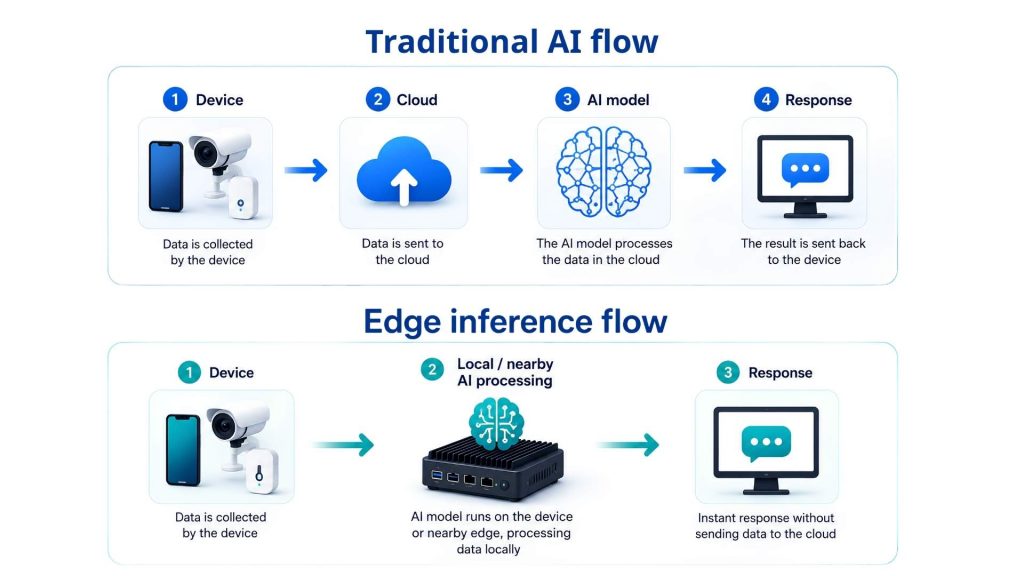
Comparison between traditional cloud AI inference and edge inference workflows
2. How Edge Inference works
After understanding what edge inference is, the next step is to understand how it works. The edge inference workflow consists of four key stages, from deploying AI models to processing data locally and synchronizing with the cloud:
2.1 Deployment
The edge inference process begins by deploying a trained AI model to an edge device or edge server. In most cases, models are trained in the cloud using high-performance computing resources before being optimized for deployment on devices with limited computing power.
Techniques such as model quantization, pruning, or format conversion help reduce model size while maintaining inference accuracy. This allows AI models to run efficiently on edge hardware, including GPUs, CPUs, NPUs, and AI accelerators. To better understand how different processors affect AI inference performance, you can also read our guide on GPU vs CPU: Key Differences and Which One to Choose for AI.
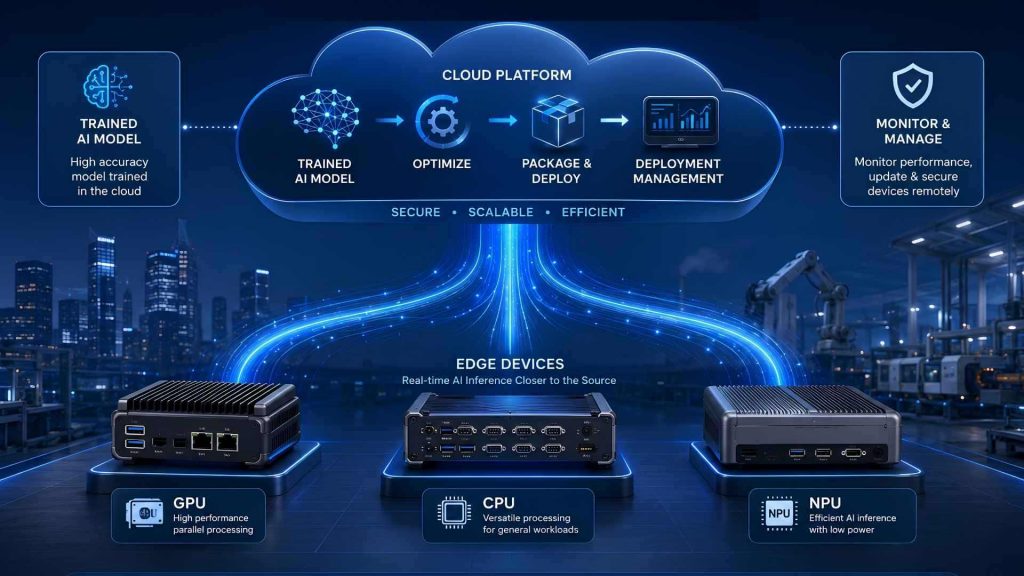
Deploying trained AI models from the cloud to edge devices
2.2. Local processing
Once deployed, the AI model performs inference directly on the edge device using locally generated data. This eliminates the need to transmit every request to a remote cloud server, significantly reducing network latency and bandwidth usage. Local processing also improves privacy because sensitive information can remain on the device instead of being continuously uploaded to the cloud.
2.3. Real-time decision making
By performing inference close to the data source, edge AI systems can make decisions almost instantly. This capability is essential for applications where even small delays may affect safety, operational efficiency, or customer experience. Instead of waiting for cloud-based processing, edge devices can respond immediately to changing conditions and trigger actions in real time.
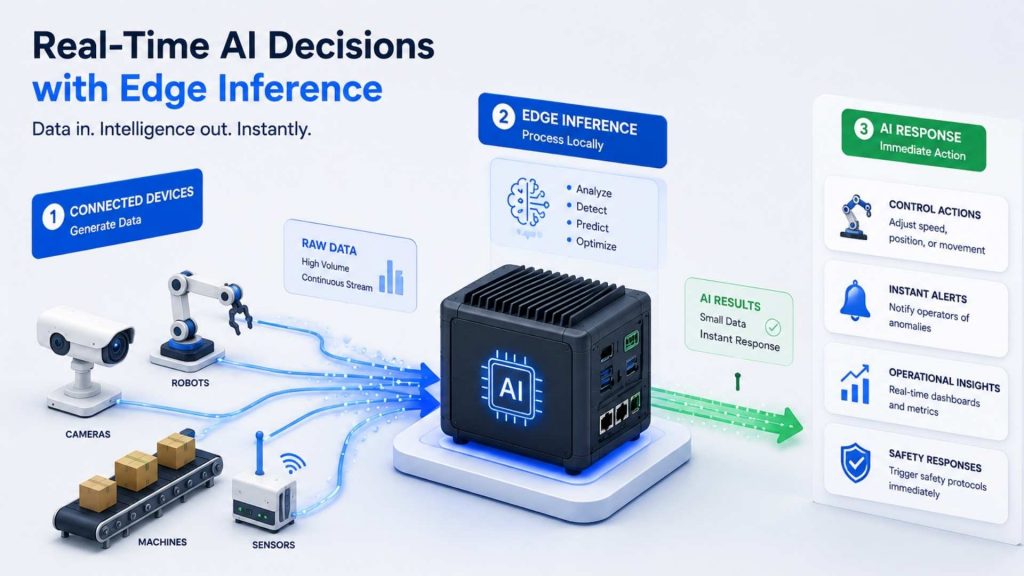
Real-time AI decisions powered by edge inference
2.4. Cloud synchronization
Although inference takes place at the edge, the cloud remains an important part of the AI lifecycle. Organizations use cloud platforms to monitor deployed models, collect operational metrics, distribute model updates, and retrain models using newly collected data. This hybrid approach combines the speed of local inference with the scalability and centralized management of cloud infrastructure. It also helps ensure AI applications remain accurate, secure, and up to date over time.
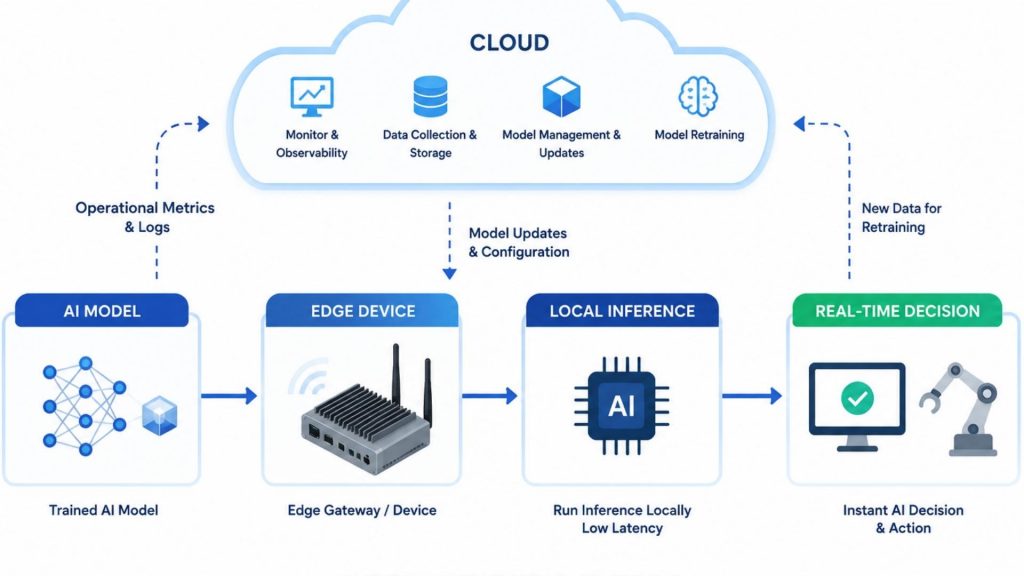
Cloud synchronization supports the continuous lifecycle of edge AI models
3. Edge Inference architecture
Edge inference relies on a distributed architecture that enables AI models to run closer to end users while remaining connected to the cloud. Here are the three key components of an edge inference architecture.
3.1. Edge devices
Edge devices are the endpoints where data is generated and AI inference is performed. They collect information from sensors, cameras, or connected applications and execute trained AI models locally to generate predictions. Processing data directly on the device reduces network latency and minimizes the need to continuously transmit data to the cloud. This enables faster AI responses while improving privacy and bandwidth efficiency.
3.2. Edge servers
Edge servers provide additional computing capacity for AI workloads that exceed the capabilities of individual edge devices. Positioned closer to users than centralized cloud data centers, they process data locally while serving multiple connected devices simultaneously. Edge servers help distribute AI workloads efficiently, improve scalability, and maintain low-latency performance across larger deployments. They also support centralized management of nearby edge devices without relying entirely on cloud infrastructure.
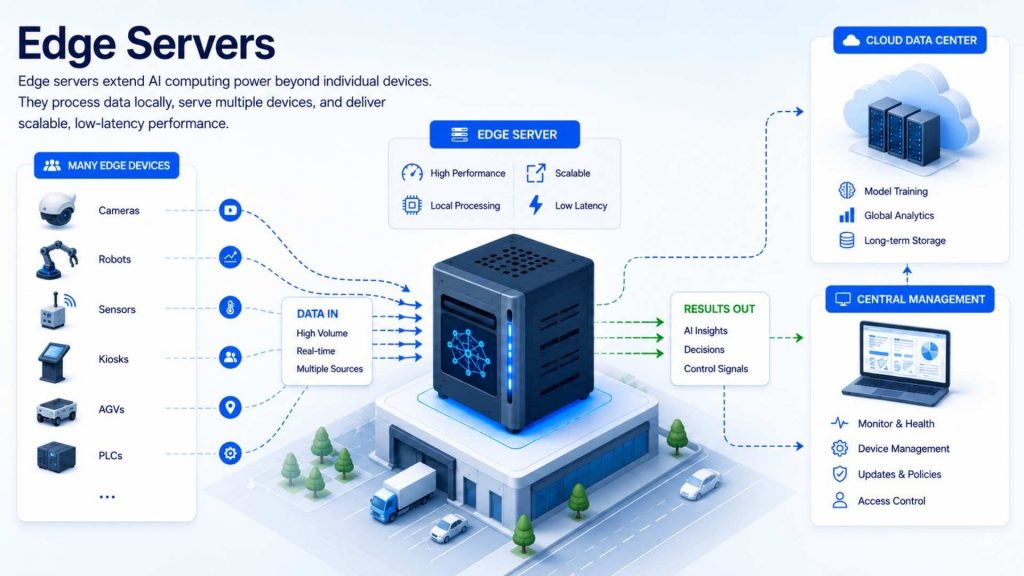
Edge servers bridge edge devices and cloud infrastructure for efficient AI inference
3.3. Cloud integration
Cloud integration complements edge inference by providing centralized services for the AI lifecycle. AI models are typically trained, monitored, updated, and managed in the cloud before being deployed to edge devices or edge servers. By leveraging the benefits of cloud computing, organizations can efficiently scale AI workloads, manage model updates centrally, and monitor deployments across distributed environments. The cloud also supports centralized management while enabling distributed machine learning across large-scale deployments.
4. Edge vs Cloud vs Hybrid Inference: Key Differences
Edge inference, cloud inference, and hybrid inference enable AI models to generate predictions through different computing architectures. Each approach has unique advantages and trade-offs in terms of processing location, latency, connectivity, and resource requirements. The following table highlights the key differences between them:
| Feature | Edge Inference | Cloud Inference | Hybrid Inference |
| Data processing location | On edge devices or nearby edge servers | In centralized cloud data centers | Distributed between edge devices and cloud infrastructure |
| Latency | Low latency with near real-time responses | Higher latency due to network transmission | Low latency for critical tasks while leveraging cloud processing when needed |
| Connectivity dependency | Can operate with limited or intermittent internet access | Requires stable internet connectivity | Can continue local processing when offline and synchronize with the cloud when connected |
| Computing resources | Limited by local device or edge server capacity | Virtually unlimited cloud computing resources | Combines local computing capabilities with scalable cloud resources |
| Best for | IoT, industrial automation, autonomous systems, healthcare | Large-scale AI services, analytics, content generation, model serving | Smart cities, autonomous vehicles, enterprise AI systems, real-time applications requiring both speed and scalability |
Edge inference is ideal for applications requiring low latency and local processing, while cloud inference is better suited for large-scale and compute-intensive workloads. Hybrid inference combines both approaches, enabling real-time processing at the edge while leveraging cloud resources for scalability and complex tasks.
5. Benefits of Edge Inference
After comparing edge inference with cloud inference, it becomes easier to understand why many organizations are adopting edge AI. Processing AI workloads closer to the data source delivers both technical and business advantages across real-time applications. Here are some key benefits of edge inference:
5.1 Lower AI application latency
Edge inference significantly reduces the time required for AI models to generate predictions because data is processed locally instead of traveling to a centralized cloud. This low-latency architecture is essential for applications that require immediate responses, such as industrial automation, robotics, and autonomous systems. Faster inference also improves user experiences and operational efficiency.
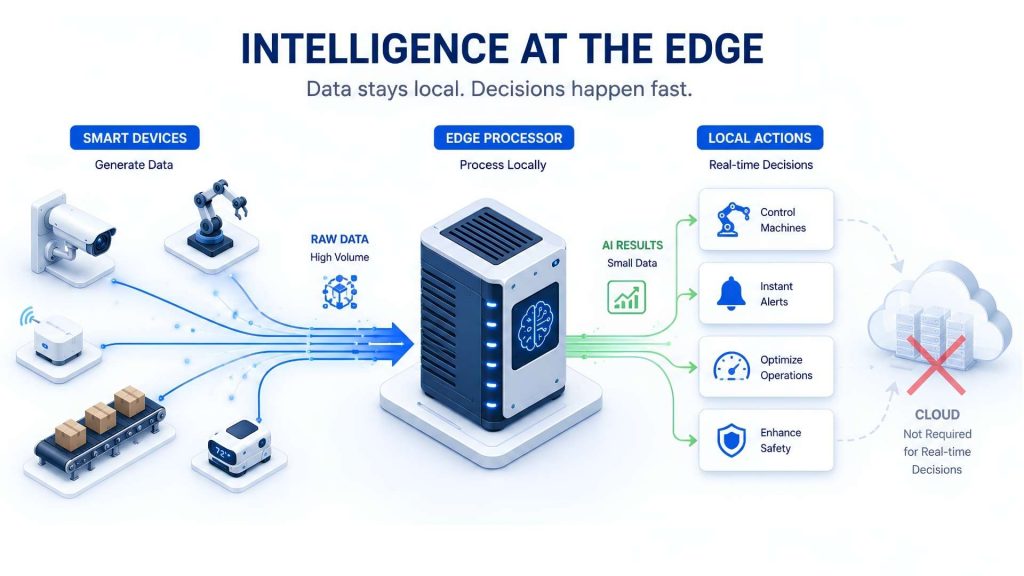
Local AI processing enables low-latency inference for real-time applications
5.2 Improved data privacy
Keeping sensitive data on local devices or edge servers reduces the amount of information transmitted across external networks. This approach helps organizations strengthen data privacy, support regulatory compliance, and lower the risk of exposing confidential information. It is especially valuable for industries handling personal or business-critical data.
5.3 Reduced bandwidth usage
Since AI inference is performed locally, only selected results or summarized information need to be sent to the cloud. This reduces network traffic and bandwidth consumption, making deployments more efficient and cost-effective. Organizations can also improve scalability without continuously increasing cloud data transfer.
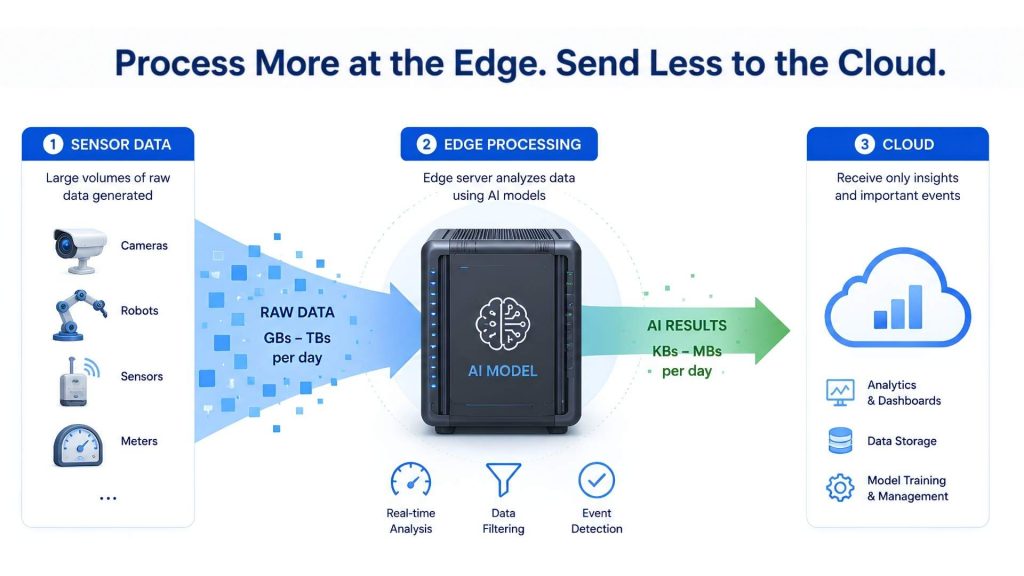
Edge inference reduces bandwidth by processing data locally
5.4 Better reliability
Edge inference enables AI applications to continue operating even when network connectivity is unstable or unavailable. By reducing dependence on cloud communication, organizations can maintain consistent AI performance in remote locations and mission-critical environments. This improves system availability and operational resilience.
6. Edge Inference use cases
Edge inference enables organizations to deploy AI applications that require fast decision-making and local data processing. By reducing latency and minimizing reliance on cloud connectivity, businesses can improve operational efficiency across many industries. Here are some common edge inference use cases.
6.1 Smart manufacturing
Manufacturers use edge inference to monitor production lines, inspect product quality, and detect equipment anomalies in real time. For example, Siemens deploys industrial edge computing to process AI data directly on factory floors. This enables immediate quality inspection and predictive maintenance without depending entirely on cloud processing.
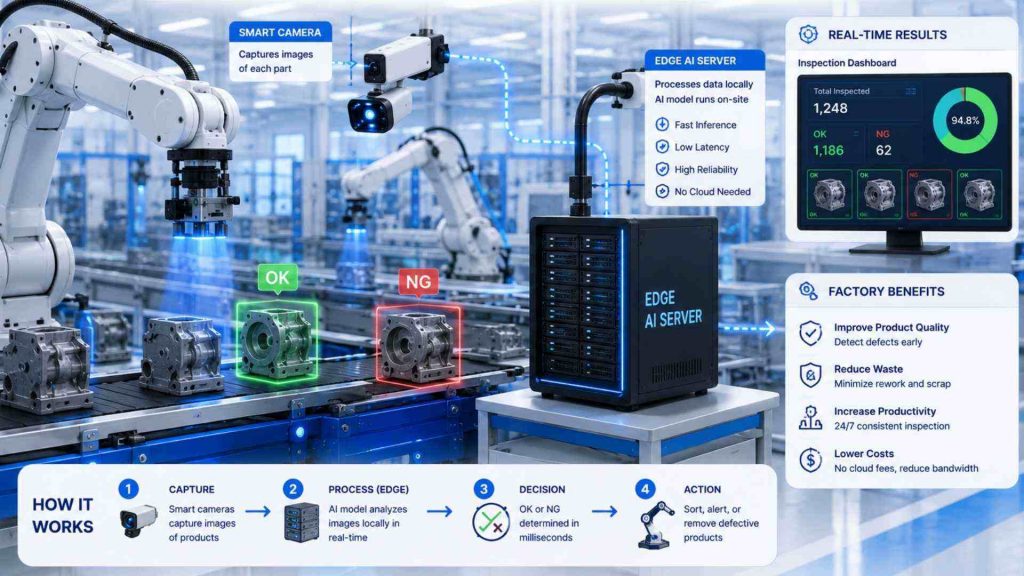
Edge inference supports real-time quality inspection in smart factories
6.2 Autonomous systems
Autonomous vehicles, drones, and mobile robots rely on edge inference to analyze sensor inputs and make decisions within milliseconds. For instance, NVIDIA DRIVE performs AI inference directly inside autonomous vehicles to support perception and driving decisions. Local inference minimizes latency and improves safety during vehicle operation.
6.3 Healthcare AI
Healthcare organizations use edge inference to analyze medical images, monitor patients, and support clinical decision-making while keeping sensitive information closer to where it is collected. For example, GE HealthCare integrates edge AI into medical imaging workflows to accelerate image analysis.
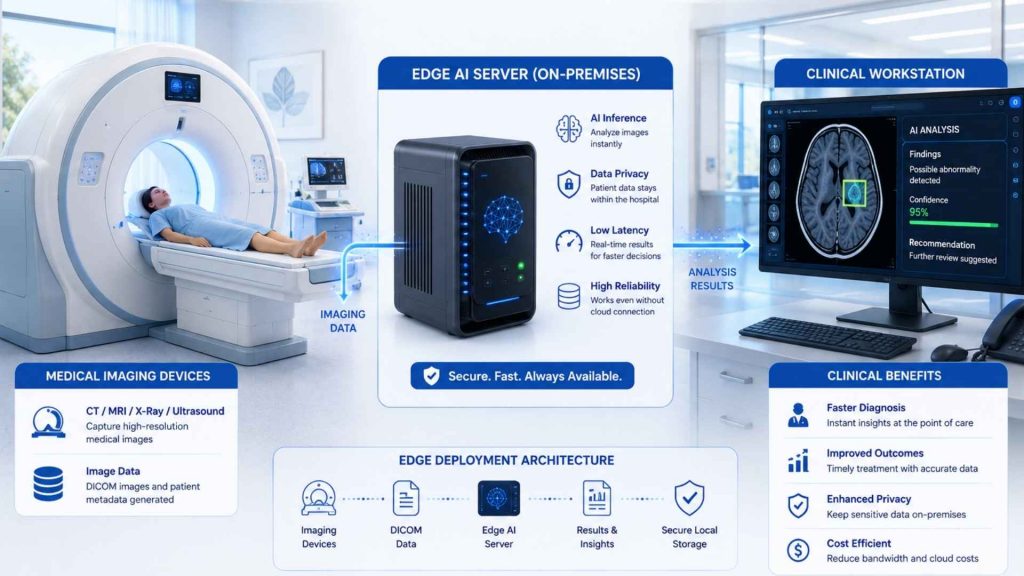
Edge AI enabling real-time medical image analysis
6.4 Retail and customer experience
Retailers deploy edge inference to analyze customer behavior, optimize store operations, and enable intelligent checkout experiences. For example, Amazon Just Walk Out technology combines computer vision and edge AI to support cashierless shopping experiences. Processing data closer to the store environment helps deliver faster customer interactions while reducing reliance on cloud communication.
7. Building a Typical Edge Inference System: Key Considerations
Designing an effective edge inference system requires careful consideration of technical, operational, and security requirements. The following factors play an important role in ensuring system reliability, efficiency, and scalability:
- Network Availability: Edge systems should support reliable operation even with limited or unstable connectivity. Local inference capabilities help maintain performance during network disruptions, while cloud connections enable synchronization and remote management.
- Power Consumption: Many edge devices operate under strict energy constraints. AI models should be optimized through techniques such as quantization, pruning, and hardware acceleration to reduce power usage while maintaining acceptable performance.
- Hardware Constraints: Edge devices have limited computing resources, memory, and storage compared to cloud infrastructure. Model size and hardware capabilities must be optimized to ensure efficient deployment and inference performance.
- Security: Edge devices may face security risks due to distributed deployment and physical accessibility. Security mechanisms such as encrypted communication, authentication, secure boot, and data protection are essential to protect the system.
- Remote Updates: Distributed edge devices require efficient update mechanisms to maintain reliability. Over-the-air (OTA) updates allow organizations to remotely deploy new models, software improvements, and security patches.
- Device Lifecycle: Long-term edge deployment requires proper lifecycle management, including device monitoring, maintenance, performance optimization, and hardware replacement to ensure continuous operation.
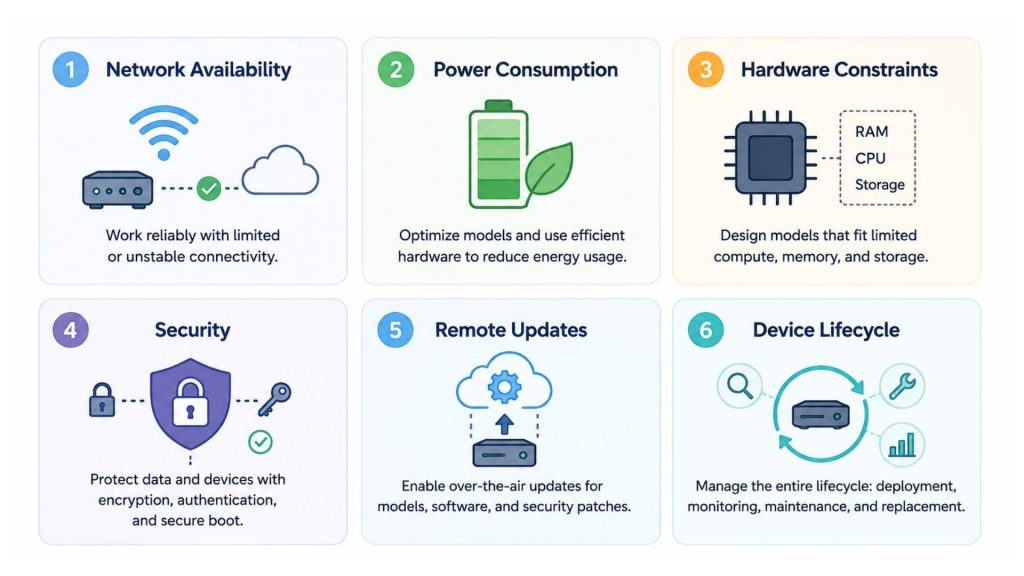
Key technical and operational considerations for edge inference systems
8. Challenges of deploying Edge Inference
While edge inference offers significant advantages for real-time AI applications, organizations also face technical and operational challenges when deploying AI models across distributed environments. Addressing these challenges is essential for achieving reliable, scalable, and cost-effective edge AI deployments.
8.1 Limited computing resources
Unlike cloud data centers, edge devices have limited processing power, memory, and storage capacity. AI models often need to be compressed or optimized before deployment to ensure they can run efficiently without sacrificing performance. Selecting the right model architecture is therefore critical for successful edge inference.
8.2 Model optimization requirements
Large AI models are often too resource-intensive for edge devices, making optimization an essential step before deployment. Techniques such as quantization, pruning, and model compression help reduce computational requirements while maintaining acceptable inference accuracy. Optimized models enable faster inference and lower energy consumption on edge hardware.
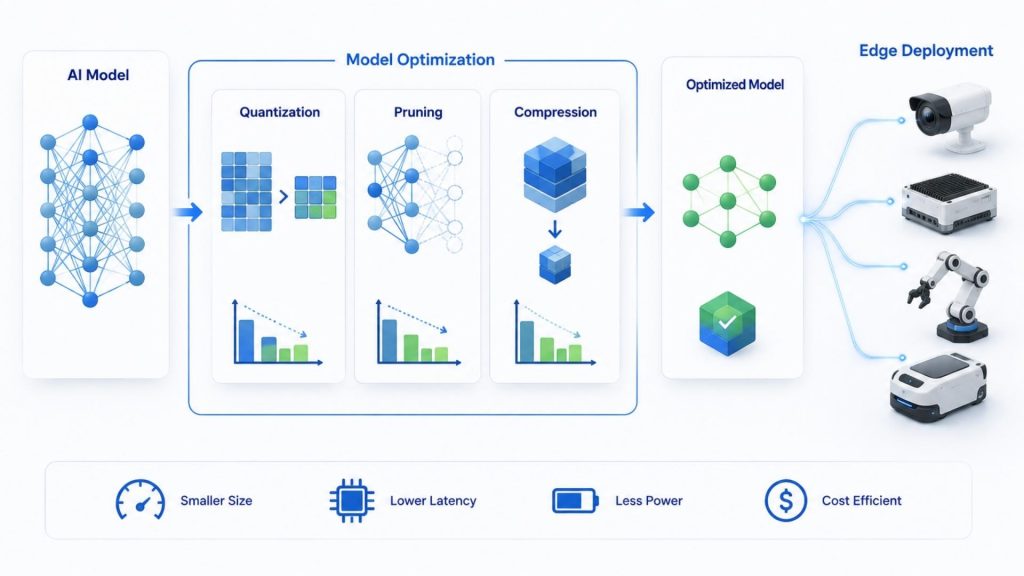
AI model optimization prepares models for edge deployment
8.3 Managing distributed AI deployments
Deploying AI models across hundreds or thousands of edge devices increases operational complexity. Organizations must manage model updates, monitor performance, maintain version consistency, and ensure reliable deployment across distributed environments. Centralized management platforms help simplify these tasks and improve operational efficiency.
8.4 Balancing performance and cost
While edge inference improves response time by processing AI workloads closer to users, deploying AI models into production still requires a reliable inference platform to manage performance, scalability, and resource efficiency.
Serverless Inference helps businesses and startups deploy AI models into real-world applications by providing a stable inference environment. The platform enables AI models to serve user requests at scale while optimizing resource usage and maintaining low latency for production workloads.
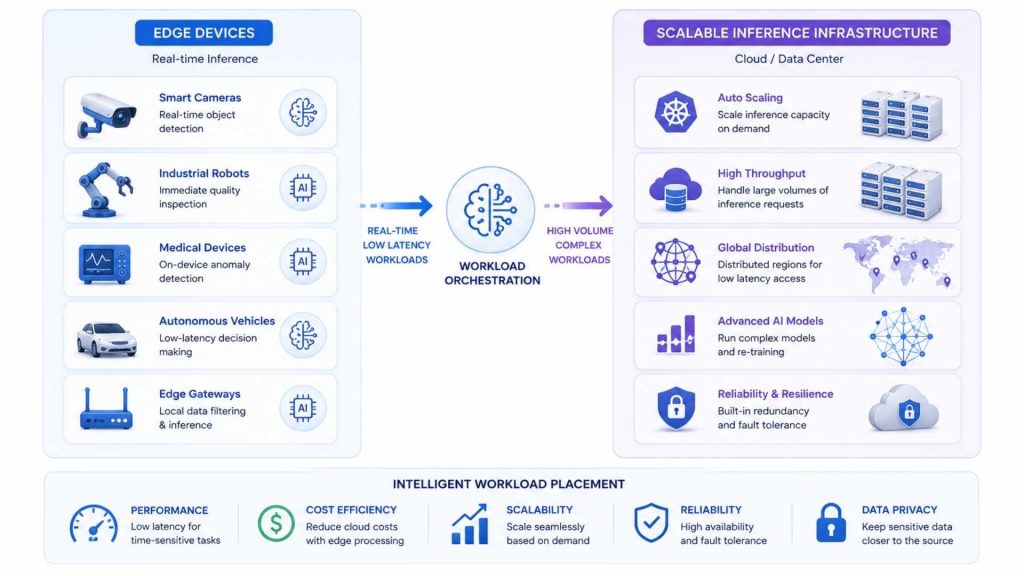
Balancing AI performance, scalability, and operational cost is a challenge of deploying edge inference
In conclusion, edge inference enables AI models to process data closer to where it is generated, reducing latency while improving privacy and real-time performance. As AI adoption grows, combining edge computing with scalable inference infrastructure helps organizations deploy production-ready AI applications more efficiently. For enterprises with large-scale AI deployments or customized infrastructure requirements, FPT AI Factory provides tailored solutions to support modern AI workloads through the contact form.
Contact Information:
- Hotline: 1900 638 399
- Email: support@fptcloud.com
Explore Related Articles: