
What is AI orchestration, and why is it becoming essential for managing modern AI workflows? As organizations deploy multiple AI models, APIs, and infrastructure across production environments, coordinating every component efficiently becomes increasingly challenging. At FPT AI Factory, we provide an AI ecosystem that helps businesses build, deploy, and scale AI applications with reliable infrastructure and scalable inference services.
|
Key Takeaways AI orchestration has become a critical layer for organizations deploying AI in production. Instead of managing individual models separately, it coordinates the entire AI workflow to improve scalability, operational efficiency, and system reliability. Here are the key insights you’ll learn in this guide:
|
Build and manage AI workflows more efficiently with FPT AI Factory. Leverage AI Gateway, Model Serving, and integrated AI tools to streamline orchestration, monitor performance, and scale AI operations across your organization. Contact FPT AI Factory to explore the right architecture for your AI initiatives.
1. What Is AI Orchestration?
1.1. Definition
AI orchestration is the practice of coordinating AI models, AI agents, AI infrastructure, data pipelines, APIs, and external applications so they function as a unified system. Instead of treating each AI component as an independent service, orchestration manages how they communicate, exchange information, and complete tasks together within a single workflow.
An AI orchestration platform typically supports capabilities such as:
- Coordinating interactions between AI models, tools, and business applications.
- Managing workflow execution across multiple AI services.
- Allocating compute resources based on workload requirements.
- Monitoring system performance and workflow status.
- Automating recovery and workflow execution when failures occur.
For example, Microsoft 365 Copilot demonstrates AI orchestration in practice. When users request a meeting summary or proposal draft, Copilot retrieves relevant data, applies permissions, selects the appropriate model, generates a response, and logs the interaction. This coordinated workflow enables accurate, context-aware results across enterprise systems.

AI orchestration coordinates AI models, data pipelines, APIs, infrastructure, and applications into a unified workflow
1.2. Difference between AI orchestration and AI automation
AI automation focuses on executing predefined tasks, while AI orchestration coordinates models, data, infrastructure, and applications across the entire AI workflow. Orchestration ensures all components work together seamlessly from deployment to optimization.
| Dimension | AI Automation | AI Orchestration |
| Primary focus | Automates repetitive tasks or business processes | Coordinates multiple AI models, services, infrastructure, and workflows |
| Scope | Individual tasks or isolated workflows | End-to-end AI workflows spanning multiple systems |
| Workflow complexity | Best suited for linear, predefined processes | Designed for dynamic, multi-step AI operations involving multiple components |
| Decision making | Executes predefined rules or actions | Coordinates model selection, workflow execution, resource allocation, and system interactions |
| Resource management | Limited infrastructure awareness | Optimizes compute resources, scheduling, and workload distribution across AI environments |
| Monitoring | Tracks task completion and execution status | Continuously monitors workflow health, model performance, resource utilization, and failures |
| Example | UiPath automates repetitive enterprise processes such as invoice processing, document understanding, and customer service workflows. In 2024, UiPath integrated its automation platform with Microsoft 365 Copilot, allowing organizations to combine AI-powered document processing with enterprise workflow automation. | Microsoft 365 Copilot uses an orchestration layer to coordinate Microsoft Graph, LLMs, enterprise data, APIs, and external actions before generating a response. Rather than relying on a single model, the orchestrator selects the appropriate skills, retrieves contextual information, executes multiple actions, and composes the final answer dynamically |
AI automation streamlines individual tasks, while AI orchestration coordinates and scales AI systems across production environments. Together, they help enterprises build efficient and scalable AI operations.
2. Why AI Orchestration Matters
Artificial intelligence is moving beyond standalone models to complex, production-ready applications. A single AI workflow may involve large language models (LLMs), AI agents, data pipelines, vector databases, APIs, business applications, and cloud infrastructure working together to complete a task. As AI adoption grows, managing these interconnected components manually becomes increasingly difficult.
AI orchestration addresses this challenge by providing a structured approach to coordinating AI workflows across the entire AI lifecycle. The following sections explain what AI orchestration is and how it differs from AI automation.
2.1 Managing complex AI workflows
As AI systems become more complex, organizations must coordinate multiple models, data pipelines, and infrastructure components across interconnected workflows. AI orchestration automates workflow coordination, ensuring tasks execute in the correct sequence while enabling seamless communication between AI services. This reduces operational complexity, improves reliability, and accelerates AI deployment.

AI orchestration streamlines complex workflows across AI models, data and infrastructure.
2.2 Improving scalability
As AI adoption continues to grow, organizations need infrastructure that can scale efficiently while maintaining reliable performance. AI orchestration streamlines resource allocation, workload balancing, and service coordination across distributed environments, allowing AI workloads to adapt automatically to changing demand. By integrating Kubernetes with serverless GPU infrastructure, organizations can provision GPU resources on demand, maximize utilization, reduce operational costs, and deliver consistent performance for production AI applications.
2.3 Improving operational efficiency
Operating AI in production requires continuous monitoring, model updates, failure recovery, and data pipeline management throughout the AI lifecycle. As a core component of modern MLOps, AI orchestration automates and coordinates these operational processes across development, deployment, and production environments. By improving visibility into system performance and reducing manual management, organizations can accelerate model deployment, simplify maintenance, lower operational costs, and ensure production AI systems remain reliable and scalable over time.
3. How AI Orchestration Works
Once organizations understand why AI orchestration matters, the next question is how it works in practice. AI orchestration coordinates several core functions that keep AI applications running efficiently, including model deployment, resource allocation, workflow coordination, context management, intelligent routing, continuous monitoring, and failure recovery. Together, these capabilities enable reliable, scalable, and resilient AI operations in production.
3.1 Model deployment management
AI orchestration streamlines AI model deployment by standardizing the process of moving models from development and testing to production environments. It provides centralized management for model versioning, deployment, updates, and rollback, ensuring consistency throughout the model lifecycle. By automating deployment workflows and reducing manual intervention, organizations can deploy AI models more quickly while minimizing service disruptions and maintaining application stability.
3.2 Resource allocation
AI applications often require significant computing resources to support inference workloads and multiple AI models simultaneously. AI orchestration automatically allocates compute resources, including CPUs, GPUs, and memory, based on workload requirements and real-time demand. This dynamic resource management improves infrastructure utilization, balances workloads across distributed environments, and helps organizations scale AI applications efficiently while controlling operational costs.
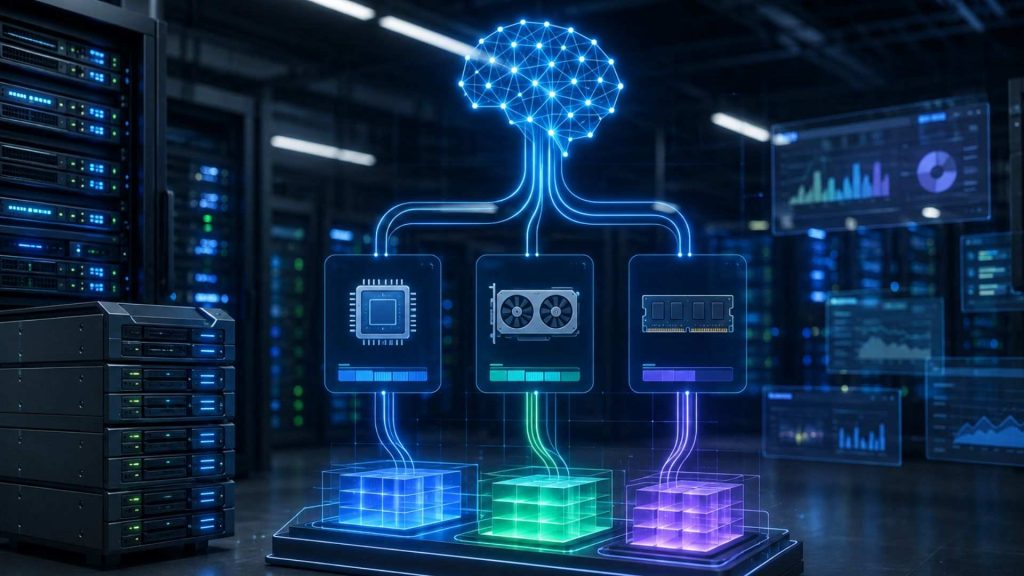
AI dynamically allocates computing resources for optimal performance
3.3 Workflow coordination
Modern AI applications rely on AI models, data pipelines, API integration, databases, and enterprise systems working together within a unified workflow. AI orchestration coordinates these interconnected components by determining execution order, routing tasks to the appropriate services, and maintaining context throughout the process. With seamless API integration across every stage of the workflow, organizations can reduce system complexity, eliminate manual handoffs, and ensure AI applications operate reliably and consistently in production environments.
3.4 Monitoring and optimization
Maintaining AI applications in production requires continuous visibility into workflow execution and system performance. AI orchestration monitors model performance, resource utilization, workflow health, and operational metrics throughout the AI lifecycle. When performance issues or failures occur, orchestration platforms can automatically trigger alerts, retry failed tasks, redistribute workloads, or deploy updated models to minimize service disruption. These monitoring and optimization capabilities help organizations improve system reliability, optimize AI workloads, and maintain consistent performance as production environments evolve.
3.5 Context management
AI applications often involve multiple AI models, external data sources, user interactions, and business rules that must remain consistent throughout a workflow. AI orchestration manages this context by maintaining conversation history, workflow states, user preferences, and application metadata across every execution step. By ensuring each model and service receives the appropriate contextual information, context management improves response accuracy, supports multi-step reasoning, and enhances the overall reliability of AI applications in production.
3.6 Routing
AI orchestration intelligently routes requests to the most appropriate AI models, services, or infrastructure based on workload characteristics, model capabilities, latency requirements, and resource availability. Rather than processing every request through the same model, orchestration platforms automatically select the optimal execution path to balance performance, cost, and scalability. This intelligent routing improves resource utilization, maintains consistent response quality, and enables AI applications to adapt efficiently to changing workloads.
3.7 Failure recovery
AI orchestration strengthens system resilience by automatically detecting failures and initiating predefined recovery actions when services, models, or infrastructure components become unavailable. Depending on the type of failure, orchestration platforms can retry failed tasks, redirect requests to backup resources, restart workflows, or switch to alternative AI models without manual intervention. These automated recovery capabilities minimize downtime, improve service reliability, and help maintain uninterrupted AI operations in production.
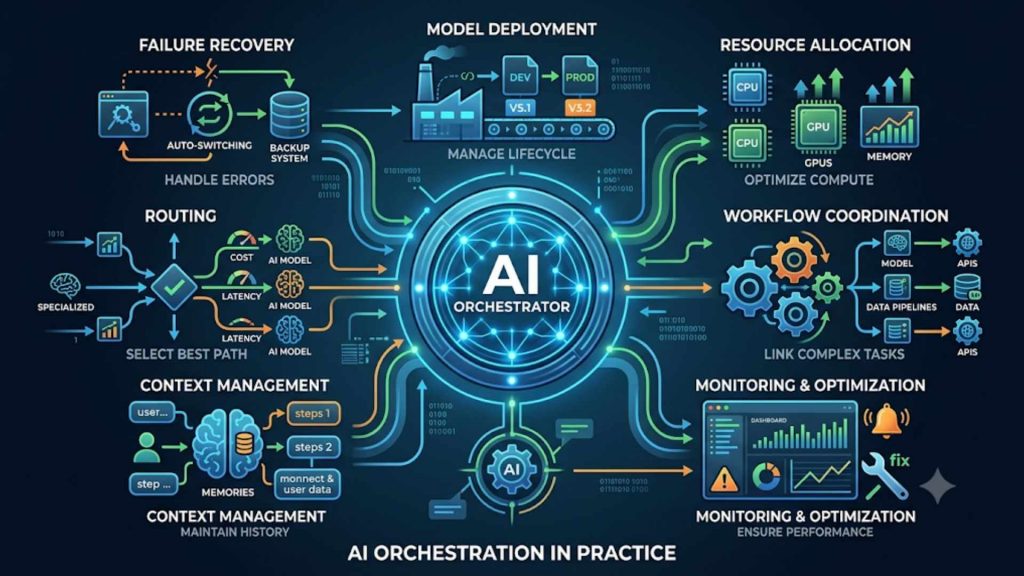
Core Architectural Capabilities Driving Scalable, Resilient, and Dynamic AI Orchestration
4. AI Orchestration vs Model Serving vs MLOps, and AI Agents
Although AI orchestration, Model Serving, MLOps, and AI Agents are all essential components of modern AI systems, they address different challenges within the AI lifecycle. AI orchestration focuses on coordinating end-to-end AI workflows across multiple models, services, and enterprise systems, while the other technologies specialize in different aspects of AI development, deployment, and execution.
| Criteria | AI Orchestration | Model Serving | MLOps | AI Agents |
| Primary purpose | Coordinate and automate end-to-end AI workflows across multiple systems and services. | Deploy AI models and provide inference endpoints for applications. | Standardize and automate the AI model lifecycle, from development to monitoring. | Execute tasks autonomously by reasoning, planning, and interacting with tools or environments. |
| Scope | Covers the complete AI workflow, including data ingestion, preprocessing, model execution, business logic, API integration, and monitoring. | Focuses on model deployment, inference execution, and runtime optimization. | Covers model development, training, testing, deployment, monitoring, and governance. | Focuses on autonomous decision-making, tool use, memory, and multi-step task execution. |
| Core capabilities | Workflow orchestration, task scheduling, model chaining, routing, context management, retries, monitoring, and API integration. | Model deployment, version management, traffic routing, autoscaling, and inference optimization. | CI/CD pipelines, experiment tracking, model registry, monitoring, governance, and automated retraining. | Planning, reasoning, memory management, tool calling, task decomposition, and autonomous execution. |
| Infrastructure focus | Coordinates communication between AI models, databases, APIs, message queues, and enterprise applications. | Optimizes GPUs, CPUs, TPUs, memory allocation, latency, and inference throughput. | Manages AI development pipelines, infrastructure automation, and model lifecycle management. | Integrates LLMs, external tools, APIs, databases, and orchestration frameworks to complete tasks. |
| Typical use case | Google Vertex AI Pipelines automates data preparation, model training, deployment, and monitoring across the ML workflow. | Spotify serves recommendation models in real time to generate personalized music suggestions with low latency. | Netflix automates model training, validation, deployment, and monitoring through its Metaflow ML platform to continuously improve production machine learning models. | Salesforce Agentforce enables AI agents to autonomously handle customer support by retrieving enterprise knowledge, interacting with business systems through APIs, and escalating complex cases when required. |
5. AI Orchestration Use Cases
AI orchestration is already being used across industries to coordinate increasingly sophisticated AI applications. Rather than supporting a single model, orchestration platforms enable multiple AI services to collaborate efficiently, making enterprise AI more reliable and scalable. Below are some of the most common real-world applications.
5.1 Enterprise AI assistants
Enterprise AI assistants often rely on multiple components beyond a single large language model (LLM). Retrieval-Augmented Generation (RAG) is a common architecture that combines enterprise data retrieval, embedding generation, vector database search, LLM inference, and security or compliance checks within a single request. AI orchestration coordinates these services automatically, ensuring each component executes in the correct sequence while maintaining low latency, reliable performance, and seamless end-to-end workflows for production AI applications.
Morgan Stanley deployed AI @ Morgan Stanley Assistant to help financial advisors search internal research and knowledge. The assistant orchestrates retrieval, search, and AI generation across more than 100,000 internal documents, enabling advisors to access trusted information within seconds. By mid-2024, over 98% of advisor teams were actively using the assistant, while document accessibility increased from 20% to 80%, significantly reducing search time and improving advisor productivity.

Morgan Stanley uses AI orchestration to streamline enterprise knowledge retrieval for financial advisors
5.2 Generative AI applications
Generative AI applications for text, image, audio, or video generation frequently combine foundation models with supporting services such as prompt management, content moderation, caching, and model routing. AI orchestration manages these interconnected workflows, enabling applications to switch between models, allocate compute resources efficiently, and maintain consistent performance as user demand fluctuates.
Adobe Firefly powers generative AI features across Photoshop, Illustrator, Express, and other Creative Cloud applications. Rather than relying on a single model, Firefly orchestrates multiple AI services for image generation, generative fill, text effects, and editing workflows. Since its launch, users have generated more than 22 billion assets with Firefly, demonstrating the need for AI orchestration to manage model execution and deliver consistent performance at global scale.
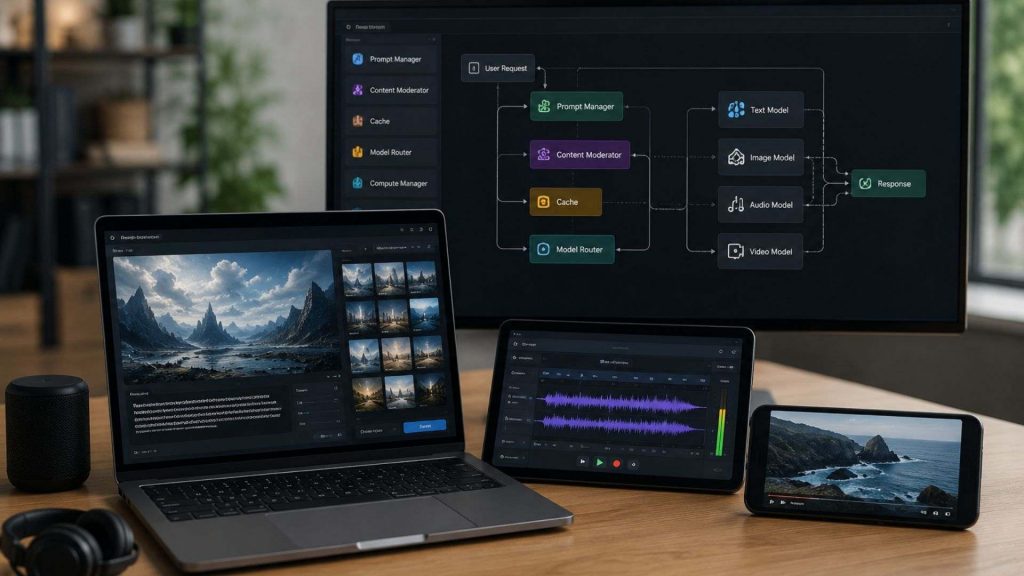
AI orchestration seamlessly coordinates models and services for reliable, scalable generative AI workflows
5.3 Multi-model AI systems
Many enterprise AI solutions combine multiple specialized models instead of relying on a single model. This approach is increasingly reflected in multi-agent AI systems, where specialized agents work together to complete complex business tasks by integrating capabilities such as computer vision, speech recognition, natural language processing, and recommendation. AI orchestration coordinates communication between these agents, synchronizes data flow, and ensures outputs from one stage are seamlessly passed to the next for consistent production performance.
Waymo’s autonomous driving system combines multiple AI models for perception, object detection, motion prediction, and path planning to make real-time driving decisions. These models continuously exchange information throughout the driving pipeline, requiring coordinated execution to ensure safe and accurate vehicle behavior. AI orchestration enables these interconnected AI workflows to operate efficiently while meeting strict real-time performance requirements.
5.4 Large-scale AI deployment
Organizations operating AI across multiple teams, cloud environments, or geographic regions require centralized management to maintain reliability and consistency. AI orchestration automates deployment, workload scheduling, resource allocation, monitoring, and model updates across distributed infrastructure. This enables organizations to scale production AI efficiently while maintaining operational visibility and governance.
Uber’s Michelangelo machine learning platform centralizes AI deployment and lifecycle management across the organization. It orchestrates data preparation, model training, deployment, monitoring, and retraining within a unified platform, supporting production use cases such as ETA prediction, fraud detection, restaurant ranking, and demand forecasting. By standardizing AI deployment workflows across engineering teams, Michelangelo enables Uber to deploy and operate AI applications more efficiently at enterprise scale.
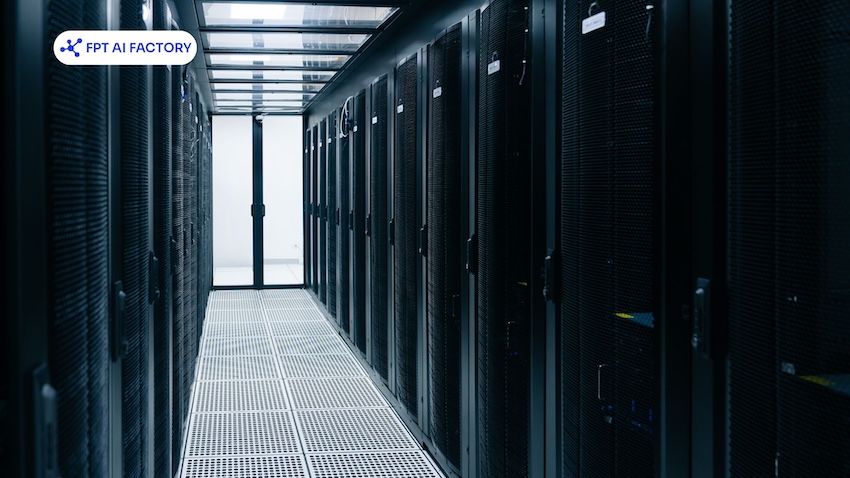
Scalable infrastructure powering AI orchestration in production
6. Choosing an AI Orchestration Platform
Selecting the right AI orchestration platform is essential for deploying reliable and scalable AI applications in production. As AI workloads become increasingly complex, organizations need platforms that not only coordinate AI workflows but also integrate with existing infrastructure, optimize resource utilization, and simplify operational management. When comparing different solutions, the following capabilities are among the most important evaluation criteria.
6.1 Multi-model support
Modern AI applications rarely depend on a single model. Instead, they often combine large language models (LLMs), computer vision models, speech recognition systems, recommendation engines, and embedding models within the same workflow. An AI orchestration platform should support multiple AI models and inference frameworks while enabling them to communicate efficiently throughout the pipeline. This flexibility allows organizations to adopt the most suitable model for each task, simplify future upgrades, and build more adaptable AI applications.
6.2 API integration
AI applications must interact with enterprise software, databases, cloud services, vector databases, and external APIs to deliver end-to-end business workflows. A robust orchestration platform should provide seamless integration with these systems through standardized APIs and cloud-native technologies. Strong integration capabilities reduce development effort, streamline deployment, and ensure AI applications can exchange data efficiently across existing business environments.
6.3 GPU scalability
Production AI workloads often fluctuate as user demand changes. An effective orchestration platform should automatically allocate GPU resources, schedule workloads, and scale inference capacity according to real-time requirements. Dynamic GPU scaling improves infrastructure utilization, maintains low latency during peak traffic, and enables organizations to expand AI services without excessive hardware provisioning or unnecessary operational costs.
6.4 Monitoring
Continuous monitoring is essential for maintaining reliable AI applications in production. AI orchestration platforms should provide visibility into workflow execution, model performance, GPU utilization, latency, throughput, and overall system health. Built-in logging, dashboards, and automated alerts help engineering teams quickly detect issues, troubleshoot failures, and optimize AI operations before performance problems affect end users.
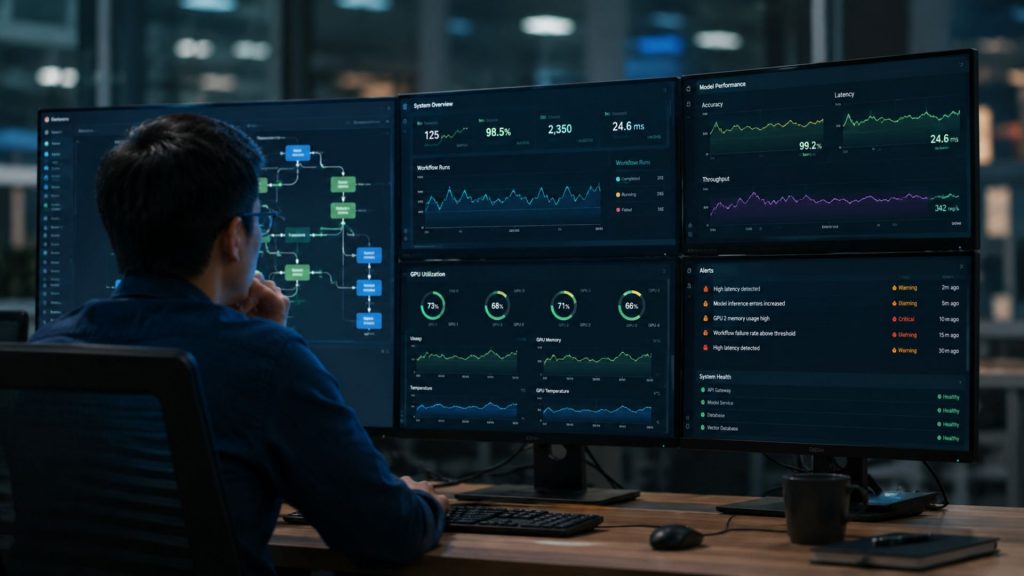
Real-time monitoring keeps AI systems healthy, efficient, and reliable
6.5 Security
Enterprise AI systems frequently process sensitive business information and proprietary AI models. A suitable orchestration platform should include enterprise-grade security features such as authentication, role-based access control (RBAC), encryption, audit logging, and policy enforcement. These capabilities help organizations protect critical assets, maintain compliance with security requirements, and safely manage AI workloads across development and production environments.
6.6 Cost optimization
As AI adoption grows, infrastructure costs can increase significantly, especially for GPU-intensive workloads. AI orchestration platforms should optimize resource utilization through intelligent workload scheduling, automatic scaling, efficient GPU allocation, and model routing. These capabilities help reduce idle resources, improve hardware efficiency, and lower cloud computing expenses while maintaining consistent performance for production AI applications.
7. Challenges Without AI Orchestration
As organizations move AI from experimentation to production, managing AI systems becomes increasingly complex. Without AI orchestration, teams must manually coordinate models, infrastructure, and operational processes, making deployments harder to scale and maintain. These challenges not only increase operational costs but also reduce the reliability and efficiency of production AI applications.
7.1. Difficult model management
As the number of AI models grows, managing model versions, deployment environments, dependencies, and updates becomes increasingly difficult. Without orchestration, engineering teams often rely on manual deployment processes, making it harder to maintain consistency across development, testing, and production environments. This increases the risk of configuration errors, deployment failures, and longer release cycles.
7.2. Poor resource utilization
AI inference workloads rarely remain constant. Traffic spikes, idle periods, and changing workload patterns can leave GPU resources either overloaded or underutilized. Without AI orchestration, organizations often provision dedicated GPU infrastructure for peak demand, resulting in higher costs and lower resource efficiency. By optimizing resource allocation according to real-time demand, AI orchestration helps organizations control Cloud GPU pricing expenses, maximize GPU utilization, and reduce unnecessary infrastructure spending.
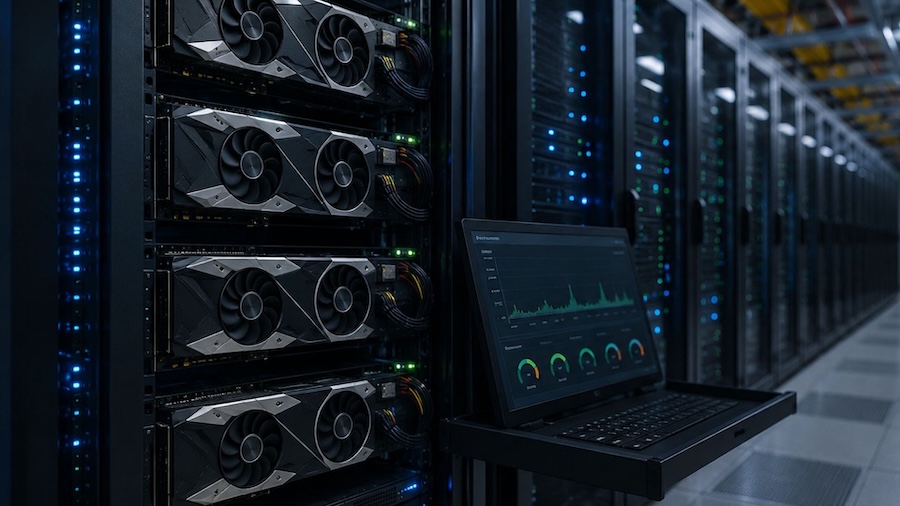
AI orchestration optimizes GPU resources based on real-time workload demand
7.3. Scaling problems
Scaling AI applications requires more than adding additional compute resources. Organizations must distribute inference requests, balance workloads across available GPUs, and provision capacity dynamically as demand changes. Without orchestration, scaling becomes a manual process that increases latency, reduces system reliability, and limits the ability to support growing production workloads.
7.4. Complex AI operations
Production AI systems require continuous monitoring, failure recovery, workload scheduling, model updates, and infrastructure management. Performing these operational tasks manually quickly becomes unsustainable as AI deployments expand. AI orchestration centralizes these responsibilities, automating routine operations while improving system visibility and operational consistency.
Serverless Inference further simplifies production AI by automatically provisioning compute resources only when inference requests arrive. Instead of managing GPU infrastructure manually, organizations can deploy AI models into real-world applications while the platform dynamically scales resources, optimizes utilization, maintains low latency, and reduces operational overhead.
8. Future of AI Orchestration
As AI applications continue to evolve, AI orchestration is expanding beyond workflow automation to become the intelligence layer that coordinates increasingly autonomous AI systems. Emerging technologies such as AI agents, dynamic model selection, and hybrid infrastructure are reshaping how organizations build and operate production AI. The following trends are expected to define the future of AI orchestration.
8.1 Multi-agent orchestration
Rather than relying on a single AI model, future AI applications will increasingly consist of multiple specialized AI agents working together to accomplish complex tasks. AI orchestration platforms will coordinate communication, task delegation, memory sharing, and execution across these agents, enabling more sophisticated and collaborative AI systems while maintaining reliability and efficiency.
8.2 Agentic AI
Agentic AI enables AI systems to reason, plan, and execute tasks with minimal human intervention. Instead of responding to individual prompts, AI agents can independently make decisions, call external tools, and complete multi-step objectives. AI orchestration provides the control layer that manages these autonomous agents, ensuring secure execution, workflow coordination, and governance across enterprise environments.
8.3 Autonomous workflows
Future AI platforms will automate entire business processes instead of isolated AI tasks. AI orchestration will coordinate data retrieval, model inference, API calls, decision-making, and workflow execution with minimal manual involvement. This shift toward autonomous workflows will enable organizations to improve operational efficiency while reducing repetitive engineering tasks.
8.4 AI Gateway and dynamic model routing
As organizations deploy multiple AI models, selecting the most appropriate model for each request becomes increasingly important. AI Gateway acts as a centralized entry point that manages authentication, security, rate limiting, and traffic control for AI services. Combined with dynamic model routing, orchestration platforms can automatically direct requests to the optimal model based on task complexity, latency, model capability, resource availability, or cost, improving both performance and infrastructure efficiency.
8.5 Model Context Protocol (MCP)
Model Context Protocol (MCP) is emerging as an open standard that enables AI models to securely access external tools, enterprise data, and business applications through a standardized interface. As MCP adoption grows, AI orchestration platforms will play a key role in managing context, coordinating tool execution, and governing interactions between AI models and external systems within complex enterprise workflows.
8.6 Hybrid cloud orchestration
Many organizations deploy AI workloads across on-premises infrastructure, private clouds, and public cloud providers to balance performance, compliance, and cost. Future AI orchestration platforms will provide unified management across these hybrid and multi-cloud environments, enabling intelligent workload scheduling, centralized monitoring, consistent governance, and seamless resource allocation regardless of where AI models are deployed.

AI orchestration is evolving into the intelligence layer for autonomous AI systems
AI orchestration is becoming an essential capability as organizations scale their AI initiatives beyond individual models and isolated use cases. By automating workflows, coordinating multiple AI services, and integrating with existing systems, AI orchestration helps teams build more reliable, efficient, and scalable AI applications.
With FPT AI Factory’s, businesses can evaluate AI models, validate predictions, and monitor performance before deployment while reducing operational complexity. For enterprises with customization or large-scale needs, please contact the FPT AI Factory team via the official contact form for dedicated support.
Contact Information:
- Hotline: 1900 638 399
- Email: support@fptcloud.com