

What is Open API? It refers to a concept that enables applications to securely expose and share data or functionality with external systems through standardized interfaces. This approach helps businesses improve integration speed, enhance scalability, and build connected digital ecosystems across industries. At FPT AI Factory, we explore what Open APIs are, how they work, their key benefits, common real-world examples, and the role they play in supporting modern AI and cloud-based applications.
1. What Is an Open API?
An Open API is an application programming interface that allows external applications, developers, or organizations to access selected data, services, or functionality through standardized communication protocols. Instead of providing direct access to internal databases, infrastructure, or source code, an Open API exposes specific capabilities through defined endpoints that authorized users can consume securely.
Organizations use Open APIs to extend the reach of their platforms beyond internal environments. By making selected services available to external users, businesses can support third-party integrations, automate cross-platform workflows, enable ecosystem growth, and accelerate digital innovation. Open APIs are commonly referred to as Public APIs because they are designed to be consumed by external developers, applications, or business partners under controlled access policies.
1.1 Open API vs OpenAPI Specification
The terms Open API and OpenAPI Specification (OAS) are frequently confused because of their similar names. However, they refer to two different concepts. An Open API describes an API that external users can access, while OpenAPI Specification is a standardized format used to describe and document how an API works. Understanding this distinction helps avoid confusion when evaluating API technologies and integration approaches.
| Criteria | Open API | OpenAPI Specification (OAS) |
| Definition | A publicly accessible API that external applications can use | An open standard used to describe and document HTTP APIs |
| Purpose | Enable data exchange and service integration between systems | Define API endpoints, parameters, authentication methods, and responses in a standardized format |
| Focus | API accessibility and connectivity | API design, documentation, and standardization |
| Primary users | Developers, partners, customers, and third-party applications | API designers, developers, architects, and platform teams |
| Example | Google Maps API, Stripe API, OpenAI API | An OpenAPI document written in YAML or JSON |
OpenAPI Specification is a vendor-neutral standard that provides a structured way to describe how an API operates. It defines elements such as available endpoints, request parameters, authentication requirements, response formats, and error handling rules in both machine-readable and human-readable formats. These specifications are typically written in YAML or JSON and can be used to automatically generate documentation, SDKs, testing tools, and other development resources.
Although many Open APIs are documented using the OpenAPI Specification, the two concepts are not interchangeable. An Open API refers to the actual service that applications can access, whereas OpenAPI Specification is the framework used to describe and document that service consistently.

Open APIs enable secure and seamless communication between different systems and applications
1.2 Why Are Open APIs Important?
Open APIs have become a key enabler of digital transformation by allowing applications, platforms, and services to connect through standardized interfaces. They help organizations build more flexible technology ecosystems while accelerating innovation and improving operational efficiency.
- Accelerate innovation and development: Open APIs allow developers to leverage existing services and functionality instead of building every component from scratch, helping reduce development time and speed up product delivery.
- Improve interoperability across systems: By providing standardized communication methods, Open APIs enable applications built on different technologies to exchange data and work together more effectively.
- Support automation and operational efficiency: Organizations can connect business applications and cloud services to automate workflows, reduce manual processes, and improve data consistency across systems.
- Expand digital ecosystems: Open APIs make it easier for partners, customers, and third-party developers to build integrations and complementary solutions that extend the value of a platform.
- Increase technology flexibility: Standardized APIs help organizations integrate with multiple vendors and services, reducing dependency on proprietary technologies and supporting long-term scalability.
- Enable AI and cloud-based innovation: Many modern AI, analytics, and cloud services are delivered through APIs, allowing businesses to adopt advanced capabilities without managing complex underlying infrastructure.
2. How Does an Open API Work?
An Open API works through a request-and-response model where client applications send requests to a server through defined endpoints. The server processes the request and returns structured data, typically in formats such as JSON or XML.
2.1 API requests and responses
Interaction with an API begins when a client application sends a request to the server to perform a specific action or retrieve data. This request is transmitted using HTTP-based methods such as GET or POST and may include headers for context and a payload containing input data. Once the server receives the request, it processes the operation and generates a response that includes a status code along with the requested results, often delivered in JSON format to simplify integration and communication between different systems.
2.2 API endpoints
Endpoints represent the defined entry points through which an API can be accessed. Each endpoint corresponds to a specific function or dataset within the system and is identified by a unique URL path. By separating functionalities into multiple endpoints, APIs ensure that external systems can interact with precise resources in a predictable and organized manner without ambiguity in data access.
2.3 API keys and authentication
Open APIs use authentication methods such as API keys and token-based credentials to verify users and manage access control. API keys are usually linked to specific applications, allowing systems to monitor and validate API usage. More secure implementations often adopt token-based frameworks like OAuth, which grant temporary and permission-specific access while reducing the risk of credential exposure.
2.4 API documentation
API documentation explains how developers can use and integrate an API. It typically includes available endpoints, required parameters, authentication methods, request formats, response structures, and common error codes. Many modern APIs also provide interactive documentation that allows developers to test requests before implementation.
2.5. Rate limiting and access control
To maintain system stability and prevent abuse, Open APIs often apply rate limiting to control how many requests a client can send within a certain period. Access control mechanisms are also used to ensure that only authorized users or applications can access specific API resources.
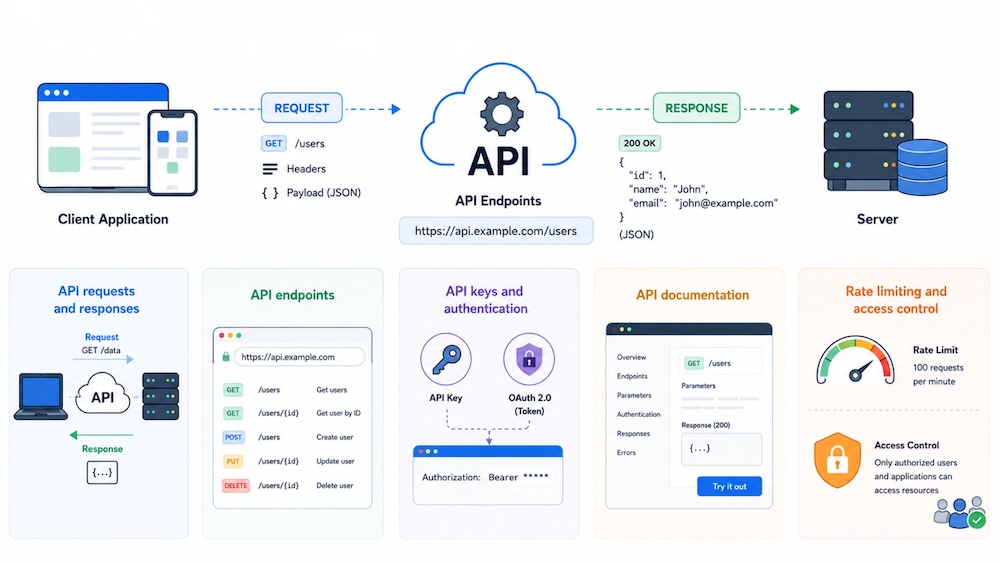
API integration and data communication process
3. Key components of an Open API
An Open API ecosystem is built on multiple foundational components that work together to expose, secure, manage, and observe API interactions at scale. These layers ensure that APIs can be consumed reliably by external systems while maintaining governance, performance, and security standards across the entire lifecycle.
3.1. API Gateway
An API Gateway serves as the centralized entry layer for all incoming API requests. Its primary function is to direct requests to the correct backend services, but it also manages additional tasks such as request validation, authentication handling, rate limiting, and data transformation when required. In more complex architectures, it can also aggregate responses from multiple services into a single output for the client, improving efficiency and reducing client-side complexity.
3.2. API Management
API Management represents the full platform layer used to control and govern APIs throughout their lifecycle. It covers API design, publishing, version control, policy enforcement, and retirement. In enterprise environments, it also supports developer onboarding, usage control, and sometimes monetization of APIs. This layer ensures APIs remain consistent, reusable, and compliant with organizational standards as they scale across multiple teams and products.
3.3. Developer Portal
A Developer Portal is a dedicated interface that provides developers with access to API documentation, onboarding guides, authentication details, and testing tools. It allows users to discover available APIs, understand integration requirements, and validate API behavior before full implementation. This improves adoption speed and reduces friction in integrating external systems.
3.4. Authentication and security controls
This component is responsible for validating user identities and controlling authorization rules that determine access permissions for API consumers. Common methods include API keys, OAuth-based token systems, and role-based access control. These mechanisms ensure that only authorized applications or users can access specific endpoints, while also enabling fine-grained permission control based on usage context.

Advanced security controls for safe and authorized system access
3.5. API monitoring and analytics
API monitoring and analytics provide continuous visibility into API performance, request behavior, and system usage patterns across distributed data infrastructure environments. This includes tracking metrics such as request volume, latency, error rates, and throughput. In more advanced setups, it may also include SLA tracking, anomaly detection, and operational insights that help teams optimize infrastructure, detect issues early, and plan capacity scaling effectively.
4. Open API Examples
Open APIs are used across a wide range of industries to enable applications, platforms, and services to exchange data and functionality in a standardized way. They help organizations accelerate integration, expand digital ecosystems, and create new user experiences without requiring direct access to underlying systems. The following examples illustrate some of the most common categories of Open APIs used today.
4.1 Payment APIs
Payment APIs enable businesses to seamlessly integrate secure transaction processing capabilities into their websites or applications without building a financial infrastructure from scratch. By connecting to global payment gateways, these APIs handle authorization, currency conversion, and fraud detection, ensuring a smooth and compliant checkout experience for users.
Example: When a customer buys a shirt on an e-commerce website and selects “Pay with PayPal,” the PayPal API securely transfers the payment request from the store to PayPal. PayPal processes the transaction and instantly sends a “Payment Successful” signal back to the website to confirm the order, without the store ever seeing the customer’s credit card details.

Enabling smooth transactions through secure payment APIs
4.2 Map and location APIs
Map and location APIs allow developers to embed interactive maps, geocoding services, and real-time navigation features directly into their digital platforms. These interfaces help enterprises leverage spatial data to calculate distances, optimize delivery routes, and provide location-based search capabilities for physical stores.
Example: When you open a ride-hailing app like Uber and enter your destination, the app calls the Google Maps API to calculate the exact distance, plot the fastest driving route on the screen, and estimate your arrival time based on live traffic data.
4.3 Social media APIs
Social media APIs allow third-party applications to interact with social networks, enabling functionalities such as user authentication, automated content publishing, and social data analytics. Businesses leverage these APIs to streamline registration processes via social logins and monitor brand mentions across various platforms.
Example: When you create an account on a new fitness app and click “Log in with Facebook,” the app uses Meta’s API to verify your identity. Facebook safely shares your name and profile picture with the app, allowing you to sign up instantly without filling out a long registration form.
4.4 Open banking APIs
Open banking APIs enable authorized third-party financial platforms to securely access banking, transaction, and other financial information from banks with user consent. Supported by financial regulations in many countries, these APIs encourage fintech innovation by enabling services such as account aggregation, automated budgeting, credit assessment, and digital financial management.
For example, personal finance applications such as Money Lover can connect securely to a user’s bank account through open banking APIs. This allows the app to automatically retrieve transaction records and organize expenses into categories like shopping or dining without requiring users to manually log into their banking platform each time.
4.5 AI and machine learning APIs
AI and machine learning APIs provide developers with access to pre-trained models and intelligent services through standardized interfaces, allowing organizations to add AI capabilities to applications without building, training, or maintaining machine learning models from scratch. These APIs support a wide range of functions, including image recognition, speech processing, optical character recognition (OCR), sentiment analysis, recommendation systems, predictive analytics, anomaly detection, and natural language processing.
By making advanced AI services available through API endpoints, these solutions help reduce development complexity and accelerate deployment. Popular examples include Google Cloud Vision API, Amazon Rekognition, Azure AI Services, and other machine learning platforms that expose AI functionality for enterprise and consumer applications.
Example: When a logistics company scans a damaged or blurry shipping label with a smartphone, the scanning app sends the image to the Google Cloud Vision API. The API analyzes the image, extracts the text (names, addresses, tracking numbers), and inputs it automatically into the company’s database in seconds.
4.6. Generative AI APIs
Generative AI APIs enable applications to access large language models and foundation models that can generate text, code, images, summaries, translations, and conversational responses. By exposing these capabilities through standardized API endpoints, organizations can integrate advanced content generation features into their products without developing and maintaining AI models from scratch.
These APIs are widely used in AI assistants, enterprise copilots, customer support automation, content creation platforms, coding tools, and knowledge management systems. Popular examples include the OpenAI API, Anthropic API, and Gemini API, which provide developers with scalable access to state-of-the-art generative AI models for a wide range of business and consumer applications.
Example: When a customer types a complex complaint into a company’s website chatbot, the chatbot sends the text to OpenAI’s GPT-4 API. The API analyzes the customer’s frustration, generates a polite, human-like, and highly accurate solution within two seconds, and sends it back to the chatbot to reply to the user.
4.7 Cloud and Enterprise APIs
Cloud and enterprise APIs allow organizations to manage infrastructure resources, automate operational workflows, and connect business applications across different environments. These APIs play a critical role in cloud computing, DevOps, enterprise software integration, and large-scale digital transformation initiatives.
Cloud infrastructure APIs provide programmatic access to computing, storage, networking, and container orchestration services, while enterprise APIs enable data exchange between business systems such as CRM, ERP, finance, and supply chain platforms.
Popular examples include:
- AWS S3 API for storing, retrieving, and managing files in cloud storage environments.
- Kubernetes API for deploying, scaling, monitoring, and managing containerized workloads.
- Salesforce API for connecting customer relationship management (CRM) data and business workflows.
- SAP API for integrating enterprise resource planning (ERP), finance, procurement, inventory, and supply chain processes.
Example: A retail company integrates Salesforce and SAP through their APIs to synchronize customer information, sales records, and inventory data automatically. This enables sales, operations, and finance teams to work with consistent information across multiple business systems while reducing manual data entry and operational errors.
5. Benefits of Open APIs
Open APIs help organizations connect systems more efficiently, simplify external integration, and accelerate application development across cloud and enterprise environments. Below are some of the most important benefits businesses gain from adopting Open APIs.
- Faster third-party integration: Standardized API structures make it easier for external applications and services to connect without major backend modifications.
- Easier workflow automation: APIs allow platforms, databases, and business tools to exchange data automatically, reducing manual processing across operations.
- Better developer experience: Well-structured documentation, predictable endpoints, and consistent authentication flows simplify implementation, testing, and maintenance.
- Stronger product ecosystem: Public APIs enable partners and external developers to build additional services, integrations, and extensions around a core platform.
- Faster AI application development: APIs provide direct access to AI models and computing resources, helping teams deploy intelligent features without building infrastructure from the ground up.
A practical implementation of this concept can be seen in Serverless Inference, which enables developers to run and deploy AI models without directly managing the underlying infrastructure. As a result, teams can reduce operational complexity and focus more on application logic and product delivery speed.

Open APIs accelerate integration, automation, and innovation across modern digital ecosystems
6. Comparison between Open API vs Private API vs Partner API
To understand how APIs shape modern software architecture, it is essential to compare the three primary types based on who can access them and how they are secured.
| Criteria | Open API | Private API | Partner API |
| Accessibility | Available to external developers and third-party applications with controlled exposure | Restricted to internal systems and not exposed outside the organization | Shared only with selected and approved business partners |
| Intended users | External developers, public platforms, and ecosystem contributors | Internal engineering teams, DevOps, and enterprise employees | Strategic partners, B2B clients, and trusted external organizations |
| Security level | Moderate to high security using mechanisms such as API keys, OAuth, and rate limiting | Very high security within internal networks and controlled infrastructure environments | High security with contractual agreements and tightly controlled access policies |
| Integration scope | Broad and scalable integration across public ecosystems and external platforms | Internal system integration across services, databases, and applications | Limited, structured integration between specific organizations or business entities |
| Common use cases | Public platform expansion, third-party application development, and ecosystem building | Internal workflows, backend service communication, and enterprise system integration | Business-to-business data exchange, partner collaboration, and joint service operations |
| Examples | Google Maps API used by food delivery apps; OpenAI API used by AI chatbots. | An internal API that connects a bank’s mobile banking app to its main customer database. | Amazon Merchant API allowing verified e-commerce sellers to sync their inventory with Amazon warehouses. |
7. Open API Security and Governance
Open API security and governance refer to the policies, technologies, and operational practices used to protect APIs throughout their lifecycle. Because Open APIs are accessible to external developers, partners, and applications, they are exposed to a broader range of security threats than internal-only systems. Common risks include API abuse, Distributed Denial of Service (DDoS) attacks, broken authentication, credential theft, excessive data exposure, unauthorized access, and insecure API configurations.
To mitigate these risks, organizations implement multiple layers of protection that combine authentication, authorization, encryption, traffic management, monitoring, and governance processes. Together, these measures help ensure that APIs remain secure, reliable, compliant, and manageable while supporting integrations across internal and external ecosystems.
7.1. Authentication and authorization
Authentication is the process of verifying the identity of a user, application, or service attempting to access an API, while authorization determines what resources and actions are permitted after identity has been confirmed. Together, these mechanisms help ensure that only trusted entities can access API resources and that permissions are granted according to predefined security policies.
Modern Open APIs commonly use OAuth 2.0 as a standardized framework for delegated authorization. OAuth 2.0 enables applications to access resources on behalf of users without exposing user credentials directly. Many organizations also implement Role-Based Access Control (RBAC), which assigns permissions based on predefined roles to reduce the risk of unauthorized access and excessive privileges.
7.2. API keys and tokens
API keys and tokens are among the most widely used mechanisms for controlling API access. API keys help identify applications making requests and allow organizations to track usage, enforce quotas, and manage access policies. While API keys are relatively simple to implement, they are often combined with more advanced authentication mechanisms to improve security.
Token-based authentication provides stronger protection by granting temporary and permission-based access. JSON Web Tokens (JWTs) are commonly used because they can securely carry authentication and authorization information in a compact, digitally signed format. When used alongside OAuth 2.0, JWTs help organizations build scalable authentication systems while reducing the risks associated with long-lived credentials.
Secure API communication typically relies on HTTPS with TLS encryption, which protects data transmitted between clients and servers from interception, tampering, and unauthorized access. Organizations should also carefully control the information returned in API responses, as excessive data exposure can unintentionally reveal sensitive customer, business, or system data even when authentication mechanisms are implemented correctly.
7.3. Rate limiting and throttling
Rate limiting controls how many API requests a client can send within a defined period, while throttling regulates the flow of traffic to prevent sudden spikes from overwhelming backend services. These controls help maintain service availability, preserve system performance, and ensure fair resource allocation among API consumers.
Beyond performance management, rate limiting and throttling play an important role in API security. They help defend against API abuse, brute-force attacks, credential-stuffing attempts, and traffic surges associated with DDoS attacks. Many organizations enforce these controls through an API Gateway, which serves as a centralized layer for request validation, authentication checks, traffic management, and policy enforcement.
7.4. Monitoring and analytics
Monitoring and analytics provide continuous visibility into API performance, reliability, and security. Organizations track metrics such as request volume, response latency, throughput, error rates, and resource consumption to identify operational issues and optimize system performance.
From a security perspective, monitoring systems can detect unusual behavior such as repeated authentication failures, abnormal traffic patterns, suspicious request volumes, or attempts to access restricted resources. By identifying these anomalies early, organizations can respond more quickly to potential threats, reduce downtime, strengthen incident response capabilities, and improve overall API resilience.
7.5. API versioning and lifecycle management
API versioning allows organizations to introduce updates, enhancements, and security improvements without disrupting existing integrations. By supporting multiple API versions simultaneously, businesses can maintain backward compatibility while providing a controlled migration path for developers and partners.
Lifecycle management extends beyond version control and covers the entire API journey, including design, testing, deployment, documentation, maintenance, security reviews, compliance validation, deprecation, and retirement. Effective governance helps ensure that APIs remain secure, well-documented, and aligned with organizational standards throughout their operational lifespan. It also supports consistency across API portfolios, reduces technical debt, and enables long-term scalability as business and technology requirements evolve.
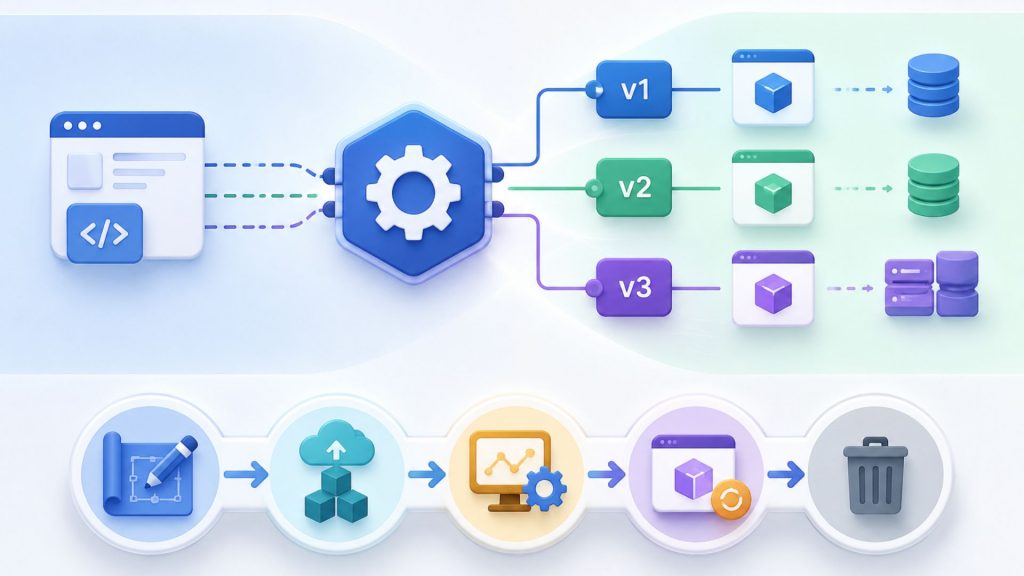
Ensuring Stable Integrations with API Versioning and Lifecycle Control
8. When Should Businesses Use Open APIs?
Open APIs are most valuable when organizations aim to expand connectivity, improve automation, or build scalable digital ecosystems. They are particularly effective in scenarios where systems need to interact in real time, integrate across platforms, or support external innovation.
8.1 Partner and vendor integrations
Businesses should adopt Open APIs when they need to establish efficient and structured collaboration with external partners or vendors. Instead of relying on manual processes or fragmented legacy integration methods, Open APIs enable real-time system-to-system communication. This allows organizations to synchronize operational data, manage supply chain activities, and process transactions such as invoicing in a faster and more automated way, reducing delays and operational overhead.
8.2 Customer-facing developer platforms
Open APIs become essential when companies aim to transform their products into scalable platforms rather than standalone applications. By exposing APIs through developer portals, organizations allow external developers and partners to build custom applications, extensions, or integrations on top of their core services. This approach helps expand ecosystem reach, encourage innovation from third parties, and strengthen long-term user and developer engagement.
8.3 Internal workflow automation
Although Open APIs are often associated with external access, they are also widely used within enterprises to connect internal systems and reduce operational fragmentation. They enable seamless communication between tools such as CRM, ERP, and cloud-based applications, helping eliminate data silos. As a result, organizations can automate repetitive workflows, reduce manual intervention, and improve overall operational consistency and efficiency.
8.4 AI, cloud, and data-driven applications
Open APIs play an important role in modern AI infrastructure by enabling scalable communication between cloud services, GPU computing resources, and real-time data-driven applications. They allow applications to integrate directly with cloud infrastructure and AI services in a flexible and programmable way.
In practice, organizations can leverage these capabilities through GPU-based infrastructure services designed for different workload needs.
- GPU Container enables quick deployment of containerized GPU environments using pre-built AI/ML templates. It is ideal for model testing, experimentation, data science tasks, and lightweight development workflows.
- GPU Virtual Machine provides full control over GPU environments with root access, fast provisioning, and support for custom drivers and libraries. It is suitable for heavy workloads such as LLM training, fine-tuning, AI inference at scale, and high-performance computing tasks.

Scalable GPU power for AI training and inference
Understanding what is open API is essential for building modern digital systems that are scalable, flexible, and easy to integrate. Open APIs enable secure communication between applications, support seamless connectivity across internal and external systems, and accelerate the development of cloud and AI-driven solutions. This makes them a foundational element for businesses aiming to improve efficiency and drive faster innovation in today’s interconnected technology landscape.
For new users, FPT AI Factory offers a Starter Plan with $100 credits, allowing you to immediately explore GPU compute, AI workloads, and deployment services before scaling into production. For enterprise or organizational needs, customized solutions are available with dedicated support, enhanced security, and flexible infrastructure options. Contact FPT AI Factory now to get started.
Contact Information:
- Hotline: 1900 638 399
- Email: support@fptcloud.com
Explore Related Articles:
What Is API Integration? How It Works, Benefits and Examples
What Is an API? Types, Real-World Examples & Use Cases
What Is Edge AI? Examples, Benefits & Future Trends
Single Agent vs Multi Agent: Which AI System Is Better?