

What is AI ethics and why does it matter when enterprises build, deploy, and scale AI models? AI ethics defines the principles that help teams design systems that are fair, transparent, reliable, privacy-aware, and accountable. At FPT AI Factory, businesses can explore AI infrastructure and deployment workflows that support responsible AI from experimentation to production.
| Key takeaways: AI ethics helps organizations build AI systems that are useful, safe, transparent, and accountable. Here are the key points to remember:
|
Build and operate responsible AI workflows with FPT AI Factory. Teams can use AI Notebook, Model Testing, GPU Container, and Serverless Inference to experiment with models, evaluate outputs, and move AI applications toward production. For customized deployment or large-scale infrastructure needs, contact FPT AI Factory for project-based consultation.
1. What Is AI Ethics?
AI ethics is the set of principles, practices, and governance controls used to ensure artificial intelligence is developed and used in ways that respect people, reduce harm, and support trustworthy decisions. It covers how data is collected, how models are trained, how outputs are evaluated, and how AI systems are monitored after deployment.
In practical terms, AI ethics helps teams move beyond model accuracy alone. It asks whether an AI system is fair, explainable, privacy-aware, reliable, secure, and accountable in its real operating context. This is especially important when AI moves from experimentation to AI inference, where model outputs begin affecting users, business workflows, and operational decisions.
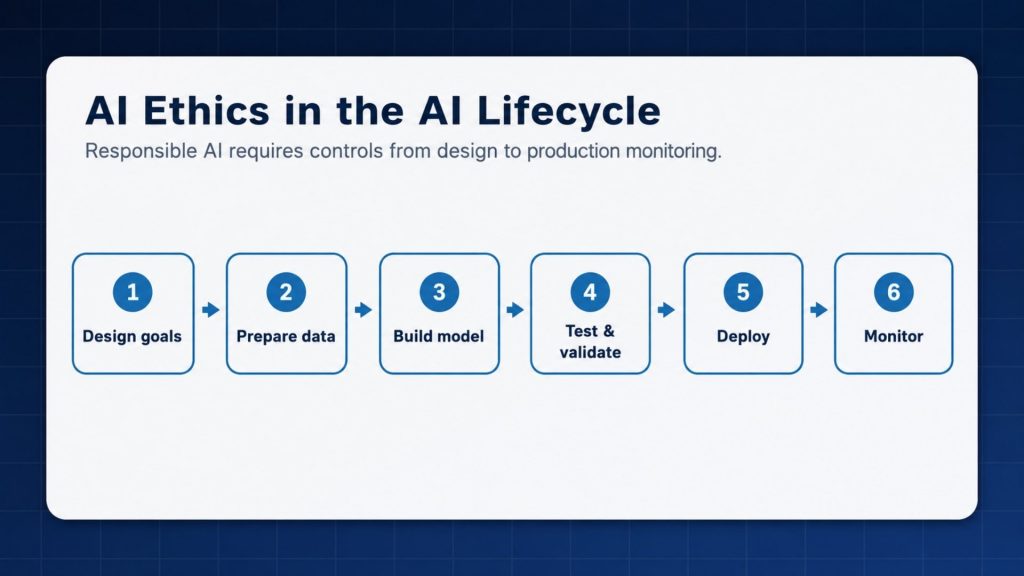
AI ethics connects model design, data governance, validation, deployment, and monitoring.
2. Why AI Ethics Matters?
AI ethics matters because AI systems can influence decisions at scale. A model used in hiring, lending, healthcare support, customer service, or fraud detection can affect thousands or millions of users. Without ethical safeguards, the same automation that improves speed can also amplify bias, privacy risks, or unreliable outputs.
Organizations also need AI ethics because public expectations and regulatory attention are increasing. The European Commission describes trustworthy AI as lawful, ethical, and robust throughout the system lifecycle, while NIST highlights characteristics such as reliability, safety, accountability, transparency, privacy, and fairness. These frameworks show that responsible AI is not only a technical issue, but also a governance and business risk issue.
For enterprises, ethical AI improves confidence across teams. Business leaders can evaluate risk more clearly, developers can test model behavior more consistently, and users can better understand how AI systems support decisions. After understanding why AI ethics matters, the next step is to examine the principles behind responsible AI models.
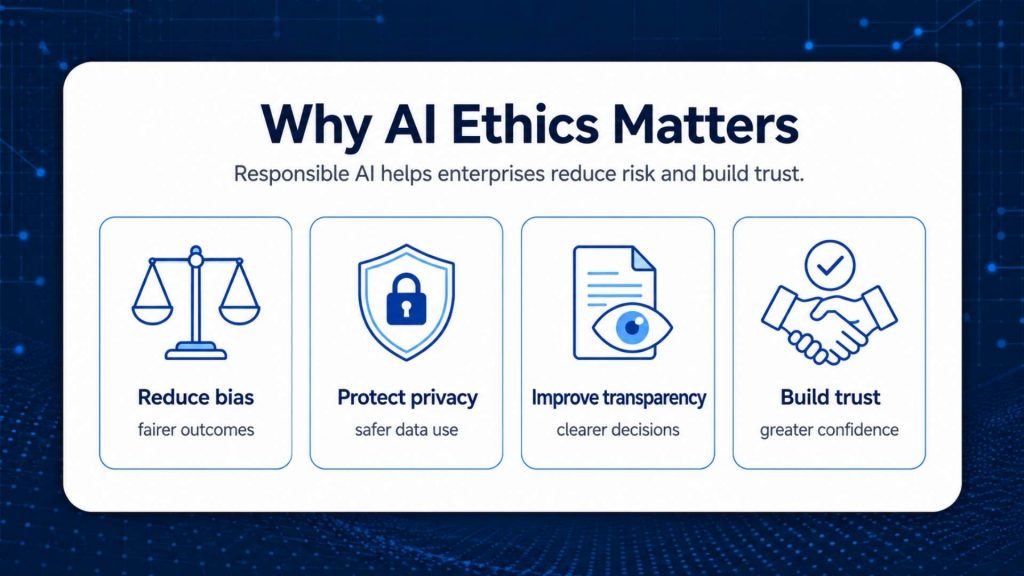
AI ethics helps enterprises reduce risk, protect users, and build trust in AI-supported decisions.
3. Foundational principles of AI ethics
Foundational AI ethics principles provide a human-centered starting point for responsible model development. They help organizations evaluate whether an AI system protects human agency, creates real benefits, avoids avoidable harm, distributes outcomes fairly, and can be explained when people need to understand or challenge its decisions.
3.1. Autonomy
Autonomy means people should retain meaningful control over decisions that affect them. In AI systems, this can involve human review, opt-out options, clear user consent, and workflows that prevent automation from replacing all human judgment in sensitive cases.
3.2. Beneficence
Beneficence means AI should create useful outcomes for people and organizations. A model should improve productivity, service quality, accessibility, or decision support rather than simply automate a process for its own sake. This principle encourages teams to define clear user benefits before deployment.
3.3. Non-maleficence
Non-maleficence focuses on avoiding harm. In AI projects, harm can include biased decisions, unsafe recommendations, privacy exposure, poor security, or overreliance on inaccurate model outputs. Teams should identify possible harms early and test models before they affect real users.
3.4. Justice
Justice requires AI systems to treat individuals and groups fairly. This includes checking whether training data underrepresents certain users, whether model outputs create unequal outcomes, and whether affected users have a fair way to raise concerns or request review.
3.5. Explicability
Explicability means AI systems should be understandable enough for the people who use, manage, or are affected by them. This does not always require explaining every model parameter, but it does require clear documentation, understandable outputs, and accountability for decisions supported by AI.
After understanding the foundational principles that define responsible AI, let’s explore how these ideas are translated into modern governance and operational practices.
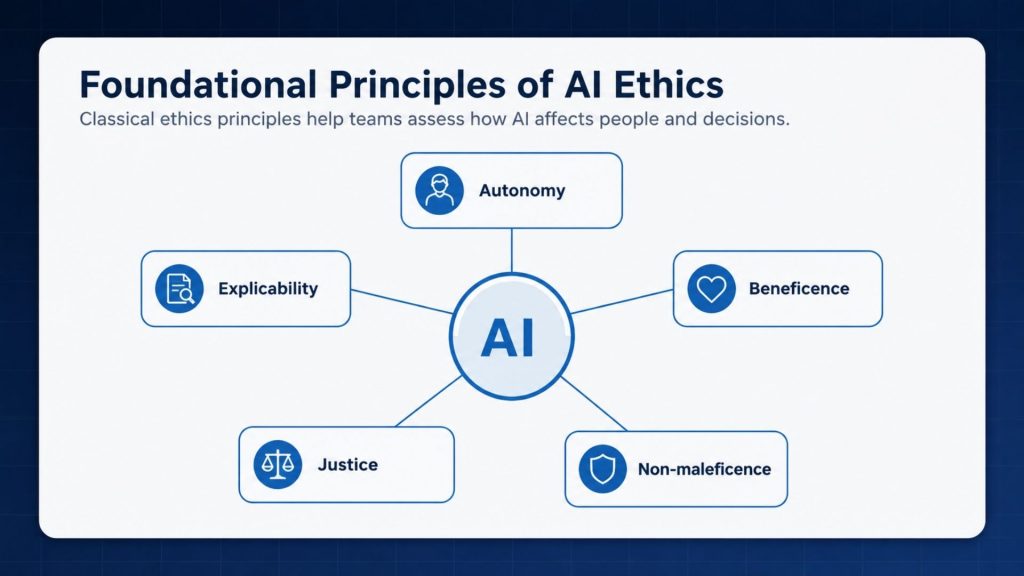
Foundational AI ethics principles guide human-centered and accountable model development.
4. Modern principles of AI ethics
Modern AI ethics principles translate ethical ideas into practical controls for enterprise AI systems. They are especially important for complex models, generative AI applications, and automated workflows that operate continuously across many teams, users, and data sources.
4.1. Fairness
Fairness means AI systems should avoid unjust or discriminatory outcomes. Teams need to evaluate whether data, labels, model design, or deployment context create biased results. Fairness checks should be repeated over time because model behavior can change when production data changes.
4.2. Transparency
Transparency means users and stakeholders should understand what the AI system does, what data it uses, and where its limitations are. Transparent documentation helps teams explain model purpose, intended use, risks, and monitoring processes without overstating what the model can do.
4.3. Accountability
Accountability means there must be clear ownership for AI decisions, model updates, risk reviews, and incident response. Enterprise AI projects should define who approves deployment, who monitors performance, and who responds when outputs are inaccurate, unsafe, or unfair.
4.4. Privacy
Privacy requires organizations to protect personal and sensitive data throughout the AI lifecycle. This includes data minimization, access control, anonymization where appropriate, secure storage, and clear rules for how user data can or cannot be used in model development.
4.5. Safety and robustness
Safety and robustness mean AI systems should continue to work reliably across expected conditions and fail safely when they encounter unusual inputs. This is where practices such as stress testing, adversarial testing, monitoring, and rollback planning become important.
4.6. Contestability
Contestability means people should have a way to question, appeal, or correct AI-supported outcomes when those outcomes affect them. For business teams, this can involve escalation workflows, human review, feedback channels, and audit trails that make decisions easier to investigate.
Once the modern principles of AI ethics are clear, the next step is to examine the practical challenges enterprises face when applying them in real-world AI systems.
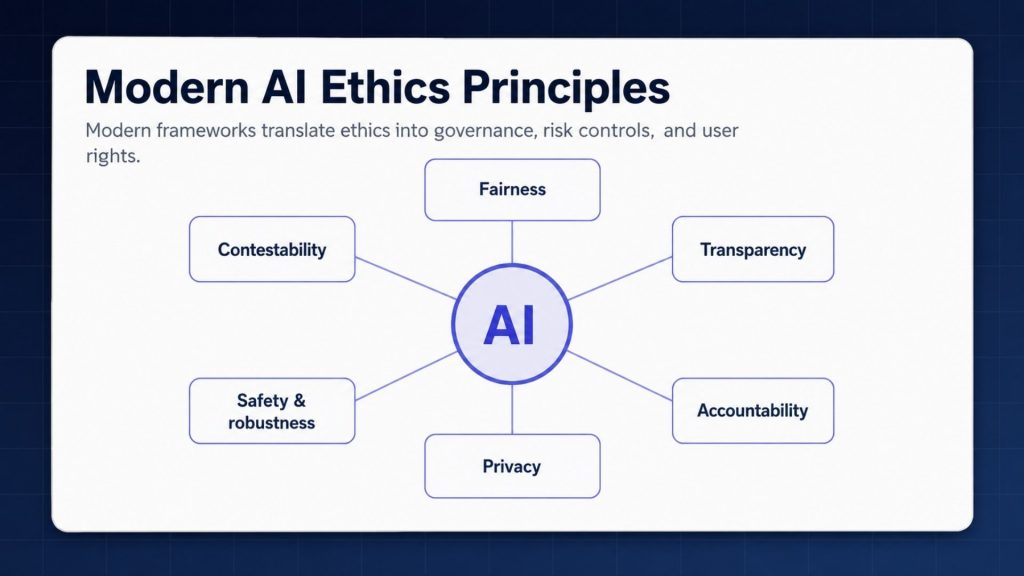
Modern AI ethics principles turn responsible AI goals into governance and risk controls.
5. AI Ethics vs AI Governance
AI ethics and AI governance are closely related, but they serve different purposes. AI ethics defines the values and principles that guide how AI should be designed and used. AI governance establishes the policies, responsibilities, review processes, and technical controls needed to apply those principles consistently.
In simple terms, AI ethics explains what responsible AI should achieve, while AI governance defines how an organization will achieve, measure, and maintain it. Ethical principles such as fairness, transparency, privacy, and accountability need governance mechanisms such as approval workflows, documentation standards, risk reviews, monitoring, and incident response.
| Criteria | AI Ethics | AI Governance |
| Primary focus | Values and principles for responsible AI | Policies, processes, roles, and controls |
| Main question | What should an AI system do or avoid? | How will the organization manage AI responsibly? |
| Key areas | Fairness, transparency, privacy, safety, and accountability | Risk assessment, ownership, approval, monitoring, and documentation |
| Typical outputs | Ethical principles, design guidance, and responsible-use standards | Governance frameworks, review processes, audit trails, and control checklists |
| Responsible parties | Product teams, developers, researchers, business leaders, and ethics specialists | Executives, legal, compliance, risk, and technical teams |
| Application stage | Across the full AI lifecycle | Across development, deployment, monitoring, and incident management |
| Relationship | Defines responsible AI goals | Turns those goals into repeatable organizational practices |
AI ethics and AI governance should not be treated as separate initiatives. Ethics provides direction, while governance converts that direction into operational responsibilities and measurable controls.
After distinguishing ethical principles from governance mechanisms, let’s examine how responsible AI practices apply to real-world business decisions.
6. Real-World Applications of AI Ethics
AI ethics becomes most meaningful when it is applied to systems that affect real people. The risks and required safeguards vary by industry, but common concerns include unfair outcomes, limited transparency, privacy exposure, unreliable recommendations, and weak human oversight.
6.1. Healthcare
AI can support medical imaging, patient prioritization, clinical documentation, and treatment recommendations. However, an inaccurate or biased model may affect patient safety, particularly when training data does not adequately represent different demographic groups.
Responsible healthcare AI requires clear validation, representative data, privacy protection, clinical oversight, and defined limits on how model outputs can be used. AI should support qualified professionals rather than replace medical judgment in high-risk decisions.
Practical scenario: A hospital uses an AI model to prioritize patients for further screening. Before deployment, the organization evaluates performance across age groups, genders, and patient populations. Clinicians review high-risk cases, while model outputs are monitored for unexpected changes after deployment.
6.2. Financial Services
Banks and financial institutions use AI for credit assessment, fraud detection, customer verification, risk analysis, and transaction monitoring. These applications can improve speed, but they may also produce unfair outcomes when historical data reflects existing social or economic inequalities.
Responsible financial AI requires bias evaluation, explainable decision factors, data protection, human review for sensitive cases, and a process that allows customers to question or appeal decisions.
Practical scenario: A lender uses an AI-assisted credit model but does not allow the model to make final decisions independently. Applications flagged as uncertain or potentially inconsistent are reviewed by trained staff, and rejected applicants receive understandable information about the main decision factors.
6.3. Recruitment
AI can help screen résumés, match candidates to roles, schedule interviews, or analyze application data. However, recruitment models may reproduce historical hiring patterns or disadvantage candidates whose backgrounds differ from previous successful employees.
Responsible recruitment AI requires representative training data, regular fairness testing, human review, transparent candidate communication, and restrictions on sensitive personal data.
Practical scenario: A company audits its recruitment model across demographic groups and discovers that certain nontraditional career paths are being ranked lower. The organization adjusts the model, expands the training data, and requires recruiters to review recommendations rather than automatically reject candidates.
6.4. Customer Service and Generative AI
Generative AI assistants and enterprise AI chatbots can answer questions, summarize documents, and support customer service teams. The main risks include inaccurate responses, disclosure of sensitive information, inappropriate content, and overconfidence in generated answers.
Responsible implementation may include retrieval from approved data sources, output filtering, access controls, human escalation, user disclosure, and ongoing monitoring.
Practical scenario: An enterprise chatbot retrieves information only from approved internal documents. When confidence is low or the query involves financial, medical, or legal decisions, the system routes the conversation to a qualified human agent.
These examples show that responsible AI is not achieved through one universal control. Each use case requires safeguards that reflect the potential impact, affected users, data sensitivity, and level of automation.
After reviewing how AI ethics applies across industries, the next step is to examine the operational challenges enterprises face when deploying responsible AI at scale.
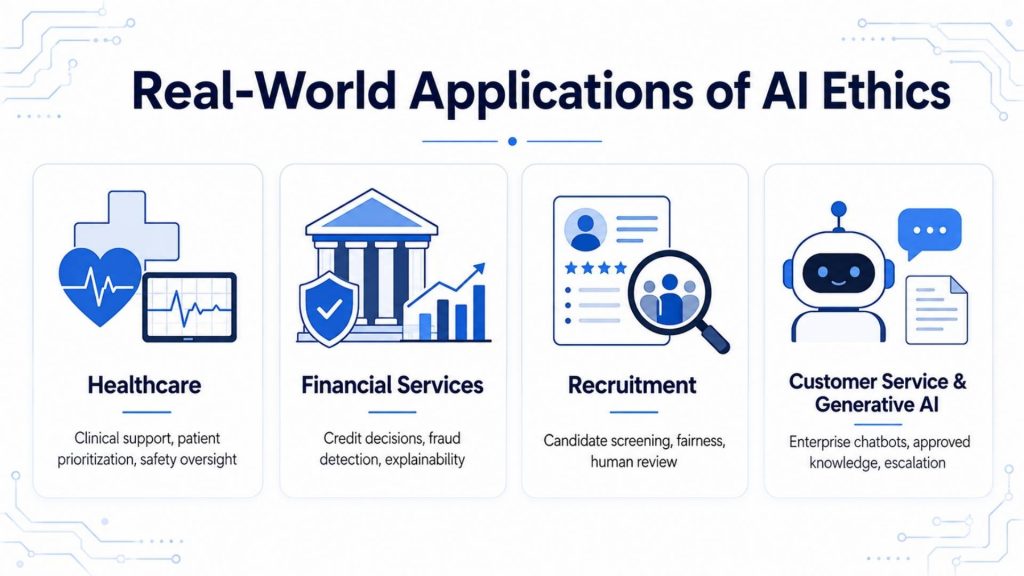
Real-World Applications of AI Ethics in Healthcare, Financial Services, Recruitment, and Customer Service.
7. AI Ethics Challenges in Enterprise AI Applications
Enterprise AI ethics becomes more difficult when models are deployed across departments, products, and customer-facing workflows. Teams need to manage not only how models are built, but also how they behave under real traffic, changing data, and operational constraints.
7.1. AI model reliability
AI model reliability is a major ethical challenge because unreliable outputs can create business errors and user harm. Even a strong model can degrade when production data differs from training data, when prompts change, or when edge cases appear. Reliability requires validation before launch and monitoring after deployment.
For enterprise teams, Model Testing can support a more structured approach to evaluating model behavior before production. Testing does not remove all risk, but it helps teams compare outputs, identify failure patterns, and decide whether a model is ready for real users.
7.2. Data governance
Data governance is essential because AI systems learn from and depend on data. Poor data quality can reduce accuracy, while unclear data ownership can create privacy, compliance, or security issues. Ethical AI requires teams to know where data comes from, who can access it, and how long it should be retained.
In development environments, teams can use controlled workspaces such as AI Notebook to experiment with data and models more consistently. For heavier workloads, GPU Container can provide GPU-powered environments for development and testing while keeping infrastructure choices flexible.
7.3. Scaling responsible AI
Scaling responsible AI is challenging because a model that works in a prototype may behave differently when integrated into real applications. When AI models are deployed to production, businesses need to consider speed, scale, monitoring, access control, and reliability at the same time.
For businesses that want to deploy AI models quickly without managing the full infrastructure stack, Serverless Inference helps simplify model deployment and scaling in cloud environments. FPT AI Factory supports bringing AI models into real applications, helping teams integrate model outputs into user-facing workflows with less operational complexity.
For a deeper understanding of how trained models generate outputs in production, you can also explore what AI inference is, how it works, and its key use cases.
After reviewing the main enterprise AI ethics challenges, let’s address the most common questions about building and using AI responsibly.
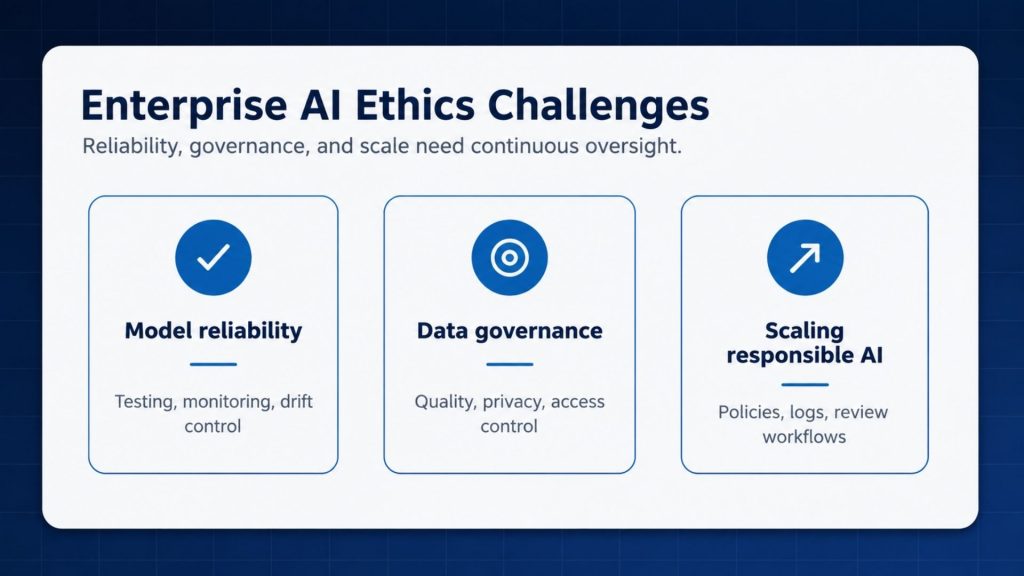
Enterprise AI ethics requires reliability, data governance, and scalable production controls.
8. Responsible AI Checklist for Businesses
A responsible AI checklist helps businesses evaluate whether ethical principles have been addressed before and after deployment. The checklist should be adapted to the risk level, industry, affected users, and intended use of each AI system.
8.1. Data governance
Confirm where training and operational data comes from, whether the organization has permission to use it, who can access it, how long it is retained, and whether sensitive data is adequately protected.
- Document data sources and ownership.
- Review data quality and representativeness.
- Apply access control and data minimization.
- Define retention and deletion rules.
- Record restrictions on data reuse.
8.2. Model testing
Test the model before deployment using representative data, edge cases, failure scenarios, and misuse scenarios. Testing should evaluate more than average accuracy.
- Define measurable acceptance criteria.
- Test normal, unusual, and adversarial inputs.
- Compare performance across relevant user groups.
- Document known limitations and failure modes.
- Retest after meaningful model or data changes.
For enterprise teams, Model Testing can support structured evaluation before a model is introduced into production workflows.
8.3. Human oversight
Define where human review is required and ensure reviewers have enough information, authority, and time to question AI-supported outputs.
- Identify decisions that must remain human-led.
- Create escalation paths for uncertain outputs.
- Allow authorized users to override recommendations.
- Train reviewers on system limitations.
- Prevent automation bias in sensitive decisions.
8.4. Bias evaluation
Evaluate whether the model produces systematically different outcomes for relevant groups or situations.
- Identify groups potentially affected by the system.
- Compare error rates and outcomes across groups.
- Investigate imbalances in training data.
- Document mitigation decisions.
- Repeat fairness assessments after deployment.
8.5. Monitoring
Production monitoring helps teams detect model drift, unusual inputs, performance degradation, and changes in user behavior.
- Define operational and ethical monitoring metrics.
- Track failures, overrides, complaints, and unusual outputs.
- Set thresholds for alerts and intervention.
- Review model behavior after data changes.
- Establish rollback or suspension procedures.
When models are deployed through Serverless Inference, teams should combine scalable serving with appropriate monitoring, access control, logging, and review processes.
8.6. Incident response
Businesses should prepare for situations in which an AI system produces harmful, inaccurate, discriminatory, or unauthorized outputs.
- Define what qualifies as an AI incident.
- Assign incident owners and escalation roles.
- Preserve logs and evidence for investigation.
- Pause or roll back affected systems when necessary.
- Document corrective and preventive actions.
8.7. Documentation
Documentation creates traceability across the AI lifecycle and helps technical, legal, business, and compliance teams understand how the system was developed.
- Record the model purpose and intended users.
- Document data sources and evaluation methods.
- Describe limitations and prohibited uses.
- Maintain version and change histories.
- Record approval and review decisions.
8.8. Compliance review
Before deployment, organizations should evaluate applicable laws, industry rules, contracts, privacy obligations, and internal policies.
- Identify relevant legal and regulatory requirements.
- Review privacy and data-protection obligations.
- Assess sector-specific requirements.
- Confirm contractual and licensing restrictions.
- Schedule periodic compliance reviews.
A checklist does not eliminate AI risk, but it helps organizations identify responsibilities, document decisions, and apply responsible AI controls more consistently across projects.
With these practical controls in place, let’s address the most common questions about AI ethics and responsible enterprise AI.
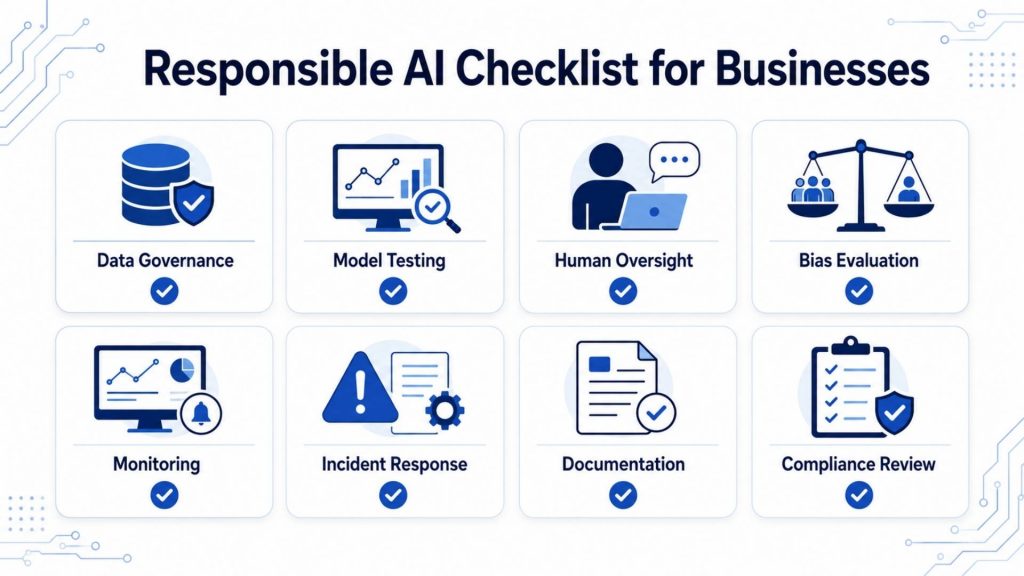
Responsible AI Checklist for Businesses Across Governance, Testing, Oversight, Monitoring, and Compliance.
9. FAQs
9.1. Why is AI ethics important?
AI ethics is important because AI systems can influence decisions, user experiences, and business operations at scale. Ethical principles help teams reduce bias, protect privacy, improve transparency, and build trust before AI models affect real users.
9.2. How can businesses use AI responsibly?
Businesses can use AI responsibly by defining clear use cases, governing data carefully, testing model outputs, keeping humans involved in sensitive decisions, monitoring production performance, and documenting how AI systems are built and maintained.
9.3. What challenges does AI ethics address?
AI ethics addresses challenges such as unfair outcomes, lack of transparency, unreliable model behavior, privacy risks, weak accountability, unsafe automation, and limited user ability to question or appeal AI-supported decisions.
AI ethics gives organizations a practical framework for building responsible AI models that are useful, reliable, fair, and accountable. As AI systems become more embedded in enterprise workflows, ethical principles should be applied across the full lifecycle, from data preparation and model testing to deployment and monitoring.
With FPT AI Factory, businesses can access AI infrastructure and deployment tools across data centers in Vietnam and Japan, with expansion to Malaysia planned. The platform provides services such as AI Notebook, GPU Container, Model Testing, and Serverless Inference, together with flexible pay-as-you-go GPU pricing for different development and production workloads. Businesses with customized deployment, large-scale infrastructure, or industry-specific requirements can also contact the FPT AI Factory team for dedicated consultation and tailored support.
Contact Information:
- Hotline: 1900 638 399
- Email: support@fptcloud.com
Explore Related Articles:
What is Explainable AI? Benefits, Techniques and Use Cases
What Is Model Serving? From AI Research to Real-World Applications