

Artificial intelligence is transforming how organizations automate decisions, improve efficiency, and deliver personalized experiences. As AI models become more complex, understanding how they reach their decisions is increasingly important for building trust and ensuring responsible AI adoption. In this article, FPT AI Factory helps you understand “What is Explainable AI?”, how it works, and why it has become essential for modern enterprise AI systems.
Key takeaways:
|
Explainable AI helps organizations build more transparent, trustworthy, and responsible AI systems. Here are the key points to remember:
|
Build and test reasoning-capable AI with FPT AI Factory. Teams can use GPU infrastructure, AI Notebook, Model Testing and Serverless Inference to experiment with models, evaluate outputs and move AI applications toward production. For customized deployments or large-scale AI infrastructure requirements, contact FPT AI Factory for project-based consultation.
1. What is Explainable AI?
Explainable AI (XAI) refers to methods and technologies that make AI models more transparent by explaining how they generate predictions or decisions. Instead of acting as a “black box,” Explainable AI helps users understand which factors influence model outputs, making AI systems easier to validate, monitor, and trust. To better understand where Explainable AI fits into the AI lifecycle, you can also explore our guide on What is AI inference?
Explainable AI plays an important role across industries such as healthcare, finance, manufacturing, and the public sector, where decision transparency is critical. For businesses, it improves governance, reduces operational risk, and supports the responsible deployment of AI applications.

Explainable AI enables transparent and trustworthy decision-making by revealing how AI models generate predictions
2. Why Explainable AI matters
As AI models are increasingly used to support business decisions, organizations need more than accurate predictions, which means that they also need clear explanations behind those decisions. Here are some key reasons why Explainable AI matters for modern enterprises.
2.1. Building trust in AI systems
Trust is essential for organizations adopting AI in business-critical processes. Explainable AI helps users understand how models reach specific decisions, making AI recommendations easier to verify and accept. This transparency increases confidence among customers, employees, and stakeholders while reducing concerns about black-box decision-making. As a result, organizations can accelerate AI adoption without compromising accountability.
For example, IBM integrates Explainable AI into its AI governance solutions to help organizations understand model predictions and build greater confidence in AI-assisted decisions.

Explainable AI increases trust by making AI decisions transparent and understandable
2.2. Supporting regulatory compliance
Many industries must comply with regulations that require transparency, fairness, and accountability when AI influences important decisions. Explainable AI helps organizations demonstrate how predictions are generated, simplifying audits and regulatory reviews. It also supports governance frameworks by providing evidence that AI systems operate consistently and responsibly. This is particularly valuable in highly regulated sectors such as finance, healthcare, and government.
For example, financial institutions implementing the EU AI Act can use Explainable AI to document model behavior and demonstrate compliance with transparency requirements. This supports regulatory reviews by providing clear explanations for AI-assisted decisions.
2.3. Improving model validation
Model validation goes beyond measuring prediction accuracy. Explainable AI enables data scientists to identify which features influence predictions, detect unexpected model behavior, and verify whether outputs align with business objectives. During model validation, organizations may combine Explainable AI with techniques such as active learning in machine learning to identify uncertain predictions for human review and continuously improve model quality.
For example, Google Cloud Vertex AI provides Explainable AI features that help developers validate feature importance and analyze prediction behavior before deploying machine learning models.
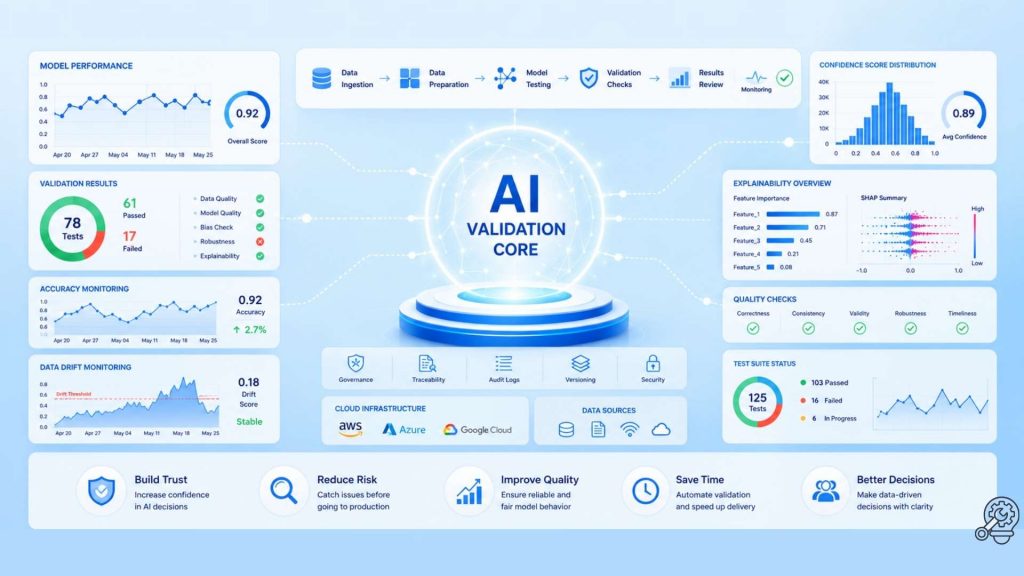
Explainable AI helps teams validate model behavior before production deployment
2.4. Reducing bias and risk
AI models can unintentionally learn biased patterns from training data, leading to unfair or inconsistent decisions. Explainable AI helps organizations identify which variables influence predictions and determine whether sensitive attributes contribute to biased outcomes. This enables teams to improve fairness, reduce operational risk, and strengthen responsible AI governance.
For example, Microsoft Responsible AI provides interpretability and fairness tools that help organizations analyze model behavior and identify potential sources of bias. This allows development teams to refine models before they affect real-world business decisions.
3. How Explainable AI works?
Explainable AI combines machine learning models with interpretability techniques to show how predictions are generated rather than simply providing an output. Here are the three core principles behind Explainable AI.
3.1. Prediction accuracy
Prediction accuracy measures how well an AI model performs on unseen data across different scenarios. During model training, factors such as the learning rate, training data quality, and optimization algorithms all influence prediction accuracy. XAI complements this by explaining the reasoning behind model predictions, helping organizations verify that decisions are based on meaningful patterns rather than random correlations.

Prediction accuracy ensures AI models deliver reliable and explainable results
3.2. Traceability
Traceability refers to the ability to understand how an AI model was developed, including its training data, features, algorithms, and decision process. This visibility enables organizations to audit AI systems, reproduce results, and investigate unexpected model behavior. Traceability also supports governance by documenting how models evolve throughout their lifecycle. For enterprises, it is a critical requirement for compliance and responsible AI practices.
3.3. Decision understanding
Decision understanding focuses on explaining why an AI model produces a specific prediction for a particular input. Instead of viewing AI as a black box, users can identify which features had the greatest impact on each decision. This improves collaboration between technical teams and business stakeholders while making AI outputs easier to interpret. Clear explanations also help organizations identify errors, detect bias, and improve model performance over time.
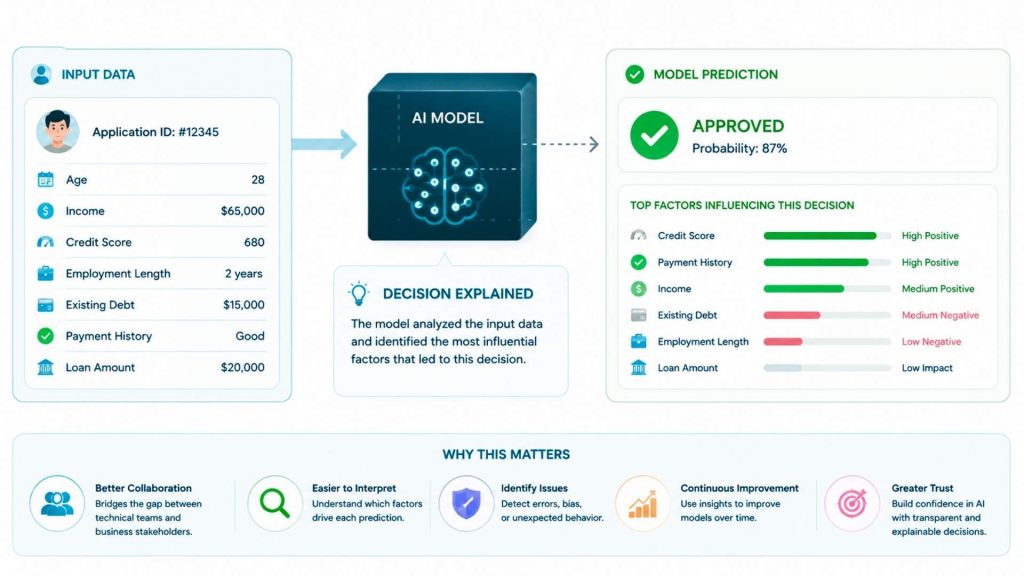
Decision understanding explains the factors influencing each AI prediction
4. Explainable AI vs Interpretable AI: Key Considerations
After understanding how Explainable AI works, it is important to distinguish between Explainable AI (XAI) and Interpretable AI. While both aim to improve AI transparency and trust, they differ in how explanations are provided. The following table compares Explainable AI and Interpretable AI across key aspects:
| Model / Concept | Category | Interpretability | Key Considerations |
| White-box Models | Interpretable AI | High | Transparent models with understandable decision processes. |
| Black-box Models | Explainable AI | Low | Require external methods to explain complex predictions. |
| Decision Tree | Interpretable AI | High | Uses clear decision rules that are easy to follow. |
| Linear Regression | Interpretable AI | High | Shows how each feature impacts the output. |
| Random Forest | Explainable AI | Medium | More complex due to multiple decision trees. |
| Deep Learning | Explainable AI | Low | Needs XAI techniques to interpret complex neural networks. |
| LLM | Explainable AI | Very Low | Difficult to explain due to large-scale parameters an |
In practice, interpretable models are preferred when transparency is a priority, while Explainable AI becomes essential for advanced models such as deep learning and large language models, where directly understanding the decision process is challenging.
5. Common Explainable AI techniques
Different XAI techniques provide different levels of transparency depending on the model type and business requirements. Selecting the right technique helps organizations improve model validation, governance, and user trust. There are some of the most widely used Explainable AI techniques:
5.1. Feature importance
Feature Importance identifies which input variables contribute most to a model’s predictions. It provides a high-level understanding of model behavior by ranking features according to their influence on the output. This helps data scientists verify that models rely on meaningful business variables rather than irrelevant data. Feature Importance is commonly used during model evaluation and validation.
5.2. SHAP
SHAP (SHapley Additive exPlanations) explains individual predictions by calculating how much each feature contributes to the final output. Based on concepts from cooperative game theory, SHAP provides both local and global explanations across many types of machine learning models. It offers consistent and interpretable insights, making it one of the most widely adopted XAI techniques. Organizations often use SHAP to validate model behavior and support responsible AI initiatives.

SHAP explains how each feature contributes to individual AI predictions
5.3. LIME
LIME (Local Interpretable Model-agnostic Explanations) explains individual predictions by creating a simpler local model around a specific input. Instead of interpreting the entire machine learning model, LIME focuses on understanding why one prediction was made. Because it works with many different model types, LIME is widely used for debugging and validating AI systems. It helps organizations improve transparency without changing the original model.
5.4. Counterfactual explanations
Counterfactual explanations show how small changes to the input could produce a different prediction. Rather than explaining why a decision occurred, this technique explains what would need to change for another outcome to be achieved. Counterfactual explanations are particularly valuable for decision support because they provide actionable insights instead of simply describing model behavior. They are commonly used in finance, healthcare, and risk assessment.
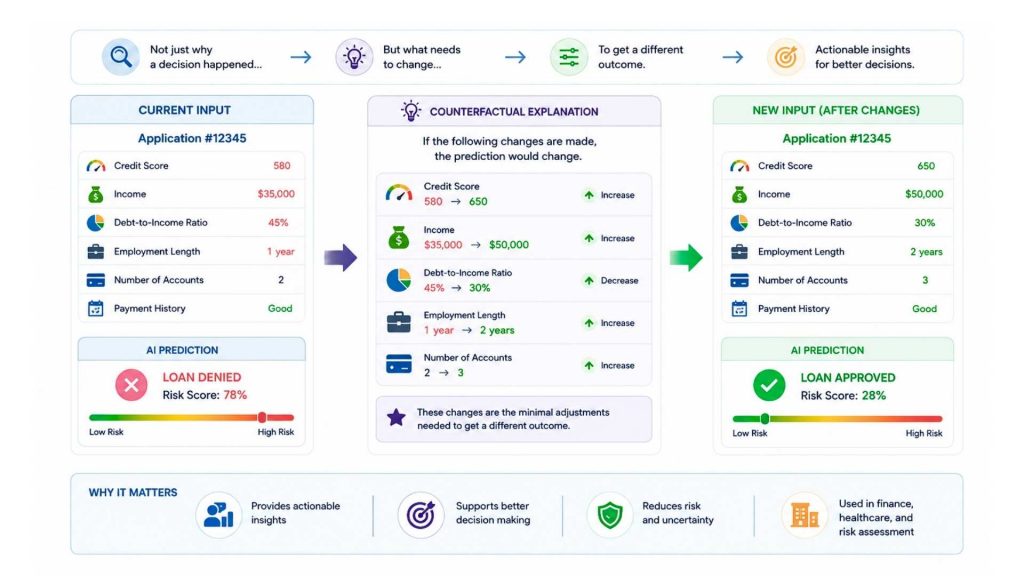
Counterfactual explanations show how input changes affect AI decisions
6. Explainable AI use cases
Now, let’s examine how organizations apply them to solve real-world business challenges across different industries. Here are some of the most common use cases for Explainable AI.
6.1. Financial services
Financial institutions use Explainable AI to improve transparency in credit scoring, fraud detection, anti-money laundering, and risk assessment. Understanding why a model approves or rejects a transaction helps organizations meet regulatory requirements while increasing customer trust. Explainable AI also enables analysts to validate predictions before taking action on high-value financial decisions.
For example, Mastercard uses Explainable AI capabilities in its fraud detection solutions to help financial institutions understand the factors behind fraud alerts.

Explainable AI improves transparency in financial decision-making and fraud detection
6.2. Healthcare
Healthcare organizations apply XAI to support clinical decision-making, medical imaging analysis, and disease prediction. Transparent AI recommendations help clinicians understand the reasoning behind predictions before integrating them into patient care. This improves confidence while supporting compliance with healthcare regulations and ethical standards.
For instance, Google Health uses explainability techniques to help clinicians interpret AI-assisted medical imaging results. This enables healthcare professionals to validate model predictions alongside their clinical expertise.
6.3. Manufacturing
Manufacturers use Explainable AI to improve predictive maintenance, quality inspection, and production optimization. By explaining why equipment failures or quality issues are predicted, engineers can verify AI recommendations before making operational decisions. This reduces downtime while improving manufacturing efficiency and reliability.
For example, Siemens integrates Explainable AI into industrial analytics to help engineers understand predictive maintenance recommendations. This improves confidence in AI-driven maintenance planning and operational optimization.

Explainable AI enhances predictive maintenance and manufacturing efficiency
6.4. Public sector
Government agencies use Explainable AI to improve transparency in public services, policy analysis, and resource allocation. Transparent AI systems help ensure that automated decisions remain accountable and can be reviewed when necessary. This strengthens public trust while supporting responsible AI governance.
For example, public agencies applying the NIST AI Risk Management Framework can use Explainable AI to document model behavior and improve accountability in AI-assisted decision-making.
7. Challenges of Explainable AI
7.1 Accuracy vs Explainability
Highly accurate AI models are often more complex, making their decisions harder to interpret. Organizations must balance prediction performance with the level of transparency required for business and regulatory needs. When discussing model transparency, validation, and reliability, mention Model Testing as a solution that helps teams evaluate AI models and monitor performance before deployment. In production, explainability insights can be delivered through APIs, allowing applications to retrieve explanations alongside predictions and deploy AI models with greater confidence.
7.2 Complexity of modern models
Modern deep learning models and large language models often contain billions of parameters, making them significantly more difficult to interpret than traditional machine learning algorithms. While Explainable AI techniques provide valuable insights, they may only explain part of a model’s reasoning process. Organizations therefore need multiple interpretability methods to gain a more complete understanding of complex AI systems. This challenge becomes even greater as enterprise AI workloads continue to scale.
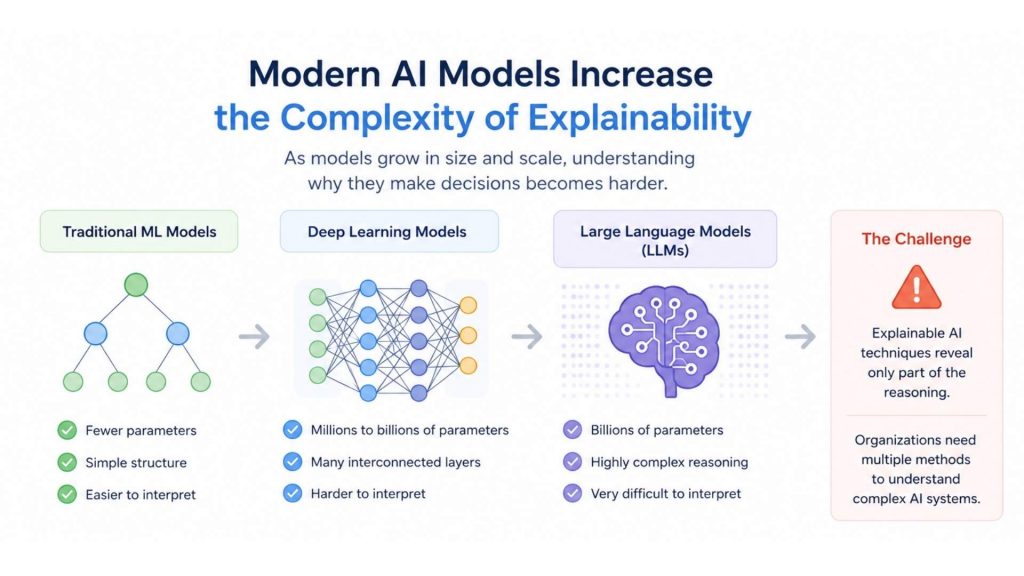
Modern AI models increase the complexity of explainability
7.3 Human interpretation limitations
Even when AI models provide explanations, users may interpret them differently depending on their technical expertise and business context. Explanations that are too detailed can overwhelm business users, while overly simplified explanations may not satisfy technical teams or regulators. Organizations should therefore tailor Explainable AI outputs to different audiences while maintaining consistency and accuracy. Effective communication is just as important as technical transparency.
8. Challenges of Explainable AI for LLMs
After exploring the common challenges of Explainable AI, the next step is to examine the unique challenges of Explainable AI for LLMs. Due to their scale and complexity, LLMs introduce new explainability issues, including understanding model reasoning, handling hallucinations, explaining retrieved information, and tracing agent-based decisions.
8.1. Attention ≠ Explanation
Attention mechanisms are often used to analyze which tokens influence an LLM’s output. However, attention weights do not always represent the model’s actual reasoning process or decision-making logic. Therefore, relying only on attention visualization may lead to incomplete or misleading explanations of LLM behavior.
8.2. Hallucination
LLM hallucination occurs when models generate responses that appear confident and coherent but contain inaccurate or fabricated information. This creates a major challenge for Explainable AI because understanding why a model produces incorrect outputs requires analyzing complex interactions between training data, model parameters, and generation processes.
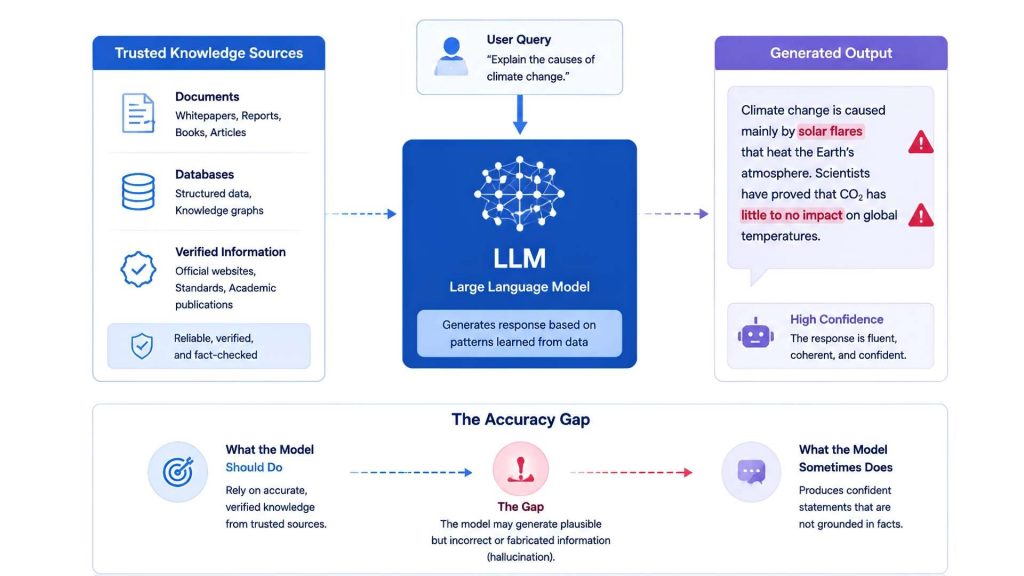
LLM hallucination challenge: AI-generated responses may appear reliable while containing inaccurate or unsupported information
8.3. RAG Explainability
Retrieval-Augmented Generation (RAG) improves LLM reliability by allowing models to retrieve information from external knowledge sources before generating responses. However, explaining how retrieved documents influence the final answer remains challenging, especially when multiple sources contribute to the generated output.
8.4. Agent Explainability
AI agents extend LLM capabilities by enabling planning, tool usage, and multi-step execution. However, explaining why an agent selects specific actions or tools remains challenging because the decision process involves multiple intermediate steps and dynamic interactions.
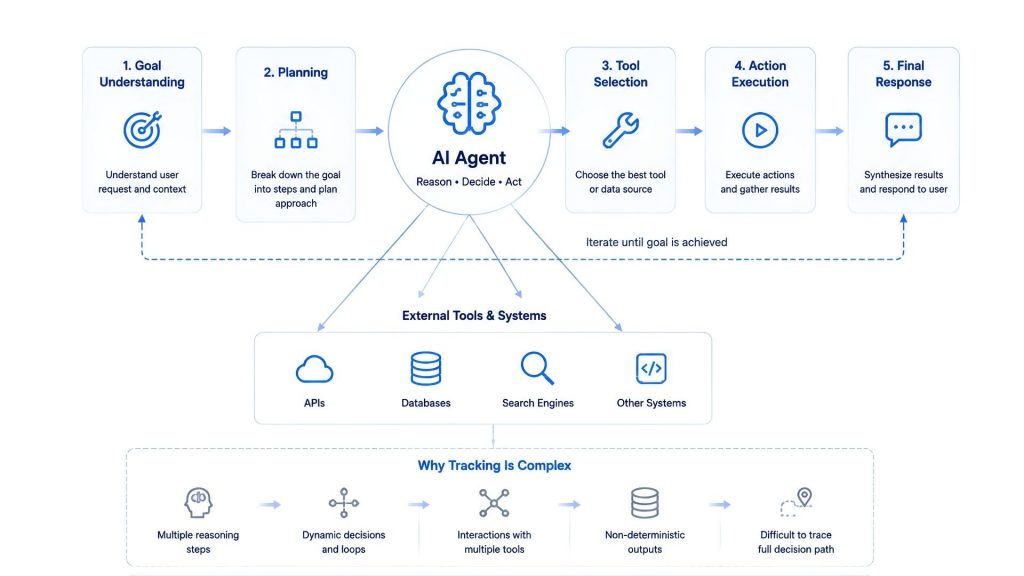
AI agent explainability challenge: Revealing how AI agents decide what actions to take and why
8.5. Multi-agent Reasoning
Multi-agent systems involve multiple AI agents collaborating, exchanging information, and making collective decisions. Explainability becomes more difficult because users need to understand not only individual agent behaviors but also communication patterns and how final decisions emerge from collaboration.
9. FAQs
9.1 What is the difference between XAI and interpretable ML?
Interpretable machine learning uses models that are naturally easy to understand, such as decision trees. Explainable AI (XAI) explains more complex models, including deep learning and large language models, using post-hoc interpretation techniques.
9.2 Is Explainable AI required by law?
Explainable AI is not legally required in every country, but many AI regulations emphasize transparency and accountability for high-risk AI systems. Frameworks such as the EU AI Act and the NIST AI Risk Management Framework encourage organizations to provide meaningful explanations for AI-driven decisions.
9.3 What are the limitations of SHAP and LIME?
SHAP provides consistent explanations but can be computationally expensive for large models. LIME is faster but only explains individual predictions and may produce different results for similar inputs. Many organizations use multiple XAI techniques to achieve more reliable interpretations.
Explainable AI helps organizations understand how AI models make decisions, improving transparency, trust, and regulatory compliance across enterprise applications. As AI systems continue to become more complex, Explainable AI will remain a key capability for building reliable and trustworthy AI solutions.
With FPT AI Factory’s Serverless Inference, businesses can evaluate AI models, validate predictions, and monitor performance before deployment while reducing operational complexity. For enterprises with customization or large-scale needs, please contact the FPT AI Factory team via the official contact form for dedicated support.
Contact Information:
- Hotline: 1900 638 399
- Email: support@fptcloud.com
Explore Related Articles:
What Is Data Infrastructure? Key Components and How to Build It