
Enterprise AI is transforming how organizations automate operations, improve decision-making, and unlock value from large-scale data. Unlike consumer AI tools designed for individual productivity, enterprise AI integrates with business systems, complies with strict governance requirements, and supports mission-critical workloads. At FPT AI Factory, businesses can access scalable AI infrastructure and deployment services that simplify the journey from experimentation to production.
|
Key takeaways Enterprise AI is becoming a strategic priority for organizations seeking to scale AI beyond experimentation. Here are the key concepts, benefits, and implementation considerations covered in this guide.
|
Power your enterprise AI initiatives with FPT AI Factory. Utilize scalable AI infrastructure, AI model deployment, and orchestration capabilities to improve resource utilization, simplify operations, and deploy AI applications with confidence. Contact FPT AI Factory to find the right architecture for your AI workloads.
1. What is Enterprise AI?
Enterprise AI is the adoption of artificial intelligence across an organization to automate business processes, improve decision-making, and create business value at scale. Unlike AI tools designed for individual users, enterprise AI combines AI technologies with enterprise data, systems, and workflows to support organization-wide operations. It also requires the infrastructure, governance, and security needed to deploy AI reliably in production environments.
As organizations expand AI adoption, enterprise AI extends beyond AI models alone. It includes the strategies, platforms, and operational frameworks that enable AI to scale across multiple teams and business functions while maintaining performance, regulatory compliance, and responsible AI practices. Many organizations also rely on a modern AI cloud platform to simplify AI development, deployment, and infrastructure management across the enterprise.

Enterprise AI integrates AI, enterprise data, and business workflows to drive intelligent, scalable operations across the organization
1.1 Enterprise AI vs Consumer AI
While enterprise AI and consumer AI share the same core technologies, they serve different purposes. Consumer AI focuses on personal productivity, whereas enterprise AI supports business operations with greater scalability, security, and governance. The table below compares their key differences, while also highlighting enterprise AI’s focus on production-ready deployment.
| Category | Consumer AI | Enterprise AI |
| Primary purpose | Personal productivity and assistance | Automating business processes and driving organizational outcomes |
| Primary users | Individual users | Teams, departments, and enterprise-wide users |
| Scale and deployment environment | Standalone applications for individual or small-team use | Integrated across enterprise applications, cloud environments, and business workflows |
| Data requirements | Public information or user-provided data | Proprietary enterprise data from multiple systems with governance controls |
| Governance and compliance | Basic privacy and security features | Enterprise-grade security, centralized governance, auditability, and regulatory compliance |
1.2 Enterprise AI vs Research AI
Enterprise AI and research AI represent different stages of the AI lifecycle and serve different purposes. Research AI focuses on developing and evaluating new models, while enterprise AI applies proven AI technologies to solve real business challenges. Enterprise AI also emphasizes secure, scalable deployment and operational reliability. The table below summarizes the key differences between the two approaches.
| Category | Research AI | Enterprise AI |
| Purpose | Advance AI capabilities through research, experimentation, and model innovation | Deliver measurable business outcomes by improving operations, decision-making, and productivity |
| Primary users | AI researchers, data scientists, and ML engineers | Business teams, IT teams, and enterprise users |
| Scalability | Optimized for model development and experimental workloads | Built to support enterprise-wide deployment across users, departments, and business applications |
| Governance | Basic governance for research workflows and data handling | Enterprise-grade security, governance, auditability, and regulatory compliance |
| Deployment requirements | Prototype and testing environments with frequent experimentation | Production-ready environments requiring monitoring, lifecycle management, high availability, and reliable performance |
2. Why Enterprise AI is different from general AI
While both enterprise AI and general-purpose AI are built on similar artificial intelligence technologies, they are designed for different objectives. General-purpose AI focuses on broad, user-oriented tasks, whereas enterprise AI is built to address complex business challenges and create measurable business value. These differences influence how AI systems are designed, deployed, and managed within enterprise environments.
2.1. Scale and Reliability requirements
Enterprise AI powers business-critical applications that process large volumes of data and support thousands of concurrent users, applications, and AI requests. Unlike standalone AI tools, enterprise AI must deliver consistent performance, low latency, and high availability across multiple business functions.
To meet these demands, organizations rely on scalable infrastructure, continuous monitoring, and automated resource management to maintain reliable AI services as workloads increase. Many enterprises also adopt GPU as a Service to scale GPU resources on demand, enabling AI workloads to handle changing compute requirements without overprovisioning infrastructure. This ensures AI can support mission-critical operations without compromising business continuity.
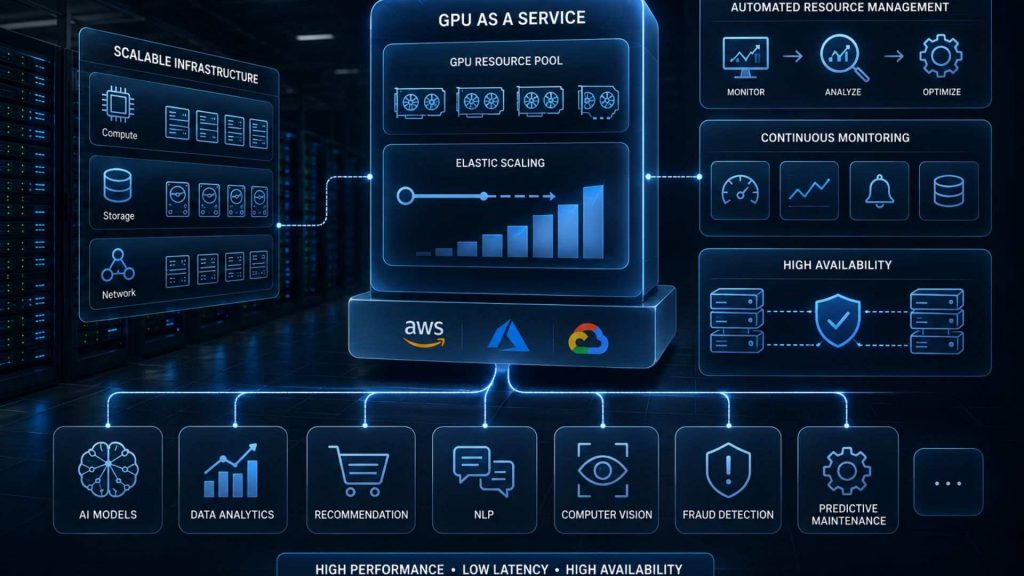
Scalable AI infrastructure for enterprise workloads
2.2. Security, Compliance, and Governance
Enterprise AI frequently processes sensitive business information, including customer records, financial data, healthcare information, and confidential corporate documents. Protecting these assets requires enterprise-grade security measures such as encryption, identity and access management (IAM), and role-based access control (RBAC). Many organizations also adopt a Zero Trust security model to continuously verify users and devices before granting access to AI systems and sensitive enterprise data.
In addition to security, organizations need governance frameworks that define how AI models are developed, versioned, deployed, monitored, and updated throughout their lifecycle. These practices help ensure compliance with industry regulations, such as GDPR and HIPAA, while promoting responsible AI adoption and reducing operational risk.
2.3. Integration with Existing Enterprise Systems
Unlike standalone AI applications, enterprise AI must integrate seamlessly with existing business systems rather than operate in isolation. It commonly connects with enterprise platforms such as ERP, CRM, HR systems, data warehouses, knowledge bases, and collaboration tools through API integration, enabling AI applications to exchange data efficiently and automate workflows across enterprise environments.
By integrating with existing infrastructure, organizations can leverage enterprise data more effectively, maximize previous technology investments, and embed AI directly into daily operations with minimal disruption.
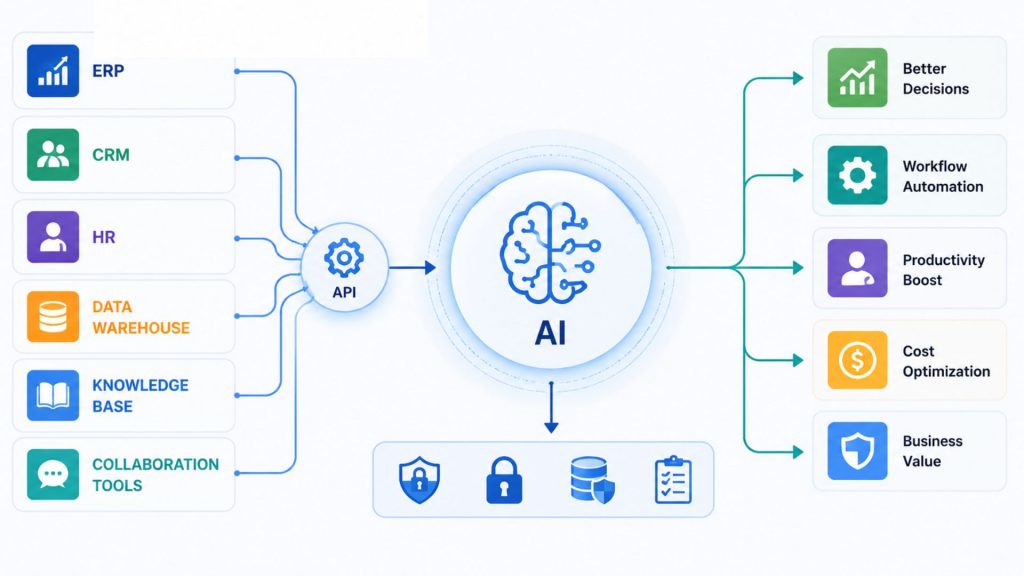
Enterprise AI integrates seamlessly with existing business systems to automate workflows and unlock greater business value
2.4. Explainability and Auditability
Many Enterprise AI applications support high-impact business decisions, such as fraud detection, loan approval, risk assessment, or clinical decision support. In these scenarios, organizations need visibility into how AI models generate predictions and recommendations rather than treating them as black boxes.
Explainability helps users understand the factors influencing AI-generated outputs, while auditability provides a traceable record of model decisions, data usage, and system activities. Together, these capabilities improve transparency, simplify regulatory compliance, and strengthen trust in AI systems deployed across the enterprise.
3. Enterprise AI architecture
A well-designed enterprise AI architecture provides the foundation for developing, deploying, and managing AI applications at scale. Rather than relying on a single AI model, enterprise AI combines multiple layers that work together to transform data into actionable insights while ensuring security, scalability, and operational reliability. Each layer plays a distinct role in supporting the AI lifecycle, from data preparation and model development to deployment and governance.
3.1. Data layer
This layer is built on robust data infrastructure that enables organizations to collect, store, process, and govern both structured and unstructured data at scale. It integrates information from databases, enterprise applications, IoT devices, and other business systems alongside unstructured content such as documents, emails, images, audio, and videos. High-quality, well-governed training data is essential for developing accurate AI models and generating reliable predictions.
In enterprise environments, the data layer also supports data integration, preprocessing, and governance to ensure information remains consistent, secure, and accessible across different business functions.
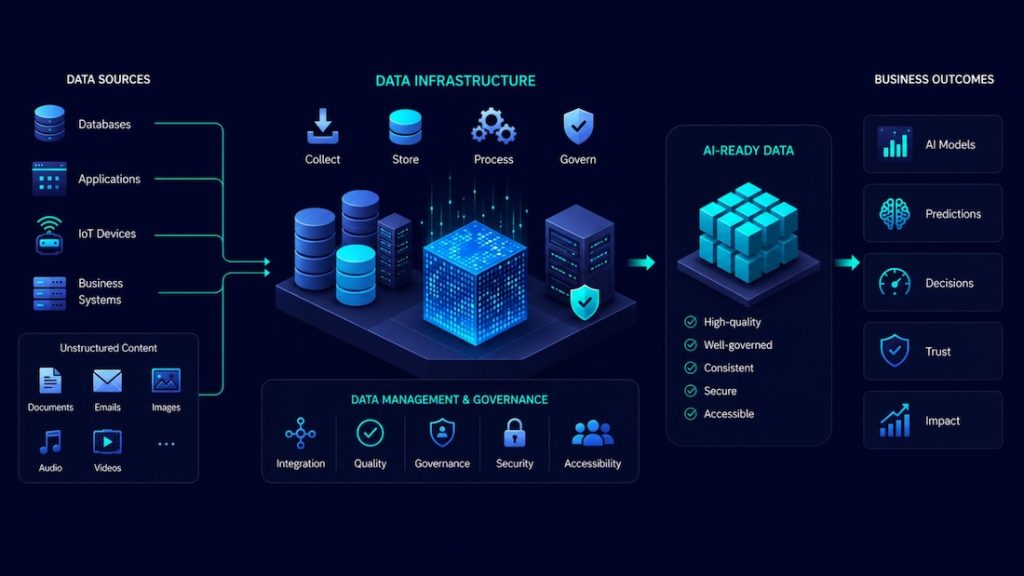
A unified data layer collects, integrates, governs, and prepares enterprise data to power accurate and reliable AI applications
3.2. Model layer
The model layer is where AI models are developed, trained, evaluated, and prepared for deployment. Depending on business requirements, organizations may use traditional machine learning models, deep learning models, large language models (LLMs), computer vision models, or predictive analytics models to solve specific business use cases. Many organizations also apply fine-tuning to adapt pre-trained models using enterprise data, improving model performance for domain-specific tasks.
This layer focuses on selecting the right models, optimizing performance, and validating results before deployment. Continuous evaluation also helps ensure models maintain accuracy as business data and operational conditions evolve.

The model layer develops, fine-tunes, and validates AI models to deliver accurate, business-specific intelligence
3.3. AI platform layer
The AI platform layer provides the tools and services that enable teams to build, manage, and scale AI applications efficiently. It streamlines AI development by supporting data scientists, machine learning engineers, and developers throughout the model lifecycle.
Modern AI development platforms bring together capabilities such as experiment tracking, model management, collaboration, workflow orchestration, and scalable compute resources in a unified environment. By centralizing these capabilities, the AI platform layer accelerates AI development while improving operational consistency.
3.4. Deployment layer
Once validated, AI models move to the deployment layer, where they are integrated into enterprise applications and business workflows. Model serving enables trained models to process real-time or batch inference requests while maintaining high availability, low latency, and consistent performance.
The deployment layer also supports model versioning, monitoring, and updates, allowing organizations to continuously improve AI applications without disrupting production systems.
3.5. Governance layer
The governance layer establishes the policies and controls needed to manage AI responsibly across the organization. It covers areas such as data governance, security, compliance, model monitoring, risk management, and auditability throughout the AI lifecycle.
By implementing strong governance practices, organizations can improve transparency, reduce operational risk, and ensure AI systems remain compliant with internal policies and external regulations as they scale.
4. Key Enterprise AI Use Cases by Industry
4.1. Financial Services
Financial institutions use enterprise AI to detect fraud, automate document processing, improve risk assessment, and enhance customer service. AI-powered Intelligent Document Processing (IDP) reduces manual work by extracting and validating financial data, while governance, auditability, and role-based access controls help ensure regulatory compliance and data security.
A well-known example is JPMorgan Chase, which developed the COIN (Contract Intelligence) platform to automate the review of commercial loan agreements. Before AI adoption, this task required approximately 360,000 hours of manual work each year by legal and operations teams. By applying machine learning to document processing, COIN significantly accelerated contract reviews while improving consistency and allowing employees to focus on higher-value work. This demonstrates how enterprise AI can increase operational efficiency and support better risk management in financial services.

JPMorgan Chase’s COIN platform demonstrates how enterprise AI automates contract review to improve efficiency and risk management
4.2. Healthcare
Healthcare organizations are increasingly using enterprise AI to improve medical imaging analysis, support clinical decision-making, streamline patient triage, and automate patient communication. By analyzing clinical records, medical images, and patient interactions, AI helps clinicians make faster decisions, reduce administrative workloads, and improve the overall quality of care. Because healthcare data is highly sensitive, enterprise AI deployments must also comply with strict privacy, security, and regulatory requirements.
One example is Mayo Clinic, which has expanded its collaboration with Google Cloud to develop enterprise AI solutions that support clinical workflows and improve access to medical information. The organization is using generative AI to help clinicians retrieve relevant knowledge more efficiently, summarize complex medical information, and accelerate clinical decision-making while maintaining strict governance over patient data. This demonstrates how enterprise AI can improve operational efficiency and patient care by embedding AI directly into healthcare workflows rather than using standalone AI tools.
4.3. Manufacturing
Manufacturers are adopting enterprise AI to improve predictive maintenance, automate quality inspection, enhance demand forecasting, and optimize production processes. By analyzing data from sensors, production equipment, and supply chain operations, AI helps manufacturers detect potential issues earlier, improve product quality, and optimize resource utilization. These capabilities enable organizations to reduce operational costs while increasing productivity and production efficiency.
Siemens combines enterprise AI with industrial IoT data to monitor equipment health, detect anomalies, and enable predictive maintenance. This allows manufacturers to turn real-time operational data into actionable insights, improving equipment reliability, production efficiency, and overall operations.
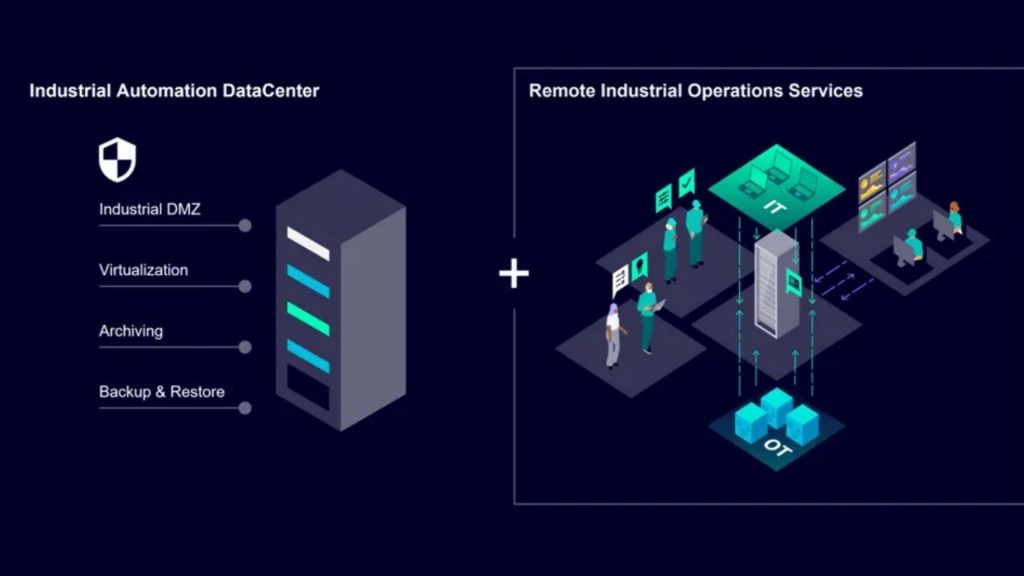
Enterprise AI helps Siemens transform industrial IoT data into actionable insights for smarter manufacturing
4.4. Retail
Retailers are increasingly adopting enterprise AI to power recommendation engines, optimize inventory management, improve demand forecasting, and automate customer support. By connecting data from e-commerce platforms, physical stores, and customer service channels, AI helps retailers better understand customer behavior, anticipate purchasing trends, and improve inventory decisions. These capabilities enable businesses to deliver more personalized shopping experiences while increasing operational efficiency across the retail value chain.
Amazon showcases how enterprise AI can drive innovation across the retail ecosystem. The company applies AI to generate personalized product recommendations, forecast customer demand, and optimize inventory placement throughout its fulfillment network. AI also supports customer service by powering intelligent virtual assistants and improving response accuracy for customer inquiries. By embedding AI into both customer-facing and operational processes, Amazon can enhance the shopping experience while improving supply chain efficiency at scale.
4.5. Logistics
Logistics organizations are increasingly adopting enterprise AI to optimize delivery routes, automate warehouse operations, improve supply chain visibility, and enhance predictive analytics. By analyzing transportation data, inventory levels, weather conditions, and customer demand, AI helps logistics providers improve operational efficiency, reduce delivery delays, and make more informed decisions across complex supply chain networks.
UPS illustrates the value of enterprise AI by using its ORION (On-Road Integrated Optimization and Navigation) system to optimize delivery routes across its global logistics network. The AI-powered platform analyzes factors such as package volume, traffic conditions, delivery schedules, and route constraints to determine the most efficient routes for drivers. According to UPS, reducing just one mile per driver per day could save the company up to $50 million annually, demonstrating how enterprise AI can significantly improve operational efficiency while reducing fuel consumption and transportation costs.

AI-powered logistics enhances route planning, warehouse automation, and supply chain performance
5. Core Components of an Enterprise AI Stack
Building enterprise AI requires more than deploying a single AI model. Organizations need an integrated AI stack that supports the entire AI lifecycle, from managing enterprise data and developing models to deploying applications and governing AI systems in production. Each component plays a critical role in ensuring AI solutions remain scalable, secure, and reliable as business needs evolve.
5.1. Data Infrastructure and Governance
A strong data foundation is essential for successful enterprise AI. Organizations typically collect data from multiple sources, including ERP and CRM platforms, databases, IoT devices, and unstructured content such as documents, emails, images, and videos. Before this data can be used for AI training or inference, it must be cleaned, integrated, and standardized to ensure consistency and accuracy.
Many organizations also implement a data catalog to improve data discovery, metadata management, and governance across distributed enterprise data assets. Combined with strong data governance, it helps establish policies for data ownership, quality, access control, and regulatory compliance, ensuring AI models are trained on trusted datasets while protecting sensitive business information.
5.2. Model Development and Training Environment
The model development and training environment provides the tools and computing resources needed to build, fine-tune, evaluate, and optimize AI models. It enables data scientists and machine learning engineers to experiment with different algorithms, validate model performance, and manage model versions before deployment.
As enterprise AI models become larger and more computationally intensive, scalable compute infrastructure becomes a critical requirement. Training large language models (LLMs), multimodal AI, and computer vision models often requires distributed GPU clusters that can process massive datasets efficiently across multiple nodes. Managed platforms such as GPU Cluster provide high-performance NVIDIA GPU infrastructure with Kubernetes orchestration, allowing organizations to accelerate model training, scale AI workloads, and reduce the complexity of managing on-premises hardware.

Distributed GPU clusters help organizations train AI models faster and more efficiently.
5.3. MLOps and Deployment Pipeline
Developing an AI model is only the first step. To generate business value, models must be deployed, monitored, and continuously improved in production. MLOps provides the practices and automation needed to streamline this process, enabling organizations to move models from development to production faster and more reliably.
A modern MLOps pipeline typically supports automated testing, model versioning, continuous integration and deployment (CI/CD), performance monitoring, and model retraining. These capabilities help organizations maintain model accuracy over time, detect performance degradation early, and rapidly deploy updates as business requirements or data patterns change.
5.4. AI Governance and Risk Management
As enterprise AI becomes embedded in critical business operations, organizations need governance frameworks to ensure AI systems remain secure, transparent, and compliant throughout their lifecycle. AI governance defines the policies and controls for responsible AI development, covering areas such as explainability, access management, auditability, and regulatory compliance.
Risk management complements governance by continuously monitoring model performance, identifying bias, detecting security vulnerabilities, and ensuring AI decisions remain reliable over time. Together, governance and risk management help organizations build trustworthy AI systems that can scale confidently while meeting both business objectives and regulatory requirements.
6. Enterprise AI Adoption: Common Challenges
While enterprise AI offers significant business value, scaling AI across an organization presents several technical and operational challenges. Common obstacles include poor data quality, limited AI expertise, governance requirements, and the complexity of deploying AI models into production. Addressing these challenges early helps organizations accelerate AI adoption while reducing implementation risks.
6.1. Data Quality and Availability
The success of enterprise AI depends on the quality of the data it uses. Enterprise data is often distributed across ERP systems, CRM platforms, data warehouses, and legacy applications, making it difficult to maintain consistent, accurate, and complete datasets. Poor data quality, duplicate records, and fragmented information can reduce model accuracy and lead to unreliable business insights.
To build trustworthy AI systems, organizations need standardized data pipelines to collect, integrate, validate, and prepare data from multiple sources before it is used for AI training or inference. Combined with strong data governance, these practices help ensure data remains consistent, secure, and accessible across the enterprise, improving model performance while supporting long-term AI scalability.
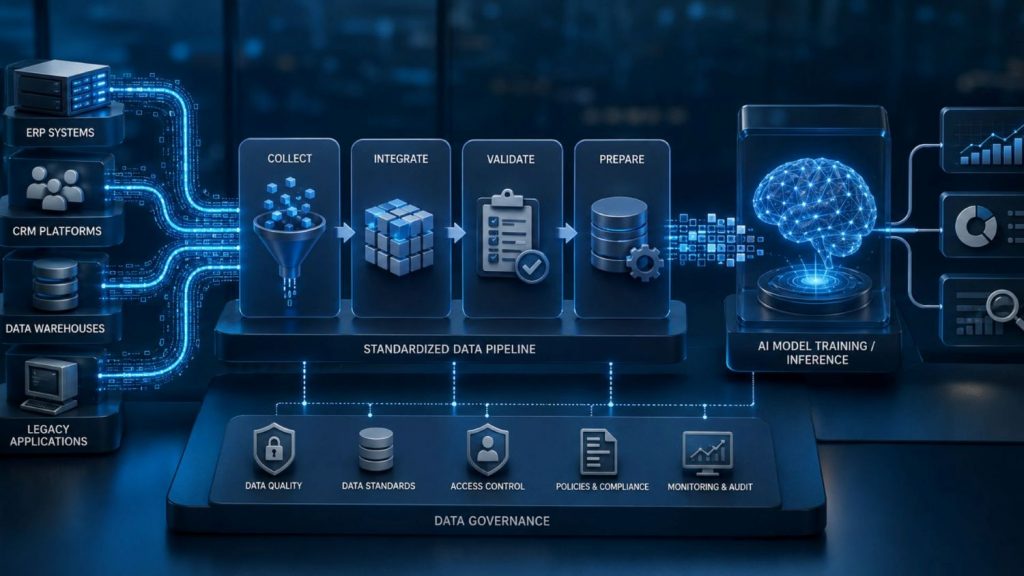
Standardized data pipelines and governance improve enterprise AI reliability and scalability
6.2. Talent Gap and Organizational Readiness
Successful enterprise AI adoption requires more than technical expertise. It depends on close collaboration between business leaders, data scientists, machine learning engineers, IT teams, security specialists, and end users. However, many organizations face shortages of AI talent while also encountering resistance to changes in established business processes.
Preparing the organization is just as important as implementing the technology itself. Organizations need clear AI strategies, executive sponsorship, employee training, and effective change management to support successful adoption across business functions. Human oversight should also remain an integral part of AI-driven workflows, particularly for business-critical decisions where AI is designed to support human decision-making rather than replace it.
6.3. Model Governance and Regulatory Compliance
As enterprise AI becomes embedded in critical business operations, organizations must ensure that AI systems remain transparent, secure, and compliant throughout their lifecycle. Since enterprise AI often processes sensitive customer and business data, governance plays a key role in protecting privacy, maintaining trust, and meeting regulatory requirements.
An effective AI governance framework should include role-based access control, model explainability, audit logging, continuous monitoring, and lifecycle documentation. These practices help organizations comply with regulations such as GDPR, HIPAA, and SOC 2 while reducing model bias, strengthening security, and improving accountability for AI-driven decisions.
6.4. Scaling from Pilot to Production
Many organizations successfully build AI proof-of-concepts but face challenges when scaling them into production. Enterprise AI requires reliable infrastructure, automated deployment, continuous monitoring, and the ability to handle fluctuating workloads without compromising performance or availability.
Serverless inference simplifies production deployment by automatically scaling compute resources based on real-time demand, eliminating infrastructure management while maintaining consistent performance. Serverless Inference provides a fully managed platform with automatic scaling and API-based integration, helping organizations accelerate AI deployment with lower operational complexity.
7. Build vs Buy vs Partner: Enterprise AI Strategy Options
Choosing the right enterprise AI strategy depends on an organization’s business objectives, technical capabilities, budget, and timeline. While some organizations have the expertise and resources to develop AI solutions in house, others may benefit from purchasing ready made platforms or partnering with specialized AI providers. Each approach offers different tradeoffs in terms of cost, customization, deployment speed, and long term maintenance.
| Criteria | Build | Buy | Partner |
| Best for | Organizations with strong AI expertise and unique business requirements | Organizations seeking fast deployment with standard AI capabilities | Organizations that need customized AI solutions without building everything internally |
| Time to deployment | Long | Short | Medium |
| Initial investment | High | Low to medium | Medium |
| Customization | Very high | Limited | High |
| Internal expertise required | High | Low | Medium |
| Maintenance responsibility | Fully managed by the organization | Managed primarily by the software vendor | Shared between the organization and the AI partner |
| Scalability | Depends on internal infrastructure | Determined by the platform provider | Shared responsibility with flexible scaling options |
| Typical use cases | Proprietary AI products, industry specific models, internal AI platforms | AI assistants, document processing, customer support automation | Enterprise AI transformation, custom AI applications, production AI deployment |
There is no one size fits all approach to enterprise AI adoption. Organizations with mature AI teams may choose to build proprietary solutions, while those seeking faster implementation often benefit from buying commercial platforms or partnering with experienced AI providers. Many enterprises ultimately adopt a hybrid strategy, combining internal development with external platforms and services to balance speed, flexibility, and long term scalability.
8. FAQs
8.1. What is an example of Enterprise AI?
Enterprise AI is used to automate and optimize business processes across industries. For example, banks use AI to detect fraudulent transactions, healthcare providers apply AI for medical imaging analysis and clinical decision support, while manufacturers leverage AI for predictive maintenance to reduce equipment downtime and improve operational efficiency.
8.2. How much does Enterprise AI cost?
Enterprise AI costs vary depending on factors such as deployment scope, infrastructure, model complexity, and implementation strategy. Organizations can reduce upfront investment by using managed AI platforms or cloud-based services, while custom AI solutions typically require higher spending on development, integration, and ongoing maintenance.
8.3. What’s the difference between Enterprise AI and traditional automation?
Enterprise AI costs vary depending on factors such as deployment scope, infrastructure, model complexity, and implementation strategy. Organizations can reduce upfront investment by using managed AI platforms or cloud-based services, while custom AI solutions typically require higher spending on development, integration, and ongoing maintenance.
Whether you are developing custom AI models, modernizing AI infrastructure, or deploying AI applications at scale, FPT AI Factory provides the platform and services to support every stage of the enterprise AI lifecycle. From high performance GPU clusters for model training to fully managed serverless inference for production deployment, FPT AI Factory enables organizations to build, deploy, and scale AI more efficiently.
If your organization requires a customized enterprise AI solution or plans to deploy AI at scale, contact the FPT AI Factory team through the contact form to discuss your requirements and receive tailored recommendations for your business.
Contact Information:
- Hotline: 1900 638 399
- Email: support@fptcloud.com
Enterprise AI Chatbot: Architecture, Benefits, and Scaling
What Is Retrieval Augmented Generation (RAG) in AI?
Best GPU Cloud Providers in 2026: Compared for Workloads