
What is reasoning in AI? It is the ability of an AI system to understand context, break a problem into steps, evaluate possible outcomes and generate a useful answer or action. In this article, FPT AI Factory will provide the definition of reasoning in AI, with the process workflow and the challenges within that help teams build, test, and scale reasoning-capable AI applications in production.
|
Key Takeaways AI reasoning helps models move beyond simple pattern matching by connecting context, logic and step-by-step problem solving. For enterprise teams, reasoning is becoming important for agents, customer support, knowledge retrieval and decision support, but it still needs careful testing, governance and scalable infrastructure.
|
Build and test reasoning-capable AI with FPT AI Factory. Teams can use GPU infrastructure, AI Notebook, Model Testing and Serverless Inference to experiment with models, evaluate outputs and move AI applications toward production. For customized deployments or large-scale AI infrastructure requirements, contact FPT AI Factory for project-based consultation.
1. What is AI Reasoning?
1.1. Definition
AI reasoning is the process that allows an artificial intelligence system to analyze information, connect ideas and make a logical decision or response. Instead of only detecting familiar patterns, the system tries to understand what the task requires, what information is relevant and what steps are needed to reach a result.
In simple terms, reasoning helps AI move from “recognizing” to “thinking through.” A reasoning model may compare facts, identify missing information, follow rules or break a complex request into smaller steps. This capability is especially important when the answer cannot be produced by a simple keyword match or one-step prediction.
For businesses, AI reasoning matters because many real workflows are not straightforward. Customer questions, internal research, document analysis and operational decisions often require context, judgment and multi-step logic. This is why reasoning is becoming a core capability in modern LLMs, AI agents and enterprise AI applications.
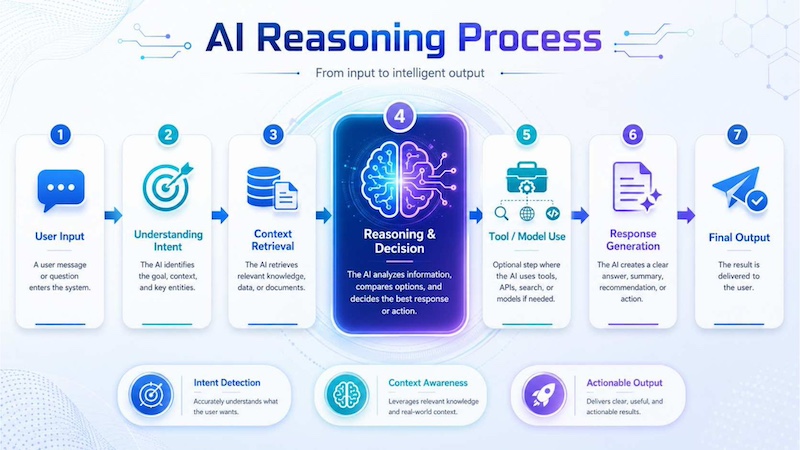
AI reasoning process transforms user input into a useful output by understanding intent, context, making decisions, using tools when needed and generating a clear response.
1.2. Difference between AI reasoning and pattern recognition
AI reasoning and pattern recognition are related, but they are not the same. Pattern recognition helps models identify similarities in data, while reasoning helps models use context and logic to solve a task. The table below summarizes the key differences.
| Criteria | Pattern Recognition | AI Reasoning |
| Main goal | Identify patterns, similarities or correlations in data. | Understand relationships, follow logic and solve tasks step by step. |
| Typical output | Classification, prediction, matching or detection. | Explanation, decision, plan, recommendation or final answer. |
| Best fit | Image classification, fraud detection, keyword matching or demand prediction. | Question answering, AI agents, document analysis and business decision support. |
| Limitation | May struggle when a task requires deeper context or multi-step logic. | Can still fail if context is incomplete, the prompt is unclear or the model generates incorrect assumptions. |
2. Why AI Reasoning matters
2.1 Solving multi-Step problems
Many enterprise tasks require more than one calculation, search or decision. For example, a support assistant may need to understand the user issue, check a policy, retrieve account information and decide whether to answer directly or escalate the case. AI reasoning helps organize these steps into a more coherent process.
This is useful for workflows such as troubleshooting, compliance review, contract analysis and technical support. Instead of producing a short generic answer, a reasoning-capable system can break the task into parts, identify dependencies and generate a response that better matches the user’s need.
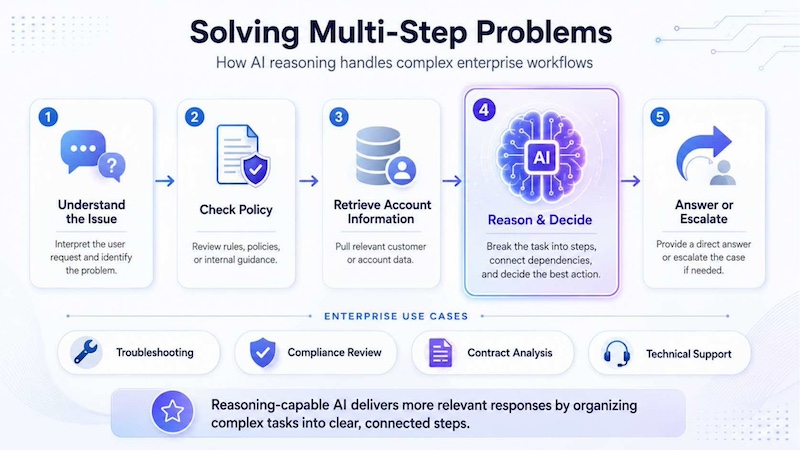
AI reasoning helps solve multi-step enterprise problems by breaking complex requests into clear steps, checking relevant information and deciding the best next action.
2.2 Supporting better decision-making
AI reasoning can support better decision-making by helping users compare options, evaluate trade-offs and explain why a recommendation makes sense. In business contexts, this can help teams review customer data, compare supplier proposals, analyze risks or summarize evidence before making a final decision.
The AI system should not replace human accountability in important decisions. However, it can reduce research time, structure information and surface key factors that people should consider. This makes reasoning especially valuable for analysts, managers and operational teams that handle complex information every day.
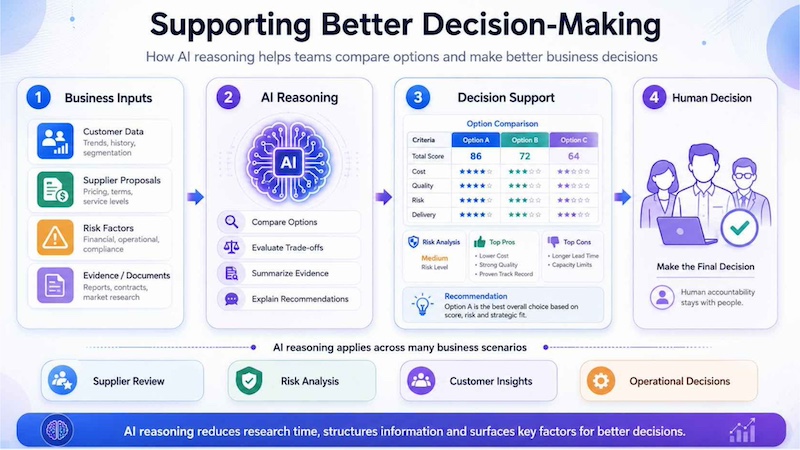
AI reasoning supports better decision-making by comparing options, evaluating trade-offs and summarizing key evidence.
2.3 Improving AI reliability
Reasoning can improve reliability when it helps the model check context, avoid unsupported assumptions and produce more structured answers. For example, a model that compares retrieved evidence before generating an answer is less likely to respond only from memory.
In enterprise applications, reasoning is often combined with Retrieval-Augmented Generation to ground responses in relevant documents. Once teams understand how retrieval supports reasoning, the next step is to look at how reasoning also enables more autonomous AI systems.
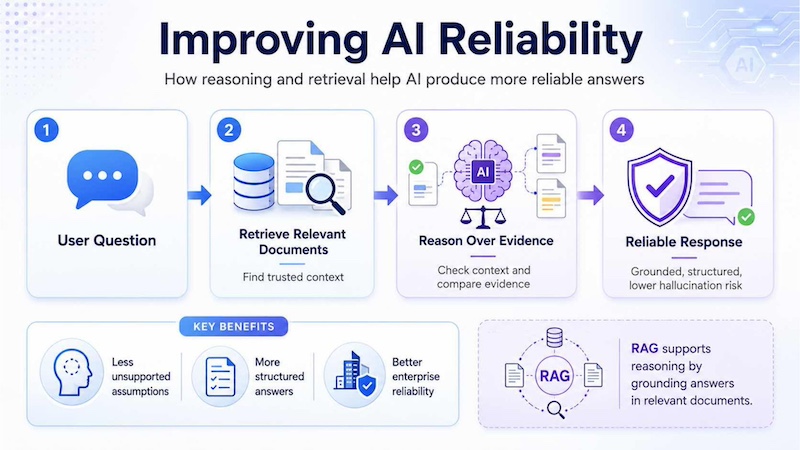
AI reliability improves when reasoning is combined with retrieval, allowing models to check relevant context, reduce unsupported assumptions.
2.4 Enabling more autonomous AI systems
AI reasoning is a foundation for more autonomous AI systems because agents need to understand goals, plan steps and decide which tools to use. In a simple workflow, an AI assistant may only answer a question. In a more advanced workflow, an AI agent may search documents, call APIs, update records and ask for approval before completing a task.
This is why reasoning is closely connected to AI agents and agentic workflows. A reasoning-capable agent can move beyond static responses and operate across a sequence of actions, but it also requires stronger governance, monitoring and infrastructure readiness.
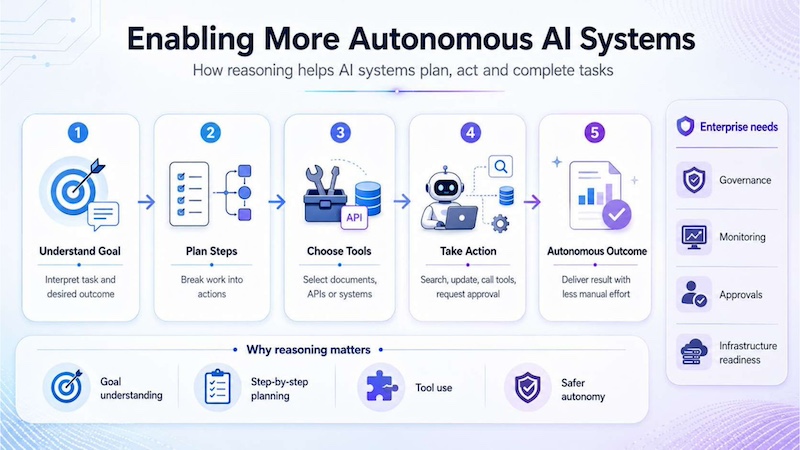
AI reasoning enables more autonomous AI systems by helping them understand goals, plan steps, use tools, take actions and complete tasks.
3. How AI Reasoning works
AI reasoning is not a single hidden step. It usually involves a sequence of operations that help the model interpret context, structure the problem and produce an answer. The process may vary by model and application, but most reasoning workflows follow the same general pattern.
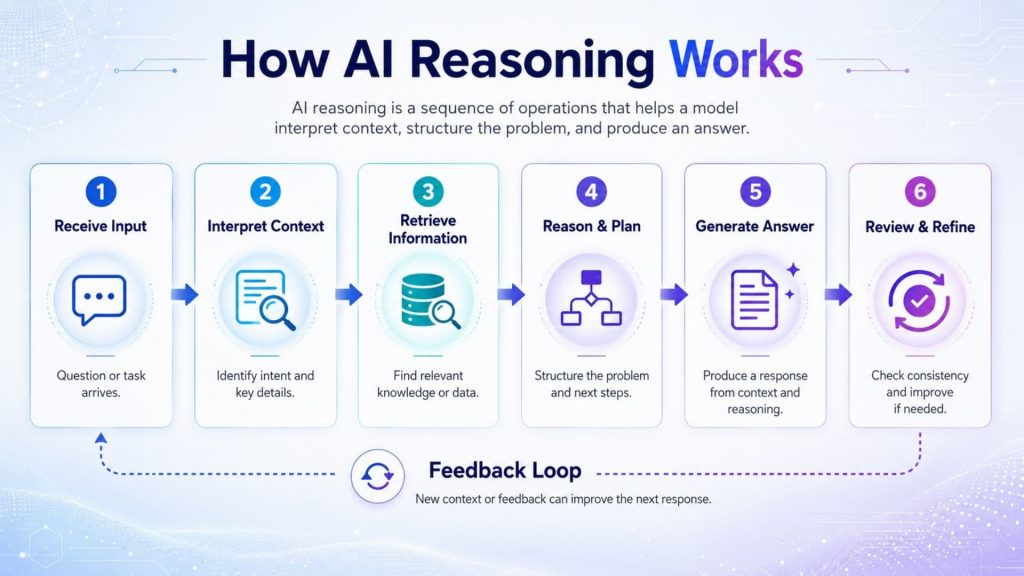
AI reasoning follows a step-by-step process: interpreting context, retrieving information, planning, generating an answer, and refining it through feedback.
3.1 Understanding context
The first step is understanding the context behind the request. The model identifies the user’s goal, key entities, constraints and any information that should be used or ignored. In enterprise settings, this context may come from the prompt, uploaded files, databases, customer records or internal knowledge sources.
For knowledge-heavy use cases, this step often depends on retrieval systems and vector databases. These technologies help the application retrieve relevant information before the model generates an answer, making the reasoning process more grounded in business data.
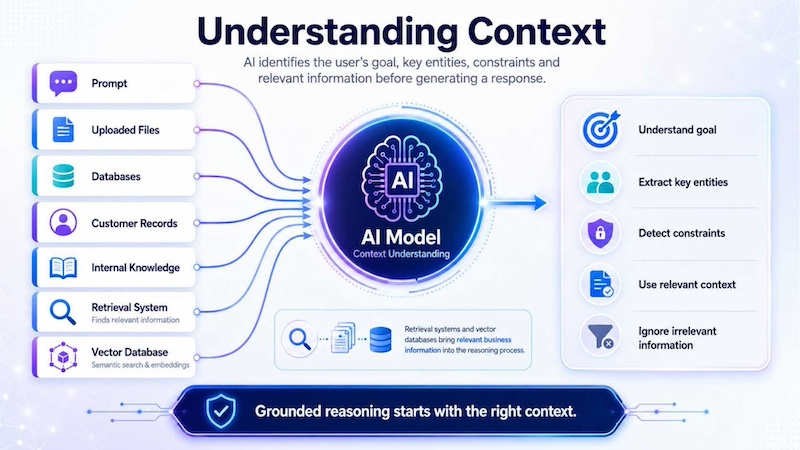
Understanding context helps AI use the right prompts, files, databases and business knowledge to generate more accurate and relevant responses.
3.2 Breaking problems into steps
After understanding the request, the model breaks the problem into smaller steps. For example, if a user asks for a comparison, the model may identify the criteria, collect relevant facts, evaluate each option and then produce a recommendation. This step-by-step structure helps the model handle tasks that are too complex for a one-shot response.
In AI applications, this stage can be designed through prompts, workflow orchestration or agent frameworks. The goal is not to expose every internal reasoning detail to users, but to make the system more reliable by giving it a clear task structure.
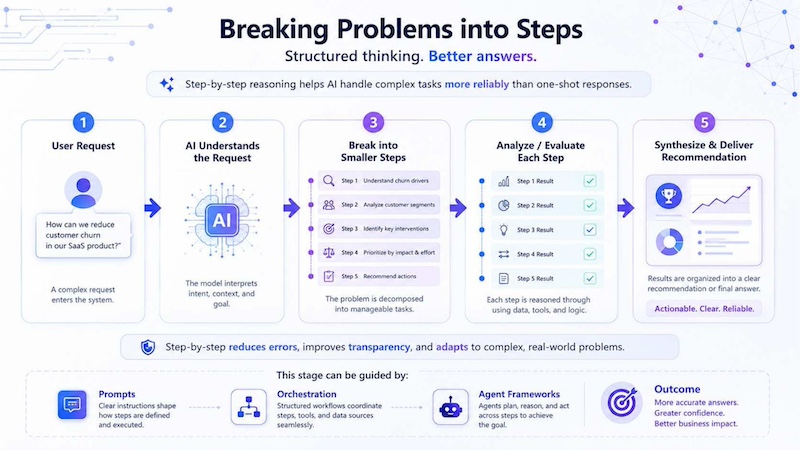
Breaking problems into steps helps AI handle complex tasks more reliably by organizing the request, analyzing each part and turning the results into a clear final answer.
3.3 Evaluating possible outcomes
Reasoning also involves evaluating possible outcomes before returning a final answer. The model may compare alternatives, check whether an answer follows the available evidence or decide whether the task needs clarification. This is especially important when the system supports business decisions, compliance workflows or customer-facing responses.
Because model outputs can still be wrong, teams should evaluate them before deployment. Model Testing can help teams compare model versions, run test data and assess output quality before a reasoning system is used in production.
3.4 Generating a final response
The final step is generating the response, prediction or action. In a chatbot, this may be a natural language answer. In a business workflow, it may be a recommendation, structured summary, extracted field or API action. The quality of the final output depends on the model, context, prompt design, retrieved evidence and evaluation process.
Once the reasoning output is ready, teams need a reliable serving layer to deliver it to users. This connects reasoning with model serving, where deployed models respond through APIs and production applications.
4. Types of AI Reasoning
Different reasoning patterns help AI systems solve different types of problems. In practice, modern AI systems may combine several types of reasoning depending on the task, available context and required output.
4.1 Deductive reasoning
Deductive reasoning applies a general rule to a specific case. If the rule is correct and the facts are true, the conclusion should logically follow. For example, if a company policy says refunds are allowed within 30 days and the customer purchased the product 10 days ago, the system can infer that the customer may be eligible for a refund.
In business applications, deductive reasoning is useful for policy checks, eligibility rules, compliance workflows and decision trees. However, it depends heavily on accurate rules and reliable input data.
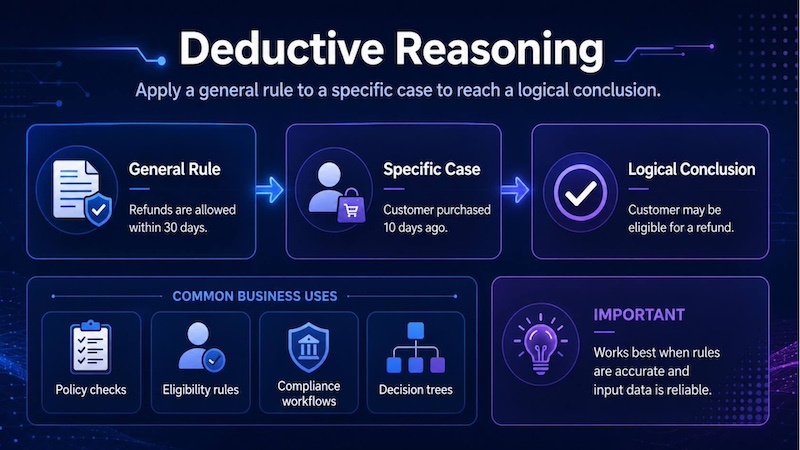
Deductive reasoning applies a general rule to a specific case to reach a logical conclusion, making it useful for policy checks, eligibility rules and compliance.
4.2 Inductive reasoning
Inductive reasoning draws a general conclusion from examples or observed patterns. For example, if many customers complain about the same product issue after a software update, the system may suggest that the update is a likely cause. This does not prove the conclusion with certainty, but it helps identify a probable pattern.
Inductive reasoning is useful for trend analysis, anomaly detection, customer feedback analysis and forecasting. In AI systems, it often works together with machine learning models that learn patterns from data.
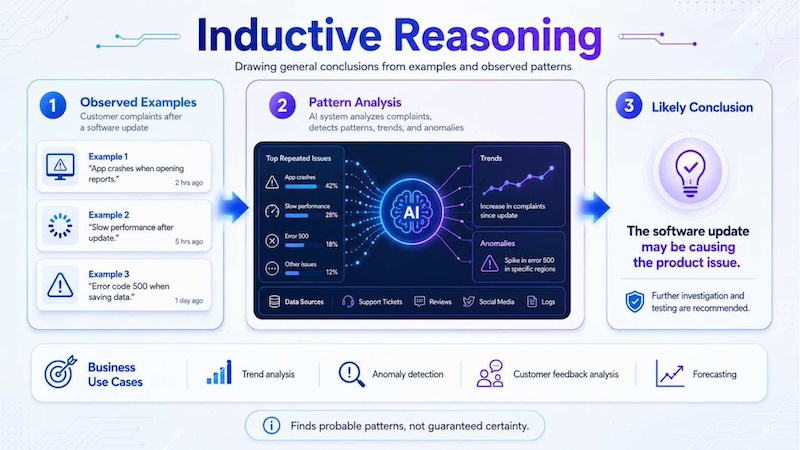
Inductive reasoning helps AI identify patterns from examples or data, supporting trend analysis, anomaly detection, customer feedback analysis and forecasting.
4.3 Abductive reasoning
Abductive reasoning chooses the most likely explanation based on incomplete information. For example, if a customer cannot log in and recently changed devices, the system may suggest device verification as a likely issue. This type of reasoning is common in troubleshooting and diagnostic workflows.
Because abductive reasoning is based on probability, it should be handled carefully. The system should explain uncertainty, ask for additional information when needed and avoid presenting guesses as confirmed facts.
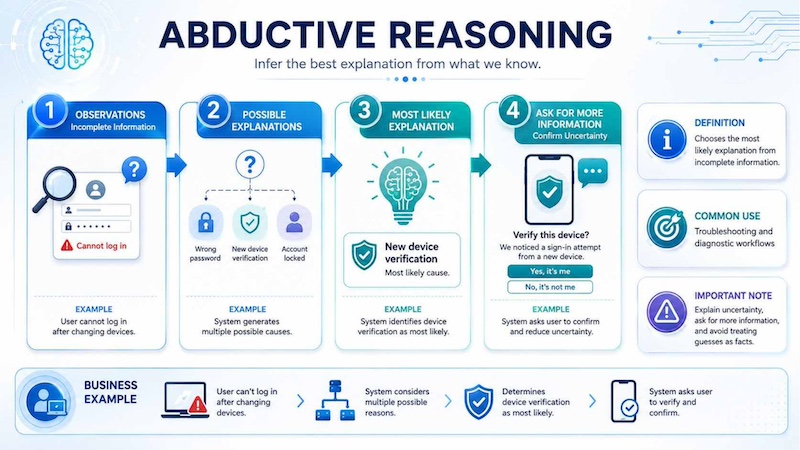
Abductive reasoning helps AI infer the most likely explanation from incomplete information, while asking for confirmation when uncertainty remains.
4.4 Chain-of-Thought reasoning
Chain-of-thought reasoning refers to breaking a complex task into intermediate steps before producing an answer. In user-facing applications, teams do not always need to show every internal reasoning step. However, designing prompts and workflows that encourage structured thinking can improve performance on tasks such as math, planning, coding and complex question answering.
For enterprise use, the goal is not to expose private reasoning details, but to produce more reliable outputs. Teams can use structured prompts, retrieval context, validation checks and evaluation datasets to guide the model toward better reasoning behavior.
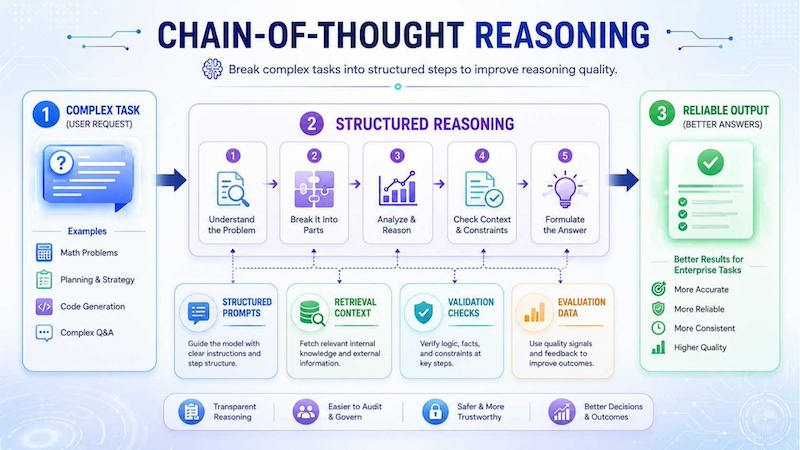
Chain-of-thought reasoning helps AI break complex tasks into structured steps, use context and validation checks, and generate more reliable enterprise outputs.
5. AI Reasoning in large language models
5.1 Reasoning vs Memorization
Reasoning and memorization are often confused in discussions about large language models. Memorization means the model recalls information seen during training or repeated in its data. Reasoning means the model uses available context to connect ideas, follow logic and solve a new task.
In practice, LLMs can display both behaviors. They may answer some questions from learned patterns, while using reasoning-like steps for tasks that require planning, comparison or synthesis. This is why enterprise teams should evaluate not only whether an answer sounds fluent, but whether it is grounded, logical and useful for the actual workflow.
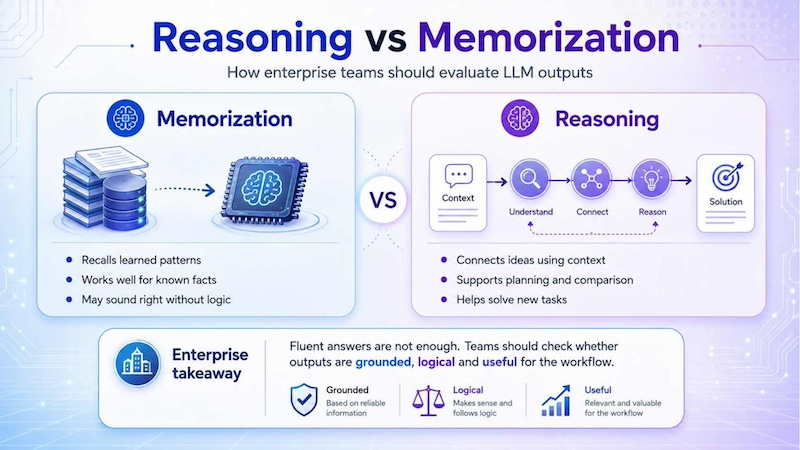
Reasoning connects ideas and context to solve new tasks, while memorization mainly recalls learned patterns without always proving the answer is grounded or logical.
5.2 Reasoning in modern LLMs
Modern LLMs are increasingly designed to handle complex tasks such as code generation, tool use, document analysis and multi-step planning. They can interpret prompts, use retrieved context, call external tools and generate structured outputs for downstream applications.
However, reasoning performance also depends on inference infrastructure. As teams move from testing to production, LLM inference becomes important because reasoning workloads may require longer context, more tokens and higher latency tolerance than simple classification tasks.
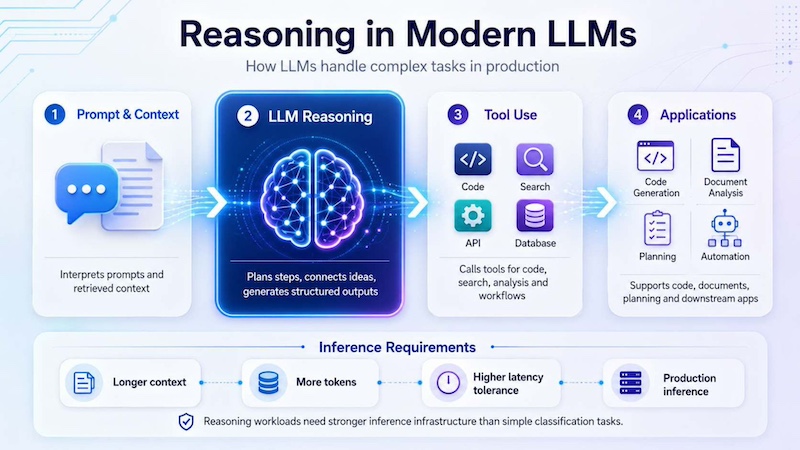
Modern LLMs use reasoning to understand context, plan actions, call tools and produce structured outputs, supported by scalable inference infrastructure in production.
5.3 Common reasoning benchmarks
Common reasoning benchmarks are used to test how models perform on tasks that require math, logic, coding, scientific reasoning or multi-step question answering. Examples include datasets for grade-school math, competition-level math, code generation, general knowledge reasoning and hard reasoning tasks.
Benchmarks are useful, but they are not enough on their own. A model that performs well on a public benchmark may still fail on a company’s internal documents, domain-specific terminology or customer workflows. For enterprise deployment, benchmark results should be combined with task-specific test sets and real workflow evaluation.
This is where Model Testing becomes important. Teams can test model outputs against representative prompts, edge cases and evaluation criteria before deciding whether a model is ready for deployment.
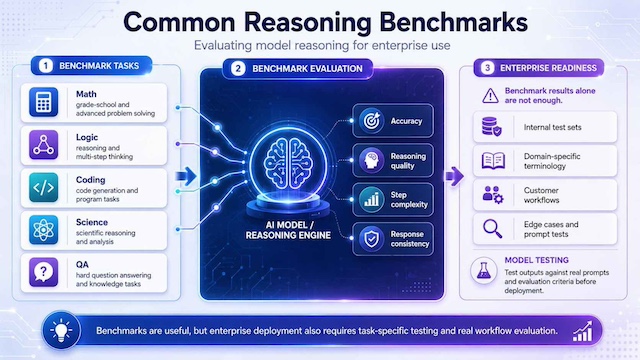
Reasoning benchmarks are useful for testing model capability, but enterprise teams still need task-specific tests and real workflow evaluation.
6. Enterprise applications of AI Reasoning
AI reasoning becomes most valuable when it is connected to real business workflows. The following use cases show how reasoning can support agents, customer service, knowledge retrieval and decision support across enterprise environments.
6.1 AI Agents and Assistants
AI agents use reasoning to understand a user goal, plan actions and interact with tools or systems. For example, an enterprise assistant may retrieve files, search the web, run code, create a report and ask for human approval before completing the task. This makes reasoning essential for workflows that go beyond simple Q&A.
A practical research example is Microsoft’s Magentic-One, which uses an Orchestrator agent to plan, track progress and delegate work to specialized agents for web browsing, file handling and code execution. This shows how reasoning can coordinate multi-step tasks across different tools and information sources.
For teams comparing agent architectures, the next related topic is single-agent vs multi-agent systems, which explains when one agent is enough and when multiple specialized agents may be more suitable.
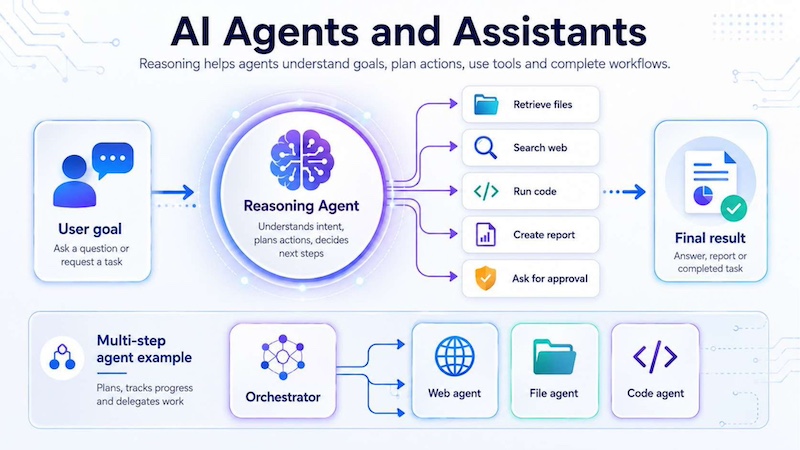
AI agents use reasoning to understand goals, plan actions, call tools and coordinate multi-step workflows from user request to final result.
6.2 Customer support automation
Customer support is one of the clearest use cases for AI reasoning. A support chatbot may need to understand the customer’s intent, check order data, review company policies and decide whether to answer, ask a follow-up question or escalate the case.
Klarna reported that its AI assistant handled 2.3 million conversations in its first month, covering two-thirds of customer service chats. The company also reported work equivalent to 700 full-time agents, a 25% drop in repeat inquiries and resolution time falling from 11 minutes to under 2 minutes.
For enterprises building customer-facing systems, reasoning should be combined with AI inference, monitoring and human escalation. This helps teams maintain response speed while reducing the risk of unsupported or low-quality answers.
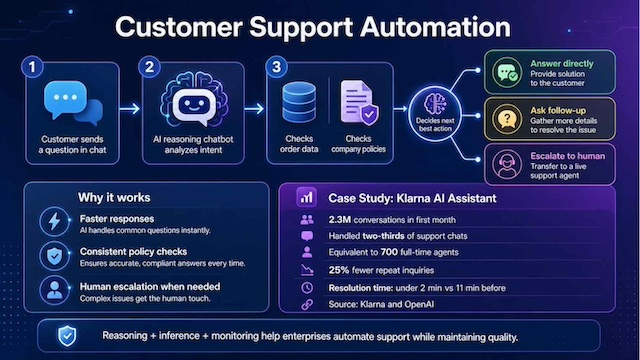
AI reasoning helps automate customer support by understanding intent, checking data and policies, and deciding whether to answer, ask follow-up questions.
6.3 Knowledge retrieval and analysis
Reasoning is also useful when employees need fast answers from internal knowledge bases, documents, reports and research materials. Instead of searching across many repositories, a reasoning-capable assistant can retrieve relevant information, summarize it and explain how it answers the user’s question.
McKinsey describes Lilli, its internal generative AI platform, as a tool that helps colleagues search and synthesize firm knowledge. The firm reported that 72% of employees were active on the platform and that colleagues reported up to 30% time savings in searching and synthesizing knowledge.
This use case often depends on RAG and semantic search. To understand the data layer behind this workflow, teams can study vector databases and how embeddings help retrieve contextually relevant information for enterprise AI systems.
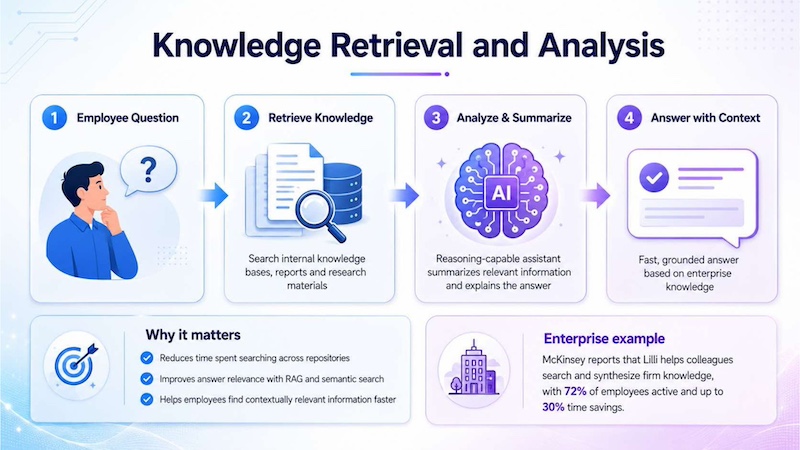
A reasoning-capable AI assistant can retrieve internal knowledge, analyze relevant documents and deliver faster, more useful answers for employees.
6.4 Business decision support
AI reasoning can support business decision-making by organizing evidence, comparing options and highlighting risks. For example, a procurement team may ask an AI assistant to compare supplier proposals, summarize contract terms and identify potential concerns before a human manager makes the final decision.
In finance, legal, operations and supply chain workflows, reasoning systems can help teams process information faster. However, these systems should support human judgment rather than replace it. High-impact decisions still require governance, traceability and clear accountability.
After organizations understand these use cases, the next step is preparing the AI development environment. A strong AI development platform helps teams manage data, experiments, models, testing and deployment in a more structured workflow.
7. Challenges of AI Reasoning
AI reasoning can create business value, but it also introduces risks that must be managed before production deployment. The main challenges include hallucinations, limited context understanding, evaluation difficulty, latency and cost.
7.1 Hallucinations and Incorrect logic
A reasoning-capable model can still produce confident but incorrect answers. It may misread context, assume missing facts or create a logical explanation that sounds plausible but is not supported by the data. This is a serious concern for customer support, legal, finance and healthcare-related workflows.
To reduce this risk, teams should combine reasoning with retrieval, guardrails and systematic evaluation. Model Testing can help teams assess response quality, compare model behavior and identify failure cases before deployment.
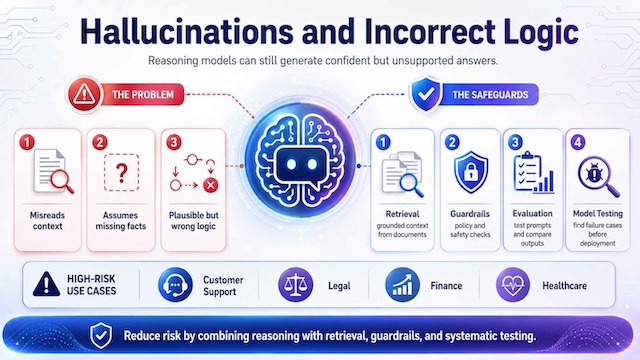
Hallucinations and incorrect logic can make AI outputs sound confident but unsupported, so teams should reduce risk with retrieval, guardrails, evaluation.
7.2 Limited context understanding
Models can struggle when a prompt is vague, the context window is too small or the retrieved documents are incomplete. In these cases, the model may miss important constraints or generate an answer based on partial information.
Teams can improve context understanding by preparing better prompts, using clean enterprise data, designing stronger RAG pipelines and adding human review for sensitive workflows. Context quality is often as important as model capability.
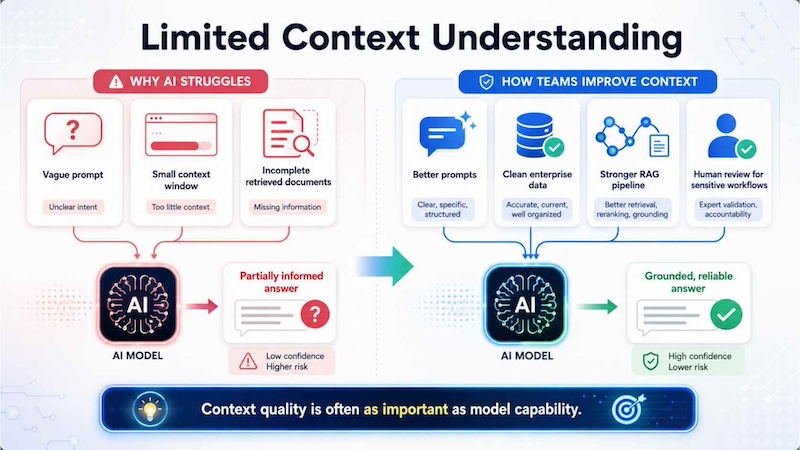
Limited context understanding can lead to partial or unreliable AI answers, so teams need better prompts, clean data, stronger RAG pipelines and human review.
7.3 Evaluation and Benchmarking challenges
Reasoning is harder to evaluate than simple classification because there may be several acceptable answers or solution paths. A model may reach a useful answer through a different sequence of steps, or it may produce an answer that is partially correct but operationally risky.
This is why enterprises should not rely only on public benchmarks. They need test sets that reflect real user questions, internal terminology, edge cases and business rules. Evaluation should also include accuracy, consistency, latency, safety and escalation behavior.
Model evaluation is closely connected to AI governance, because organizations need clear standards for when a reasoning system is safe, reliable and ready for production use.
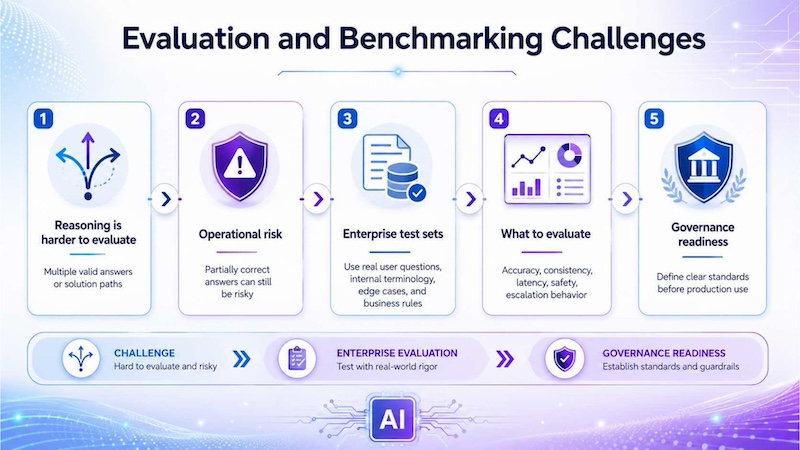
Evaluation and benchmarking help enterprises assess whether AI reasoning systems are accurate, safe, consistent, and ready for real-world use.
7.4 Cost and latency considerations
AI reasoning workloads can be more expensive and slower than simple inference tasks because they often require longer prompts, more retrieved context, tool calls or multiple model passes. When request volume increases, teams need to control latency while keeping inference costs predictable.
Before deployment, Model Testing can help teams evaluate reasoning accuracy, hallucination risks, response consistency and model reliability across real business scenarios. This is important because a reasoning model may appear useful in simple tests but fail when handling complex prompts, incomplete context or multi-step tasks.
For production applications, Serverless Inference helps teams connect models through APIs and scale inference based on demand without managing the full serving layer manually. For heavier experiments, custom workloads or optimization tasks, GPU Container and GPU Virtual Machine provide flexible GPU resources for development, testing and deployment.
8. FAQs
8.1 What is the difference between reasoning and inference in AI?
Reasoning is the process of using context and logic to solve a problem, while inference is the process of running a trained model to generate an output from a new input. In practice, reasoning happens within or around the inference process when the model analyzes context, plans steps or evaluates possible answers before generating a response.
8.2 Can LLMs truly reason?
LLMs can perform reasoning-like tasks such as multi-step problem solving, planning, code generation and document analysis, but they are not perfect reasoning systems. They can still hallucinate, miss context or produce incorrect logic. For enterprise use, teams should combine LLMs with retrieval, testing, monitoring and human review for important workflows.
8.3 Which AI models are best at reasoning?
The best model depends on the task. Some models are stronger at math and coding, while others perform better in long-context analysis, multilingual tasks or enterprise document workflows. Teams should evaluate models using real business prompts, domain-specific datasets and production constraints such as latency, cost and safety requirements.
AI reasoning helps models solve multi-step problems, support better decisions and power more autonomous enterprise workflows. It is useful for AI agents, customer support, knowledge retrieval and decision support, but it also requires careful evaluation because fluent answers are not always correct answers.
To build reasoning-capable AI in production, teams need reliable infrastructure, model evaluation and scalable inference. FPT AI Factory supports this process through GPU infrastructure, AI Studio tools, Model Testing and Serverless Inference. For enterprises that need customized AI solutions, large-scale deployment or expert consultation, contact FPT AI Factory through the official contact form.
Contact Information:
- Hotline: 1900 638 399
- Email: support@fptcloud.com
Explore more articles