

From AI chatbots and intelligent search to document automation and multilingual communication, Natural Language Processing is now a core technology behind many AI-powered applications. In this article, FPT AI Factory helps you understand “What is Natural Language Processing?” and how it drives modern enterprise automation.
|
Key Takeaways: Natural Language Processing is transforming how organizations interact with and extract value from language data. Here are the key points to remember about NLP and its role in modern AI applications:
|
FPT AI Factory provides the tools to build and validate reasoning-capable AI efficiently. With GPU infrastructure, AI Notebook, Model Testing, and Serverless Inference, teams can prototype models, assess outputs, and streamline the path to production. Organizations requiring custom deployments or large-scale infrastructure can contact FPT AI Factory for project-specific solutions.
1. What is Natural Language Processing?
Natural Language Processing (NLP) is a branch of artificial intelligence (AI) that enables computers to understand, interpret, generate, and interact with human language. By combining machine learning, computational linguistics, and deep learning, NLP transforms unstructured text or speech into structured information that AI systems can process. Today, NLP powers a wide range of enterprise applications, including AI assistants, customer service automation, document analysis, enterprise search, and content generation.
2. How does NLP work?
NLP converts human language into structured information that AI systems can understand and act upon. The process combines data preprocessing, language understanding, machine learning models, and inference to transform raw text or speech into meaningful outputs. Hence, businesses can automate language-intensive tasks with greater speed, consistency, and scalability. The following diagram illustrates the NLP workflow:
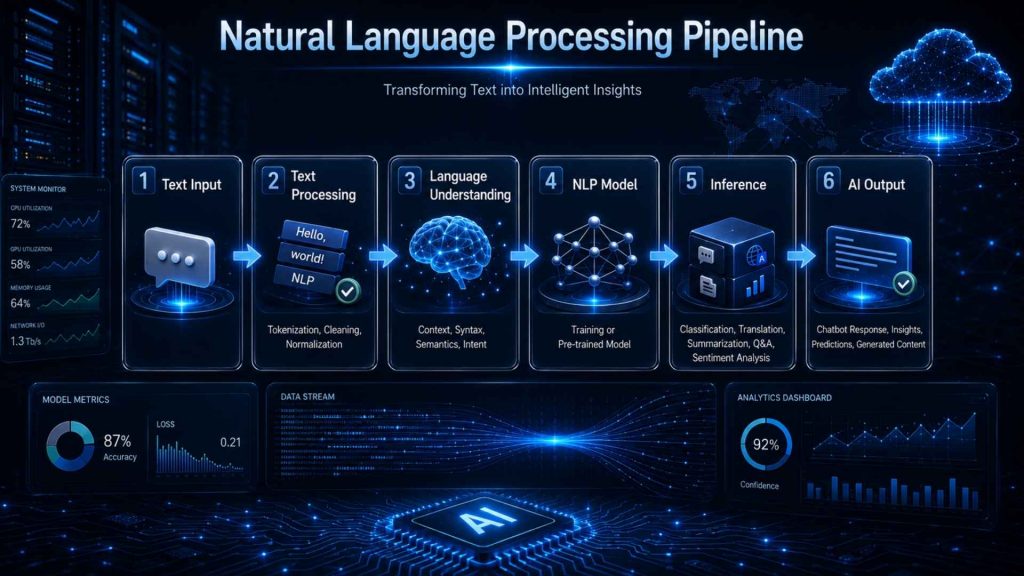
The end-to-end NLP workflow from text input to AI-generated output
2.1 Text Processing
Text processing serves as the foundational stage where raw conversational or written data is cleaned and standardized for machine analysis. This step involves techniques like tokenization, lemmatization, and stop-word removal to strip away linguistic noise and isolate core semantic elements. In an enterprise AI context, efficient text processing ensures that downstream machine learning models receive high-quality, normalized data inputs.
For example, a financial institution may process thousands of customer emails by removing formatting inconsistencies and identifying key financial terms. This improves semantic analysis by providing cleaner, more consistent input.
2.2 Language Understanding
After preprocessing, NLP models analyze the meaning of words, phrases, and sentences by identifying grammar, context, semantics, and user intent. Rather than examining individual words alone, modern NLP considers relationships between words to better understand the overall meaning of a sentence. This capability enables AI systems to distinguish similar phrases used in different contexts, then improves customer interactions, document interpretation, and intelligent search experiences.
For example, a customer may ask, “My payment failed.” An NLP system recognizes the user’s intent as a payment issue rather than simply detecting the word “payment,” allowing customer support automation to provide more relevant assistance.
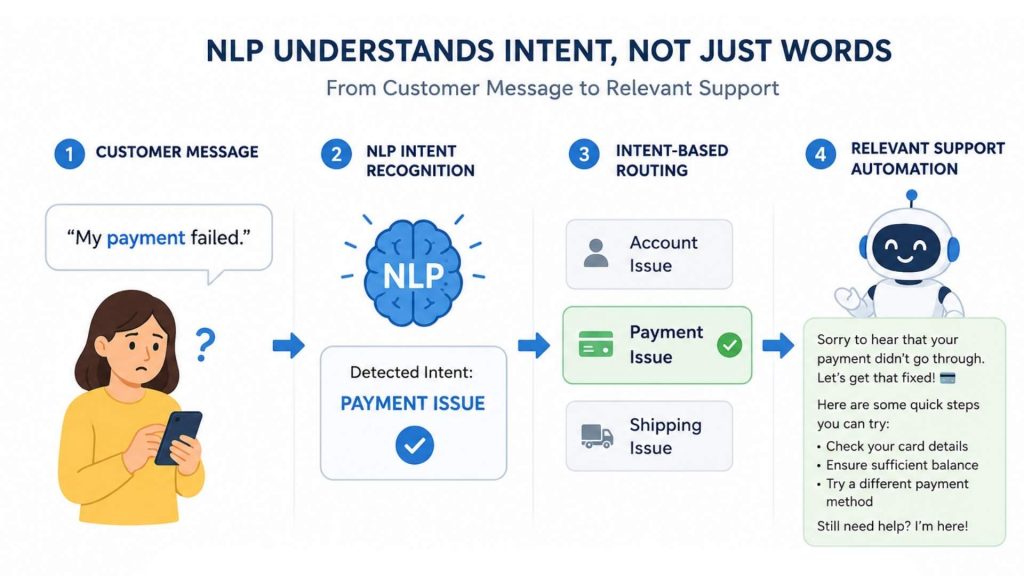
Language understanding enables AI to recognize context, semantics, and user intent
2.3 Model Training
Model training allows NLP systems to learn language patterns by analyzing large collections of text from books, websites, business documents, and conversations. During training, parameters such as learning rate, batch size, and optimization algorithms are carefully adjusted to improve model accuracy while ensuring stable convergence. Some NLP systems also apply active learning in machine learning, where the model identifies uncertain predictions for human annotation, improving accuracy while reducing labeling costs.
For example, Mayo Clinic fine-tuned an NLP model using clinical notes from electronic health records, enabling more accurate recognition of medical terminology and patient information than a general-purpose language model (Chiang et al., 2024).
2.4 Inference and Output Generation
Once trained, the NLP model enters the inference stage, where it processes new text and generates predictions or responses in real time. Depending on the application, the output may include sentiment classification, document summarization, language translation, chatbot responses, or extracted business insights. Scalable inference infrastructure also enables enterprises to serve thousands of users simultaneously while maintaining consistent performance.
For example, an AI customer service assistant can analyze incoming support requests and generate personalized responses within seconds. Fast inference improves customer satisfaction while reducing manual workloads for support teams.
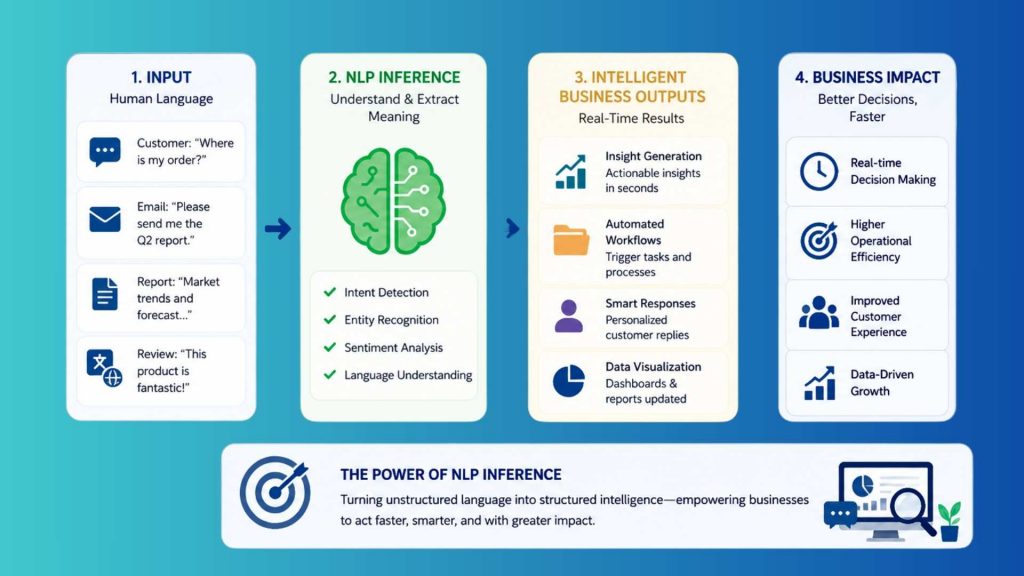
NLP inference transforms language into intelligent business outputs in real time
3. Benefits of Natural Language Processing
Implementing natural language processing offers profound advantages for organizations aiming to optimize their operations and scale their digital capabilities. Here are some key benefits of deploying modern NLP solutions within the enterprise:
3.1 Automate Language-Based tasks
NLP enables organizations to automate repetitive language-intensive tasks such as document classification, email routing, transcription, and information extraction. Automating these processes reduces manual effort, improves consistency, and accelerates business workflows. As a result, employees can focus on higher-value activities instead of routine administrative work.
For example, an insurance company can automatically classify incoming claims and extract policy information before routing cases to the appropriate department. This reduces processing time while improving operational efficiency.
3.2 Improve customer experiences
NLP allows AI systems to better understand customer questions, requests, and feedback through natural language conversations. This enables chatbots, virtual assistants, and customer service platforms to provide faster and more accurate responses. Moreover, it also helps organizations deliver more personalized customer interactions across multiple communication channels.
For example, Allianz Benelux implemented an AI-powered chatbot to help customers quickly find the correct insurance claim forms and support information. The chatbot simplified customer journeys and achieved over 90% positive user feedback.

NLP enables intelligent and personalized customer interactions
3.3 Extract insights from unstructured data
Organizations generate large volumes of unstructured data from emails, reports, contracts, social media, and customer feedback. NLP converts this information into structured insights by identifying topics, entities, relationships, and sentiment. These insights support faster business decisions and help organizations uncover trends that may otherwise remain hidden.
For example, Hapag-Lloyd (a global container shipping company) uses AI and NLP to analyze more than 15,000 customer feedback comments each month. The system automatically identifies sentiment and key themes, enabling product teams to make faster, data-driven decisions.
3.4 Support multilingual communication
Modern NLP systems support multiple languages, allowing organizations to communicate more effectively with global customers and employees. Capabilities such as machine translation, multilingual search, and cross-language document analysis reduce communication barriers across international operations. This enables enterprises to deliver consistent services while expanding into new markets.
For example, a multinational e-commerce company can automatically translate customer support requests into the agent’s preferred language while preserving the original meaning. This improves response quality and accelerates global customer support.
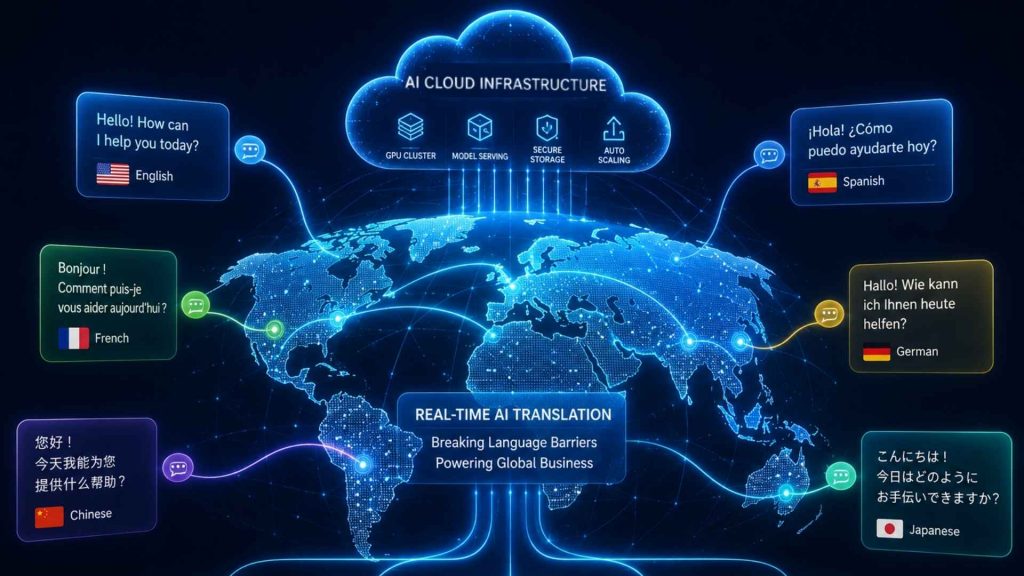
Multilingual NLP enables seamless communication across global organizations
3.5 Enable scalable AI applications
NLP, commonly deployed through APIs, serves as a foundation for enterprise AI applications such as intelligent search, virtual assistants, document processing, and generative AI. As user demand fluctuates, organizations require scalable AI infrastructure and efficient AI inference capabilities to maintain low latency and optimize operational costs.
Solutions such as FPT AI Factory Serverless Inference enable enterprises to automatically scale NLP inference workloads based on real-time demand, reducing operational complexity while optimizing infrastructure utilization. This serverless approach allows businesses to focus on developing AI applications rather than managing underlying computing resources.
For example, an enterprise knowledge platform may experience significant spikes in search requests during business hours. With serverless inference, NLP models automatically scale to handle increased traffic while maintaining low latency and cost efficiency.
4. Key NLP techniques
NLP relies on several core techniques that enable AI systems to understand, analyze, and generate human language. Here are some of the most important NLP techniques used in modern AI systems:
4.1 Named Entity Recognition (NER)
Named Entity Recognition (NER) identifies and classifies specific entities within text, such as people, organizations, locations, dates, and products. By converting unstructured text into structured information, NER helps organizations extract valuable business data more efficiently. This technique is widely used in document processing, compliance monitoring, and knowledge management systems.
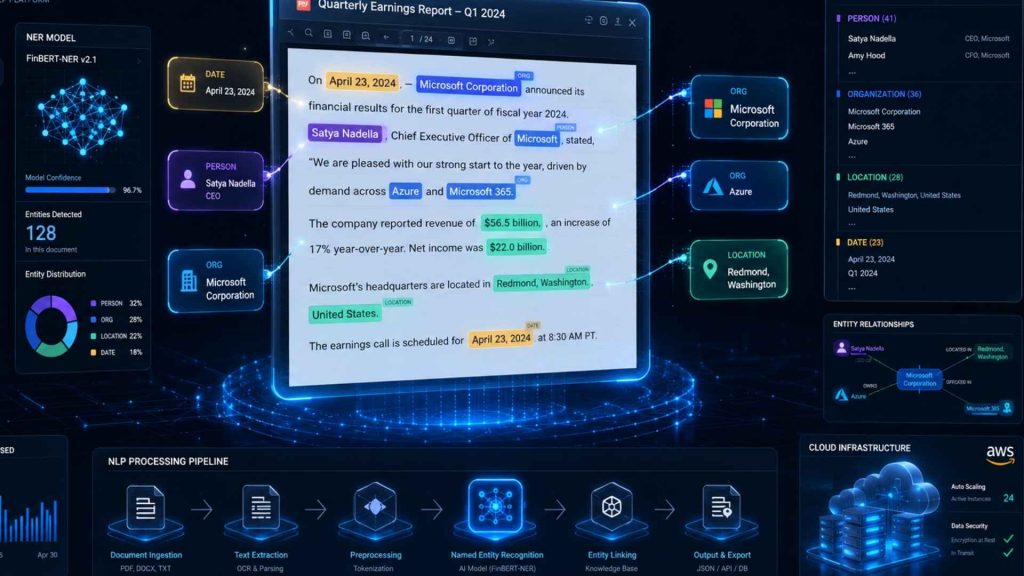
NER extracts key entities such as people, organizations, locations, and products from text
4.2 Sentiment Analysis
Sentiment Analysis determines whether a piece of text expresses positive, negative, or neutral opinions. Organizations use this technique to monitor customer feedback, social media conversations, product reviews, and brand perception at scale. By understanding customer sentiment, businesses can respond more effectively to market trends and customer concerns.
For example, Coca-Cola has used AI-driven sentiment analysis to monitor social media conversations and better understand consumer perceptions of its products and marketing campaigns.
4.3 Text Classification
Text Classification automatically categorizes text into predefined groups based on content and context. Common applications include spam detection, topic categorization, customer support ticket routing, and content moderation. This technique enables organizations to process large volumes of text more efficiently while improving operational consistency.
For example, Gmail uses machine learning and NLP-based classification models to automatically identify spam, phishing attempts, and promotional emails.
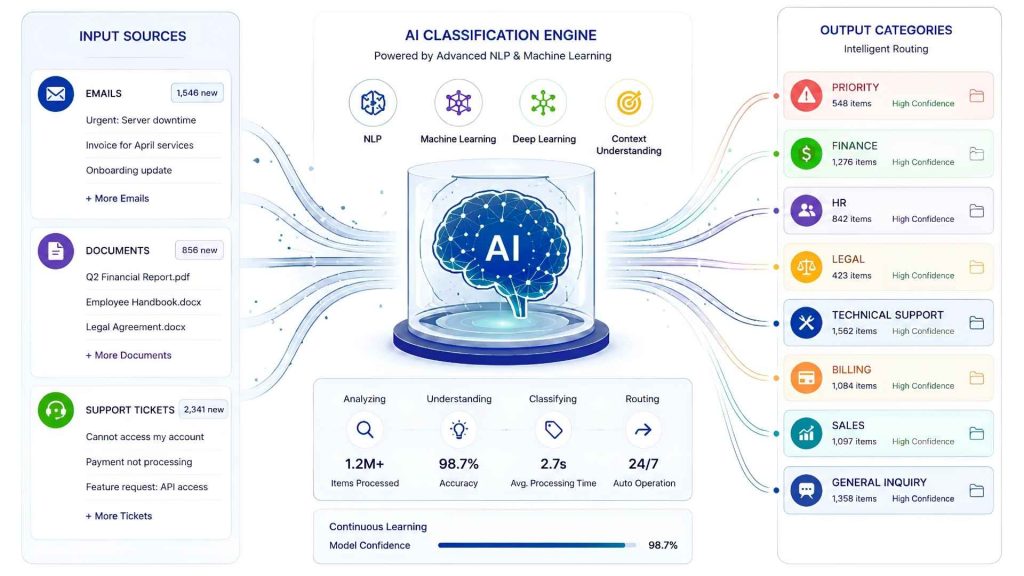
Text Classification automatically categorizes documents, emails, and messages based on content
4.4 Machine Translation
Machine Translation converts text from one language into another while preserving meaning and context. Modern AI-powered translation systems use deep learning models to improve accuracy across multiple languages. This capability supports global communication, multilingual customer service, and international business operations.
For example, Google Translate uses advanced neural machine translation models to translate content across hundreds of languages.
4.5 Information Extraction
Information Extraction identifies and retrieves specific facts, relationships, and structured data from unstructured text. Organizations use this technique to process contracts, invoices, financial reports, medical records, and other business documents. By automating data extraction, enterprises can reduce manual workloads and improve decision-making speed.
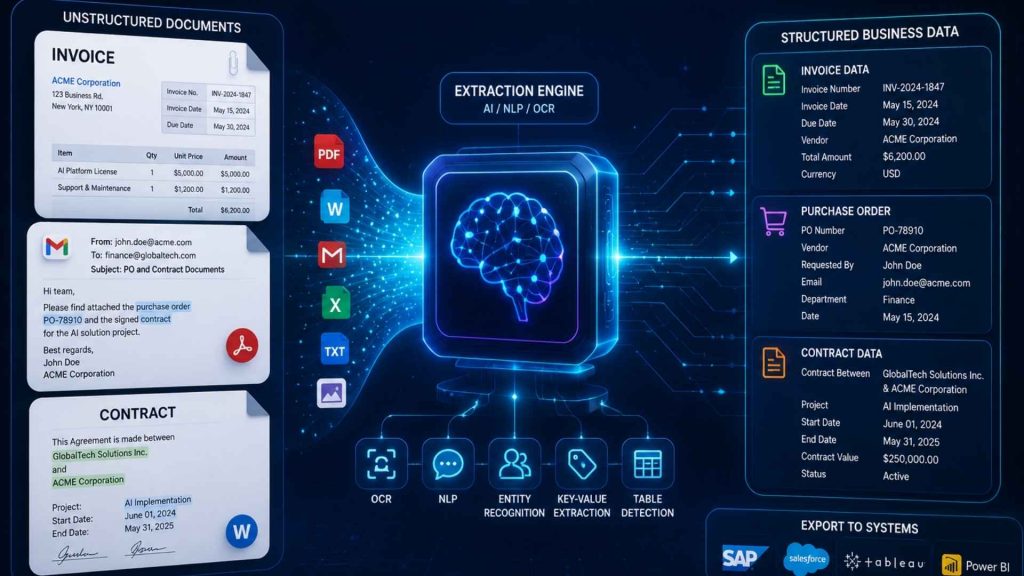
Information Extraction converts unstructured documents into structured business data
5. NLP vs Large Language Models (LLMs)
Although Natural Language Processing (NLP) and Large Language Models (LLMs) are closely related, they are not the same. Now, let’s discover the similarities and differences between them, then understand their relationship to help organizations choose the right AI solution for different business needs.
5.1 How NLP and LLMs are related
Large Language Models are built upon Natural Language Processing techniques and advances in deep learning. Traditional NLP methods focus on specific language tasks, while LLMs can perform multiple NLP tasks using a single foundation model. To better understand how these models generate responses in production, it’s also helpful to explore the concept of LLM inference, which refers to the process of running trained LLMs on new inputs. As a result, modern AI applications often combine traditional NLP techniques with LLM capabilities to achieve higher accuracy and greater flexibility.
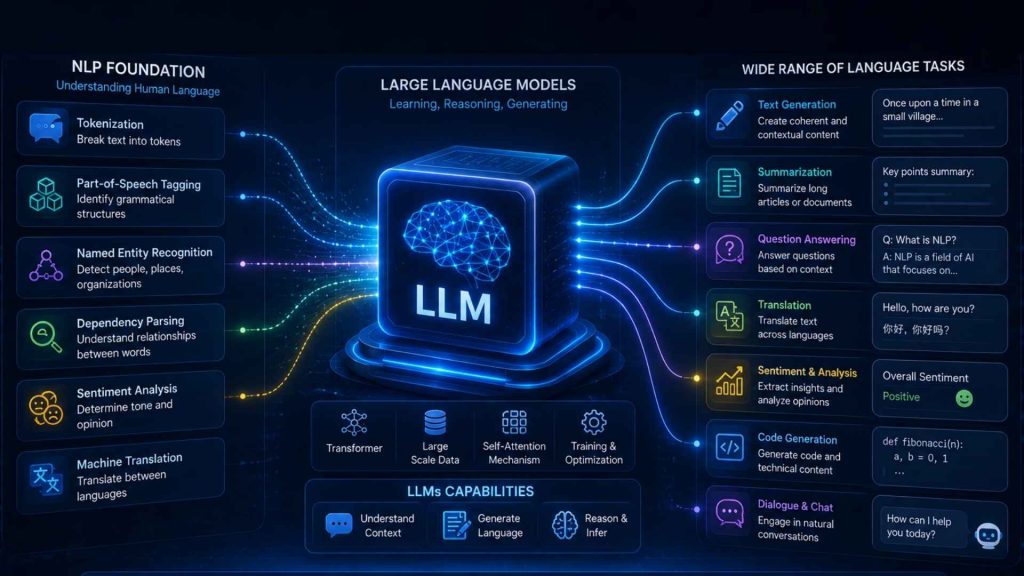
Large Language Models build upon Natural Language Processing to perform a wide range of language tasks
5.2 Key differences
While NLP and LLMs share the same objective of processing human language, they differ in architecture, capabilities, and computational requirements. Here is a table comparing the two approaches:
| Feature | NLP | Large Language Models |
| Scope | Focuses on specific language tasks | Supports multiple language tasks with a single model |
| Model Size | Smaller and task-specific | Large foundation models with billions of parameters |
| Training Data | Domain-specific datasets | Massive internet-scale datasets |
| Flexibility | Limited to predefined tasks | Can generalize across many language tasks |
| Infrastructure | Lower computing requirements | Requires more powerful GPU infrastructure |
| Common Use Cases | Text classification, NER, sentiment analysis | AI assistants, content generation, summarization, question answering |
Understanding these distinctions allows enterprise architects to optimize their technology stack for maximum efficiency and return on investment. While LLMs offer unprecedented flexibility, traditional NLP remains highly cost-effective and precise for narrow, specialized operational workloads.
5.3 When to use NLP vs LLM-Based solutions
The choice between traditional NLP and LLMs depends on business objectives, accuracy requirements, and available computing resources. Traditional NLP is often the preferred option for structured workflows such as document classification, entity extraction, and sentiment analysis because it offers lower operational costs and predictable performance. Meanwhile, LLM-based solutions are better suited for applications requiring advanced reasoning, natural conversations, content generation, and complex question answering.
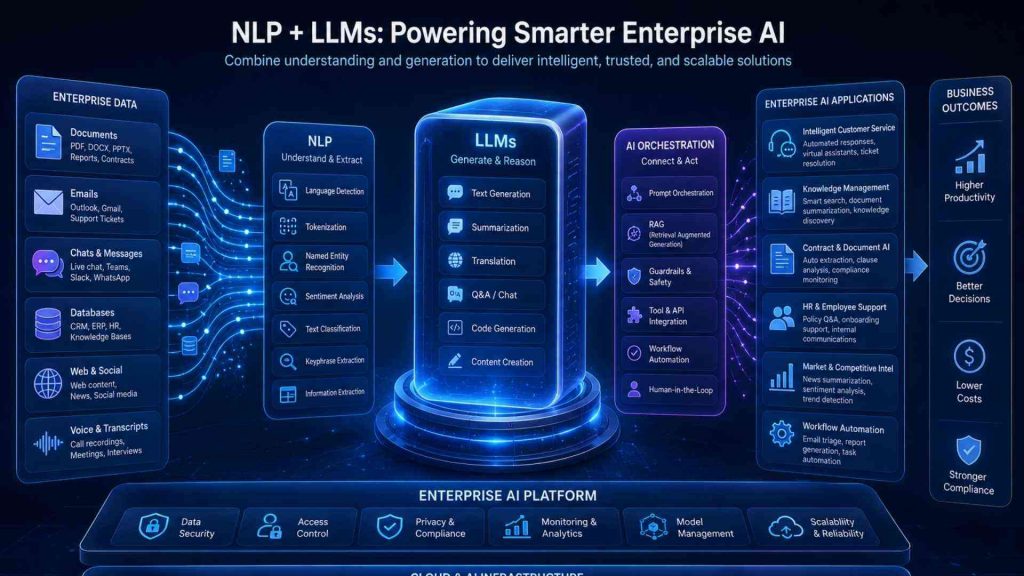
Organizations can combine NLP and LLMs to optimize enterprise AI applications
6. Common NLP applications
NLP models are increasingly deployed through cloud services and Edge AI devices, enabling real-time speech recognition, translation, and virtual assistants with lower latency. From intelligent search to generative AI, NLP enables organizations to extract greater value from unstructured data. Here are some of the most common enterprise applications of NLP.
6.1 Enterprise search
Enterprise search applications revolutionize how corporate knowledge workers locate critical business insights across distributed, multi-cloud data repositories. By replacing traditional keyword matching with semantic search capabilities, employees can query internal systems using natural phrasing and receive highly relevant contextual results thanks to NLP. This improves operational efficiency by significantly reducing the time spent hunting through disparate corporate intranets.
6.2 AI Chatbots and Virtual Assistants
NLP enables chatbots and virtual assistants to understand user questions, maintain context, and generate natural responses. This improves customer support, employee assistance, and self-service experiences while reducing response times. Modern conversational AI often combines NLP with Large Language Models for more human-like interactions.
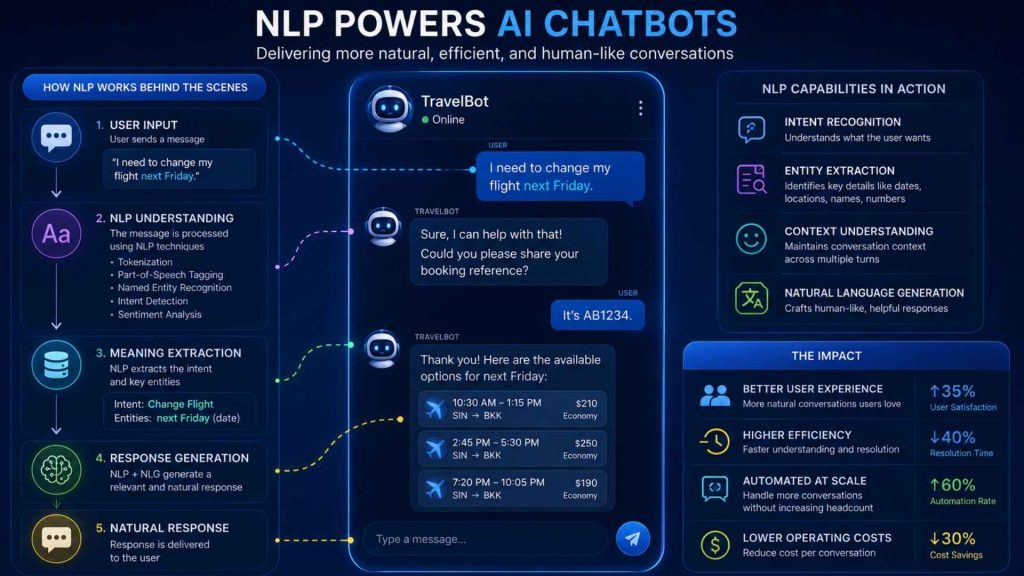
NLP enables AI chatbots to deliver more natural and efficient conversations
6.3 Intelligent Document Processing
NLP helps organizations automatically extract, classify, and organize information from documents such as invoices, contracts, forms, and reports. This reduces manual data entry, improves processing accuracy, and accelerates business workflows. Intelligent Document Processing is widely adopted in industries that manage large volumes of paperwork.
6.4 Customer support automation
NLP automates customer support by classifying requests, routing tickets, generating responses, and analyzing customer sentiment. This allows support teams to resolve issues more efficiently while delivering faster and more consistent service. It also helps organizations scale customer operations without significantly increasing staffing requirements.

NLP streamlines customer support through intelligent automation
6.5 Content generation
NLP, combined with Large Language Models, enables AI systems to generate articles, product descriptions, emails, reports, and summaries with minimal human input. This helps businesses accelerate content creation while maintaining consistency and improving productivity. Organizations can also customize AI-generated content for different audiences and business needs.
7. Challenges in Natural Language Processing
Despite its rapid advancement, NLP still faces several technical and operational challenges. Here are some of the key challenges organizations should consider when implementing NLP solutions.
7.1 Language ambiguity
Human language often contains words or phrases with multiple meanings, making accurate interpretation difficult for AI systems. The intended meaning usually depends on context, tone, or domain-specific knowledge rather than the words themselves. Resolving ambiguity is essential for improving the accuracy of search, chatbots, and document analysis.
For example, the word “bank” may refer to a financial institution or the side of a river. NLP models must analyze the surrounding context to determine the correct meaning.
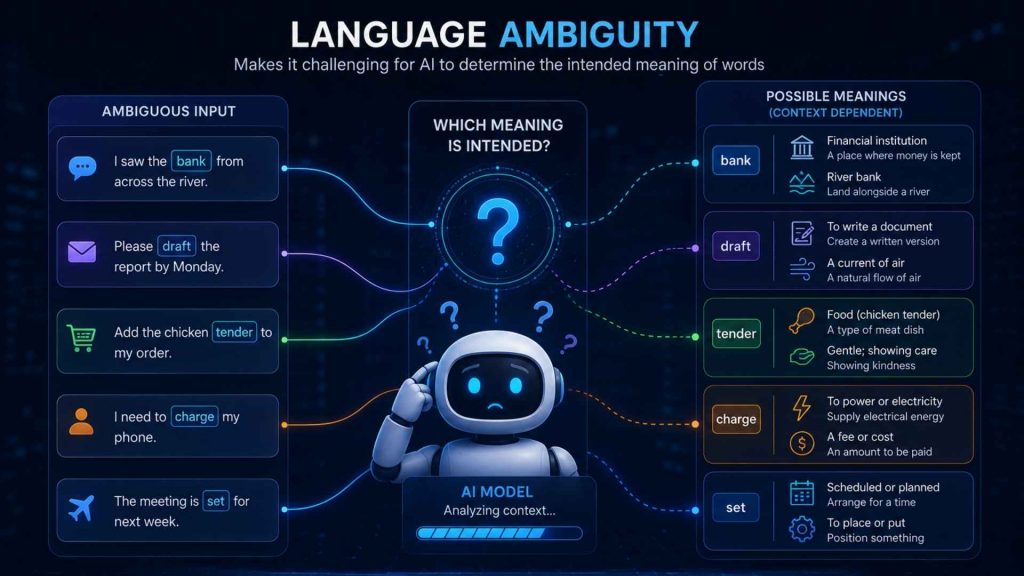
Language ambiguity makes it challenging for AI to determine the intended meaning of words
7.2 Context understanding
Understanding context remains one of the biggest challenges in NLP because the meaning of a sentence often depends on previous conversations or surrounding information. AI systems must recognize relationships between words, sentences, and user intent to generate accurate responses. Strong contextual understanding is especially important for conversational AI and enterprise assistants.
For example, if a customer asks, “Where is my order?” followed by “Can I change it?”, AI must understand that “it” refers to the order placed earlier in the conversation.
7.3 Bias and Fairness
NLP models learn from large datasets that may contain historical or societal biases. If these biases are not properly addressed, AI systems may produce unfair or inaccurate results that affect customer experiences and business decisions. Organizations should continuously evaluate training data, model performance, and governance practices to improve fairness and transparency.
For example, an AI recruitment system trained on biased historical hiring data may unintentionally favor certain candidate profiles over others. Regular model evaluation helps reduce these risks and supports more responsible AI deployment.
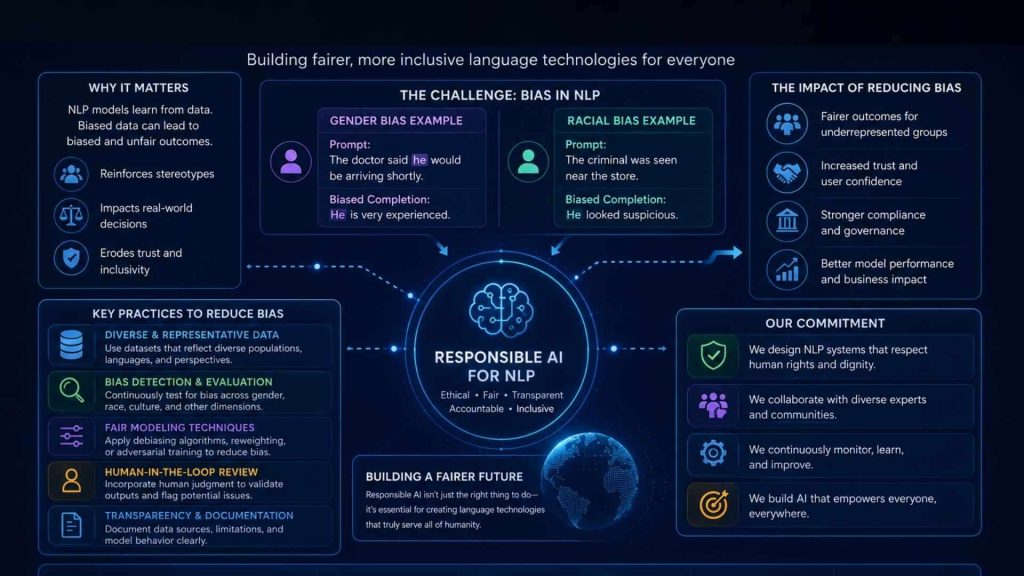
Responsible AI practices help reduce bias in NLP models
7.4 Multilingual processing
Supporting multiple languages is challenging because each language has unique grammar, vocabulary, cultural expressions, and writing systems. In addition, it often requires flexible compute resources such as serverless GPU environments. NLP models must accurately understand these differences while maintaining consistent performance across regions. This becomes increasingly important for global organizations serving multilingual customers.
For example, an international customer support platform may need to process English, Japanese, Vietnamese, and Spanish requests while preserving meaning and intent across all languages.
Natural Language Processing has become a foundational technology for modern AI, enabling organizations to understand, analyze, and generate human language at scale. From intelligent search and customer support automation to document processing and content generation, NLP helps businesses improve efficiency, enhance customer experiences, and unlock insights from unstructured data.
Choosing the right infrastructure is equally important to ensure reliable performance, cost efficiency, and seamless deployment. With FPT AI Factory’s Serverless Inference, businesses can deploy and run AI models in production more efficiently while reducing operational complexity. For enterprises with customization or large-scale needs, please contact the FPT AI Factory team via the official contact form for dedicated support.
Contact Information:
- Hotline: 1900 638 399
- Email: support@fptcloud.com
Explore Related Articles:
What is Fine-Tuning? An In-Depth Guide for When to Use
What Is Data Infrastructure? Key Components and How to Build It