

Machine learning infrastructure is the foundation that allows teams to store data, train models, deploy services and monitor performance over time. At FPT AI Factory, businesses can access GPU infrastructure and AI tooling to move from ML experimentation to production more efficiently.
|
Key Takeaways Machine learning infrastructure gives teams the data, compute, orchestration, deployment and monitoring foundation needed to build reliable ML systems. Strong infrastructure is as important as the algorithm itself because it determines how fast teams can train, validate, deploy and improve models in production.
|
FPT AI Factory helps teams build scalable machine learning infrastructure from experimentation to production. With GPU resources, containerized environments and inference services, teams can train, test, deploy and scale ML workflows more efficiently. Organizations that need customized architecture, large-scale deployment or project consultation can contact FPT AI Factory for tailored support.
1. What is machine learning infrastructure?
Machine learning infrastructure is the set of systems, tools and resources that support the full machine learning lifecycle, from data preparation and model training to deployment, monitoring and retraining. It includes data storage, compute resources, workflow orchestration, experiment tracking, model registries, serving environments and monitoring systems.
Infrastructure is important because machine learning success depends on more than model algorithms. A strong algorithm may still fail if the data pipeline is unreliable, the training environment cannot be reproduced, GPU resources are unavailable or model performance is not monitored after deployment.
It is also useful to separate machine learning infrastructure from broader AI infrastructure. AI infrastructure can include large language models, generative AI applications, agent systems and inference platforms, while machine learning infrastructure focuses more specifically on the systems needed to develop, train, validate, and operate ML models.
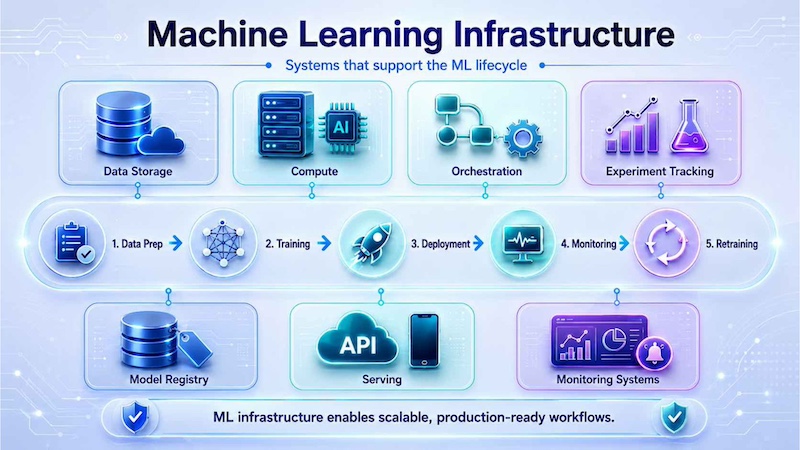
Machine learning infrastructure connects data storage, and monitoring to support workflows.
2. Core components of machine learning infrastructure
A production-ready ML environment usually includes several connected layers. Each layer supports a different part of the workflow, but they must work together so teams can move from raw data to reliable model outputs without rebuilding the setup for every project.
2.1. Data storage and management
Data storage and management provide the foundation for machine learning infrastructure. Teams need a reliable place to store raw data, processed datasets, labels, features, metadata and training outputs. This layer should support access control, versioning and data quality checks so models are trained on trusted information.
As data volume grows, teams also need a reliable data pipeline to collect, clean, transform and deliver data into training and serving environments. Without this layer, model quality can decline because data becomes inconsistent, delayed or difficult to trace.
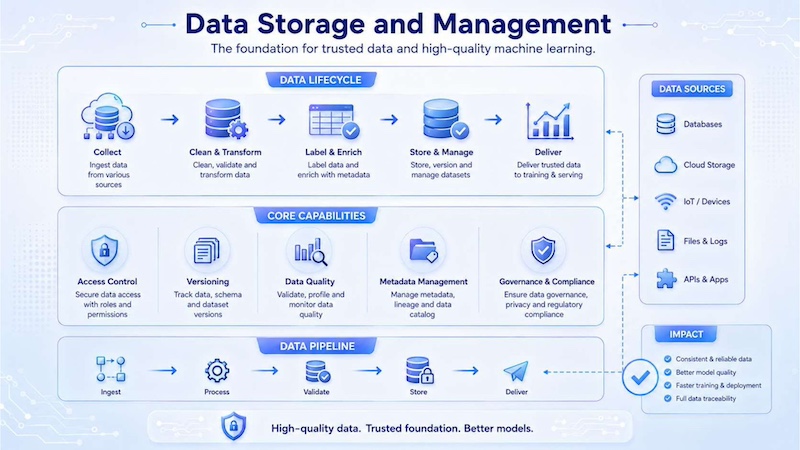
Reliable data storage and management help teams build better ML models with trusted, traceable, and high-quality data.
2.2. Compute resources (CPU, GPU, Accelerators)
Compute resources provide the processing power needed to train and run machine learning models. CPUs are useful for preprocessing, orchestration and general workloads, while GPUs and accelerators are often required for deep learning, computer vision, natural language processing and large-scale experimentation.
For teams that need flexible access to high-performance compute, GPU Virtual Machine and GPU Container can help accelerate model training, experimentation and performance testing without requiring teams to manage physical GPU servers directly.
2.3. Training pipelines and orchestration
Training pipelines automate the steps required to move data into a model training workflow. This may include data ingestion, preprocessing, feature generation, training, validation and artifact storage. Orchestration tools help schedule these steps, handle dependencies and reduce manual errors.
In enterprise environments, orchestration becomes important because teams often run many experiments across different models, datasets and environments. A well-orchestrated workflow makes training more repeatable and easier to scale across data science, engineering and operations teams.
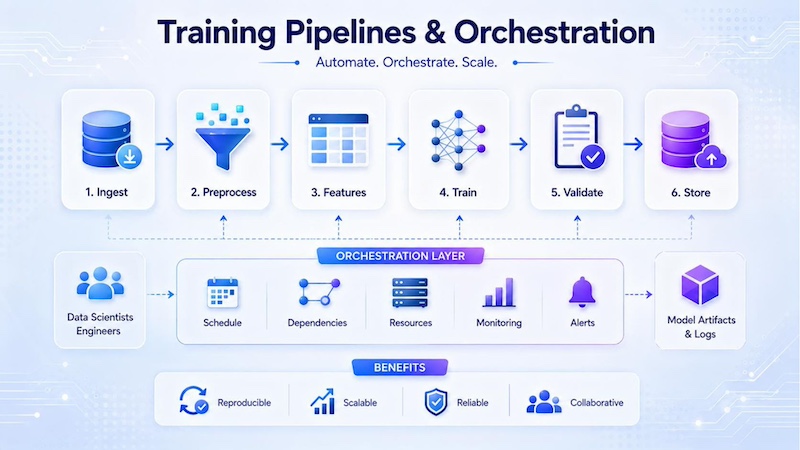
Training orchestration makes ML workflows automated, repeatable, scalable, and easier to manage across teams.
2.4. Experiment tracking and model registry
Experiment tracking records important details such as model versions, datasets, parameters, metrics and training results. A model registry stores approved models and helps teams understand which version is ready for testing, deployment or rollback.
This layer supports governance and reproducibility. After teams understand how experiments are tracked, they should also consider model evaluation practices such as evaluation metrics in machine learning because reliable metrics help determine whether a model is ready for production.
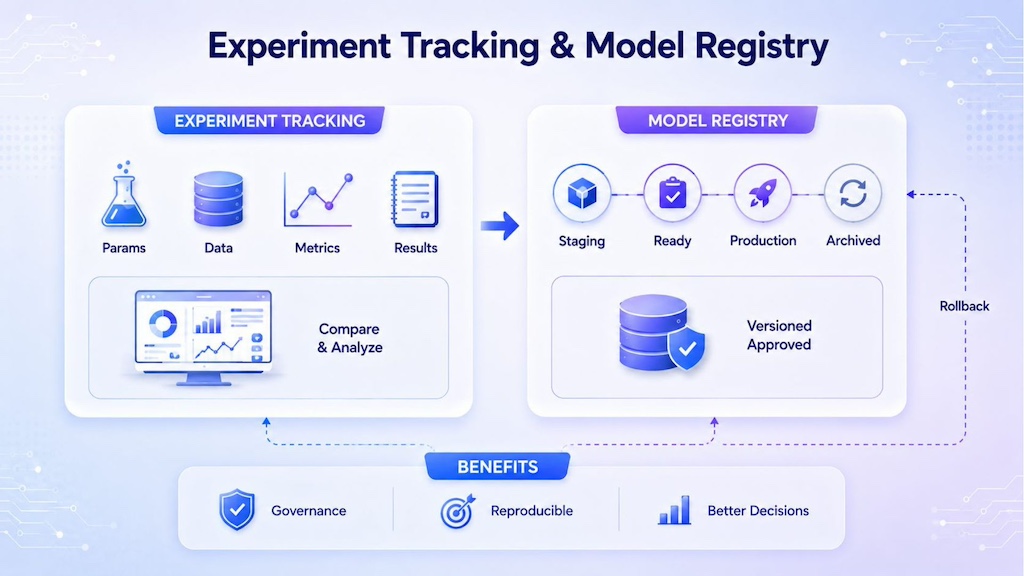
Experiment tracking and model registry make ML development more reproducible, governed, and production-ready.
2.5. Deployment and serving infrastructure
Deployment and serving infrastructure turns trained models into usable services. This layer may include model servers, APIs, inference endpoints, load balancing, scaling policies and access controls. It allows applications to send requests and receive predictions in a stable production environment.
For teams moving models into real applications, Serverless Inference can support API-based model serving with dynamic scalability. This is useful when teams need to integrate ML or AI models into chatbots, document workflows, recommendation systems or internal business applications.
2.6. Monitoring and retraining systems
Monitoring systems help teams track model quality, latency, errors, cost and data drift after deployment. Because real-world data changes over time, models may need retraining or adjustment to stay accurate and useful.
This is where machine learning infrastructure connects closely with MLOps. Monitoring and retraining make the workflow continuous instead of one-time, helping teams maintain model performance after launch.
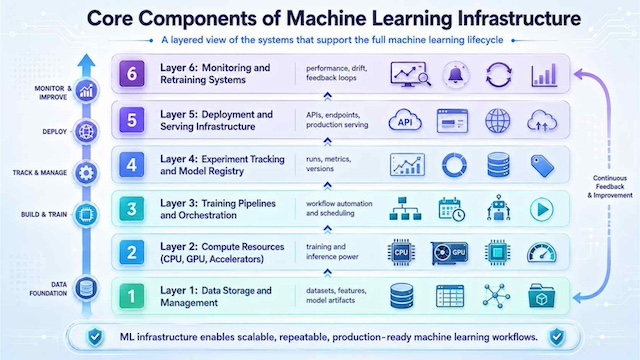
Machine learning infrastructure combines data, compute, orchestration, deployment, and monitoring layers to support scalable, production-ready ML workflows.
3. ML infra vs AI infra vs MLOps
Machine learning infrastructure, AI infrastructure and MLOps are closely related, but they solve different problems. After understanding the core layers, the next step is to clarify how infrastructure differs from operational practices and broader AI systems. For a wider view of platforms that combine compute, tooling and deployment, teams can also explore AI development platforms.
| Criteria | ML Infrastructure | AI Infrastructure | MLOps |
| Primary Purpose | Supports the lifecycle of machine learning models from data to deployment. | Supports broader AI workloads, including ML, generative AI, LLMs, agents and inference. | Manages the operational process for building, deploying and maintaining models. |
| Infrastructure Components | Data storage, compute, pipelines, experiment tracking, model registry, serving and monitoring. | GPU clusters, AI data centers, model serving platforms, inference services, storage and networking. | CI/CD, model governance, monitoring, testing, versioning and retraining workflows. |
| Compute Requirements | CPU/GPU resources for training, validation and model serving. | High-performance GPUs, distributed systems and scalable inference resources. | Depends on the underlying ML or AI infrastructure used by the team. |
| Data Types Supported | Structured data, tabular data, features, labels, logs, images and text depending on the ML use case. | Structured and unstructured data, multimodal data, embeddings, documents, audio, video and enterprise data. | Data and model artifacts needed for operations, monitoring and continuous improvement. |
| Model Types | Traditional ML models, deep learning models and domain-specific models. | ML models, foundation models, LLMs, VLMs, embedding models and AI agents. | Any model that needs controlled deployment, monitoring and lifecycle management. |
4. How machine learning infrastructure works
Machine learning infrastructure works as a connected workflow. Data enters the system, is processed for model training, moves through validation, becomes a deployable model and is monitored after release. Each step depends on the previous layer being reliable and traceable.
4.1. Data ingestion and processing
The workflow begins when data is collected from sources such as databases, applications, logs, sensors or external systems. This data is then cleaned, transformed and prepared for training. Processing may include removing duplicates, handling missing values, encoding features and validating data quality.
Since data quality directly affects model quality, teams often connect this stage with data preprocessing practices. Clean and well-structured data helps models learn more stable patterns and reduces the risk of unreliable outputs.
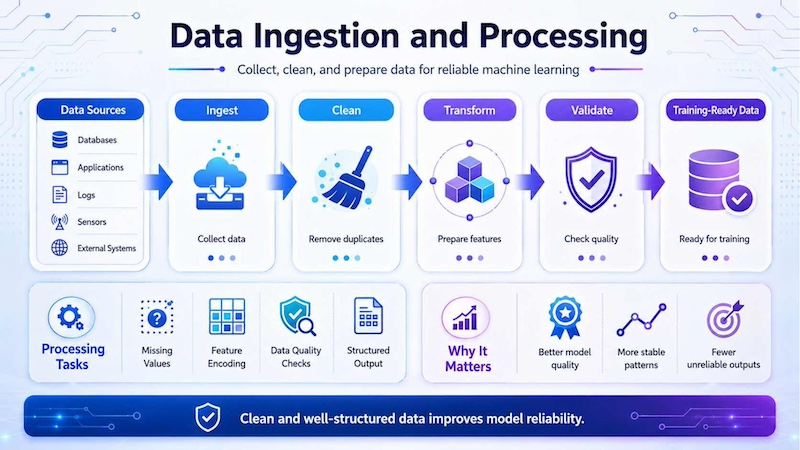
Data ingestion and processing turn raw data into clean, training-ready input for more reliable machine learning.
4.2. Model training and validation
After data is prepared, the model training pipeline uses compute resources to learn patterns from the dataset. Validation then checks whether the model performs well on unseen data and whether it meets business requirements such as accuracy, precision, recall, latency or robustness.
In larger projects, teams may run many experiments with different features, algorithms, parameters or training datasets. This makes experiment tracking, version control and consistent environments essential for comparing results fairly.
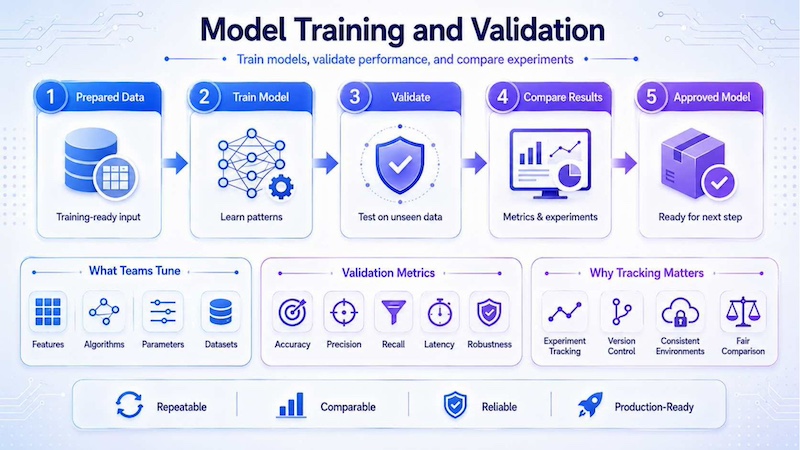
Model training and validation help teams compare experiments, measure performance, and identify models that are ready for production.
4.3. Model deployment and serving
Once a model is approved, deployment infrastructure makes it available to applications. This may happen through batch scoring, real-time APIs or model serving endpoints. Teams that want a deeper understanding of production predictions can connect this topic with AI inference, where deployed models generate outputs for users or systems.
Deployment should also include rollback options, access control, scaling configuration and performance monitoring. These controls help teams reduce risk when new model versions are released.
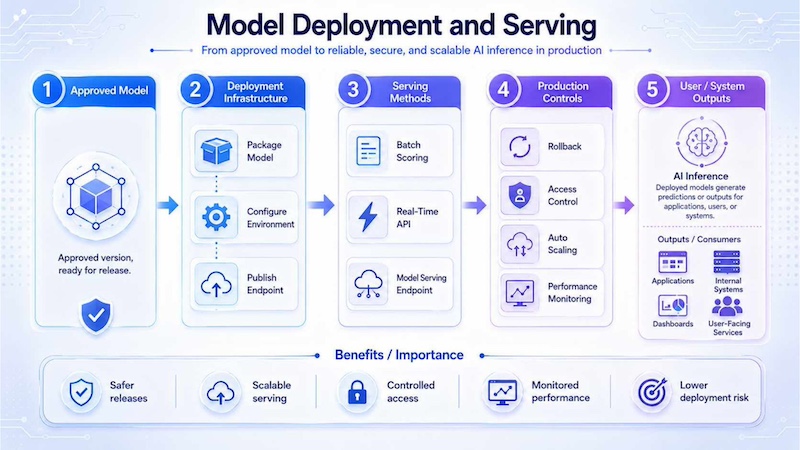
Model deployment and serving make approved models available to applications through scalable, monitored, and controlled production infrastructure.
4.4. Monitoring and continuous improvement
After deployment, the model should be monitored for data drift, prediction quality, latency, errors and user behavior. When performance declines, teams may retrain the model, update features or adjust the serving configuration.
This continuous loop helps organizations keep machine learning systems useful after launch. Without monitoring and improvement, models can become outdated as business conditions, customer behavior or data patterns change.
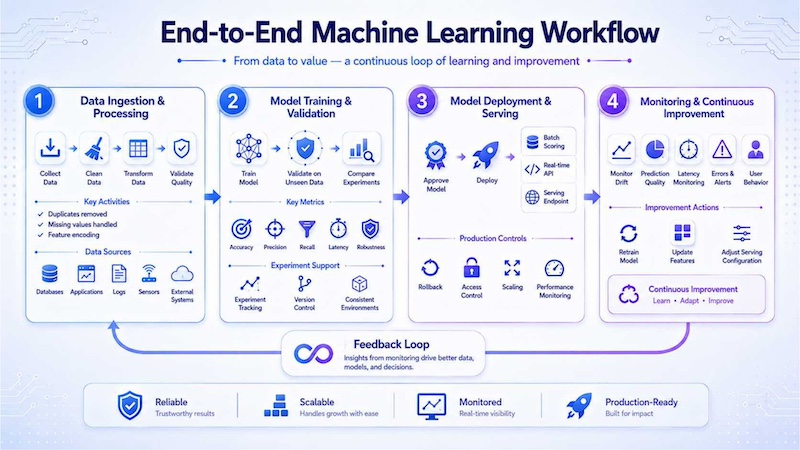
End-to-end machine learning workflow from data ingestion to monitoring and retraining.
5. ML Infrastructure Stack
A machine learning infrastructure stack connects different technical layers into one end-to-end environment for building, training, deploying and monitoring models. Each layer has a specific purpose, but they need to work together so teams can move from raw data to production ML applications more efficiently.
| Layer | Purpose | Common Technologies |
| Data layer | Stores, manages and prepares data for training, validation and inference. | Data warehouses, data lakes, object storage, databases, feature stores, vector databases |
| Compute Layer | Provides processing power for model training, experimentation and inference workloads. | CPUs, GPUs, accelerators, GPU virtual machines, GPU containers, GPU clusters |
| Development Layer | Supports model development, coding, testing and experimentation in a controlled environment. | AI Notebook, Jupyter Notebook, Python environments, SDKs, ML libraries |
| Pipeline & Orchestration Layer | Automates data processing, training workflows and deployment steps across environments. | Workflow orchestration tools, CI/CD pipelines, container orchestration, Kubernetes |
| Experiment & Model Management Layer | Tracks experiments, manages model versions and supports model selection before deployment. | Experiment tracking tools, model registry, metadata stores, evaluation dashboards |
| Serving Layer | Deploys trained models into applications so they can return predictions or responses in real time. | Model servers, inference APIs, API gateways, load balancers, Serverless Inference |
| Monitoring & Operations Layer | Tracks model performance, infrastructure health and production behavior over time. | Monitoring dashboards, logging systems, alerting tools, drift detection, retraining workflows |
Together, these layers help teams build a more reliable ML workflow. Instead of managing data, compute, deployment and monitoring separately, a well-designed infrastructure stack gives teams a clearer foundation for scaling machine learning from experimentation to production.
6. Common machine learning infrastructure challenges
Building machine learning infrastructure is not only a technical setup task. Teams must balance reproducibility, data reliability, GPU availability, model versioning and workload scaling while keeping development simple enough for data scientists and engineers to use.
6.1. Reproducibility across environments
Models may behave differently when code, libraries, drivers or hardware configurations change across local machines, notebooks, staging environments and production systems. This makes it difficult to debug results or repeat successful experiments.
Containerized environments can reduce this risk by packaging code, dependencies and runtime settings together. GPU Container is useful for teams that need repeatable GPU-powered environments for training, testing and experimentation without rebuilding the setup manually each time.
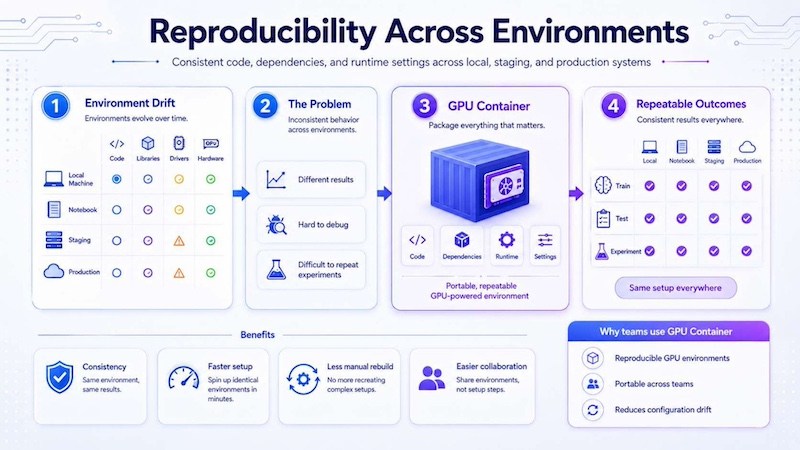
GPU Container makes ML environments portable, repeatable, and consistent across teams and systems.
6.2. Data pipeline reliability
Unreliable data pipelines can delay training, introduce errors or cause models to learn from incomplete information. Problems may include missing records, schema changes, duplicate data, inconsistent labels or delayed data delivery.
To reduce these risks, teams should design pipelines with validation, monitoring and clear ownership. Once data pipelines become stable, teams can scale toward more advanced workflows such as active learning in machine learning, where models improve by prioritizing the most valuable data for review or labeling.
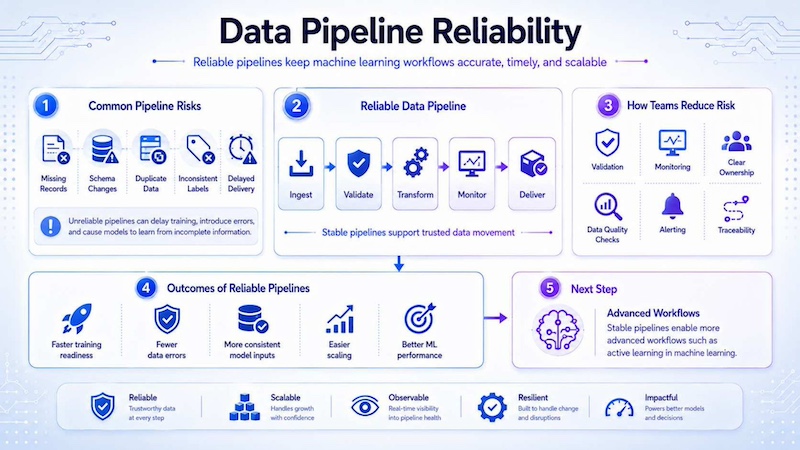
Reliable data pipelines help teams detect data issues, reduce errors, monitor pipeline health, and deliver trusted inputs for scalable machine learning workflows.
6.3. GPU availability and cost management
Machine learning teams often need GPUs for short experiments, larger training jobs or production inference. Buying and maintaining physical hardware can create high upfront costs, while underused infrastructure can waste budget.
Cloud-based GPU access helps teams match resources to workload demand. FPT AI Factory provides pay-as-you-go options through GPU Virtual Machine and GPU Container, helping teams train and test models with flexible compute while keeping room to scale as projects grow.
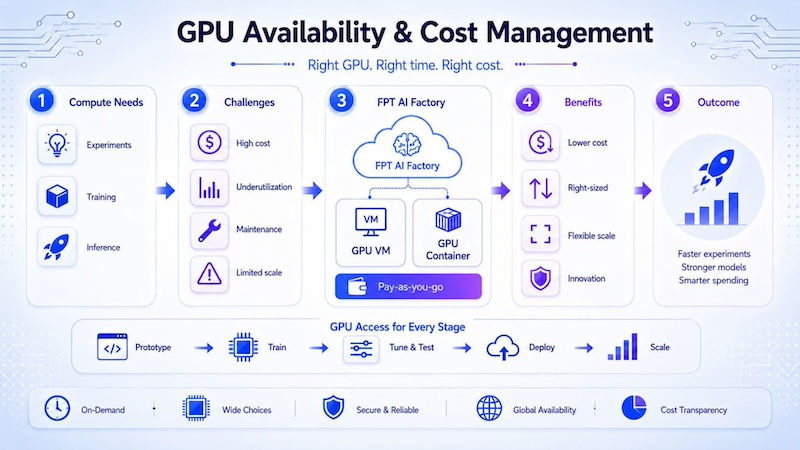
FPT AI Factory provides flexible, pay-as-you-go GPU access for cost-efficient ML training, testing, and scaling.
6.4. Model versioning at scale
As teams run more experiments, model versioning becomes harder to manage. Without clear version control, teams may lose track of which dataset, code, parameter set or model artifact produced a specific result.
A strong model registry and testing workflow helps teams decide which model should move forward. It also makes rollback easier if a model version performs poorly after deployment.
6.5. Scaling Machine Learning Workloads
Scaling machine learning workloads means supporting more experiments, larger datasets, heavier models and more users without slowing down development. To do this effectively, teams need flexible compute resources, reliable storage and consistent environments for training, testing and deployment.
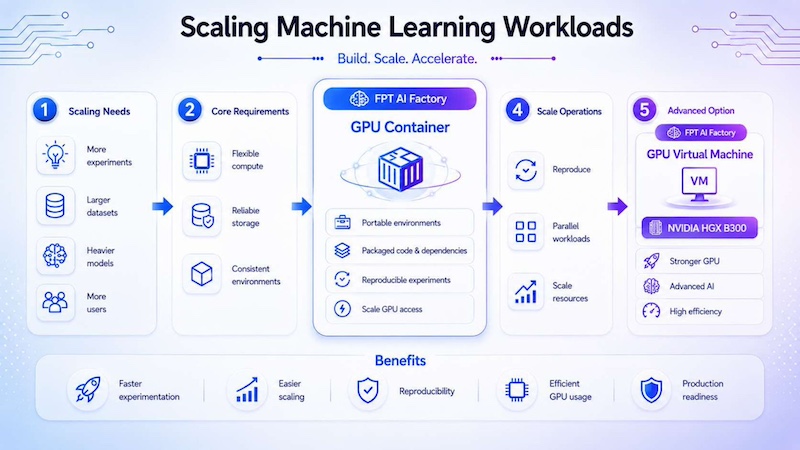
GPU Container and GPU VM help teams scale ML workloads with flexible, repeatable, and efficient GPU resources.
7. GPU Infrastructure for Machine Learning
While there are numerous best GPU for AI available on the market, three prominent options stand out to meet diverse computing demands. Matching the infrastructure to the workload helps teams improve speed, cost efficiency, and operational control.
7.1. GPU VM
A GPU Virtual Machine is suitable when teams need more control over the operating system, libraries, drivers, networking and storage configuration. This is useful for custom machine learning environments, intensive training jobs, model optimization and workloads that require dedicated compute resources.
For more complex projects that require stronger GPU performance, teams can also review GPU Virtual Machine with NVIDIA HGX B300 availability. This can support advanced AI workloads, high-efficiency token generation and demanding model development needs.
To explore the differences between NVIDIA’s HGX B200 and HGX B300 (Blackwell Ultra), you can read further into their hardware configurations in this article: B200 vs B300: A Compete Comparison of Blackwell GPUs
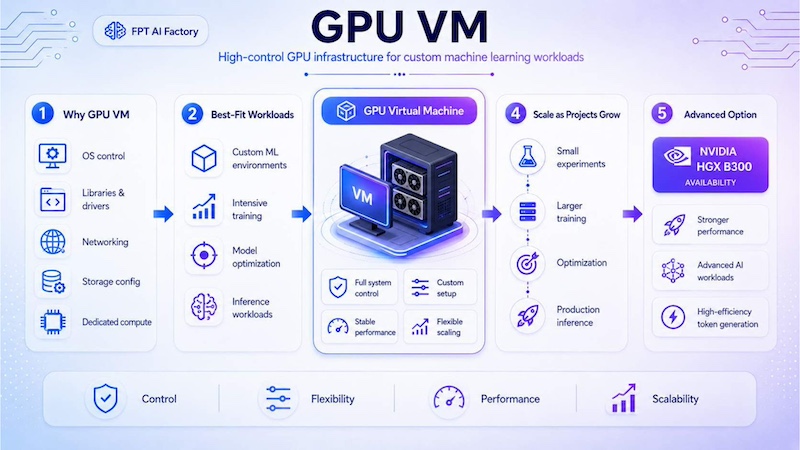
GPU VM gives teams high-control GPU infrastructure for custom ML environments, intensive training, model optimization, and scalable inference workloads.
7.2. GPU Container
GPU Container can support this process by helping teams scale machine learning workloads and accelerate access to GPU resources for model training and experimentation. With containerized environments, teams can package code, libraries and dependencies consistently, making it easier to reproduce experiments, run multiple workloads and scale resources as project demand grows.
This approach is especially helpful for data science teams that need to test different model architectures, run training jobs, tune parameters or validate prototypes quickly. It also supports teams that want to reduce infrastructure setup time while keeping GPU access flexible.
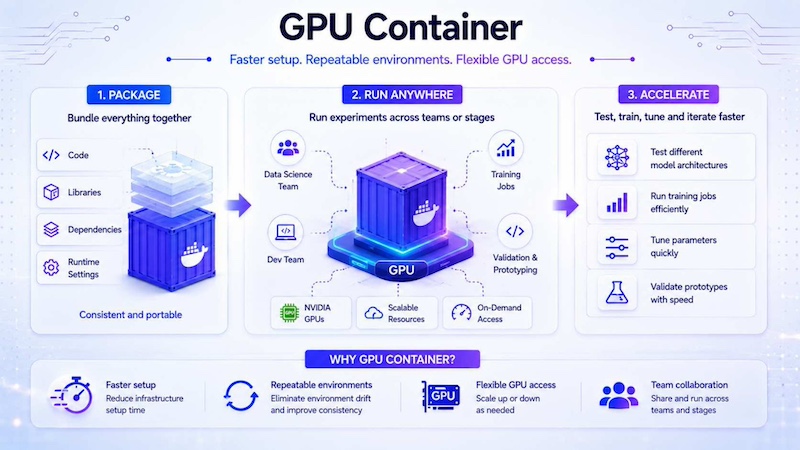
GPU Container enables faster setup, repeatable environments, and flexible GPU access for ML experiments and training.
7.3. GPU Cluster
GPU Cluster supports larger machine learning workloads that need distributed training, shared storage and Kubernetes-based orchestration. It is suitable when teams need to run many workloads across multiple nodes or train models that exceed the limits of a single machine.
FPT AI Factory’s GPU Cluster includes high-performance shared storage with NVMe block storage up to 50 GB/s throughput for training and distributed file storage, along with real-time data synchronization across nodes. This makes it relevant for large-scale model training, HPC workloads and production-ready model serving.
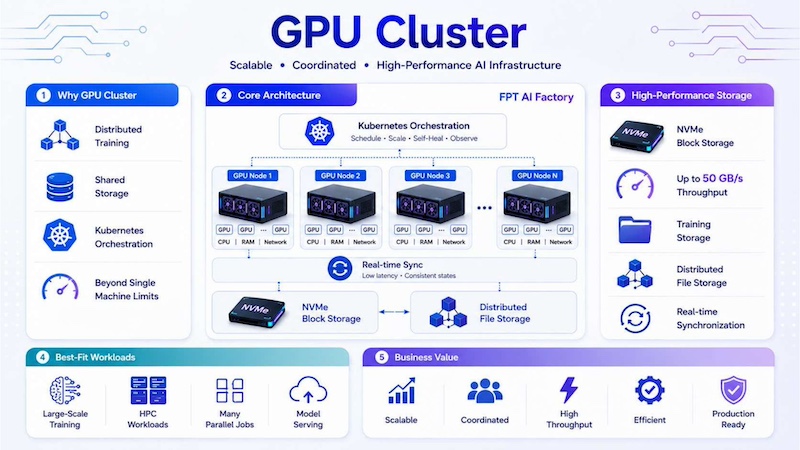
GPU Cluster enables large-scale ML workloads with distributed training, shared storage, Kubernetes orchestration, and high-performance multi-node scaling.
8. FAQs
8.1. What infrastructure do I need to train a machine learning model?
At minimum, you need reliable data storage, a clean training environment, compute resources such as CPU or GPU, a training pipeline and a way to track experiments. For more advanced models, teams may also need GPU acceleration, model registries, monitoring and scalable deployment infrastructure.
8.2. Is cloud or on-premise better for ML infrastructure?
Cloud infrastructure is often better for teams that need flexibility, faster setup and scalable resources without buying hardware upfront. On-premise infrastructure may be suitable for organizations with strict data control, predictable workloads or existing hardware investments. Many enterprises use a hybrid approach depending on cost, compliance and performance needs.
8.3. What’s the minimum setup to run ML in production?
A minimum production setup should include a reliable data pipeline, version-controlled model artifacts, a serving endpoint, monitoring, logging, access control and a rollback process. This helps teams detect problems, manage model updates and keep the ML system stable after deployment.
Machine learning infrastructure gives teams the foundation to train, deploy and improve models reliably. FPT AI Factory supports this process with GPU infrastructure, containerized environments, AI Notebook and inference services that help teams move from experimentation to production more efficiently. With GPU options such as NVIDIA HGX H100 and HGX H200, teams can access strong compute resources for model training, fine-tuning, experimentation and inference workloads. For enterprise projects that require higher memory capacity, stronger performance and more demanding AI workloads, NVIDIA HGX B300 on GPU Virtual Machine is also suitable for advanced model development, high-efficiency token generation and large-scale AI deployment.
For businesses or organizations that need customized AI solutions, large-scale deployment or expert consultation, contact FPT AI Factory through the official contact form.
Contact information
- Hotline: 1900 638 399
- Email: support@fptcloud.com
Explore more articles: