

AI infrastructure architecture defines how compute, storage, networking, orchestration, AI tooling and serving layers work together to support AI workloads. Unlike a general overview of AI infrastructure, this article focuses on how those layers are organized into a production-ready architecture. In this article, FPT AI Factory will explore the essential layers of AI infrastructure architecture and dive deep into the critical challenges of building a scalable foundation.
|
Key Takeaways AI infrastructure architecture explains how compute, storage, networking, orchestration, AI tooling and serving layers work together to support model training, deployment and inference. A clear architecture helps teams reduce bottlenecks, improve scalability and move AI workloads from experimentation to production more reliably.
|
Build and scale AI infrastructure with FPT AI Factory: teams can access GPU infrastructure, AI development tools and inference services for training, testing, deployment and production AI workloads. For customized infrastructure or large-scale deployment needs, contact FPT AI Factory through the official contact form.
1. What is AI infrastructure architecture?
AI infrastructure architecture is the blueprint that defines how hardware, data systems, networking, orchestration tools, AI platforms and serving layers work together. It is not only about having GPUs or cloud servers. It is about organizing resources so AI teams can process data, train models, deploy applications and monitor performance in a reliable way.
This distinction matters because AI infrastructure and AI infrastructure architecture are related but not identical. AI infrastructure refers to the resources and technologies used to run AI workloads. AI infrastructure architecture explains how those resources are connected, governed and scaled to support real business applications.
For example, an enterprise chatbot may need GPU compute for model workloads, storage for enterprise data, a vector database for retrieval, APIs for application integration and monitoring for production reliability. Architecture brings these components together so the system can move from a prototype to a stable AI application.
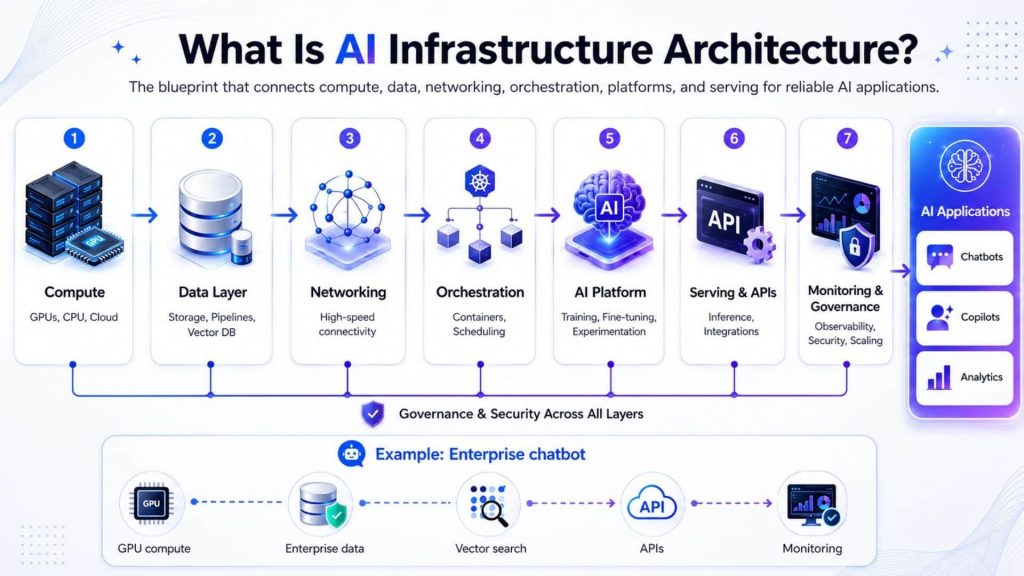
AI infrastructure architecture connects data and monitoring into a reliable blueprint for production AI applications.
2. The core layers of AI infrastructure architecture
A practical AI infrastructure architecture can be viewed as six connected layers. Each layer has a different role, but the system only works well when the layers are designed together. After defining the architecture at a high level, the next step is to understand how each layer contributes to training, deployment and inference.
2.1. Layer 1: Compute (GPU, CPU, TPU)
Compute is the foundation of AI infrastructure architecture. GPUs are commonly used for deep learning, large language models, computer vision and generative AI because they process many operations in parallel. CPUs remain important for orchestration, preprocessing, application logic and general workloads, while TPUs may be used in some specialized AI environments.
In enterprise projects, compute requirements vary by workload. Model training and fine-tuning usually require powerful GPU resources, while inference workloads may need optimized serving capacity to handle many user requests. Teams that need flexible compute for experiments can use GPU Virtual Machine or GPU Container, depending on how much system-level control they need.
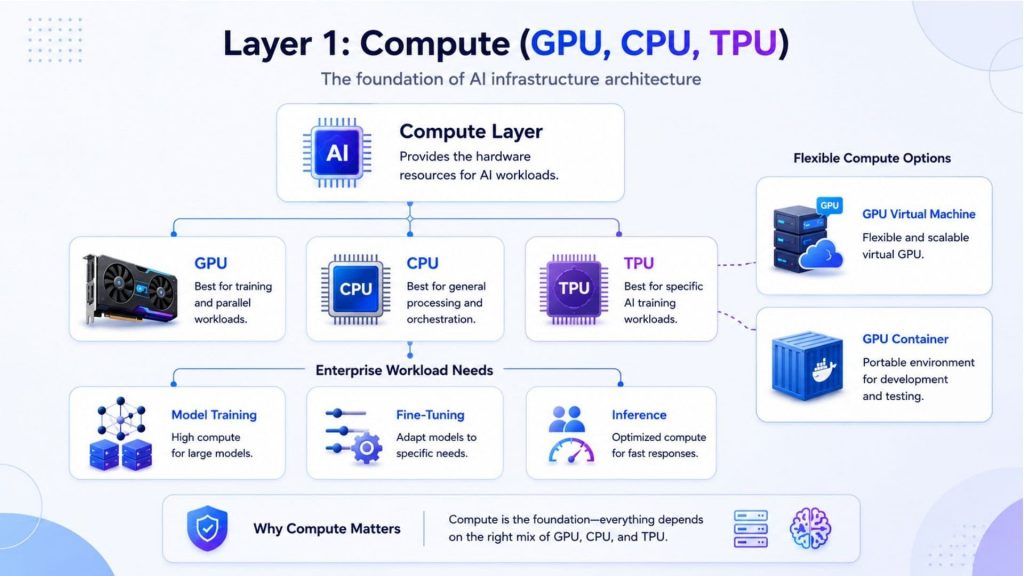
Compute resources such as GPUs, CPUs, and TPUs provide the essential foundation for scalable AI training, inference, and application deployment.
2.2. Layer 2: Storage and Data Management
AI systems need storage that can handle large datasets, model checkpoints, embeddings, logs and application data. This layer must support both capacity and speed because training jobs may read massive datasets repeatedly, while inference applications may need fast access to context or historical records.
Storage and data management are closely connected with data infrastructure and data lifecycle design. For AI teams, this includes data ingestion, preprocessing, versioning, metadata management, access control and backup strategies. Without a reliable data layer, even strong compute infrastructure can become underused or produce inconsistent outputs.
2.3: Layer 3: Networking and Interconnects
Networking connects compute, storage and application layers. In AI workloads, the network must move data quickly between GPUs, nodes and storage systems. This is especially important for distributed training, where multiple GPUs need to exchange model parameters and intermediate results during each training step.
The right network design depends on the workload. Large training clusters may require high-bandwidth, low-latency interconnects, while inference-heavy applications may prioritize stable API connectivity and predictable traffic routing. After choosing compute and storage, teams should evaluate network trade-offs such as InfiniBand vs Ethernet based on workload scale, latency goals and cost constraints.
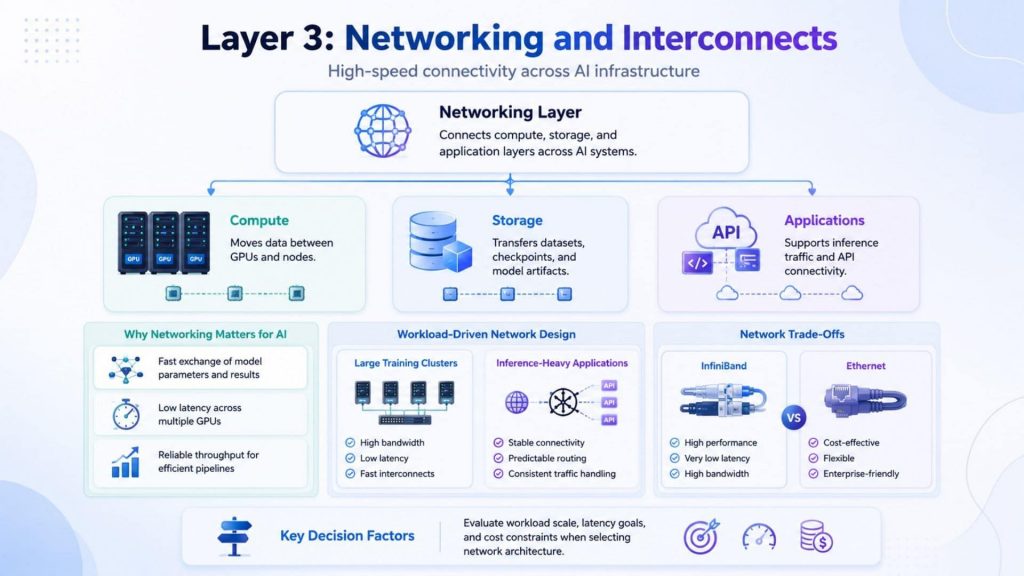
Networking and interconnects provide the high-speed, low-latency foundation that helps AI workloads exchange data efficiently between GPUs, and applications.
2.4: Layer 4: Orchestration and Containerization
Orchestration and containerization help teams manage AI workloads across environments. Containers package code, dependencies and runtime settings into reproducible units, while orchestration systems schedule workloads, allocate resources and support scaling. This layer is important when multiple teams run experiments, model services or pipelines on shared infrastructure.
For cloud-native AI development, containerized environments make it easier to move workloads from development to testing and production. They also reduce setup time because teams can reuse consistent environments across experiments. This is why GPU Container can be useful for training tests, model optimization and repeatable AI workflows.
2.5: Layer 5: AI/ML Platform and Tooling
The AI/ML platform layer includes the tools that help teams build, test, manage and improve models. This may include notebooks, experiment tracking, model evaluation, model registries, monitoring tools and collaboration workflows. Instead of treating infrastructure as separate hardware, this layer makes it usable for data scientists, ML engineers and application teams.
As AI projects mature, teams often need more than raw compute. They need AI development platforms that support repeatable workflows, model validation and deployment readiness. Tooling helps teams reduce manual steps, compare experiments and standardize how models move toward production.
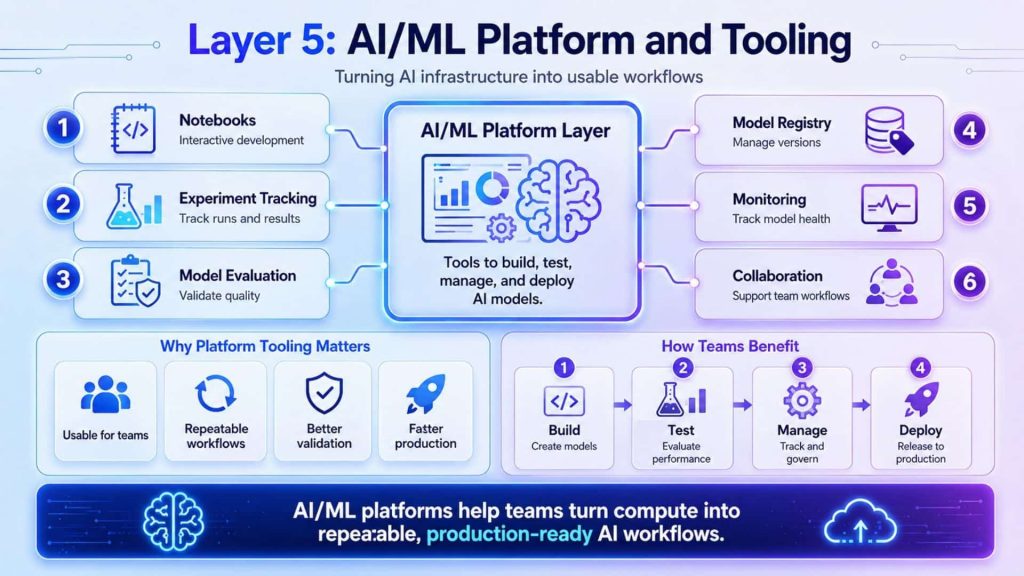
AI/ML platforms make AI infrastructure usable by helping teams standardize model development, evaluation, collaboration, and deployment workflows.
2.6: Layer 6: AI Application and Serving Layer
The application and serving layer is where trained models create business value. This layer connects models with APIs, chatbots, copilots, recommendation engines, document workflows, analytics tools or AI agents. It must support low latency, high availability and stable performance because real users depend on the application experience.
In this layer, model serving and AI inference become central. Teams need to expose models through secure endpoints, monitor usage and scale serving capacity as traffic changes. Serverless Inference can help teams connect models to applications through APIs without managing the full serving layer manually.
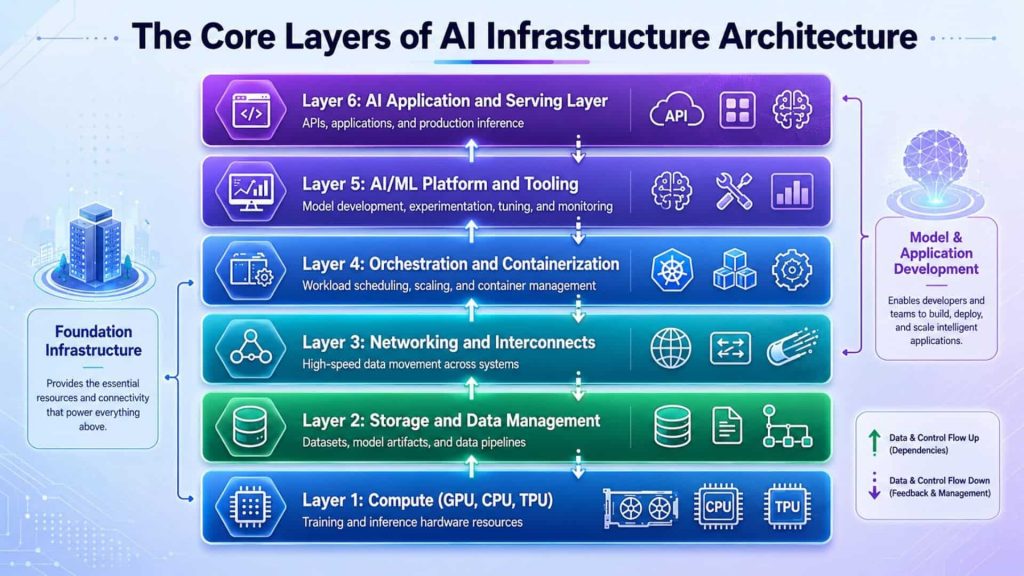
AI infrastructure architecture connects six layers from compute to production serving .
3. How AI infrastructure architecture works
AI infrastructure architecture works by moving data, models and application requests across connected layers. In a production workflow, the architecture must support both development and runtime operations. The same system may help teams prepare data, train models, deploy endpoints and serve predictions to users.
3.1 From Data Processing to Model Training
The workflow usually starts with data. Raw data is collected from business systems, logs, documents, sensors or customer interactions. It then moves through cleaning, transformation, labeling and feature preparation before it is used for training or fine-tuning.
This process depends on a reliable data pipeline. If data movement is slow or inconsistent, model quality can suffer and experiments may become difficult to reproduce. Once data is ready, training workloads use GPU resources to process batches, update model parameters and generate model checkpoints for evaluation.
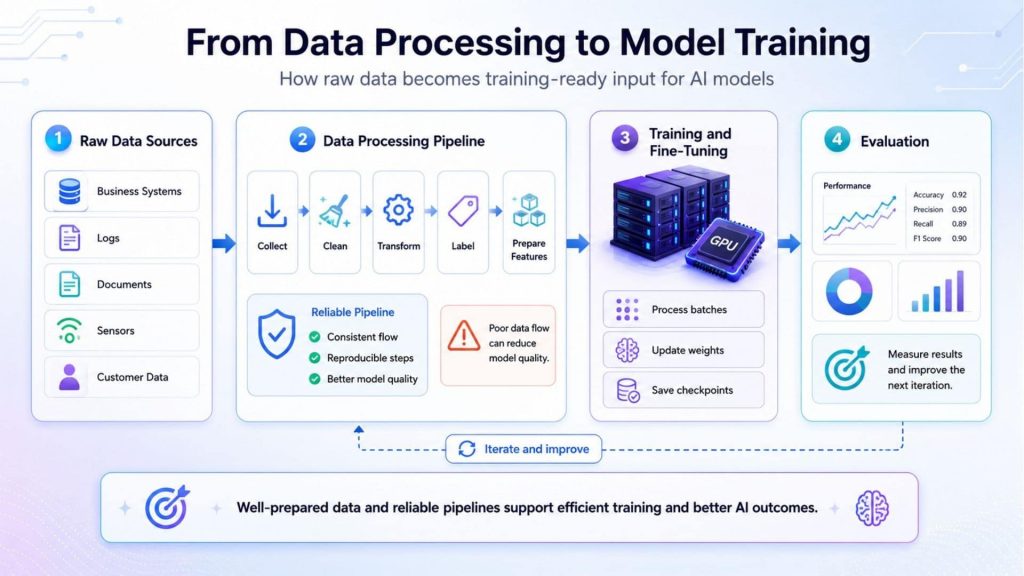
A reliable data pipeline turns raw data into training-ready input, enabling efficient model training, better evaluation, and more repeatable AI workflows.
3.2 From Model Deployment to Inference
After a model is trained and evaluated, it must be deployed so applications can use it. Deployment may involve packaging the model, choosing a serving environment, setting up APIs and defining monitoring rules. At this stage, the goal changes from improving model accuracy to delivering stable outputs under real user demand.
Inference workloads require careful architecture because traffic may change quickly. A chatbot may receive sudden spikes during business hours, while a document processing system may run large batches at the end of the month. Serving architecture should therefore consider latency, throughput, scaling policy, endpoint security and cost control.
3.3 Supporting Enterprise AI Applications
Enterprise AI applications often combine several infrastructure patterns. A RAG assistant may need a vector database, embedding model, language model and API layer. A computer vision workflow may require high-throughput image storage, GPU inference and monitoring. An AI agent may connect models with tools, enterprise data and workflow systems.
Because these applications depend on many components, architecture should be designed for observability and change. Teams need to monitor infrastructure health, model behavior, API latency, data quality and user-facing performance. After understanding how the architecture works, teams can better identify where bottlenecks and scaling challenges appear.
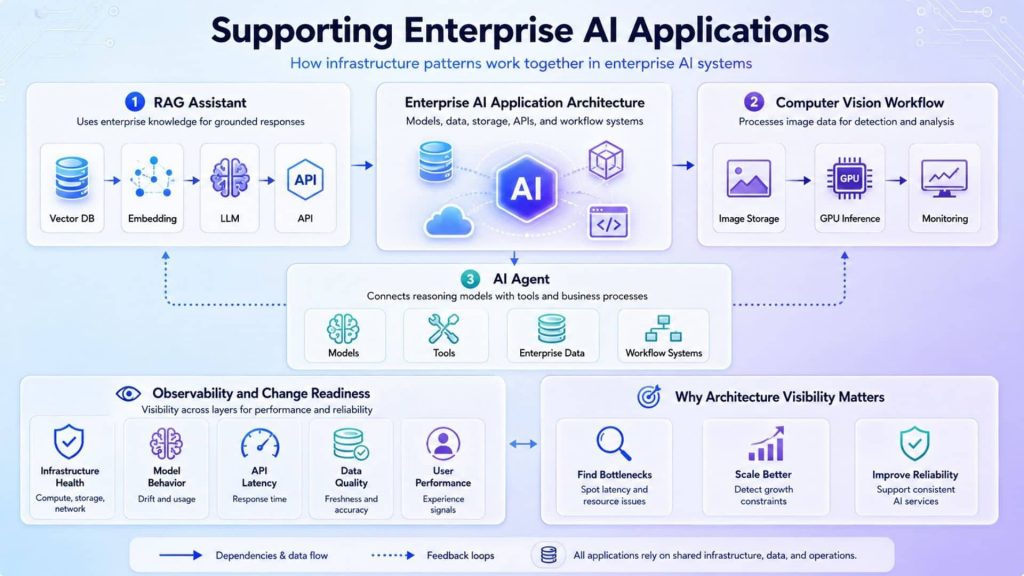
Enterprise AI architecture connects models, data, APIs, tools, and monitoring systems to support scalable, reliable AI applications.
4. Common challenges in AI infrastructure architecture
Building AI infrastructure architecture is not only a technical design task. It also involves cost planning, workload prioritization, security, operational governance and production performance. The most common challenges appear when teams move from small experiments to shared enterprise environments.
4.1. Managing high compute and infrastructure costs
AI workloads can become expensive when teams overprovision GPUs, keep idle resources running or use infrastructure that does not match each project stage. Training, fine-tuning and large-scale experiments often require strong compute performance, but startups and enterprise teams may not need a permanent dedicated cluster from the beginning.
With GPU Container and GPU Virtual Machine, teams can access flexible GPU resources for model training, testing and experimentation. This infrastructure allows teams to train and run models with optimized performance, while staying ready to scale as a startup project grows. FPT AI Factory also supports competitive pricing and a pay-as-you-go approach, helping teams control infrastructure spending more effectively.
Cost planning should also include storage, data transfer, monitoring, inference traffic and engineering effort. Instead of focusing only on GPU price, teams should evaluate the full architecture and choose the right environment for each stage, from experimentation and training to deployment and production serving.
4.2. Handling large-scale data pipelines
AI infrastructure depends on data pipelines that can handle large, changing and sometimes unstructured data. If data pipelines are slow or unreliable, training jobs may fail, models may use outdated data and production systems may return less relevant results.
A scalable pipeline should support automated ingestion, validation, transformation and delivery to the right storage or model workflow. For enterprise AI systems, this also means managing permissions, metadata, data freshness and traceability. Strong pipeline design reduces manual work and helps teams maintain consistent model performance over time.
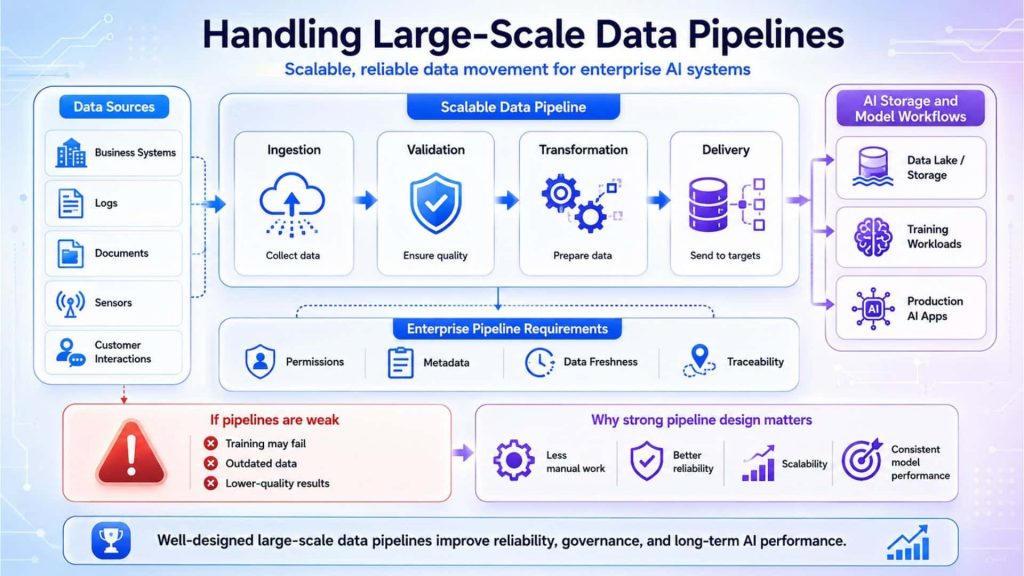
Scalable data pipelines help enterprise AI systems move, prepare, and deliver data reliably, improving governance, efficiency, and long-term model performance.
4.3. Scaling AI workloads ccross teams and environments
As more teams use AI infrastructure, scaling becomes more complex. Data scientists may need notebooks and experiment environments, ML engineers may need containers and pipelines, while application teams need stable inference endpoints. Without clear resource management, teams may compete for GPUs, storage and deployment environments.
For large-scale workloads, GPU Cluster can support managed Kubernetes clusters powered by GPU Bare Metal or GPU VMs. The service provides high-performance shared storage with NVMe block storage up to 50 GB/s throughput for training and distributed file storage, as well as real-time data synchronization across nodes. This helps teams support distributed training, shared workloads and production model serving more efficiently.
4.4. Meeting security, governance, and compliance requirements
AI infrastructure often connects sensitive business data, models, logs and user interactions. This creates security and governance requirements across access control, data storage, API usage, monitoring and compliance reporting. A weak architecture can expose private data, create unclear accountability or make it difficult to audit model behavior.
A secure architecture should define who can access datasets, models, endpoints and infrastructure resources. It should also include logging, monitoring, identity controls and clear approval processes for production deployment. For enterprises building regulated AI systems, AI governance should be considered early rather than added after the system is already in production.
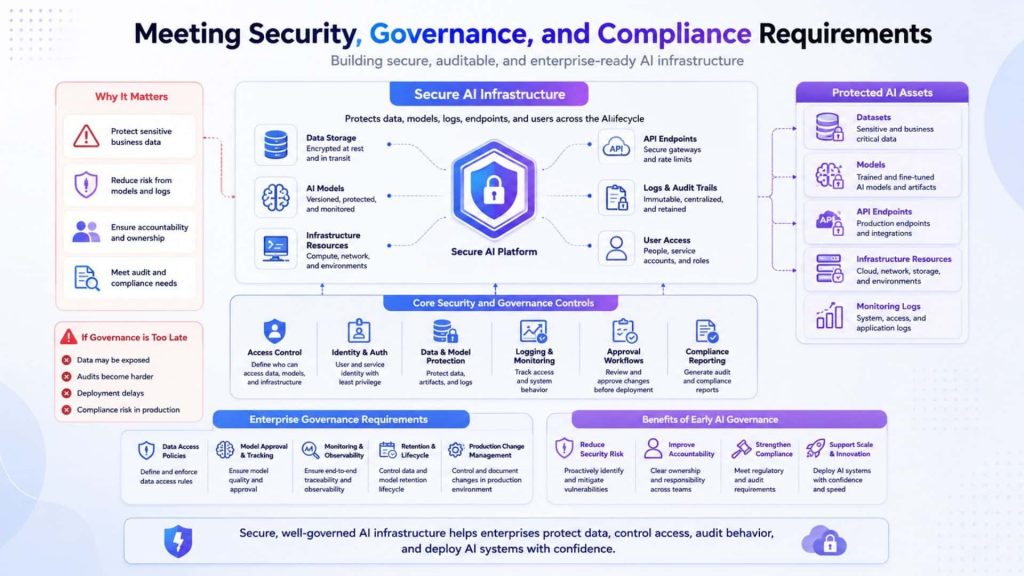
Secure AI infrastructure protects data, controls access, monitors activity, and supports governance and compliance.
4.5. Optimizing model serving and inference performance
Inference performance is one of the most important production challenges. Even a strong model can create poor user experience if responses are slow, unstable or too expensive at scale. Model serving architecture should therefore optimize latency, throughput, availability and cost per request.
For teams deploying AI applications through APIs, Serverless Inference provides access to multiple AI models and OpenAI-compatible APIs for application integration. It is especially useful when teams need scalable inference for chatbots, document processing, AI agents, code generation or multimodal workflows without managing every infrastructure component directly.
5. AI infrastructure components in practice
Different AI infrastructure components serve different stages of the AI lifecycle. Some are better suited for development and experimentation, while others support distributed training or production inference. Choosing the right component helps teams avoid overbuilding infrastructure while keeping a clear path to scale.
5.1. GPU VM
GPU Virtual Machine is suitable when teams need deeper control over the operating environment, libraries, drivers and runtime configuration. It is useful for large-scale model training, fine-tuning, inference testing, simulation and custom AI workloads that require a dedicated GPU stack.
This option works well for teams that need full root access, custom dependencies or predictable compute for intensive experiments. It also supports planning for more advanced GPU options such as NVIDIA HGX B300, which can be relevant for reasoning-heavy workloads, high-efficiency token generation and next-generation AI workloads.
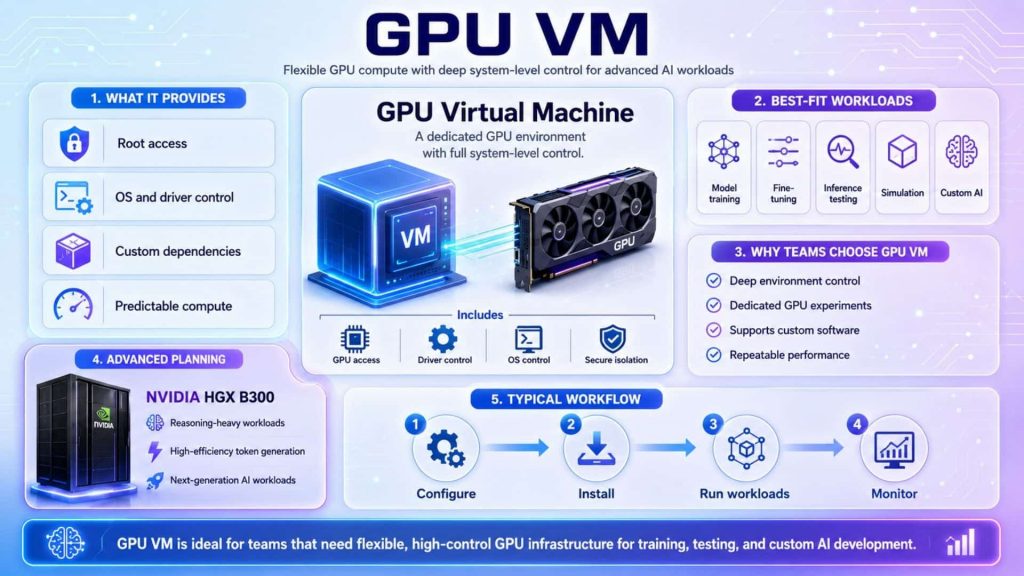
GPU VM gives teams flexible, high-control GPU infrastructure for training, testing, and custom AI workloads.
5.2. GPU Container
GPU Container is suitable for teams that want faster setup and reproducible development environments. Containers package code, frameworks and dependencies together, making it easier to move workloads across development, testing and production stages.
This component is useful for startups, research teams and product teams that need to run experiments quickly without spending too much time configuring infrastructure. It can support model training, testing, optimization and repeatable workflows while keeping infrastructure flexible as the project grows.
5.3. GPU Cluster
GPU Cluster is designed for larger workloads that need distributed compute, shared storage and multi-node coordination. It is suitable for foundation model training, HPC workloads, large-scale model serving and teams that need to scale across many GPUs or users.
A cluster-based architecture is more complex than a single VM or container environment, but it becomes important when workloads exceed one machine. Shared storage, synchronization and orchestration help reduce bottlenecks and make distributed AI workloads easier to operate across teams.
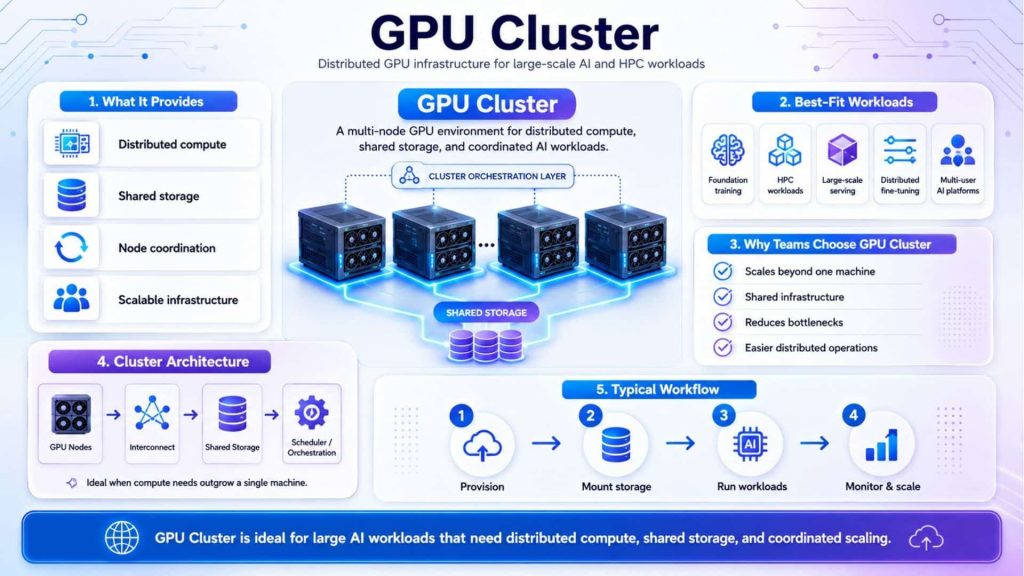
GPU Cluster enables large-scale AI workloads with distributed compute, shared storage, and coordinated multi-node operation.
5.4. Serverless Inference
Serverless Inference is used when teams need model serving through APIs without managing the full infrastructure layer. It supports production applications that need fast integration, flexible scaling and simpler operation.
This approach is suitable for chatbots, AI assistants, document processing, image analysis, summarization, translation and agentic workflows. Instead of provisioning and maintaining inference servers directly, teams can connect applications to model endpoints and scale based on request demand.
6. Best practices for building AI infrastructure
A strong AI infrastructure architecture should be designed for growth, not only for the first experiment. The best approach is to start with the workload requirements, then define compute, storage, networking, tooling and serving layers around those needs.
6.1 Design for scalability
Scalability should be planned from the beginning. Teams should separate development workloads from production workloads, define scaling policies and avoid locking every project into one fixed infrastructure pattern. A small prototype may start with a GPU VM or container, while a production system may need serverless inference or a GPU cluster.
Scalable design also requires region and latency planning. FPT AI Factory supports AI workloads across Vietnam and Japan, with Malaysia coming soon, which can be relevant for teams serving users across Asia. Regional availability can help improve latency planning, support operations across time zones and provide more flexible deployment options.
6.2 Build reliable data pipelines
Reliable data pipelines are essential because AI models depend on fresh, accurate and well-prepared data. Teams should automate data ingestion, validation, transformation and delivery whenever possible. They should also define data ownership, schema control and quality checks before pipelines become business critical.
For AI applications that use retrieval or enterprise documents, teams should also consider how data is chunked, indexed and retrieved. Systems that rely on vector databases need clear update policies so users receive answers based on current and relevant information.
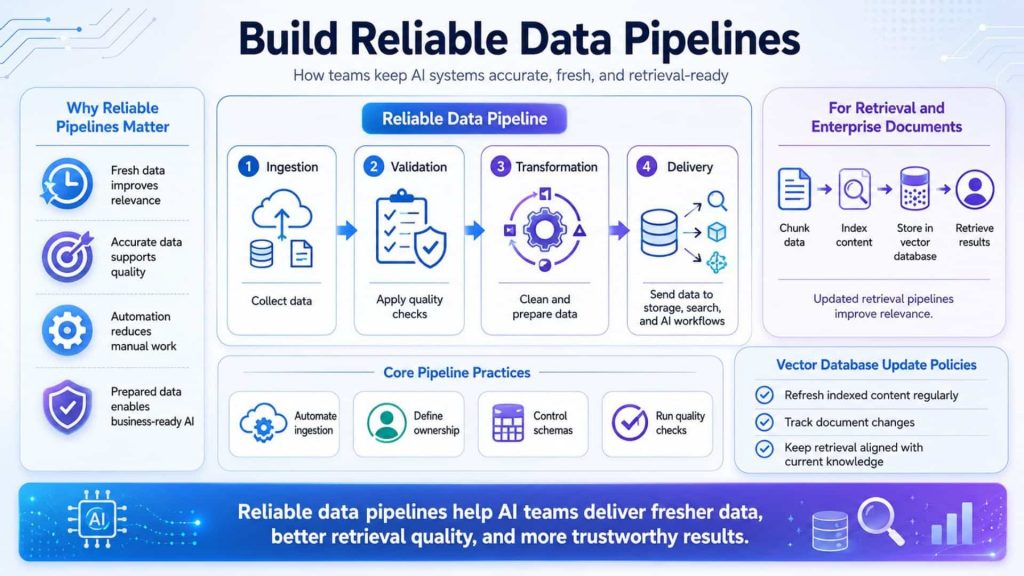
Reliable data pipelines help AI teams automate ingestion, validate and transform data, support retrieval workflows, and keep enterprise knowledge systems accurate.
6.3 Implement automation and monitoring
Automation reduces manual work across deployment, scaling, recovery and environment setup. Infrastructure-as-code, CI/CD pipelines, container orchestration and automated health checks can help teams manage AI systems more consistently.
Monitoring should cover both infrastructure and model behavior. Teams need visibility into GPU utilization, storage performance, API latency, error rates, model outputs and user experience. This makes it easier to detect bottlenecks, investigate incidents and optimize infrastructure before problems affect production users.
6.4 Prioritize security and governance
Security and governance should be built into the architecture instead of treated as final checks. Access control, private networks, audit logging, token management and data retention policies are important when AI systems connect to enterprise applications or sensitive datasets.
Governance also helps teams decide which models can be deployed, which data sources can be used and how outputs should be reviewed. For regulated industries, this can reduce compliance risk and make AI systems easier to audit as usage expands across departments.
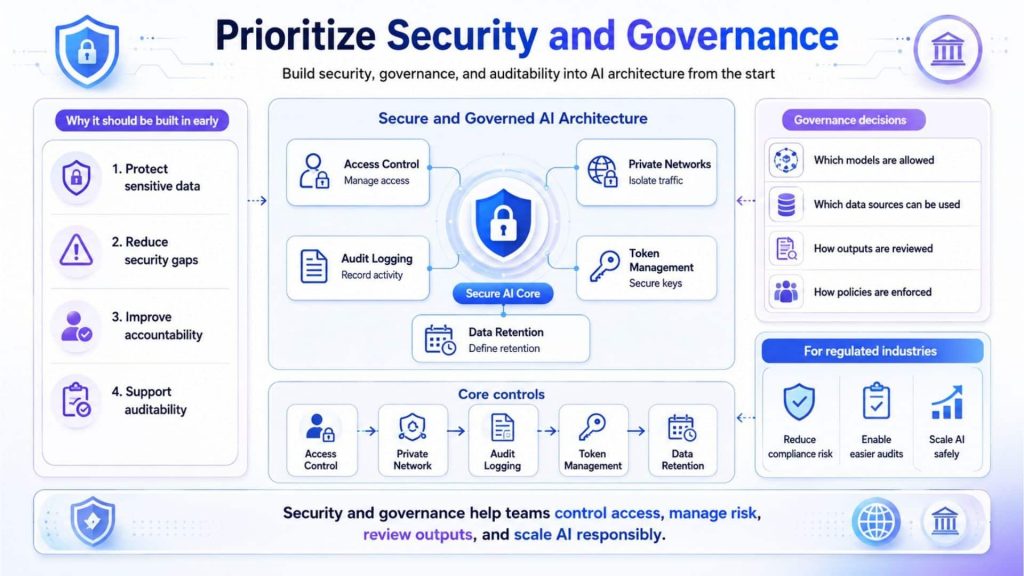
Built-in security and governance help enterprises protect sensitive data, control access, audit AI behavior, and scale AI systems safely AI across teams.
7. FAQs
7.1. What hardware is needed for AI infrastructure?
AI infrastructure usually needs GPU or CPU compute, storage, networking and supporting software. GPU resources are especially important for deep learning, generative AI, computer vision and large-scale inference workloads, while CPUs, storage and networking support data movement, orchestration and application logic.
7.2. How much does AI infrastructure cost?
AI infrastructure cost depends on workload size, GPU type, storage volume, network requirements, usage time and whether the system runs training or inference. Teams should estimate total cost across compute, storage, data transfer, monitoring and operations, then review official pricing before deployment.
7.3. What’s the difference between AI infrastructure and MLOps?
While AI infrastructure provides the raw power: compute, storage, networking, and serving layers, MLOps manages the lifecycle processes like building, testing, deploying, and monitoring models. Together, they form the backbone of reliable AI systems.
To maximize this synergy, a well-designed AI infrastructure synchronizes all layers to help teams scale effortlessly from experimentation to production. With FPT AI Factory, organizations can seamlessly bridge infrastructure and MLOps to reduce operational friction and ensure reliable performance.
For teams building enterprise AI applications, FPT AI Factory provides GPU infrastructure, AI development tools and inference services to support model training, testing, deployment and serving. Businesses or organizations that need customized AI infrastructure, large-scale GPU deployment or expert consultation can contact FPT AI Factory through the official contact form.
Contact information
- Hotline: 1900 638 399
- Email: support@fptcloud.com
Explore more articles
What Is Model Serving? From AI Research to Real-World Impact
What is an AI Data Platform and How Does It Work?