
MLOps vs DevOps is more than a comparison between two operational practices. As organizations adopt AI systems and machine learning models, traditional DevOps workflows are no longer enough to manage data, model training, inference, and continuous retraining in production. In this article, FPT AI Factory will explore how these practices work and which businesses should choose.
Quick Reference: MLOps vs DevOps at a Glance
| Dimension | DevOps | MLOps |
| Primary focus | Software development and application delivery | Machine learning model lifecycle management |
| Main workflow | Build → Test → Deploy → Monitor applications | Data → Train → Validate → Deploy → Monitor models |
| Core assets | Application code and infrastructure | Models, datasets, features, and pipelines |
| Deployment target | Web apps, APIs, backend services | ML models and AI inference services |
| Testing approach | Functional, integration, and performance testing | Model validation, bias testing, drift detection |
| Monitoring | Application uptime, latency, errors | Model accuracy, drift, inference quality |
| CI/CD scope | Continuous integration and software deployment | Continuous training (CT), CI/CD for ML pipelines |
| Data dependency | Limited dependency on training data | Highly dependent on data quality and freshness |
| Update frequency | Triggered by code changes | Triggered by code, data, or model changes |
| Collaboration teams | Developers + IT operations | Data scientists + ML engineers + DevOps teams |
| Infrastructure needs | Containers, cloud, orchestration tools | GPU infrastructure, feature stores, model registries |
| Common tools | Jenkins, Docker, Kubernetes, GitHub Actions | MLflow, Kubeflow, Airflow, SageMaker, Vertex AI |
1. What are MLOps and DevOps?
1.1. What is DevOps?
DevOps is a set of practices that combines software development (Dev) and IT operations (Ops) to shorten the software development lifecycle while delivering features, fixes, and updates reliably and continuously. It emphasizes automation, collaboration between development and operations teams, and fast feedback loops through CI/CD pipelines.
In a DevOps workflow, code is the primary artifact. Teams write code, run automated tests, package applications into containers, and deploy to production environments, often multiple times per day. The key metrics are deployment frequency, lead time for changes, mean time to recovery, and change failure rate.
DevOps has become the standard operating model for modern software teams. It is well-suited to applications where the behavior of the system is entirely determined by code, and where the path from a developer’s commit to a running service is predictable and repeatable.
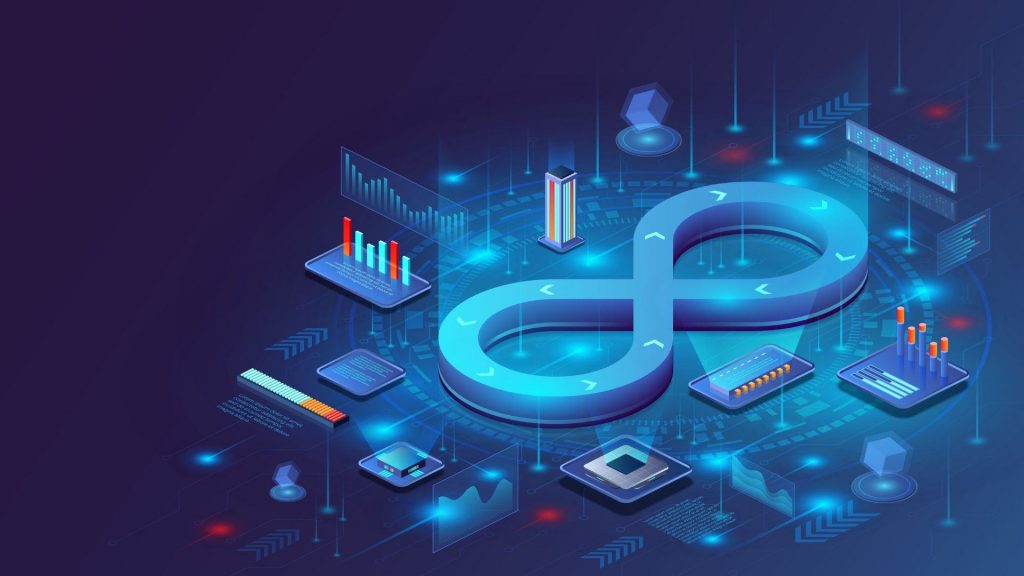 DevOps is a set of practices that combines software development and IT operations
>>> Explore more: The Importance of Cloud Computing in DevOps: Detailed Guide
1.2. What Is MLOps?
MLOps, or Machine Learning Operations, applies DevOps principles to the machine learning lifecycle, but extends them to address the unique challenges of building and maintaining ML systems. While DevOps mainly manages code and software releases, MLOps must manage code, data, models, experiments, and the dependencies between them.
Because of this, even when the code does not change, a model can degrade over time as real-world data shifts away from the original training distribution. MLOps addresses this by adding operational stages such as data ingestion and validation, model training, experiment tracking, model evaluation, model registry management, inference serving, and continuous monitoring for data drift and model performance. Each stage requires its own tooling, versioning strategy, and governance process.
As AI systems evolve from traditional machine learning models to large language models, many teams are also extending MLOps into LLMOps. LLMOps focuses on the operational needs of LLM-based applications, including prompt management, retrieval-augmented generation pipelines, vector databases, model evaluation, guardrails, inference cost control, and latency optimization.

MLOps is a set of practices combining machine learning, DevOps, and data engineering
2. MLOps vs DevOps: Key Differences
The table below compares MLOps and DevOps across the dimensions that matter most for infrastructure planning and team design. The core distinction is that DevOps focuses on releasing software reliably, while MLOps must additionally manage data pipelines, model versioning, experiment tracking, model drift, retraining cycles.
| Aspect | DevOps | MLOps |
| Main focus | Accelerating software delivery and system reliability | Operationalizing ML models from experiment to production |
| Core asset | Application code | Data, trained models, and feature pipelines |
| Pipeline | CI/CD: build, test, deploy | CT/CD: data ingestion, training, validation, deploy, retrain |
| Testing approach | Unit, integration, and end-to-end tests on code | Data validation, model evaluation, bias checks, and A/B testing |
| Deployment target | Application services, APIs, microservices | Model serving endpoints, inference APIs, embedded models |
| Monitoring requirement | Uptime, latency, error rates, resource usage | Model accuracy, data drift, concept drift, inference latency |
| Lifecycle complexity | Moderate, code versioning and release management | High, data versioning, experiment tracking, model registry, retraining loops |
| Feedback loop | User behavior and system logs inform the next release | Prediction quality and data distribution shifts trigger retraining |
| Team collaboration | Developers, QA, and operations engineers | Data scientists, ML engineers, data engineers, and operations |
| Infrastructure requirement | Compute for app hosting, containers, load balancers | GPU clusters for training, feature stores, model registries, inference servers |
3. MLOps vs DevOps infrastructure requirements
The infrastructure required to support MLOps is significantly more complex than what a standard DevOps setup demands. Beyond the usual compute and networking considerations, ML systems introduce additional layers for data management, model lifecycle, and inference serving, each of which must be provisioned, scaled, and monitored independently.
3.1. DevOps Infrastructure
- CI/CD pipelines: Automated pipelines that build, test, and deploy application code on every commit, typically using tools such as GitHub Actions, GitLab CI, or Jenkins.
- Cloud infrastructure: Scalable compute and networking resources provided by cloud platforms, enabling elastic capacity for application workloads without fixed hardware investment.
- Containers and orchestration: Docker containers packaged with application dependencies, managed at scale using Kubernetes or similar orchestration systems for consistent deployment across environments.
- Monitoring and logging tools: Observability AI cloud platform that collect metrics, logs, and traces from running services, enabling teams to detect and resolve incidents quickly.
3.2. MLOps infrastructure
- Data pipelines and feature stores: Automated workflows that ingest, clean, transform, and serve data to training and inference systems. Feature stores ensure that the same features used in training are available consistently at inference time.
- Model training environment: High-performance compute resources, typically GPU clusters, required to run training jobs efficiently at scale. GPU Virtual Machine from FPT AI Factory provides on-demand access to GPU compute, including NVIDIA H100 and H200, for model training, fine-tuning, and large-scale AI experimentation, without the overhead of managing physical hardware.
- Model registry and experiment tracking: Systems that log hyperparameters, metrics, and artifacts for every training run, and maintain a versioned record of all models progressed to staging or production.
- Inference infrastructure: Serving layers that host trained models and expose them as APIs for downstream applications. Serverless Inference from FPT AI Factory provides a managed inference environment that scales automatically with request volume, reducing the operational burden of maintaining dedicated serving infrastructure.
- Monitoring for data drift, model drift, latency, and accuracy: Continuous evaluation pipelines that compare live data distributions against training baselines, track prediction quality over time, and trigger alerts or automated retraining when thresholds are breached.
>>> Explore more: What Is Data Infrastructure? Key Components and How to Build It
4. How MLOps and DevOps workflows compare
Both DevOps and MLOps follow structured workflows to ensure reliable deployment and continuous improvement. However, while DevOps focuses on delivering software efficiently, MLOps introduces additional steps to manage data and maintain machine learning model performance over time.
4.1. DevOps workflow
The DevOps workflow is designed to streamline software delivery through a consistent and repeatable pipeline, ensuring that code changes can be built, tested, and released quickly with minimal risk. Its process include: Code → Build → Test → Deploy → Monitor
- Code: Developers write and update application logic, implement features, and manage source control.
- Build: Compile code, resolve dependencies and package it into deployable artifacts (e.g., binaries, containers).
- Test: Run automated tests (unit, integration) to ensure functionality and stability.
- Deploy: Release the application to staging or production environments.
- Monitor: Track system performance, logs, and errors to detect issues and improve reliability.
In a traditional DevOps workflow, engineers deploy application updates such as checkout improvements, UI fixes, or payment integrations. The primary concern is whether the application functions correctly after deployment.
4.2. MLOps workflow
The MLOps workflow expands on DevOps by incorporating data and model lifecycle management, enabling machine learning systems to remain accurate and effective in dynamic, real-world environments. The process includes Data → Train → Validate → Deploy → Monitor → Retrain
- Data: Raw data is ingested, validated, and transformed into training-ready features.
- Train: A model is trained on the prepared dataset, with experiments logged automatically.
- Validate: The trained model is evaluated against held-out data and business-defined quality thresholds.
- Deploy: The validated model is registered and served via an inference endpoint.
- Monitor: Live prediction quality, latency, and data distributions are tracked continuously.
- Retrain: When drift or performance degradation is detected, a new training run is triggered automatically or manually.
In an MLOps workflow, teams must additionally manage machine learning models powering recommendation systems or demand forecasting engines. Even if the application code remains unchanged, the model’s performance may degrade over time as customer behavior changes.
This means MLOps teams must continuously monitor prediction accuracy, detect model drift, retrain models, and redeploy updated versions without disrupting production systems.
MLOps extends DevOps by adding data, model training, monitoring, and retraining layers to the software delivery workflow.
5. When to use MLOps vs DevOps
Choosing between DevOps, MLOps, or a combination of both comes down to whether your system’s behavior is determined by code alone or also by a trained model. The decision table below maps common engineering scenarios to the appropriate operational approach.
| Situation | Recommended approach | Reasons |
| Traditional web or mobile application | DevOps | No ML model to manage, standard CI/CD and release workflows are sufficient |
| Cloud-native software product | DevOps | Focus is on service reliability and deployment velocity, not model lifecycle |
| Predictive ML model in production | MLOps | Requires experiment tracking, model versioning, and drift monitoring over time |
| LLM or AI application with inference workload | MLOps + DevOps | Combines software delivery best practices with model serving and performance monitoring |
| Enterprise AI system requiring retraining and monitoring | MLOps | Ongoing data and model management demands dedicated MLOps tooling and processes |
6. Challenges of implementing MLOps compared with DevOps
MLOps introduces a category of operational challenges that simply does not exist in a standard DevOps environment. Teams adopting MLOps for the first time frequently underestimate the effort required to build and maintain the additional infrastructure layers that ML systems depend on.
- Managing data quality and dataset versioning: Unlike code, data is mutable and difficult to reproduce exactly. Tracking which dataset version was used to train which model, and ensuring data quality does not degrade silently, requires dedicated tooling and process discipline.
- Tracking experiments and model versions: A single ML project may involve hundreds of training runs with varying hyperparameters, architectures, and data splits. Without systematic experiment tracking, teams lose the ability to reproduce results or understand why one model outperformed another.
- Monitoring model drift and performance degradation: Models that perform well at deployment can silently degrade as the real-world data they encounter shifts over time. Detecting this requires ongoing statistical monitoring that most application observability stacks are not designed to provide.
- Scaling inference workloads in production: Serving a trained model under variable traffic is more complex than hosting a stateless application. Inference endpoints must handle batching, cold-start latency, and the memory requirements of large models, particularly for LLM-based systems.
- Aligning data science, engineering, and operations teams: MLOps sits at the intersection of three disciplines with different tooling preferences, priorities, and definitions of “done.” Building shared workflows and ownership models across these teams is often the hardest part of a successful MLOps implementation.
For organizations looking to reduce this complexity, FPT AI Factory provides a purpose-built ecosystem of infrastructure and tooling designed to support AI workloads at production scale, from GPU compute for training to managed inference for deployment, without requiring teams to build and maintain each layer from scratch.
7. Frequently Asked Questions
7.1. Is MLOps the Same as DevOps?
No. MLOps and DevOps share foundational principles such as automation, continuous delivery, and cross-functional collaboration, but they are not the same practice. DevOps focuses on the reliable delivery of application software. MLOps extends those principles to cover the additional lifecycle requirements of ML systems, including data management, experiment tracking, model versioning, and inference monitoring, none of which exist in a conventional software delivery workflow.
7.2. Does MLOps Replace DevOps?
No. MLOps is not a replacement for DevOps, it is a complement to it. Most production AI systems consist of both ML models and the application code that wraps or calls them. The application layer still requires standard DevOps practices for reliable delivery. MLOps adds an operational layer on top to manage the model-specific concerns. Teams building AI-powered products typically need both disciplines running in parallel.
7.3. Why Does Machine Learning Need MLOps?
Machine learning systems behave differently from traditional software because their outputs depend not just on code but on the data they were trained on and the statistical properties of that data. MLOps provides the processes and tooling needed to detect this degradation, trigger retraining, and maintain model quality continuously in production, something standard DevOps practices are not designed to address.
7.4. What Tools Are Used in MLOps?
Common MLOps tooling spans several categories. For experiment tracking and model registry: MLflow, Weights & Biases, and Neptune. For data pipeline orchestration: Apache Airflow and Prefect. For model serving: TorchServe, Triton Inference Server, and managed inference platforms. For monitoring: Evidently AI and Arize. For training infrastructure: GPU cloud platforms providing on-demand H100 or H200 compute. The right combination depends on the scale of the ML workload, the maturity of the team, and whether the organization prefers a managed platform or a self-assembled open-source stack.
7.5. Is LLMOps part of MLOps?
Yes. LLMOps is considered a specialized branch of MLOps focused specifically on deploying, monitoring, and optimizing Large Language Models (LLMs). While MLOps manages traditional ML systems, LLMOps adds capabilities like prompt management, RAG pipelines, vector databases, hallucination monitoring, and AI safety.
The distinction between MLOps and DevOps is not academic; it has direct consequences for infrastructure investment, team structure, and the operational maturity required to sustain AI systems in production. To get started with GPU infrastructure for model training or managed inference for deployment, explore FPT AI Factory. New users receive $100 in free credits under the Starter Plan, available immediately upon login with no upfront cost. For enterprises with larger-scale or customized requirements, contact the FPT AI Factory team to discuss tailored solutions and dedicated support.
Contact Information:
- Hotline: 1900 638 399
- Email: support@fptcloud.com
Explore more articles: