

What is intelligent document processing? It is an AI-powered approach that helps businesses automatically capture, extract, classify, and process data from documents, reducing manual work and improving operational accuracy. In this guide, FPT AI Factory explores how intelligent document processing works, its key benefits, and why it matters for modern document-heavy workflows.
1. Intelligent Document Processing Overview
In today’s digital-first business environment, organizations are dealing with an ever-growing volume of documents coming from multiple sources such as emails, scanned PDFs, online forms, invoices, contracts, and mobile-captured images. Traditional manual processing methods are no longer efficient enough to handle this scale, speed, and complexity. This is where Intelligent Document Processing (IDP) plays a critical role in modern enterprise automation.
1.1 What is Intelligent Document Processing?
Intelligent Document Processing (IDP) is an AI-driven technology that automates document handling, from classification and data extraction to validation and integration with business systems. By combining AI, Machine Learning (ML), Optical Character Recognition (OCR), and Natural Language Processing (NLP), IDP can process both structured and unstructured documents at scale.
Unlike traditional document processing methods, IDP understands document context, extracts relevant information, and continuously improves through machine learning. By converting unstructured content into structured, actionable data, it helps organizations reduce manual effort, improve accuracy, and accelerate business workflows.
For example, organizations use IDP to automatically process documents such as invoices, claims, contracts, and financial records, reducing review time while improving operational efficiency and compliance.
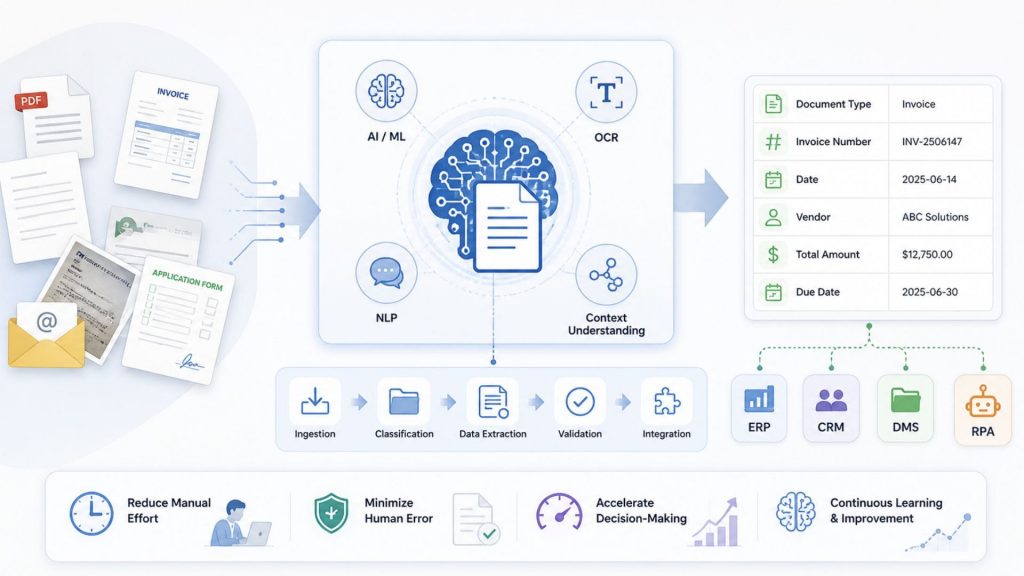
Intelligent Document Processing (IDP) is an AI technology that automates document workflows.
1.2 Intelligent Document Processing vs Optical Character Recognition
While Optical Character Recognition (OCR) is often associated with document digitization, it represents only a foundational component of Intelligent Document Processing.
OCR is primarily designed to convert printed or handwritten text from images or scanned documents into machine-readable text. However, it does not understand meaning, context, or relationships within the data. It simply recognizes characters and outputs raw text.
In contrast, Intelligent Document Processing goes much further. It not only extracts text but also:
| Aspect | OCR | Intelligent Document Processing (IDP) |
| Core function | Converts images/text into machine-readable text | Understands, extracts, and structures business-relevant data |
| Context understanding | None | Yes, interprets meaning and relationships |
| Document handling | Limited to text recognition | Handles classification of multiple document types |
| Output | Raw, unstructured text | Structured, validated, and enriched data |
| Intelligence level | Rule-based / basic recognition | AI-driven learning and adaptation over time |
| Business usage | Digitization only | End-to-end automation and decision support |
In simple terms, OCR answers the question “What is written in the document?”, while IDP answers “What does this document mean, and how can this data be used?”
This distinction makes IDP a far more powerful solution for enterprise automation, as it transforms documents from static information sources into actionable business intelligence.
2. How Intelligent Document Processing Works
Intelligent Document Processing (IDP) operates as a multi-stage workflow that transforms raw, unstructured documents into structured and actionable data. Each step plays a critical role in ensuring accuracy, consistency, and seamless integration with downstream business systems.
Step 1: Document ingestion and classification
At this stage, documents are collected from multiple sources such as emails, scanned files, APIs, cloud storage, or mobile uploads. The IDP system then processes and categorizes them based on their type, such as invoices, contracts, receipts, or application forms. AI models analyze layout, structure, and content patterns to automatically assign the correct document class, enabling more efficient downstream processing.
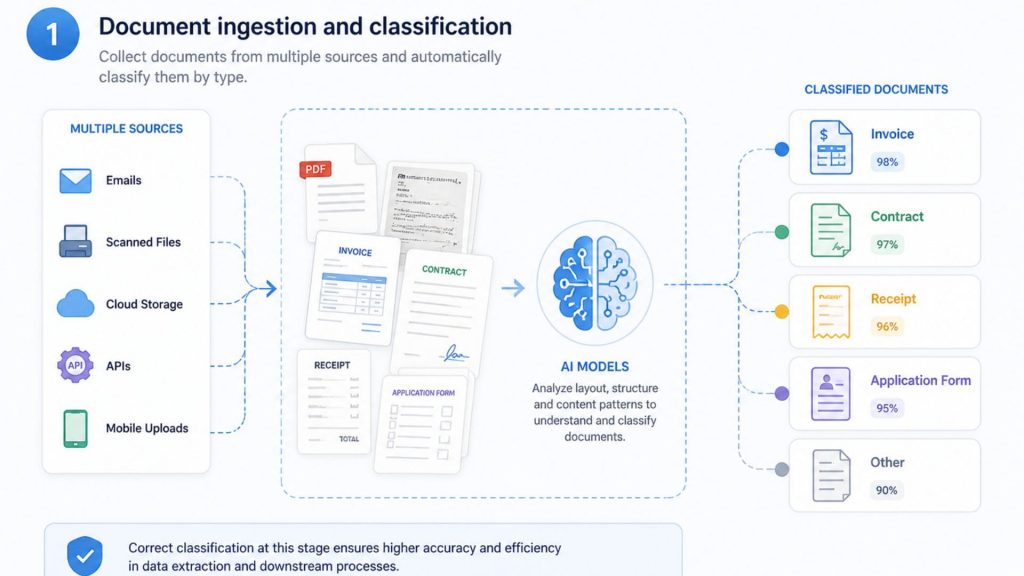
Document intake and categorization
Step 2: Data extraction
Once classified, the system identifies and extracts relevant information from the document. Using technologies like Optical Character Recognition (OCR) and Natural Language Processing (NLP), IDP captures key data fields such as names, dates, amounts, reference numbers, and other business-critical attributes. This step focuses on turning unstructured content into structured data points.
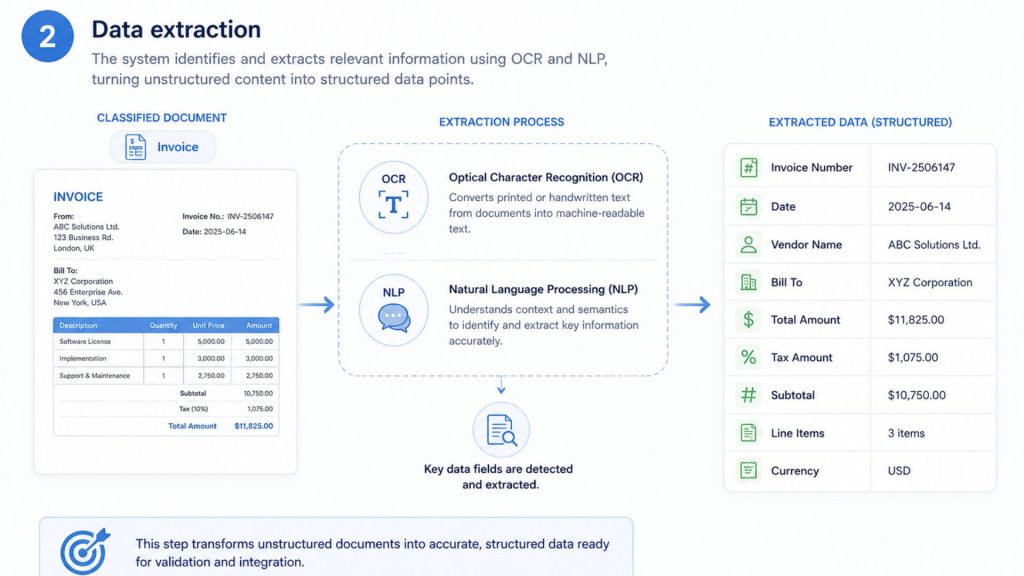
Data extraction refers to the process of identifying and retrieving relevant information from documents
Step 3: Data validation and enrichment
After extraction, the data is verified to ensure accuracy and consistency. Validation rules are applied to detect missing, incorrect, or inconsistent values. In addition, the system may enrich the data by cross-referencing external databases or internal business systems, improving completeness and reliability before further use.
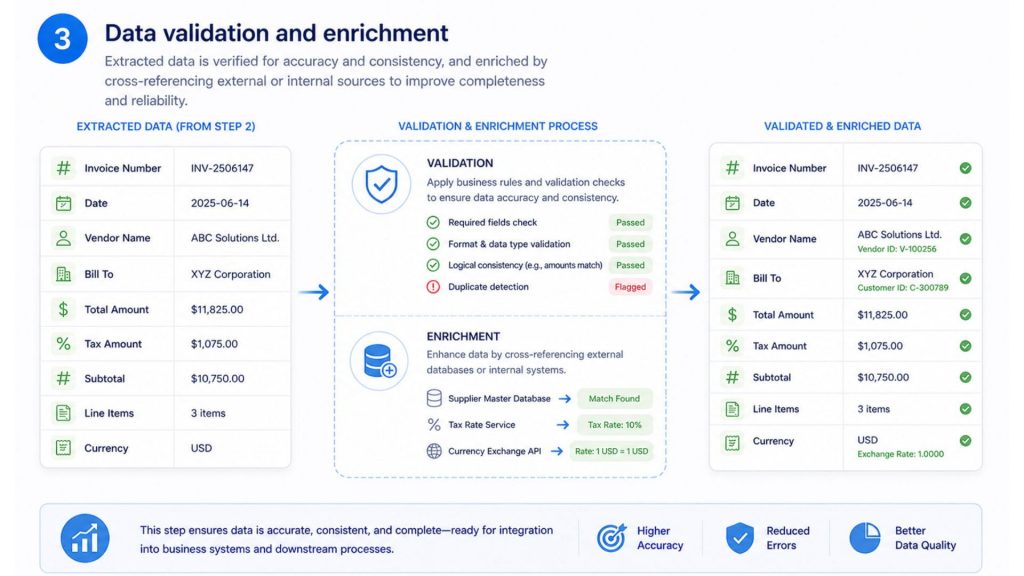
Data validation and enrichment is the process of checking extracted data.
Step 4: Output and system integration
In the final step, the processed and validated data is converted into a structured format such as JSON or XML. It is then integrated into enterprise systems like ERP, CRM, or workflow automation platforms. This enables seamless downstream processing, such as triggering approvals, updating records, or initiating automated business workflows.
3. Intelligent Document Processing pipeline overview
The Intelligent Document Processing (IDP) pipeline is designed as an end-to-end architecture that converts raw documents into structured, business-ready data. It combines AI models, data processing layers, and enterprise integration to ensure scalability, accuracy, and real-time automation.
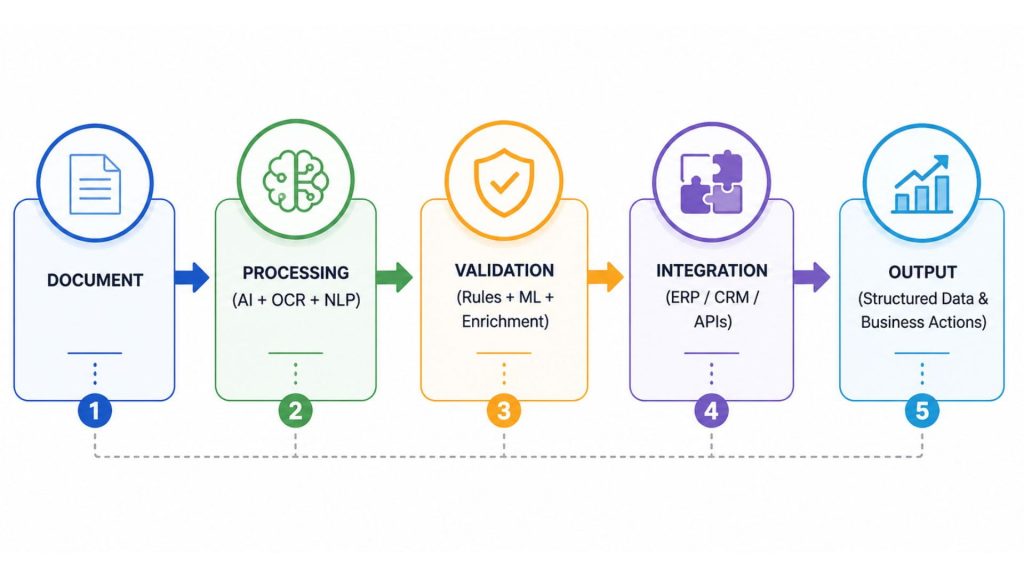
Intelligent Document Processing (IDP) pipeline overview describes the end-to-end flow.
Document Layer
This is the entry point of the pipeline where data is collected from multiple sources such as PDFs, emails, scanned images, or digital forms. Documents are ingested into the system in various formats and quality levels, forming the raw input for AI processing.
Processing Layer
At this stage, AI models analyze and interpret the documents using OCR, NLP, and machine learning techniques. The system performs classification, identifies key entities, and extracts relevant information from unstructured content. This layer transforms raw documents into structured data candidates.
Validation Layer
Extracted data is then checked for accuracy, consistency, and completeness. Business rules, predefined constraints, and AI-based anomaly detection are applied. In many systems, this stage also includes data enrichment by cross-referencing internal databases or external sources.
Integration Layer
Validated data is connected to enterprise systems such as ERP, CRM, data warehouses, or workflow automation platforms. This layer ensures seamless data flow across business applications and enables downstream automation such as approvals, reporting, or triggering processes.
Output Layer
The final output is structured, standardized, and ready for business use. Data can be exported in formats like JSON or XML, or directly used to drive automated workflows, analytics dashboards, and decision-making systems.
To handle enterprise-scale workloads, the IDP pipeline is designed to run on high-performance GPU infrastructure, enabling faster AI model training and inference without compromising accuracy. Depending on deployment needs, this can be supported through dedicated AI infrastructure services such as those offered by FPT AI Factory, which provide the computing backbone for demanding document processing operations. With the right infrastructure in place, the system can:
By leveraging GPU acceleration, the system can:
- Process high volumes of documents in real time
- Improve OCR and NLP model performance
- Reduce latency in large-scale enterprise deployments
- Support continuous AI model training and optimization
This makes the IDP pipeline not only intelligent but also highly scalable and production-ready for enterprise environments.
4. Intelligent Document Processing Use Cases by Industry
Intelligent Document Processing (IDP) is widely adopted across industries where document-heavy workflows dominate daily operations. Its core value lies in eliminating manual data entry, reducing processing time, and improving data accuracy.
4.1 Banking and Finance
Problem: Banks and financial institutions process massive volumes of documents such as account opening forms, loan applications, invoices, and compliance reports. Most of these processes are still manual, leading to delays, high operational costs, and data entry errors.
Solution: IDP automates document classification, extracts financial data (income, credit details, transaction records), and validates it against internal banking systems and regulatory rules. It integrates directly with core banking systems and loan processing workflows.
Infrastructure Pattern: Documents are uploaded through banking portals, email channels, or internal document management systems into a centralized ingestion layer. OCR and AI models process the documents to classify file types and extract structured financial information. The extracted data is then validated through rule-based engines and connected with core banking systems, customer databases, and compliance platforms through APIs. Once verified, the structured output is routed automatically into loan approval, onboarding, or audit workflows for further processing and decision-making.
Impact:
- Significantly faster customer onboarding and loan approval processes
- Reduced operational workload for back-office teams
- Improved regulatory compliance and audit traceability
- Lower error rates in financial data processing
- Enhanced customer experience through faster service delivery
Example: A bank uses IDP to process mortgage applications by automatically extracting salary information, employment history, credit scores, and property documents from multiple sources, then feeding structured data into a loan approval engine for faster decision-making.
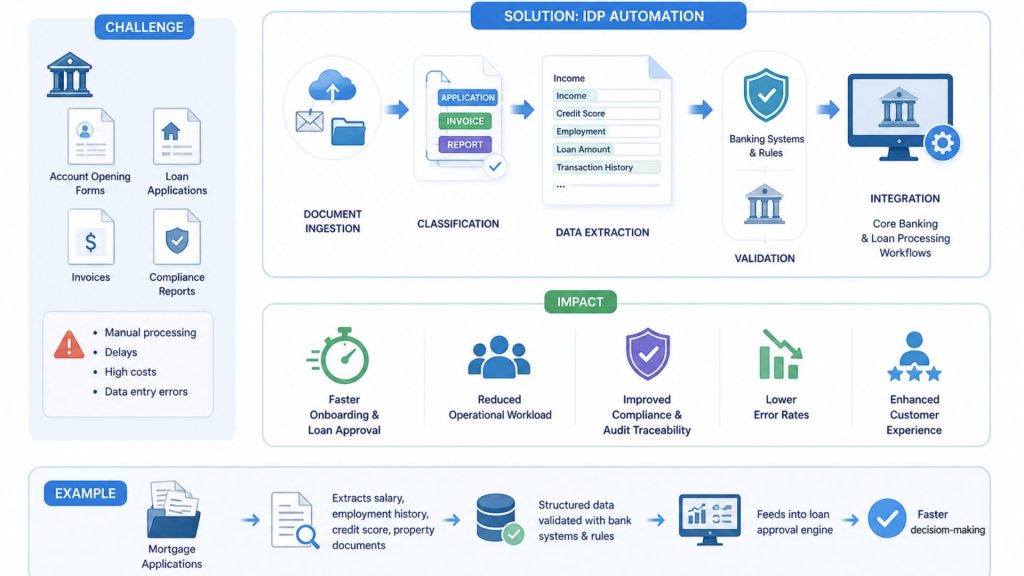
Intelligent Document Processing in Finance and Finance
4.2 Insurance
Problem: Insurance companies handle claims, policy documents, and supporting evidence in multiple formats. Manual claim processing is slow, inconsistent, and prone to fraud or human error.
Solution: IDP classifies incoming documents (e.g., auto claims, health claims, property damage reports), extracts relevant claim data, and validates it against policy terms. AI models can also detect anomalies or inconsistencies that may indicate potential fraud. The system integrates with claims management platforms to automate workflows.
Infrastructure Pattern: Documents are submitted through banking portals, email systems, or internal platforms into a centralized ingestion layer. OCR and AI models classify documents and extract financial data, which is then validated through rule engines and integrated with core banking systems via APIs. Verified data is automatically routed into onboarding, loan approval, and compliance workflows for further processing.
Impact:
- Faster claims processing and settlement times
- Improved fraud detection through data pattern analysis
- Reduced dependency on manual claim assessment
- Higher accuracy in policy validation and eligibility checks
- Better customer trust and satisfaction
Example: An insurance provider processes car accident claims by extracting details from police reports, repair invoices, and uploaded photos, automatically validating coverage and initiating payout workflows without manual intervention.
4.3 Healthcare
Problem: Healthcare organizations deal with highly sensitive and complex documentation, including patient records, lab results, prescriptions, insurance claims, and clinical reports. These documents are often stored in different formats across multiple systems, leading to inefficiencies, data fragmentation, and delays in patient care.
Solution: IDP extracts and structures medical data from diverse document types and integrates it into Electronic Health Record (EHR) systems. It can recognize medical terminology, patient identifiers, diagnosis codes, and treatment details. Advanced NLP capabilities help interpret unstructured clinical notes.
Infrastructure Pattern: Medical documents from hospitals, labs, insurance providers, and patient portals are ingested into secure processing systems. OCR and NLP models extract patient data, diagnosis codes, prescriptions, and clinical information, which are then standardized and synchronized with EHR platforms through secure APIs. Access control and compliance monitoring ensure data privacy and regulatory security.
Impact:
- Faster access to patient information for healthcare providers
- Improved accuracy of medical records
- Reduced administrative burden on medical staff
- Better coordination between departments and systems
Example: A hospital uses IDP to digitize discharge summaries and lab reports, automatically updating patient records in the EHR system and enabling doctors to access complete medical histories in real time.
4.4 Logistics and Supply Chain
Problem: Logistics operations rely heavily on documents such as shipping manifests, customs declarations, bills of lading, delivery notes, and invoices. Manual processing of these documents often leads to shipment delays, customs clearance bottlenecks, and inaccurate tracking information.
Solution: IDP automates extraction of shipment-related data such as container numbers, tracking IDs, delivery schedules, and customs codes. It integrates with logistics management systems to enable real-time visibility and automation of shipment workflows.
Infrastructure Pattern: Shipping documents, customs forms, invoices, and delivery records are collected into a centralized processing pipeline. OCR and AI models extract shipment data such as tracking numbers, container IDs, and delivery schedules, which are then validated and integrated with logistics and warehouse systems through APIs. Automated workflows update tracking systems and support real-time supply chain operations.
Impact:
- Faster customs clearance and reduced shipment delays
- Improved end-to-end supply chain visibility
- Reduced manual errors in logistics documentation
- Enhanced tracking accuracy and operational efficiency
- Better coordination between global supply chain partners
Example: A logistics company uses IDP to process shipping documents automatically, extracting container IDs and delivery timelines, then updating real-time tracking systems used by customers and warehouse operators.
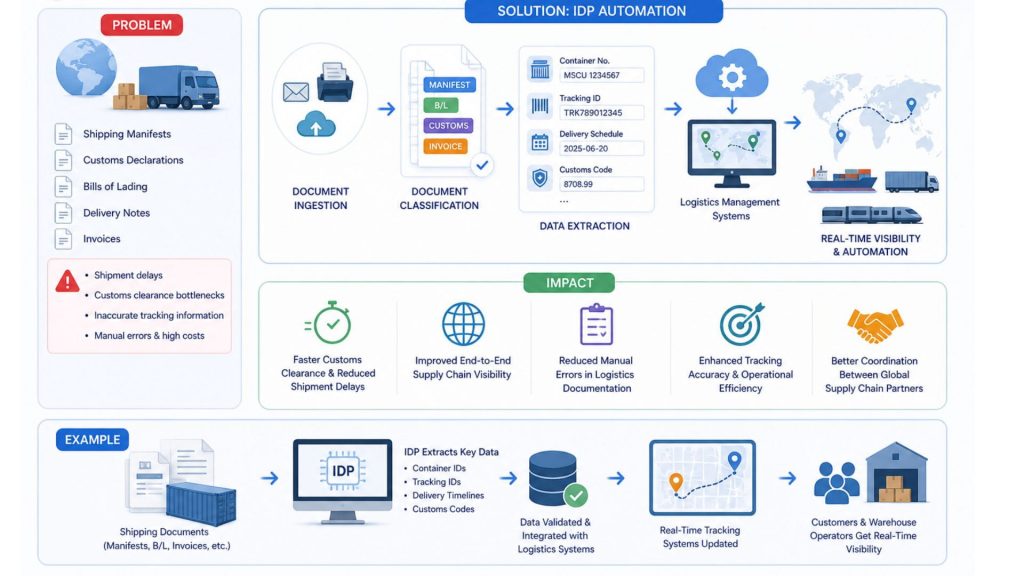
Intelligent Document Processing in Logistics and Supply Chain
4.5 Legal and Compliance
Problem: Legal and compliance teams must review large volumes of contracts, regulatory filings, audit reports, and legal agreements. Manual review is time-consuming, requires high expertise, and increases the risk of missing critical clauses or compliance obligations.
Solution: IDP uses NLP and AI models to analyze legal documents, extract key clauses (e.g., renewal terms, penalty clauses, obligations), and identify compliance risks. It can also categorize documents and enable intelligent search across large legal repositories.
Impact:
- Faster contract review and approval cycles
- Reduced legal and compliance risks
- Improved visibility into contractual obligations
- Enhanced document search and retrieval capabilities
- Lower operational cost for legal teams
Infrastructure Pattern: Contracts, audit reports, and legal documents are ingested into a centralized processing system from enterprise repositories and cloud platforms. NLP and LLM models analyze documents, extract clauses and obligations, and identify compliance risks. The extracted insights are integrated with GRC platforms through APIs, while automated workflows support legal review, approval, and compliance tracking.
Example: A corporate legal department uses IDP to analyze vendor contracts, automatically identifying renewal dates, liability clauses, and compliance requirements, and generating alerts for upcoming deadlines or risks.
5. Benefits of Implementing IDP
Implementing Intelligent Document Processing (IDP) brings significant operational and strategic advantages to organizations by transforming manual, document-heavy workflows into automated, AI-driven processes.
- Faster processing: IDP dramatically reduces the time required to process documents by automating extraction, classification, and validation steps, enabling near real-time data handling and faster business decision-making.
- Higher accuracy: By leveraging AI and machine learning, IDP minimizes human errors in data entry and interpretation, ensuring more consistent and reliable data across systems.
- Reduced manual work: IDP eliminates repetitive and time-consuming manual tasks such as data entry and document sorting, allowing employees to focus on higher-value activities like analysis and decision-making.
- Better compliance: Automated validation rules and audit trails help ensure that data processing aligns with regulatory requirements, improving transparency and reducing compliance risks.
- Scalable operations: IDP systems can handle increasing document volumes without a proportional increase in resources, enabling organizations to scale operations efficiently as business demands grow.
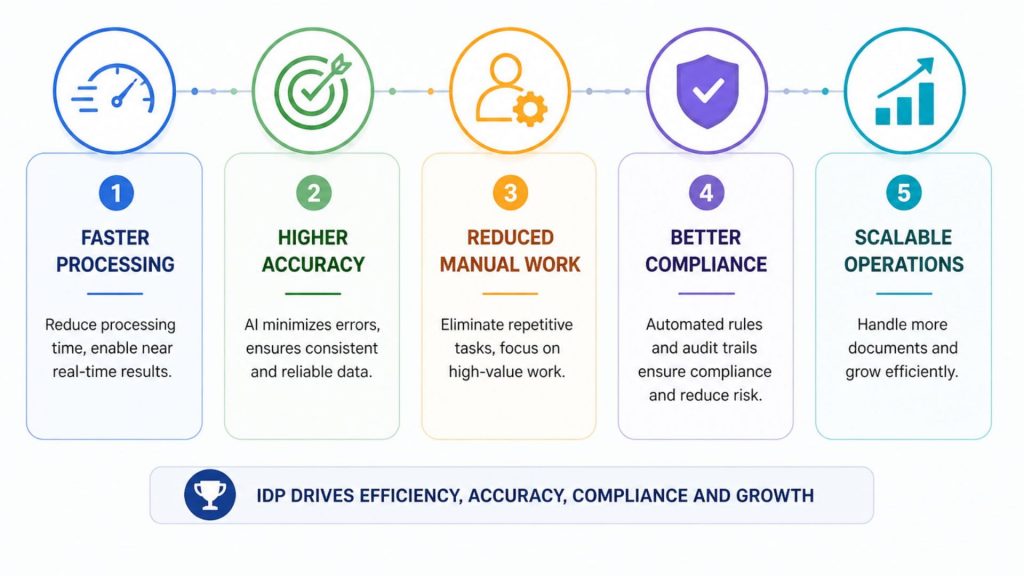
Implementing IDP transforms manual document workflows into automated, AI-driven processes, improving efficiency and business outcomes.
6. Key Technologies Behind IDP
Intelligent Document Processing (IDP) is built on a combination of AI technologies that work together to enable machines to read, understand, and structure complex documents at scale. Each technology plays a specific role in transforming raw data into actionable business insights.
6.1 Optical Character Recognition (OCR)
OCR is the foundational technology in IDP that converts printed or handwritten text from scanned documents, PDFs, or images into machine-readable text. It enables systems to digitize physical documents, making the content accessible for further processing.
However, OCR alone only recognizes characters, it does not understand meaning, context, or relationships within the document.
6.2 Natural Language Processing (NLP)
NLP enables IDP systems to understand and interpret human language. It helps extract meaning from unstructured text such as emails, contracts, or medical notes.
With NLP, systems can identify entities (names, dates, amounts), understand relationships between data points, and interpret intent within documents, significantly improving the quality of extracted information.
6.3 Machine Learning and Computer Vision
Machine Learning (ML) allows IDP systems to learn patterns from historical document data and improve accuracy over time. It is widely used for document classification, anomaly detection, and predictive extraction.
Computer Vision complements this by analyzing visual structure, such as layouts, tables, stamps, signatures, and form structures, allowing the system to understand documents beyond plain text.
Together, ML and Computer Vision enable IDP to handle highly variable and complex document formats.
6.4 Large Language Models in Modern IDP
Modern Intelligent Document Processing (IDP) systems are increasingly powered by Large Language Models (LLMs), marking a fundamental shift from traditional OCR and rule-based NLP pipelines toward contextual reasoning and knowledge-aware processing. Unlike template-driven extraction, LLMs can interpret document meaning, capture semantic relationships, and adapt across diverse document formats — enabling a new generation of more flexible and intelligent document AI.
6.4.1. LLM-Based Contextual Understanding
LLMs improve document processing by enabling systems to:
- Understand document meaning and context beyond keyword matching
- Process unstructured and semi-structured content such as invoices, contracts, reports, and forms
- Adapt to different document layouts with reduced manual configuration
- Improve extraction accuracy through semantic understanding and contextual reasoning
Within the FPT AI Factory ecosystem, LLM technologies can be leveraged to develop more flexible and scalable document AI workflows for enterprise use cases.
6.4.2. Retrieval and Vector Search in Modern Document AI
Beyond contextual understanding, modern IDP systems increasingly combine LLMs with retrieval mechanisms and vector search technologies to improve document intelligence and enterprise knowledge access.
Documents can be transformed into vector embeddings and stored in vector databases to enable semantic retrieval instead of traditional keyword-based search. This allows systems to:
- Retrieve contextually relevant document content
- Support enterprise document question-answering
- Improve information discovery across large-scale document repositories
- Enhance Retrieval-Augmented Generation (RAG) workflows
These retrieval capabilities help modern document AI systems provide more accurate and context-aware responses across enterprise document ecosystems.
6.4.3. Fine-Tuning and AI Studio for Scalable IDP Development
LLM-based IDP workloads require scalable AI environments for experimentation, model customization, and deployment. AI Studio within FPT AI Factory provides a unified workspace for building and testing AI-driven document processing workflows.
AI Studio supports model development and fine-tuning workflows through:
- GPU-based infrastructure for high-performance training workloads
- AI Notebook environments for interactive experimentation and model iteration
- Integrated environments for testing, optimization, and workflow development
By combining LLM contextual understanding, retrieval-augmented workflows, and model customization capabilities within FPT AI Factory, organizations can build domain-specific IDP systems that continuously improve through operational usage — accelerating document-driven processes and reducing manual effort at enterprise scale.
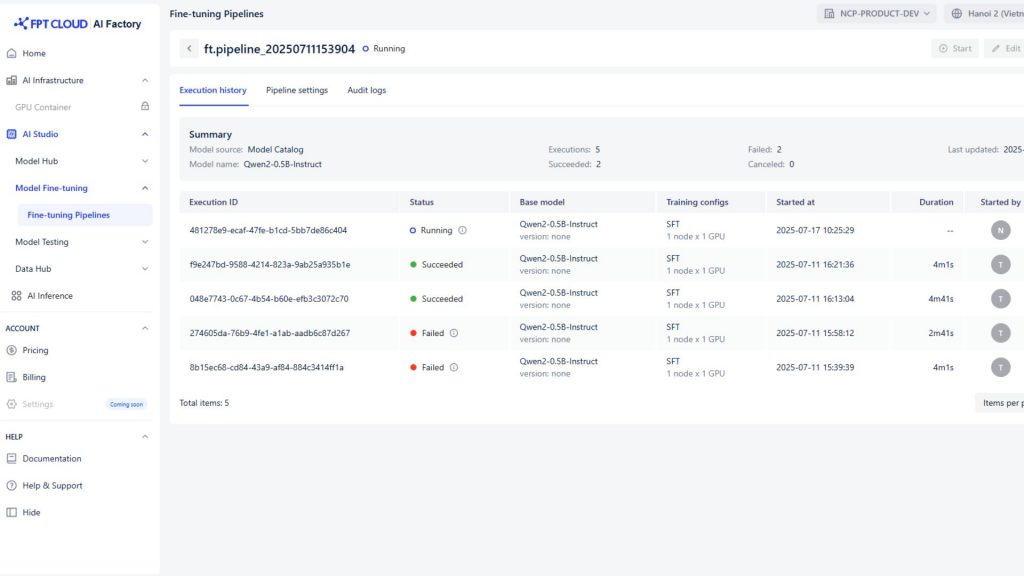
Model fine-tuning capabilities provided by FPT AI Factory (Source: FPT AI Factory)
>>> Read more: What is LLM Inference? How it works, metrics, and scaling
7. Frequently Asked Questions
7.1. What are the differences between IDP and OCR?
OCR is used to convert images or scanned documents into raw machine-readable text, while IDP goes further by understanding the content, extracting meaningful data, and structuring it with context. In short, OCR is a component of IDP, but IDP is a complete AI-driven system for document understanding and automation.
7.2. How accurate is IDP?
The accuracy of IDP systems can be very high, typically ranging from 90% to 99% depending on document quality, model training data, and use case complexity. In addition, accuracy improves continuously over time as the system learns from new documents and corrections.
7.3. What documents can IDP process?
IDP can handle a wide variety of document types, including structured documents like forms and tables, semi-structured documents like invoices and purchase orders, and unstructured documents such as contracts, emails, medical records, and scanned images. It is designed to adapt to different formats and layouts across industries.
Intelligent Document Processing (IDP) is becoming a key foundation for automating document-heavy operations, helping enterprises move from manual data handling to AI-driven workflows that can understand, extract, and structure information at scale. By combining OCR, NLP, Machine Learning, and Large Language Models, IDP goes beyond basic extraction to deliver deeper contextual understanding across diverse and complex document types.
Harness the power of Intelligent Document Processing (IDP) to automate document-heavy workflows, improve data accuracy, and accelerate business operations. With FPT AI Factory, organizations can build and scale AI-powered document intelligence solutions on top of enterprise-grade infrastructure.
To summarize:
- Intelligent Document Processing (IDP) combines OCR, NLP, Machine Learning, and AI to automatically classify documents, extract information, validate data, and integrate outputs into business systems.
- Unlike traditional OCR, which only converts documents into text, IDP understands context and transforms unstructured content into structured, actionable business data.
- The IDP workflow includes document ingestion, classification, data extraction, validation, and integration, enabling end-to-end automation across document-centric processes.
- Organizations across banking, insurance, healthcare, logistics, and legal services use IDP to reduce manual work, improve accuracy, accelerate processing times, and enhance compliance.
- FPT AI Factory provides the GPU infrastructure, AI Studio, AI Notebook, and LLM development capabilities needed to build, optimize, and scale modern document intelligence solutions for enterprise workloads.
To implement these capabilities effectively, organizations need a robust AI development platform. FPT AI Factory provides this foundation through an integrated ecosystem that enables teams to build, experiment, and scale IDP and LLM-based solutions. With GPU-powered infrastructure, AI Notebook, and AI Studio, businesses can train models, run document intelligence workloads, and transition from experimentation to production more efficiently.
For new users, FPT AI Factory also offers a Starter Plan with $100 credits, allowing teams to explore GPU compute, AI notebooks, and inference services before scaling into production. For enterprise needs, tailored options are available with dedicated support, enhanced security, and flexible deployment capabilities.
Together, IDP capabilities and a robust AI infrastructure like FPT AI Factory help organizations shorten the journey from experimentation to real-world adoption, making document intelligence a practical and scalable part of digital transformation.
Contact Information:
- Hotline: 1900 638 399
- Email: support@fptcloud.com
Explore more articles:
Top Cloud Service Providers with GPU for AI Workloads
What is AI governance? Principles, framework and practices
Agentic AI vs AI agents: key differences and how to choose