
AI Development Platforms are transforming the way businesses design, train, and deploy intelligent solutions at scale. Choosing the right platform is a critical decision that directly impacts development speed, model performance, and long-term scalability. At FPT AI Factory, we provide a comprehensive AI development ecosystem that empowers organizations to build and operationalize AI faster, smarter, and more efficiently.
1. What are AI development platforms?
AI development platforms are integrated software environments, combining compute infrastructure, data management tools, model training frameworks, deployment pipelines, and monitoring dashboards. It is designed to support the full AI lifecycle, from raw data preparation and model training to deployment and ongoing management. They bring together everything teams need in one place, making it easier to build and scale AI solutions.
Whether you’re a developer, data scientist, or enterprise team, these platforms streamline collaboration and help you move from idea to production faster. Simply put, they remove the heavy lifting so teams can focus on building AI that actually works.
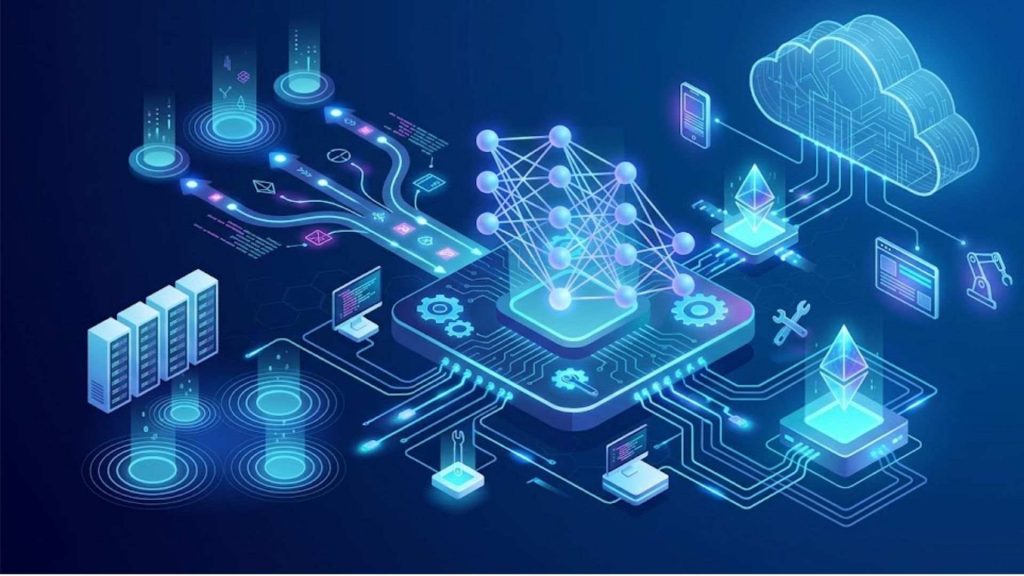
AI development platforms are integrated tools designed to support the full AI lifecycle
>>> Read more: What is an AI Data Platform and How Does It Work?
2. Benefits of AI development platforms
Adopting the right AI development platform can fundamentally change how your team builds and delivers AI solutions. Instead of dealing with fragmented tools and manual processes, teams gain a structured, efficient environment to work smarter and ship faster. Here’s what the right platform brings to the table:
- Reduced complexity: Managing AI projects involves countless moving parts. A dedicated platform consolidates tools, data pipelines, and workflows into one unified environment, making the entire process far more manageable for teams of any size.
- Faster development & deployment: Pre-built components, automation, and ready-to-use templates significantly cut down development time. Teams can go from experimentation to production in a fraction of the time compared to building from scratch.
- Better team collaboration: AI projects rarely succeed in silos. These platforms create a shared workspace where developers, data scientists, and business stakeholders can contribute, review, and iterate together seamlessly.
- Scalability & performance: As data volumes grow and model demands increase, a robust platform scales alongside your needs. You won’t have to rebuild your infrastructure every time your AI initiatives expand.
- Standardized workflows: Consistency is key to reliable AI outcomes. Platforms enforce best practices and repeatable processes across projects, reducing errors and making it easier to maintain quality at scale.

Adopting the right AI development platform can change how your team builds AI solutions
3. Key features of AI development platforms
Not all AI platforms are built the same, the best ones cover every stage of the AI lifecycle, from data to deployment. Here’s a breakdown of the key capabilities to look for:
3.1. Data management and processing
Every AI project starts with data, and managing it well makes all the difference. AI development platforms provide built-in tools to collect, clean, label, and version datasets, ensuring your models are trained on reliable, high-quality inputs. With centralized data management, teams spend less time wrestling with messy pipelines and more time building.
3.2. Model development and training
A strong platform gives teams a flexible environment to experiment, build, and refine AI models efficiently. From notebook integrations to automated training pipelines, these features support the full model development cycle, whether you’re working with classic machine learning or large-scale deep learning architectures. The goal is to make iteration faster and experimentation more structured.
3.3. Compute infrastructure
Training and fine-tuning AI models demand serious computing power, and having the right infrastructure on demand is essential. FPT AI Factory’s GPU Virtual Machine provides flexible, high-performance compute resources purpose-built for training, fine-tuning, and AI experimentation. Teams can scale compute up or down based on project needs, without the overhead of managing physical hardware.
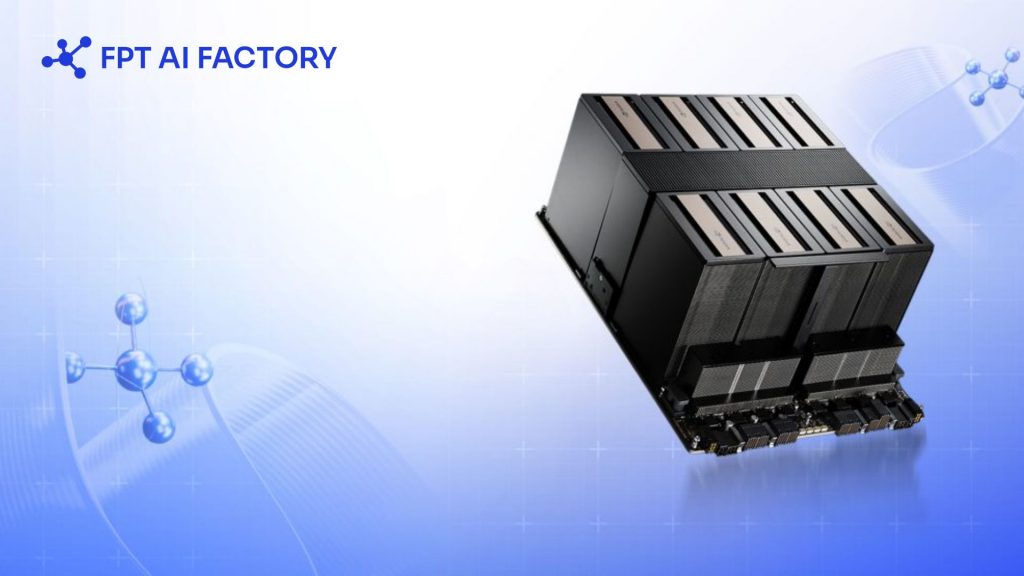
FPT AI Factory’s GPU Virtual Machine provides flexible resources (Source: FPT AI Factory)
3.4. Model deployment and inference
Getting a model into production is often where teams hit the most friction. A good platform simplifies deployment with tools that handle versioning, serving, and monitoring, so models run reliably at scale. FPT AI Factory’s Serverless Inference offers a flexible, scalable solution for deploying and serving AI models in production, automatically adjusting to traffic demands without manual intervention.
FPT AI Factory’s Serverless Inference offers a flexible, scalable solution (Source: FPT AI Factory)
3.5. MLOps and lifecycle management
Building a model is just the beginning, maintaining it over time is where MLOps comes in. AI development platforms provide end-to-end lifecycle management tools that track experiments, monitor model performance, manage versioning, and trigger retraining when needed. This keeps your AI systems accurate, auditable, and continuously improving in production.
3.6. Security and governance
As AI adoption grows, so does the need for responsible and secure practices. Enterprise-grade platforms include access controls, data privacy safeguards, audit trails, and compliance frameworks to ensure AI systems meet regulatory and organizational standards. Security and governance features give teams the confidence to scale AI initiatives without compromising trust or integrity.
4. Types of AI development platforms
AI development platforms come in many shapes and sizes, and choosing the right type depends heavily on your team’s technical expertise, project scope, and business goals. Here’s a look at the main categories and what each one is best suited for:
4.1. End-to-end AI platforms
End-to-end AI platforms cover the entire AI development lifecycle under one roof, from data ingestion and model training to deployment and monitoring. Rather than stitching together separate tools, teams get a unified environment where every stage of the workflow is connected and consistent. These platforms are typically cloud-based and come with built-in infrastructure, collaboration features, and MLOps capabilities.
This type is best suited for enterprises and large development teams that need to manage complex, production-grade AI systems at scale. If your organization is running multiple AI projects simultaneously and requires standardized processes, governance, and reliable performance, an end-to-end platform is often the most practical choice.

End-to-end AI platforms cover the entire AI development lifecycle
4.2. Low-code and no-code AI platforms
Low-code and no-code AI platforms are designed to make AI accessible to users without deep technical backgrounds. Through visual interfaces, drag-and-drop workflows, and pre-built model templates, these platforms allow business users and citizen developers to build and deploy AI applications with minimal coding required. The focus is on speed and accessibility over deep customization.
This type works well for business teams, product managers, or organizations looking to quickly prototype AI-powered features without depending entirely on engineering resources. They’re especially useful for use cases like automated reporting, customer segmentation, or simple prediction models where time-to-value matters more than technical sophistication.
4.3. Specialized AI tools
Specialized AI tools are purpose-built platforms designed to solve a specific problem or serve a particular domain, such as computer vision, natural language processing, speech recognition, or recommendation systems. They often come pre-loaded with domain-specific models, datasets, and APIs that accelerate development within that niche. Rather than being a general-purpose solution, they go deep in one area.
These tools are a strong fit for teams tackling well-defined AI problems where domain expertise and pre-trained models can fast-track results. Industries like healthcare, retail, and finance often benefit from specialized tools that are already optimized for their data types, compliance requirements, and use-case-specific performance benchmarks.
5. AI Frameworks and Development Ecosystems
While AI cloud platforms provide the infrastructure and managed environments to run AI workloads, frameworks, and development ecosystems are the foundational software layer that data scientists and engineers use actually to build and train models. Understanding the most widely adopted frameworks helps organizations make informed decisions about their AI development stack.
5.1. PyTorch
Developed by Meta AI and released in 2016, PyTorch has become the dominant deep learning framework for both research and production. As of Q3 2025, PyTorch commands over 55% of production share, thanks to its research-friendly architecture that no longer compromises on production performance. Its dynamic computation graph, known as Autograd, allows developers to build and debug neural networks intuitively, adjusting model behavior on the fly.
The entire LLM ecosystem, including Hugging Face, vLLM, DeepSpeed, Megatron-LM, and TensorRT-LLM, is built around PyTorch. This ecosystem gravity is PyTorch’s single biggest structural advantage. When a new model is released, a PyTorch checkpoint is typically available within hours, while ports to other frameworks may take weeks or never arrive.
5.2. TensorFlow
Developed by Google and first released in 2015, TensorFlow remains the backbone of production ML at enterprise scale. TensorFlow has a clear edge in production-grade tooling, with TensorFlow Serving as a battle-hardened system for production environments and TensorFlow Lite as the standard for deploying optimized models on edge and mobile devices.
TensorFlow 2.x addressed earlier usability criticisms by making eager execution the default and introducing Keras as its primary high-level API, making it significantly more accessible for prototyping while retaining its production strengths. TensorFlow holds 32.9% of AI job listings, reflecting its continued dominance in enterprise engineering roles.
5.3. Scikit-learn
Scikit-learn is the most widely adopted Python library for classical machine learning, covering algorithms for classification, regression, clustering, dimensionality reduction, and model selection. Unlike deep learning frameworks, Scikit-learn is purpose-built for structured and tabular data, where traditional ML methods often outperform neural networks in both accuracy and computational efficiency.
Scikit-learn remains essential for structured data problems, including fraud detection, customer churn prediction, and recommendation systems, where traditional machine learning outperforms deep learning.
Its consistent, well-documented API makes it the standard starting point for data science teams: models can be swapped in and out with minimal code changes, and built-in tools for cross-validation, hyperparameter tuning, and preprocessing cover the full classic ML workflow out of the box.
5.4. Hugging Face
Hugging Face is the central hub of the open-source AI ecosystem, functioning simultaneously as a model repository, a development library, and a deployment platform. As of 2025, Hugging Face grew to 13 million users, more than 2 million public models, and over 500,000 public datasets, with activity nearly doubling year over year
At its core is the Transformers library, which provides a unified API for loading, fine-tuning, and deploying thousands of pre-trained models across NLP, computer vision, audio, and multimodal tasks. The Hugging Face Transformers library is the de facto standard for working with language models, offering more than 220,000 PyTorch-compatible models versus around 15,000 for TensorFlow, a gap that directly accelerates development speed for teams using the platform.
Beyond model hosting, Hugging Face also provides Spaces for deploying interactive demos, the Inference API for production serving, AutoTrain for no-code fine-tuning, and Datasets for standardized data access. Over 30% of the Fortune 500 now maintain verified accounts on Hugging Face, reflecting its growing role not just in research but in enterprise AI workflows.
6. Common use cases of AI development platforms
AI development platforms aren’t just for building models, they power a wide range of real-world applications across industries. From automating repetitive workflows to deploying intelligent agents, here’s how organizations are putting these platforms to work today:
6.1. Building machine learning models
AI development platforms provide the tools to design, train, evaluate, and iterate on models, whether for classification, regression, clustering, or more advanced deep learning tasks. Teams can manage the entire model-building process in a single environment, reducing errors and speeding up iteration cycles.
In practice, this spans a wide range of industries. Retailers use ML models to power product recommendation engines, Amazon attributes a significant portion of its revenue to its recommendation system. Healthcare providers develop diagnostic models that help detect conditions like diabetic retinopathy from medical imaging, with studies showing AI matching or exceeding specialist-level accuracy in controlled settings.
6.2. Training and fine-tuning AI models
Training AI models requires substantial compute resources and careful management of data, hyperparameters, and evaluation metrics. AI development platforms streamline this process by providing scalable infrastructure, experiment tracking, and version control so teams can run and compare multiple training runs efficiently. Fine-tuning pre-trained models on domain-specific data is increasingly common as organizations look to adapt foundation models to their unique needs.
This use case is particularly relevant for companies in sectors like legal, finance, and healthcare, where general-purpose AI models need to be adapted to industry-specific language, compliance requirements, or data formats. For example, a financial services firm might fine-tune a language model on earnings reports and regulatory filings to build a more accurate document analysis tool.
Training AI models requires substantial computing resources (Source: FPT AI Factory)
6.3. Deploying AI applications
Building a model is only half the battle, getting it into production reliably and at scale is where many teams struggle. AI development platforms simplify deployment by handling model serving, API integration, traffic management, and performance monitoring in a structured way. The goal is to bridge the gap between a working model in a notebook and a production-ready application that serves real users.
Across industries, this looks different in practice. E-commerce platforms deploy real-time pricing models that adjust based on demand and competitor data. In customer service, AI models are deployed as virtual assistants handling millions of interactions daily. Companies like Bank of America report that their AI assistant Erica had surpassed 1 billion customer interactions in recent years.
6.4. Running AI agents and LLM applications
AI agents and large language models (LLMs) represent one of the fastest-growing use cases on modern AI platforms. These systems go beyond simple predictions, they reason, plan, use tools, and take actions autonomously to complete complex tasks. AI development platforms provide the infrastructure needed to orchestrate multi-step agent workflows, manage context and memory, integrate external tools and APIs, and monitor agent behavior in production.
Enterprises are already deploying LLM-powered agents for use cases like automated code review, intelligent document processing, and customer-facing copilots. According to Gartner, by 2028, at least 15% of day-to-day work decisions are expected to be made autonomously by agentic AI, which is up from virtually zero in 2024.

AI agents and large language models represent one of the fastest-growing use cases
6.5. Automating data pipelines and workflows
AI development platforms also play a key role in automating the data pipelines and operational workflows that feed into AI systems. This includes scheduling data ingestion jobs, transforming and validating data at scale, triggering model retraining when performance drifts, and orchestrating end-to-end workflows across multiple systems. Automation here reduces manual effort, minimizes human error, and ensures AI systems stay up to date with fresh, reliable data.
This is especially critical in data-intensive industries. Manufacturing companies automate sensor data pipelines to feed predictive maintenance models that flag equipment failures before they happen. GE has reported significant cost savings through AI-driven predictive maintenance programs. According to a Deloitte survey, organizations that automate their data and AI workflows report faster time-to-insight and stronger ROI from their AI investments overall.
7. How to choose the right AI development platform
With so many platforms available, finding the right fit can feel overwhelming. Use this checklist to evaluate your options with clarity:
- Supported frameworks and tools: Check whether the platform supports the frameworks your team already uses, such as PyTorch, TensorFlow, or Hugging Face. Flexibility here reduces onboarding friction and ensures compatibility as your tech stack evolves.
- Compute and infrastructure capabilities: Evaluate GPU availability, instance types, and on-demand compute options for training and fine-tuning workloads. Reliable, scalable infrastructure is a baseline requirement, especially for large-scale AI experimentation.
- Scalability and performance: Consider whether the platform can handle growing data volumes, increasing model complexity, and higher user demand over time. What works for a prototype may not hold up under real production load, so test for scale early.
- Ease of use and developer experience: Look at the quality of documentation, interface design, and how quickly new team members can get up to speed. Strong CLI tools, notebook support, and well-structured workflows make a real difference in day-to-day productivity.
- Integration with existing systems: The platform should connect smoothly with your data sources, cloud infrastructure, CI/CD pipelines, and business applications. Poor integration creates silos and manual workarounds that slow down delivery and increase operational overhead.
- Cost and pricing model: Go beyond the base subscription, factor in compute, storage, API usage, and scaling costs to understand the true total cost of ownership. A transparent, usage-based pricing model is generally easier to forecast and manage as workloads grow.
- Security and compliance: Verify support for role-based access controls, data encryption, audit logging, and relevant compliance standards such as SOC 2, ISO 27001, or GDPR. For enterprises handling sensitive data, this isn’t optional but a foundational requirement.

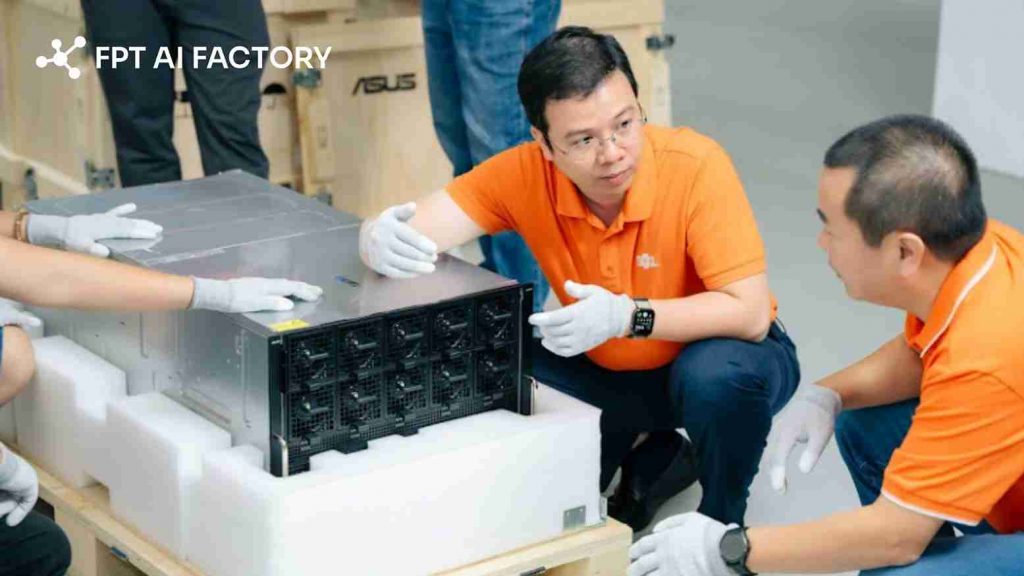
Finding the right AI development platforms can feel overwhelming (Source: FPT AI Factory)
>>> Read more: Top best AI tools need to know for researchers in 2026
8. Challenges of AI development platforms
Adopting an AI development platform brings significant advantages, but it’s not without its hurdles. The good news is that the right platform partner can help you navigate these challenges more effectively. Here’s what to watch out for:
- Complexity of integration: Connecting an AI platform with existing data systems, cloud environments, and business tools is rarely plug-and-play. Teams often face compatibility issues, custom API work, and lengthy configuration processes that can delay project timelines if not planned carefully.
- High infrastructure cost: Training and running AI models at scale demands serious compute resources, and the costs can add up quickly, especially with GPU-intensive workloads. Without careful resource management and a transparent pricing model, infrastructure spending can easily spiral beyond initial projections.
- Skill requirements: Building and maintaining AI systems requires a diverse mix of expertise, data engineering, ML modeling, DevOps, and more. Many organizations struggle to find or retain talent with the right combination of skills, which can slow down adoption and limit what teams can realistically deliver.
- Managing data and models at scale: As AI initiatives grow, so does the complexity of managing datasets, model versions, experiments, and retraining pipelines. Without proper tooling and governance in place, teams can quickly lose track of what’s running, what’s working, and what needs to be updated.
- Ensuring reliability and performance in production: Getting a model to work in a notebook is one thing. Keeping it accurate, stable, and performant under real-world conditions is another. Production environments introduce unexpected variables like data drift, traffic spikes, and latency requirements that require continuous monitoring and rapid response.
Platforms like FPT AI Factory are designed to directly address these pain points, offering a streamlined, enterprise-ready environment that reduces integration complexity, provides scalable compute on demand, and accelerates the path from development to production. Instead of building and maintaining infrastructure from scratch, teams can focus on what matters most – building AI that delivers real business value.
FPT AI Factory is designed to directly address these challenges (Source: FPT AI Factory)
9. FAQ
9.1. Are AI development platforms only for developers?
No, while software engineers use them to build and integrate AI systems, these platforms are also designed for data scientists, researchers, and even non-technical users through low-code or no-code tools. Many platforms simplify complex processes like data preparation, model training, and evaluation, making them accessible to a broader audience and enabling collaboration across different roles in an organization.
9.2. What is the difference between AI platforms and ML frameworks?’
AI platforms and ML frameworks serve different purposes in the AI ecosystem. ML frameworks are primarily tools for building and training models, focusing on algorithms and computation. In contrast, AI platforms provide a complete, integrated environment that includes not only model development but also data management, deployment, monitoring, and governance.
9.3. Can AI development platforms support LLMs?
Yes, modern AI development platforms are increasingly designed to support large language models (LLMs). They offer capabilities such as fine-tuning pre-trained models, managing prompts, building retrieval-augmented generation (RAG) pipelines, and orchestrating AI agents. Many platforms also integrate with multiple LLM providers and provide tools for monitoring performance, evaluating outputs, and managing costs.
9.4. How do AI platforms help with deployment?
AI platforms simplify deployment by providing built-in infrastructure and tools to move models from development to production. They often include features like model serving, scalability through cloud or container systems, monitoring performance, and automated retraining pipelines. This reduces the need for manual setup and integration, allowing teams to deploy models faster, maintain them more easily, and ensure reliability in real-world applications.
Ready to build smarter AI solutions faster? Get started with FPT AI Factory and experience a complete AI development platform built for modern teams. New users receive a free $100 credit, available immediately upon login with no setup required. The credit is valid for 30 days and covers:
- $10 for GPU Container and $10 for GPU Virtual Machine
- $10 for AI Notebook and $70 for AI Inference & AI Studio
- Access to up to 5M tokens with Llama-3.3 and 20+ state-of-the-art models
For enterprises or teams with more complex requirements, such as large-scale deployment, custom integrations, or dedicated infrastructure, contact FPT AI Factory directly to receive tailored solutions and dedicated support.
Not sure which AI development platform setup is right for your organization? Our specialists are ready to help you design an AI environment that fits your specific goals, workflows, and scale. Reach out to FPT AI Factory today for a personalized consultation!
Contact Information:
- Hotline: 1900 638 399
- Email: support@fptcloud.com
Explore Related Articles:
What Is AI Infrastructure? Key Layers & Business Benefits
What is LLM Inference? How it works, metrics, and scaling