
AI chatbots are increasingly used to automate conversations and enhance customer experiences across digital platforms. Building on that, AI chatbot examples demonstrate how this technology is applied in real life across industries like customer service, healthcare, finance, and education. At FPT AI Factory, organizations can build and deploy AI chatbot systems on top of LLM infrastructure with flexibility and scale.
1. The evolution of AI Chatbots
The evolution of AI chatbots has changed the way we interact with technology, shifting from simple rule-based systems to intelligent assistants that can understand context and respond more naturally like humans.
Early stage (1960s–1990s): Pattern-based chatbots
The first chatbots like ELIZA only worked by matching and replacing keywords. They didn’t truly understand language; they just followed fixed rules to simulate conversation.
Next stage (2010s): Smart assistants
Later, tools like Siri and Alexa appeared. They could understand basic user requests and perform simple actions like setting reminders, searching information, or controlling devices using early NLP technology.
Recent stage (2022–2025): Generative AI
With large language models such as ChatGPT and Gemini, chatbots became much more advanced. Instead of fixed answers, they can generate new responses, help with writing, coding, and having more natural conversations.
Current trend (2026+): AI agents
Today’s AI is moving toward more autonomous agents that can handle multiple types of input (text, image, audio) and perform complex tasks, acting more like assistants that can actually work alongside users.
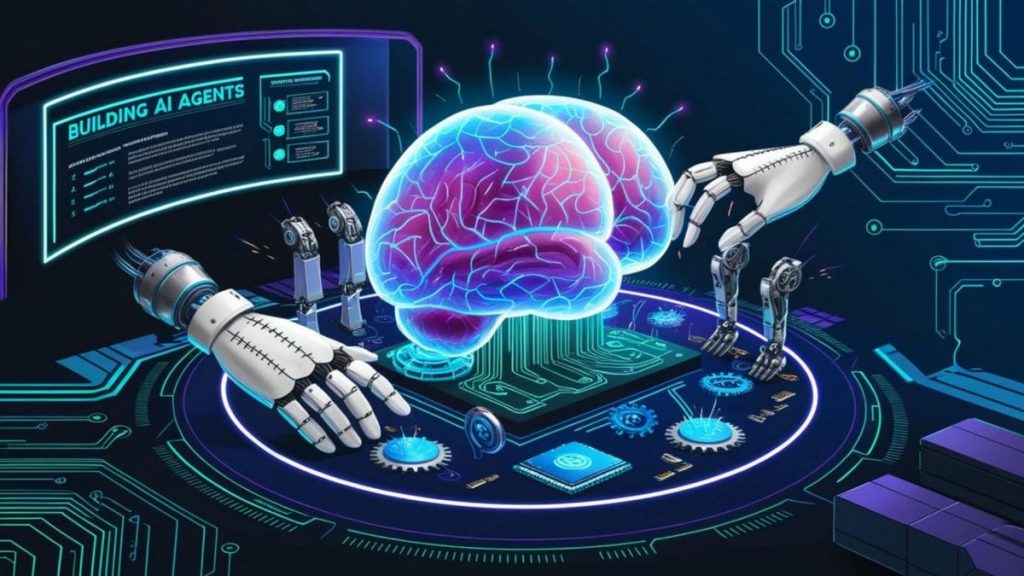
Modern AI is evolving into assistants that can handle text, image, and audio while performing complex tasks alongside users
2. Types of customer support chatbots
Customer support chatbots are categorized based on how they understand user input and generate responses. Each type serves different needs, from simple automation to advanced AI-driven conversational experiences across multiple channels.
- Rule-based chatbots: Operate on predefined scripts and “if–then” logic. They are effective for FAQs and repetitive queries but cannot handle unexpected inputs, making them less flexible in real-world scenarios.
- AI-powered chatbots (NLU-based): Use Natural Language Understanding to interpret user intent and context beyond keywords. They can handle variations in phrasing and improve performance over time through training data.
- Generative AI chatbots (LLM-based): Built on large language models, these chatbots generate dynamic, human-like responses. They can manage complex conversations, summarize content, and adapt to different user needs in real time.
- Hybrid chatbots: Combine rule-based flows with AI capabilities. This allows businesses to keep structured control for critical processes while still enabling flexible, intelligent interactions.
- Voice and omnichannel chatbots: Support multiple touchpoints such as chat, voice, mobile apps, and messaging platforms. They ensure consistent user experience across channels using both speech and text-based interaction.
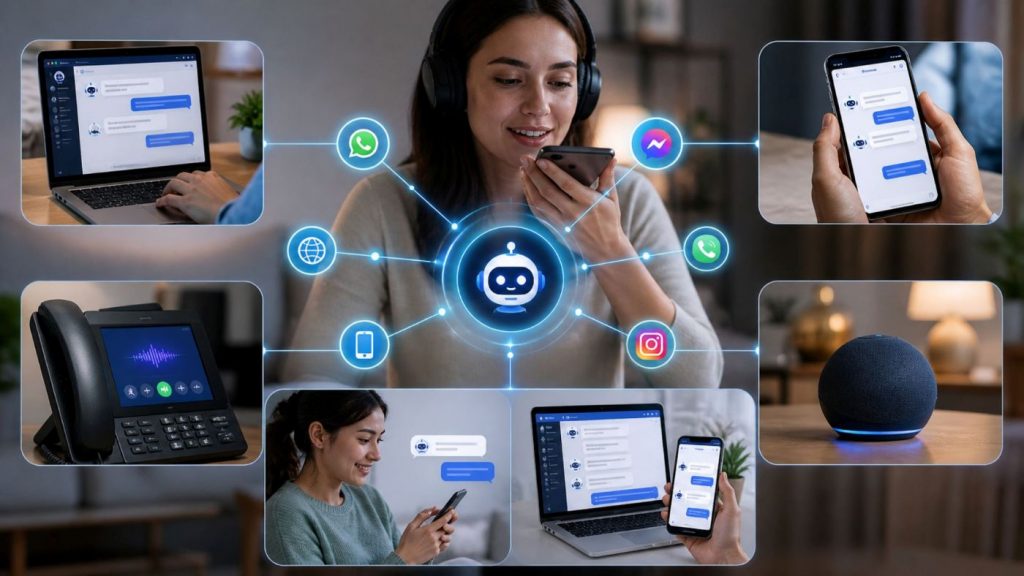
Customer chatbots range from rule-based to advanced AI-driven omnichannel systems
3. AI Chatbot Examples in Customer Service
Customer service is one of the most mature areas where AI chatbots are applied at scale. These tools are widely used to automate support, improve response time, and enhance customer experience while reducing operational workload.
3.1 Zendesk AI
Zendesk AI is an intelligence layer integrated into the Zendesk Resolution Platform that supports automated customer service across channels such as email, chat, voice, and messaging. It leverages large-scale customer service data to identify intent, sentiment, and context, helping improve routing, response quality, and resolution speed with minimal initial configuration.
Key learning
Combining intent detection, sentiment analysis, and AI-driven automation enables more efficient ticket routing and supports partial or full resolution of customer requests depending on workflow setup.
Real-world impact
Helps reduce first response time, improves support efficiency, and automates a significant portion of repetitive customer service interactions across channels.
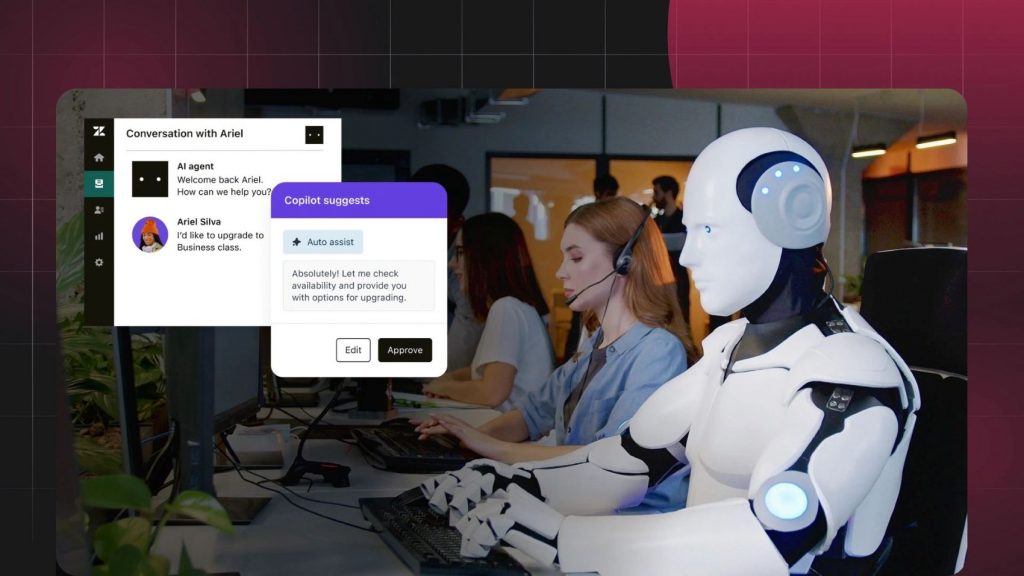
Zendesk AI automates and streamlines multi-channel customer support
3.2 Intercom Fin
Intercom Fin is a generative AI customer agent powered by large language models and retrieval-augmented generation, designed to resolve customer queries across chat, email, and messaging channels. It understands context, pulls information from connected knowledge sources, and delivers accurate, human-like responses in real time, while also adapting to different roles such as support, sales, or ecommerce assistance depending on the conversation.
Key learning
Combining LLMs with retrieval systems helps ensure responses are both natural and grounded in trusted business data, reducing hallucinations and improving accuracy.
Real-world impact
Helps automate a large portion of customer interactions, improves first-contact resolution, and maintains consistent support quality across multiple channels.
3.3 Shopify Sidekick
Shopify Sidekick is an AI-powered assistant built for ecommerce merchants to simplify store management and support decision-making. It analyzes business data such as sales performance, customer behavior, and product trends to provide actionable insights, while also assisting with operational tasks like inventory tracking and order management.
Key learning
AI can function as a unified business assistant by combining analytics, automation, and recommendation capabilities to reduce manual workload and improve decision speed.
Real-world impact
Helps merchants optimize store operations, improve inventory accuracy, enhance customer experience, and make faster, data-driven decisions without requiring deep technical expertise.
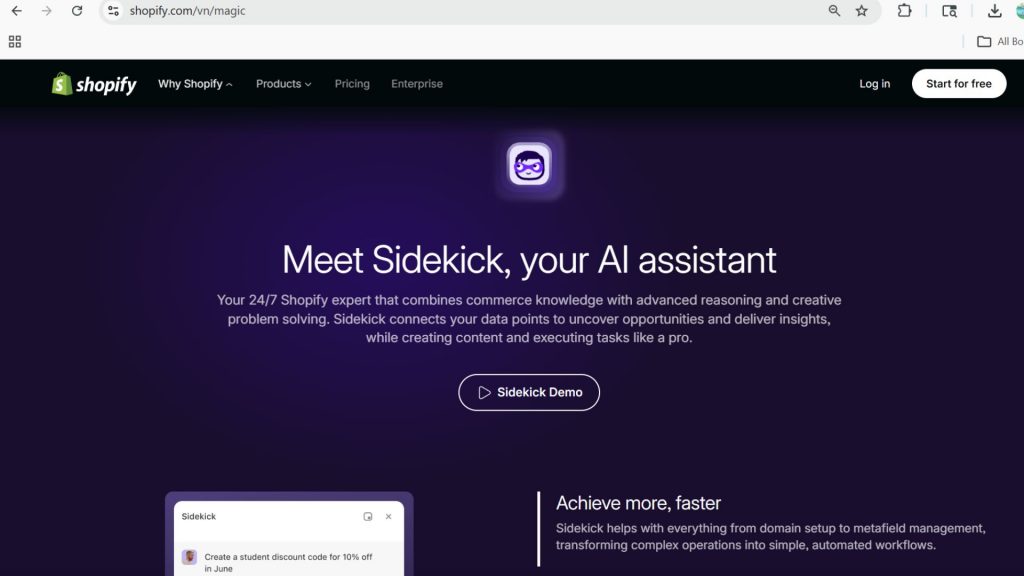
Shopify Sidekick helps merchants manage stores and make data-driven decisions using AI
>> Explore more: Top 12 Best Chatbots for Customer Service in 2026
4. AI Chatbot Examples in Healthcare
4.1. Babylon Health
Babylon Health was a digital healthcare platform that combined AI technology with virtual medical services to support online consultations and basic health assessments. It allowed users to describe symptoms through chat or video, helping with initial diagnosis and connecting them with healthcare professionals when necessary. This approach made primary healthcare more accessible while reducing the need for in-person visits.
Key takeaway:
The platform demonstrates how AI can be integrated with human doctors to scale healthcare access and improve early-stage medical support and triage.
Real-world impact:
Babylon Health expanded to multiple countries and served millions of users globally, but later faced financial issues and ceased operations in 2023, with parts of its business acquired and rebranded.
4.2. Florence
Florence is an AI-based “virtual nurse” chatbot designed to help users manage everyday health needs such as taking medication on time, tracking personal health data, and locating nearby healthcare services. It is accessible through messaging platforms, allowing patients to interact with it easily at any time for continuous health support.
Key takeaway:
Florence highlights how AI can extend beyond diagnosis by focusing on long-term patient care, especially improving medication adherence and supporting ongoing health monitoring outside clinical settings.
Real-world impact:
Florence has been applied in healthcare workflows to support patients after treatment, enhance medication adherence, and lower hospital readmission rates by ensuring ongoing patient engagement.

AI chatbot enhancing healthcare with intelligent support and digital care solutions
4.3. Ada Health
Ada Health is an AI-driven health assessment platform that helps users evaluate their symptoms and decide on the most appropriate level of care. Developed with input from medical professionals and researchers, it functions as a conversational symptom checker that analyzes user input and suggests possible conditions based on medical knowledge.
Key takeaway:
Ada Health demonstrates the effectiveness of adaptive questioning in improving symptom analysis, where AI adjusts its questions based on user information to produce more structured and clinically relevant insights.
Real-world impact:
Since its launch in 2016, Ada Health has completed millions of health assessments globally and is widely used for initial symptom evaluation. It is also integrated into healthcare systems to support triage processes and reduce unnecessary clinic visits while maintaining high user trust and accuracy.
5. AI Chatbot Examples in Banking and Finance
5.1. Bank of America’s Erica
Erica is Bank of America’s AI-powered virtual assistant designed to help customers manage banking tasks through simple conversational interactions. It supports activities like checking balances, tracking spending, and getting financial guidance in a more intuitive way compared to traditional app navigation.
Key takeaway:
Erica highlights how conversational AI can simplify complex banking experiences by reducing the need for manual searching inside apps and enabling more natural, intent-based interactions.
Real-world impact:
Since its launch, Erica has been widely adopted, processing hundreds of millions of interactions annually and reaching billions of total engagements. It has significantly improved customer engagement and reduced reliance on traditional support channels like call centers and branch visits.
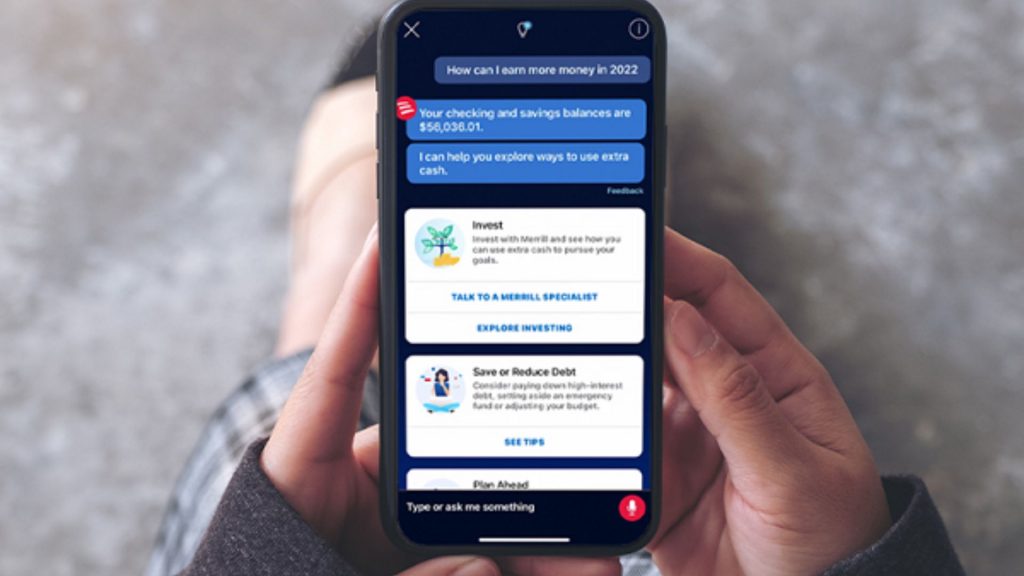
Erica is Bank of America’s AI assistant that simplifies banking through conversation
5.2. Cleo (Personal Finance AI)
Cleo is an AI-powered finance chatbot that helps users, especially young adults, manage their money in a simple and conversational way. It tracks spending, provides insights into financial habits, and suggests ways to budget and save more effectively, making personal finance easier and more engaging.
Key takeaway:
Cleo shows how AI can address real financial behavior issues by combining personalization with simple conversational guidance, helping users build better financial habits over time.
Real-world impact:
Research indicates strong interest from younger users in using AI for money management, with Cleo gaining popularity among Gen Z and young adults. Many users report improved awareness of spending patterns and better financial discipline through regular AI-driven insights and reminders.
5.3. Mastercard’s KAI
KAI is an AI chatbot developed by Mastercard that enables conversational banking for users, banks, and merchants. It allows customers to check account details, review transactions, track spending, and receive personalized financial insights directly through messaging platforms, while also supporting merchants in enabling chatbot-based shopping and payment experiences.
Key takeaway:
KAI illustrates how AI chatbots can be embedded into financial ecosystems to connect banking, payments, and customer engagement within a single conversational interface.
Real-world impact:
It has been adopted in partnership with financial institutions to enhance digital banking experiences, improve customer support efficiency, and enable new conversational commerce models across messaging platforms.
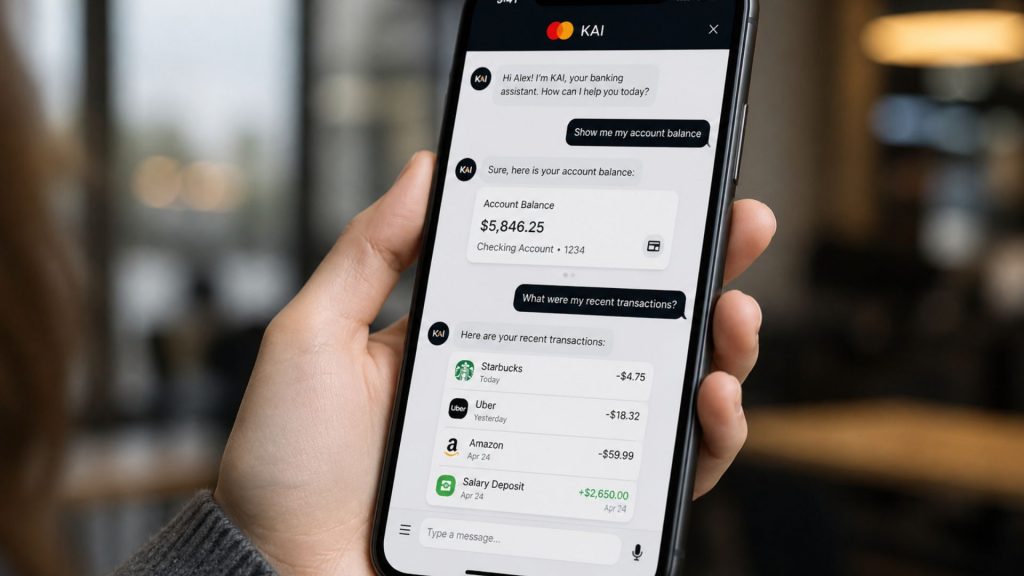
A realistic glimpse of Mastercard KAI, where everyday banking becomes a seamless conversation
6. AI Chatbot Examples in Enterprise and Internal Tools
6.1. Microsoft Copilot (Workplace Assistant)
Microsoft Copilot is an AI assistant embedded in Microsoft 365 apps such as Word, Excel, PowerPoint, Outlook, and Teams. It helps users complete everyday work tasks like writing documents, analyzing data, summarizing meetings, and managing emails directly within existing workflows.
Key takeaway:
Copilot shows that AI creates the most value in enterprise settings when it is integrated into familiar tools. This reduces repetitive work and supports employees in focusing more on analysis and decision-making instead of manual tasks.
Real-world impact:
Copilot helps employees complete work faster by turning complex tasks such as report writing, data analysis, and presentation creation into quick, automated processes. It also improves collaboration by summarizing discussions and extracting action points from meetings, leading to higher productivity and more efficient teamwork.
6.2. Slack’s AI Summarization Bot
Slack AI Summarization Bot is an AI assistant integrated into Slack that helps users quickly digest long conversations, threads, and shared files. It automatically summarizes key points, decisions, updates, and action items, allowing teams to stay informed without manually reviewing entire message histories.
Key takeaway:
Slack AI shows how summarization tools reduce information overload in modern workplaces. By turning long and complex discussions into clear insights, it helps teams stay aligned and maintain productivity without manually reviewing entire conversations.
Real-world impact
In practice, Slack AI helps users quickly catch up on missed conversations without scrolling through long chat histories. It improves efficiency by highlighting key decisions, updates, and next steps from channels or threads, enabling faster collaboration, clearer communication, and better team alignment across projects.
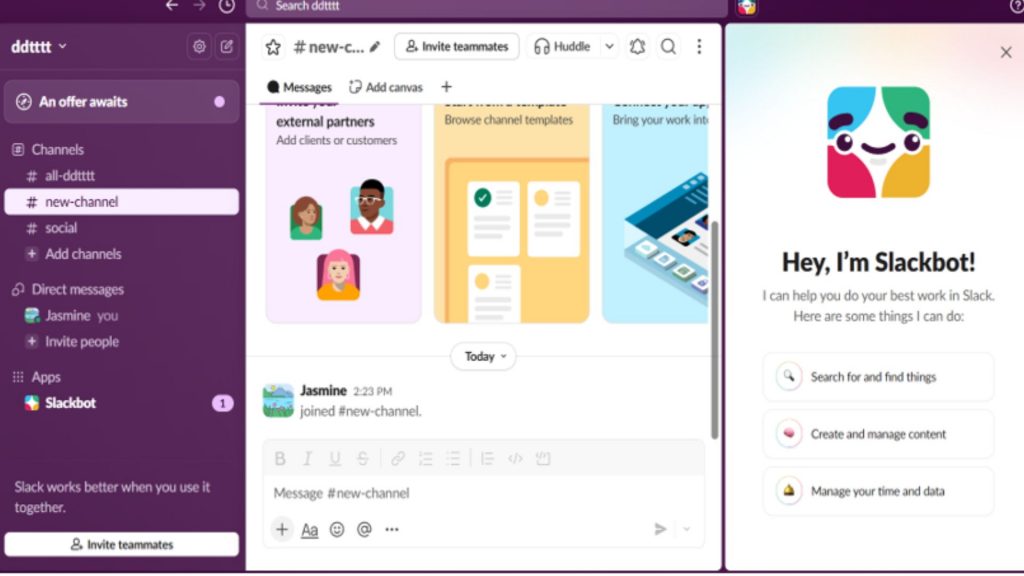
Slack’s AI Summarization Bot turns long conversations into quick, clear summaries to improve team productivity and alignment
6.3. ServiceNow Virtual Agent
ServiceNow Virtual Agent is an AI-powered chatbot that automates internal service requests across IT, HR, and enterprise workflows. It understands natural language and can perform tasks such as creating tickets, checking request status, and guiding users through self-service processes, while integrating with platforms like ServiceNow, Microsoft Teams, and Slack.
Key takeaway:
ServiceNow Virtual Agent highlights how enterprise chatbots become more valuable when they move beyond answering questions and directly execute workflows inside business systems.
Real-world impact
In practice, it reduces IT and HR service desk workload by handling repetitive requests automatically. Employees get faster support through self-service, while organizations benefit from lower ticket volume, quicker resolution times, and improved operational efficiency.
7. AI Chatbot Examples in Education
7.1. Duolingo Max
Duolingo Max is an AI-powered learning experience built on GPT-4 that enhances language learning through interactive features like Video Call and Roleplay. Instead of only doing traditional exercises, learners can practice real conversations with AI characters that respond dynamically and adapt to context.
Key takeaway:
Duolingo Max shows how AI can turn language learning into real interaction. By simulating conversations and giving instant feedback, it helps learners practice speaking more naturally and build confidence faster.
Real-world impact:
Learners can practice everyday scenarios such as ordering food or asking for directions in a safe, interactive environment. AI feedback highlights mistakes and suggests improvements, making learning more engaging and consistent than traditional methods.
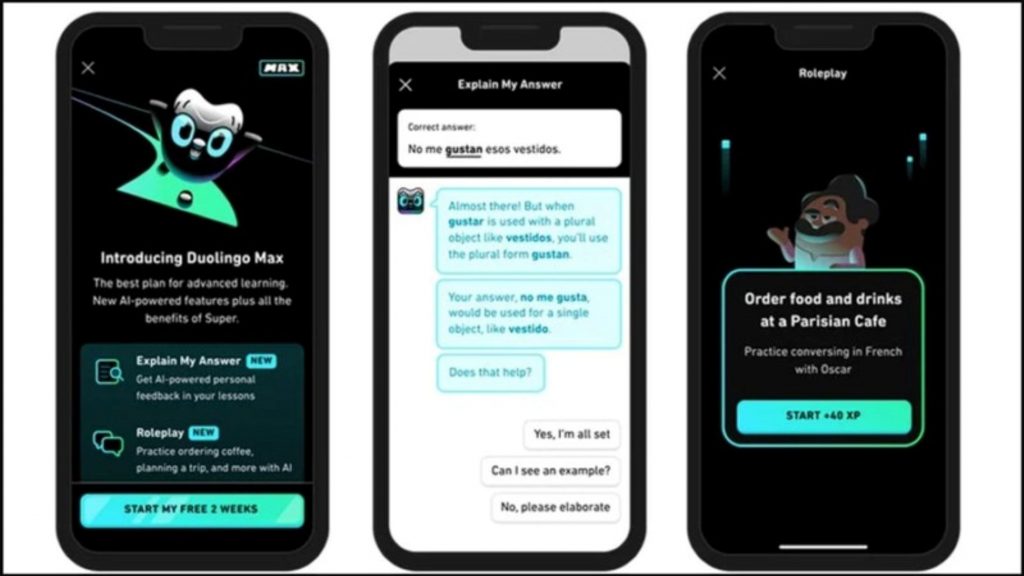
Duolingo Max uses AI to make language learning interactive through real-time conversations and feedback
7.2. Khanmigo by Khan Academy
Khanmigo is an AI learning assistant from Khan Academy that supports students, teachers, and parents in education. It guides learners through step-by-step thinking instead of giving direct answers, helping them better understand subjects like math, writing, and coding, while also assisting teachers with tasks such as lesson planning and rubric creation.
Key takeaway:
Khanmigo shows how AI can act as a guided tutor that promotes critical thinking rather than just providing answers, making learning more interactive and independent.
Real-world impact:
Students receive step-by-step support while solving problems, teachers save time on preparation tasks, and parents can better assist homework. This improves learning efficiency, engagement, and understanding across different user groups.
8. Common AI Chatbot Architectures by Industry
AI chatbots also differ in how their infrastructure and architecture are designed across industries. Depending on the use case, each system may prioritize security, scalability, compliance, personalization, or real-time processing, leading to different architecture models for different sectors.
Below are some of the most common AI chatbot architectures used across different sectors and services
8.1. Healthcare AI Chatbot Architecture
Healthcare AI chatbots are designed to support patient communication, symptom checking, appointment scheduling, and healthcare assistance while ensuring strict privacy and regulatory compliance.
Typical architecture components:
- Patient chatbot interface for websites, mobile apps, or telemedicine platforms
- Secure API gateway for encrypted communication and request routing
- Authentication and patient identity verification systems
- Electronic Health Record (EHR) integration layer
- Medical knowledge base and vector database
- Large Language Model (LLM) processing layer
- Monitoring, logging, and compliance infrastructure
Key characteristics:
- Prioritizes security and patient privacy
- Uses medical knowledge bases and RAG
- Supports human review for sensitive cases
- Commonly deployed on private or hybrid cloud

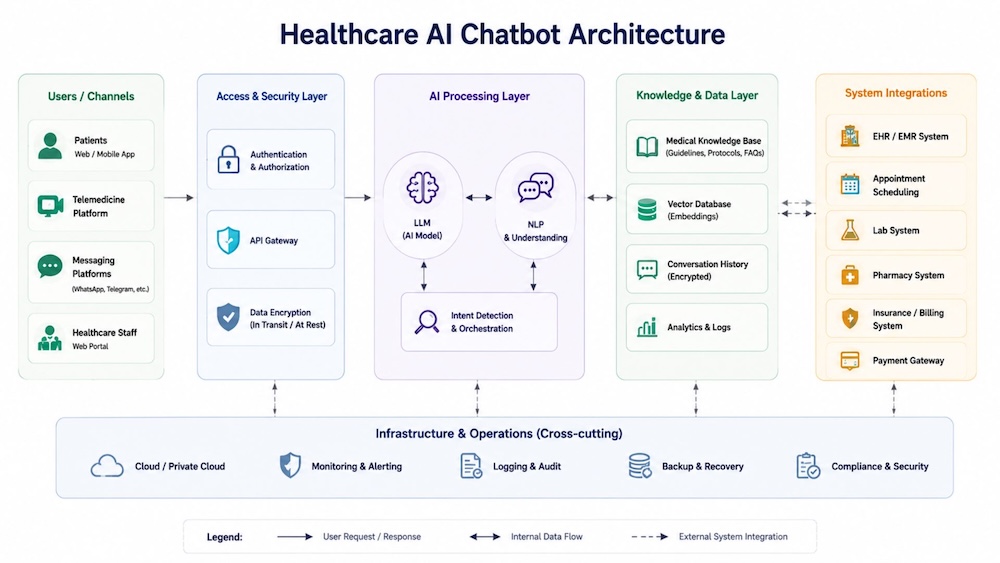
Healthcare AI chatbot architecture with secure AI processing and hospital system integration
8.2. Banking AI Chatbot Architecture
Banking AI chatbots operate in highly secure financial environments where authentication, fraud prevention, and transaction accuracy are critical.
Typical architecture components:
- Mobile banking or web-based chatbot interface
- Multi-factor authentication and identity verification systems
- Core banking API integration layer
- Fraud detection and transaction monitoring systems
- Payment processing infrastructure
- Large Language Model (LLM) orchestration layer
- Audit logging and compliance management systems
Key characteristics:
- Focuses on security and compliance
- Supports real-time banking services
- Integrates with payment and core banking systems
- Includes fraud detection capabilities

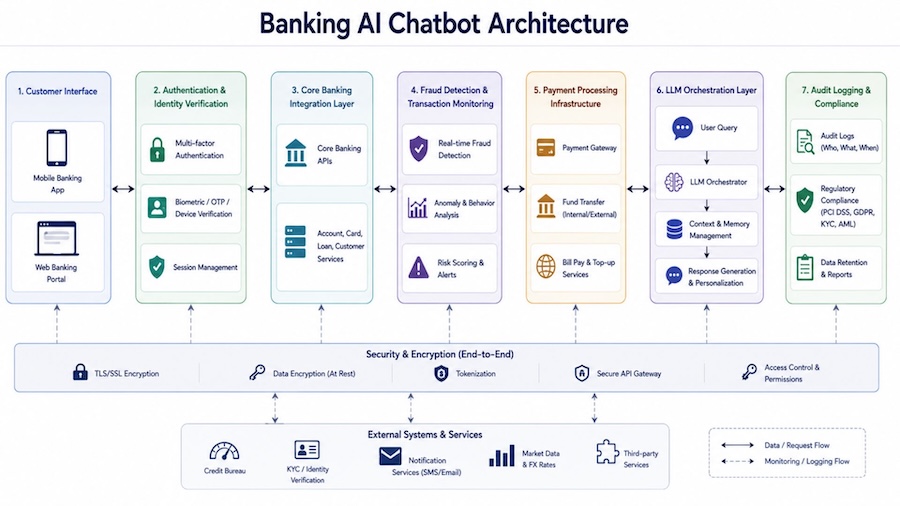
Secure AI chatbots enable intelligent and real-time digital banking services
8.3. Enterprise Internal AI Assistant Architecture
Enterprise AI assistants are built to improve employee productivity by connecting internal knowledge, enterprise systems, and workflow automation into a centralized conversational platform.
Typical architecture components:
- Employee chat interface integrated with collaboration platforms
- Enterprise Single Sign-On (SSO) authentication systems
- Internal document retrieval and enterprise search infrastructure
- Vector database for company knowledge indexing
- Workflow orchestration and automation engines
- Large Language Model (LLM) conversational layer
- Access control and permission management systems
Key characteristics:
- Connects to internal knowledge sources
- Integrates with enterprise applications
- Automates employee workflows
- Provides secure access to company data
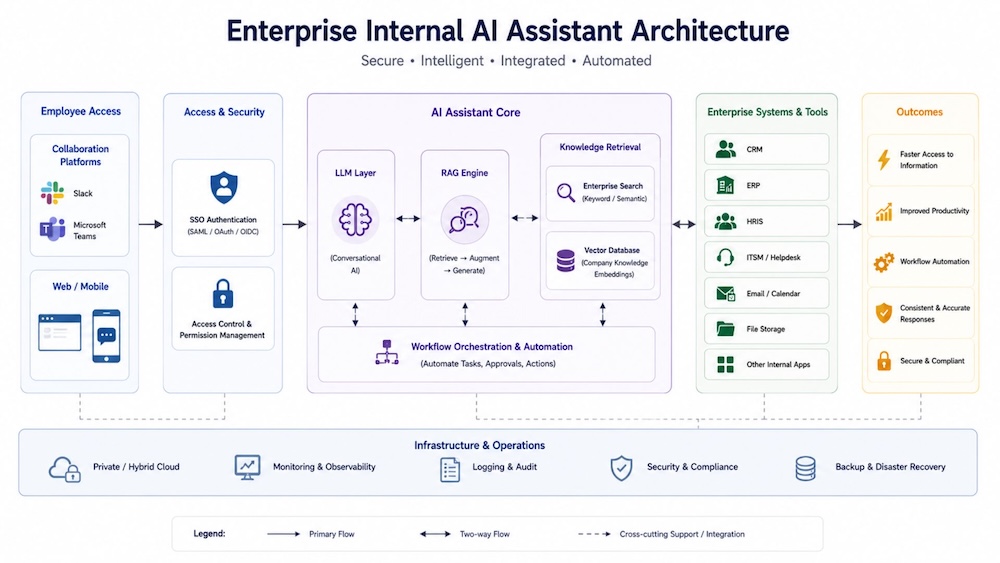
Enterprise AI assistant architecture for secure knowledge retrieval and workflow automation
8.4. Educational AI Tutor Architecture
Educational AI tutors focus on personalized learning, adaptive feedback, and interactive educational support for students and teachers.
Typical architecture components:
- Student-facing learning platform or mobile application
- AI tutoring and conversational learning engine
- Curriculum and educational content databases
- Learning analytics and progress tracking systems
- Vector database for educational content retrieval
- Teacher dashboard and reporting systems
- Multimodal interaction support for text, voice, and image input
Key characteristics:
- Delivers personalized learning experiences
- Adapts content based on learner progress
- Provides real-time feedback and guidance
- Supports multiple learning formats and devices

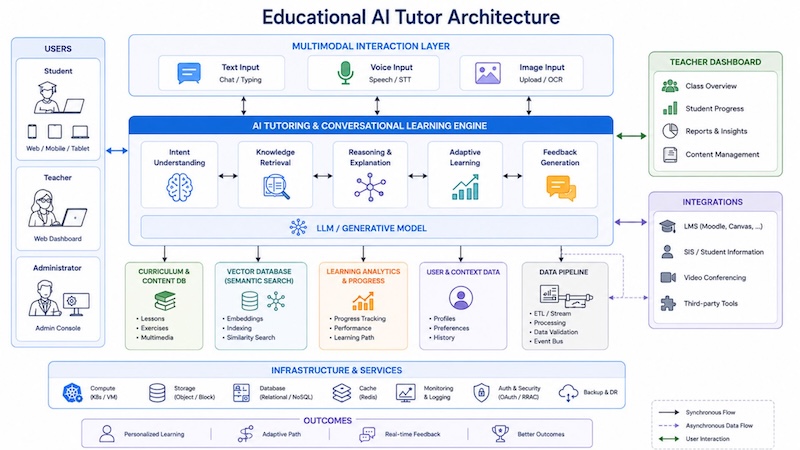
AI-powered tutoring systems designed for adaptive, personalized, and interactive learning experiences
9. How to Choose the Right AI Chatbot?
Choosing the right AI chatbot depends on your business goals, user needs, and technical requirements. While some organizations only need simple FAQ automation, others require advanced AI assistants capable of accessing enterprise knowledge, automating workflows, and supporting complex conversations.
When evaluating a chatbot solution, consider the following factors:
- Use case: Determine whether the chatbot is intended for customer support, sales, employee assistance, education, or industry-specific applications.
- AI capabilities: Choose between rule-based, AI-powered, or LLM-based chatbots depending on the level of conversational intelligence required.
- System integration: Ensure the chatbot can connect with business tools such as CRM systems, helpdesk platforms, databases, and internal applications.
- Scalability and security: Evaluate whether the solution can support future growth while meeting security and compliance requirements.
The most effective AI chatbots combine conversational intelligence, business system integration, and workflow automation to deliver meaningful value for both users and organizations.
10. What makes a great AI chatbot?
A great AI chatbot is not just a system that can answer questions, but a solution that understands context, adapts to users, and can actively support real business workflows. The most effective chatbots combine language understanding with system integration and automation capabilities to deliver meaningful, reliable, and scalable interactions.
To evaluate the quality of an AI chatbot, several key criteria should be considered:
- Context awareness: The chatbot can maintain conversational context across multiple turns, understand follow-up questions, and avoid requiring users to repeat information.
- Personalization: It adapts responses based on user profiles, behavior history, and specific needs, delivering relevant and targeted interactions instead of generic replies.
- Tool integration: A strong chatbot connects with enterprise systems such as CRM platforms, helpdesk tools, databases, and internal APIs to retrieve or update real-time information.
- Workflow automation: Beyond conversation, it can execute end-to-end tasks such as creating support tickets, checking order status, or booking appointments directly within the chat interface.
- Accuracy and response quality: Responses must be reliable, clear, and consistent, with minimized hallucinations to ensure trustworthy outputs in real-world usage.
- Human handoff: When issues exceed its capability, the chatbot should smoothly transfer the conversation to a human agent without disrupting user experience.
To accelerate the development of such advanced systems, FPT AI Factory provides a complete AI environment for building and deploying chatbot applications on top of Large Language Models. With Serverless Inference, teams can deploy scalable chatbot solutions with automatic scaling, API integration, and support for multimodal models, suitable for both customer-facing assistants and complex enterprise or coding use cases.

FPT AI Factory enables scalable LLM-based chatbot deployment with serverless AI infrastructure.
AI chatbot examples are now widely used across industries, showing how conversational AI can improve efficiency, automate tasks, and enhance user experience. From customer support and workplace assistants to education and enterprise systems, these chatbots help reduce manual workload, speed up information access, and support better decision-making through real-time, context-aware interactions.
Harness the power of AI chatbots to automate conversations, improve user experiences, and streamline business operations. With FPT AI Factory, organizations can build and scale intelligent chatbot solutions powered by enterprise-grade LLM infrastructure.
To summarize:
- AI chatbots have evolved from simple rule-based systems into advanced LLM-powered assistants capable of understanding context, generating responses, and supporting complex business workflows.
- Real-world AI chatbot examples such as Zendesk AI, Intercom Fin, Microsoft Copilot, Erica, and Khanmigo demonstrate how conversational AI is transforming customer service, healthcare, finance, education, and enterprise productivity.
- Modern AI chatbots combine technologies such as Large Language Models (LLMs), Retrieval-Augmented Generation (RAG), vector databases, and workflow automation to deliver more accurate and context-aware interactions.
- Industry-specific chatbot architectures vary by use case, with healthcare and banking prioritizing security and compliance, while enterprise and education solutions focus on knowledge retrieval, automation, and personalization.
- FPT AI Factory provides the infrastructure and development environment needed to build, deploy, and scale enterprise AI chatbot applications without managing complex AI infrastructure.
For teams exploring AI chatbot examples to build their own solutions, FPT AI Factory provides a development environment for deploying LLM-based applications without infrastructure complexity. Users can get started immediately with $100 free credits available upon login. For enterprises or organizations that need customized, large-scale AI chatbot solutions, they can contact FPT AI Factory directly via the official contact form for tailored support and deployment.
Contact information
- Hotline: 1900 638 399
- Email: support@fptcloud.com
Explore Related Articles:
Best GPUs for AI in 2026: Use Case and Performance
Best GPU for AI Training: From Personal to Business Project