

Best chatbot for customer service technology has evolved from simple automated scripts into sophisticated AI partners that redefine how businesses interact with their global audience. At FPT AI Factory, we provide the high-performance infrastructure needed to power these advanced conversational experiences, ensuring seamless and intelligent customer journeys.
Quick Summary:
- Best overall: Intercom (Fin), AI agent, best for high-growth tech & enterprise
- Best for SMB/e-commerce: Tidio (Lyro AI), from $29/month, fast setup
- Best for existing helpdesk users: Zendesk AI, deep helpdesk + agent-assist integration
- Best CRM-native: HubSpot Chatbot, free to start, syncs directly to CRM records
- Best for regulated industries: Comm100, compliance-focused, healthcare/finance/government
- Best for social media DMs: ManyChat, Instagram/Facebook automation
- Chatbots now resolve 55-70% of support requests end-to-end without human handoff
- Key selection criteria: NLU quality, omnichannel coverage, CRM integration, human handoff, pricing model
1. What is a customer service chatbot?
A customer service chatbot is an AI-powered software application designed to handle user inquiries through a chat interface without direct human intervention. These bots serve as the first line of defense, providing instantaneous answers to frequently asked questions and performing routine tasks like order tracking or password resets.
By integrating into websites and social platforms, these chatbots help businesses stay available at all times. They ensure customers receive timely responses, so no one has to wait regardless of the hour or day.
Modern AI chatbots provide instant support and enhance customer experiences 24/7.
2. Key features of a customer service chatbot
Modern customer service bots are far more than simple “if-then” scripts; they are highly integrated systems that understand nuance. To be effective in 2026, these tools must possess a specific set of technical capabilities that allow them to function as true digital colleagues rather than just software utilities.
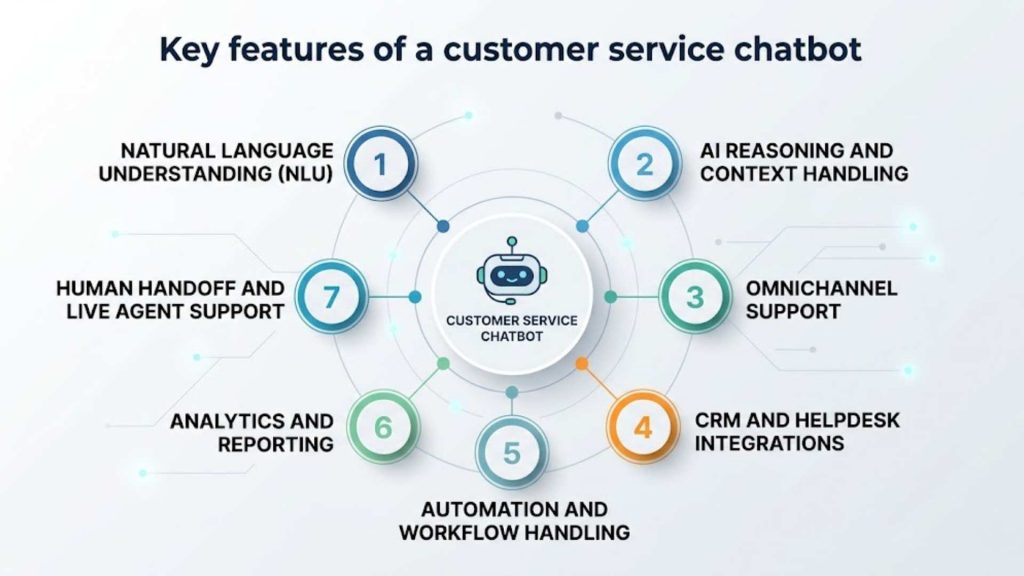
Key features of a customer service chatbot
2.1 Natural language understanding (NLU)
NLU is the core technology that enables a chatbot to decipher the underlying intent of a customer’s message, even if it contains slang or typos. Instead of just searching for keywords, the bot analyzes the entire sentence structure to provide a response that truly matches what the user is asking for.
2.2 AI reasoning and context handling
This feature allows a chatbot to remember what was said earlier in a conversation, preventing the customer from having to repeat themselves constantly. By maintaining context, the bot can handle multi-turn dialogues and provide logical follow-up suggestions that feel natural and personalized to the user’s specific journey.
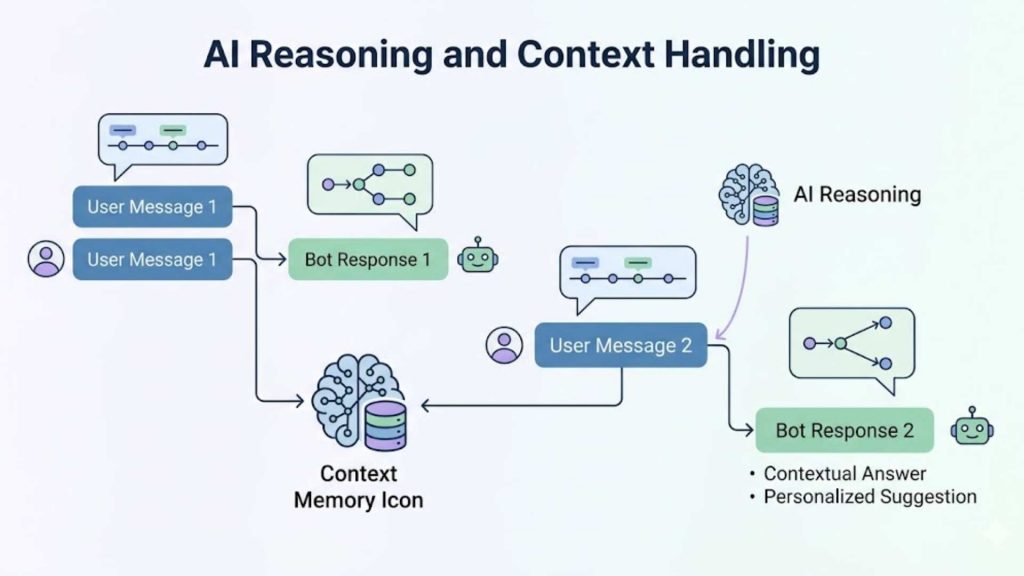
A diagram illustrating how AI leverages context memory and multi-turn reasoning to provide personalized suggestions.
2.3 Omnichannel support
Top-tier chatbots provide a unified experience across every digital touchpoint, from WhatsApp and Facebook Messenger to your official company website. This ensures that a customer can start a conversation on one platform and finish it on another without any loss of data or continuity in the support process.
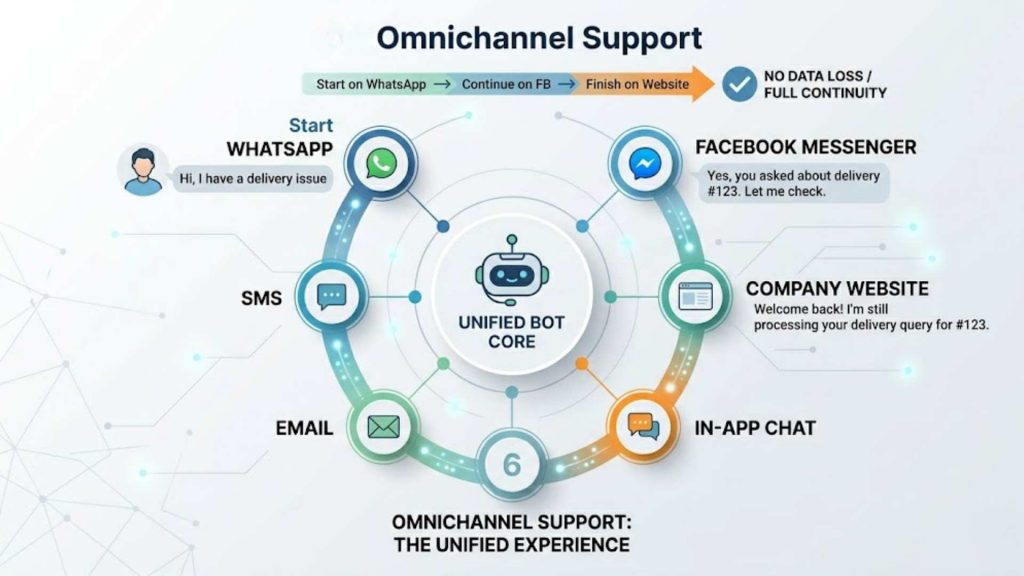
Unified omnichannel support diagram showing seamless customer conversation continuity across multiple platforms.
2.4 CRM and helpdesk integrations
Seamless integration with CRM systems like Salesforce or Zendesk allows the bot to instantly pull up a customer’s purchase history and personal preferences. This data connectivity transforms a generic bot into a personalized assistant that can resolve issues with specific account details rather than just providing general information.
2.5 Automation and workflow handling
Beyond just answering questions, the most advanced bots can execute complex workflows like processing a refund or booking a technical service appointment. These bots interact directly with your back-end systems to get work done, significantly reducing the administrative burden on your human support staff.
2.6 Analytics and reporting
A robust analytics suite allows managers to track key performance indicators such as the rate of successful automated resolutions and average customer satisfaction scores. These insights are vital for identifying gaps in the bot’s knowledge base, allowing for continuous improvement of the conversational experience over time.\
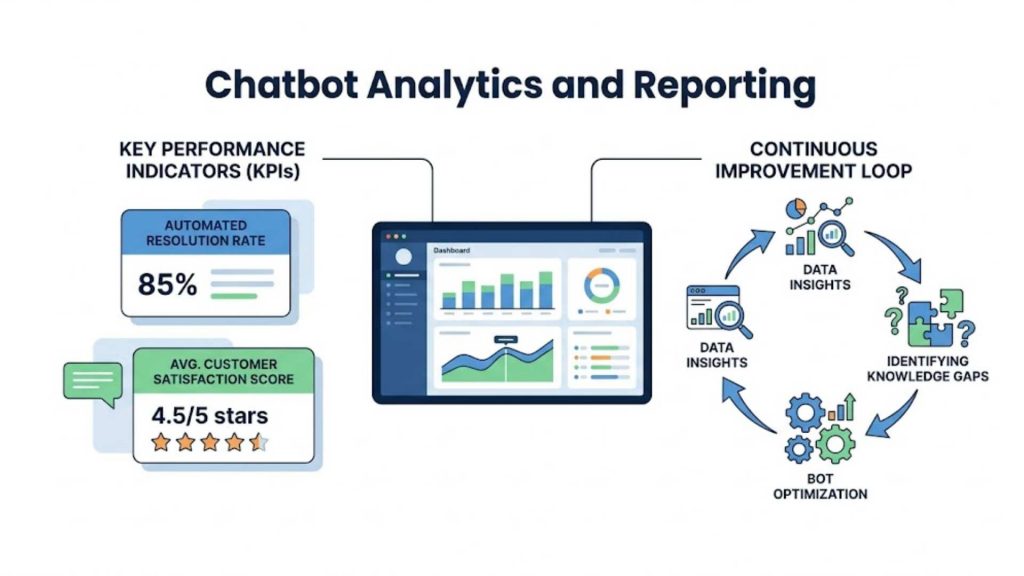
A business dashboard showcasing chatbot performance KPIs and the continuous improvement loop for bot optimization.
2.7 Human handoff and live agent support
Even the most advanced AI will occasionally encounter a problem it cannot solve, making a smooth transition to a human agent an essential feature. The bot should be able to pass the full transcript and context of the interaction to a live representative, ensuring the customer never feels stuck in an automated loop.
3. Types of customer service chatbots
Before choosing a specific platform, it is essential to understand the different architectural approaches to conversational AI. Each type of bot offers varying levels of complexity and cost, meaning the best choice for your organization depends heavily on your specific volume and the complexity of the issues your team handles daily.
| Type | Description |
| Rule-based chatbots | Operates on a rigid decision tree; ideal for simple, repetitive FAQ tasks where the paths are predictable. |
| AI-powered chatbots | Uses Machine Learning and Large Language Models to interpret intent, learn from data, and provide dynamic answers. |
| Hybrid chatbots | Combines the speed of automation with a seamless fail-safe path to human live agents for complex or sensitive issues. |
| Voice chatbots | Utilizes speech-to-text and text-to-speech technology to handle customer service inquiries over standard phone lines. |
| Omnichannel bots | Deployed across all digital touchpoints while syncing interaction data to a single, central dashboard for management. |

Understanding different types of customer service chatbots helps businesses select the most efficient automation strategy.
4. 12 best chatbots for customer service
The market for conversational AI is diverse, ranging from all-in-one enterprise suites to nimble tools designed for social media growth. To find the right solution, you must evaluate tools based on their primary positioning, technical strengths, and how well they integrate into your existing workflow and long-term business strategy.
4.1. Enterprise customer service platforms
Intercom
Intercom has reinvented itself with “Fin,” a breakthrough AI agent designed specifically for high-growth tech companies and large-scale enterprises. It focuses on delivering a proactive and personalized support experience that goes beyond traditional ticketing systems to create meaningful customer relationships.
Key features & highlights:
- Core feature: Fin AI Agent capable of resolving a high percentage of support queries instantly.
- Key benefit: Dramatically reduces ticket volume and lowers the stress on human support teams.
- Strength: A highly intuitive interface coupled with one of the best automated workflow builders.
- Limitation: Pricing can scale rapidly and become quite high for businesses with large chat volumes.
- Pricing: Custom enterprise pricing, contact sales, Fin AI Agent billed per resolution.
Best for: Technology-driven companies looking for a polished, AI-first customer engagement ecosystem.
- Highly intuitive interface with one of the best automated workflow builders on the market
- Fin AI Agent resolves a high percentage of support queries instantly, cutting ticket volume fast
- Pricing scales quickly and can get expensive for businesses with large chat volumes
- Best suited for tech-forward teams; less ideal for simple, low-budget use cases
Zendesk AI
Zendesk AI builds upon the foundation of the world’s leading helpdesk to offer enterprise-grade automation that is both powerful and reliable. It is designed to work silently in the background, assisting both customers and agents with data-driven insights and automated workflows.
Key features & highlights:
- Core feature: Built-in intent recognition and automated macro suggestions for human agents.
- Key benefit: Significantly increases agent productivity by providing context-aware response drafts.
- Strength: Access to a massive marketplace of integrations and highly sophisticated reporting.
- Limitation: The platform’s vast array of features can make initial setup and customization quite complex.
- Pricing: AI Agents billed per resolution; base plans from ~$19/agent/month.
Best for: Large organizations requiring a deeply integrated helpdesk with powerful AI capabilities.
- Massive integration marketplace and highly sophisticated reporting
- Context-aware response drafts significantly boost agent productivity
- Vast feature set makes initial setup and customization quite complex
- Best value only realized by teams already invested in the Zendesk ecosystem
Drift
Drift is synonymous with “Conversational Service,” specializing in a unified approach that bridges the gap between marketing, sales, and support. It is built to ensure that every visitor to your site is greeted by an intelligent assistant that can qualify leads or solve support issues in real-time.
Key features & highlights:
- Core feature: Conversational AI that seamlessly handles both lead qualification and support tasks.
- Key benefit: Shortens the sales cycle while simultaneously improving the quality of customer support.
- Strength: Exceptional at delivering personalized user journeys based on real-time site behavior.
- Limitation: The platform is heavily geared towards B2B and can sometimes feel too sales-oriented.
Best for: B2B companies looking to integrate their support and sales efforts into one interface.
- Exceptional at personalizing user journeys based on real-time site behavior
- Seamlessly bridges support and sales into one conversational interface
- Heavily geared toward B2B and can feel too sales-oriented for pure support teams
- Less suited for companies that don’t run marketing/sales through the same platform
LivePerson
LivePerson is a global leader in conversational AI, specializing in managing massive interaction volumes for the world’s largest brands. Their “Conversational Cloud” is built to scale across mobile messaging and social channels while maintaining the highest levels of security and brand consistency.
Key features & highlights:
- Core feature: The Conversational Cloud powered by advanced Generative AI and LLM technology.
- Key benefit: Allows brands to scale their support to millions of users without losing the personal touch.
- Strength: Unmatched expertise in voice-to-messaging transitions and high-level enterprise security.
- Limitation: Implementing the full suite of features often requires a significant technical investment.
Best for: Fortune 500 companies that need to manage millions of customer interactions every month.
- Unmatched expertise in voice-to-messaging transitions and enterprise-grade security
- Scales support to millions of users without losing a personal touch
- Full feature suite requires significant technical investment to implement
- Overkill for small or mid-size support teams with lower interaction volume
4.2 SMB-friendly chatbot tools
Freshchat
Part of the Freshworks family, Freshchat provides a modern and sleek messaging experience that is uniquely accessible for small to medium businesses. It strikes a perfect balance between sophisticated AI automation and a user-friendly interface that doesn’t require an army of developers.
Key features & highlights:
- Core feature: Freddy AI, which powers both automated bot resolutions and smart agent assistance.
- Key benefit: Extremely fast deployment, allowing businesses to launch AI support in a matter of days.
- Strength: Features very transparent pricing and excellent functionality right out of the box.
- Limitation: Many of the most powerful AI capabilities are restricted to the higher-priced subscription tiers.
Best for: Growing SMBs looking for a versatile chat solution that can scale alongside their business.
- Transparent pricing and strong out-of-the-box functionality
- Freddy AI enables fast deployment — live in days, not weeks
- Most powerful AI capabilities are locked behind higher-priced tiers
- Less depth for complex, multi-department enterprise workflows
Tidio
Tidio is a favorite among e-commerce entrepreneurs because it combines live chat with simple yet effective AI bots specifically tuned for online retail. It is designed to help small shops recover abandoned carts and answer product questions the moment a customer shows interest.
Key features & highlights:
- Core feature: Lyro AI, which uses your website’s own content to provide accurate answers.
- Key benefit: Directly improves sales conversion rates by providing instant answers during the checkout.
- Strength: Offers an incredibly easy installation process and a very generous free tier for startups.
- Limitation: It lacks the deep customization options required for complex, multi-department workflows.
- Pricing: Free tier available; paid plans from $29/month, Lyro AI add-on ~$39/month
Best for: Shopify and e-commerce stores that need a quick, sales-focused AI support tool.
- Very easy installation with a generous free tier for startups
- Lyro AI uses existing site content to answer accurately, boosting conversion at checkout
- Lacks deep customization needed for complex, multi-department workflows
- Better suited to e-commerce than broad enterprise support use cases
ManyChat
ManyChat is the undisputed leader in automating social media interactions, particularly on platforms like Instagram and Facebook. It allows brands to build automated flows that turn social media comments and direct messages into structured support or sales opportunities.
Key features & highlights:
- Core feature: A visual, drag-and-drop flow builder designed for social messaging platforms.
- Key benefit: Keeps your social media engagement high 24/7 without requiring manual monitoring.
- Strength: Deep and seamless integration with the entire Meta messaging ecosystem.
- Limitation: It does not offer the same level of helpdesk or CRM depth as enterprise support tools.
Best for: Brands and influencers with high social media engagement who need to automate DMs.
- Deep, seamless integration with the entire Meta messaging ecosystem
- Visual drag-and-drop builder keeps social engagement active 24/7 without manual monitoring
- Lacks the helpdesk/CRM depth of enterprise support platforms
- Limited value for businesses without a strong social media presence
Chatfuel
Chatfuel offers a simplified and efficient way for businesses to launch AI chatbots on Facebook and Instagram. They have recently expanded their capabilities to include web-based AI assistants, focusing on making bot-building accessible to non-technical users through templates.
Key features & highlights:
- Core feature: A large library of templates designed for standard customer service scenarios.
- Key benefit: Rapidly reduces response times on social media platforms without writing a single line of code.
- Strength: One of the fastest platforms for deploying basic social media automation.
- Limitation: Not intended for high-level enterprise data processing or complex system integrations.
Best for: Small businesses whose customer base interacts primarily through social media channels.
- One of the fastest platforms to deploy basic social media automation
- Large template library covers standard customer service scenarios out of the box
- Not built for high-level enterprise data processing or complex integrations
- Best fit only for social-first small businesses, not omnichannel operations
Botsify
Botsify is a versatile platform that excels at creating white-label chatbots for a wide variety of platforms, including SMS and WhatsApp. They focus on providing a low-friction entry point for businesses that want a unified bot experience across all their digital communication channels.
Key features & highlights:
- Core feature: Broad multi-platform support that covers web, SMS, and popular messaging apps.
- Key benefit: Allows for the unified management of all bot interactions from a single control panel.
- Strength: They offer “done-for-you” development services for companies that prefer not to build.
- Limitation: The management interface can feel a bit cluttered and dated compared to newer rivals.
Best for: Businesses looking for a fully managed chatbot service that operates across many platforms.
- Broad multi-platform support across web, SMS, and popular messaging apps
- Offers “done-for-you” development for teams that prefer not to build in-house
- Management interface feels cluttered and dated compared to newer rivals
- Managed-service model may cost more than fully self-serve alternatives
4.3. Marketing and conversational automation tools
HubSpot Chatbot
The HubSpot Chatbot is uniquely powerful because it is built directly into the HubSpot CRM, making it a dream for marketing teams. Every conversation handled by the bot is instantly logged in the customer’s profile, allowing for highly personalized follow-ups and data-driven support.
Key features & highlights:
- Core feature: A deep, native connection between the chat interface and the central CRM records.
- Key benefit: Ensures that every customer interaction provides valuable data for the marketing team.
- Strength: It is free to start and integrates perfectly for businesses already using HubSpot.
- Limitation: The builder is more rigid and less flexible than dedicated AI-first platforms.
Best for: Marketing-focused teams that are already deeply invested in the HubSpot ecosystem.
- Free to start and integrates perfectly for teams already using HubSpot CRM
- Every conversation logs directly to the customer profile for personalized follow-ups
- Builder is more rigid and less flexible than dedicated AI-first platforms
- Full value only realized within the HubSpot ecosystem
Ada
Ada is a specialized automated customer service platform that leverages AI to create highly personalized customer journeys at massive scale. It is designed to be managed by support teams rather than developers, allowing for agile updates to the bot’s knowledge and personality.
Key features & highlights:
- Core feature: A purpose-built AI engine that empowers non-technical teams to train and manage it.
- Key benefit: Provides a high level of personalization that can significantly increase brand loyalty.
- Strength: Excellent multilingual support and the ability to trigger proactive customer engagements.
- Limitation: The enterprise-level pricing makes it a significant investment for any organization.
Best for: Large consumer brands that need to provide personalized, global support in multiple languages.
- Excellent multilingual support with the ability to trigger proactive engagements
- Managed by support teams directly — no developer dependency for updates
- Enterprise-level pricing makes it a significant investment for smaller organizations
- Less suited to businesses that only need single-language, basic support
Comm100
Comm100 provides a secure and highly compliant messaging environment that is tailored for industries with strict regulatory requirements. Their platform combines AI automation with high-level security features to ensure that sensitive customer data is always protected during support sessions.
Key features & highlights:
- Core feature: A security-focused AI chatbot with deep integration into human-agent workflows.
- Key benefit: Allows regulated businesses to automate support while maintaining strict data compliance.
- Strength: A strong focus on digital accessibility and government-level security standards.
- Limitation: The pace of innovation for their user interface can be slower than retail competitors.
Best for: Organizations in healthcare, finance, or government that prioritize data security.
- Strong focus on digital accessibility and government-level security standards
- Enables regulated industries to automate support while maintaining strict compliance
- UI innovation pace is slower than retail-focused competitors
- Compliance focus may add unnecessary complexity for non-regulated businesses
5. How to choose the best chatbot for customer service
Finding the ideal bot requires a strategic look at your company’s technical capacity and the expectations of your customers. A tool that works perfectly for a small boutique may struggle with the data demands of a global bank, so choosing a solution that can grow with your operational needs is paramount to long-term success.
| Use Case | Recommended Chatbot Type | Why It Fits |
| Small Business | Simple Chatbot Tools (Tidio, Freshchat) | Low monthly cost, easy setup, and an immediate return on investment. |
| E-commerce | Chatbot + CRM Integration (HubSpot) | Directly synchronizes real-time order data with customer support flows. |
| Enterprise | Advanced AI Platforms (Intercom, Ada) | Capable of handling massive interaction scale and complex business logic. |
| High-volume Support | Automation-focused (LivePerson) | Focuses on maximizing resolution rates to minimize human agent overhead. |
| Complex Support | Chatbot + Human Hybrid (Zendesk) | Delivers accuracy through AI with a seamless path for human escalation. |
| AI/LLM at Scale | Scalable Inference Infrastructure | Essential for providing high-quality, real-time responses at a global scale. |
For organizations deploying AI chatbots or LLM-based customer service systems at a massive scale, selecting the interface is only half the battle. You also require a high-performance infrastructure to handle traffic spikes and ensure low-latency conversations. FPT AI Factory’s Serverless Inference provides the backend layer necessary to deploy and scale these AI workloads efficiently without the burden of server management.
FPT AI Factory’s Serverless Inference provides the high-performance backend to scale your AI chatbot infrastructure. (Source: FPT AI Factory)
6. Challenges of using chatbots for customer service
While the benefits of automation are clear, companies must be prepared to handle the inherent challenges that come with replacing human interaction. Successful AI deployment is an ongoing process that requires constant monitoring and a willingness to adjust your strategy based on real-world customer feedback and performance data.
- Limited understanding of complex queries: Even modern bots can struggle with sarcasm, emotional nuances, or highly technical questions that require deep expertise.
- Requires training and optimization: AI systems are not “set and forget”; they need constant feeding with high-quality data to improve their accuracy over time.
- Integration with legacy systems: Connecting a modern AI bot to an older company database can present significant technical hurdles and security concerns.
- Maintaining conversation quality: It is a constant challenge to ensure the bot maintains a professional brand voice rather than sounding repetitive or robotic.
- Balancing automation and human support: Finding the right mix where customers feel efficiently served by AI but still have easy access to human help when needed.
Chatbots also require continuous optimization to improve accuracy and response quality. For LLM-based systems, fine-tuning can help adapt the model to specific business data, support workflows, and brand communication style.

Addressing common challenges is vital to maintaining high-quality interactions in a best chatbot for customer service system.
7. FAQ
7.1. What is the best chatbot for customer service?
The best chatbot depends on your specific needs: Zendesk is unrivaled for large enterprise support, whereas Tidio is perfect for small e-commerce shops. You must evaluate your budget and technical goals before making a final choice.
7.2. Are AI chatbots better than live agents?
Chatbots excel at providing 24/7 speed and handling simple, repetitive tasks without fatigue. However, human live agents remain far superior for handling complex, high-stakes issues that require deep empathy and nuanced judgment.
7.3. How much does a customer service chatbot cost?
Costs vary wildly, from free versions for small startups to thousands of dollars per month for enterprise-grade AI platforms. Most businesses should expect to pay based on their monthly conversation volume and needed features.
7.4. Can chatbots handle complex customer issues?
Advanced AI bots can now manage multi-step workflows like processing returns or troubleshooting software. Despite this, highly unique or emotionally sensitive problems still typically require a handoff to a skilled human support representative.
7.5. How do I choose the right chatbot for my business?
Begin by assessing your budget, the specific channels where your customers are most active, and your technical requirements. Ensure the tool you choose can integrate deeply with your current CRM to provide the best possible experience.
Deploying the best chatbot for customer service is a strategic move that balances modern technology with a personal touch. By selecting the right platform and supporting it with world-class infrastructure, you can transform your customer support from a cost center into a powerful engine for growth and satisfaction.
Take the next step in your AI journey today! Explore how FPT AI Factory can provide the high-performance foundation for your business’s AI goals. New users can join our Starter Plan and receive $100 in credits to test our ecosystem for 30 days. Log in now to begin scaling your AI capabilities immediately!
7.6. Live chat vs. chatbot: what’s the difference for customer service?
7.7. How do you measure ROI from a chatbot for customer service?
For large-scale enterprises requiring customized AI infrastructure or high-performance GPU services, please contact our expert team for a personalized consultation today.
Contact information
- Hotline: 1900 638 399
- Email: support@fptcloud.com
Explore Related Articles
What Is AI Infrastructure? Key Components and How It Works
What is LLM Inference? How It Works, Metrics, and Scaling
What is AI inference? How It Works, Types, and Use Cases