
Large language models can generate impressive responses, but they do not always understand user intent or follow instructions consistently without additional training. Instruction tuning addresses this challenge by teaching pretrained models how to respond more effectively to natural language requests. In this article, FPT AI Factory helps you explain “What is instruction tuning?“ and how it works, why it has become an essential technique for building more capable and reliable AI models.
|
Key takeaways: Instruction tuning has become one of the most effective techniques for improving how large language models interact with users and perform real-world tasks. Here are the key takeaways to remember before applying instruction tuning in AI development.
|
FPT AI Factory provides the tools to build and validate reasoning-capable AI efficiently. With GPU infrastructure, AI Notebook, Model Testing, and Serverless Inference, teams can prototype models, assess outputs, and streamline the path to production. Organizations requiring custom deployments or large-scale infrastructure can contact FPT AI Factory for project-specific solutions.
1. What Is Instruction Tuning?
As large language models (LLMs) become more capable, helping them understand and follow user instructions accurately has become increasingly important. The following sections explain what instruction tuning is and why it plays a critical role in improving LLM performance.
1.1. Definition
Instruction tuning is a supervised fine-tuning method in which an AI model is trained on pairs of natural language instructions and their expected responses. Unlike pretraining, which focuses on predicting the next token from a massive text corpora, instruction tuning teaches the model how to complete specific tasks requested by users. The training data typically includes questions, commands, summaries, translations, classifications, and reasoning tasks written in natural language.
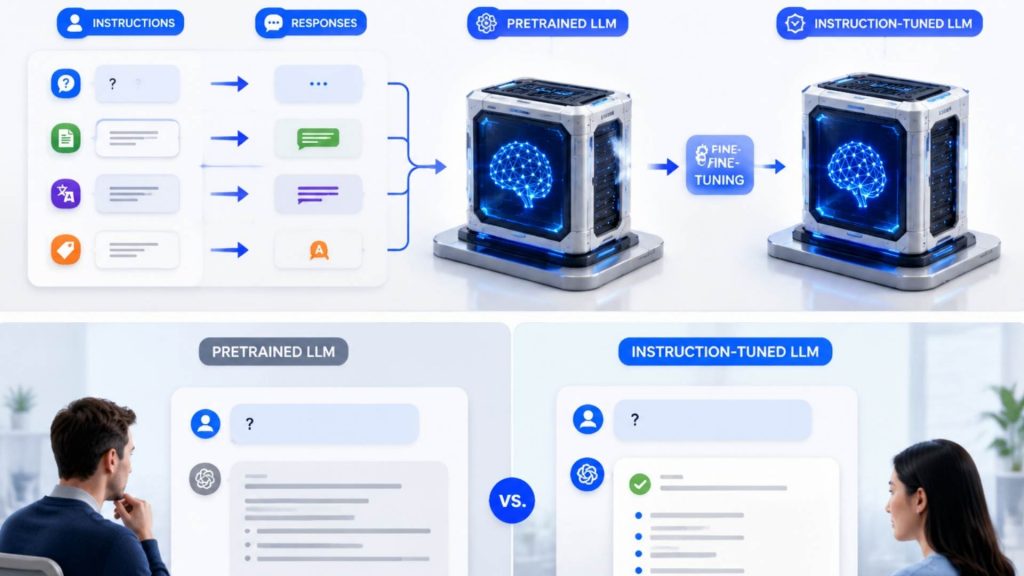
Instruction tuning trains AI models to better understand and follow natural language instructions
1.2. Why do LLMs need Instruction Tuning?
Although pretrained LLMs possess extensive language knowledge, they are not specifically optimized to follow user instructions. Without instruction tuning, models may generate verbose, ambiguous, or irrelevant outputs because their objective is simply to predict likely text rather than fulfill user intent.
Instruction tuning aligns model behavior with real-world interactions, making responses more helpful, consistent, and task-oriented. It also improves the overall user experience by enabling AI systems to understand a wider variety of prompts without requiring highly detailed prompt engineering.
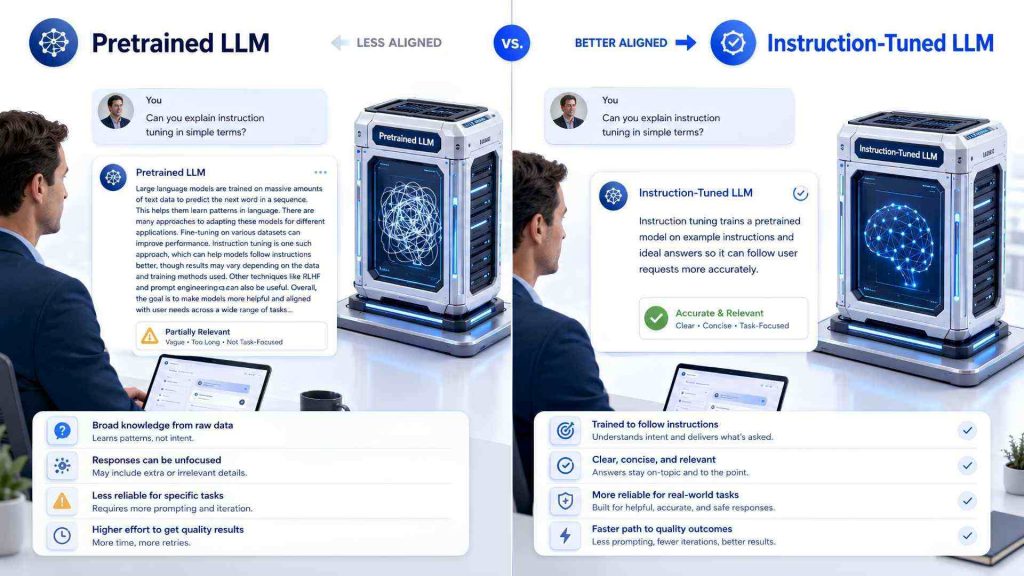
Instruction tuning helps LLMs generate more accurate, consistent, and task-oriented responses
1.3. When to Use Instruction Tuning
Instruction tuning improves a model’s ability to understand and follow user instructions. However, the suitable approach depends on whether the goal is improving guidance, general instruction-following, or domain-specific performance. The table below summarizes common goals, recommended approaches, and practical examples for choosing between Prompt Engineering, Instruction Tuning, and Fine-tuning.
| Goal | Recommended Approach | Example |
| Improve task guidance without changing the model | Prompt Engineering | Designing prompts for better chatbot responses |
| Improve general instruction-following ability | Instruction Tuning | Training an LLM to follow commands across summarization, Q&A, and generation tasks |
| Adapt the model for specific domains or behaviors | Fine-tuning | Training a model for medical, legal, or company-specific use cases |
| Enforce consistent formats or workflows | Instruction Tuning / Fine-tuning | Generating structured reports or standardized outputs |
2. How Instruction Tuning Works
After understanding what instruction tuning is and why LLMs need it, the next step is exploring how instruction tuning is performed in practice. Instruction tuning follows a structured workflow that transforms a general-purpose pre-trained model into one that can better understand and execute user instructions. This illustration shows these stages of how instruction tuning works:
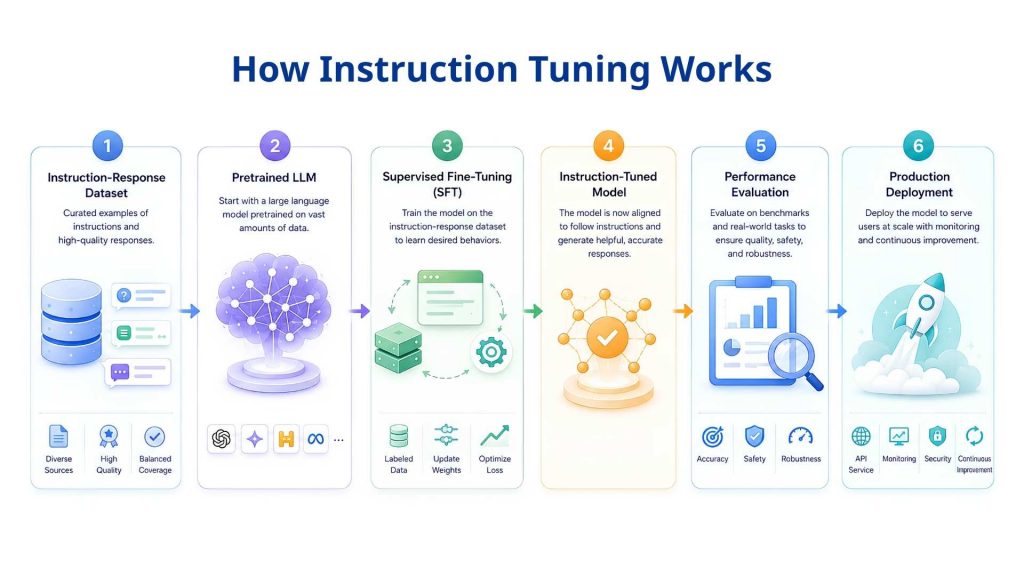
The instruction tuning workflow for large language models
2.1 Collect instruction-response datasets
The first step is building a high-quality dataset containing diverse instruction-response pairs. These datasets teach the model how to perform tasks such as answering questions, summarizing documents, translating languages, generating code, and solving reasoning problems. High-quality instructions should be clear, accurate, and representative of real user interactions to maximize model generalization. A well-designed dataset forms the foundation of successful instruction tuning.
2.2 Fine-tune pretrained models
Once the dataset is prepared, supervised learning is used to fine-tune the pretrained model so it can generate responses that closely match the expected outputs. During this stage, model parameters are adjusted to improve instruction-following behavior while preserving the language knowledge learned during pretraining. Hyperparameters such as the learning rate, batch size, and training epochs are carefully selected to achieve stable optimization and avoid overfitting.
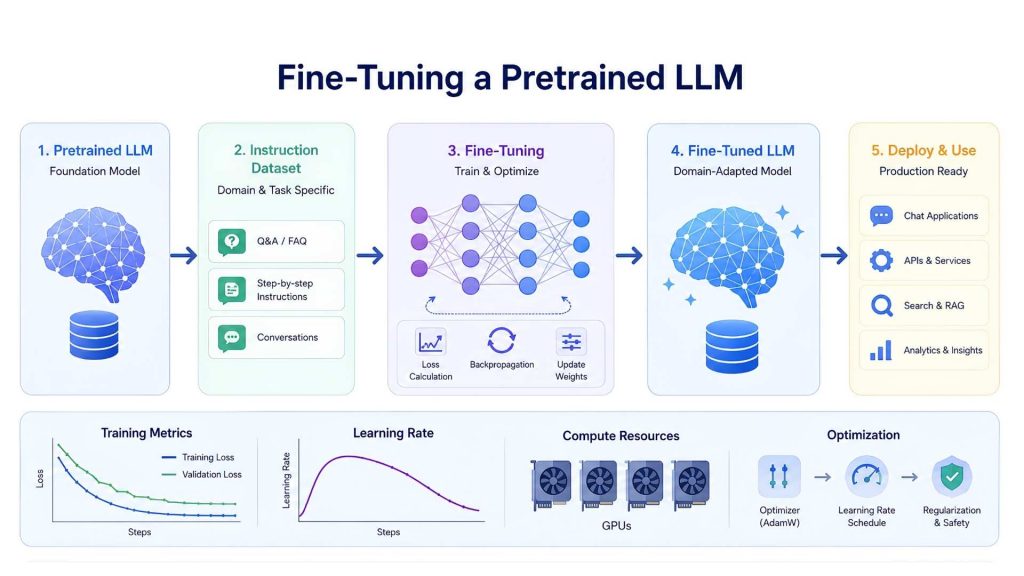
Fine-tuning adapts pretrained language models to follow user instructions
2.3 Evaluate model performance
After fine-tuning, the model is evaluated to verify improvements in instruction-following accuracy, response quality, and consistency. Evaluation typically combines automated benchmarks with human assessment to measure helpfulness, correctness, and safety across different tasks. Organizations often compare tuned models against baseline versions to determine whether instruction tuning delivers meaningful improvements before deployment.
3. Instruction Tuning vs Other Techniques
Now that we’ve explored how instruction tuning works, it’s useful to compare it with other popular techniques for improving large language models. Depending on the objective, organizations may also use fine-tuning, prompt engineering, or reinforcement learning from human feedback (RLHF). Here is a table comparing these approaches:
| Criteria | Instruction Tuning | Fine-Tuning | Prompt Engineering | RLHF |
| Goal | Improve instruction-following ability | Adapt a model to domain-specific knowledge or tasks | Improve outputs by refining prompts | Align model behavior with human preferences |
| Dataset | Instruction-response pairs | Domain-specific labeled datasets | No additional training data | Human preference and ranking data |
| Output Improvement | More helpful, consistent, and instruction-aware responses | Better performance on specialized tasks | Better responses for specific prompts | Safer, more natural, and human-aligned outputs |
| Use Case | AI assistants, copilots, chatbots | Healthcare, finance, legal AI | Rapid experimentation and prompting | Conversational AI and assistant alignment |
| Scope (Tasks) | Broad range of natural language tasks | Limited to target domain or application | Depends on prompt quality | General model behavior and response quality |
4. Benefits of Instruction Tuning
Understanding the differences between instruction tuning and other techniques also helps explain why instruction tuning has become widely adopted. Here are the key benefits it provides for modern AI applications.
4.1. Better User Interaction
Instruction-tuned models understand natural language requests more effectively, allowing users to communicate without carefully crafting complex prompts. The model learns to interpret instructions in a way that feels more intuitive and conversational. This improves accessibility for both technical and non-technical users. As a result, AI assistants become easier to adopt across organizations.

Instruction tuning improves natural interactions between users and AI
4.2. Improved Accuracy
By learning from high-quality instruction-response examples, the model becomes better at producing responses that match the user’s intended task. Rather than relying only on language prediction, it learns how to execute instructions correctly across different scenarios. This leads to more accurate and relevant outputs in practical business applications. Consistent evaluation further helps maintain performance over time.
4.3. Consistent Responses
Instruction tuning helps standardize how an AI model responds to similar requests. Instead of generating inconsistent or unpredictable outputs, the model follows learned response patterns while maintaining flexibility across different tasks. This consistency is especially valuable in enterprise environments where reliability and compliance are important. It also improves trust in AI-powered applications.
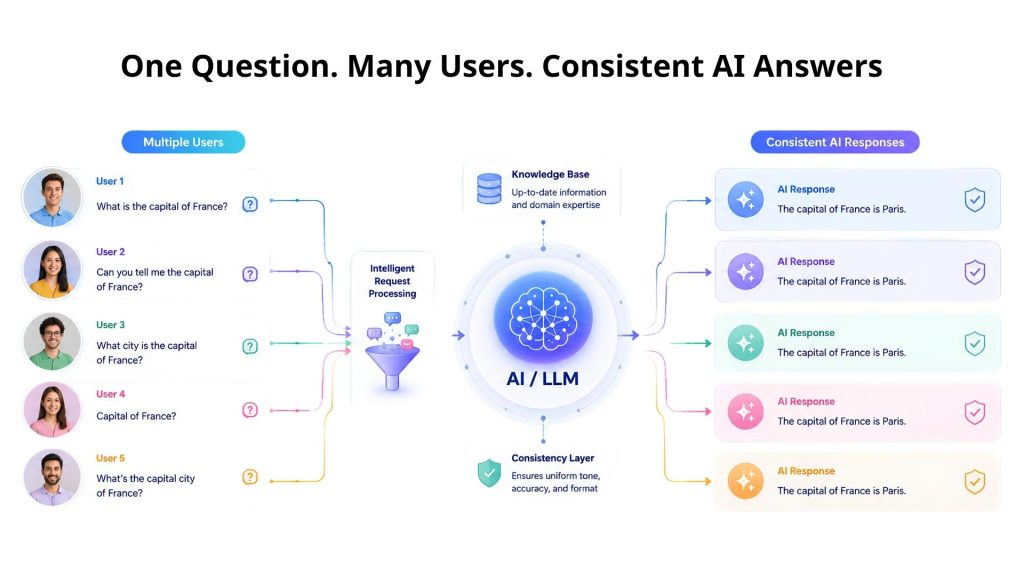
Instruction tuning produces more consistent AI responses
4.4. Reduced Prompt Complexity
Without instruction tuning, users often need carefully engineered prompts to achieve the desired output. Instruction-tuned models require less prompt optimization because they better understand user intent from straightforward instructions. This reduces development effort and makes AI applications easier to use across different teams. Organizations can therefore deploy AI solutions with a lower learning curve.
5. Instruction Tuning Applications
The advantages of instruction tuning have led to its adoption across a wide range of industries. Here are some real-world applications that demonstrate how organizations use instruction-tuned models to solve practical business challenges.
5.1. AI assistants for healthcare
Healthcare AI assistants use instruction tuning to better understand clinical questions and generate responses that align with medical workflows. This helps improve the consistency and relevance of AI-generated outputs while making interactions more intuitive for healthcare professionals.
For example, Google developed Med-PaLM 2, an instruction-tuned large language model designed to answer medical questions more accurately and safely. Instruction tuning helps the model better follow clinical instructions and generate responses aligned with healthcare workflows. According to Singhal et al. (2023), the model achieved an accuracy of 86.5% on MedQA.
5.2. Enterprise copilots
Enterprise copilots use instruction tuning to understand internal knowledge, business terminology, and employee requests more effectively. This enables AI assistants to automate workplace tasks while delivering responses that better match organizational requirements.
For example, Microsoft 365 Copilot uses instruction-following capabilities together with enterprise data to assist users across Microsoft applications. It helps employees summarize documents, answer business questions, draft content, and automate routine workflows using natural language instructions.
Enterprises often combine Model Fine-Tuning with instruction tuning to customize AI models for company-specific use cases. FPT AI Factory provides an environment for developing, fine-tuning, and deploying AI solutions tailored to business requirements. Teams can also use AI Notebook for interactive development or leverage on-demand GPU infrastructure for flexible training and fine-tuning workflows.
5.3. Customer support AI
Customer support platforms use instruction tuning to generate responses that follow company policies while remaining accurate and conversational. This helps AI assistants resolve customer issues more consistently and reduces the workload for human support agents.
For example, Intercom’s Fin AI Agent is designed to resolve customer questions by understanding natural language instructions and retrieving relevant knowledge base content. According to Intercom, Fin can autonomously resolve up to 50% of customer support inquiries, allowing human agents to focus on more complex cases (Wallis, 2025).
5.4. Content Creation
Content generation platforms use instruction tuning to produce outputs that better match user requests and writing styles.
For example, OpenAI’s ChatGPT uses instruction tuning to generate articles, summaries, code, and reports from natural language prompts. In the InstructGPT study (Ouyang et al., 2022), human evaluators preferred instruction-tuned outputs over GPT-3 in approximately 70% of evaluation prompts.
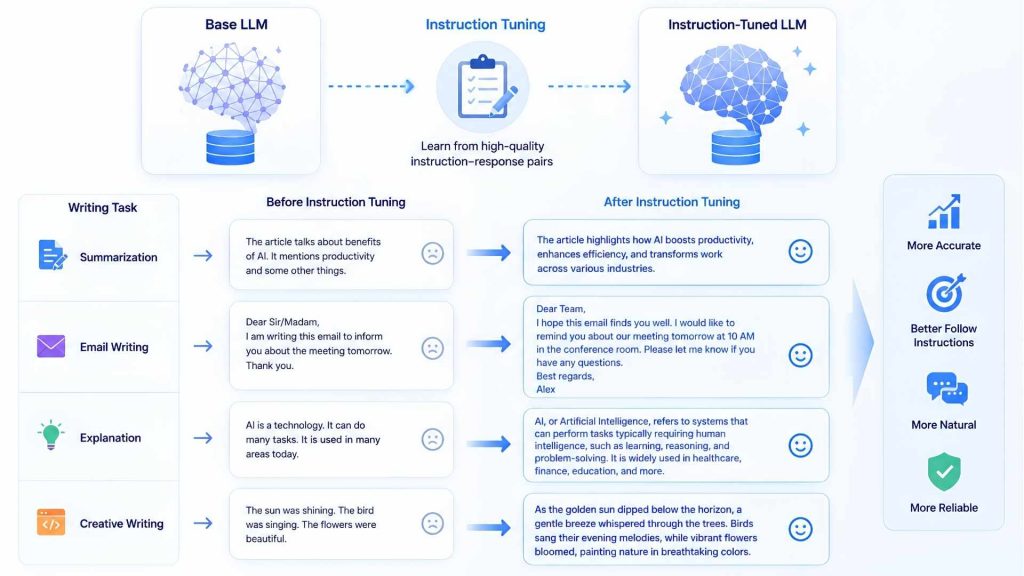
Instruction tuning improves AI-generated content across multiple writing tasks
5.5. E-commerce
E-commerce platforms use instruction tuning to improve conversational shopping experiences and product discovery. AI assistants can better understand customer requests, compare products, and provide personalized recommendations based on natural language interactions.
For example, Amazon Rufus is an AI shopping assistant that helps customers explore products and make purchasing decisions using conversational queries. It follows shopping-related instructions to recommend products, compare features, and answer customer questions more naturally.
5.6. Marketing & Advertising
Marketing teams increasingly use instruction-tuned AI to generate campaign ideas, advertising copy, audience segmentation, and creative content. The model can better follow brand guidelines, tone of voice, and campaign objectives provided through natural language instructions.
For instance, Google Workspace with Gemini helps users generate marketing emails, campaign drafts, presentations, and promotional content using natural language instructions. This accelerates campaign creation while maintaining consistency across marketing channels.

AI assistants help marketers generate campaign content from natural language instructions
6. Best Practices for Instruction Tuning
While instruction tuning can significantly improve model performance, achieving reliable results depends on following proven development practices. The following best practices help organizations build more accurate, robust, and production-ready AI models.
6.1. Dataset Quality
The quality of the instruction dataset is one of the most important factors affecting instruction tuning performance. Well-curated datasets enable models to better understand user intent, generalize across tasks, and generate more reliable responses. To build high-quality instruction datasets, organizations should:
- Collect diverse tasks such as question answering, summarization, reasoning, translation, and text generation.
- Use high-quality human-written instructions with clear prompts and accurate responses.
- Balance task distribution to prevent overrepresentation of certain task types.
- Remove duplicated, noisy, or low-quality samples before training.
- Evaluate datasets before deployment through human review and benchmark testing.
Popular benchmark datasets such as FLAN, Alpaca, and Dolly continue to be widely referenced for instruction tuning, alongside newer proprietary and synthetic instruction datasets used in modern LLM development.
6.2. Evaluation Metrics
Evaluation should measure more than traditional accuracy. Organizations often assess helpfulness, correctness, consistency, factual accuracy, and safety using both automated benchmarks and human evaluation. Monitoring these metrics helps teams identify performance gaps before deployment and compare different instruction-tuning strategies objectively. A structured evaluation process supports reliable AI applications in production.
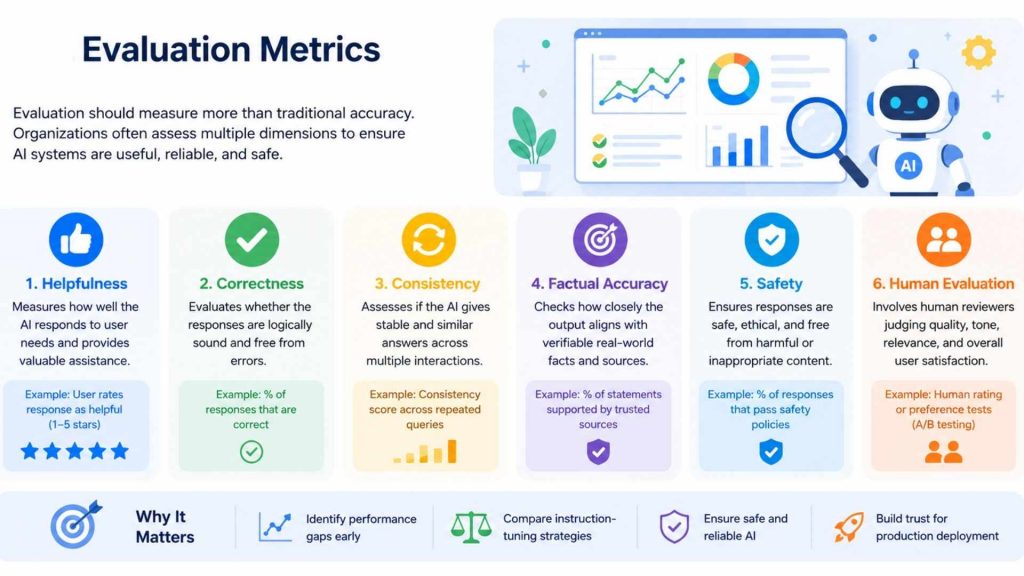
Evaluation metrics measure the effectiveness of instruction tuning
6.3. Human Feedback
Human feedback plays an important role in refining instruction-tuned models. Domain experts can identify unclear, incomplete, or inaccurate responses that automated evaluation may overlook. This feedback helps improve response quality while ensuring the model better aligns with business requirements and user expectations. In many AI development workflows, human review complements automated testing throughout the model lifecycle.
6.4. Continuous Improvement
Instruction tuning should be viewed as an ongoing process rather than a one-time training step. Organizations should continuously collect user feedback, update instruction datasets, evaluate new model versions, and retrain models as business requirements evolve. Regular optimization helps AI systems remain accurate, relevant, and effective in changing production environments.
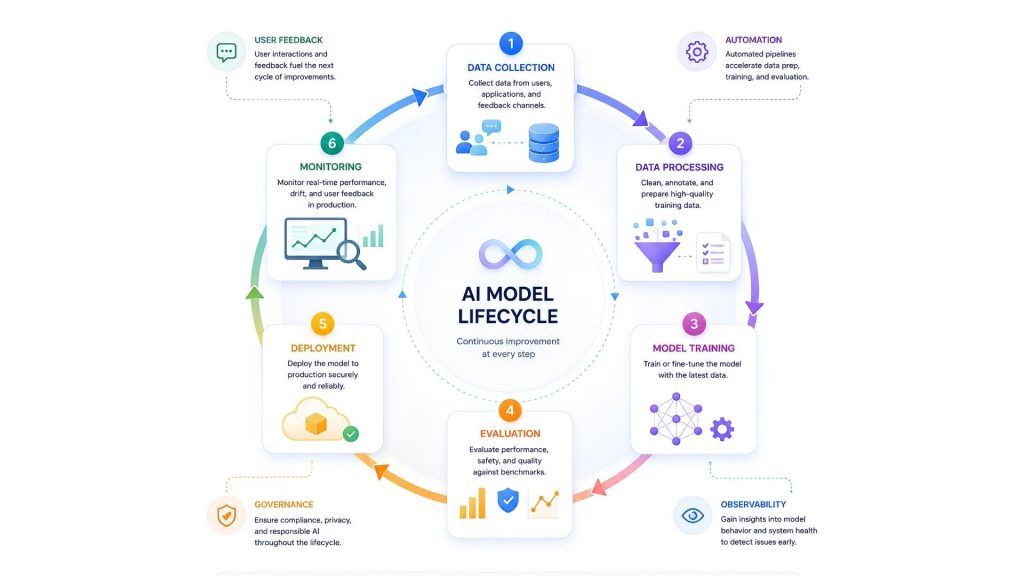
Continuous improvement keeps instruction-tuned AI models up to date
7. FAQs
7.1. Can instruction tuning improve model accuracy?
Instruction tuning improves how well a model follows user instructions and produces task-relevant responses. While it does not increase the model’s underlying knowledge, it often improves response accuracy and consistency across many real-world tasks.
7.2. Does instruction tuning eliminate the need for prompt engineering?
No. Instruction tuning reduces the need for complex prompts by making models better at understanding natural language instructions. However, well-designed prompts can still improve output quality for specialized or complex tasks.
7.3. What data is used for instruction tuning?
Instruction tuning uses datasets containing natural language instructions paired with high-quality responses. These examples may include question answering, summarization, translation, classification, coding, reasoning, and domain-specific business tasks.
Instruction tuning enables large language models to better understand user intent, follow instructions consistently, and deliver more reliable responses across a wide range of applications. Combined with high-quality datasets, systematic evaluation, and continuous improvement, it has become a fundamental technique for building production-ready AI systems. For enterprises with customization or large-scale AI requirements, please contact the FPT AI Factory team via the official contact form for dedicated support.
Contact Information:
- Hotline: 1900 638 399
- Email: support@fptcloud.com
Explore Related Articles:
What Is Model Serving? From AI Research to Real-World Impact