
When businesses move to the cloud, one of the most critical decisions they face is choosing between private cloud vs public cloud. Each model comes with its own trade-offs across security, cost, scalability, and control, and the right choice can significantly impact how an organization operates and grows. At FPT AI Factory, we help businesses navigate these decisions with advanced AI and cloud infrastructure solutions tailored to their specific needs.
1. What is a Public Cloud?
A Public Cloud is a computing model where server and storage services are delivered over the internet by a third-party provider. Instead of investing heavily in physical servers, businesses can rent resources and deploy them instantly.
Cloud computing grants organizations on-demand access to a broad spectrum of computing resources, from web hosting, storage, and backup, to data analytics, DevOps pipelines, networking, and security infrastructure. Rather than investing in dedicated on-premise servers, businesses can provision exactly the resources they need, when they need them, and scale up or down as demand changes. Within this broader cloud ecosystem, AI-specific services have emerged as one of the fastest-growing segments.
Key Characteristics
- Flexible resource sharing: The model is built to safely serve multiple organizations simultaneously on the same shared physical infrastructure.
- On-demand self-service: Users can instantly provision and allocate computing resources based on their actual needs with just a few simple clicks.
- Rapid elasticity: The system effortlessly scales your computing power up or down to match your real-time workload fluctuations perfectly.
Pros
- Zero upfront costs: It eliminates the heavy financial burden of purchasing, installing, and housing physical hardware.
- Accelerated deployment: Projects can be launched quickly, significantly reducing time-to-market for your new products or services.
- Effortless maintenance: The service provider shoulders the entire responsibility for system updates, security patches, and hardware troubleshooting.
- Limitless scalability: This is highly beneficial when your business needs to mobilize massive computing power to train complex AI models quickly.
Cons
- Limited hardware control: Users generally have restricted access to deeply customized the underlying physical architecture of the system.
- Strict compliance hurdles: Organizations with ultra-strict internal data privacy standards might hesitate to migrate highly sensitive data to a shared infrastructure.
- Unpredictable scaling costs: Without careful resource monitoring and optimization, your monthly expenses can spike rapidly as usage scales up.
- Internet dependency: The overall operational experience and system accessibility rely heavily on the speed and stability of your internet connection.

A Public Cloud is a computing model where server and storage services are delivered over the internet
>> Explore more: Benefits of cloud computing: When is the right time to move?
2. How Public Cloud Works?
Public cloud works by allowing users to access computing resources from provider-managed data centers through the internet. Instead of owning physical servers, businesses rent virtualized resources such as compute, storage, networking, databases, containers, and application services based on actual demand.
At the infrastructure level, public cloud providers use virtualization and automation to divide large pools of physical resources into separate environments for different customers. Each customer can deploy applications, store data, run websites, build development environments, or scale digital services without directly managing the underlying hardware.
To deliver a flexible and cost-efficient cloud experience, public cloud typically relies on four core mechanisms:
- Resource pooling: Computing power, memory, storage, and networking resources are combined into shared pools and dynamically allocated to users based on demand.
- Multi-tenancy architecture: Multiple customers use the same physical infrastructure, but their applications, workloads, and data remain logically separated and protected.
- Self-service provisioning: Users can launch servers, databases, storage, containers, or other services through a dashboard or API without waiting for manual hardware setup.
- Metered service: Usage is tracked based on actual consumption, allowing businesses to pay for the resources they use rather than maintaining fixed infrastructure capacity.
Tis model makes public cloud especially useful for businesses that need fast deployment, flexible scaling, and lower upfront infrastructure costs.
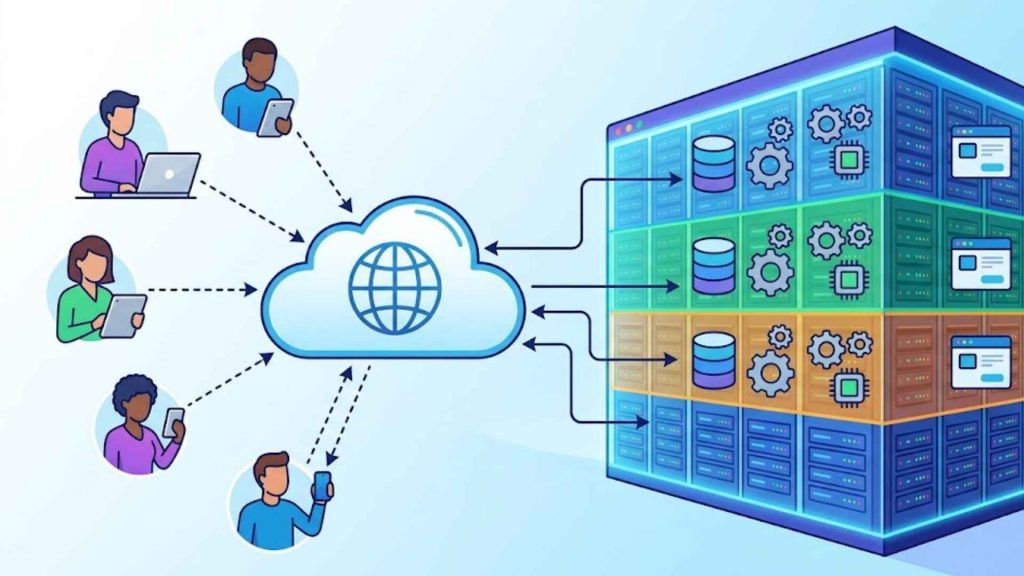
Public Cloud operates on a vast network that is directly built and maintained by the service provider
3. What is a Private Cloud?
A private cloud works by applying cloud technologies such as virtualization, orchestration, automation, and centralized management to infrastructure dedicated to a single organization. Unlike public cloud, where resources are shared across many customers, private cloud keeps compute, storage, and networking resources isolated for one business only.
The infrastructure may be hosted in the company’s own data center or managed by a third-party provider. In both cases, the organization has greater control over system configuration, security policies, data location, access management, and compliance requirements.
To provide a cloud-like experience while maintaining strict isolation, private cloud relies on several core processes:
- Dedicated virtualization: A virtualization layer separates physical hardware from computing environments, allowing IT teams to create virtual machines or containers on dedicated infrastructure.
- Centralized orchestration: Cloud management software helps automate provisioning, monitoring, scaling, and resource allocation across the private environment.
- Exclusive resource pooling: Compute, memory, storage, and networking resources are pooled for internal use only, giving the organization more predictable performance and stronger control.
- Secure access control: Users typically access the private cloud through internal networks, private connections, VPNs, or strict identity and access management systems.
This model is commonly used for sensitive data, regulated industries, core enterprise systems, internal applications, financial platforms, healthcare records, and workloads that require consistent performance or strict governance.
Key Characteristics
- Single-tenancy: The entire infrastructure is dedicated solely to your business, eliminating the “noisy neighbor” effect often found in shared cloud environments.
- Absolute customization: Organizations can freely tailor the server configurations, storage arrays, and software stacks to perfectly match their specific operational workloads.
- Enhanced network security: The system typically operates on highly secure, private networks rather than the public internet, drastically reducing external attack surfaces.
Pros
- Maximum data privacy: It offers unparalleled security, making it the perfect choice for training sensitive enterprise AI models or handling confidential financial records.
- Predictable performance: With dedicated computing power, your critical applications and heavy workloads will consistently run at peak efficiency without sudden bottlenecks.
- Total architectural control: Your IT team holds complete governance over the underlying physical servers, network routing, and deep system customizations.
- Simplified compliance: Meeting stringent industry regulations and strict data sovereignty laws becomes much easier when your data resides in an isolated environment.
Cons
- High initial investment: Building this infrastructure requires a massive amount of upfront capital to purchase servers, software licenses, and networking equipment.
- Complex maintenance: Your organization is entirely responsible for ongoing hardware upgrades, security patching, and employing a skilled IT operations team.
- Restricted scalability: Expanding your computing power requires buying and installing new physical hardware, which takes significantly longer than public cloud scaling.
Types of Private Cloud
- On-Premise Private Cloud: The physical infrastructure is securely located within your company’s own internal data center. Your internal IT department is fully responsible for purchasing, powering, cooling, and maintaining every single piece of hardware day and night.
- Hosted Private Cloud: The dedicated servers are physically housed in a third-party provider’s high-tech data center. While the resources remain exclusively yours, the provider handles the facility management, power supply, and foundational hardware maintenance.
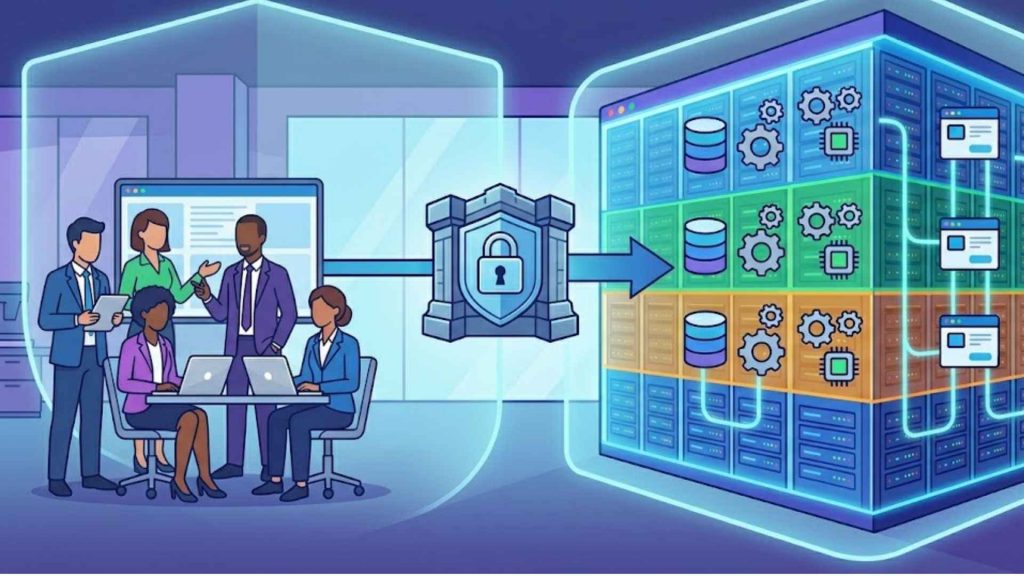
A Private Cloud is a computing environment dedicated entirely to one organization
4. How Private Cloud Works?
A Private Cloud functions by applying advanced virtualization technology to a dedicated pool of physical servers that belong exclusively to your organization. Instead of sharing the underlying hardware with other companies, your IT team or a trusted provider creates isolated virtual machines on your own private infrastructure.
Cloud management software then sits on top of this hardware, pulling computing power, memory, and storage together into a unified, easily manageable system. This architecture guarantees that your business-critical workload, whether core banking systems, patient health records, internal enterprise applications, or large-scale data processing pipelines, has uninterrupted, exclusive access to all necessary computing resources.
To provide a cloud-like experience while maintaining strict isolation, a Private Cloud relies on several fundamental technical processes:
- Dedicated Virtualization: A software layer called a hypervisor is installed directly onto your exclusive physical servers to separate the underlying resources from the hardware itself. This enables your IT team to instantly carve out multiple flexible virtual environments from your dedicated CPU and GPU clusters.
- Centralized Orchestration: Specialized cloud management software seamlessly connects, monitors, and automates the entire internal infrastructure to eliminate slow manual configurations. This intelligent system ensures that computing power is efficiently and dynamically routed to your heaviest data processing tasks.
- Exclusive Resource Pooling: All of your dedicated storage, memory, and processing power are aggregated into a single, massive corporate resource pool. However, unlike public platforms, this massive digital reservoir is heavily fenced off and strictly reserved for your internal business departments only.
- Highly Secure Access: Instead of relying on the open, public internet, users typically connect to this environment through an internal corporate network or tightly encrypted VPNs. This closed-loop network architecture creates a formidable, secure barrier against external cyber threats and unauthorized data breaches.
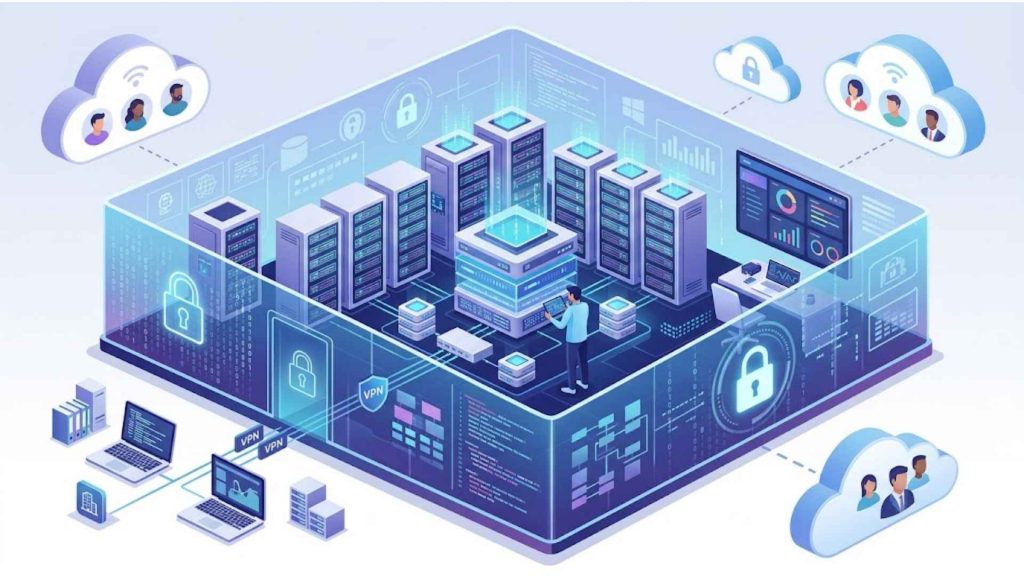
A Private Cloud relies on several fundamental technical processes
5. Private Cloud vs Public Cloud: Detailed Comparison
Choosing between private and public cloud isn’t a one-size-fits-all decision. The right model depends on your business size, industry, workload type, and long-term priorities. Here’s a side-by-side breakdown across the dimensions that matter most.
| Criteria | Private Cloud | Public Cloud |
| Security | Dedicated infrastructure with full isolation, data stays behind your own firewall | Shared infrastructure with robust provider-managed security follows a shared responsibility model |
| Cost Model | High upfront CapEx, more predictable long-term costs for stable workloads | No upfront investment, pay-as-you-go OpEx, but costs can spike without proper governance |
| Scalability | Scalable but limited by physical hardware capacity, requires procurement to expand | Near-unlimited on-demand scalability, spin resources up or down in minutes |
| Compliance | Easier to meet strict regulatory standards (HIPAA, GDPR, PCI DSS), full control over data location | Compliance is achievable but more complex, it relates to provider certifications and careful configuration |
| Customization | Highly customizable – Tailor hardware, software, and network to specific needs | Standardized environments – Limited customization options beyond what the provider offers |
| Maintenance | Your team (or managed service provider) handles all updates, patches, and upkeep | Provider manages all maintenance, updates, and infrastructure, with zero burden on your IT team |
| Latency | Lower latency for on-premises workloads – Ideal for real-time, performance-sensitive applications | Latency varies by region – Providers mitigate this with globally distributed data centers |
| Control | Full visibility and control over infrastructure, security policies, and configurations | Limited control – Provider dictates infrastructure decisions and upgrade cycles |
| Best For | Healthcare, finance, government, and any organization with sensitive data or strict compliance needs | Startups, tech companies, and businesses with variable workloads or rapid growth plans |
Beyond the numbers, the clearest way to frame it is this: private clouds are safer, especially for sensitive data and compliance, due to isolated environments and enhanced security, while public clouds are secure but may pose risks in shared settings. On the cost side, public clouds use a pay-as-you-go model that is cost-effective for variable or temporary workloads, while private clouds involve higher upfront costs but may be more economical for long-term, stable workloads.
When it comes to compliance, the gap is significant. Organizations using private cloud experience 64% fewer audit findings and achieve 82% faster compliance certifications compared to public cloud environments, according to IDC (2024). That said, public cloud is far from a poor choice – it offers the most advanced and scalable AI services, making it ideal for organizations looking to innovate quickly.
To put theory into practice, understanding the specific triggers for each cloud model is crucial. Here is a quick guide on exactly when to deploy each environment and what that looks like in action:
- Public Cloud: Use this when you have unpredictable traffic, need rapid scalability on demand, or want to avoid expensive upfront hardware costs. Example: An e-commerce platform instantly scaling up server capacity to handle massive traffic during a Black Friday sale, paying only for the resources consumed during the spike.
- Private Cloud: Use this when dealing with highly sensitive data, strict legal compliance, or stable, heavy workloads that require absolute control. Example: A hospital managing millions of Electronic Health Records (EHR) behind a dedicated, on-premises firewall to ensure maximum security and strict compliance with privacy laws.
- Hybrid Cloud: Use this when you need the isolated security of a private cloud for core assets, combined with the flexible scalability of a public cloud for front-end operations. Example: A retail bank securing its core financial ledgers on a private cloud, while hosting its customer-facing mobile banking app on a public cloud to handle sudden surges in user logins smoothly.
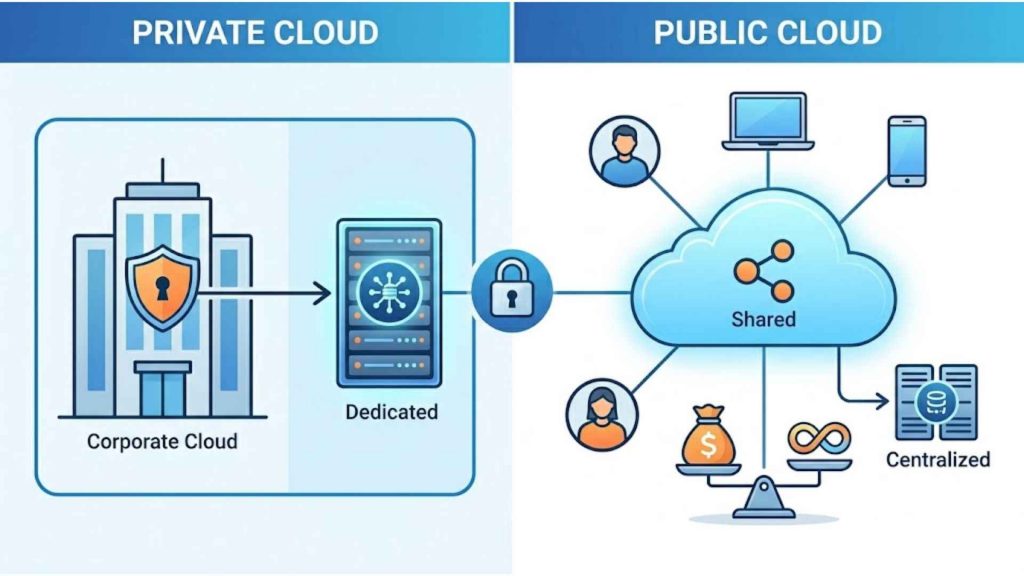
Detailed comparison between private cloud vs public cloud
>> Explore more: What is a hybrid cloud? Benefits, architecture & use cases
6. How to Decide the Right Cloud Deployment Model?
There’s no universal answer when it comes to choosing between private and public cloud. The right model depends on a combination of business, technical, and financial factors that are unique to each organization. Here are the five key dimensions to evaluate before making your decision.
6.1. Workload Requirements
The nature of your workloads is often the starting point. Ask yourself how much fluctuation your workloads experience. Public clouds excel at scaling resources up or down quickly, making them well-suited for variable traffic patterns, seasonal demand spikes, or rapidly growing user bases. For more predictable and stable workloads, such as internal enterprise systems, batch processing pipelines, or core business applications that run at consistent capacity, private clouds can be a more reliable and cost-efficient option.
Also consider latency sensitivity. Real-time applications, whether that’s live transaction processing, customer-facing web services, or operational dashboards, demand consistently low latency, which dedicated private infrastructure handles more reliably than shared environments.
For organizations exploring AI and GPU-intensive workloads in particular, starting with a public GPU cloud is a practical way to test, benchmark, and iterate before committing to a larger infrastructure investment.

The nature of your workloads is the starting point (Source: FPT AI Factory)
6.2. Regulatory Compliance
Specific industries like healthcare and finance should deploy private cloud solutions to satisfy certain regulatory requirements. If your business handles sensitive customer data or must comply with frameworks like HIPAA, GDPR, or PCI DSS, a private deployment gives you the control and auditability needed to meet those obligations. Cloud providers can meet the most common regulatory requirements, but if compliance is a more complicated road, it may be best to choose a private cloud deployment model.
6.3. Technical Expertise and Resources
Consider the operational expertise and preferences of your IT team before committing to a model. Private cloud demands a dedicated team to manage hardware, security configurations, patching, and uptime, which can be a significant burden for lean engineering teams. Public cloud, by contrast, offloads that complexity to the provider, freeing your team to focus on building and deploying AI applications rather than managing infrastructure.

Consider the operational expertise and preferences of your IT team (Source: FPT AI Factory)
6.4. Capital and Operational Expenditure
The public cloud offers a cost-effective solution with pay-as-you-go pricing, ideal for businesses with limited budgets. In contrast, private clouds require significant investment in infrastructure and ongoing maintenance, making them suitable for larger organizations with specific security needs.
In short, if your workloads are variable or you’re still in the experimentation phase, public cloud is the most financially sensitive starting point. If your usage is steady and large-scale, a private cloud can reduce the total cost of ownership over time.
6.5. Customization and Control
Opt for a private cloud deployment model if stringent security and compliance requirements are paramount, or if customization and control over infrastructure are essential. Private cloud lets you configure hardware, networking, and security policies exactly to your specifications – something standardized public cloud environments cannot always accommodate.
This level of control matters across a wide range of enterprise scenarios. Organizations running legacy ERP or core banking systems that require specific hardware configurations, businesses with proprietary data pipelines that cannot traverse public networks, or regulated industries that need to enforce strict access controls and audit trails at the infrastructure level.
7. Private Cloud vs Public Cloud in AI Development
For general business workloads, the choice between private and public cloud usually depends on cost, compliance, scalability, and control. For AI development, the decision becomes more specific because AI workloads often require high-performance computing, GPU resources, large-scale data processing, and secure model deployment environments.
A public AI cloud is suitable for teams that need to move fast. It allows businesses to access GPU resources on demand, test different model architectures, run experiments, fine-tune models, and deploy inference workloads without investing in physical infrastructure upfront. This is especially useful for startups, research teams, and enterprises that are still validating AI use cases.
A private AI cloud is more suitable when the organization needs stronger isolation, dedicated infrastructure, or tighter control over sensitive data. This model is often preferred for regulated industries, proprietary AI models, confidential datasets, or long-term workloads that require predictable performance and strict governance.
Many enterprises start with public AI cloud to test and benchmark workloads, then move selected workloads to private deployment when compliance, data sensitivity, or infrastructure control becomes more important. This approach helps businesses balance speed in the early stage with security and control as AI adoption scales.
For teams with AI workloads that demand custom GPU configurations or isolated networking, private deployment is equally where that level of control lives. Whether you’re just starting with AI or scaling an established workload, FPT AI Factory supports both paths, public GPU cloud and private deployment, so you’re never locked into a single model.
For teams looking to move fast, GPU Containers powered by NVIDIA H100 and H200 deliver high-performance workloads with unmatched speed and cost efficiency – available on-demand, with no data infrastructure to manage. It’s an ideal starting point to test AI workloads, benchmark performance, and validate your architecture before making a larger commitment.
For teams that need dedicated resources with full control, GPU Virtual Machines on FPT AI Factory offer NVIDIA HGX H100 and HGX H200 GPUs on a dedicated GPU stack with complete control over compute, network, and storage, with flexible scaling from 1x to 8x GPUs depending on workload requirements. Reserved capacity is also available for teams with predictable, long-term needs.
A practical approach many enterprises take is to start on a public GPU cloud to test and iterate AI workloads, then migrate to private deployment as compliance requirements or data sensitivity increase. FPT AI Factory’s team can guide you through this transition with tailored consultation for your industry and use case.
FPT AI Factory is offering early access to the NVIDIA HGX B300 GPU Cloud at exclusive rates. If you’re planning for next-generation AI infrastructure, now is the time to pre-order or join the waitlist. Whether you are testing the agile flexibility of a Public Cloud or planning the secure architecture of a Private Cloud, FPT AI Factory is ready to accelerate your development. Kickstart your next AI project today by exploring our Starter Plan.
New users will instantly receive a free $100 credit upon login, with absolutely zero setup delays. Valid for 30 days, this trial package empowers you to experience our robust infrastructure firsthand. Your credits are strategically allocated as follows:
- $10 dedicated to GPU Containers and $10 for GPU Virtual Machines.
- $10 to explore AI Notebooks, alongside $70 for AI Inference & AI Studio capabilities.
- Processing power for up to 5 million tokens, utilizing Llama-3.3 and over 20 other state-of-the-art models.
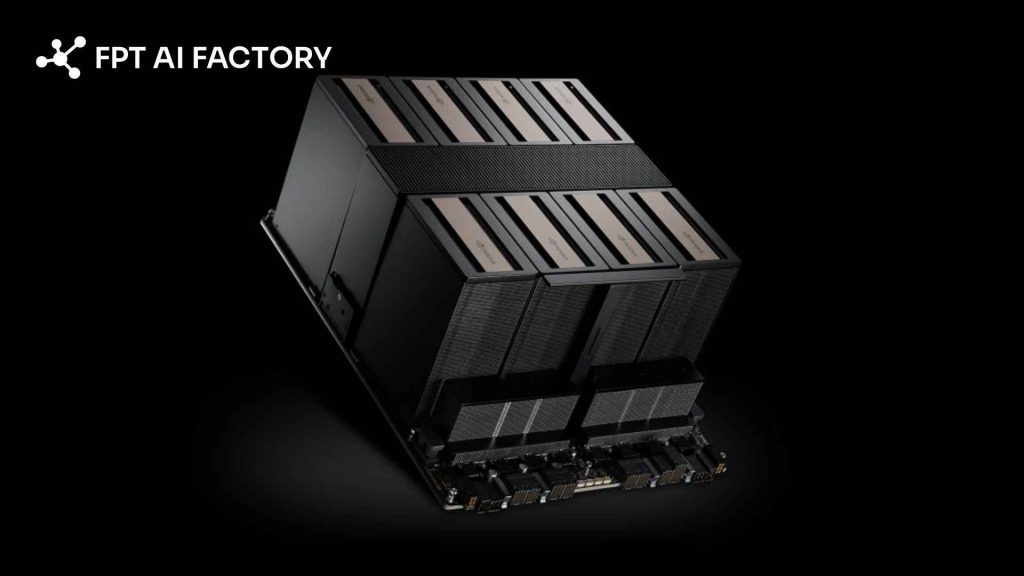
GPU Virtual Machines on FPT AI Factory offer NVIDIA HGX H100 and HGX H200 GPUs (Source: FPT AI Factory)
8. Frequently Asked Questions
8.1. Is a private cloud always more secure?
Not necessarily. A private cloud is often considered more secure because it provides dedicated infrastructure and greater control over data and access. However, security ultimately depends on how well the system is configured and managed. Major public cloud providers invest heavily in advanced security technologies and compliance standards, which can make public cloud environments equally, or sometimes even more secure.
8.2. Can you switch from public to private cloud?
Yes, it is possible to switch from a public cloud to a private cloud, but the process can be complex. It typically involves data migration, application restructuring, and potential downtime, all of which require careful planning and resources. Because of these challenges, many organizations choose a hybrid cloud approach instead, allowing them to combine both environments and move workloads more flexibly without fully committing to a single model.
8.3. What do most enterprises actually use?
Most enterprises today use a combination of cloud models rather than relying on just one. Hybrid and multi-cloud strategies are the most common, enabling organizations to balance performance, cost, and security. Public cloud is widely used for scalability and cost efficiency, while private cloud or on-premises infrastructure is often reserved for sensitive data and critical systems.
Ultimately, deciding between a private cloud vs public cloud depends entirely on your specific business goals and security requirements. There is no one-size-fits-all answer, as many enterprises even blend both approaches to maximize their operational efficiency.
No matter which deployment model best fits your long-term strategy, FPT AI Factory is ready to empower your next technological breakthrough. With our state-of-the-art GPU infrastructure, flexible cloud solutions, and dedicated expert support, you can seamlessly scale your AI projects with absolute confidence.
Contact Information:
- Hotline: 1900 638 399
- Email: support@fptcloud.com
Explore Related Articles: