
Data infrastructure is the foundational layer that determines how effectively an organization can collect, store, process, and act on data. As AI adoption accelerates and data volumes grow, having a reliable infrastructure is no longer optional, it is a strategic requirement. At FPT AI Factory, we provide cloud-native AI infrastructure solutions that help businesses build scalable, high-performance data environments ready for modern workloads.
1. What is Data Infrastructure?
Data infrastructure refers to the set of hardware, software, networks, and services that organizations use to collect, store, manage, process, and distribute data. It acts as the backbone of any data-driven operation, enabling everything from day-to-day business analytics to large-scale machine learning pipelines.
A well-designed data infrastructure ensures that data is available when needed, protected from unauthorized access, and capable of scaling as business demands increase. Without it, even the most sophisticated analytics tools or AI models cannot function effectively.
In practice, big data infrastructure spans multiple layers, including storage, compute, pipelines, governance, and monitoring, all working together to ensure reliable and efficient data flow.
It is worth distinguishing data infrastructure from the related concept of a data platform. While the two terms are often used interchangeably, data infrastructure refers specifically to the foundational layer of the physical and virtual resources such as servers, storage, networking, and compute. A data platform, by contrast, is the software layer built on top: the query engines, orchestration tools, and data catalogs that teams interact with day to day. Infrastructure is what makes the platform possible, not the platform itself.

Data infrastructure include hardware, software, networks, and services
2. Main types of Data Infrastructure
Not all data infrastructure is built the same way. Depending on business size, data sensitivity, and workload requirements, organizations can choose from several types of infrastructure. The table below outlines the most common types and their ideal use cases:
| Type | Description | Best for |
| Traditional Infrastructure | On-premises servers, storage, and networking hardware owned and managed by the organization. | Regulated industries with strict compliance requirements (banking, government) |
| Cloud Infrastructure | Computing resources delivered over the internet by third-party providers such as AWS, Azure, or Google Cloud. | Startups, scaling teams, or businesses with variable workloads |
| Hybrid Infrastructure | A combination of on-premises systems and cloud services, connected to work as one environment. | Enterprises that need data sovereignty alongside cloud flexibility |
| Converged Infrastructure | Pre-packaged bundles of servers, storage, and networking managed through a single interface. | Organizations seeking simplified deployment and reduced IT management overhead |
| Hyper-Converged Infrastructure (HCI) | Software-defined environment that integrates compute, storage, and networking into a single system. | Modern data centers prioritizing scalability and automation |
| Edge Infrastructure | Localized computing resources placed closer to the source of data generation rather than a central data center. | IoT deployments, real-time analytics, and latency-sensitive applications |
In practice, most organizations do not rely on a single type. Hybrid and hyper-converged approaches have grown significantly in adoption because they offer a balance between control, scalability, and cost efficiency, particularly for businesses managing both legacy systems and new cloud-native workloads.
>> Read more:
What is a hybrid cloud? Benefits, architecture & use cases
Benefits of cloud computing: When is the right time to move?
3. Core components of Data Infrastructure
Regardless of the type chosen, every reliable data infrastructure shares a common set of core components. Each plays a specific role in ensuring data is handled efficiently from ingestion to analysis:
- Storage: The foundation for persisting data, ranging from traditional block storage and file systems to modern object storage and data lakes designed for unstructured data at scale.
- Processing: The software layer that orchestrates how compute resources are used to execute data workloads including batch pipelines, real-time stream processing, and distributed computing frameworks such as Spark or Flink. While compute provides the raw power, processing defines the logic and sequencing applied to the data.
- Networking: The connectivity layer that enables data transfer between systems, data centers, and cloud environments, including bandwidth management, routing, and low-latency network design.
- Compute: The underlying hardware resources: CPUs, GPUs, and TPUs that power all data and AI workloads. Compute resources can be provisioned on-demand in cloud environments, making it possible to spin up GPU clusters for intensive training jobs and scale back down when the job is done, rather than maintaining idle capacity.
- Security: Encryption, access controls, identity management, and compliance mechanisms that protect data throughout its lifecycle and prevent unauthorized access or breaches.
- Monitoring and Management: Tools and dashboards that track system health, resource usage, data quality, and performance metrics, allowing teams to respond quickly to issues and optimize operations over time.
Together, these components form an integrated environment where data can move, be processed, and be secured without bottlenecks. Gaps in any one area tend to create downstream problems that affect reliability, performance, and compliance. In cloud-based infrastructure specifically, one of the most significant architectural advantages is the separation of storage and compute, meaning each layer can scale independently based on demand, rather than being tied to the same physical hardware. This decoupling gives organizations far greater flexibility in managing costs and performance as their data operations grow.

Core Components of Data Infrastructure
4. Steps to build a reliable data infrastructure
Building data infrastructure is not a single project, it is an ongoing engineering discipline. The following steps provide a structured path from initial planning through to long-term operational readiness.
4.1. Define your data needs and business goals
Before selecting any tool or platform, organizations need a clear picture of what they are building toward. This means identifying what types of data the business generates, how it will be used, and who will access it. Data infrastructure built without this clarity tends to be over-engineered in some areas and insufficient in others.
Key questions to answer at this stage include: What is the expected data volume and growth rate? Are workloads batch-based, real-time, or both? What compliance or data residency requirements apply? Answering these questions upfront prevents costly architecture changes later.
4.2. Design a reliable data ingestion layer
Data ingestion is the entry point of any pipeline, the mechanism by which raw data from source systems flows into the infrastructure. A well-designed ingestion layer handles multiple data formats (structured, semi-structured, and unstructured), supports both batch and streaming modes, and includes error handling to avoid data loss.
Common ingestion patterns include event-driven pipelines using systems like Apache Kafka or change data capture (CDC) pipelines that pull data from databases or APIs, and real-time connectors for IoT or transactional systems. The right design depends on latency requirements and source diversity.

Design a Reliable Data Ingestion Layer
4.3. Choose the right data storage architecture
Storage architecture has a significant impact on query performance, cost, and scalability. Organizations typically use a combination of storage tiers: a data lake for raw, unprocessed data; a data warehouse for structured, query-optimized data; and operational databases for transactional workloads.
The rise of the lakehouse architecture, combines the flexibility of data lakes with ACID transactions and performance optimizations traditionally associated with data warehouses, has made it a popular choice for businesses handling mixed workloads. Choosing the right architecture depends on access patterns, data retention requirements, and the tools used for downstream analysis.
4.4. Build efficient data transformation workflows
Raw data rarely arrives in a form that is immediately usable. Transformation workflows — often referred to as ETL (Extract, Transform, Load) or ELT pipelines — clean, enrich, and restructure data so it can be reliably used for reporting, machine learning, or operational decision-making.
As transformation workflows grow more complex, particularly when handling large-scale processing or AI workloads, the underlying compute infrastructure becomes a critical factor. These workflows are typically coordinated through an orchestration layer using tools such as Apache Airflow or similar schedulers, which manages task dependencies, execution order, and retry logic across data pipelines. When this orchestration layer is handling high volumes or time-sensitive jobs, CPU-based environments can become a bottleneck for tasks such as model training, feature engineering at scale, or real-time inference pipelines.
This is where GPU Virtual Machine becomes relevant. Designed for AI and data-intensive workloads, it delivers high-performance GPU compute that integrates directly into data pipelines. Key benefits include on-demand GPU provisioning, scalable configurations for different workload sizes, and support for popular ML frameworks – making it well-suited for teams that need reliable compute without the overhead of managing physical hardware.
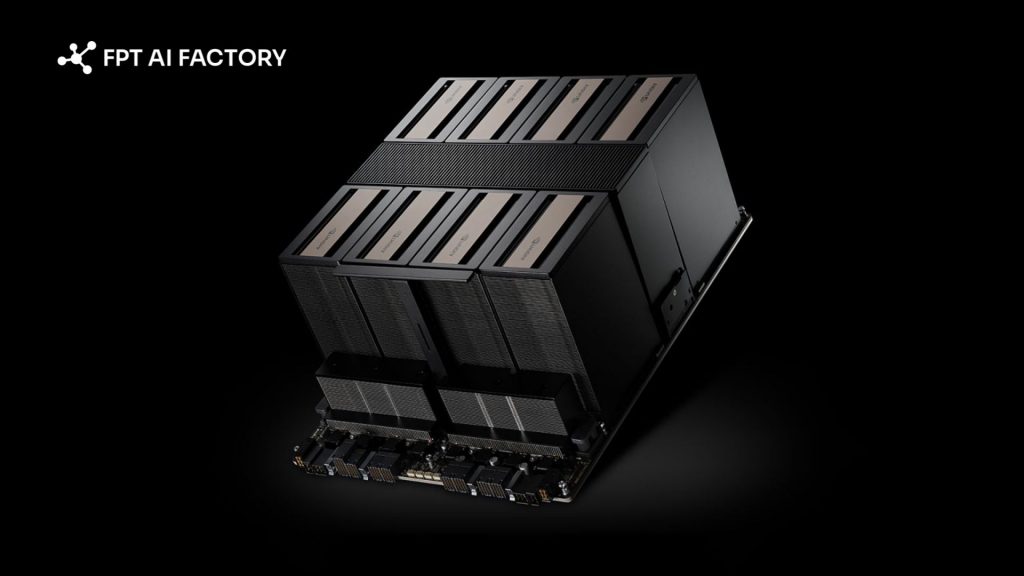
NVIDIA HGX B300 (Source: NVIDIA)
4.5. Ensure data access, governance, and long-term performance
A data infrastructure that cannot be trusted by teams, regulators, or auditors creates more risk than value. Governance frameworks define who can access what data, under what conditions, and with what level of traceability. This includes role-based access controls, data lineage tracking, and audit logging. Equally important are data quality monitoring systems, which continuously validate completeness, consistency, and accuracy across pipelines to catch issues before they reach downstream consumers. Metadata management systems complement this by maintaining a structured record of what data exists, where it originates, how it has been transformed, and who is responsible for it, giving both technical teams and compliance stakeholders a shared, reliable source of context.
Long-term performance also requires ongoing monitoring. As data volumes grow and usage patterns shift, infrastructure components need regular tuning, capacity planning, and in some cases, re-architecture. Investing in observability tooling early makes this significantly more manageable over time.
5. Examples of Data Infrastructure in practice
To make these concepts concrete, here are a few examples of how data infrastructure is implemented across different industries
- E-commerce: A large online retailer ingests clickstream data, transaction records, and inventory updates in real time. Their data infrastructure and analytics system combines a streaming ingestion layer, a cloud-based data lake for raw storage, and a data warehouse for business intelligence dashboards, all built on a scalable big data infrastructure and connected through automated ETL pipelines.
- Healthcare: A hospital network manages patient records, imaging data, and clinical trial datasets. Their infrastructure prioritizes compliance (HIPAA), data residency, and high availability, often using a hybrid model that keeps sensitive records on-premises while leveraging cloud compute for analytics.
- Financial services: A bank processes millions of transactions per day while running fraud detection models in near real-time. Their data infrastructure includes low-latency networking, GPU-accelerated processing for model inference, and strict access controls across all data layers.
- AI-native startups: Companies building LLM-based products require infrastructure that can support large-scale model training, fast data iteration, and flexible deployment. Cloud-based GPU Virtual Machines and managed model serving platforms are common choices in this space.
These examples illustrate that data infrastructure is not a one-size-fits-all solution. The right design reflects the organization’s data strategy, technical maturity, and the specific demands of its applications.
In summary, data infrastructure is the foundation for scaling data and AI effectively, requiring a clear approach to storage, processing, compute, security, and governance. With cloud-native infrastructure and AI platforms from FPT AI Factory, teams can build and scale more efficiently without starting from scratch. You can begin quickly with the Starter Plan from FPT AI Factory, which grants $100 in free credits available immediately after you sign up, so you can log in and start using the platform without any delay. The plan gives you enough capacity to explore and deploy data infrastructure workflows, allowing you to validate your architecture and iterate on real workloads without any initial cost.
If your business or organization is looking for tailored solutions or planning deployment at a larger scale, please reach out to FPT AI Factory via the contact form. Our team will work with you to provide consultation and support aligned with your specific requirements.
Contact Information:
- Hotline: 1900 638 399
- Email: support@fptcloud.com
Explore more articles: