

As large language models become more powerful, optimizing inference has become essential for delivering fast, scalable, and cost-efficient AI applications. Inference optimization helps organizations maximize model performance while making better use of computing resources. In this article, FPT AI Factory helps you understand inference optimization, the techniques behind efficient LLM serving, and the infrastructure required to deploy AI models at scale.
| Key takeaways: LM inference optimization extends beyond improving model speed—it also involves choosing the right serving techniques and infrastructure to maximize production performance.
|
FPT AI Factory provides the tools to build and validate reasoning-capable AI efficiently. With GPU infrastructure, AI Notebook, Model Testing, and Serverless Inference, teams can prototype models, assess outputs, and streamline the path to production. Organizations requiring custom deployments or large-scale infrastructure can contact FPT AI Factory for project-specific solutions.
1. What is Inference optimization?
Inference optimization is the process of improving how trained AI models generate predictions in production environments while minimizing latency, computational cost, and resource consumption. Rather than changing how a model is trained, it focuses on making inference faster and more efficiently through model optimization, serving strategies, and infrastructure improvements. As large language models (LLMs) continue to grow in size, inference optimization has become essential for delivering responsive AI applications at scale.
2. Why AI inference optimization matters
As AI applications handle more users and increasingly complex models, efficient inference becomes critical for maintaining performance and controlling infrastructure costs. Here are some of the key advantages of AI inference optimization:
2.1. Lower latency
Lower latency enables AI models to generate responses more quickly, creating a smoother experience for end users. Optimized inference reduces delays by improving model execution, memory access, and request scheduling. This is especially important for interactive AI applications such as chatbots, code assistants, and real-time recommendation systems. Faster response times also improve application reliability and user satisfaction.
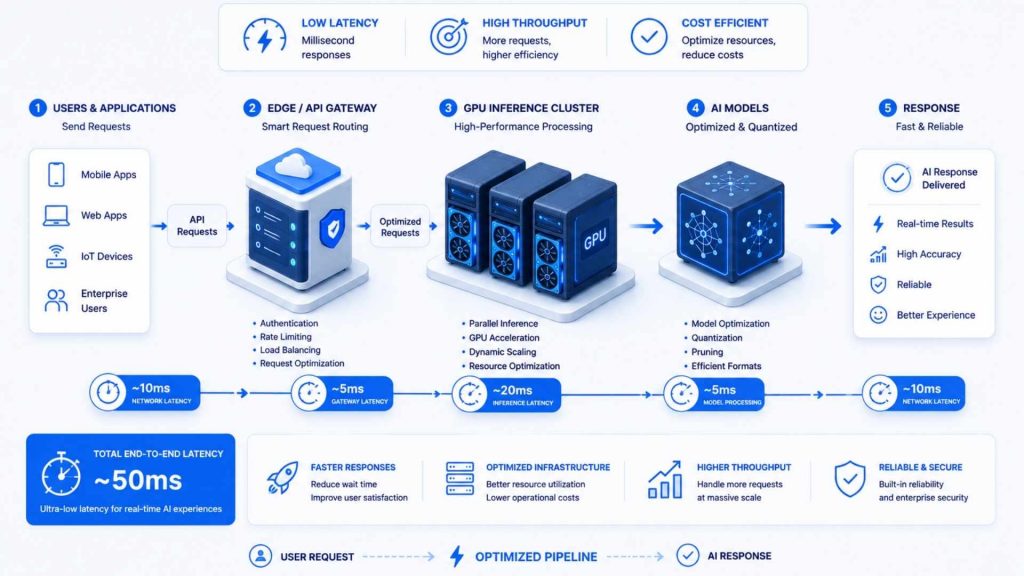
Inference optimization reduces latency for real-time AI applications
2.2. Higher throughput
Higher throughput is essential for production AI services operating at scale. Throughput measures how many inference requests an AI system can process within a given period. Optimized inference increases throughput by improving hardware utilization and serving multiple requests more efficiently. This enables organizations to support larger numbers of concurrent users without proportionally increasing infrastructure resources.
2.3. Lower GPU cost
Inference optimization helps organizations reduce GPU costs by improving hardware efficiency and minimizing unnecessary computational workloads. Techniques such as quantization, batching, and optimized model serving enable more requests to be processed using the same GPU resources. Better resource utilization lowers infrastructure expenses while maintaining consistent AI performance. This makes large-scale LLM deployments more cost-effective.

Optimized inference improves GPU utilization and reduces infrastructure cost
2.4. Better user experience
Users expect AI applications to deliver accurate responses with minimal waiting time. Efficient inference improves responsiveness, reduces interruptions, and provides more consistent application performance during peak demand. This creates a smoother experience across conversational AI, enterprise assistants, and intelligent search applications. Better user experiences also encourage higher adoption and engagement.
2.5. Scalability
As AI applications grow, inference systems must efficiently support increasing traffic without sacrificing performance. Optimization techniques enable organizations to scale AI services by improving resource allocation and maximizing hardware utilization. This allows businesses to handle fluctuating workloads while maintaining stable response times. Scalable inference infrastructure is critical for enterprise AI deployments.

Scalable inference supports growing AI workloads efficiently
2.6. Support real-time AI applications
Many AI applications require immediate responses to support business operations and user interactions. Optimized inference enables low-latency processing for workloads such as conversational AI, intelligent search, fraud detection, and edge AI systems. By reducing processing delays, organizations can deploy AI applications that operate reliably in real time. This capability is increasingly important as enterprises adopt generative AI across customer-facing and operational workflows.
3. Key techniques for inference optimization
After understanding why inference optimization matters, the next step is exploring the techniques that improve LLM inference performance. The table below summarizes common optimization goals and the most suitable techniques.
| Goal | Recommended Techniques |
| Lower latency | Flash Attention, Speculative Decoding |
| Reduce GPU cost | Quantization, Pruning, Continuous Batching |
| Support long context | KV Cache, Flash Attention |
| Handle large models | Tensor Parallelism, Pipeline Parallelism |
| Increase concurrency | Continuous Batching, KV Cache |
| Reduce model size | Quantization, Knowledge Distillation |
| Scale production serving | Efficient Model Serving, Continuous Batching |
The choice of optimization technique depends on the specific inference goal, whether improving speed, reducing cost, or increasing scalability. The following sections explore these key optimization techniques and how they improve LLM inference performance.
3.1. Quantization
Quantization reduces the precision of model weights and activations, such as converting FP32 values to FP16, INT8, or INT4. This significantly lowers memory usage and computational requirements while maintaining acceptable inference accuracy. As a result, AI models can run faster and support more concurrent requests on the same hardware. Quantization is widely used to optimize large language models for production deployment.
3.2. Pruning
Pruning removes redundant or less important model parameters that contribute little to prediction quality. By reducing model complexity, pruning decreases computational overhead and improves inference efficiency. Optimized models also consume less memory and execute more quickly on production hardware. This technique is commonly combined with quantization for greater performance gains.
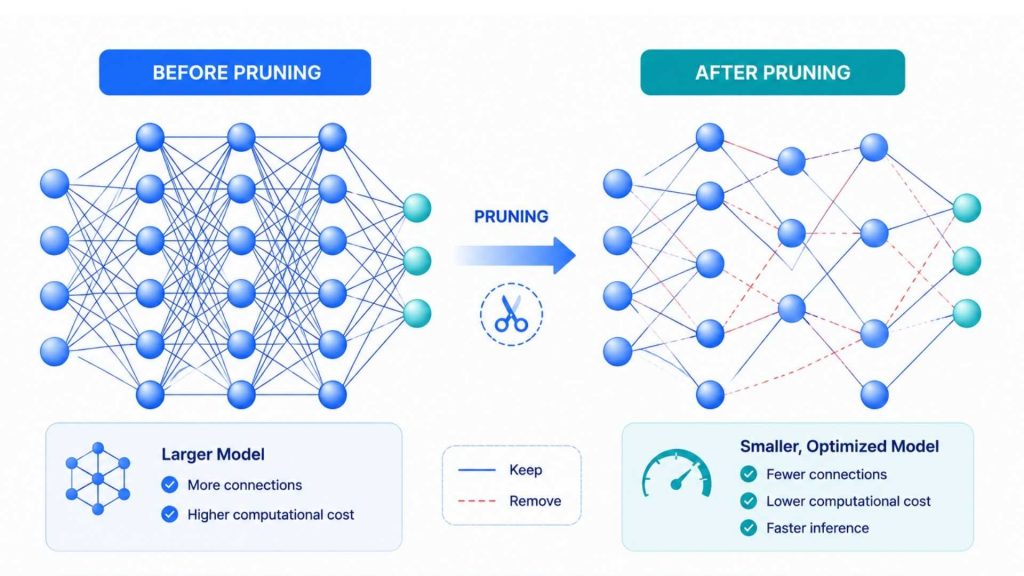
Pruning removes unnecessary model parameters to improve inference efficiency
3.3. Distillation
Knowledge distillation trains a smaller student model to reproduce the behavior of a larger teacher model. The resulting model delivers similar performance while requiring fewer computational resources during inference. Distillation is especially useful for deploying AI models on resource-constrained infrastructure without significantly sacrificing quality. It also helps reduce operational costs for large-scale AI services.
3.4. Flash Attention
Flash Attention is an optimized attention algorithm that reduces memory access and improves GPU utilization during transformer inference. Instead of repeatedly reading and writing intermediate attention matrices, it performs attention computation more efficiently within GPU memory. This significantly accelerates inference for large language models while reducing memory consumption. Flash Attention is widely adopted in modern LLM serving frameworks.
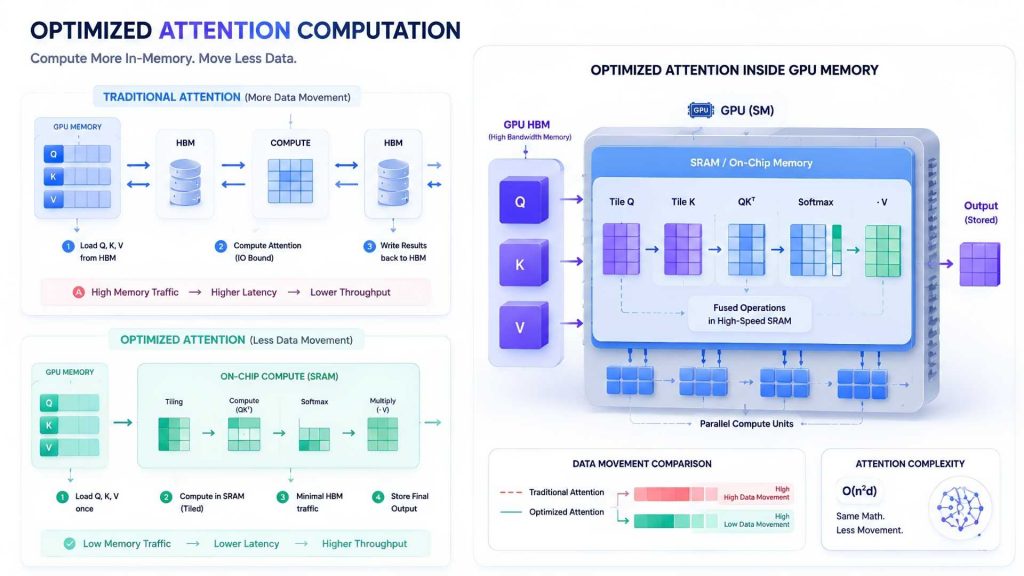
Flash Attention accelerates transformer inference through efficient memory usage
3.5. KV Cache
KV Cache stores previously computed key and value tensors during autoregressive generation, allowing the model to reuse earlier computations instead of recalculating them. This dramatically reduces computation during token generation and lowers inference latency. KV Cache becomes increasingly important as output sequences grow longer. It is one of the core optimization techniques for LLM inference.
3.6. Continuous batching
Continuous batching dynamically groups incoming inference requests so GPU resources remain efficiently utilized. Instead of waiting for entire batches to complete, new requests are continuously added as resources become available. This improves GPU utilization, increases throughput, and reduces idle time during production inference. Continuous batching is widely used in high-performance LLM serving engines such as vLLM.
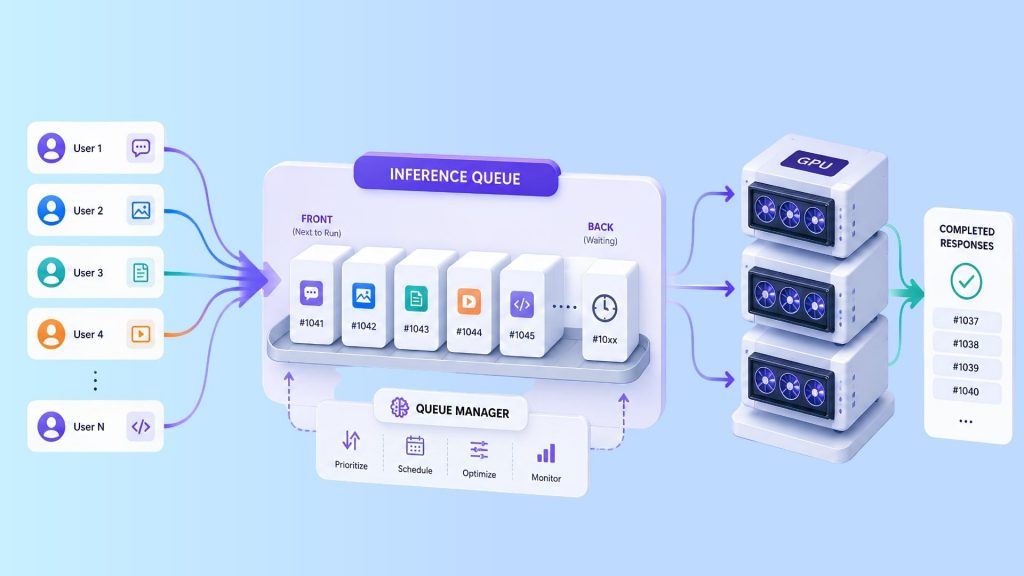
Continuous batching maximizes GPU utilization for LLM serving
3.7. Speculative decoding
Speculative decoding accelerates text generation by using a smaller draft model to predict candidate tokens before verification by a larger language model. The primary model validates multiple predicted tokens simultaneously, reducing overall decoding time. This technique improves inference speed while preserving output quality. It has become an important optimization strategy for serving large language models.
3.8.Tensor/Pipeline parallelism
Large language models often exceed the memory capacity of a single GPU. Tensor parallelism distributes model computations across multiple GPUs, while pipeline parallelism splits model layers into sequential processing stages. Together, these techniques enable inference for very large models while improving scalability and hardware utilization. Multi-GPU parallelism is essential for serving frontier-scale LLMs.
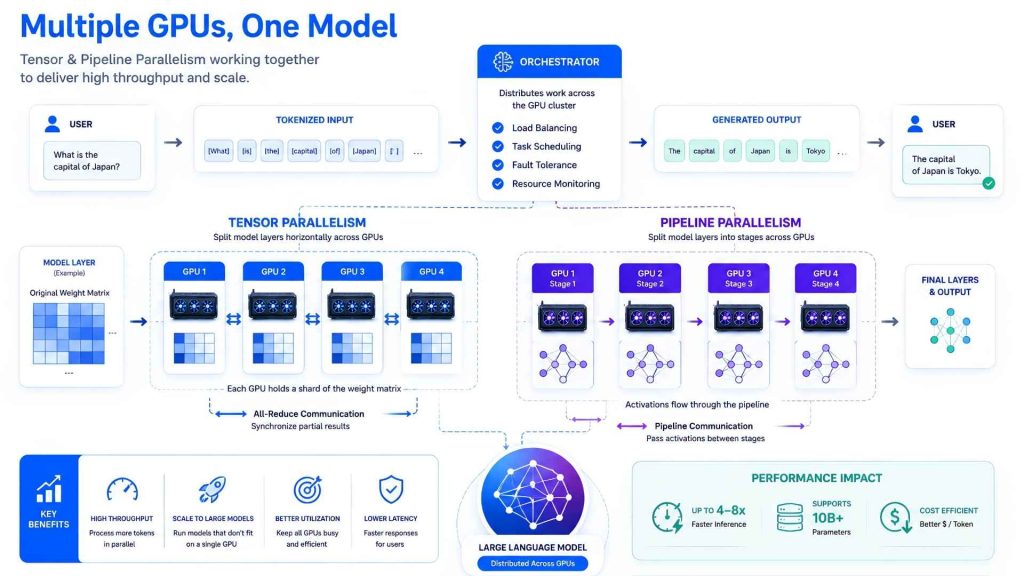
Parallel inference distributes LLM workloads across multiple GPUs
3.9. Efficient model serving
Efficient model serving coordinates optimized hardware, inference engines, request scheduling, and deployment infrastructure to deliver fast and reliable AI responses. Modern serving frameworks combine techniques such as continuous batching, KV Cache, and parallelism to maximize performance. Together, these optimizations enable scalable production inference while controlling infrastructure costs.
4. How LLM inference works
Understanding the inference workflow helps explain why optimization techniques have such a significant impact on performance. During inference, an LLM first processes the input prompt and then generates output tokens one at a time. This illustration shows these phases of how LLM Inference works:
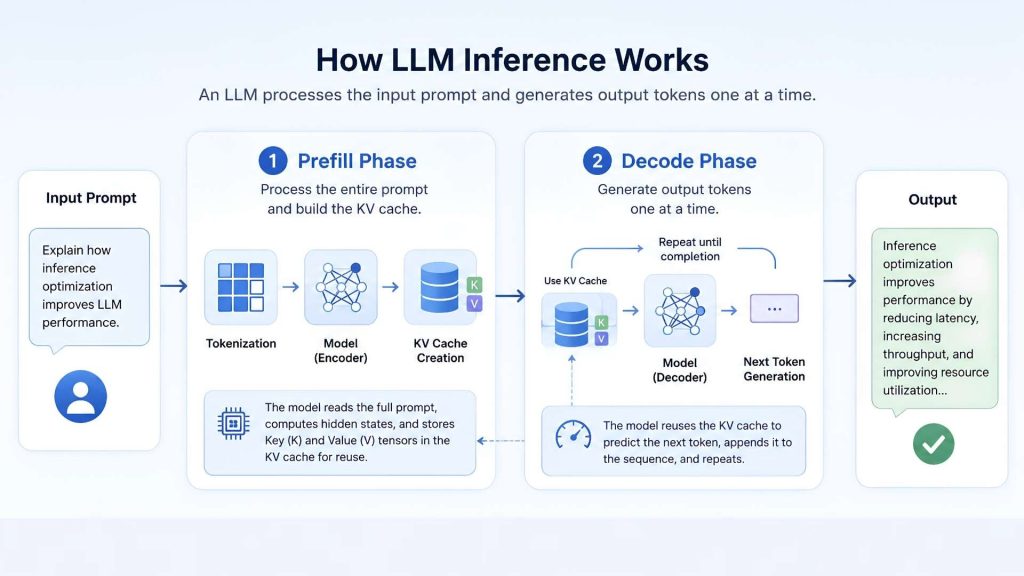
Overview of the LLM inference process, from prompt encoding to sequential token generation
4.1. Prefill phase
The prefill phase processes the entire input prompt and computes the initial hidden states required for text generation. During this stage, the model builds the KV Cache that will be reused throughout the decoding process. Because all prompt tokens are processed simultaneously, prefill is highly compute-intensive and benefits from optimized GPU utilization and efficient attention algorithms. The speed of this phase directly affects the time to first token (TTFT).
4.2. Decode phase
After the prompt has been processed, the decode phase generates one output token at a time until the response is complete. Each decoding step reuses the KV Cache to avoid recomputing previous attention states, significantly improving inference efficiency. Since this phase is repeated for every generated token, optimizing decoding strategies has a major impact on latency and throughput. Techniques such as speculative decoding and continuous batching are commonly applied during this stage.
5. Infrastructure Optimization for LLM Inference
Production AI systems require more than powerful hardware, they also need intelligent workload orchestration, monitoring, and automatic scaling. FPT AI Factory’s Serverless Inference provides a production-ready inference platform that helps organizations deploy AI models efficiently while optimizing resource utilization and maintaining low-latency performance.
For different AI workloads, FPT AI Factory offers flexible GPU infrastructure. GPU Virtual Machine provides flexible compute resources for AI development, experimentation, and model validation. GPU Container delivers an optimized environment for AI training and model fine-tuning with preconfigured software stacks. For large-scale distributed AI projects, GPU Cluster supports high-performance training and inference workloads across multiple GPUs, enabling enterprises to scale efficiently as computational demands grow.
6. Common challenges in AI inference optimization
Although many optimization techniques improve inference efficiency, organizations must also overcome several technical challenges when deploying LLMs in production. Here are certain popular challenges in AI Inference optimization:
6.1. Accuracy vs Performance
Aggressive optimization techniques can improve inference speed but may reduce model accuracy. Organizations must evaluate the trade-offs between latency, memory consumption, and output quality before deploying optimized models. Careful benchmarking helps identify the right balance for different business applications.
6.2. Memory bottlenecks
LLMs consume significant GPU memory, particularly when processing long prompts or serving multiple users simultaneously. Memory limitations can reduce throughput and increase inference latency if resources are not managed efficiently. Techniques such as KV Cache optimization, Flash Attention, and quantization help alleviate these bottlenecks.
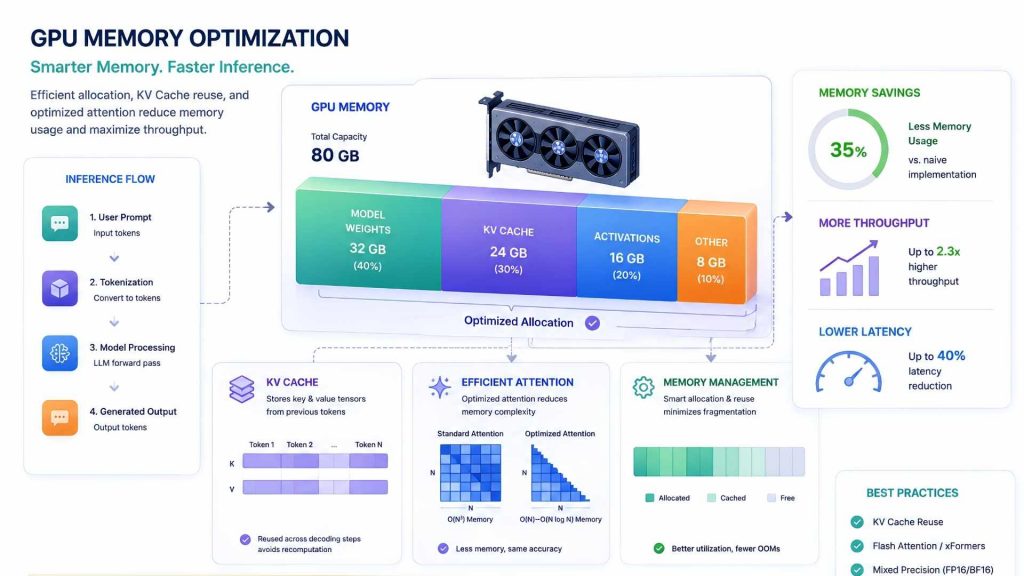
Memory optimization improves LLM inference efficiency
6.3. Long context windows
Supporting long context windows increases memory usage and computational complexity during inference. As input sequences become longer, attention operations require more resources, making optimization increasingly important. Efficient attention algorithms and memory management help maintain performance for context-intensive AI applications.
6.4. Concurrent requests
Production AI services often need to process thousands of simultaneous inference requests. Without efficient request scheduling and resource allocation, response times can quickly degrade during traffic spikes. Continuous batching and scalable inference infrastructure help maintain consistent performance under heavy workloads.
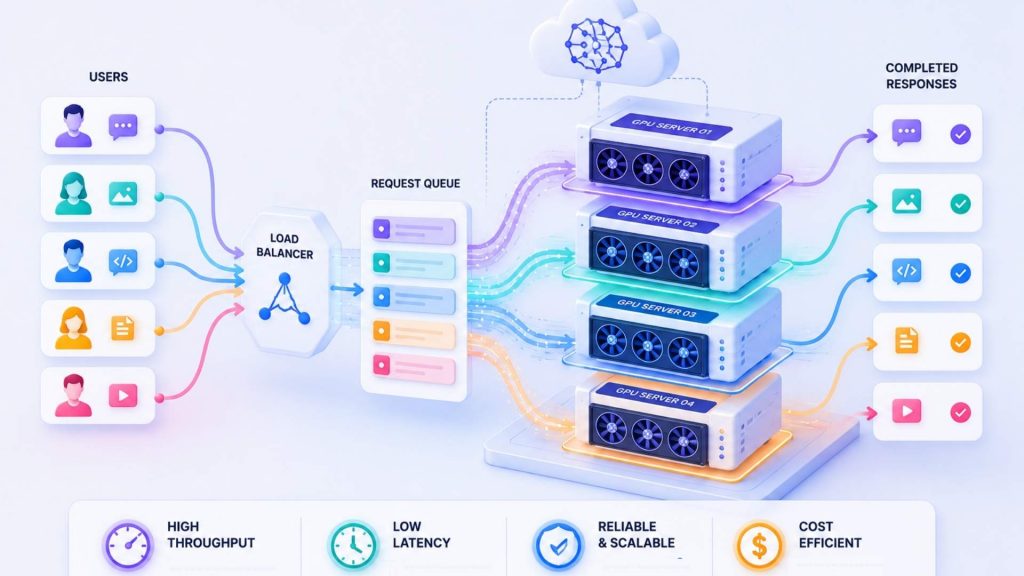
Optimized inference supports high volumes of concurrent AI requests
6.5. Continuous benchmarking
Inference optimization is an ongoing process rather than a one-time task. Organizations should continuously benchmark latency, throughput, GPU utilization, and response quality to identify optimization opportunities as workloads evolve. While optimization techniques improve model efficiency, overall inference performance also depends on the infrastructure running the model, including resource allocation, scalability, and serving efficiency.
FPT AI Factory’s Serverless Inference provides an optimized inference environment that helps enterprises deploy and serve AI models efficiently in production. By combining scalable inference infrastructure with optimized resource management, it improves AI application performance while helping organizations manage computational costs as workloads grow.
7. Best Practices for LLM Inference Optimization
With a clear understanding of the common challenges, the focus now shifts to practical strategies for optimizing LLM inference performance. The following best practices outline key principles for effective LLM inference optimization:
- Benchmark before optimizing: Establish baseline performance metrics such as latency, throughput, and resource usage before making changes. This helps identify actual bottlenecks and measure optimization impact.
- Optimize the largest bottleneck first: Focus on the component that contributes most to inference inefficiency, whether it is memory usage, compute workload, data transfer, or serving architecture.
- Combine quantization with efficient serving: Quantization can reduce model size and accelerate inference, but its benefits are maximized when combined with optimized inference engines, batching strategies, and scalable serving frameworks.
- Continuously monitor TTFT and TPS: Track Time To First Token (TTFT) and Tokens Per Second (TPS) to evaluate user-perceived latency and overall generation speed during production.
- Test model quality after every optimization: Performance improvements should not compromise accuracy. Validate outputs after each optimization step to ensure the model maintains acceptable quality and reliability.
8. FAQs
8.1. What metrics should I monitor for LLM inference optimization?
The most important metrics include latency, throughput, GPU utilization, memory usage, time to first token (TTFT), and tokens per second (TPS). Together, these metrics help evaluate both inference performance and infrastructure efficiency.
8.2. How do I choose between latency and throughput?
The choice depends on the application. Interactive AI assistants prioritize low latency, while large-scale batch processing often focuses on maximizing throughput. Many production systems balance both using optimized serving strategies.
8.3. How to optimize LLM inference speed?
Organizations typically combine model optimization techniques such as quantization and KV Cache with efficient serving frameworks and scalable GPU infrastructure. Optimizing both the model and the inference platform delivers the best production performance.
Inference optimization is essential for delivering fast, scalable, and cost-efficient AI applications in production. Combining model optimization techniques with efficient serving strategies and modern GPU infrastructure enables organizations to improve latency, throughput, and resource utilization. For enterprises with large-scale AI deployments or customized infrastructure requirements, FPT AI Factory provides tailored solutions to support modern AI workloads. Contact through the official form more detailed consultation.
Contact Information:
- Hotline: 1900 638 399
- Email: support@fptcloud.com
Explore Related Articles: