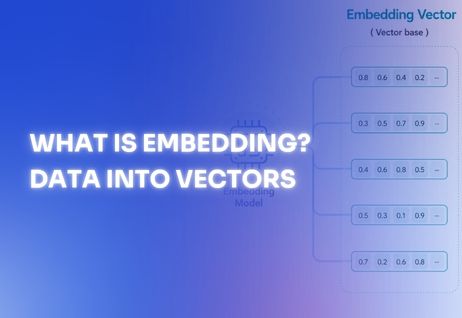

What is semantic search? Semantic search is an AI-powered search approach that understands the meaning, context, and intent behind a query instead of relying only on exact keywords. In this article, FPT AI Factory explains how semantic search works, how it differs from keyword search, and why it matters for modern business applications.
Build intent-aware AI applications with FPT AI Factory. Teams can use AI Notebook to prototype embedding workflows, GPU Container to run reproducible development environments, and Serverless Inference to integrate AI models through APIs. For customized semantic search or large-scale AI infrastructure needs, contact FPT AI Factory for project-based consultation.
|
Key takeaways: Semantic search helps AI systems return results based on meaning, not only exact words. Here are the key points to remember:
|
1. What Is Semantic Search?
1.1. Definition
Semantic search is a search method that tries to understand the meaning behind a query rather than matching only the exact words typed by the user. Google Cloud defines semantic search as a data searching technique focused on contextual meaning and user intent. This makes it useful when users search with natural language, incomplete phrases, synonyms, or business-specific terms.
In a business setting, semantic search can help employees find policies, tickets, product documents, research files, or customer records even when they do not know the exact title or keyword. It is also a foundation for AI applications that need retrieval, such as internal copilots, document assistants, and question-answering systems.
1.2. Difference between keyword search and semantic search
Keyword search looks for exact terms or close lexical matches. Semantic search looks for meaning, relationships, and intent. After understanding how semantic search differs from keyword-based methods, let’s examine the technical process it uses to interpret queries and retrieve relevant results.
| Criteria | Keyword search | Semantic search |
| Matching method | Matches exact words or close lexical variants. | Matches meaning, context, and related concepts. |
| Query understanding | Limited when users use synonyms or unclear wording. | Better at interpreting user intent and natural language. |
| Best fit | Simple site search, filters, structured catalogs. | Knowledge search, chatbots, document retrieval, recommendations. |
| AI capability | Usually lower; may not require embeddings. | Often uses NLP, embeddings, and similarity search. |
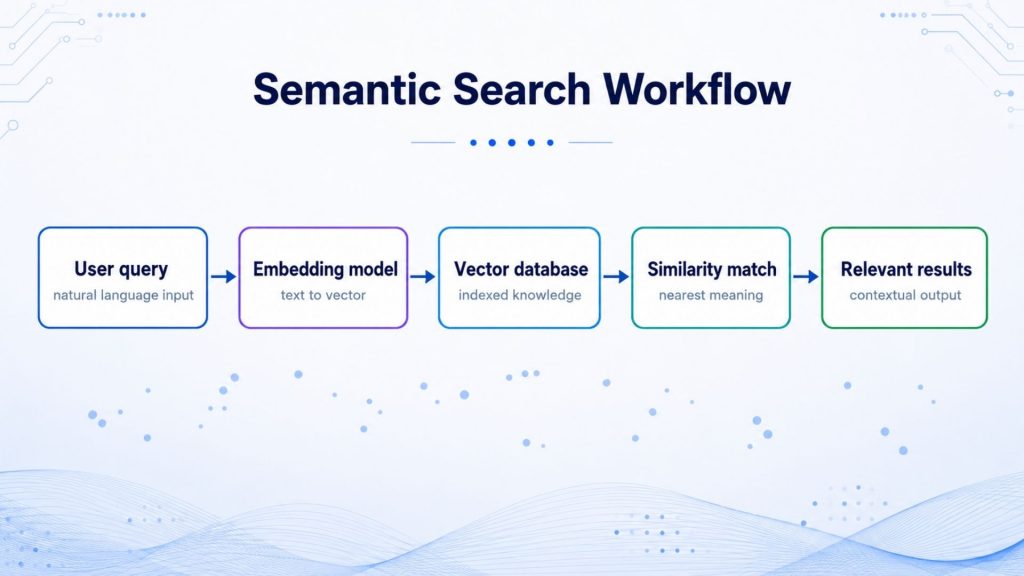
Semantic search converts user intent into vector-based retrieval steps.
2. How Semantic Search Works
Semantic search usually follows a pipeline: convert text into embeddings, represent documents and queries as vectors, compare vector similarity, and retrieve the most relevant results. Microsoft explains that embeddings are information-dense vector representations where distance in vector space is correlated with semantic similarity.
2.1. Query Understanding
The system first analyzes the user query to identify meaning, context, entities, and intent. This step helps semantic search understand whether a user is asking for a definition, a comparison, a troubleshooting answer, or a specific business document.
2.2. Embedding Generation
An embedding model then converts the query and stored content into numeric representations that preserve semantic meaning. For example, two sentences that use different words but describe the same business problem can still end up close together in vector space.
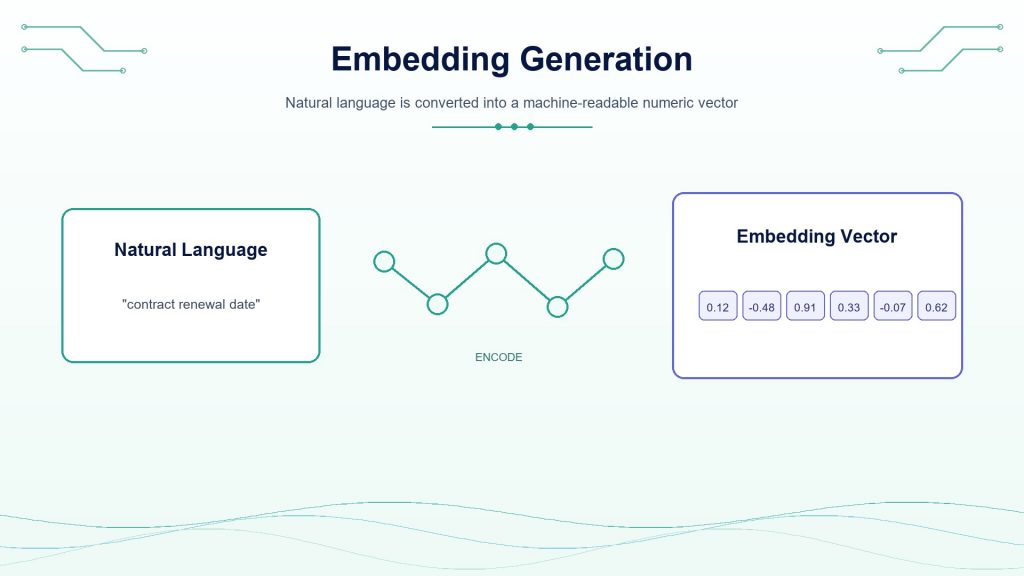
Embedding generation converts natural language into numeric vectors that machines can compare.
2.3. Vector Representation
After embeddings are generated, each query or document becomes a vector in a high-dimensional space. These vectors make it possible to compare meaning mathematically and store searchable representations of large text collections.
2.4. Similarity Search
Similarity search compares the query vector with document vectors to find the closest matches. Common approaches include cosine similarity and approximate nearest neighbor search, which help return content that is semantically related even when exact terms do not appear in the document.
2.5. Ranking & Retrieval
The retrieval layer ranks, filters, and returns the most relevant results to the user or passes them into another AI system. In retrieval-augmented generation, semantic search can retrieve relevant documents and provide context to a language model before it generates an answer. Once the semantic search workflow is clear, the next step is to examine the core components that support embedding, storage, similarity matching, and retrieval.
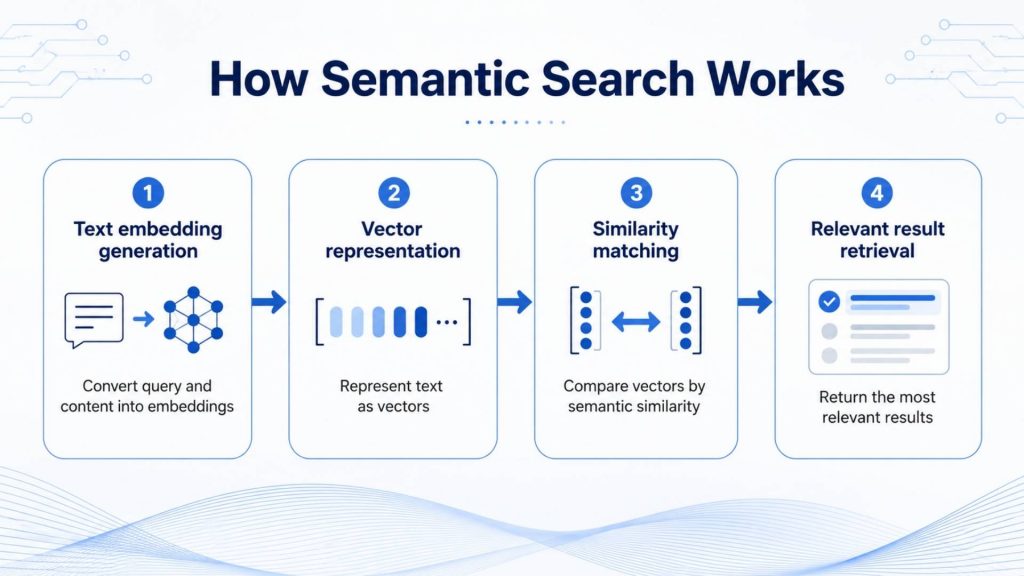
Semantic search converts text into embeddings, represents it as vectors, compares semantic similarity, and retrieves the most relevant results.
3. Core Components of a Semantic Search System
A semantic search system combines model, storage, retrieval, and application layers. Each component has a clear role in turning unstructured text into searchable business knowledge. Once these components are connected, teams can build search assistants, chatbots, and analytics workflows on top of the same retrieval foundation.
3.1. Embedding Models
Embedding models encode words, sentences, documents, or queries into vectors. The quality of the embedding model affects how well the system understands industry terms, acronyms, product names, and multilingual content. For enterprise use, teams should test whether the embedding model performs well on real internal data before deployment.
3.2. Vector Database
A vector database stores embeddings and supports fast similarity search. It also needs indexing, metadata filtering, update workflows, and access control. For businesses handling large document collections, a vector database can make unstructured data easier to search and connect with AI applications.
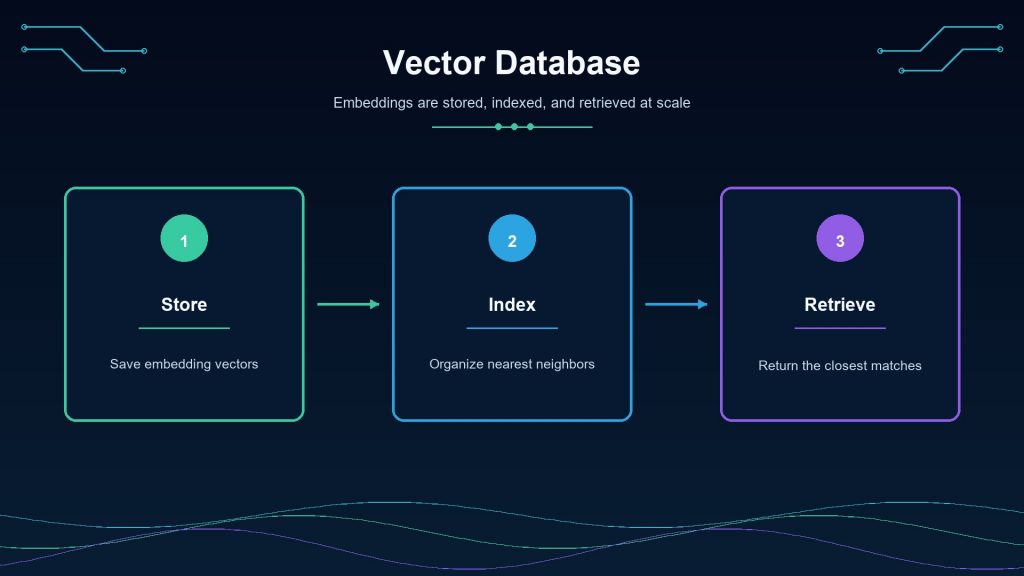
A vector database stores, indexes, and retrieves embeddings for semantic search at scale.
3.3. Similarity Search Algorithms
Similarity search algorithms identify which vectors are closest to the query vector. Exact search may be useful for small datasets, while approximate nearest neighbor search is often used for larger systems where speed matters. The right choice depends on dataset size, latency requirements, and retrieval quality expectations.
3.4. Retrieval Layer
The retrieval layer organizes how results are returned, filtered, reranked, and connected to downstream applications. In enterprise systems, this layer may also enforce permissions so that users only see documents they are allowed to access. When results are served through an application, AI inference becomes the stage where retrieved context is turned into useful outputs. After examining the components of a semantic search system, let’s compare semantic search with other common search methods to clarify their differences.
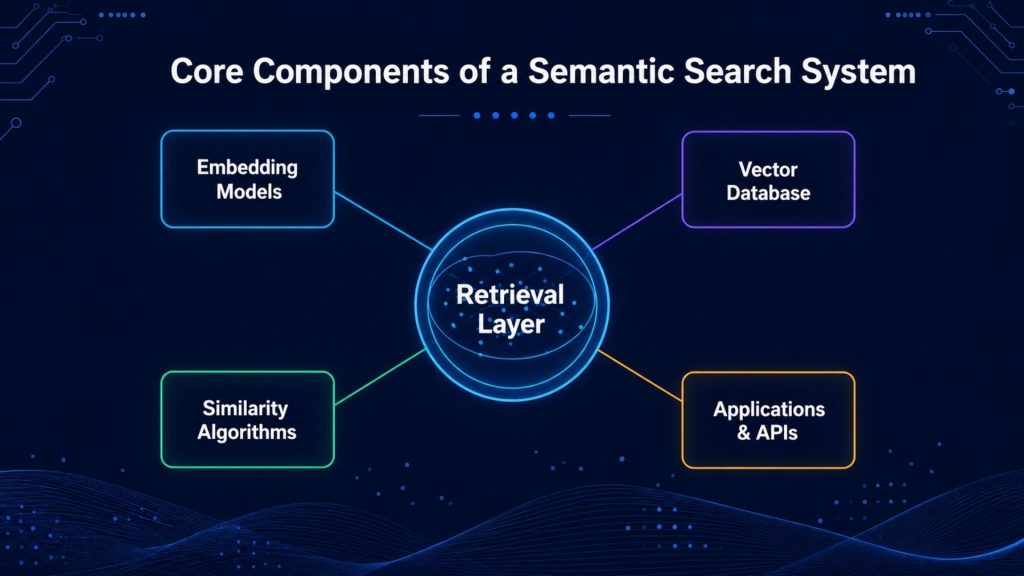
A semantic search system connects embeddings, vector storage, similarity search, and retrieval.
4. Semantic Search vs Other Search Methods
Semantic search is related to keyword, lexical, contextual, and vector search, but it is not identical to all of them. The table below summarizes how these search methods differ by matching method, understanding, user intent, and AI capability.
| Method | Matching method | Understanding | User intent | AI capability |
| Keyword search | Exact words | Low to medium | Limited | Low |
| Lexical search | Literal terms and variants | Medium | Limited | Low to medium |
| Contextual search | Query plus user context | Medium to high | Moderate | Medium |
| Vector search | Embedding similarity | High for semantic proximity | Moderate to high | High |
| Semantic search | Meaning, context, and relationships | High | High | High |
Vector search is often one technical method used inside semantic search. However, semantic search is broader because it also considers intent, relationships, entities, context, ranking logic, and user experience. After comparing these search methods, let’s explore how semantic search is applied across real-world business workflows.
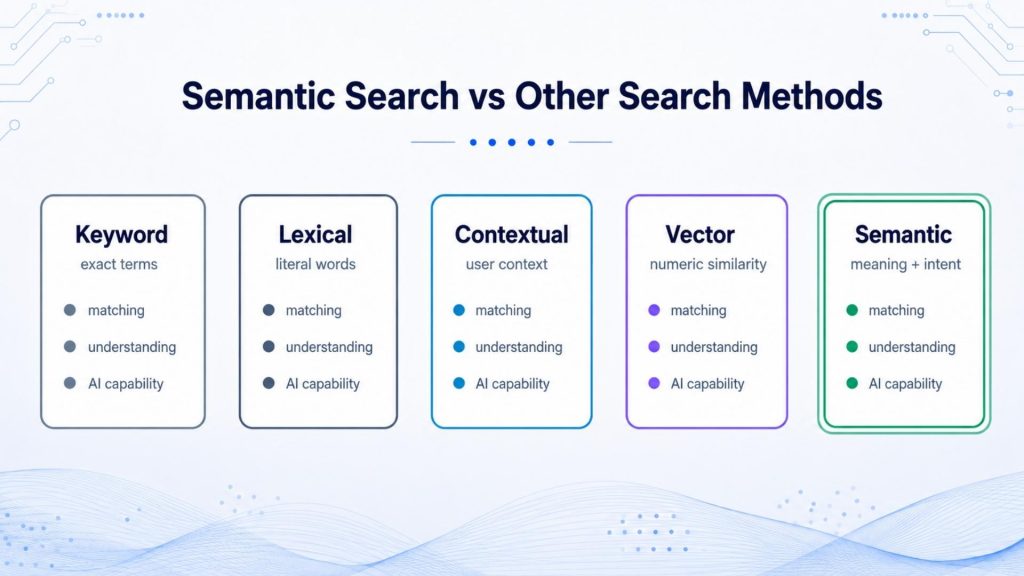
Semantic search focuses on meaning and intent, while other methods may focus on terms, context, or vector similarity.
5. Technologies Behind Semantic Search
Semantic search depends on several AI and data infrastructure technologies working together. These technologies help the system understand language, encode meaning, store vectors, and retrieve relevant results quickly.
5.1. Natural Language Processing
Natural language processing helps the system interpret query wording, entities, relationships, and context. It supports search experiences where users can ask natural questions instead of typing exact keywords.
5.2. Transformer Models
Transformer models improve semantic understanding by reading words in context. This makes them useful for interpreting long queries, ambiguous terms, domain-specific language, and sentences where meaning depends on surrounding words.
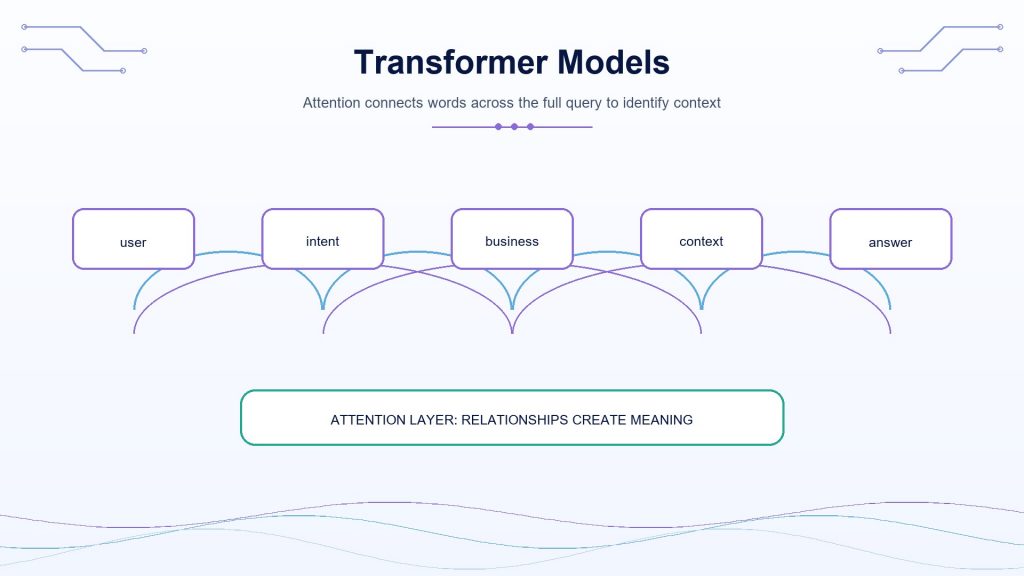
Transformer models use attention mechanisms to understand relationships between words across a full query.
5.3. Embeddings
Embeddings convert text into vectors that capture semantic relationships. They allow the system to compare a user query with documents, FAQs, product descriptions, or knowledge base articles based on meaning.
5.4. Vector Database
A vector database stores embeddings and supports fast retrieval with metadata filters, indexes, and update workflows. This is important when businesses need to search across large document collections or frequently changing knowledge sources.
5.5. ANN Search
Approximate nearest neighbor search helps systems find similar vectors quickly without comparing every record one by one. This improves latency when semantic search runs across large-scale enterprise datasets.
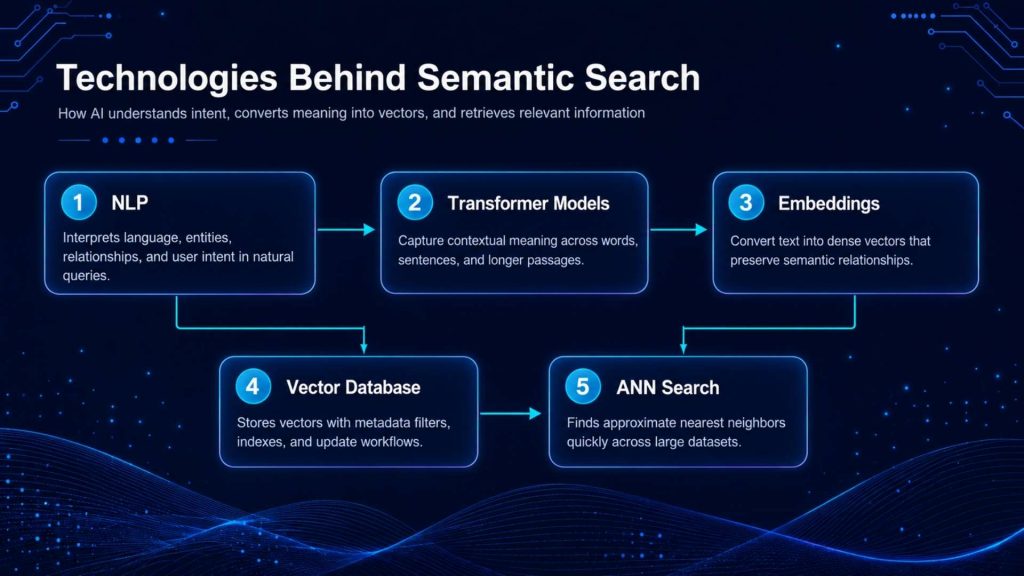
Technologies behind semantic search include NLP, transformer models, embeddings, vector databases, and ANN search.
6. Semantic Search Use Cases
Semantic search is most valuable when users need to find information across messy, unstructured, or fast-growing data. These use cases show how meaning-based retrieval supports enterprise productivity, AI assistants, recommendations, and document workflows.
6.1. Enterprise knowledge search
Enterprise data is often scattered across PDFs, wikis, chat logs, tickets, and shared drives. McKinsey research has been widely cited for showing that employees can spend around 1.8 hours per day searching and gathering information. Semantic search helps reduce this friction by allowing employees to ask natural questions and retrieve related knowledge even when filenames or keywords do not match exactly.
6.2. AI chatbot
Semantic search is also a key retrieval layer for AI chatbots. Instead of answering only from model memory, a chatbot can retrieve relevant internal documents and use them as context. FPT AI Factory describes retrieval systems as a way for LLMs to access up-to-date and domain-specific knowledge, which is important for enterprise chatbots that must answer with company-approved information.
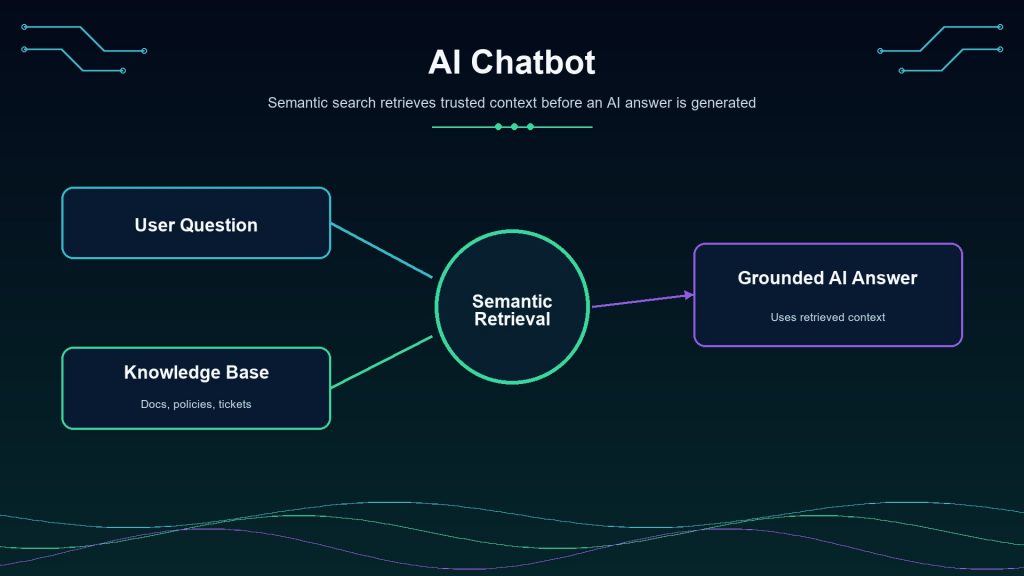
Semantic search helps AI chatbots retrieve trusted context before generating grounded answers.
6.3. Recommendation systems
Recommendation systems can use semantic search to match users with products, articles, courses, videos, or support materials based on meaning. For example, a user searching for “low-latency model deployment” may be shown content about real-time inference, model serving, and API deployment even if those exact words are not all present. This improves discovery when catalogs contain many similar items.
6.4. Document retrieval
Legal, finance, insurance, and operations teams often need to retrieve clauses, policies, invoices, or reports by meaning. Semantic search can find documents that discuss the same concept using different wording. For example, a query about “payment delay penalties” could retrieve contract sections about late fees, overdue invoices, or breach terms. After reviewing these practical use cases, let’s examine why semantic search is increasingly important for business performance and user experience.
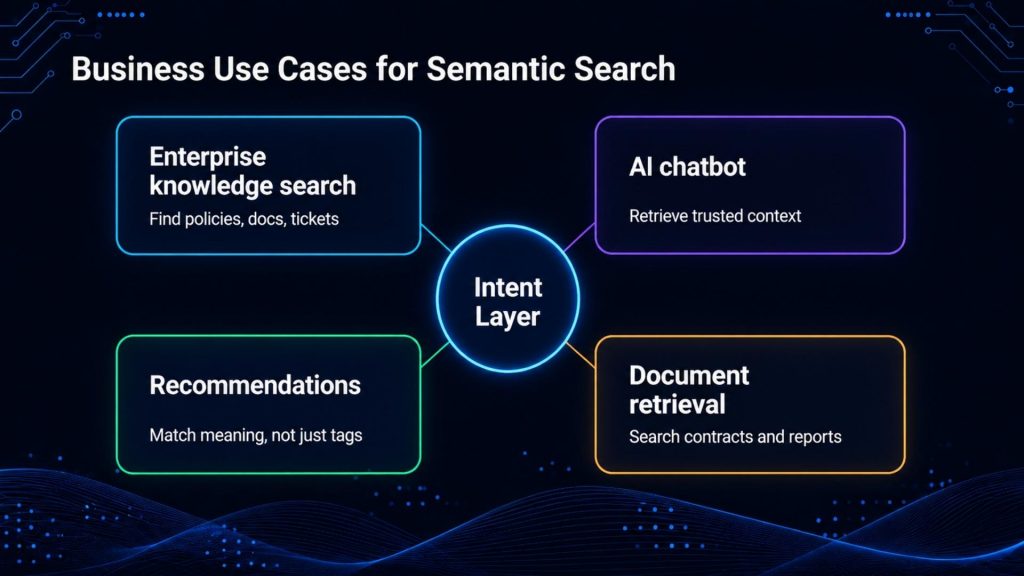
Semantic search supports enterprise knowledge search, AI chatbot, recommendations, and document retrieval.
7. Why Is Semantic Search Important for Businesses?
7.1. Improved relevance
Traditional search cannot always understand context, especially when users ask vague, conversational, or domain-specific questions. Semantic search improves relevance by analyzing meaning rather than only counting matching terms. Google has also used models such as BERT to better understand the intent behind search queries, showing how important context has become in modern search.
7.2. Enhanced user experience
By helping users find relevant information with natural-language queries, semantic search reduces search friction and makes enterprise knowledge easier to access.
Enterprise data is difficult to access when documents are fragmented across systems. To build AI applications with semantic retrieval, businesses need a development environment that connects data, models, and processing workflows. AI Notebook can help teams experiment with retrieval pipelines, while GPU Container supports reproducible AI development environments.
FPT AI Factory also supports teams with GPU infrastructure and AI development services across Japan and Vietnam, with Malaysia planned. This regional presence can help organizations in Asia consider latency, support, and deployment location when building semantic search or AI retrieval systems.
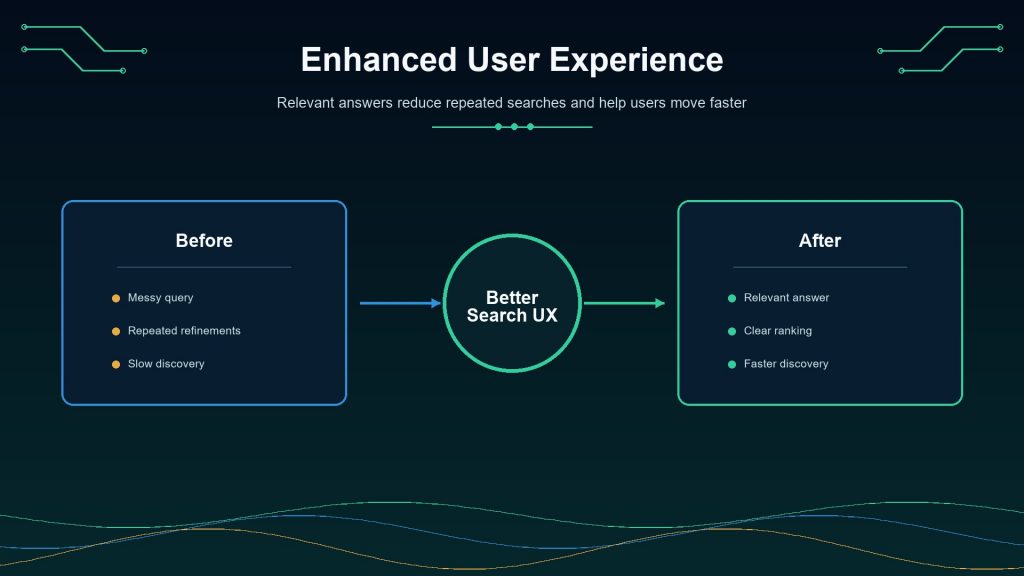
Semantic search improves user experience by helping users find relevant answers faster with fewer repeated searches.
7.3. Increased engagement
When users receive relevant results faster, they are more likely to continue using the search experience. In customer-facing applications, this can improve product discovery, support deflection, and content engagement. In internal tools, it can help employees trust the system and use it as a daily knowledge layer rather than a last resort.
With the main business benefits now clear, let’s address the most common questions about how semantic search is used in modern AI systems.
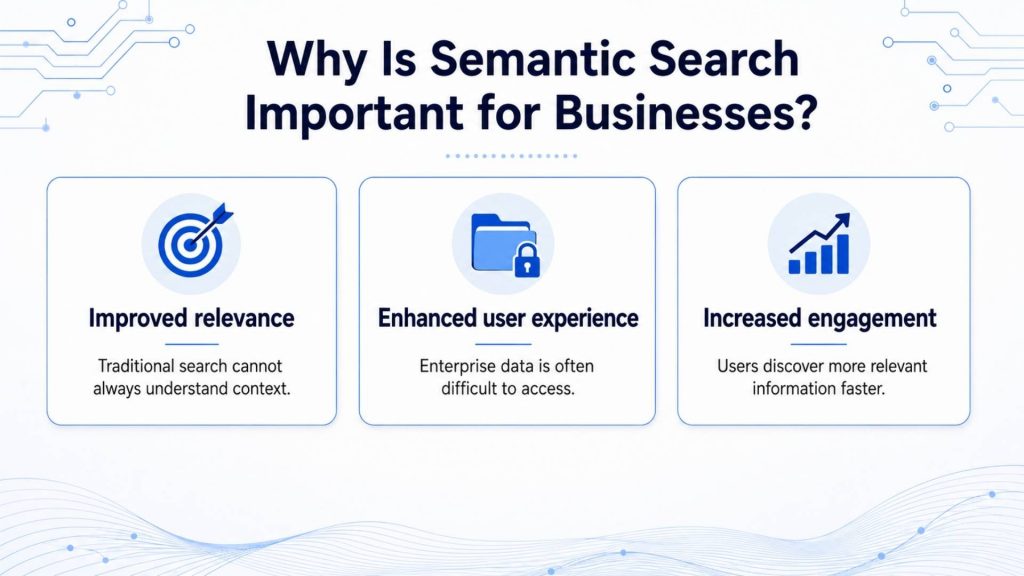
Semantic search helps businesses improve result relevance, enhance user experience, and increase engagement.
8. FAQs
8.1. Is Google a semantic search?
Google Search uses many systems, and semantic understanding is one important part of how it interprets queries. Google has publicly discussed using BERT to understand words in context, especially for intent behind search queries. So while Google is not only semantic search, semantic understanding is part of modern Google Search.
8.2. Does ChatGPT use semantic search?
ChatGPT itself is a language model, but applications built with language models may use semantic search when connected to external documents, vector databases, or retrieval-augmented generation workflows. In those systems, semantic search helps retrieve relevant context before the model generates an answer.
Semantic search helps businesses move from exact-word matching to meaning-based retrieval. It improves search relevance, supports AI chatbots, enables document retrieval, and helps users find information even when they do not know the exact keywords. For enterprises, the main challenge is not only building the search model, but also connecting data, embeddings, vector storage, retrieval logic, governance, and deployment infrastructure.
8.3. Does semantic search require embeddings?
Most modern semantic search systems use embeddings because embeddings turn text into vectors that can be compared by meaning. Some systems may combine embeddings with keyword, metadata, or reranking methods, but embeddings are usually the foundation for intent-aware semantic retrieval.
8.4. What is semantic search in AI?
Semantic search in AI is a meaning-based search approach that uses language models, embeddings, vector representations, and ranking logic to understand user intent and retrieve relevant information. It is commonly used in AI chatbots, RAG systems, enterprise search, and recommendation workflows.
With FPT AI Factory, businesses can prototype semantic search workflows with AI Notebook, run development workloads with GPU Container, integrate models through Serverless Inference, and plan scalable capacity with GPU Virtual Machine. For project-specific semantic search or enterprise AI deployment needs, contact the FPT AI Factory team through the official contact form.
Contact Information:
- Hotline: 1900 638 399
- Email: support@fptcloud.com
Explore Related Articles:
What Are Vector Databases? How Does It Work and Use Cases