

As AI models become larger and datasets grow more complex, traditional sequential computing often struggles to meet the performance demands of modern workloads. Organizations are increasingly adopting parallel computing to accelerate data processing, shorten AI model training times, and efficiently scale compute-intensive applications. In this article, FPT AI Factory helps you understand: “What is parallel computing?”, how it works, why it matters for AI and high-performance computing.
|
Key takeaways: Parallel computing is a foundational technology behind today’s AI and high-performance computing systems. Here are the key takeaways to help you quickly understand its core concepts and business value:
|
FPT AI Factory helps organizations build, test, and deploy AI models with an integrated development platform. Supported by GPU infrastructure, AI Notebook, Model Testing, and Serverless Inference, teams can accelerate AI development while improving model quality and deployment efficiency. For custom AI projects or enterprise-scale infrastructure, contact FPT AI Factory for tailored solutions.
1. What Is Parallel Computing?
Parallel computing is a computing approach that divides a large problem into smaller tasks and processes them simultaneously across multiple processors, CPU cores, GPUs, or computing nodes. Instead of executing operations one after another, the system performs many calculations at the same time, significantly reducing total execution time. This approach is widely used in artificial intelligence, big data analytics, scientific research, and high-performance computing environments where massive workloads must be completed quickly.

Parallel computing accelerates complex workloads by processing many tasks simultaneously across multiple processors
2. Why Parallel Computing Matters
As data volumes and computational demands continue to grow, organizations need faster ways to process information and train AI models. Parallel computing has become essential because it allows many operations to run concurrently instead of waiting for a single processor to finish each step sequentially. Here are some key reasons why parallel computing matters:
2.1. AI workloads
Artificial intelligence workloads often involve training models on billions of parameters and processing enormous datasets. Parallel computing allows these computations to be distributed across many GPUs or compute nodes so that training can occur simultaneously rather than sequentially. This significantly reduces training time and enables organizations to iterate on models faster. In enterprise AI environments, parallel processing is essential for large language models, computer vision systems, recommendation engines, and generative AI applications. To explore how GPUs power these workloads in practice, read our guide on Top 5 GPU Use Cases for Generative AI and LLMs.
2.2. Big data
Big data platforms must analyze terabytes or petabytes of information from transactions, sensors, logs, and digital services. Parallel computing enables data processing frameworks to split datasets into partitions and process them concurrently across multiple machines. This approach improves throughput and reduces the time needed for analytics, reporting, and machine learning pipelines. Hence, businesses can generate insights more quickly and respond to changing conditions with greater agility.

Parallel data processing helps organizations analyze massive datasets at high speed
2.3. Scientific computing
Scientific computing frequently requires simulations and calculations that would take impractically long on a single processor. Researchers use parallel computing to run climate models, molecular simulations, physics calculations, and engineering analyses across thousands of processing units simultaneously. This allows larger and more accurate simulations to be completed within practical timeframes.
3. How Parallel Computing Works
Parallel computing improves performance by dividing a complex problem into smaller tasks that can be executed simultaneously. Instead of relying on a single processor to complete every operation in sequence, the workload is distributed across multiple processing units, allowing computations to occur concurrently. The following diagram shows how parallel computing works:
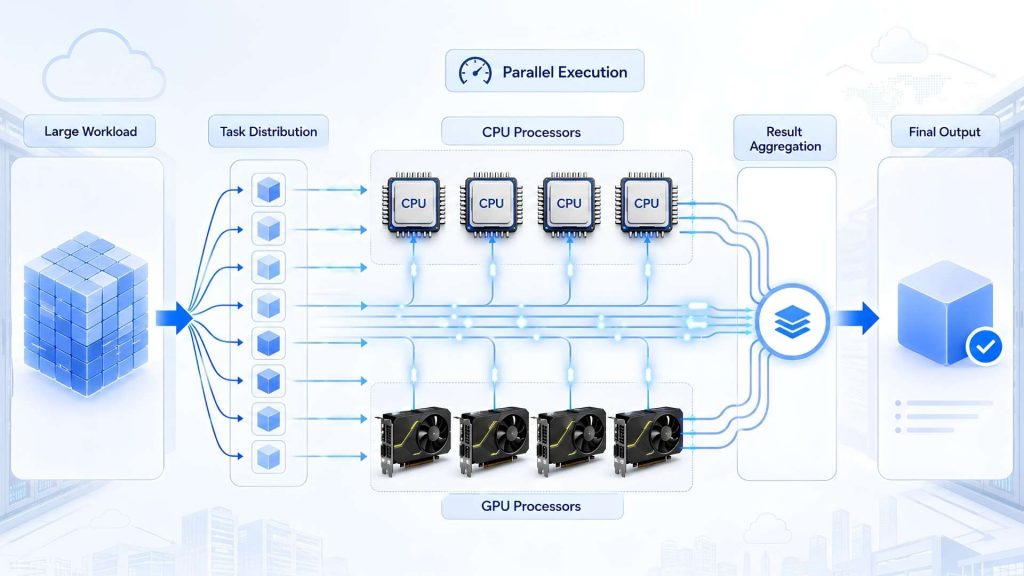
Parallel computing distributes workloads across multiple processors before combining the results into a single output
3.1 Task distribution
The first step in parallel computing is dividing a large computational problem into multiple independent or partially independent tasks. Each task is assigned to a separate processor, CPU core, GPU, or compute node, enabling many calculations to begin at the same time. Effective task distribution also balances the workload across available resources, preventing individual processors from becoming overloaded while others remain idle.
3.2 Multiple processors execution
Once the workload has been divided, multiple processors execute their assigned tasks simultaneously. Depending on the computing architecture, these processors may include multicore CPUs, GPUs with thousands of parallel cores, or distributed computing nodes connected through a high-speed network. Because many operations occur concurrently, large datasets and complex algorithms can be processed much faster than with sequential computing.
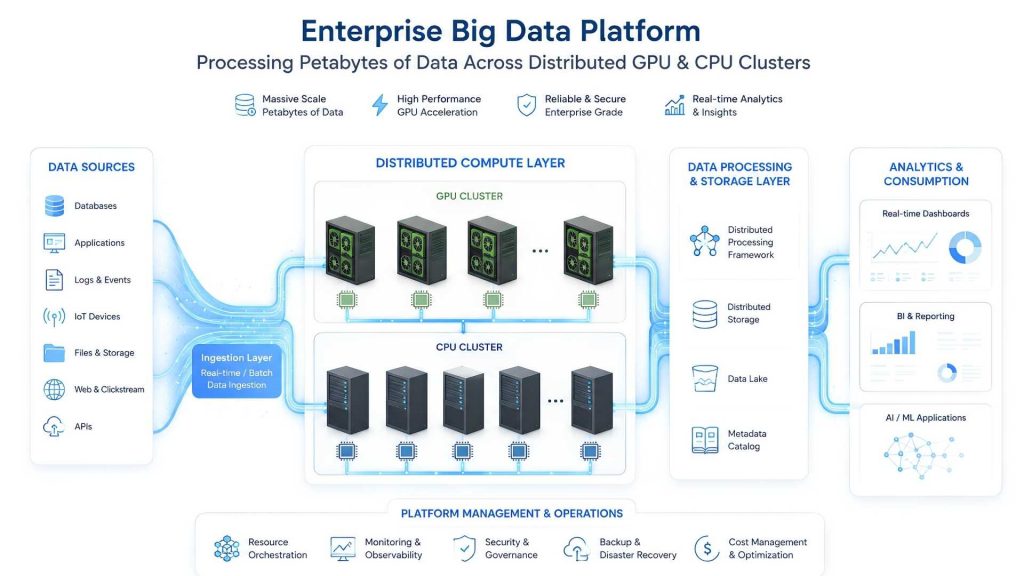
Multiple processors execute independent tasks simultaneously to accelerate AI and data-intensive workloads
3.3 Result aggregation
After every processor completes its assigned task, the system gathers and combines the intermediate outputs into a single final result. This aggregation stage ensures that all parallel computations remain synchronized and produce accurate, consistent outcomes. As AI workloads continue to scale, optimizing this final step becomes increasingly important for maximizing overall system efficiency.
4. Parallel Computing Architectures
Parallel computing architecture defines how multiple processing units work together to execute tasks simultaneously. Three common architectures in HPC include shared-memory architecture, distributed-memory architecture, and GPU architecture. The diagram below illustrates the main parallel computing architectures used in HPC environments.
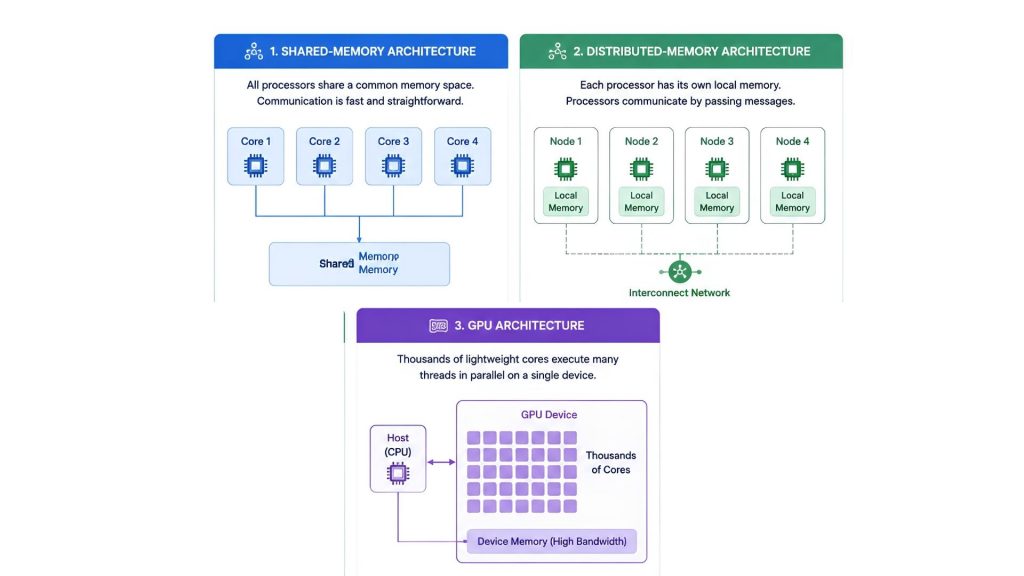
Different architectures enable parallel execution by coordinating CPUs, computing nodes, and GPU cores
4.1 Shared-memory architecture
In shared-memory architecture, multiple CPU cores execute tasks in parallel while accessing the same memory space. This allows processors to quickly exchange data through shared variables.
Parallel characteristics:
- Multiple cores process different parts of a workload simultaneously.
- Data sharing is fast because all processors access the same memory.
- Scalability is limited when many cores compete for memory resources.
4.2 Distributed-memory architecture
In distributed-memory architecture, parallel computation is achieved by connecting multiple independent nodes. Each node has its own processor and memory, and they communicate by exchanging messages.
Parallel characteristics:
- Workloads are divided across multiple machines.
- Each node processes a portion of the task simultaneously.
- Supports large-scale parallel computing with thousands of processors.
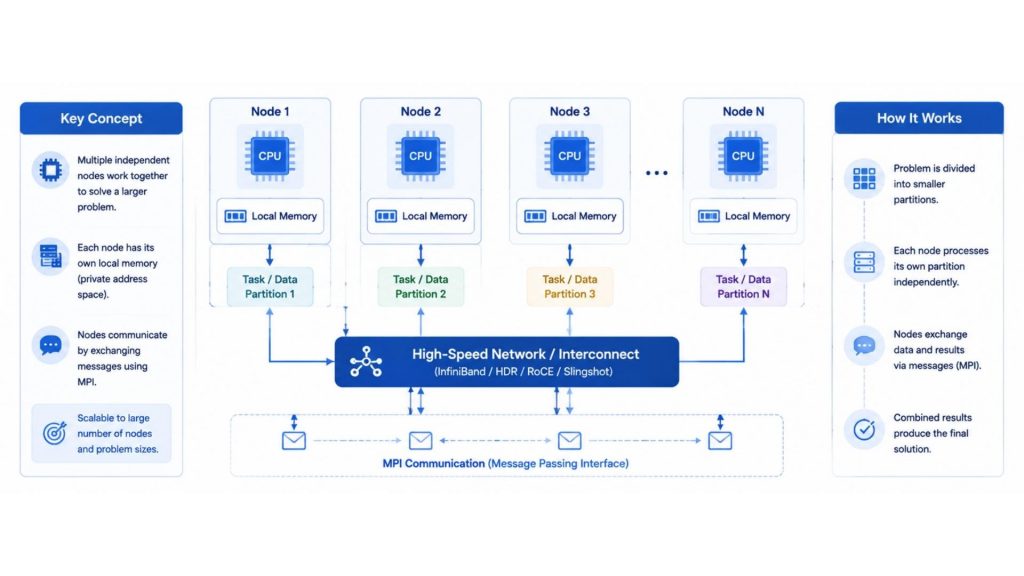
Distributed-Memory Architecture in Parallel Computing
4.3 GPU architecture
GPU architecture enables massive parallel processing by using thousands of small processing cores to execute many similar operations simultaneously.
Parallel characteristics:
- Large numbers of threads run concurrently.
- Highly efficient for repetitive mathematical operations.
- Accelerates compute-intensive workloads such as AI and simulations.
5. Why Parallel Computing Matters for AI
As AI models continue to increase in size and complexity, sequential computing becomes a bottleneck that limits training speed and overall performance. Parallel computing overcomes this challenge by distributing AI workloads across multiple CPUs, GPUs, or compute nodes, enabling faster computation and more efficient resource utilization. Here are critical reasons why parallel computing matters for AI:
5.1. Model training
Training modern AI models involves repeatedly processing massive datasets while updating billions of parameters through countless mathematical operations. Parallel computing distributes these computations across multiple GPUs or computing nodes, allowing many calculations to occur simultaneously instead of sequentially. For large language models and other foundation models, parallel computing is essential for completing training within practical timeframes.
5.2. Large data processing
AI systems rely on enormous datasets collected from applications, sensors, customer interactions, and enterprise systems. Parallel computing enables these datasets to be partitioned and processed simultaneously, reducing bottlenecks in data preparation, feature engineering, and analytics workflows. Faster data processing allows organizations to build more accurate models while shortening the time required to move from raw data to actionable insights.
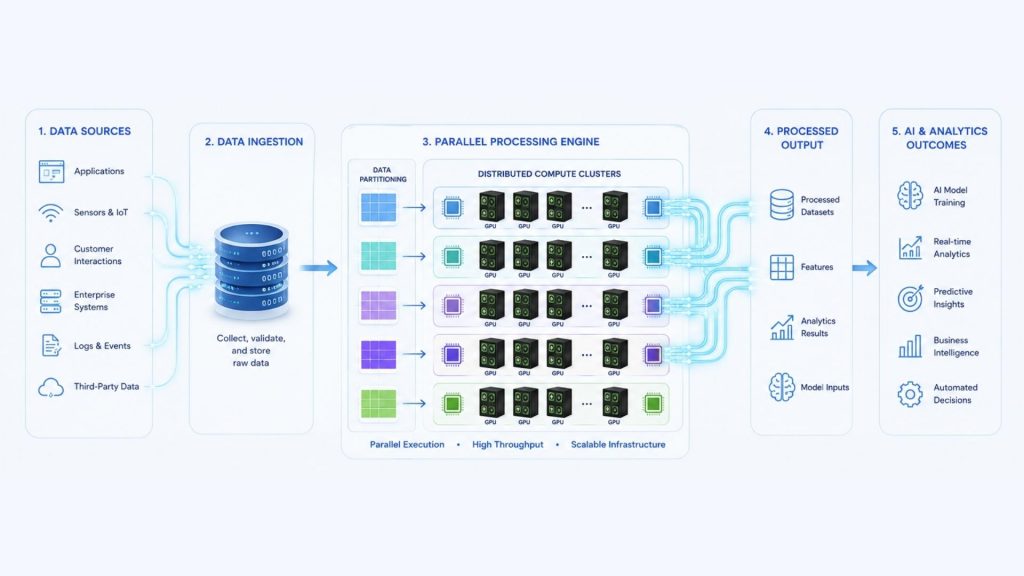
Parallel computing processes large datasets faster to support AI development and analytics
5.3. Deep learning
Deep learning models consist of many interconnected neural network layers that require intensive matrix and tensor calculations. These operations are highly parallelizable, making GPUs and other parallel computing architectures ideal for executing them efficiently. By processing thousands of mathematical operations simultaneously, parallel computing improves both training performance and inference speed for deep learning applications.
6. Parallel Computing vs Distributed Computing Comparison
Although parallel computing and distributed computing are often discussed together, they solve computational challenges in different ways. Here is a table comparing parallel computing vs distributed computing across key enterprise and AI infrastructure criteria:
| Criteria | Parallel Computing | Distributed Computing |
| Scalability | Scales within a single system or tightly coupled cluster | Scales across multiple networked systems |
| Training Capacity | Optimized for high-speed AI model training | Optimized for large-scale distributed workloads |
| Resource Utilization | Uses multiple CPUs or GPUs simultaneously | Uses resources across independent machines |
| Infrastructure Resilience | Lower fault tolerance due to shared resources | Higher fault tolerance through distributed nodes |
| AI Workload Suitability | Deep learning, HPC, and GPU-intensive tasks | Big data processing and cloud-native AI services |
7. Types of Parallel Computing in AI
Depending on the model architecture, dataset size, and available infrastructure, organizations may split data, divide models, or distribute workloads across multiple computing nodes. Choosing the right approach helps improve training speed, optimize hardware utilization, and support scalable AI deployment.
7.1 Data parallelism
Data parallelism distributes different portions of the same dataset across multiple GPUs or compute nodes while each processor runs an identical copy of the AI model. After each processor completes its calculations, the model parameters are synchronized to maintain consistent training results. It is one of the most common parallel computing techniques in modern AI frameworks such as PyTorch and TensorFlow.
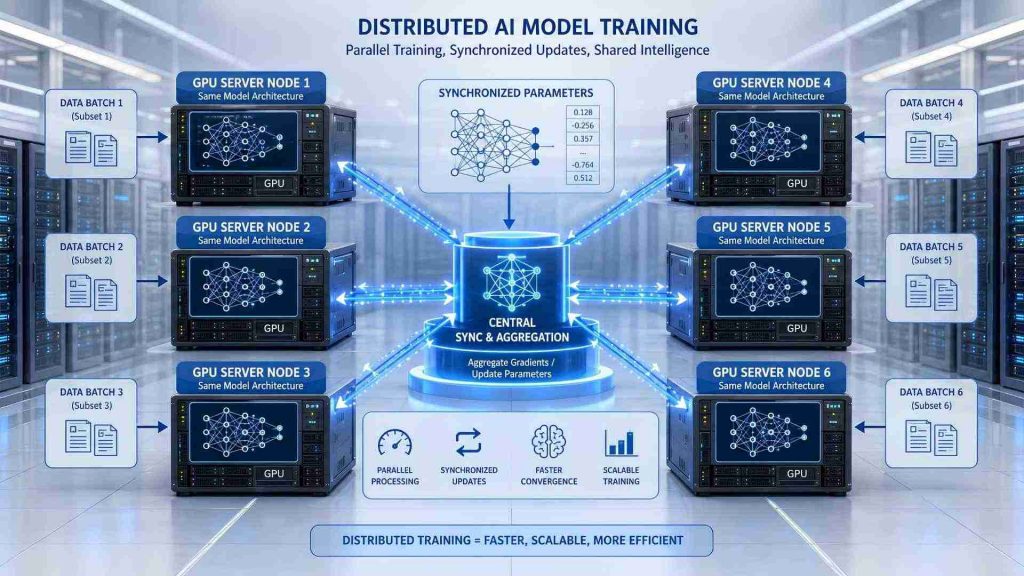
Data parallelism accelerates AI training by processing different data batches simultaneously
7.2 Model parallelism
Model parallelism divides a single AI model across multiple GPUs when the model is too large to fit into the memory of one device. Each processor is responsible for computing a different portion of the neural network before passing intermediate results to the next processor. This approach enables organizations to train foundation models and large language models with billions of parameters.
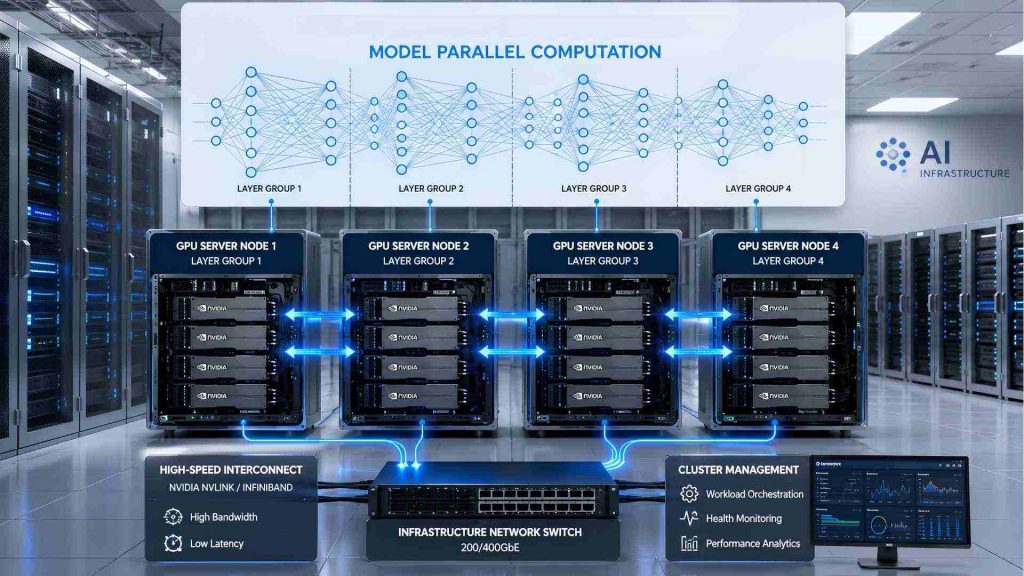
Model parallelism distributes large AI models across multiple GPUs for efficient training
7.3 Distributed computing
Distributed computing extends parallel computing by coordinating workloads across multiple interconnected servers or clusters. Instead of relying on a single machine, distributed systems share computational tasks and storage resources across a network to improve scalability and availability. This architecture enables organizations to process extremely large datasets and deploy AI applications across cloud environments.

Distributed computing connects multiple servers to scale AI workloads across enterprise infrastructure
8. Challenges of Parallel Computing
After exploring the different types of parallel computing architectures, the next section discusses the key challenges that affect the performance, efficiency, and scalability of parallel systems. The major challenges include:
- Load Balancing: A challenge occurs when workloads are not evenly distributed across processors or compute nodes. Some processing units may become overloaded while others remain idle, reducing overall system efficiency and increasing execution time.
- Synchronization: Parallel tasks often depend on shared data or results from other processes. Poor synchronization can cause delays, race conditions, or incorrect results due to conflicts between concurrent operations.
- Communication Overhead: In distributed systems, processors need to exchange data through networks. Frequent communication between nodes can introduce latency and reduce performance gains from parallel execution.
- Memory Bottlenecks: Parallel processors require fast access to large amounts of data. Limited memory bandwidth, data transfer delays, or competition for shared memory resources can prevent processors from reaching their full performance.
- Scalability: Increasing the number of processors or compute nodes does not always lead to proportional performance improvements. Communication costs, synchronization requirements, and resource management complexity can limit system scalability.
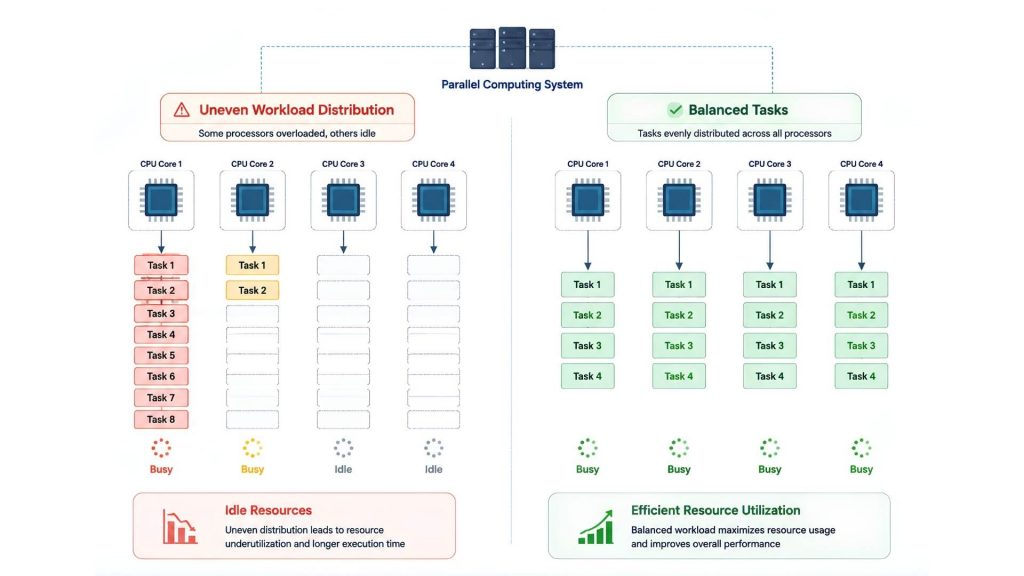
Impact of load balancing on resource utilization in parallel computing systems
9. Real-World Applications of Parallel Computing
Parallel computing powers many of today’s most demanding applications by enabling large computational tasks to run simultaneously across multiple processors or GPUs. Here are some of its most common real-world applications:
9.1. Artificial Intelligence
AI is one of the most important applications of parallel computing because AI models require enormous computational power to process data and perform billions of mathematical operations. By dividing a large problem into many smaller tasks and executing them simultaneously across multiple processors or GPUs, parallel computing significantly accelerates model training and inference.
As AI workloads continue to grow, high-performance GPU infrastructure becomes essential for maintaining speed and scalability. FPT AI Factory has enterprise-ready GPU Virtual Machine which provides flexible computing resources for AI development, GPU Container delivers optimized environments for model training and fine-tuning. In addition, GPU Cluster enables scalable distributed training and inference across multiple GPUs for high-performance AI workloads.
9.2. Scientific Simulations
Scientific research often requires simulations involving millions of variables and complex mathematical calculations. Parallel computing allows these simulations to run simultaneously across multiple processors, significantly reducing the time needed to generate accurate results.
For instance, researchers at Argonne National Laboratory developed AERIS, an AI foundation model for weather prediction that runs on the Aurora exascale supercomputer using advanced parallelization techniques across thousands of GPUs. This enables faster and more accurate weather forecasts while supporting climate research.
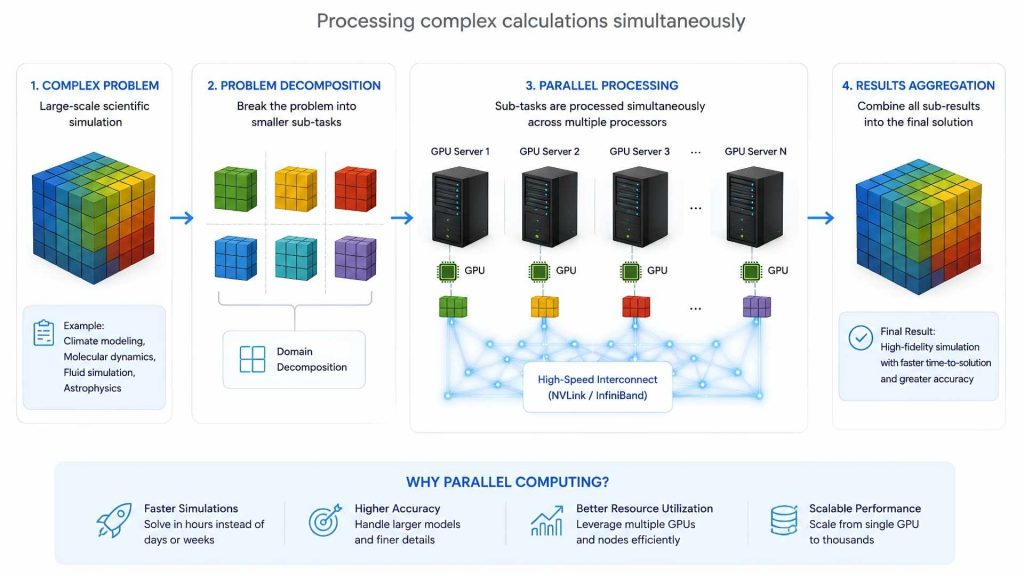
Parallel computing accelerates scientific simulations by processing complex calculations simultaneously
9.3. Computational Biology
Modern biology generates vast amounts of genomic and molecular data that require intensive computational analysis. Parallel computing enables researchers to process DNA sequencing, protein structure prediction, and drug discovery workloads much faster than traditional computing methods. This capability supports faster medical research and improves the ability to analyze complex biological systems.
One of the best-known examples of parallel computing in computational biology is AlphaFold, developed by Google DeepMind. Predicting protein structures requires intensive matrix computations that are accelerated using parallel processing on GPUs and high-performance computing infrastructure.
9.4. Signal Processing and Communications
Telecommunications systems continuously process enormous volumes of audio, video, and network traffic in real time. Parallel computing enables these signals to be analyzed, compressed, and transmitted simultaneously, improving communication quality while reducing latency. It also supports advanced technologies such as 5G networks, real-time video streaming, radar systems, and wireless communications.
For instance, telecommunications providers use parallel computing to process millions of wireless signals simultaneously across 5G networks. Tasks such as beamforming, signal encoding, decoding, and traffic optimization are executed in parallel to reduce latency and improve network performance.

Parallel computing improves real-time signal processing for modern communication networks
9.5. Computer Graphics
Computer graphics applications require millions of calculations to render realistic images, animations, and visual effects. Parallel computing allows GPUs to process thousands of graphical operations simultaneously, making high-resolution rendering and real-time graphics possible.
For example, film studios such as Pixar use parallel computing to render complex 3D scenes and animations. Instead of rendering each frame sequentially, rendering workloads are distributed across hundreds or thousands of CPU and GPU cores, allowing high-resolution visual effects to be produced much faster.
Parallel computing has become a fundamental technology for accelerating AI workloads, processing massive datasets, and supporting high-performance computing across industries. Whether supporting deep learning, scientific research, or enterprise analytics, parallel computing provides the foundation for faster and more intelligent computing. Whether you’re building prototypes or deploying AI at scale, FPT AI Factory provides flexible GPU infrastructure in Vietnam and Japan, with Malaysia launching soon. With FPT AI Factory, organizations also benefit from competitive hourly pricing and expert consultation tailored to their AI workloads. Businesses with customized requirements or large-scale projects can contact through the official contact form.
Contact Information:
- Hotline: 1900 638 399
- Email: support@fptcloud.com
Explore Related Articles:
What Is GPU Computing and How Does It Work? A Complete Guide