

High performance computing (HPC) combines parallel processing, high-speed networking and scalable storage to solve computational problems that traditional systems cannot handle efficiently. From training large AI models to running scientific simulations, FPT AI Factory helps organizations access flexible GPU infrastructure for demanding AI and HPC workloads without building every component from scratch.
| Key Takeaways:
High Performance Computing (HPC) combines powerful compute resources, high-speed networking and parallel processing to handle complex AI workloads at scale. Here are the key points to remember:
|
FPT AI Factory provides GPU infrastructure for AI development, distributed computing and production deployment. Teams can use GPU Container for containerized development, GPU Virtual Machine for dedicated GPU environments and GPU Cluster for distributed AI, machine learning and HPC workloads. Organizations with custom requirements or large-scale infrastructure needs can contact the FPT AI Factory team for project-specific consultation.
1. What Is High Performance Computing (HPC)?
High performance computing is an approach that combines powerful processors, accelerators, storage and networking to execute complex calculations at high speed. Rather than relying on one machine to complete every operation sequentially, an HPC environment distributes a problem across multiple compute resources that work together.
HPC is especially useful when a workload contains a large number of similar calculations, very large datasets or strict processing-time requirements. Examples include weather and climate simulation, computational fluid dynamics, molecular modeling, financial risk analysis, computer-generated imagery and training deep learning models.
For AI teams, HPC is closely connected to the wider concept of AI infrastructure. Both depend on coordinated compute, storage, networking and software layers. HPC emphasizes high-throughput parallel execution, while AI infrastructure also covers model development, deployment, inference and lifecycle operations.
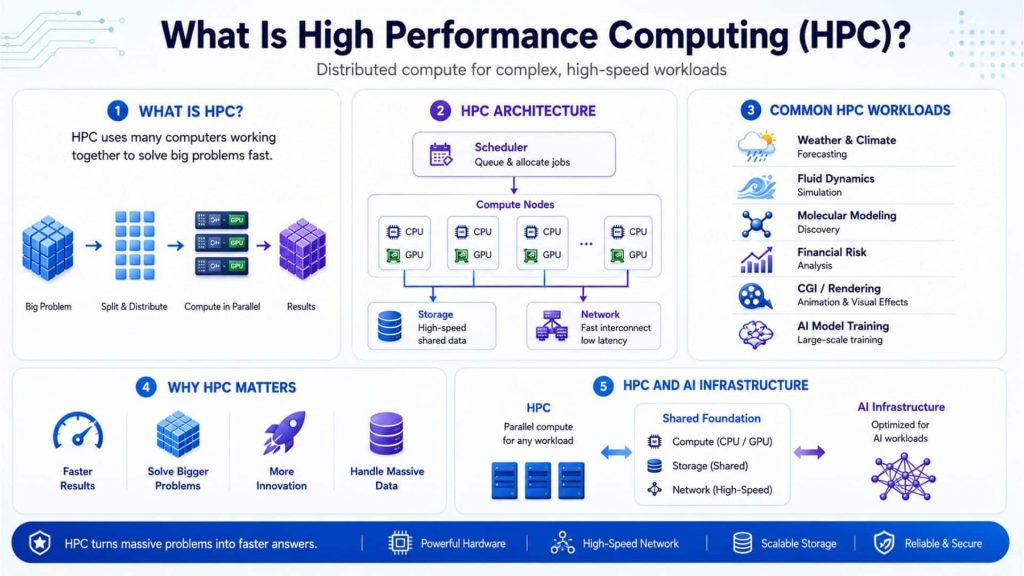
HPC combines powerful compute, storage, and networking to process large, complex workloads at high speed.
2. How does HPC work?
An HPC system turns one large computational problem into many smaller tasks, assigns those tasks to available resources and combines the results. Performance depends on more than processor speed: the system must move data quickly, keep workers synchronized and prevent storage or network bottlenecks from leaving expensive compute resources idle.
2.1. Massively parallel computing
Massively parallel computing allows thousands of CPU cores or GPU cores to perform calculations at the same time. A simulation may divide a physical environment into many regions, while an AI training job may distribute model layers, parameters or batches across multiple accelerators. The workload is faster only when tasks can be divided efficiently and synchronized with limited overhead.
GPUs are particularly valuable because they are designed to apply similar mathematical operations across large arrays of data. This makes them well suited to matrix multiplication, tensor operations, image processing and other calculations used in deep learning and generative AI.
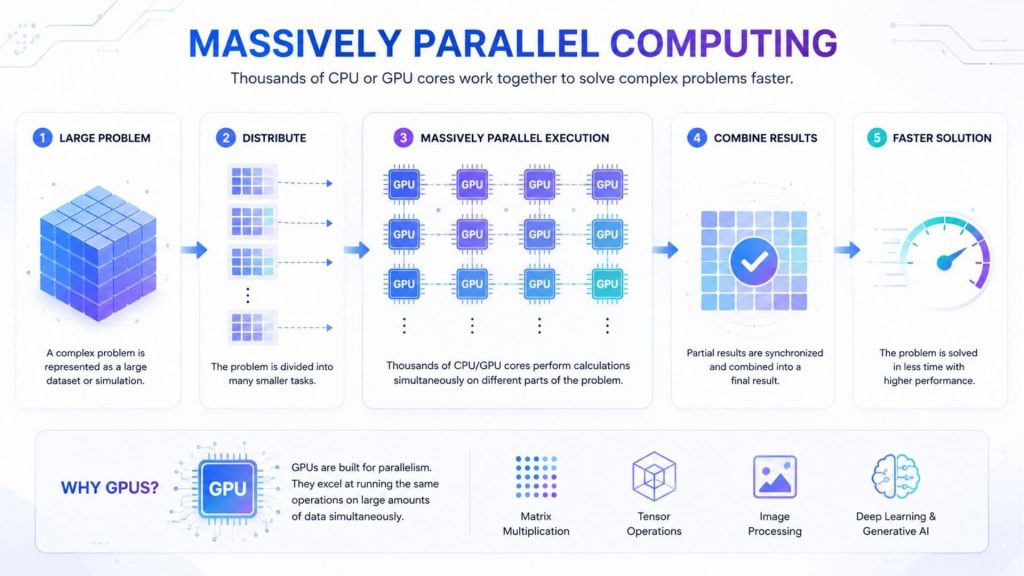
Massively parallel computing uses many CPU or GPU cores at once to solve complex workloads faster.
2.2. Computer clusters
A computer cluster is a group of connected servers, often called nodes, that operate as a coordinated environment. A cluster can include CPU nodes for general processing, GPU nodes for accelerated workloads, login nodes for user access and management nodes for orchestration. Capacity can be expanded by adding nodes instead of replacing the complete system.
For workloads that exceed one server, a GPU Cluster provides the multi-node foundation needed for distributed training, scientific computing and large-scale machine learning. The architecture should match the workload because adding more nodes does not guarantee linear performance gains.
2.3. High-performance Interconnects
Interconnects carry data between compute nodes and accelerators. Distributed workloads frequently exchange gradients, parameters and intermediate results, so latency and bandwidth can directly affect job completion time. High-performance fabrics help reduce communication delays and keep distributed workers synchronized.
Network selection becomes increasingly important as clusters scale. The comparison between InfiniBand and Ethernet for AI workloads shows how latency, throughput, congestion control and operational requirements influence distributed AI performance.
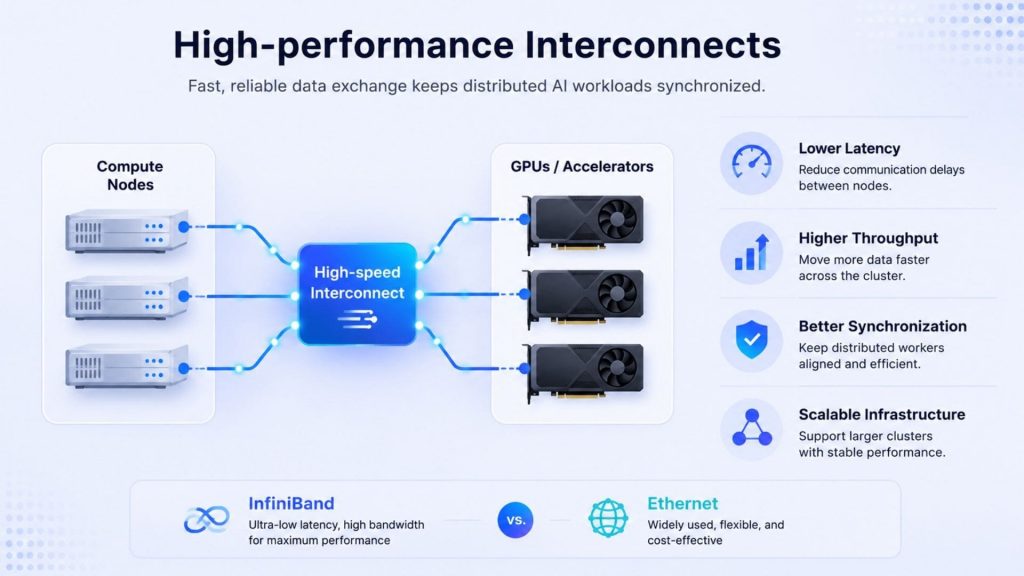
High-performance interconnects keep distributed AI and HPC workloads fast, synchronized, and scalable.
2.4. Parallel Storage
Parallel storage allows many nodes to read and write data concurrently. HPC workloads may process millions of files, large simulation outputs, model checkpoints or high-resolution media, making storage throughput a critical design factor. A fast compute cluster can still perform poorly when data loading cannot keep pace with processors.
Teams should assess file size, access patterns, metadata volume, checkpoint frequency and retention needs before selecting a storage architecture. Data staging and caching can also reduce repeated movement between lower-cost storage and high-performance working storage.
2.5. Job Scheduling
A job scheduler accepts workload requests, evaluates resource requirements and decides when and where each job will run. It may allocate CPUs, GPUs, memory, storage bandwidth and execution time while enforcing project priorities and usage quotas. Scheduling improves utilization by preventing resource conflicts and matching jobs with suitable nodes.
In shared environments, schedulers also support fairness and governance. Teams can prioritize urgent experiments, limit long-running jobs, reserve resources for production tasks and track usage by department or project.
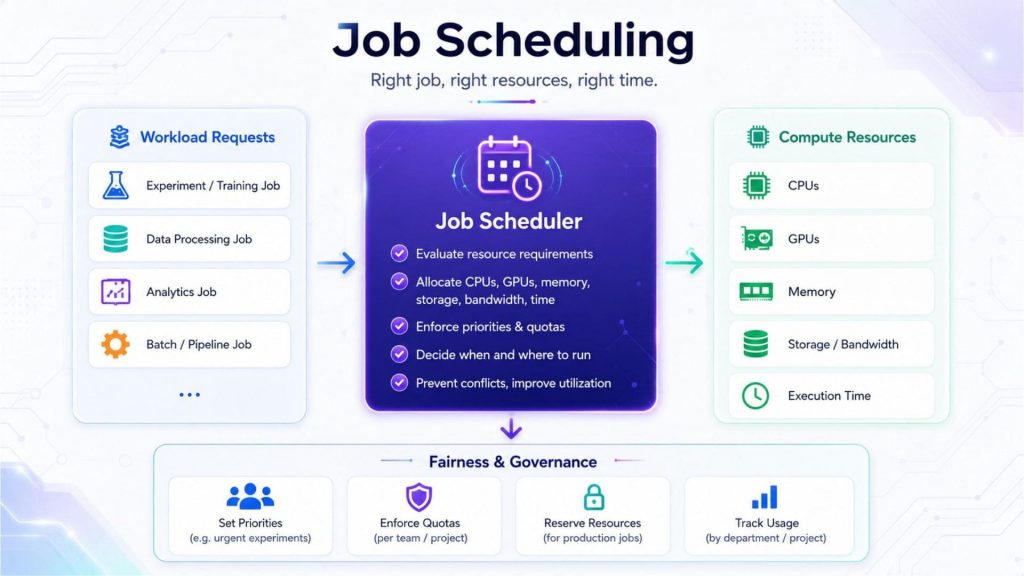
AI-powered job scheduling evaluates workload requirements, allocates suitable compute resources and enforces, usage governance across shared infrastructure.
3. Core Components of HPC
An HPC environment is an integrated system rather than a collection of independent high-end servers. Each component must be sized and configured for the target workload, because an imbalance between compute, network and storage can reduce overall performance.
3.1. Compute Nodes
Compute nodes perform the main calculations. CPU-focused nodes suit serial logic, preprocessing and many scientific codes, while GPU nodes accelerate highly parallel workloads such as deep learning, rendering and numerical simulation. Memory capacity and bandwidth are also important because some jobs cannot keep processors supplied with data efficiently.
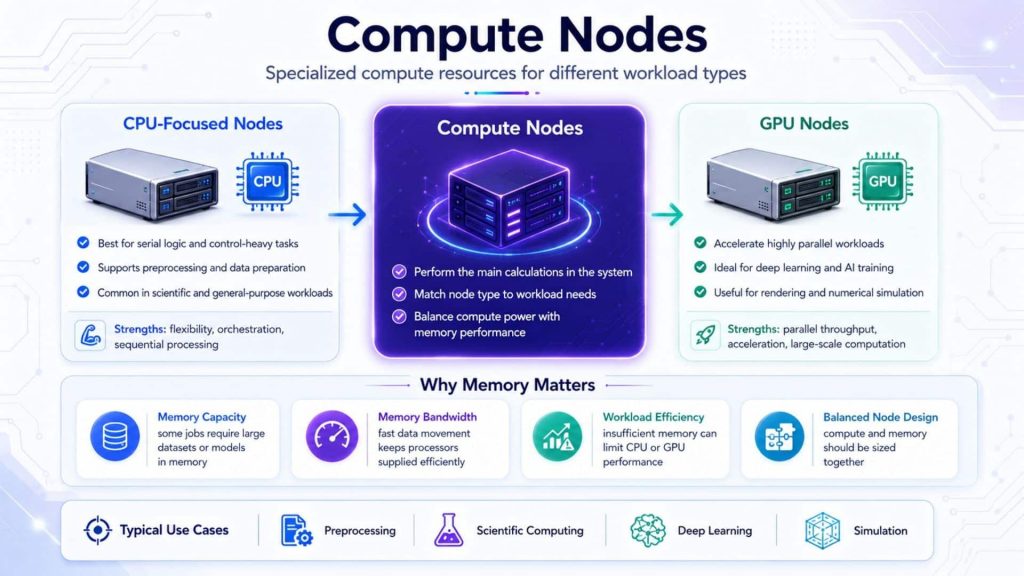
Compute nodes match CPU and GPU resources to different workload types, while sufficient memory capacity help maintain efficient processing performance.
3.2. Networking
The network connects compute resources, storage systems and management services. HPC networking must support reliable, low-latency communication under sustained load. Network topology, adapter capabilities and collective communication libraries can affect how efficiently a distributed workload scales from one node to many.
3.3. Storage
HPC storage typically includes high-throughput working storage, durable object or archive storage and local node storage for temporary data. The right combination depends on whether the workload uses large sequential files, many small files, frequent checkpoints or real-time data streams.
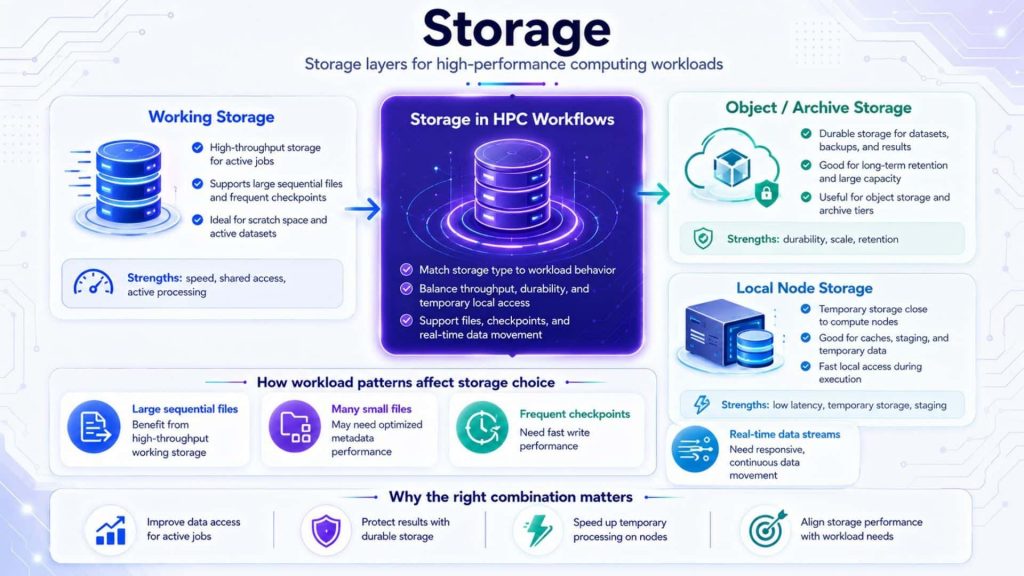
HPC storage combines high-throughput working storage, durable object or archive storage to support different workload and data-access requirements.
3.4. Scheduler
The scheduler coordinates resource allocation and workload queues. It helps improve utilization, prevents oversubscription and provides operational visibility into job status, waiting time and resource consumption. Policies can be adjusted according to business priorities, service levels and project deadlines.
3.5. Software Stack
The software stack includes operating systems, drivers, compilers, numerical libraries, container runtimes, distributed computing frameworks and monitoring tools. AI environments may also include CUDA libraries, PyTorch, TensorFlow, distributed training frameworks and experiment-tracking systems.
Development teams that need an interactive workspace can use AI Notebook alongside GPU infrastructure to prepare data, test code and run experiments. Containerized environments can further improve reproducibility by packaging dependencies and runtime configurations consistently.
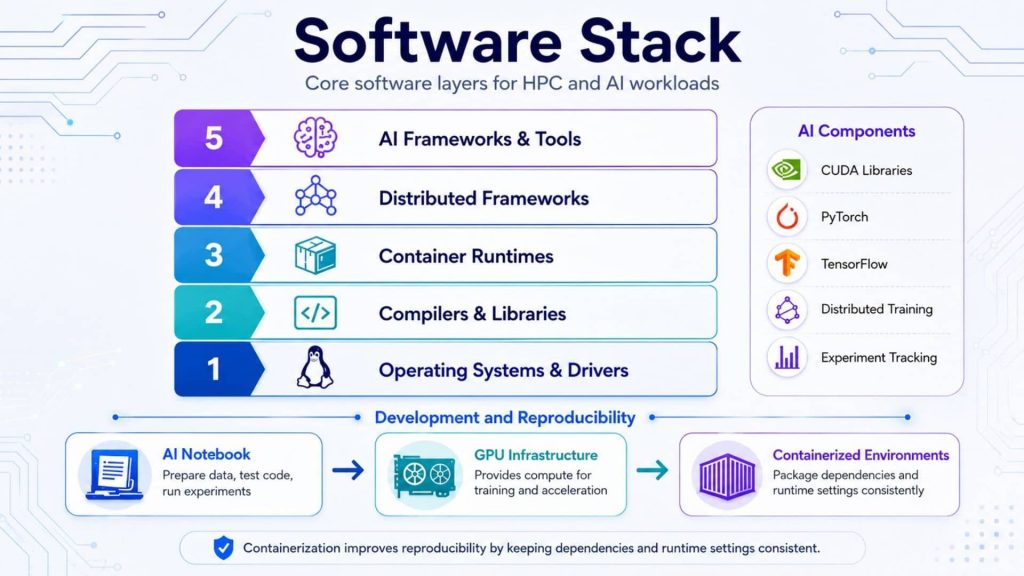
The HPC and AI software stack combines operating systems, drivers, libraries, containers and distributed frameworks.
4. HPC vs Traditional Computing
Traditional computing remains effective for everyday applications, transactional systems and workloads that cannot be divided efficiently. HPC is designed for problems that benefit from parallel processing, large memory capacity, rapid data movement and coordinated resource management.
| Criteria | Traditional computing | High performance computing |
| Processing power | Usually relies on one workstation or a small number of general-purpose servers. | Combines many CPUs, GPUs or accelerator nodes for parallel processing. |
| Workload scale | Best for routine business applications, moderate datasets and sequential tasks. | Designed for large datasets, complex simulations and compute-intensive workloads. |
| Computing architecture | Resources are often independent and optimized for general use. | Compute, network, storage and scheduling are engineered as an integrated cluster. |
| AI applications | Suitable for data preparation, small experiments and lightweight inference. | Supports distributed training, large-model development, high-throughput inference and scientific AI. |
| Scalability | Scaling may require upgrading a single machine or adding loosely connected servers. | Scales across coordinated nodes, subject to workload parallelism and communication efficiency. |
| Operations | Simpler to manage but offers limited performance for extreme workloads. | Requires scheduling, monitoring, workload tuning and stronger cost governance. |
The choice is not always either-or. Many organizations use traditional systems for business applications and preprocessing, then move only the most demanding jobs to HPC resources. This hybrid approach can control cost while giving specialist teams access to higher performance when required.
5. HPC Applications in AI
AI has increased demand for HPC because modern models process large datasets and perform repeated tensor operations. HPC helps shorten experimentation cycles, support larger models and run AI alongside simulations or domain-specific scientific workflows.
5.1 Training large AI models
Training large models may require distributing data, parameters or model layers across many GPUs. Each accelerator performs part of the computation, while the network synchronizes updates. Cluster design affects training speed, fault tolerance and the ability to scale beyond the memory capacity of one device.
To run AI workloads that require substantial computational capacity, enterprises need HPC infrastructure that can provide stable and scalable resources. FPT AI Factory supports compute-intensive AI development through GPU Container, GPU Virtual Machine and GPU Cluster, helping teams select containerized, dedicated or distributed GPU environments according to workload scale.
Teams evaluating the role of GPUs across model development can also review the top GPU use cases for generative AI and LLMs, which explains why parallel processing, memory capacity and data-center GPU features matter for larger AI workloads.
5.2 Scientific computing
Scientific computing uses numerical methods to model physical, chemical and biological systems. AI can complement these simulations by identifying patterns, approximating expensive calculations or prioritizing promising experimental candidates. The resulting workflow may combine traditional HPC codes with deep learning models on the same accelerated infrastructure.
In research environments, AI and accelerated computing can help process large experimental datasets and shorten simulation cycles. FPT AI Factory’s article on how GPU clusters accelerate scientific discovery highlights applications in molecular screening, astrophysics and real-time experimental data analysis.
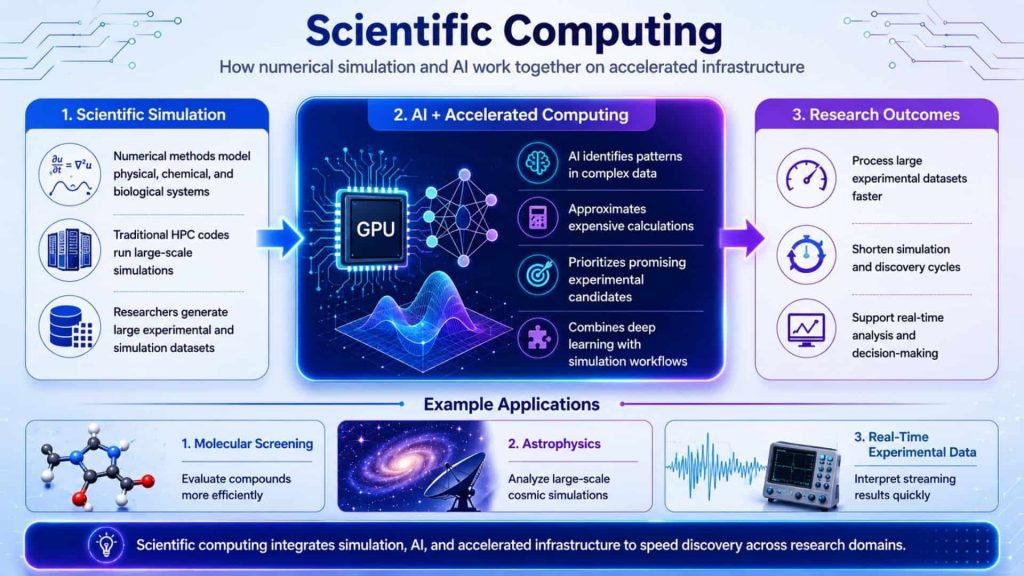
Scientific computing combines numerical simulations, AI models and accelerated GPU infrastructure to analyze complex datasets and support faster research discovery.
5.3 Generative AI workloads
Generative AI workloads include pre-training, fine-tuning, image or video generation, retrieval-augmented generation and model serving. Training emphasizes throughput and distributed synchronization, while inference requires predictable latency, memory efficiency and the ability to handle changing request volumes.
After a model is developed, the infrastructure requirement shifts from experimentation to serving. Understanding AI inference and how it works helps teams plan model endpoints, batching, autoscaling and monitoring for production applications. Serverless Inference can support API-based model integration without requiring teams to manage the complete serving layer manually.
5.4 Simulation and analytics
HPC accelerates simulations such as computational fluid dynamics, finite-element analysis, Monte Carlo modeling and digital twins. It also supports large-scale analytics when datasets are too large or processing windows are too short for traditional systems. AI can then analyze simulation results, detect anomalies or optimize design parameters.
This combination is valuable because simulation generates synthetic data and AI helps interpret or approximate complex systems. Organizations can test more scenarios before physical production, evaluate risk faster and improve decisions with a broader evidence base.
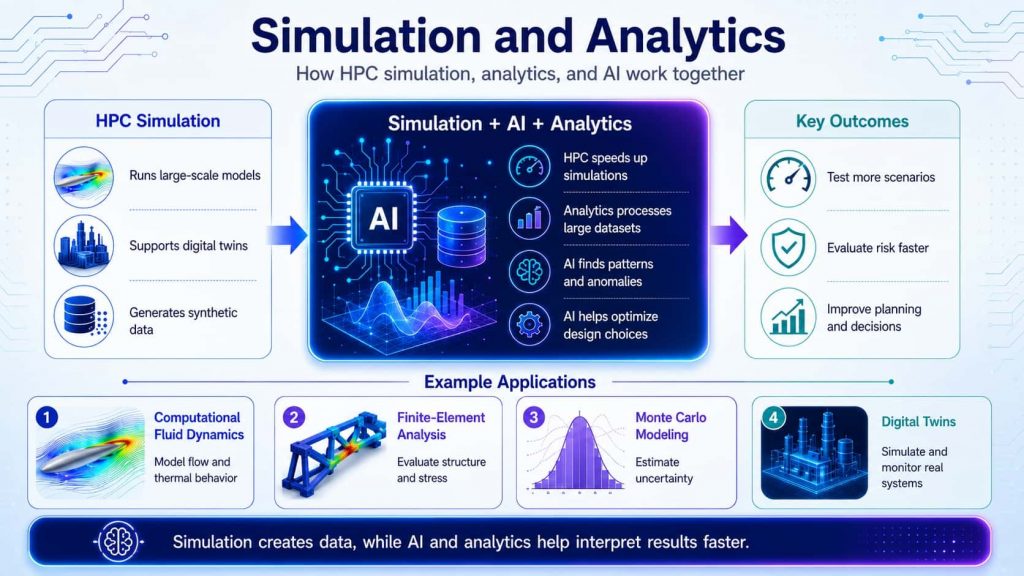
HPC simulations generate data, while AI and analytics reveal patterns, assess risks and improve decisions.
6. HPC use cases
HPC creates value when processing speed, data scale or simulation complexity affects business outcomes. The following sectors illustrate how organizations combine parallel computing and AI to reduce turnaround time and support more detailed analysis.
6.1. Healthcare, genomics and life sciences
Healthcare and life sciences use HPC for genome analysis, protein modeling, medical imaging and computational drug discovery. Genome pipelines may process billions of sequence reads, while molecular simulations evaluate interactions across large numbers of candidate compounds. AI models can prioritize promising results or identify patterns in imaging and clinical datasets.
Because health and genomic data is sensitive, organizations should combine performance planning with access control, encryption, audit logging and jurisdiction-specific governance. The infrastructure must support both computational scale and responsible data handling.
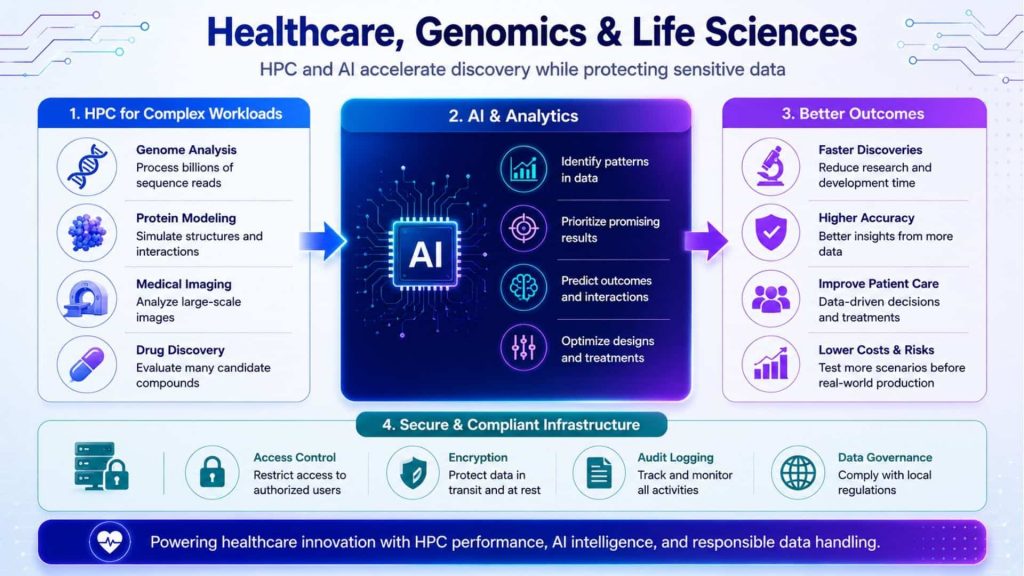
HPC and AI accelerate healthcare research while secure infrastructure protects sensitive genomic and clinical data.
6.2. Media and entertainment
Studios and media companies use HPC for rendering, visual effects, animation, transcoding and AI-assisted content workflows. A production may need to render thousands of high-resolution frames, with each frame containing complex lighting, texture and physics calculations. Parallel rendering distributes frames or scene regions across many GPUs to shorten production timelines.
Generative AI adds workloads such as image synthesis, video generation, upscaling, speech processing and automated localization. Teams should plan storage throughput carefully because large media files can make data movement a bigger bottleneck than raw compute.
6.3. Banking and financial services
Financial institutions use HPC for derivative pricing, Monte Carlo simulations, portfolio optimization, fraud analytics and risk reporting. Many of these workloads run large numbers of scenarios independently, making them suitable for parallel execution. Faster processing allows analysts to evaluate more market conditions within intraday or regulatory reporting windows.
AI models can complement quantitative systems by detecting anomalies, analyzing documents and supporting customer-facing applications. Governance remains essential because model decisions, data lineage and computational results may need to be reviewed or reproduced.
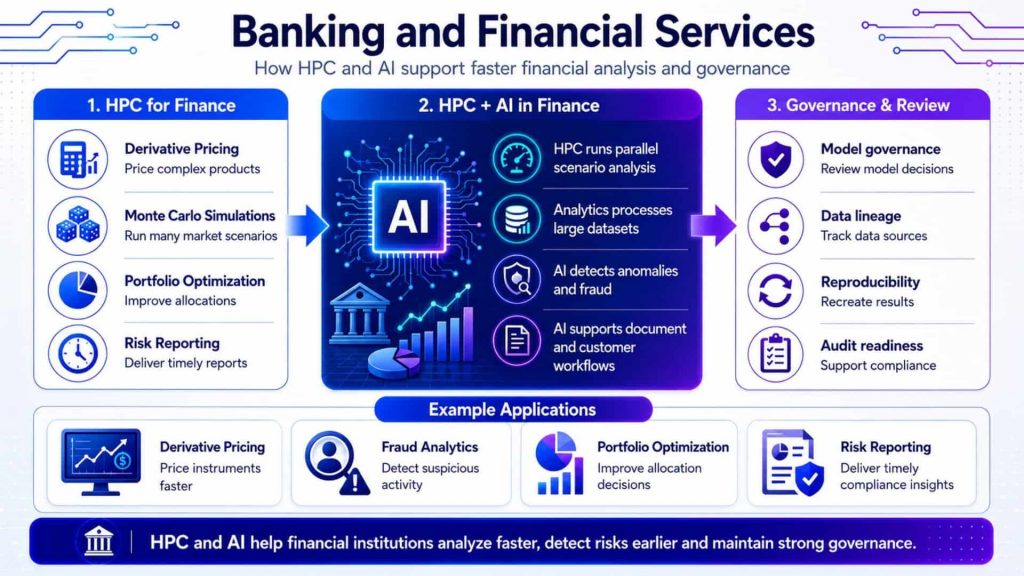
HPC and AI accelerate financial analysis, detect risks and support transparent, reproducible governance.
6.4. Government and defense
Government and defense organizations use HPC for weather forecasting, geospatial analysis, cryptography, engineering simulation and large-scale intelligence processing. These workloads may combine real-time data streams with historical datasets and simulation models. High availability and strict access boundaries are often as important as processing speed.
Sensitive projects may use dedicated, private or hybrid environments. Workload placement should reflect data classification, latency requirements, operational control and applicable regulations rather than relying on one infrastructure model for every project.
6.5. Automotive industry
Automotive teams use HPC for crash simulation, computational fluid dynamics, battery modeling, materials analysis and virtual vehicle testing. Engineers can evaluate many design variants digitally before building physical prototypes, helping reduce development time and focus laboratory testing on the most promising configurations.
AI workloads include perception training, sensor-data processing, driver-assistance development and digital twins. These use cases often require both large offline training jobs and lower-latency validation or inference pipelines.
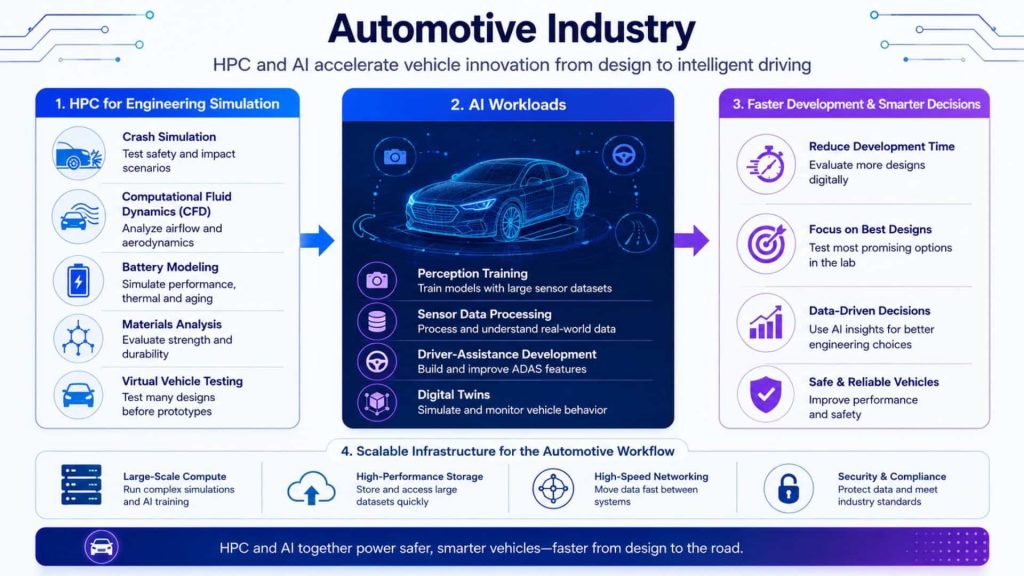
HPC and AI accelerate automotive simulation, vehicle testing and intelligent driving development.
6.6. Cybersecurity
Cybersecurity teams use HPC to analyze large event streams, inspect network traffic, model attack patterns and accelerate password or cryptographic research in controlled environments. Parallel processing can help correlate signals across millions of records and identify anomalies faster than sequential analysis.
AI can improve classification and threat detection, but models should be continuously monitored for drift, false positives and adversarial behavior. Security teams also need clear access policies so the infrastructure used to analyze threats does not become an additional attack surface.
FPT AI Factory supports security-sensitive AI and HPC workloads with high-performance infrastructure in Japan and Vietnam, with Malaysia coming soon. Its AI factories in Japan and Vietnam ranked among the TOP500 supercomputers, while the platform follows international security standards, including SOC 2 and SOC 3 certifications for relevant sites.
Organizations can access GPU Container, GPU Virtual Machine and GPU Cluster with competitive hourly pricing, while Serverless Inference supports API-based production deployment. Dedicated consulting is also available to help teams select suitable infrastructure, strengthen workload security and scale demanding AI projects efficiently. Organizations with customized requirements or large-scale projects can contact FPT AI Factory through the official contact form.
Contact information
- Hotline: 1900 638 399
- Email: support@fptcloud.com
Explore more articles:
Top Cloud Service Providers with GPU for AI Workloads