

LLM inference optimization helps teams improve response speed, throughput, GPU utilization and infrastructure cost when serving large language models in production. In this article, FPT AI Factory will explore the essential LLM Inference Optimization Techniques and actionable blueprints for modern enterprises.
| Key Takeaways:
LLM inference optimization helps large language models generate responses faster, more efficiently and at lower operating cost in production environments. Here are the key points to remember:
|
FPT AI Factory helps teams build, optimize and scale LLM inference from experimentation to production AI applications. With GPU infrastructure, AI development tools and inference services, teams can improve deployment efficiency, support high-performance workloads and manage production inference more effectively. Organizations that need customized AI solutions, large-scale deployment or expert consultation can contact FPT AI Factory to discuss the right architecture for their workloads.
1. What is LLM Inference optimization?
1.1 What is LLM inference?
LLM inference is the process where a trained large language model receives an input prompt and generates an output, such as an answer, summary, code snippet or classification. Unlike training, inference does not teach the model new patterns. It uses the model’s existing parameters to generate responses for real users and applications.
LLM inference optimization focuses on making this process faster, more scalable and more cost-efficient. It helps reduce response delay, improve throughput, increase GPU utilization and control serving costs as request volume grows. For enterprise applications, optimization is important because users expect AI chatbots, copilots, search assistants and AI agents to respond quickly and reliably.
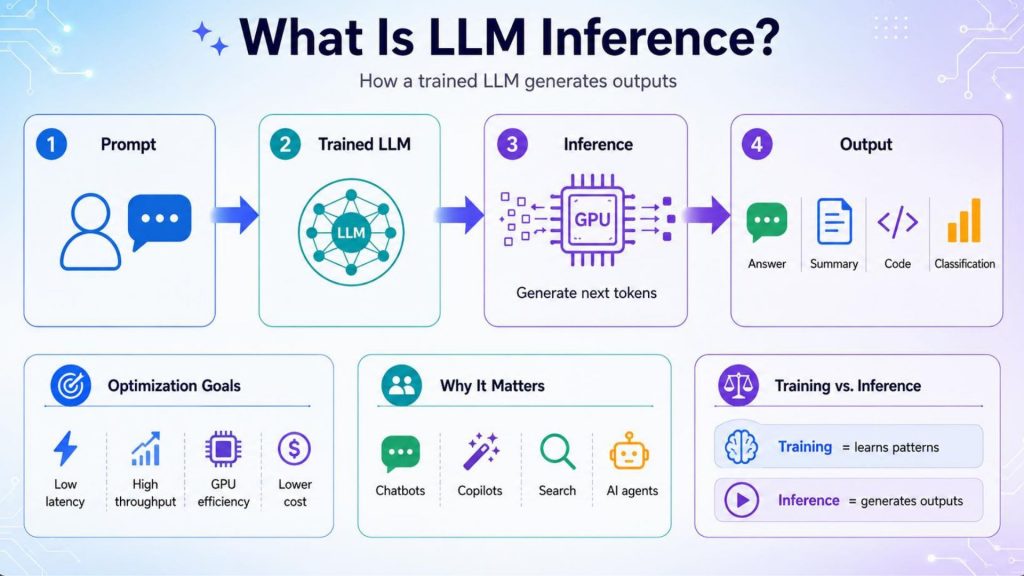
LLM inference turns prompts into useful outputs using a trained model, with optimization improving speed, scale, and cost efficiency.
1.2 Key metrics for measuring inference performance
A reliable LLM inference system should be evaluated with multiple metrics instead of only one performance number. Latency measures how fast users receive responses, while throughput shows how many requests or tokens the system can process. Cost and GPU utilization help teams understand whether the serving architecture is efficient enough for production demand.
| Metric | What It Measures | Why It Matters |
| Latency | How long it takes for the model to return a response or first token. | Lower latency improves user experience in chatbots, copilots and real-time applications. |
| Throughput | How many requests, users or tokens the system can process over time. | Higher throughput helps serve more users without adding unnecessary infrastructure. |
| Cost | The infrastructure cost required to serve each request or token. | Cost tracking helps teams avoid overprovisioning and maintain predictable AI operations. |
| GPU Utilization | How effectively GPU resources are used during inference. | Better utilization reduces idle compute and improves return on GPU investment. |
| TTFT (Time to First Token) | How long it takes for the model to generate the first token after receiving a request. | Lower TTFT makes responses feel faster, especially for chatbots, copilots and streaming applications. |
2. Why LLM inference optimization matters
2.1 Reduce response latency
Latency directly affects how users experience AI applications. In a customer support chatbot or enterprise copilot, a slow first response can make the system feel unreliable even when the final answer is accurate. Optimization techniques such as KV cache usage, batching control and faster decoding can help reduce waiting time.
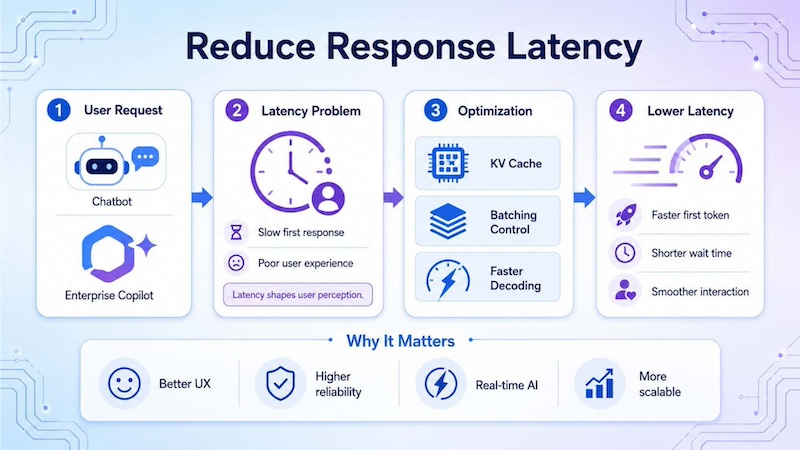
Latency optimization helps AI applications deliver faster responses, smoother interactions, and better user experience.
2.2 Improve throughput
Throughput becomes critical when an application serves many users at the same time. A model that works well in testing may struggle in production if hundreds or thousands of requests arrive together. Improving throughput helps teams serve more requests with the same infrastructure, especially during traffic spikes or peak business hours.
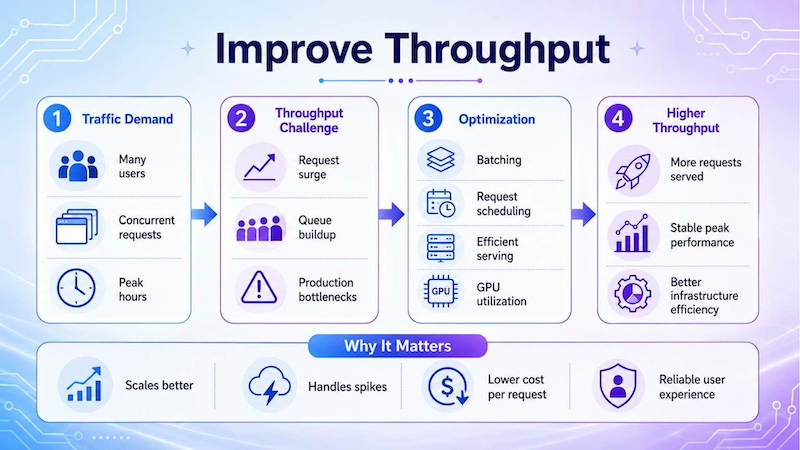
Improving throughput helps AI systems handle more users, reduce bottlenecks, and serve requests more efficiently.
2.3 Lower infrastructure costs
LLM inference can become expensive when GPUs are underused, requests are inefficiently batched or models are larger than the workload requires. Optimization helps reduce cost by improving GPU utilization, selecting the right model size and controlling the number of tokens generated per request. This is important for teams that need to scale AI applications while keeping operating cost predictable.
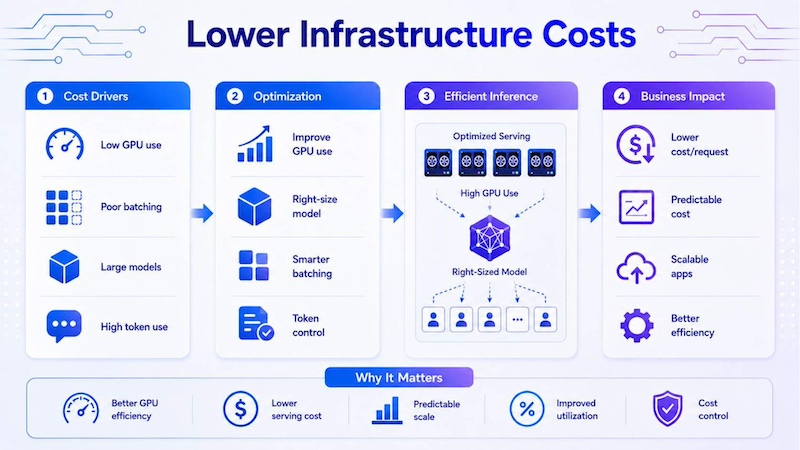
Optimized LLM inference lowers serving costs by improving GPU usage, batching, model sizing, and token control.
2.4 Support enterprise-scale AI applications
Enterprise AI applications often need stable performance, secure APIs and scalable serving infrastructure. After teams understand AI inference, they also need to plan how models will be served, monitored and optimized for real users. This makes LLM inference optimization a practical requirement for chatbots, internal assistants, AI agents, document processing tools and customer-facing applications.
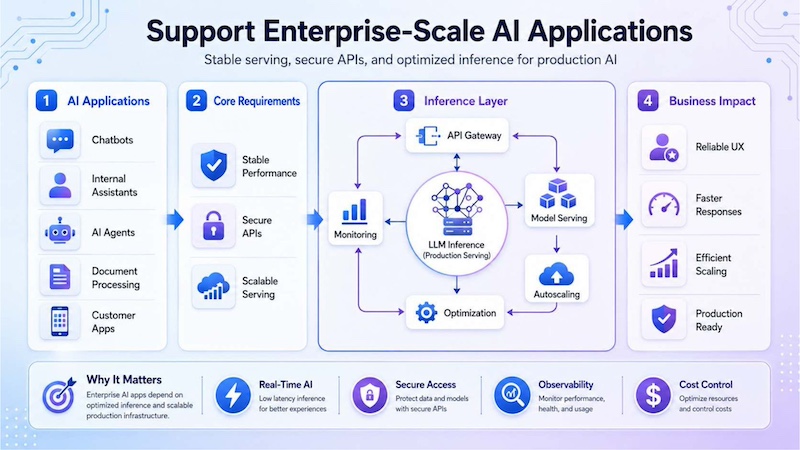
Optimized inference helps enterprise AI applications stay scalable, secure, reliable, and ready for production.
3. Techniques for optimizing LLM inference
LLM inference optimization combines model-level, memory-level and infrastructure-level techniques. The right approach depends on model size, traffic pattern, response quality requirements and available GPU resources. In practice, teams often combine several techniques instead of relying on one method.
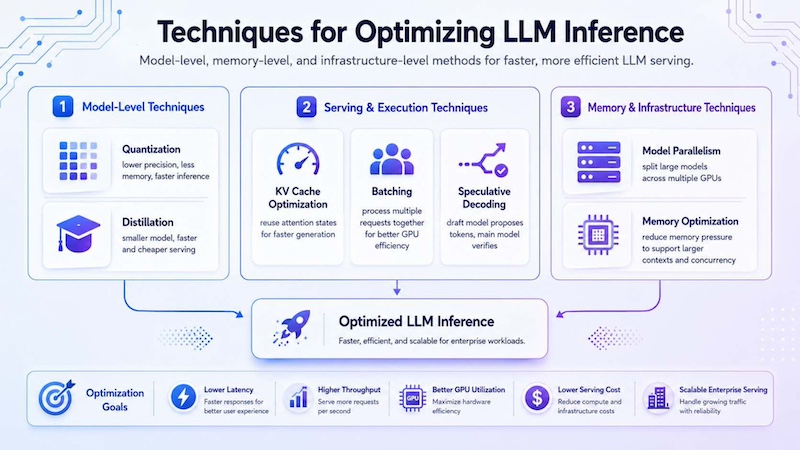
LLM inference optimization combines model compression, memory optimization, batching and parallel execution to improve production performance.
3.1. Quantization
Quantization reduces the precision of model weights and activations, such as moving from higher-precision formats to lower-precision formats. This can reduce memory usage and speed up inference, especially for large models. However, teams should test carefully because aggressive quantization may affect output quality or reasoning performance.
3.2. Distillation
Distillation trains a smaller model to behave like a larger model. The smaller model can often serve responses faster and at lower cost, making it useful for high-volume applications with predictable tasks. Distillation is especially relevant when the full capability of a very large model is not required for every request.
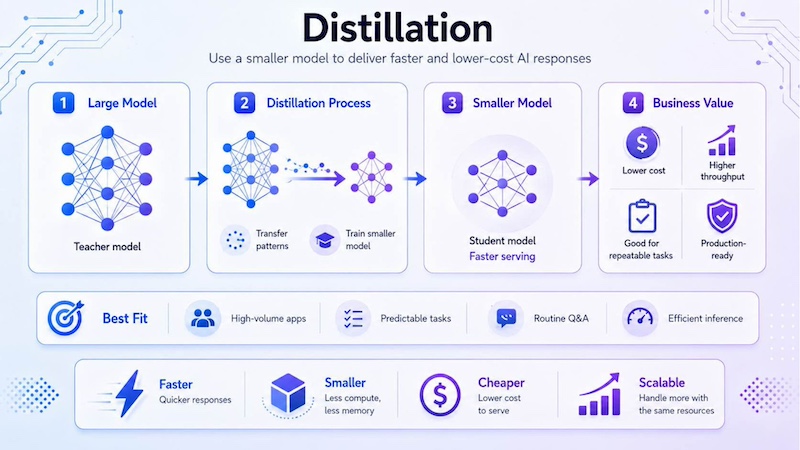
Distillation trains a smaller student model to learn from a larger teacher model, helping teams deliver faster, lower-cost, and scalable AI responses for predictable tasks.
3.3. KV cache optimization
KV cache optimization stores attention key-value states from previous tokens so the model does not need to recompute them during generation. This is important because LLMs generate text token by token, and each new token depends on previous context. Efficient cache management can improve speed, but it also requires memory planning for long prompts and concurrent users.
3.4. Batching
Batching groups multiple requests together so the inference engine can process them more efficiently on GPU resources. Static batching can work for predictable workloads, while dynamic batching can adapt to changing request patterns. Teams need to balance throughput gains with user-facing latency because waiting too long to form a batch can delay responses.
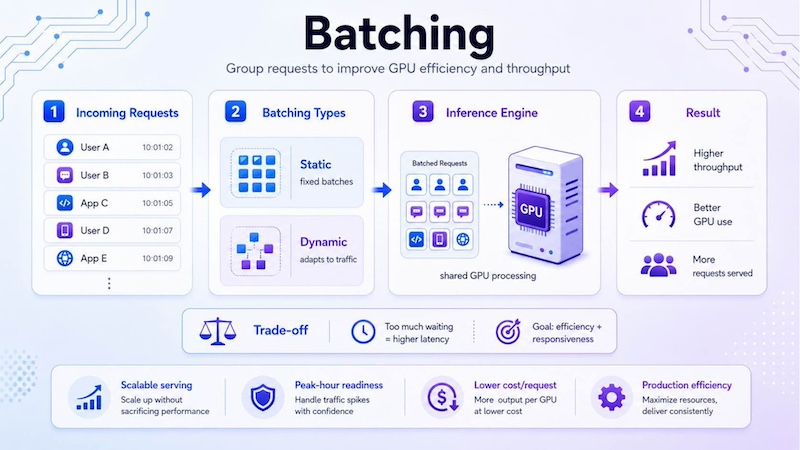
Batching helps AI systems serve more requests efficiently by improving throughput, GPU usage, and cost efficiency.
3.5. Speculative decoding
Speculative decoding uses a smaller or faster draft model to propose tokens, while the larger model verifies them. When implemented well, this can speed up generation without changing the final model output significantly. It is useful for workloads where token generation speed is a major bottleneck.
3.6. Model parallelism
Model parallelism splits a large model across multiple GPUs when it cannot fit or run efficiently on one device. This can support larger models and higher performance, but it also requires strong networking, memory coordination and serving architecture. It is often used for advanced LLM workloads that need more GPU memory or compute capacity.
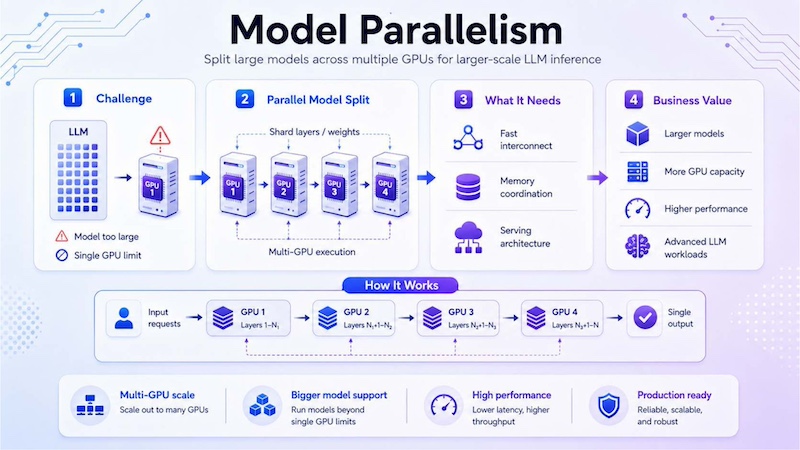
Model parallelism splits large models across multiple GPUs, enabling bigger LLM workloads, higher performance, and scalable inference beyond single-GPU limits.
3.7. Memory optimization
Memory optimization focuses on reducing GPU memory pressure during inference. Techniques may include efficient attention mechanisms, cache management, tensor placement and choosing the right model format. Better memory usage helps teams serve larger context windows, more concurrent users or bigger models without unnecessary infrastructure expansion.
4. Infrastructure best practices for LLM inference
Optimization does not stop at the model level. Production LLM inference also depends on GPU selection, monitoring, autoscaling and deployment architecture. Teams should design infrastructure based on real traffic patterns, response time requirements and business priorities.
4.1 Select the right GPU resources
Choosing the right GPU resources depends on model size, context length, traffic volume, latency target and budget. Smaller chatbots or internal assistants may run well on a single GPU setup, while high-traffic enterprise applications may need multi-GPU or multi-node infrastructure.
For many LLM inferenceworkloads, NVIDIA H100 and H200 are suitable options. H100 works well for high-performance AI workloads, while H200 can support larger memory needs and heavier inference demand. Teams can compare NVIDIA H100 and H200 to choose the right GPU model.
For more demanding enterprise workloads, NVIDIA HGX B300 may be suitable for larger models, longer context windows and advanced AI applications. Teams planning next-generation infrastructure can also review B200 vs B300. For production workloads that require higher throughput or multiple nodes, GPU Cluster can support scalable LLM inference infrastructure.
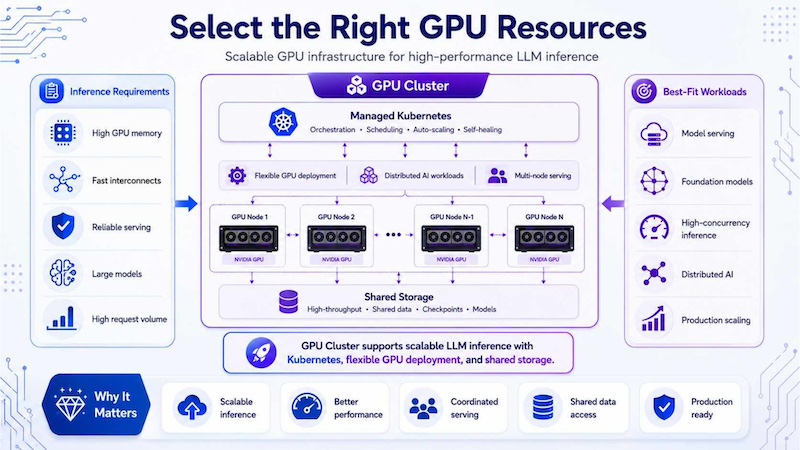
GPU Cluster provides scalable, production-ready GPU infrastructure for high-performance LLM inference and distributed AI workloads.
4.2 Monitor latency and throughput
Monitoring helps teams understand whether inference performance is stable in production. Important signals include time to first token, total generation time, tokens per second, queue length, error rate, GPU memory usage and cost per request. Without monitoring, teams may not notice that latency is increasing, batching is inefficient or GPU resources are underused.
4.3 Implement autoscaling
Autoscaling adjusts serving capacity when request demand changes. This helps avoid overprovisioning during quiet periods and capacity shortages during traffic spikes. For LLM applications, autoscaling should consider not only request count but also token length, context size, model type and GPU availability.
4.4 Optimize deployment architecture
A strong deployment architecture should connect APIs, inference engines, load balancing, GPU resources, monitoring and security controls. Once teams understand model serving, they can design serving systems that make models accessible through applications and workflows while maintaining reliability, scalability and performance.
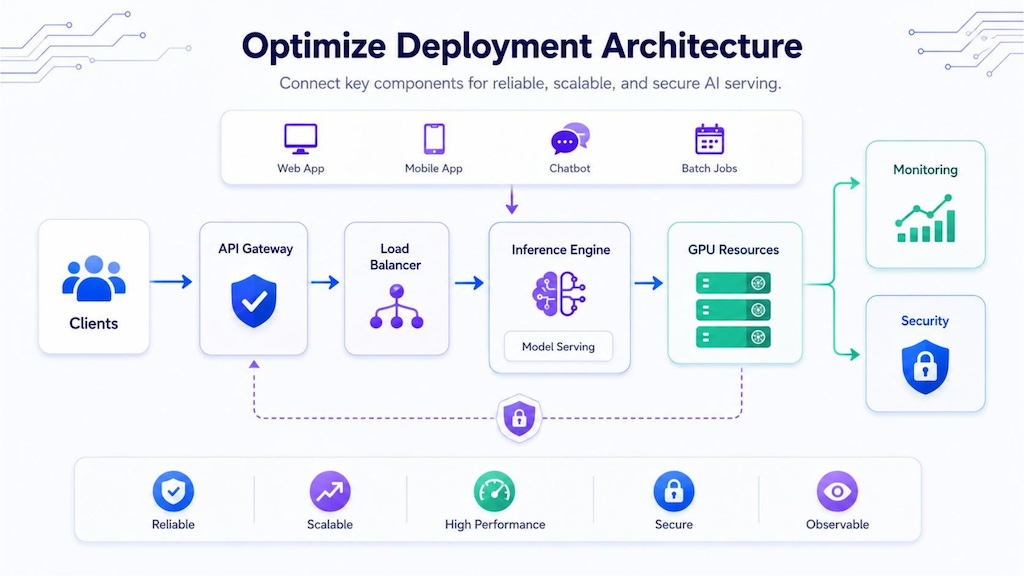
Optimized deployment architecture connects clients, APIs, inference engines, GPU resources, and security to deliver reliable, and high-performance AI serving.
5. LLM serving architecture
LLM serving architecture defines how user requests move from an application to the model and back to the user. A production setup usually includes an API gateway, load balancing, GPU infrastructure and an inference engine. Each layer helps improve reliability, scalability and operational control.
5.1. API gateway
The API gateway receives requests from applications and controls how they enter the serving system. It can handle authentication, routing, request validation, rate limits and API policies. This layer is important for enterprise use cases because it protects model endpoints and creates a consistent interface for applications.
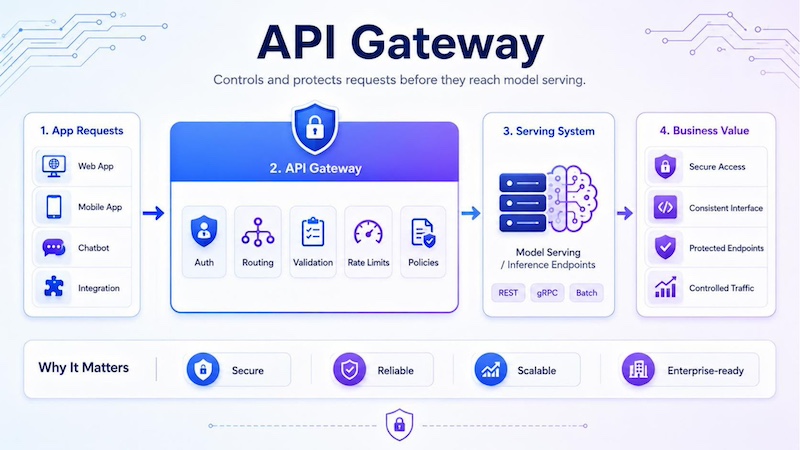
API Gateway protects model serving by managing authentication, routing, validation, rate limits, and policies before requests reach inference endpoints.
5.2. Load balancing
Load balancing distributes requests across available serving instances or GPU workers. This prevents one instance from becoming overloaded while others remain idle. For LLM inference, load balancing should consider request size, model type, GPU memory and queue length instead of only counting requests.
5.3. GPU cluster
The GPU cluster provides the compute foundation for running large models and high-volume inference. It may support multiple model replicas, distributed inference and autoscaling across nodes. Strong GPU infrastructure becomes more important when workloads require low latency, high throughput or large context windows.
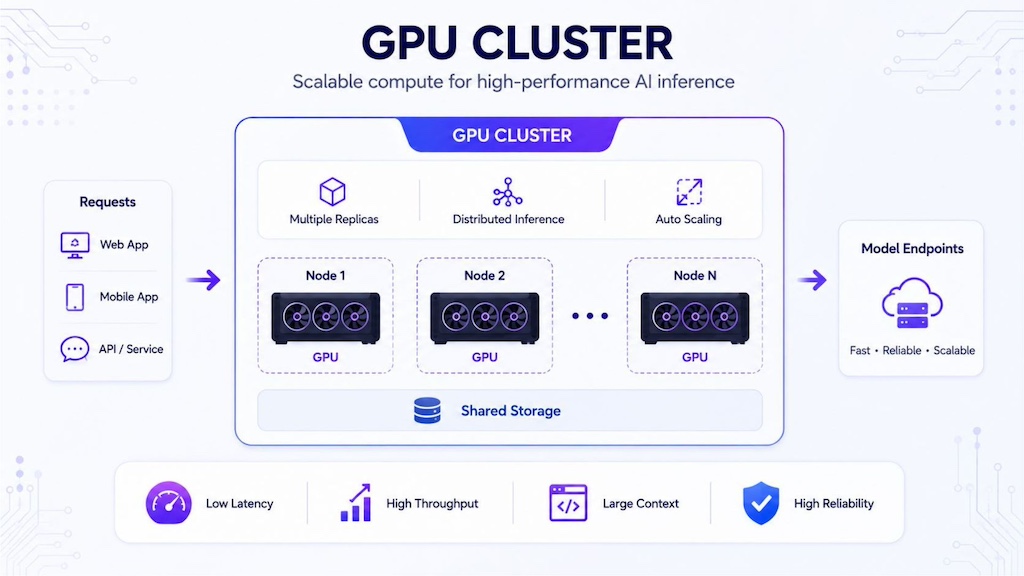
GPU Cluster provides scalable compute for high-performance AI inference, supporting multiple replicas, distributed serving, shared storage, and reliable model endpoints.
5.4. Inference engine
The inference engine executes the model and manages token generation. It may support batching, KV cache management, quantized models, model parallelism and efficient scheduling. Choosing the right inference engine helps teams improve performance without changing the user-facing application.
6. Common trade-offs in LLM inference optimization
Optimization usually involves trade-offs. A technique that improves one metric may affect another, so teams should evaluate changes with real prompts, expected traffic and business constraints. The goal is not always maximum speed, but the best balance between user experience, cost, quality and operational simplicity.
6.1 Latency vs Throughput
Batching can improve throughput by processing more requests together, but it may increase latency if requests wait too long in the queue. Real-time chat applications usually prioritize lower latency, while background summarization or batch processing workflows may accept longer waiting times for better efficiency.
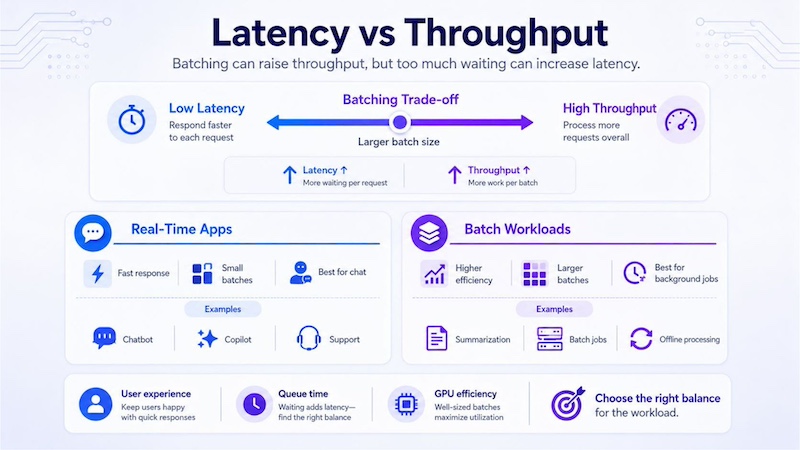
Latency vs throughput shows the trade-off between faster responses and higher serving efficiency.
6.2 Cost vs Performance
High-performance GPU infrastructure can improve speed and capacity, but it must be matched with workload demand. For variable inference workloads, Serverless Inference can help optimize infrastructure costs while maintaining scalability through API-based access, OpenAI-compatible APIs and dynamic scaling. This approach is useful when teams need production inference without managing the full serving layer manually.
6.3 Accuracy vs Compression
Compression techniques such as quantization and distillation can reduce memory usage and cost, but they may affect model quality if not tested properly. Teams should evaluate response accuracy, safety, reasoning behavior and domain-specific performance before using compressed models in production.
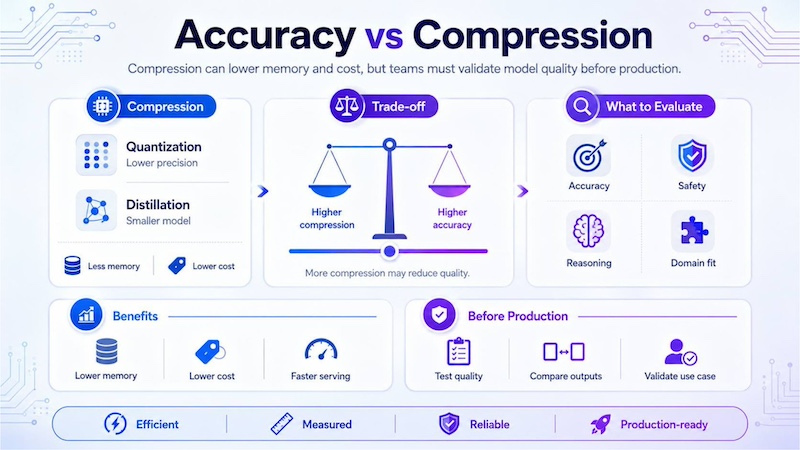
Accuracy vs compression shows the trade-off between lower serving cost and reliable model quality.
6.4 Simplicity vs Optimization complexity
Advanced optimization techniques can improve performance, but they also increase engineering complexity. A simple deployment may be easier to maintain for early-stage applications, while high-scale enterprise systems may justify more complex tuning, monitoring and infrastructure design. Teams should start with clear performance targets and optimize step by step.
LLM inference optimization requires the right balance of model techniques, serving architecture and GPU infrastructure. FPT AI Factory supports this process with GPU infrastructure, AI development tools and inference services for teams building chatbots, copilots, agents and enterprise AI applications. For businesses that need customized deployment or expert consultation, contact FPT AI Factory through the official contact form.
Contact information
- Hotline: 1900 638 399
- Email: support@fptcloud.com
Explore more articles:
B200 vs B300: A Compete Comparison of Blackwell GPUs
What Is GPU Computing and How Does It Work? A Complete Guide