
What is an AI data center and why is it becoming critical for modern enterprises? As AI adoption accelerates, organizations need specialized infrastructure to handle massive datasets and complex models. At FPT AI Factory, businesses can access scalable AI infrastructure and platforms to build, train, and deploy AI efficiently within a unified ecosystem
1. What is an AI data center?
An AI data center is a specialized facility designed to host the computing infrastructure required for training, deploying, and operating artificial intelligence applications and services. It is built with advanced compute resources, high-performance networking, and optimized storage systems to efficiently handle data-intensive AI workloads.
In addition, AI data centers are equipped with robust power delivery and advanced cooling technologies to support the intensive energy demands of large-scale AI processing.
A single rack of AI servers can consume more than 100 kW of power, significantly higher than traditional enterprise server racks.
Who needs an AI data center:
AI data centers are essential for organizations that require high-performance computing to run large-scale AI workloads, process massive datasets, and deploy intelligent applications in real time.
- Hyperscale cloud providers and technology companies developing AI and machine learning systems
- Research institutions running complex simulations and data-intensive scientific workloads
- Healthcare, finance, and biotech sectors requiring fast and accurate data processing
- Autonomous system developers working on robotics, drones, and self-driving technologies
- Enterprises with strict data security, governance, and compliance requirements
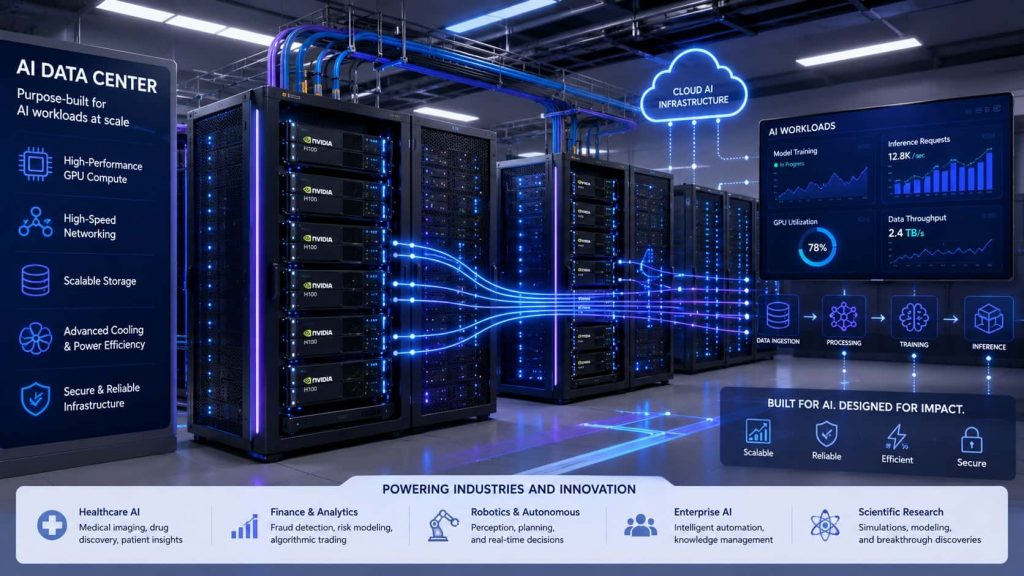
AI data centers are built to handle data-intensive AI operations
2. How AI data center architecture works
AI data center architecture is a core part of modern AI infrastructure, designed to integrate compute, storage, networking, and software layers into a unified system for handling large-scale AI workloads. It is built around GPU-centric computing, where high-performance GPU clusters form the main compute layer for training and inference at scale across distributed environments.
The architecture is also designed to handle continuous data growth from AI applications. High-performance storage enables fast access to training and inference data, while intelligent workload orchestration helps optimize resource usage and maintain cost efficiency. This combination ensures stable and scalable AI operations across different use cases.
>>> Read more: What is an AI Data Platform and How Does It Work?
3. Difference between AI data center vs traditional data center
Although AI data centers and traditional data centers both handle data storage and processing, they are built with fundamentally different design priorities. AI data centers focus on GPU-centric, high-density computing to support large-scale AI workloads, while traditional data centers are primarily CPU-based and optimized for general-purpose IT operations.
| Criteria | AI Data Center | Traditional Data Center |
| Compute architecture | GPU-centric, optimized for parallel AI processing | CPU-centric, designed for sequential general workloads |
| Networking | High-bandwidth, low-latency interconnects for distributed training | Standard networking for enterprise applications |
| Storage | High-throughput storage optimized for large-scale datasets | General-purpose storage systems for business data |
| Power & cooling | High-density power design with advanced liquid or hybrid cooling | Air-based cooling with standard power density |
| Workloads | AI training, deep learning, real-time inference workloads | Web hosting, databases, enterprise systems |
Overall, AI data centers require significantly higher compute density, faster data movement, and more advanced thermal management compared to traditional infrastructure. This makes them better suited for continuous GPU-intensive workloads, while traditional data centers remain optimized for stable and general-purpose computing tasks.
>>> Read more: GPU vs CPU: Key Differences and Which One to Choose for AI
4. Core components of an AI data center
An AI data center is built from several key infrastructure layers that work together to deliver high-performance computing for artificial intelligence workloads. These components are designed to ensure efficient processing, fast data movement, stable operation, and scalable deployment across large-scale AI systems.
- GPU-accelerated compute: The core processing layer that powers AI training and inference through parallel computing at scale.
- High-speed networking / interconnect: Enables fast, low-latency communication between compute nodes for distributed AI workloads. Modern AI data centers may use technologies such as NVIDIA NVLink for high-speed GPU-to-GPU interconnects, along with InfiniBand and RDMA-enabled networking to support low-latency, high-bandwidth communication across distributed GPU clusters.
- High-performance storage: Provides fast and reliable access to large datasets used in training, fine-tuning, and model execution.
- Power systems: Deliver stable, high-capacity energy to support dense and continuous GPU workloads.
- Cooling systems: Maintain optimal operating temperatures using advanced cooling methods for high-density infrastructure.
- Management & orchestration: Automates resource allocation, workload scheduling, and system monitoring to optimize performance and efficiency. Platforms such as Kubernetes and Slurm are commonly used to manage AI workloads across GPU clusters.
- AI-optimized hardware and software layers: Modern AI infrastructure may also include DGX and HGX systems, distributed training frameworks, and optimized inference engines to support large-scale model training, faster deployment, and more efficient model serving.
Together, these components form a tightly integrated infrastructure that enables AI data centers to operate efficiently at large scale while maintaining performance, stability, and flexibility.
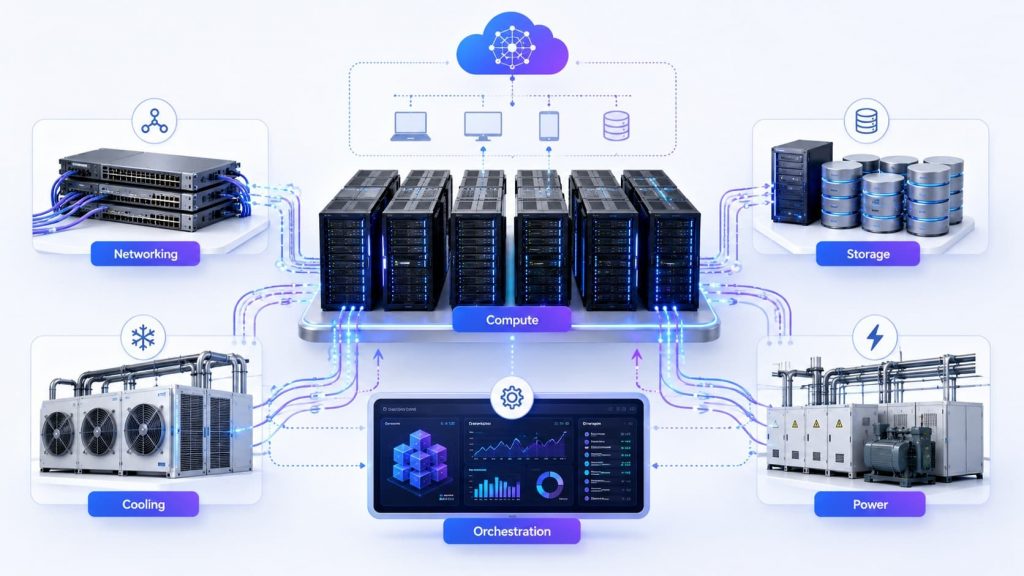
Core components enable scalable performance and efficient AI workload processing
5. How AI data centers support different AI workloads
AI data centers are designed to support the full lifecycle of AI workloads, from model training to real-time inference. By leveraging GPU computing, high-speed interconnects, and scalable storage systems, they enable efficient processing of large datasets while maintaining performance across different stages of AI deployment.
5.1 AI training workloads
AI training workloads require significant computational power to process large datasets and optimize model parameters, especially for LLMs (large language models). AI data centers handle this by distributing workloads across GPU clusters, enabling parallel processing and faster training times, while high-speed networking and storage ensure stable data flow and efficient resource utilization.
>>> Read more: Transfer Learning vs. Fine Tuning: A Comprehensive Guide
5.2 AI inference workloads
AI inference workloads focus on delivering predictions in real time, requiring low latency and high throughput. AI data centers optimize this stage through GPU acceleration and scalable infrastructure, allowing applications such as chatbots, recommendation systems, and real-time analytics to run efficiently even under heavy user demand.
6. Common use cases of AI data centers
AI data centers are widely used across industries that require large-scale computing power, high scalability, and real-time data processing. They support the entire AI lifecycle, from model development and training to deployment and inference at scale.
6.1 Training large AI models (LLMs)
AI data centers provide the high-performance computing resources needed to train LLMs (large language models) with billions of parameters. By distributing workloads across multiple GPUs and high-speed interconnects, they enable parallel processing of massive datasets, helping reduce training time while maintaining model accuracy and stability.
6.2 Fine-tuning enterprise models
Organizations use AI data centers to adapt pre-trained models to specific business needs. Fine-tuning allows models to be optimized for domain-specific tasks such as customer support automation, financial analysis, healthcare applications, and recommendation systems, improving accuracy and real-world performance.
6.3 Running AI applications in production
AI data centers support the transition of AI models from development to live production environments. Common applications include real-time chatbots, fraud detection systems, advanced search engines, and dynamic personalization engines. These workloads require a highly stable infrastructure with ultra-low latency and high availability to ensure consistent service delivery.
6.4 Supporting AI research
Research institutions and AI laboratories rely on these data centers to test novel algorithms, build experimental prototypes, and run large-scale simulations. Access to high-density computing resources accelerates the pace of innovation and shortens the development cycles for groundbreaking AI research.
6.5 Large-scale inference systems
AI data centers enable large-scale inference by processing millions of real-time requests simultaneously. This is critical for global applications serving a massive user base, where high throughput and minimal response latency are essential for maintaining system performance and user experience.
For enterprises requiring a flexible GPU environment for training or testing without the immediate need to build a full-scale AI data center, GPU Virtual Machines are an ideal solution. This allows for on-demand access to high-performance compute resources, facilitating rapid experimentation and cost-effective scaling.
>>> Read more: Transformer Architecture in AI: How it works in practice
7. Challenges of AI data centers
Despite their strong performance and scalability advantages, AI data centers also introduce several challenges that organizations need to carefully evaluate before deployment and operation.
- High upfront cost: Establishing an AI data center requires significant investment in advanced hardware such as GPUs, storage systems, networking infrastructure, as well as supporting software and facility setup
- Operational complexity: Managing AI infrastructure is more complex than traditional systems due to tightly integrated components that require specialized technical skills for configuration, monitoring, and maintenance
- Power demand: AI workloads consume large amounts of energy, especially during continuous training and inference processes, which can increase operating costs and raise sustainability concerns
- Physical infrastructure constraints: High-density computing systems require sufficient space for servers, cooling equipment, and power distribution, which may limit deployment options for some organizations
- Fast technology evolution: AI hardware and software evolve rapidly, making it necessary for organizations to continuously upgrade infrastructure to maintain performance and avoid obsolescence
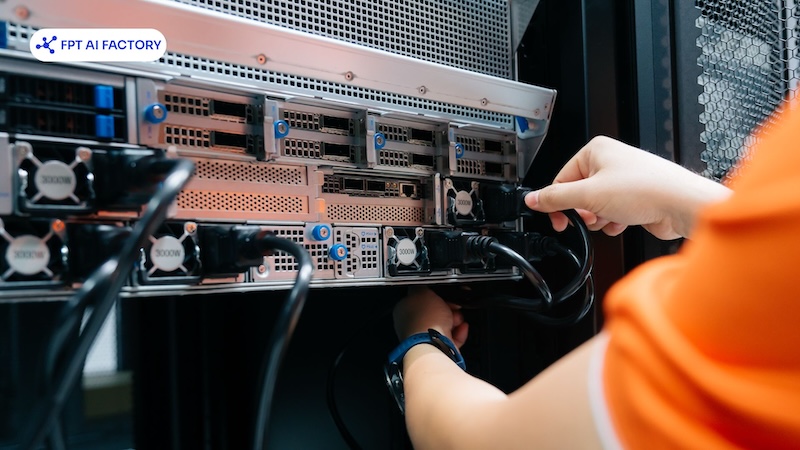
High cost and operational complexity are key challenges of AI data centers (Source: FPT AI Factory)
8. Future of AI Data Centers
The future of AI data centers will be shaped by continuous advancements in AI hardware and infrastructure, with innovations like next-generation accelerators, high-speed connectivity, and intelligent management systems improving performance, scalability, and efficiency.
Key trends include:
- Adoption of next-generation GPUs and AI accelerators with higher compute density and improved efficiency
- Expansion of intelligent infrastructure management using AI for real-time optimization, automation, and predictive maintenance
- Integration of advanced cooling technologies, including liquid and hybrid cooling systems, to support higher power density workloads
- Development of more energy-efficient and sustainable architectures to reduce operational impact
- Growth of distributed and cloud-native AI infrastructure to support global-scale AI applications
- Increasing use of AI-driven analytics to improve operational decision-making and resource utilization
AI data centers are expected to become more autonomous and intelligent, optimizing performance in real time while improving efficiency, reducing costs, and supporting future AI-driven innovation.
9. FAQs
9.1. What is the difference between a data center and an AI data center?
An AI data center is optimized for GPU-intensive workloads, high-speed networking, and AI model training, while a traditional data center primarily supports general IT applications and business systems.
9.2. Why do AI data centers use GPUs?
GPUs can process thousands of operations simultaneously, making them significantly more efficient than CPUs for training and running AI models.
9.3. How much does an AI data center cost?
Costs vary depending on scale, but enterprise AI data centers can require millions of dollars in hardware, power, cooling, and networking infrastructure.
In conclusion, understanding what is an AI data center is essential for organizations aiming to scale AI efficiently with GPU centric infrastructure, high speed networking, and optimized storage systems. These environments power model training, inference, and large scale AI applications across industries. At FPT AI Factory, users can start instantly with a $100 credit, simply log in and use it right away. For enterprises or organizations with customized or large scale requirements, tailored solutions are available via the official contact form.
Contact information:
- Hotline: 1900 638 399
- Email: support@fptcloud.com
Explore related article: