
AAAI-26, held in Singapore, brought together some of the world’s leading research groups in Artificial Intelligence. FPT Smart Cloud, a member of FPT Corporation, had two representatives presenting applied research projects at the conference.
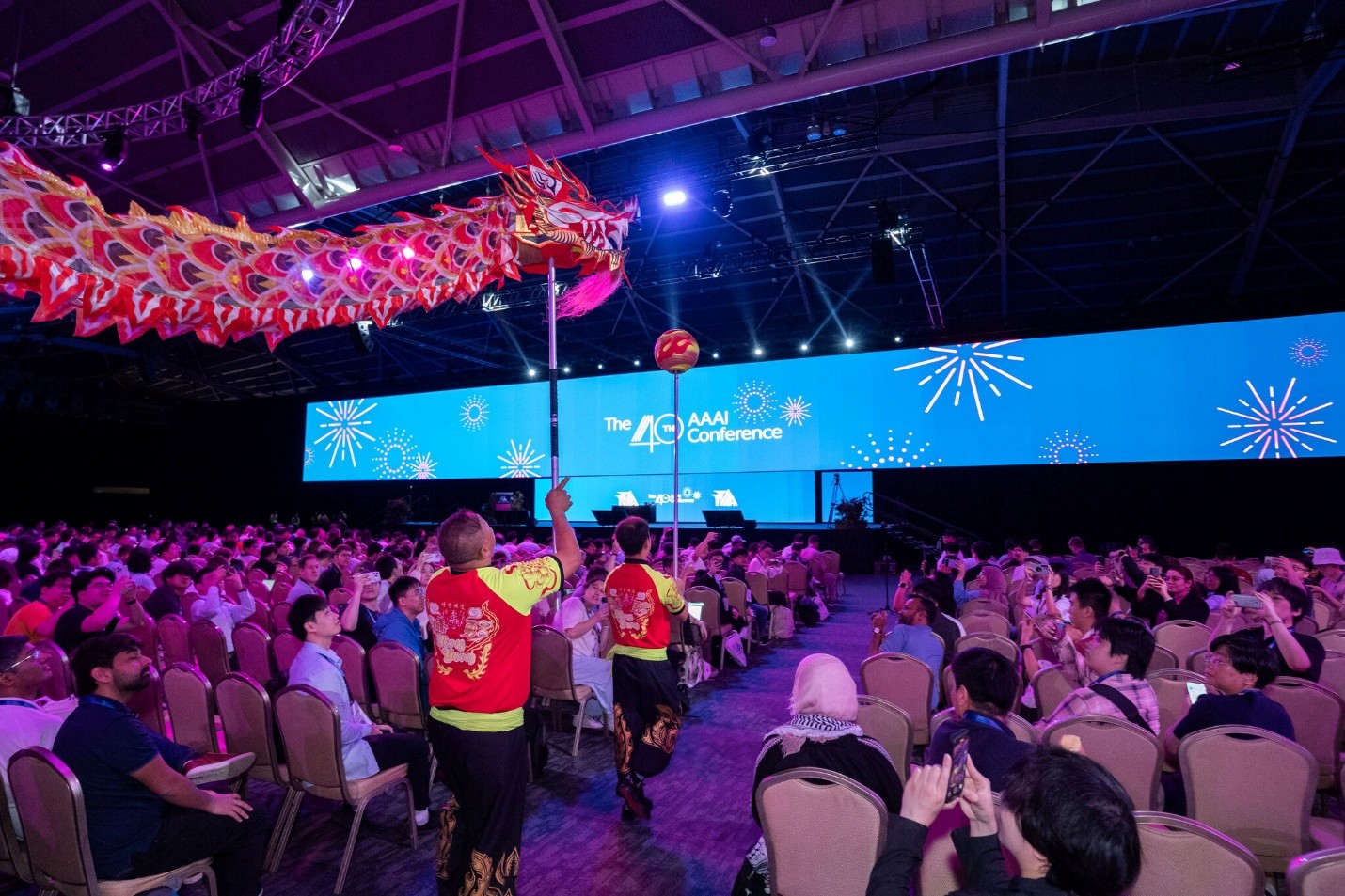
AAAI-26 (the 40th Annual AAAI Conference on Artificial Intelligence) is the 40th annual meeting of the Association for the Advancement of Artificial Intelligence, one of the most prestigious academic conferences in the field. Hosted in Singapore in early 2026, the event featured top global research teams and followed a rigorous peer-review process with a low acceptance rate. This year, only about 17.5% of submissions were accepted, reflecting intense competition. Of those, just 3% were selected for in-person presentation at the conference.
Behind the two research projects presented at AAAI-26 was strong support from FPT AI Factory, an AI ecosystem that provides end-to-end services across the research lifecycle. By leveraging its infrastructure, deployment environment, and AI services for inference and validation, two engineers from FPT Smart Cloud were able to complete highly applicable technology projects tailored for enterprise use.
A Small AI Model That Learns to “Behave Properly” from a Larger Model
Nguyen Thi Ngan (born in 2000) represented her team in presenting the paper titled “CTPD: Cross Tokenizer Preference Distillation”. The research introduces a distillation method that transfers human-aligned response behavior between models using different tokenizers. The author team includes Truong Nguyen, Phi Van Dat, Ngan Nguyen, Linh Ngo Van, Trung Le, and Thanh Hong Nguyen. Their shared goal was clear: build a model that is “small yet strong” and practical for real-world deployment.

In AI deployment, large language models often deliver high-quality responses but come with high operational costs. Businesses therefore tend to choose smaller models to ensure faster performance and more efficient resource usage, especially for high-volume applications like chatbots. The challenge is that smaller models often struggle to produce responses that align with human expectations as well as larger, carefully trained models do.
According to Ngan, CTPD enables a smaller model to learn human-aligned response styles from a stronger model, even when the two models use different tokenizers.
“We developed a way for the smaller model to learn how to respond in a way that aligns with user expectations from a larger model that already performs well. The key is that even if the two models segment text differently, we align them using character positions in the original sentence,” she explained.
In simple terms, instead of forcing both models to tokenize text in the same way, CTPD anchors the alignment to the original sentence and uses character positions as a shared reference point. This allows the smaller model to learn preferred response behaviors without being constrained by differences in tokenization.
In principle, the method can be applied across industries such as customer service, law, and banking, as long as there is data structured in the form of one question paired with two answers, with a clear indication of which answer is preferred. Because the AI learns directly from these preference signals, it can be adapted to industry-specific response standards.
To validate the method, the team conducted transfer experiments from Qwen to Llama and evaluated performance on benchmark datasets including ARC, HellaSwag, Winogrande, MMLU, TruthfulQA, and GSM8K. Results showed that CTPD delivered consistent improvements over baseline methods, especially in enterprise settings where model families are frequently updated or replaced.
Throughout multiple training and fine-tuning iterations, FPT AI Factory played a critical role by providing pretrained models, computing infrastructure, and training environments. Model version tracking, performance comparison, and hyperparameter optimization were managed on a centralized platform, reducing trial-and-error time. This support enabled the team to refine results just days before the submission deadline.
Ngan emphasized the practical value of the work:
“This paper presents a way to transfer human-aligned response styles from a powerful model to a smaller one, so that the smaller model can still respond naturally while being easier to deploy. We hope this approach helps the community reuse existing strong models to create compact, cost-effective, and practical solutions for various tasks.”
Looking ahead, the team plans to focus more deeply on specialized domains such as healthcare and education, where standards for “good answers” are clearly defined and safety requirements are strict. By maintaining human-aligned performance in smaller models, they aim to shorten the path from research to enterprise deployment.
Download paper: https://arxiv.org/abs/2601.11865
Learning in Groups with AI Agents: Structured, Process-Oriented Problem Solving
The second FPT Smart Cloud research team at AAAI-26 was represented by Dr. Tran Van Khanh, an AI engineer. The team introduced “SAGE: A Compositional Multi-Agent LLM Framework with Pedagogical Reasoning for Structured Collaborative Problem Solving.” The work addresses a familiar challenge in online education: students studying alone often lose motivation; group study can become chaotic; and teachers find it difficult to design structured and pedagogically sound group-learning scenarios.
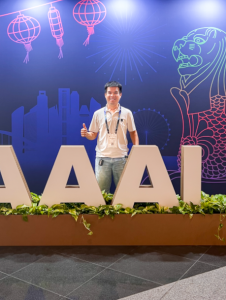
According to the team, SAGE is an “AI-powered group learning” framework. Instead of relying on a single chatbot that simply answers questions, the system creates a team of AI “study partners,” each with a clear role.
The framework simulates a realistic group study session:
- One AI agent acts as a facilitator, reminding participants of goals and progress.
- One agent serves as a subject-matter expert, providing knowledge and solution guidance.
- One agent plays the role of motivator, reducing stress and maintaining engagement.
By assigning distinct roles, the system balances task completion with the learner’s emotional experience, rather than focusing solely on producing correct answers.
A notable feature of SAGE is its mechanism that determines when an AI agent should speak and when it should remain silent. In many previous systems, speaking turns are rigidly assigned, making discussions feel unnatural and sometimes encouraging student dependency. With SAGE, agents autonomously decide whether to intervene and what to say based on the learning context. This results in discussions that feel more like authentic group interactions and reduces the risk of the AI providing solutions too early.
Pedagogically, SAGE operates using a scaffolding approach in two phases. In the offline planning stage, the system generates a structured instructional script to reduce lesson design workload. During interactive learning, AI agents initially provide substantial support to prevent learners from getting stuck. As students demonstrate understanding, the system gradually reduces assistance, encouraging independent problem-solving. This transition helps students move from dependence to autonomy instead of passively receiving answers.
Dr. Tran Van Khanh noted that developing SAGE required multiple rounds of complex interaction testing and behavioral measurement. FPT AI Factory supported the team by building training and inference pipelines, tracking performance across model versions, and integrating experimental evaluation tools. With ready-to-use computing infrastructure and resource management mechanisms, the team was able to control costs and latency during experimentation rather than rebuilding infrastructure each time model configurations changed.
The team tested SAGE on Grade 12 curriculum problems and reported a 72.13% win rate in pedagogical effectiveness compared to several alternative approaches under their evaluation setup. According to their observations, when AI agents provide support at the right moment and step back appropriately, students tend to become more confident, participate more actively, and follow clearer problem-solving processes instead of jumping straight to final answers.
SAGE is well suited for online education platforms, collaborative problem-solving training programs, and virtual classroom simulations designed to strengthen teamwork skills. For teachers and instructional designers, the system reduces the time and expertise required to create structured group-learning scenarios. For students, it shortens the period of uncertainty about where to start by guiding them step by step, while still aiming for full learner autonomy.
From cost optimization in AI deployment to improving the quality of learning experiences, these two projects reflect FPT’s application-driven approach to AI: solving concrete problems in measurable and scalable ways. They also lay the foundation for deeper specialization in the future, turning academic research from leading global conferences into practical value for businesses and the broader community.