
Artificial intelligence has advanced rapidly through large-scale model training, but the industry is now entering a new phase. As models move into real-world deployment, the challenge is no longer how to build them, but how to operate them efficiently at scale. This transition is placing increasing pressure on GPU cloud infrastructure, where performance, scalability, and cost efficiency are becoming critical factors.
In production environments, infrastructure decisions such as GPU selection, scaling strategy, and cost optimization are foundational. Once deployed, these choices are difficult to reverse, making it essential to align infrastructure with long-term workload requirements from the outset.
This article takes a practical look at NVIDIA GPU platforms, focusing on HGX B300, HGX H200, and HGX H100, and how each supports modern AI workloads.
The Shift from AI Training to Inference
AI workloads are evolving beyond model training toward continuous, large-scale deployment. Once in production, models serve millions or even billions of requests, making real-world usage the dominant driver of compute demand.
Unlike training, which happens intermittently, deployed systems must operate continuously across diverse applications. These range from autonomous agents performing multi-step reasoning and tool orchestration, to large-scale LLM serving copilots and assistants, as well as complex reasoning tasks such as coding and problem-solving.
At the same time, AI capabilities are expanding into multimodal domains that combine text, image, and video, alongside real-time systems such as voice interfaces and interactive applications. These scenarios require not only scale, but also consistent responsiveness and high concurrency.
As these workloads become more demanding, infrastructure requirements are shifting. Systems must now deliver sustained throughput, low latency, and efficient resource utilization in production environments. This change is accelerating demand for GPU cloud and driving a new wave of data center expansion centered around real-world AI deployment.
Expanding AI Cloud Capabilities with NVIDIA HGX B300
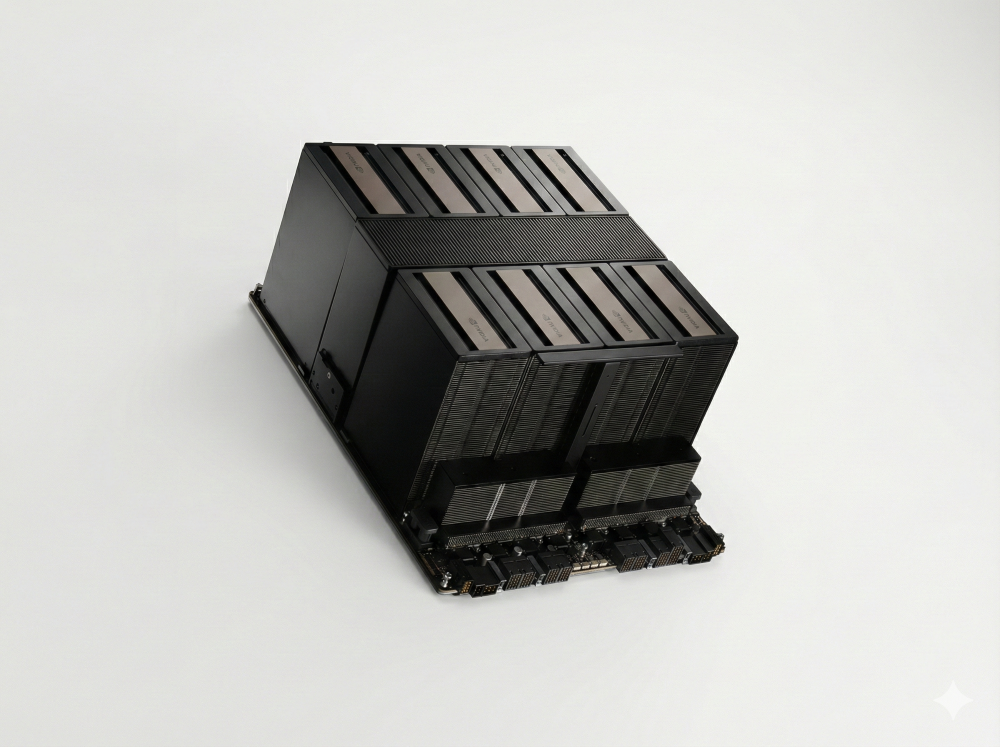
As AI systems grow in complexity, the limitations of previous-generation GPUs are becoming increasingly visible. Workloads that involve longer context windows, continuous interactions, and higher concurrency place pressure not just on computer, but on memory capacity and inter-GPU communication. Architectures originally optimized for training often struggle to support these patterns efficiently at scale.
NVIDIA HGX B300 addresses these challenges by introducing a new class of GPU infrastructure tailored for modern AI workloads. The platform brings together higher memory capacity, increased throughput, and next-generation interconnects to support more demanding applications.
Each GPU provides up to 192 GB of HBM3e memory, with total system memory exceeding 2 TB in an 8-GPU configuration. This allows large models to run without fragmentation while maintaining efficiency. At the same time, improvements in NVLink and NVSwitch bandwidth enable faster communication between GPUs, supporting more complex and tightly coupled workloads.
Operational efficiency is another key advantage. Higher utilization, reduced latency, and improved throughput make HGX B300 particularly well-suited for production environments where both performance and cost per inference must be carefully balanced.
How does NVIDIA HGX B300 Level Up GPU Cloud?
To understand how NVIDIA HGX B300 advances AI inference in practice, it’s useful to look at how it compares with previous-generation NVIDIA GPUs such as H200 and H100.
While all three are designed for AI workloads, they are optimized for different priorities from balanced compute performance to memory capacity and large-scale inference efficiency.
| Specification | NVIDIA HGX B300 | NVIDIA HGX H200 | NVIDIA HGX H100 |
| Architecture | Blackwell | Hopper | Hopper |
| AI Compute (FP8) | Higher (optimized with FP4/FP8) | ~4 PFLOPS | ~4 PFLOPS |
| FP4 Support | Native | X | X |
| GPU Memory | ~192 GB HBM3e (per GPU) |
141 GB HBM3e | 80 GB HBM3 |
| Memory Bandwidth | >5 TB/s | ~4.8 TB/s | ~3.35 TB/s |
| Total System Memory (8 GPU) |
~2.1 TB | ~1.1 TB | ~640 GB |
| Interconnect | NVLink 5 (next gen) | NVLink 4 | NVLink 4 |
| LLM Throughput | Up to 11–15× | ~1.2× | 1× |
| Inference Efficiency | Significantly higher (FP4) | Improved | Baseline |
| Latency (Inference) | Lowest (real-time ready) | Lower | Standard |
| Best For | Agentic AI / real-time inference | Long-context / RAG workloads | Training & inference |
Source: NVIDIA
Taken together, these improvements position NVIDIA HGX B300 as a significant step forward in the GPU cloud. Larger memory capacity, higher bandwidth, and support for advanced precision formats such as FP4 translate into improved efficiency and scalability for demanding AI workloads.
Performance benchmarks further highlight this advantage, with NVIDIA HGX B300 delivering up to 11–15× higher LLM inference throughput per GPU compared to the Hopper generation. This makes it particularly effective for systems that require high concurrency and real-time responsiveness.
Meanwhile, NVIDIA HGX H100 and HGX H200 continue to provide strong and reliable performance across a wide range of use cases. HGX H100 remains a versatile option for both training and mixed workloads, while HGX H200 extends this capability with increased memory capacity, making it well-suited for memory-intensive applications such as long-context processing and retrieval-augmented generation.
From an infrastructure standpoint, selecting the right GPU depends not only on peak performance, but on how well each platform aligns with workload characteristics, scaling requirements, and cost efficiency.
Final Thoughts
As AI systems move into production at scale, high-performance GPU computing requirements are undergoing a fundamental shift. Incremental improvements are no longer sufficient. Instead, organizations and AI developers need platforms that can support increasingly complex workloads with consistent performance and operational efficiency.
NVIDIA HGX B300 represents this shift. Designed to handle modern AI workloads, it enables real-time applications and supports the growing demands of production-scale systems.
At FPT AI Factory, NVIDIA HGX B300 is delivered through a unified GPU cloud platform, allowing organizations and AI builders to access next-generation infrastructure with simplified deployment and seamless scalability. By removing infrastructure complexity, FPT AI Factory helps teams accelerate the transition from experimentation to production.
👉 Explore more: https://factory.fpt.ai
👉 Secure early access to NVIDIA HGX B300: https://short.factory.fpt.ai/MqcjA