
What is sovereign AI and why is it becoming one of the most critical priorities for governments and businesses worldwide? Sovereign AI refers to a nation’s or organization’s ability to develop, own, and control AI infrastructure, data, and capabilities entirely within its own borders and governance frameworks. At FPT AI Factory, we provide end-to-end AI solutions designed to help countries and businesses build true AI sovereignty, from data localization to full-stack model deployment.
1. What is Sovereign AI?
Sovereign AI is the ability of a nation or organization to develop, deploy, and govern artificial intelligence that they fully own and control. Rather than depending on foreign technology providers, sovereign AI ensures that the entire intelligence stack remains within a defined jurisdiction and governed by local rules. According to McKinsey, sovereign AI is not about owning technology for its own sake, it’s about retaining full control over the entire AI lifecycle.
It’s important to understand that sovereign AI goes far beyond data residency. A country or enterprise may keep data within its borders and still have little control over who trains the models, who operates the infrastructure, or how governance decisions are made. True sovereign AI means controlling the full AI lifecycle, compute, data pipelines, model development, deployment environments, and governance framework.

Sovereign AI is the ability of a nation or organization to develop AI
2. Why is Sovereign AI Important?
As AI becomes central to national security, economic competitiveness, and enterprise operations, the question of who controls AI has never mattered more. McKinsey estimates that roughly 40% of the total value of AI depends on sovereign or sovereign-equivalent solutions, which makes this a strategic economic priority, not just a compliance concern.
2.1. Sovereign AI for National Priority
Governments around the world increasingly view AI capabilities as critical national infrastructure, similar to energy networks, telecommunications systems, and cloud computing platforms. As AI becomes a key driver of economic growth, innovation, and national security, many countries are incorporating Sovereign AI into their national AI strategies to strengthen technological independence and long-term competitiveness.
Investments in Sovereign AI typically focus on:
- Building domestic AI infrastructure, including high-performance computing (HPC) and sovereign cloud environments.
- Supporting the development of local foundation models that reflect national languages, cultures, and regulatory requirements.
- Strengthening control over sensitive government, defense, healthcare, and citizen data.
- Reducing reliance on foreign technology providers and mitigating geopolitical risks.
- Developing AI talent, research ecosystems, and public-private partnerships to accelerate innovation.
This trend can be seen across multiple regions. The European Union is investing in AI factories and digital sovereignty initiatives, while countries such as France, Germany, Japan, South Korea, Singapore, Saudi Arabia, and the United Arab Emirates are expanding investments in domestic AI infrastructure and national AI programs. These efforts reflect a growing recognition that AI sovereignty is becoming an important component of national competitiveness in the digital economy.
2.2. Sovereign AI for Organizations and Businesses
Beyond government initiatives, organizations are increasingly adopting Sovereign AI to gain greater control over their data, infrastructure, and AI operations. As regulatory requirements evolve and concerns around privacy, security, and vendor dependency grow, Sovereign AI offers a framework for deploying AI while maintaining ownership and governance over critical assets.
Key benefits of Sovereign AI include:
- Greater control over data and infrastructure: Ensure sensitive data never leaves your environment
- Lower dependence on external AI providers: Reduce exposure to geopolitical risk and supply chain disruption
- Better compliance with local regulations: Align with data localization laws, sector-specific mandates, and national AI policies
- Stronger protection for sensitive data: Critical for defense, healthcare, finance, and public services
- More control over model deployment and governance: Define who can access, audit, and modify AI systems
- Reduced vendor lock-in: Avoid single-provider dependencies that limit flexibility and drive up long-term costs
- Support for national or enterprise AI strategies: Sovereign AI is a foundation for building lasting competitive advantage

Key reasons organizations and governments are prioritizing sovereign AI
3. How does Sovereign AI work?
Sovereign AI is not a single technology, it’s a coordinated system of controls spanning the entire AI lifecycle. Each layer works together to ensure that data, compute, models, and governance all remain within a defined boundary. Here’s how each component functions in practice.
3.1 Data control and residency
Data control is the starting point of any sovereign AI system. All data must be collected, stored, and processed within an infrastructure that the organization or nation directly controls, it cannot leave a defined geographic or legal boundary.
This involves applying end-to-end encryption, granular access controls, and continuous data lineage tracking throughout the data lifecycle. Beyond being a technical requirement, data residency is increasingly a legal obligation under frameworks such as GDPR or national data protection laws.
3.2. Sovereign compute infrastructure
To achieve true sovereign AI, AI workloads must run on secure, regulation-compliant infrastructure located within domestic boundaries. Rather than relying entirely on foreign public cloud providers, organizations and governments build or procure dedicated GPU and compute resources.
Whether on-premise, hybrid cloud, or through sovereign cloud providers operating under local regulatory frameworks. This layer ensures that training pipelines, inference services, and model orchestration all remain within the organization’s control.
3.3. Model training and fine-tuning
In a sovereign AI setup, model training and fine-tuning must happen within a controlled internal environment, free from third-party dependencies. AI models need to be governed and fine-tuned internally, allowing for national or organizational oversight and customization without external influence. This means building dedicated data pipelines, selecting appropriate model architectures, and maintaining full control from data preparation through to performance evaluation
3.4. Deployment and inference control
Once a model is developed, deployment and inference must also remain within a controlled environment. The inference process, which uses trained models to make predictions or decisions, must be fully auditable and traceable within national or organizational control, with no external dependencies or risk of data leakage. This ensures every AI-generated output can be traced, explained, and audited in line with legal or internal requirements.
3.5. Governance, security, and access management
Governance is the connective layer that holds the entire sovereign AI system together. Organizations are increasingly adopting a “governance by design” approach, embedding accountability, transparency, and traceability throughout the AI lifecycle, from model design all the way through to deployment. This includes identity management, role-based access control, activity logging, and automated compliance checks built directly into AI development and operations pipelines.
3.6. Compliance with local laws and policies
Sovereign AI cannot be separated from the local regulatory environment in which it operates. Designing AI solutions within a sovereign environment requires consistent application of sovereignty controls across the entire AI lifecycle, from data sourcing and labeling to training, fine-tuning, deployment, inference, monitoring, and model retirement.
This is especially critical for organizations in regulated sectors such as finance, healthcare, and the public sector, where non-compliance carries significant legal and operational risk.
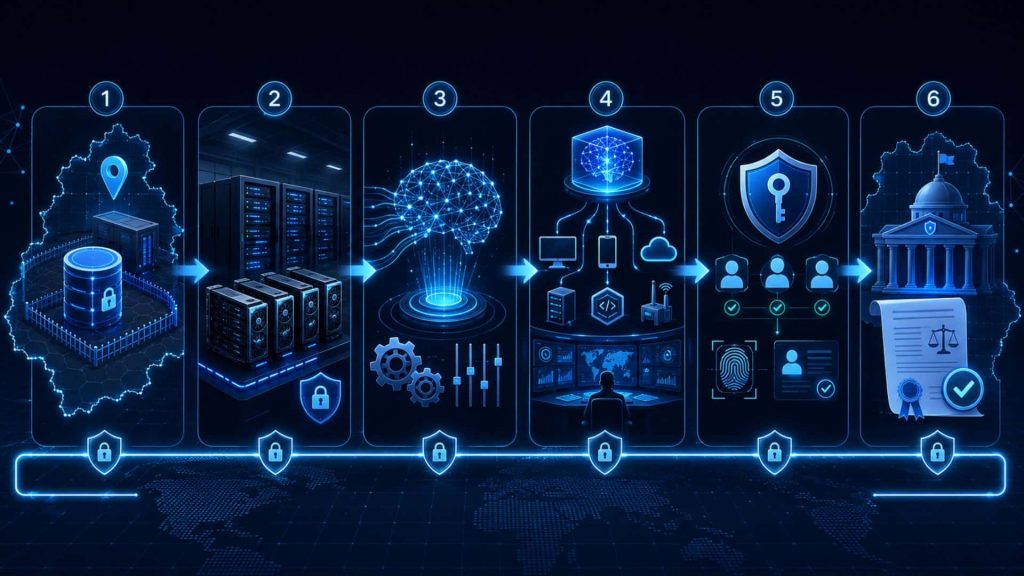
Each layer works together to ensure that data all remain within a defined boundary
4. Sovereign AI vs Data Sovereignty vs Cloud Sovereignty
Sovereign AI, data sovereignty, and cloud sovereignty are related but different concepts. In short, data sovereignty focuses on legal control over data, cloud sovereignty focuses on control over cloud infrastructure, while sovereign AI covers the broader ability to build and govern AI with controlled data, infrastructure, models, and talent.
| Criteria | Sovereign AI | Data Sovereignty | Cloud Sovereignty |
| Definition | The ability to develop, deploy, and govern AI using controlled infrastructure, data, workforce, and business networks. | The principle that data is subject to the laws of the country or region where it is generated, stored, or processed. | The ability to use cloud services while maintaining control over data location, access, operations, and legal jurisdiction. |
| Main focus | AI capability, model independence, compute power, and strategic control over AI systems. | Legal and regulatory control over data. | Cloud infrastructure, data residency, operational control, and compliance. |
| Scope | Broadest scope: Data, models, compute, talent, governance, and AI ecosystem. | Narrower scope: Data location, processing, access, and legal authority. | Covers cloud platforms, hosting, operations, security, and data handling. |
| Infrastructure control | Requires control over AI infrastructure such as data centers, GPUs, HPC, and deployment environments. | Infrastructure control is not always required, but data must follow local legal requirements. | Infrastructure control is central, especially for local hosting, sovereign regions, or restricted administrator access. |
| Data control | Important because local and domain-specific data is often used for training, fine-tuning, and inference. | Core requirement: Focuses on where data is stored, processed, transferred, and accessed. | Important for data residency, encryption, access management, and cross-border transfer control. |
| Model control | Key requirement: Includes control over model training, fine-tuning, deployment, evaluation, and ownership. | Usually not focused on AI models unless the data is used in AI training or processing. | May support AI model hosting, but the main focus is cloud platform control rather than model ownership. |
| Governance requirement | Requires AI governance, model risk management, cybersecurity, transparency, and compliance. | Requires privacy compliance, data classification, access control, retention policies, and transfer rules. | Requires vendor oversight, auditability, identity management, encryption, and operational resilience. |
| Example | SEA-LION is an open-source multilingual AI model family designed to understand Southeast Asian languages, cultures, and contexts. | IBM’s explanation of data sovereignty notes that data is governed by the laws of the country or region where it is generated or processed. | Google Sovereign Cloud offers data residency and administrative access controls for governments and enterprises. |
5. Key layers of a Sovereign AI stack
NVIDIA CEO Jensen Huang described AI as a “five-layer cake,” spanning energy, chips and computing infrastructure, cloud data centers, AI models, and the application layer. In the context of sovereign AI, each of these layers must be owned, controlled, or governed at an appropriate level to avoid dependency on external parties.
5.1. Energy
Energy is the most foundational layer of the sovereign AI stack. Sovereign AI clusters consume enormous amounts of electricity, making power costs a major constraint for any nation or organization building at scale. Countries are increasingly investing in renewable energy infrastructure to ensure both sustainability and energy independence alongside AI development. Canada’s TELUS, for example, has built its AI factory running on 99% renewable energy.
5.2. Chips & Compute
GPUs and AI chips are the backbone of the entire sovereign AI stack. NVIDIA alone supplies GPUs for 52% of all tracked sovereign AI infrastructure projects globally. For countries and organizations pursuing genuine AI sovereignty, securing stable and controlled access to compute resources is a prerequisite. This layer determines the capacity for model training, fine-tuning, and inference across the entire system.
5.3. Cloud infrastructure
The cloud infrastructure layer encompasses data centers, storage systems, networking, and workload orchestration platforms. Infrastructure sovereignty means an organization’s ability to manage its AI workloads, including compute, storage, and networking, within trusted, locally governed environments, rather than depending entirely on external platforms.
5.4. AI models
The model layer is where intelligence is actually built. Model projects within sovereign AI, including government-backed efforts to develop or adapt foundation models for local languages and contexts, make up approximately 34% of all sovereign AI projects tracked globally. Controlling this layer means the organization decides which models are used, when they are updated, and who has access, without depending on foreign model providers.
5.5. Applications
The application layer is where sovereign AI translates into real-world value for end users. This is the layer that ministries, enterprises, and institutions interact with directly, from government chatbots and healthcare analytics systems to enterprise automation tools. To maintain sovereignty at the application layer, organizations need to establish continuous monitoring and auditing systems that provide unified visibility into AI operations while remaining compliant with sovereignty requirements throughout.
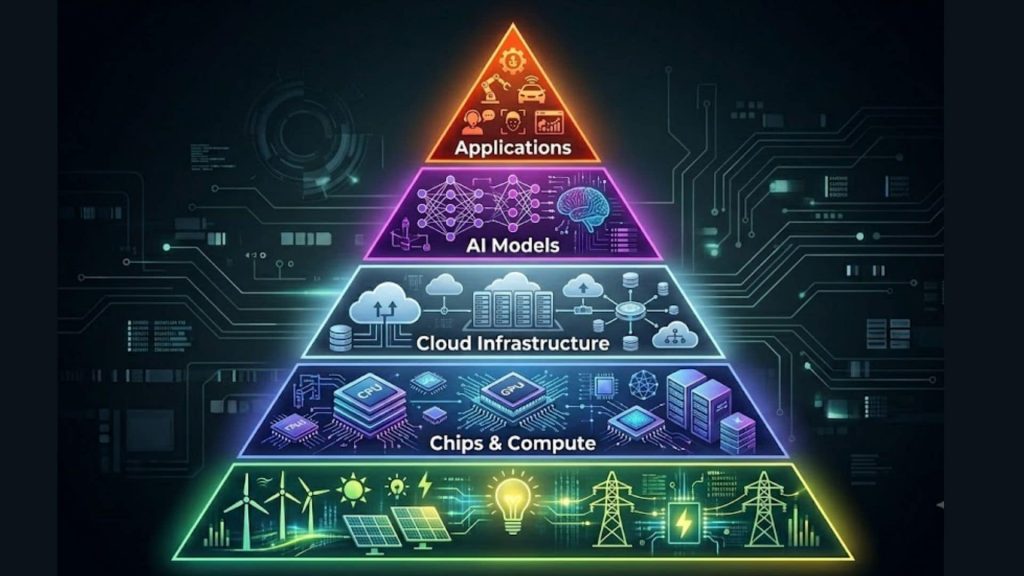
Five key layers of Sovereign AI infrastructure
6. Key components of Sovereign AI infrastructure
Building sovereign AI requires more than access to AI models. Organizations also need a comprehensive infrastructure layer to support controlled computing, secure data management, model development, deployment, and governance throughout the AI lifecycle.
6.1 Controlled compute infrastructure
Sovereign AI needs compute infrastructure that an organization or country can control for model training, fine-tuning, and production AI workloads. This usually includes GPU capacity, high-performance networking, storage, and deployment environments that can meet internal governance, security, and compliance requirements.
For example, FPT AI Factory’s GPU Virtual Machine provides access to NVIDIA H100/H200 GPU options, local NVMe storage, root access, and scalable GPU configurations, supporting AI teams that need controllable GPU compute for training, fine-tuning, or running AI workloads in a governed infrastructure environment.

FPT AI Factory’s GPU Virtual Machine provides access to NVIDIA H100/H200 GPU options (Source: FPT AI Factory)
6.2 Secure data storage and data pipelines
Data is the foundation of sovereign AI, so organizations need secure storage and controlled data pipelines to collect, clean, classify, move, and use data without exposing it to unauthorized systems or jurisdictions. This includes encryption, access control, audit logs, data residency policies, and data lineage across the AI lifecycle. These capabilities help ensure that data used for AI development remains traceable, protected, and aligned with local compliance requirements.
6.3 Model development and fine-tuning environment
A sovereign AI stack also needs a controlled environment where AI teams can explore data, build prototypes, test models, and fine-tune foundation models without losing visibility over datasets, code, and experiments. Notebook environments are especially useful because they give data scientists and ML engineers a reproducible workspace for experimentation.
FPT AI Factory’s AI Notebook is designed for exactly this, giving data scientists and ML engineers an interactive notebook environment to process data, prototype models, and fine-tune AI within a governed AI workflow.

FPT AI Factory’s AI Notebook is designed for giving data scientists and ML engineers (Source: FPT AI Factory)
6.4 Model deployment and inference layer
Once a model is ready, deploying it reliably and at scale is the next challenge. In sovereign AI, inference infrastructure must be auditable, controllable, and capable of running within defined boundaries, while still being practical for development teams to operate.
Businesses that need to expose AI capabilities through APIs, without the overhead of building and managing their own inference infrastructure, can use FPT AI Factory’s Serverless Inference to deploy models quickly while keeping operational control within a governed environment.
FPT AI Factory’s Serverless Inference helps deploy models quickly (Source: FPT AI Factory)
6.5 Monitoring, security, and access governance
Sovereign AI infrastructure must include continuous monitoring, identity and access management, cybersecurity controls, and governance policies for models, data, users, and infrastructure. These controls help organizations detect misuse, manage model risk, prove compliance, and ensure that sensitive data and AI outputs remain within approved boundaries.
7. Sovereign AI use cases
Sovereign AI is not a theoretical concept, it is already being adopted across industries where data sensitivity, regulatory pressure, and strategic autonomy are non-negotiable.
7.1 Government and public sector AI
Government agencies handle some of the most sensitive data in existence, from citizen identity records to national security intelligence. Deploying AI on foreign infrastructure creates both legal and geopolitical risks. Governments are already deploying large language models for internal use, with private GPU instances per agency, air-gapped environments to prevent data leakage, and fully auditable, locally compliant responses.
For example, France mandates its highest cloud security standard, SecNumCloud 3.2, for all public sector organizations and institutions in defense, healthcare, and finance. In September 2025, Mistral’s “Le Chat” assistant was integrated into a SecNumCloud 3.2-certified environment, enabling government agencies to use generative AI while meeting strict national security and GDPR compliance requirements.
7.2 Healthcare and sensitive data applications
Healthcare is one of the clearest use cases for sovereign AI. Patient data is legally protected under frameworks like HIPAA in the US and equivalent laws in other jurisdictions, meaning sending clinical data to a third-party cloud AI service can create direct compliance violations. Sovereign AI in healthcare enables organizations to protect sensitive patient data while running AI-driven diagnostics and research, ensuring compliance with stringent health data regulations
To shed light on this, Arvato Systems implemented a hybrid sovereign cloud solution for AOK, one of Germany’s largest health insurers, migrating 7,000 servers, 3,000 applications, and 24,000 users while maintaining full GDPR and PDSG compliance and zero downtime throughout the migration.
7.3 Banking, finance, and regulated industries
Financial institutions operate under some of the world’s most demanding regulatory frameworks, with strict requirements around data residency, auditability, and risk controls. Financial services institutions are leveraging sovereign AI to strengthen fraud detection and risk assessment, while keeping sensitive financial data protected, and using it to support AI-driven regulatory compliance and risk mitigation strategies.
According to McKinsey, regulated industries like healthcare, banking, and defense are currently seeing limited AI adoption precisely because sovereign AI offerings are not yet widely available, making the gap between demand and supply one of the biggest blockers to AI adoption at scale in these sectors.
7.4 Enterprise AI platforms
Large enterprises increasingly want to run AI on their own terms without depending on a shared public cloud environment. According to an IBM Institute for Business Value study, approximately 79% of executives believe AI will positively impact their revenue by 2030, but rapid adoption is also creating new dependencies on AI infrastructure and raising concerns around control, compliance, and competition.
A global bank might deploy a private AI platform for internal document analysis, risk modeling, and customer service automation, with models fine-tuned on proprietary financial data that never leaves the organization’s infrastructure.
7.5 National language and local AI models
One of the most compelling sovereign AI use cases is the development of AI models that reflect local languages, cultural context, and regulatory norms, something that general-purpose, English-first global models cannot do adequately. Many AI models will need to be specific to local languages and context, with use cases in healthcare, education, and agriculture varying greatly between developed and emerging economies.
For example, India’s $1.2 billion IndiaAI Mission, launched in February 2024, selected Sarvam AI to develop the country’s first foundational model trained on local language datasets, joining a growing list of nations building sovereign LLMs, including France (Mistral), UAE (Falcon), Singapore (SEA-LION), and Saudi Arabia (ALLaM).
7.6 Private AI workloads for businesses
Beyond regulated industries, businesses of all sizes are running AI workloads that require isolation, performance control, and governance, whether for competitive reasons, data sensitivity, or operational reliability. Containerized AI deployments allow organizations to run workloads in isolated, reproducible environments that can scale without compromising on control.
FPT AI Factory’s GPU Container is purpose-built for this, enabling businesses to deploy containerized AI workloads in an environment that supports easy scaling, workload isolation, and governance alignment, without the complexity of managing bare-metal infrastructure.
For example, a fintech company running proprietary credit-scoring models might use GPU containers to deploy and update models independently across multiple environments, which maintain full control over who can access the model, how it’s versioned, and where the output data goes.

FPT AI Factory’s GPU Container is purpose-built for enabling businesses to deploy containerized AI workloads (Source: FPT AI Factory)
8. Challenges of building Sovereign AI
Although sovereign AI offers greater control, security, and strategic independence, it is difficult to build at scale. Organizations and governments must balance infrastructure cost, technical complexity, regulatory requirements, talent shortages, and long-term operational sustainability.
- High infrastructure investment: Sovereign AI requires large spending on data centers, GPUs, networking, storage, security systems, and operations.
- Shortage of AI and infrastructure talent: Building sovereign AI is not only a hardware project. It also requires AI researchers, data engineers, MLOps teams, cybersecurity specialists, cloud architects, and governance experts who can operate complex AI systems safely.
- Complex governance and compliance requirements: Sovereign AI must meet privacy laws, sector regulations, AI governance standards, audit requirements, and internal risk policies. This becomes harder when AI systems use sensitive data or make decisions in regulated sectors such as healthcare, finance, and public services.
- Difficulty balancing openness and control: Organizations may want to use open-source models, global research, and external tools, but they must also protect data, infrastructure, and intellectual property. Too much control can slow innovation, while too much openness can increase sovereignty and security risks.
- Model performance and scalability challenges: Local or sovereign models may need significant data, compute, and engineering work to match the quality of leading global models. They also need scalable inference systems to handle real-world traffic without high latency or unstable performance.
- Energy, GPU availability, and operational cost: Sovereign AI depends heavily on GPU capacity and reliable power. As demand for AI infrastructure grows worldwide, organizations may face GPU shortages, rising energy costs, and pressure to operate data centers sustainably.
- Risk of vendor lock-in if architecture is not designed carefully: Even a sovereign AI project can become dependent on one cloud provider, model vendor, hardware supplier, or proprietary platform. To reduce this risk, organizations should design portable architectures, use open standards where possible, and keep clear ownership of data, models, and deployment workflows.

Organizations and governments must balance challenges when building sovereign AI
9. FAQs
9.1 Why do countries and businesses need Sovereign AI?
Countries and businesses need sovereign AI to keep strategic control over their data, AI models, infrastructure, and decision-making processes. For governments, this helps protect national security, public services, healthcare, finance, and culturally relevant AI systems. For businesses, it supports compliance with local regulations, protects proprietary data, and reduces dependence on foreign or third-party technology providers during geopolitical, legal, or economic disruptions.
9.2 Is Sovereign AI only for governments?
No, sovereign AI is not only for governments. While the concept is often discussed at the national level, enterprises also use sovereign AI to control where data is stored, who can access it, how AI models are trained, and how systems are governed. Industries such as banking, healthcare, telecommunications, defense, and manufacturing may adopt sovereign AI to meet privacy, compliance, security, and operational-control requirements.
9.3 What infrastructure is needed for Sovereign AI?
Sovereign AI requires secure and scalable infrastructure, including local or jurisdiction-controlled data centers, high-performance computing such as GPUs, secure cloud or hybrid-cloud platforms, protected data storage, networking, cybersecurity controls, model governance systems, and skilled AI talent. Beyond hardware, organizations also need rules for data access, encryption, auditing, model lifecycle management, and compliance with local laws.
9.4 How does Sovereign AI reduce vendor lock-in?
Sovereign AI reduces vendor lock-in by giving organizations more control over their AI stack instead of relying entirely on one proprietary cloud, model provider, or foreign technology platform. This can include using portable architectures, open standards, hybrid or multi-cloud deployment, local infrastructure, and clear ownership of data, models, and intellectual property. As a result, businesses and governments can move workloads, change providers, or operate critical AI systems independently when needed.
If you are ready to put sovereign AI into practice, explore FPT AI Factory today. New users will receive a free $100 credit after registering for the reward through the banner, automatically added to their account within approximately 3 minutes after registration, with no setup delay required.
- $10 for GPU Container and $10 for GPU Virtual Machine
- $10 for AI Notebook and $70 for AI Inference & AI Studio
- Access to up to 5M tokens with Llama-3.3 and 20+ other state-of-the-art models
For enterprises or organizations with needs for customization or large-scale sovereign AI deployment, please contact FPT AI Factory directly via the official contact form to receive tailored support and dedicated solutions.
In short, understanding what sovereign AI is only the beginning, the real value comes from acting on it. If you are still evaluating how sovereign AI fits into your organization’s infrastructure strategy, our specialists are available to help you design an approach that aligns with your compliance requirements, data governance goals, and operational scale. Contact through the official contact form.
Contact Information:
- Hotline: 1900 638 399
- Email: support@fptcloud.com
Explore more articles
What is Physical AI? How it works, use cases and challenges
What Is AI Infrastructure? Key Components and How It Works
What is an AI Data Platform and How Does It Work?