

What is vLLM and why is it widely used for large language model deployment? As generative AI moves into production, vLLM helps improve inference speed, GPU memory efficiency and scalability. With FPT AI Factory, organizations can access GPU-powered infrastructure to support reliable, high-performance AI workloads.
|
Key Takeaways: vLLM improves large language model serving by optimizing GPU memory usage, increasing throughput and reducing inference latency. Here are the key points to remember:
|
FPT AI Factory provides enterprise AI infrastructure that helps organizations develop, deploy and scale production AI applications. With GPU Container, GPU Virtual Machine, GPU Cluster and Serverless Inference, teams can optimize model serving, improve GPU utilization and support large-scale inference workloads. Organizations with custom AI requirements or enterprise-scale infrastructure needs can contact the FPT AI Factory team for tailored solutions.
1. What Is vLLM?
1.1. Definition of vLLM
vLLM is a high-performance inference framework developed for serving transformer-based large language models. In this term, LLM stands for large language model, which refers to AI models trained to understand and generate text, code or other language-based outputs. The lowercase “v” is part of the framework’s name and is commonly associated with a virtualized, optimized serving layer for LLM workloads.
Unlike frameworks primarily designed for model training, vLLM focuses exclusively on inference performance. Its architecture allows multiple requests to share GPU resources efficiently while maintaining low latency, making it well suited for production AI services that must support many concurrent users.
The framework has gained widespread adoption because it integrates easily with existing AI ecosystems and supports widely used APIs, enabling developers to migrate applications without extensive modifications.
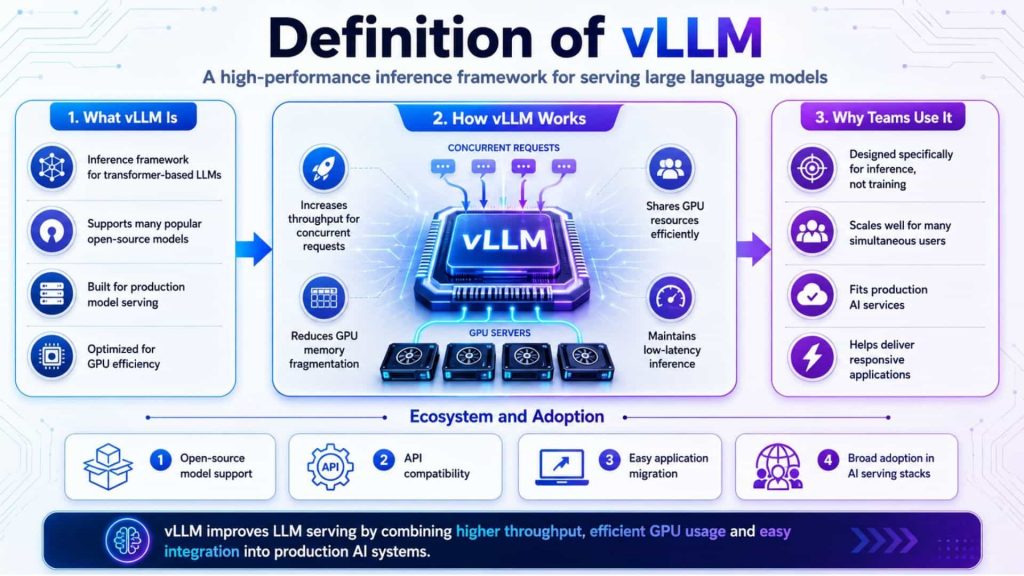
vLLM enables high-throughput, low-latency LLM inference through efficient GPU resource sharing and broad model compatibility.
1.2. Role of vLLM in improving LLM serving performance
Serving large language models efficiently involves much more than loading a model into GPU memory. Every user request requires continuous token generation, memory allocation, scheduling and cache management. As workloads increase, inefficient resource utilization quickly becomes a bottleneck.
vLLM addresses these challenges by introducing innovations such as PagedAttention and continuous batching, which improve both GPU utilization and request throughput. Instead of allocating memory statically for every request, the framework dynamically manages GPU resources so that more inference requests can be processed simultaneously.
This optimization allows organizations to:
- reduce inference latency
- increase request throughput
- improve GPU utilization
- lower serving costs
- support larger numbers of concurrent users
As AI workloads continue to grow, these improvements become increasingly valuable for enterprises deploying generative AI applications at scale.
After understanding what vLLM is and why it improves model serving, the next step is to examine the challenges that make inference optimization necessary in the first place. Learning more about LLM Inference Optimization also helps explain why techniques such as memory optimization, batching and GPU scheduling have become essential components of modern AI infrastructure.
2. Why LLM Inference Needs Optimization
Large language models deliver impressive capabilities, but serving them efficiently remains challenging. Models with billions of parameters require significant GPU memory and computing resources, which can lead to higher costs, slower response times and limited scalability. Modern inference frameworks such as vLLM address these challenges by improving resource utilization while maintaining high-quality model outputs.
2.1. Large model size
Modern foundation models often contain billions or even hundreds of billions of parameters. Loading these models into GPU memory requires significant computational resources before inference can even begin.
Larger models also generate larger key-value (KV) caches during token generation, increasing memory requirements throughout each conversation. Without efficient memory management, organizations may need additional GPUs simply to serve growing user demand.
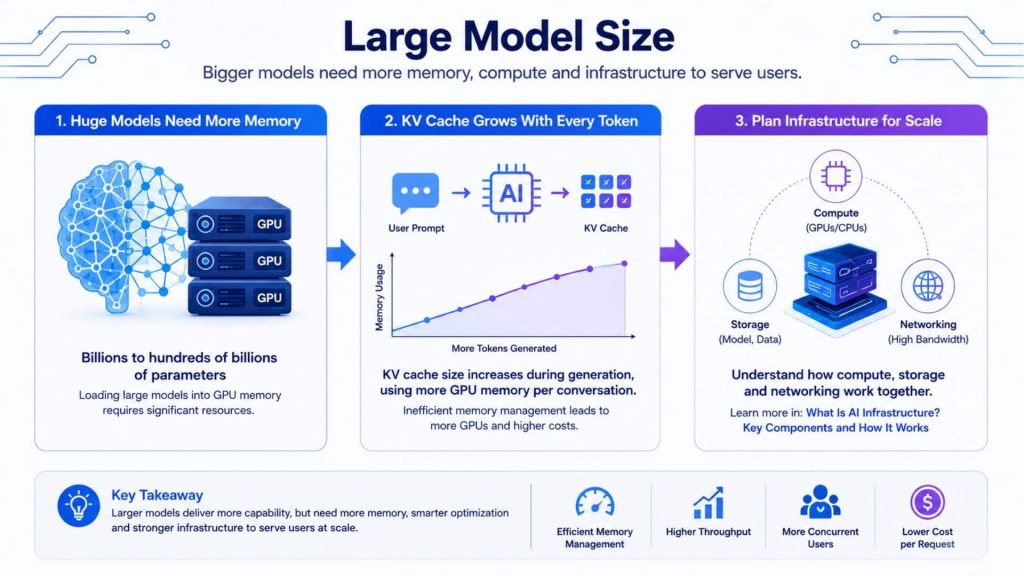
Larger models require more GPU memory, growing KV cache capacity and scalable AI infrastructure.
2.2. High GPU memory usage
GPU memory is one of the most valuable resources in LLM inference. During response generation, the model must store weights, intermediate activations and the key-value (KV) cache that preserves conversational context. As prompts become longer or multiple users interact with the model simultaneously, memory consumption increases rapidly.
Traditional inference frameworks often allocate GPU memory conservatively to avoid allocation failures, which can leave significant portions of memory underutilized. This inefficiency reduces the number of concurrent requests a GPU can support and increases the infrastructure cost required to serve production workloads.
For enterprise AI platforms, efficient GPU memory management is critical because it directly affects throughput, scalability and operating expenses. By reducing memory waste, organizations can serve more users without continuously adding new GPU resources.
2.3. Increasing user requests
Generative AI applications are expected to respond quickly regardless of how many users access the service simultaneously. Enterprise chatbots, AI assistants, document analysis platforms and code generation tools may receive thousands of concurrent requests during peak periods. If the inference engine cannot process these requests efficiently, response queues become longer and user experience deteriorates.
A common challenge is that traditional serving frameworks often execute requests independently, limiting GPU utilization and reducing overall throughput. As user demand grows, organizations may be forced to deploy additional GPU servers simply to maintain acceptable response times, increasing infrastructure costs.
Modern inference frameworks such as vLLM are designed to process multiple requests dynamically while keeping GPUs fully utilized. This enables AI platforms to support significantly higher request volumes using the same hardware resources.
Organizations planning large-scale AI deployment should also understand how AI infrastructure supports scalable inference through optimized compute, networking and resource orchestration. These architectural components work together to maintain reliable performance as workloads continue to grow.
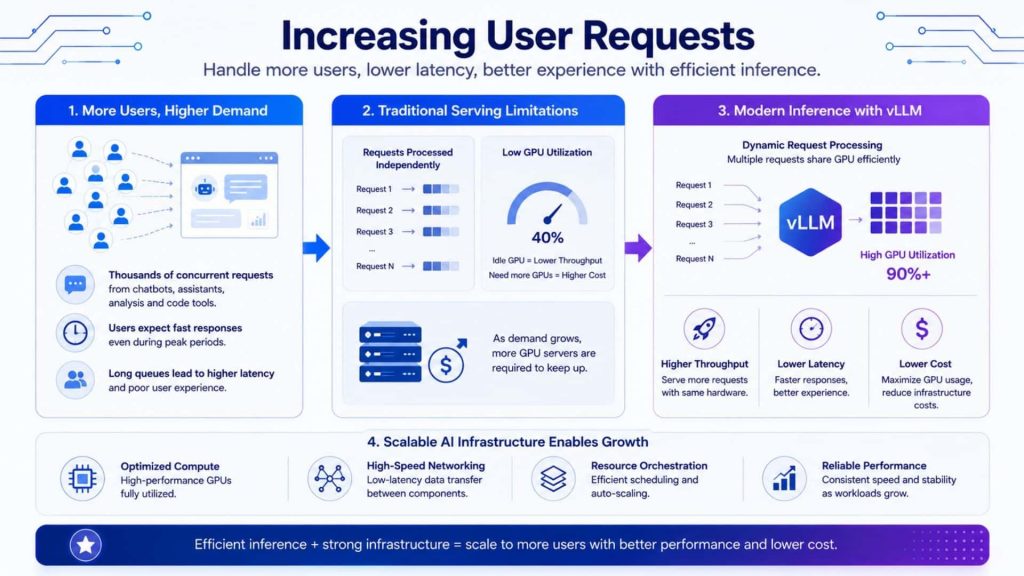
vLLM handles growing user demand with higher GPU utilization, lower latency and scalable inference.
2.4. Slow response generation
Inference latency has a direct impact on the usability of AI applications. Whether users are interacting with customer service chatbots, virtual assistants or code generation tools, they expect responses to begin almost immediately. Even small delays can reduce user satisfaction and affect the perceived quality of AI services.
Response generation involves much more than predicting the next token. Every generated token requires repeated attention calculations, memory access and GPU computation. As conversations become longer or models become larger, latency naturally increases unless the serving engine optimizes these operations.
Modern inference engines improve response generation by reducing unnecessary memory operations, scheduling requests more efficiently and maximizing GPU utilization throughout the inference process. These optimizations allow models to deliver lower latency while maintaining high throughput for concurrent users.
After examining the main inference challenges, the next section explores how vLLM addresses these limitations through PagedAttention, continuous batching and efficient LLM serving techniques, enabling organizations to deploy production AI applications with better scalability and lower infrastructure costs.
3. How vLLM Works
vLLM improves LLM serving by managing GPU memory more efficiently and scheduling multiple requests dynamically. Its core techniques—PagedAttention, continuous batching and optimized model serving—help reduce memory waste, increase throughput and maintain low latency as workloads scale. For a broader view, LLM inference optimization explains how memory management, batching and GPU scheduling improve production AI performance.
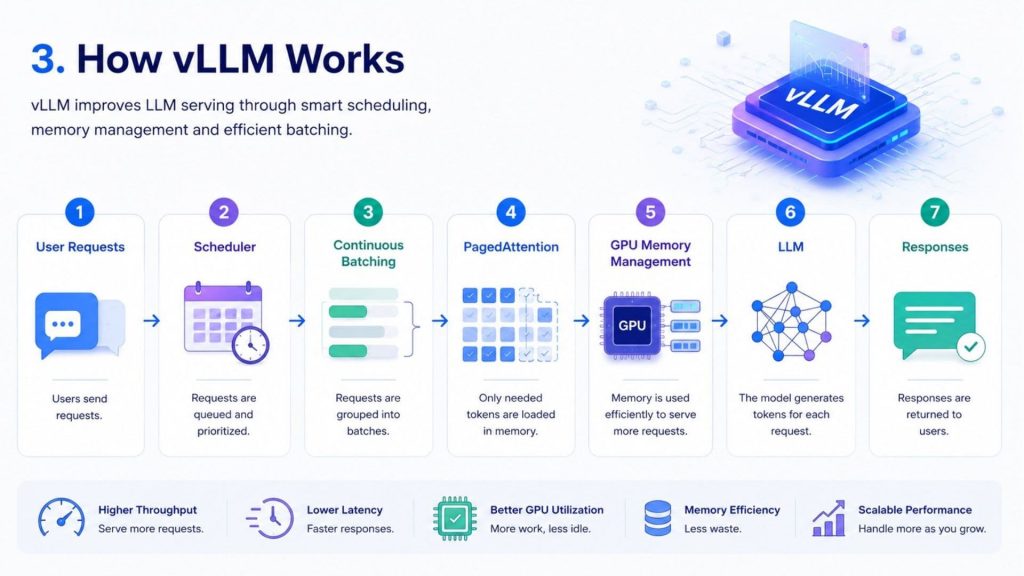
vLLM improves LLM serving through efficient scheduling, batching, and GPU memory management for faster, lower-latency inference.
3.1 PagedAttention: How vLLM Reduces GPU Memory Waste
One of vLLM’s most important innovations is PagedAttention, a memory management technique designed specifically for large language model inference. Traditional inference frameworks typically allocate continuous blocks of GPU memory for each request, which often leads to fragmentation and unused memory. As conversations vary in length, these fixed allocations become increasingly inefficient.
PagedAttention addresses this problem by organizing the key-value (KV) cache into smaller memory blocks, similar to how virtual memory works in modern operating systems. Instead of reserving one large continuous memory region, vLLM allocates only the memory blocks that are actually required. This significantly reduces wasted GPU memory while allowing the KV cache to expand dynamically as conversations grow.
Because GPU memory is used more efficiently, the same hardware can serve more concurrent inference requests without increasing memory requirements. Organizations can therefore improve overall throughput while reducing infrastructure costs.
In addition to improving memory utilization, efficient KV cache management also helps maintain stable inference performance for long conversations and high-volume AI applications.
As enterprise AI deployments continue to scale, understanding the relationship between GPU memory efficiency and inference performance becomes increasingly important.
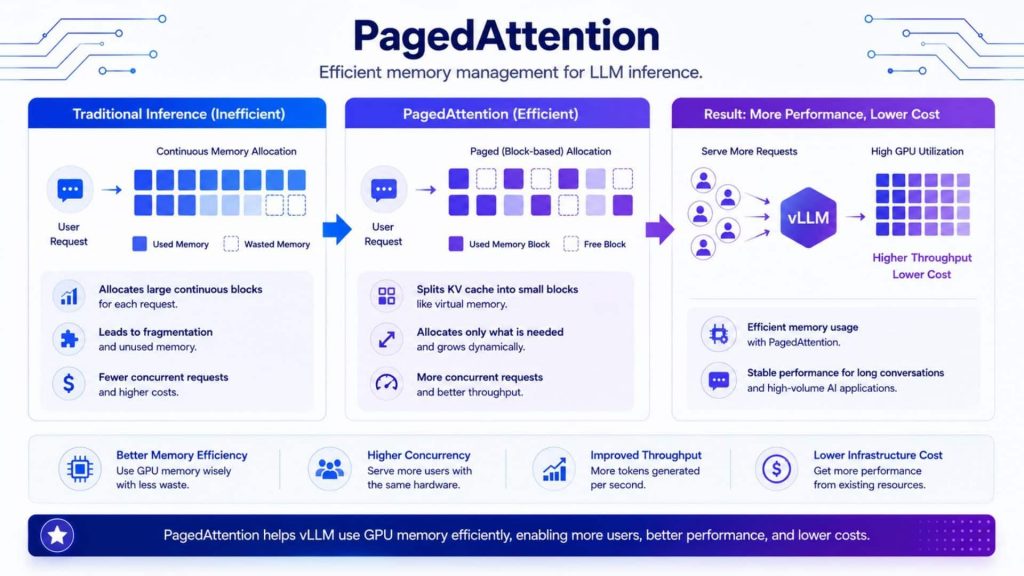
PagedAttention reduces GPU memory waste, enabling higher throughput, more concurrent requests and lower inference costs.
3.2 Continuous batching
Traditional LLM serving systems often process requests in fixed batches. Once a batch begins execution, new user requests must wait until the current batch finishes before they can be processed. This scheduling approach leaves GPU resources idle and increases response latency during periods of heavy demand.
vLLM overcomes this limitation through continuous batching, which dynamically adds new requests to the inference pipeline whenever GPU resources become available. Instead of waiting for an entire batch to complete, the scheduler continuously accepts incoming requests and processes them alongside existing workloads.
This dynamic scheduling provides several advantages:
- Higher GPU utilization by reducing idle compute time.
- Greater throughput because more requests can be processed simultaneously.
- Lower response latency for newly arriving user requests.
- Improved scalability during fluctuating traffic patterns.
Continuous batching is particularly valuable for production AI services such as customer support assistants, enterprise chatbots and document analysis platforms, where request volumes can change rapidly throughout the day. By keeping GPUs consistently busy, organizations can deliver a smoother user experience while making better use of existing hardware investments.
After understanding how requests are scheduled more efficiently, the next step is to examine how these optimizations contribute to faster and more scalable LLM serving overall.
3.3 Efficient LLM serving
The combination of PagedAttention and continuous batching enables vLLM to deliver significantly more efficient LLM serving than many traditional inference frameworks. By optimizing both memory allocation and request scheduling, the framework minimizes unnecessary GPU overhead while maximizing the amount of useful computation performed.
One of the most noticeable improvements is faster token generation. Because GPU resources are utilized more effectively, generated tokens can be produced with lower latency, resulting in faster responses for end users. This improvement is especially important for conversational AI applications where responsiveness directly affects user experience.
Efficient resource management also provides better scalability. As demand grows, organizations can support a larger number of concurrent users without proportionally increasing GPU infrastructure. This allows enterprises to expand AI services more cost-effectively while maintaining consistent performance across production workloads.
These advantages make vLLM well suited for AI applications that require high-throughput inference, including virtual assistants, code generation tools, document processing systems and enterprise knowledge assistants.
After understanding how vLLM improves model serving internally, the next section explores the practical benefits organizations can expect when adopting vLLM for production AI deployments, including faster inference speed, higher throughput, better GPU utilization and lower serving costs.
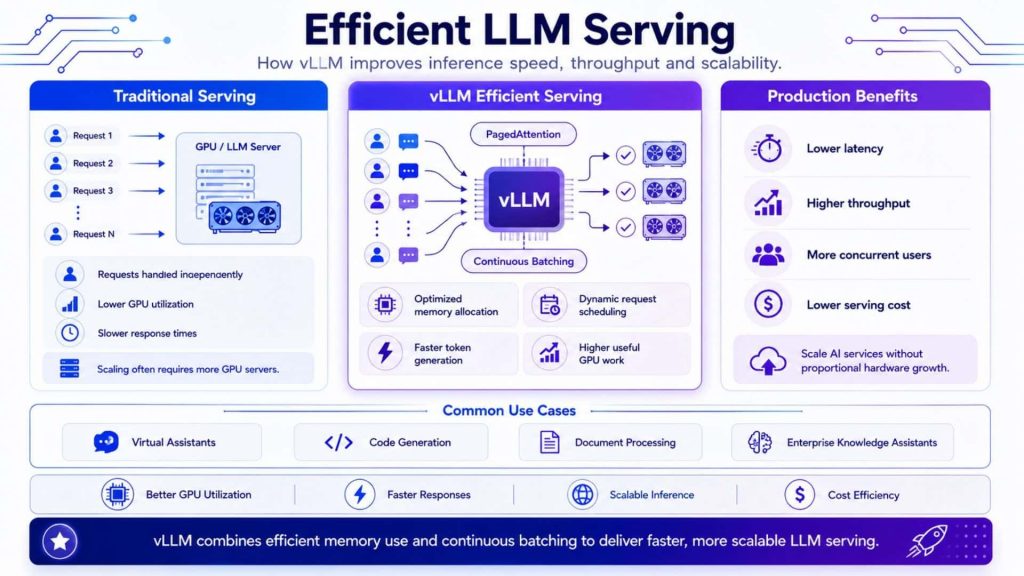
vLLM improves LLM serving with PagedAttention and continuous batching, enabling faster, more scalable inference.
4. Benefits of Using vLLM
Organizations deploying large language models need more than accurate model outputs—they also require fast response times, efficient infrastructure utilization and predictable operating costs. By combining advanced memory management with dynamic request scheduling, vLLM delivers measurable improvements across multiple aspects of production AI serving.
These benefits become increasingly valuable as AI applications scale from internal testing to enterprise deployment, where thousands of concurrent inference requests must be processed reliably and cost-effectively.
4.1. Faster inference speed
One of the primary advantages of vLLM is its ability to reduce inference latency. Instead of waiting for GPU resources to become available after each request, vLLM continuously schedules workloads and manages memory more efficiently. This minimizes idle GPU time and allows tokens to be generated more quickly.
Lower latency is particularly important for interactive AI applications where users expect near real-time responses. Customer service assistants, enterprise search, document analysis and AI coding assistants all benefit from faster response generation, leading to a better overall user experience.
As organizations continue optimizing production AI systems, reducing inference latency becomes an important part of broader LLM inference optimization strategies that balance speed, throughput and infrastructure efficiency.
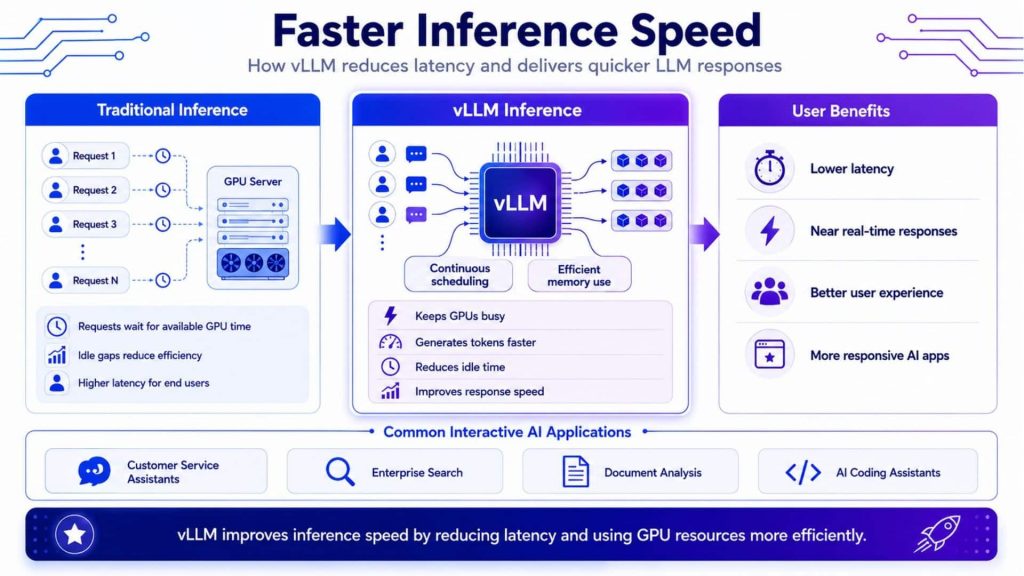
vLLM reduces inference latency through continuous scheduling and efficient GPU use, enabling faster responses for interactive AI applications.
4.2. Higher throughput
Throughput measures how many inference requests an AI system can process within a given period. Traditional serving frameworks often leave GPU resources underutilized because requests are processed independently or in fixed batches.
vLLM increases throughput by combining PagedAttention with continuous batching, allowing multiple user requests to share GPU resources dynamically. As new requests arrive, they can enter the scheduling queue without waiting for previous batches to finish, enabling GPUs to remain productive throughout the inference process.
Higher throughput enables organizations to:
- Support more concurrent users.
- Handle peak traffic more effectively.
- Improve overall infrastructure efficiency.
- Deliver consistent AI performance during periods of high demand.
These capabilities are especially valuable for enterprise AI platforms that operate customer-facing applications around the clock.
4.3. Better GPU utilization
GPU accelerators represent one of the largest infrastructure investments for AI deployments. Maximizing GPU utilization is therefore essential for improving return on investment while reducing unnecessary hardware expansion.
Traditional LLM serving frameworks may leave significant GPU memory and compute capacity unused because of fragmented memory allocation and inefficient request scheduling. In contrast, vLLM allocates memory dynamically and continuously schedules inference requests, allowing GPUs to spend more time performing useful computation rather than waiting for resources to become available.
Improved GPU utilization allows organizations to process larger workloads using existing infrastructure while maintaining stable inference performance.
Enterprises deploying production AI applications should also consider how modern AI infrastructure combines GPU compute, networking and storage to achieve high utilization across distributed inference workloads.
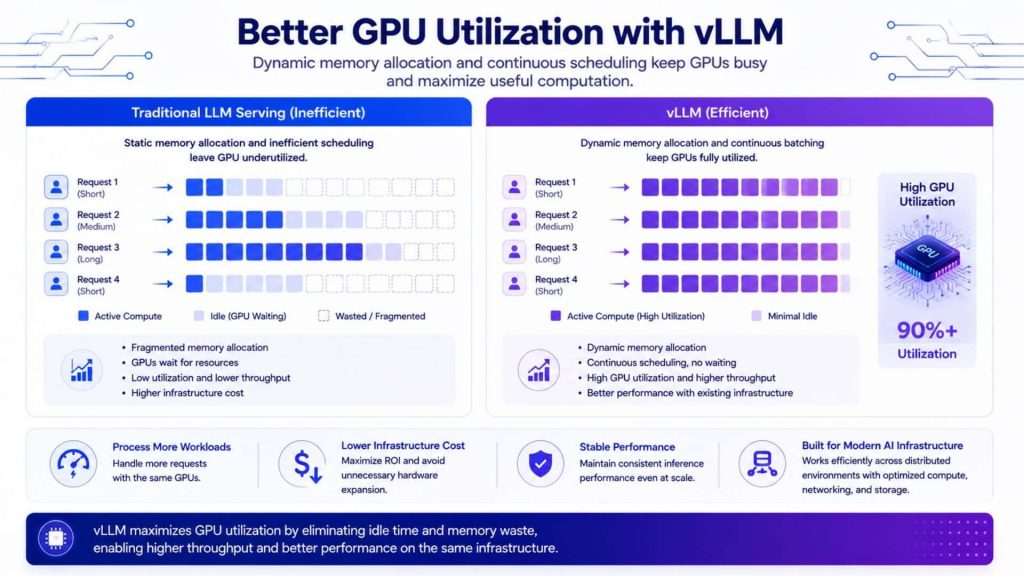
vLLM improves GPU utilization through dynamic memory allocation and continuous scheduling, enabling higher throughput on existing infrastructure.
4.4. Lower serving cost
Infrastructure cost is one of the biggest challenges associated with serving large language models at scale. As user demand grows, organizations often need to deploy additional GPU servers simply to maintain acceptable response times.
Because vLLM improves GPU utilization and increases throughput, more inference requests can be served using the same hardware resources. This reduces the number of GPUs required for production workloads and lowers infrastructure expenses over time.
Lower serving costs also make it easier for organizations to expand AI services into additional business functions without significantly increasing operational budgets. Whether deploying enterprise chatbots, internal knowledge assistants or customer-facing AI applications, efficient inference frameworks help organizations scale sustainably.
After understanding the practical benefits of vLLM, it is useful to compare its architecture with other popular LLM serving frameworks to understand where each solution is best suited.
5. vLLM vs Other LLM Serving Frameworks
Several frameworks are available for deploying large language models in production, each designed with different priorities such as inference performance, hardware optimization, model compatibility or enterprise scalability. While vLLM focuses on maximizing throughput and GPU efficiency through PagedAttention and continuous batching, other frameworks provide different strengths depending on deployment requirements.
The following comparison highlights the key differences between vLLM, TensorRT-LLM, Hugging Face Text Generation Inference (TGI) and NVIDIA Triton Inference Server.
| Criteria | vLLM | TensorRT-LLM | Hugging Face TGI | NVIDIA Triton |
| Primary focus | High-throughput LLM serving | Maximum inference performance on NVIDIA GPUs | Easy deployment of Hugging Face models | General-purpose model serving platform |
| Memory management | PagedAttention minimizes KV cache fragmentation and GPU memory waste | Highly optimized GPU memory management using TensorRT | Standard KV cache management | Depends on backend framework |
| Throughput | Very high through continuous batching | Extremely high on NVIDIA hardware after optimization | High for many production workloads | High for mixed-model deployments |
| Latency | Low latency with dynamic scheduling | Very low latency after engine optimization | Good latency | Varies by backend and workload |
| Hardware support | NVIDIA GPUs and multiple open-source LLMs | Primarily NVIDIA GPUs | Broad GPU support | CPU, GPU and multiple AI frameworks |
| Ease of deployment | Simple deployment for many open-source models | Requires TensorRT engine optimization | Easy integration with Hugging Face ecosystem | More complex enterprise deployment |
| Scaling | Excellent horizontal scaling for concurrent inference | Excellent on NVIDIA infrastructure | Good Kubernetes scalability | Enterprise-scale multi-model serving |
| Resource efficiency | Excellent GPU utilization through dynamic batching | Excellent after hardware optimization | Good | Depends on deployment architecture |
| Best suited for | Enterprise chatbots, AI assistants, production LLM serving | Maximum NVIDIA GPU performance | Organizations using Hugging Face models | Large enterprise AI platforms serving multiple model types |
Each framework serves different deployment needs. Organizations already using the Hugging Face ecosystem may prefer TGI for rapid deployment, while NVIDIA-centric environments often benefit from TensorRT-LLM’s hardware-specific optimizations. Triton provides a flexible serving platform for multiple AI frameworks and model types.
However, for enterprises seeking a balance between high throughput, efficient GPU utilization, ease of deployment and broad compatibility with open-source large language models, vLLM has become one of the most widely adopted inference frameworks.
As organizations evaluate these deployment options, it is also useful to explore AI model deployment and Serverless Inference strategies to understand how production AI services can be managed efficiently across different infrastructure environments.
6. Use Cases of vLLM
vLLM is widely adopted across industries because it enables organizations to deploy large language models more efficiently while maintaining high performance and cost-effective infrastructure utilization. By improving inference speed, GPU efficiency and scalability, vLLM supports a wide range of production AI applications, from conversational AI to software development and scientific research.
The following examples illustrate how organizations use vLLM to power real-world AI workloads.
6.1. Chatbots and Virtual Assistants
Conversational AI applications require fast response times, consistent performance and the ability to serve many users simultaneously. Whether supporting customer service, internal knowledge assistants or AI-powered enterprise search, chatbots often experience fluctuating workloads throughout the day. An efficient inference engine such as vLLM helps maintain low latency while processing thousands of concurrent requests.
However, high-performance inference alone is only one part of production AI deployment. Organizations also need a reliable platform to deploy, integrate and manage AI models securely across different business applications.
FPT AI Factory provides Serverless Inference, an OpenAI-compatible model serving platform that enables enterprises to deploy AI models without managing inference infrastructure. Organizations can choose from more than 20 foundation models or deploy models that best fit their business requirements while benefiting from automatic scaling, API-based integration and enterprise-grade infrastructure. This allows development teams to focus on building AI applications instead of operating complex serving environments.
As conversational AI adoption continues to grow, organizations should also understand What Is AI Inference? How It Works, Types and Use Cases, which explains how production inference platforms support reliable AI applications at scale.
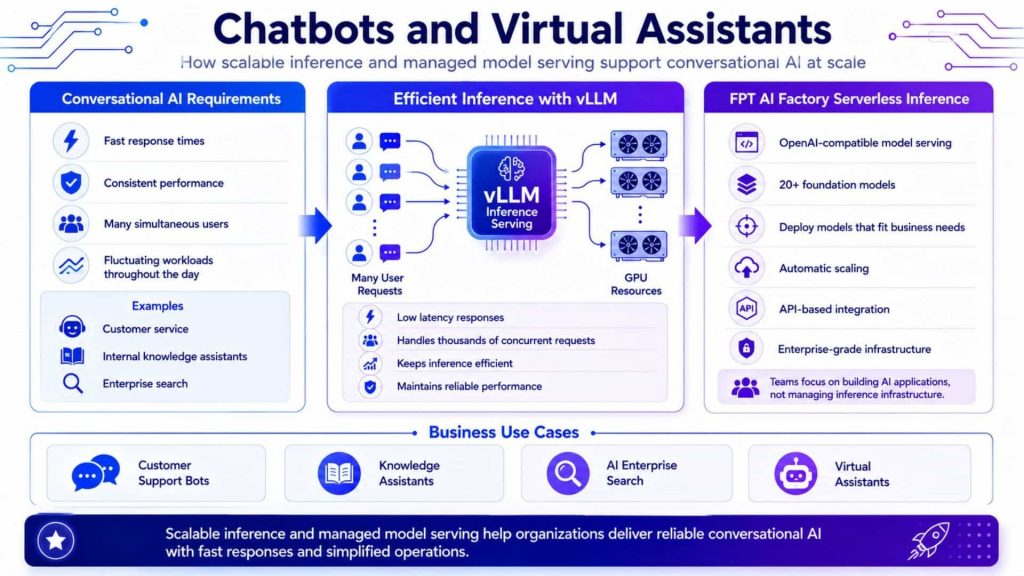
vLLM and Serverless Inference enable fast, scalable chatbots and virtual assistants without complex infrastructure management.
6.2. Writing and Content Creation
Generative AI has become an important tool for content creation across marketing, media, education and enterprise communications. Large language models assist with drafting articles, summarizing reports, generating product descriptions, translating documents and creating personalized customer communications.
These applications often process many requests simultaneously, especially for online content platforms and AI writing assistants. vLLM improves response speed and increases throughput, enabling content generation services to deliver faster results while using GPU resources more efficiently.
Organizations building enterprise content generation solutions should also consider how LLM inference optimization techniques improve latency, throughput and infrastructure efficiency for large-scale generative AI workloads.
6.3. Code Assistance
AI-powered coding assistants help software engineers generate code, explain programming concepts, identify bugs and automate repetitive development tasks. Because developers expect interactive responses while writing code, low inference latency is essential for maintaining productivity.
vLLM enables code generation models to respond quickly by improving memory utilization and processing multiple inference requests efficiently. As development teams grow, the framework can support increasing numbers of users without requiring proportional increases in GPU infrastructure.
Combined with scalable AI infrastructure, efficient inference allows organizations to integrate AI coding assistants into software development workflows while maintaining reliable performance for engineering teams.
6.4. Research and Experiments
Research organizations frequently evaluate different foundation models, prompts and inference configurations before deploying AI applications into production. These experiments often require running multiple models, testing different parameters and comparing inference performance under various workloads.
vLLM helps researchers perform these evaluations more efficiently by maximizing GPU utilization and reducing infrastructure overhead during experimentation. Faster inference enables teams to iterate more quickly, evaluate more model variants and accelerate AI development cycles.
For organizations conducting large-scale AI research, combining efficient inference with scalable compute infrastructure provides additional flexibility. FPT AI Factory offers services such as GPU Container, GPU Virtual Machine and GPU Cluster, allowing research teams to provision GPU resources that match different experimentation and production requirements without maintaining on-premises infrastructure.
After exploring these common use cases, it is helpful to address several frequently asked questions about deploying and operating vLLM in production AI environments.
7. FAQs
7.1. Can the output of a prompt vary across runs in vLLM?
Yes. Like other large language model inference frameworks, vLLM can produce different outputs from the same prompt depending on the model configuration and sampling parameters. Settings such as temperature, top-p and random seeds influence how tokens are generated during inference. When deterministic output is required, organizations can use fixed random seeds and more conservative decoding strategies to produce consistent responses.
7.2. Can vLLM serve multiple models?
Yes. vLLM supports serving multiple large language models, although deployment strategies depend on available GPU resources and workload requirements. Organizations may deploy different models for specialized tasks such as customer support, document analysis, coding assistance or multilingual AI applications. Resource planning remains important because larger models require additional GPU memory and compute capacity.
For enterprise AI deployments that require scalable model serving, Serverless Inference from FPT AI Factory enables organizations to access more than 20 foundation models through OpenAI-compatible APIs without managing the underlying inference infrastructure. Teams can integrate the models that best fit their applications while benefiting from automatic scaling and enterprise-grade deployment capabilities.
7.3. How does vLLM compare to other LLMs?
vLLM is widely recognized for its efficient GPU memory management through PagedAttention and its dynamic continuous batching mechanism, which help improve throughput and GPU utilization for production inference workloads. Compared with frameworks such as TensorRT-LLM, Hugging Face Text Generation Inference (TGI) and NVIDIA Triton Inference Server, each solution offers different strengths depending on hardware environments, deployment complexity and performance requirements.
Organizations selecting an inference framework should evaluate factors such as model compatibility, latency, throughput, infrastructure cost, operational complexity and long-term scalability. The most suitable framework ultimately depends on specific AI workloads and deployment objectives.
FPT AI Factory provides enterprise AI infrastructure that helps organizations develop, evaluate and deploy AI models at scale. With GPU Container, GPU Virtual Machine, GPU Cluster, AI Notebook and Serverless Inference, development teams can optimize model serving, accelerate experimentation and build reliable production AI applications without managing complex infrastructure. Organizations with custom AI requirements or large-scale deployment needs can contact FPT AI Factory through the official contact form.
Contact information:
- Hotline: 1900 638 399
- Email: support@fptcloud.com
Explore more articles:
What is AI inference? How it works, types, and use cases
What is AI Infrastructure? Key Components and How Its Works