
A modern AI inference engine is the runtime layer that turns trained AI models into usable responses, predictions, or classifications in real applications. As businesses move from AI experiments to production, understanding modern AI inference engines helps teams improve speed, scalability, cost control, and reliability. In this article, FPT AI Factory explains what a modern AI inference engine is, how it works, and how to choose the right deployment approach.
|
Key takeaways An inference engine helps AI applications process inputs, execute models, optimize runtime behavior, and return outputs efficiently. Here are the key points to remember:
|
FPT AI Factory accelerates your AI journey by offering flexible GPU infrastructure, including Containers, VMs, and Clusters, along with comprehensive tools to build, fine-tune, and deploy intelligent LLM applications. From integrating enterprise knowledge to scaling workloads, we provide a seamless path to production-ready AI. For custom setups or large-scale projects, contact our team today for a tailored consultation.
1. What Is an AI Inference Engine?
An AI inference engine is the software and runtime environment that executes a trained AI model when a user or application sends new input. It is responsible for receiving requests, preparing data, running the model, applying runtime optimizations, and returning a usable output. In practical terms, the inference engine is what allows an AI model to serve real users after training is complete.
For example, when a chatbot generates an answer, a recommendation system ranks products, or a vision system detects objects in an image, the inference engine manages the model execution behind the scenes. To understand the broader lifecycle, teams can review what AI inference is and how it works.
1.1 Definition of Modern AI Inference Engine
A modern AI inference engine goes beyond simply running a model file. It often includes batching, memory management, hardware acceleration, request routing, logging, monitoring, and API serving. These capabilities are especially important for large language models and real-time applications that must handle many users at the same time.
The basic flow is simple: Input -> AI Model -> Inference Engine -> Output. However, production systems add extra layers to control latency, throughput, cost, reliability, and security.
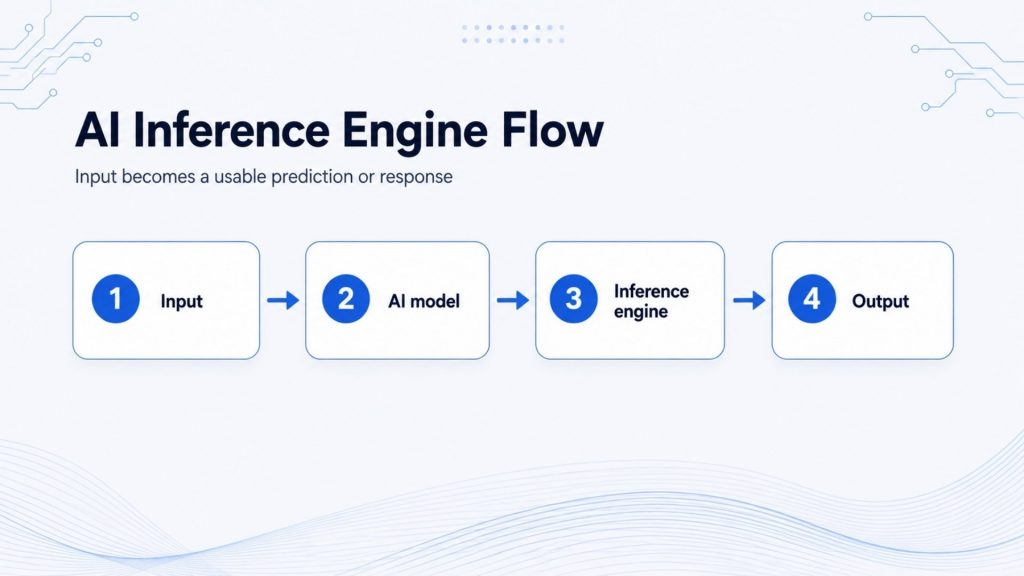
Inference engine flow from input to AI model execution and output.
1.2 AI Inference Engine vs Traditional Expert System
Traditional expert systems rely on hand-written rules created by domain experts, while modern AI inference engines execute trained machine learning or deep learning models that learn patterns from data. Classical rule-based inference engines commonly use two reasoning mechanisms: forward chaining, which starts from known facts, and backward chaining, which starts from a target conclusion. Modern AI inference engines extend this core reasoning role through learned models, optimized runtimes, and scalable serving. The table below highlights the key differences.
| Criteria | AI Inference Engine | Traditional Expert System |
| AI approach | Runs trained AI or machine learning models | Applies predefined logic and rules |
| Knowledge source | Learned patterns from training data | Expert-defined rules and knowledge bases |
| Decision process | Statistical or neural model execution, often optimized for runtime | Rule matching, if-then logic, and symbolic reasoning |
| Example | LLM chatbot, object detection system, recommendation model | Rule-based medical triage, tax rule checker, simple diagnostic system |
With the definition and key distinctions now clear, let’s move on to how an AI inference engine actually processes data and produces outputs.
2. How Does an AI Inference Engine Work?
An AI inference engine typically works through four steps: input data, model execution, optimization layer, and output generation. The goal is to make predictions or responses available quickly and consistently, even when traffic changes throughout the day.
First, the system receives input from a user, API, application, device, or data pipeline. Next, the model runtime executes the trained model. Then, optimization techniques such as batching, quantization, caching, or hardware acceleration help reduce latency and improve throughput. Finally, the system returns the output in a format that the application can use.
This workflow is one reason inference differs from training. Training focuses on learning from historical data, while inference focuses on applying a finished model to new data. For a deeper comparison, explore AI inference vs training before choosing your deployment architecture.
Now that the inference workflow is clear, let’s explore why inference engines matter for modern AI applications.
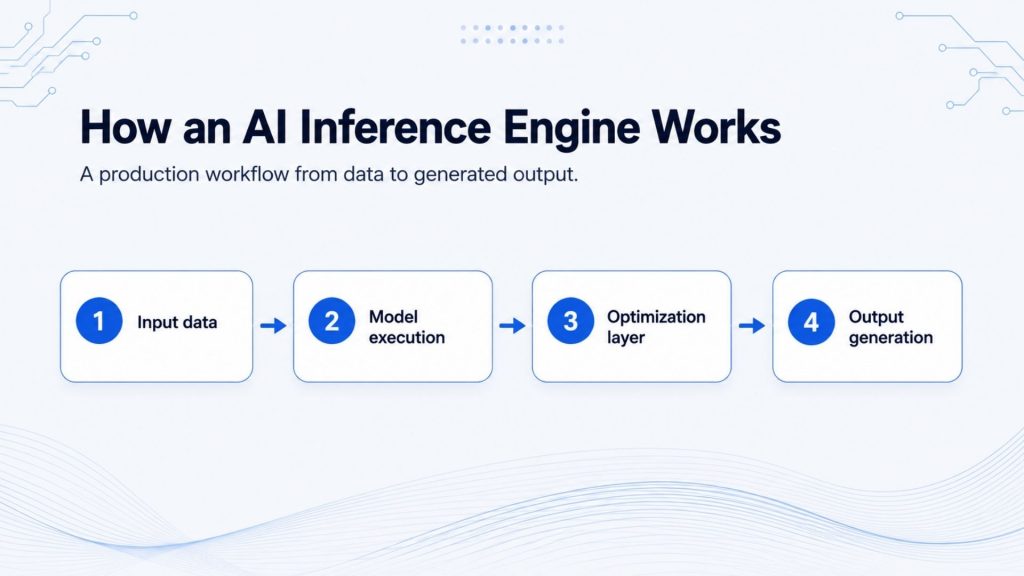
Inference engine workflow from input data to optimized output generation.
3. Why AI Inference Engines Matter for Modern AI Applications
Once AI models move into production, inference quality often determines the end-user experience. A strong model is not enough if responses are slow, costs are unpredictable, or the system cannot scale. This is why inference engines play a central role in modern AI applications.
3.1 Improving Response Speed
Response speed is critical for chatbots, copilots, fraud detection, search, personalization, and customer-facing AI products. Inference engines improve response time by reducing unnecessary compute, batching requests efficiently, and using hardware acceleration when available. For LLMs, engines such as vLLM use techniques like PagedAttention to improve memory usage and serving throughput.
3.2 Supporting Real-Time AI Applications
Real-time AI applications need low latency and stable responses. Examples include smart cameras, call center assistants, fraud alerts, and interactive recommendation systems. If the inference layer is unstable, users may experience delays, incomplete outputs, or inconsistent results.
3.3 Optimizing Resource Utilization
AI models can be expensive to serve, especially when they require GPUs. Inference engines help teams use resources more efficiently through dynamic batching, quantization, autoscaling, and request scheduling. This matters because production workloads often fluctuate by hour, region, or user demand.
3.4 Enabling AI at Scale
At scale, inference engines must handle more than a single model call. They need observability, rate control, versioning, fallback behavior, and integration with cloud or edge infrastructure. Teams deploying models at scale can use model serving patterns to manage APIs, runtime environments, and production monitoring more effectively.
After understanding their role in production AI, let’s examine the core components that enable an inference engine to operate reliably.
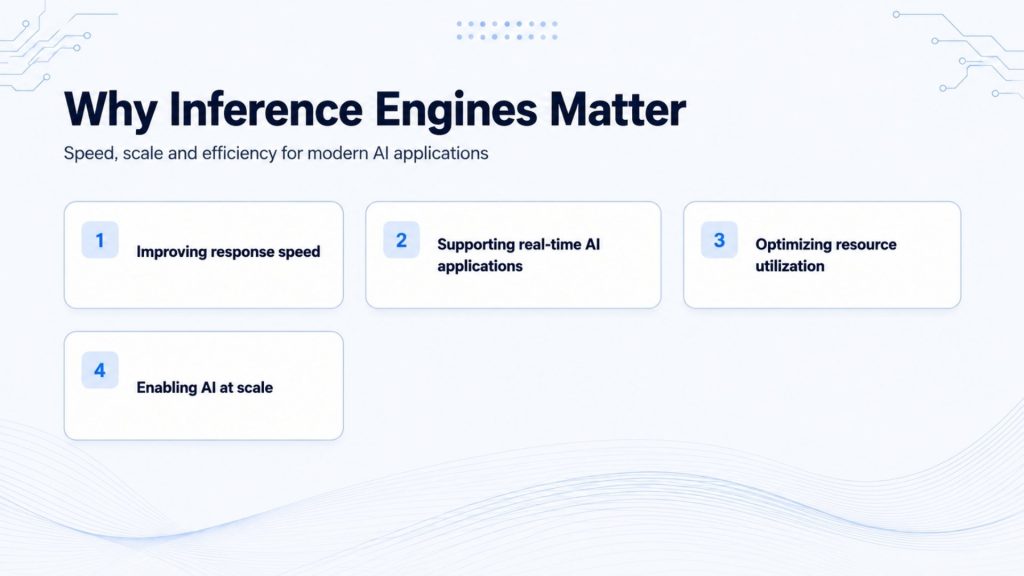
Inference engine benefits for speed, real-time AI, resource efficiency and scale.
4. Key Components of a Modern AI Inference Engine
A modern AI inference engine usually combines runtime execution with operational layers that make the model usable in production. These components help teams move from a model artifact to a reliable AI service.
4.1 Model Runtime
The model runtime loads the model and executes it on the selected hardware. Depending on the workload, the runtime may support GPUs, CPUs, NPUs, or edge devices. Examples include ONNX Runtime for cross-platform model execution and TensorRT-LLM for optimized LLM inference on NVIDIA GPUs.
4.2 Request Processing Layer
The request processing layer receives API calls, validates inputs, prepares data, and routes requests to the correct model. For LLM workloads, it may also manage prompts, tokenization, context windows, and streaming responses.
4.3 Resource Management
Resource management controls how compute is allocated. It helps decide when to batch requests, scale instances, reserve GPU memory, or distribute workloads across machines. This layer becomes essential when multiple teams, applications, or models share the same infrastructure.
4.4 Optimization Techniques
Optimization techniques improve speed and cost efficiency. Common approaches include quantization, caching, kernel optimization, batching, model compilation, and memory planning. For example, TensorRT-LLM provides optimizations for LLM inference on NVIDIA GPUs, while vLLM is designed for fast LLM serving.
4.5 Monitoring and Logging
Monitoring and logging help teams understand latency, throughput, error rates, token usage, and system health. This visibility supports troubleshooting and governance. It also helps businesses detect when a model or inference workflow needs adjustment.
Having examined the components that support reliable inference, the next step is to compare the engine types used for different AI workloads.
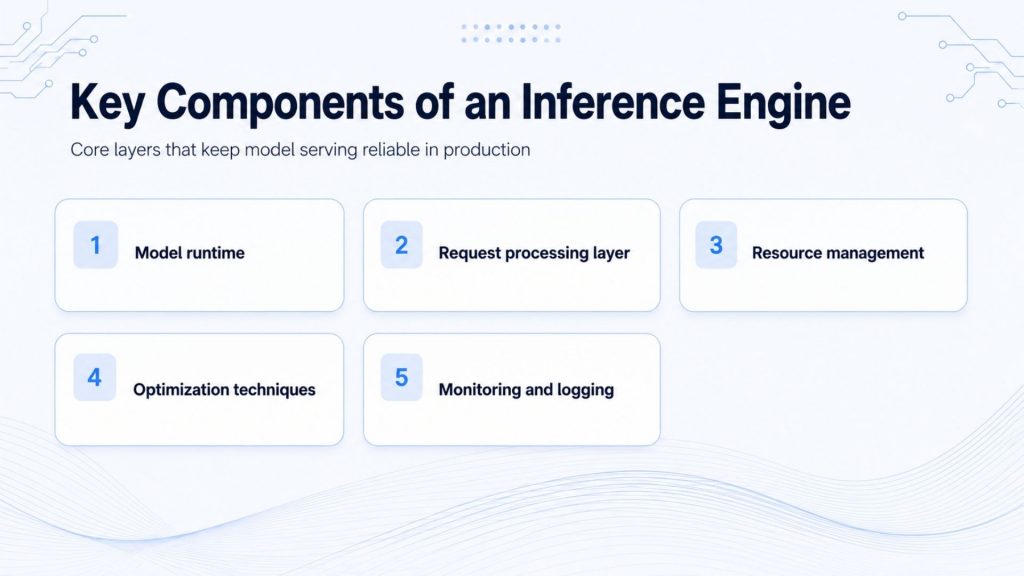
Key components of a modern AI inference engine.
5. Types of AI Inference Engines
Different AI applications require different inference approaches. The right engine depends on model type, hardware, latency goals, and where the application runs. Below are three common categories.
5.1 LLM Inference Engines
LLM inference engines are designed to serve large language models efficiently. They often focus on token generation speed, KV cache management, batching, streaming output, and GPU memory usage. Common examples include vLLM, TensorRT-LLM, and ONNX Runtime GenAI.
For enterprise teams, LLM inference engines are often used in chatbots, code assistants, internal knowledge assistants, and agentic workflows. When the workload requires GPU acceleration, teams can evaluate GPU Container for containerized serving or GPU Virtual Machine for workloads that need more control over the runtime environment.
5.2 Computer Vision Inference Engines
Computer vision inference engines are optimized for image and video workloads such as image recognition, object detection, quality inspection, and security monitoring. These systems often need high throughput because they may process many images or video frames in parallel.
In manufacturing, for example, a vision model may inspect product defects on a production line. In retail, a computer vision model may analyze shelf availability or customer traffic patterns. The inference engine must keep latency low enough for operational teams to act quickly.
5.3 Edge AI Inference Engines
Edge AI inference engines run models closer to where data is generated, such as IoT devices, smart cameras, sensors, or industrial machines. This reduces data transfer needs and can support low-latency decisions even when network connectivity is limited.
Edge deployments are useful when privacy, bandwidth, or real-time response is important. However, they also require careful optimization because edge devices usually have less compute capacity than cloud infrastructure.
After reviewing the main inference engine types, let’s examine the practical criteria for selecting the right option.
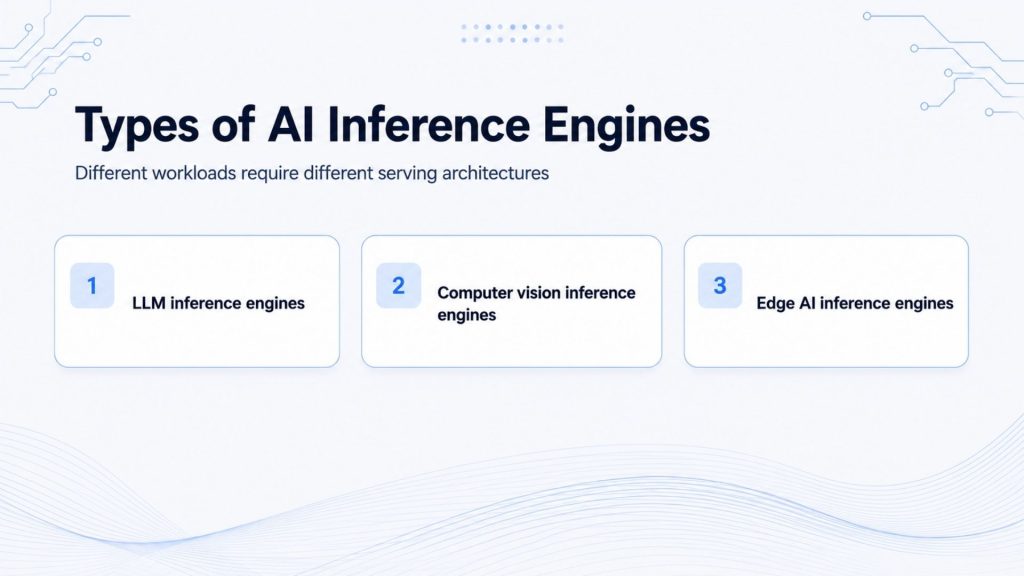
Types of inference engines for LLM, computer vision and edge AI workloads.
6. How to Choose the Right AI Inference Engine
Choosing an inference engine is both a technical and business decision. Teams should evaluate the model, hardware, latency goal, scaling pattern, integration needs, and operational responsibilities before deployment.
6.1 Match Engine to Hardware
The first step is to match the inference engine to the available hardware. LLMs often benefit from GPUs, while smaller classical models may run efficiently on CPUs. If teams want flexible infrastructure, GPU Container and GPU Virtual Machine can support different model serving and experimentation needs. FPT AI Factory also provides information for NVIDIA HGX B300 GPU Cloud access on the GPU Virtual Machine page.
6.2 Consider Model Compatibility
Model compatibility includes framework support, model format, tokenizer handling, quantization support, and runtime dependencies. ONNX Runtime may be suitable for models exported into ONNX format, while TensorRT-LLM focuses on optimized inference for LLMs on NVIDIA GPUs.
6.3 Evaluate Latency vs Throughput
Latency measures how fast a single request receives a response. Throughput measures how many requests or tokens the system can process over time. Some applications require very low latency, while others prioritize large batch throughput. The best engine depends on which metric matters most for the application.
6.4 Deployment Environment
Organizations should also consider where AI models will run in production. While some teams deploy inference engines directly on-premises or manage their own GPU infrastructure, others prefer managed or serverless environments to reduce operational complexity.
FPT AI Factory Serverless Inference provides a serverless deployment option that allows businesses to access and serve AI models through APIs without managing underlying infrastructure. This approach is particularly suitable for teams seeking faster deployment, automatic scaling, and reduced operational overhead.
With the selection criteria covered, let’s address the most common questions about inference engines in production.
7. Practical Workflow for Operating a Modern AI Inference Engine
Selecting the right AI inference engine is only the first step toward deploying production-ready AI applications. Once an inference engine has been chosen, organizations must establish an operational workflow that ensures the system remains fast, reliable, scalable, and cost-efficient under real-world traffic.
Unlike the engine selection process, which focuses on comparing frameworks, hardware compatibility, and deployment options, operational management concentrates on maintaining performance after deployment. It includes benchmarking, performance optimization, monitoring, scaling, version control, and deployment validation throughout the model lifecycle.
A structured operational workflow enables teams to identify performance bottlenecks early, minimize infrastructure costs, reduce deployment risks, and deliver consistent user experiences as AI workloads continue to grow.
7.1 Benchmark Before Deployment
Before deploying an AI model into production, establish a clear performance baseline by benchmarking the complete inference pipeline.
Rather than measuring only raw inference speed, evaluate how the model performs under realistic production conditions. This includes testing different request volumes, prompt lengths, batch sizes, hardware configurations, and concurrency levels.
Key metrics to benchmark include:
- Response latency (P50, P95, P99)
- Throughput (requests or tokens per second)
- GPU memory consumption
- GPU utilization
- Time to first token (TTFT) for generative AI applications
- Cost per inference request
These benchmarks help determine whether the selected inference engine can satisfy service-level objectives (SLOs) before production traffic begins.
7.2 Optimize Performance Bottlenecks
After benchmarking, identify the components that limit overall inference performance.
Depending on the workload, bottlenecks may originate from GPU memory constraints, inefficient batching, slow token generation, excessive CPU preprocessing, network overhead, or suboptimal runtime configuration.
Common optimization techniques include:
- Dynamic request batching
- KV cache optimization for large language models
- Model quantization
- Tensor parallelism or pipeline parallelism
- Faster model formats such as TensorRT or ONNX Runtime
- Optimized scheduling strategies
- Request caching for repeated queries
Rather than applying every optimization, teams should prioritize changes that provide the greatest improvement for their specific workloads while maintaining acceptable accuracy.
7.3 Monitor Latency Continuously
Production inference systems require continuous monitoring because workload characteristics constantly evolve over time.
Changes in traffic patterns, model updates, prompt complexity, or infrastructure utilization can introduce performance regressions that are difficult to detect without proper observability.
A comprehensive monitoring strategy should track:
- End-to-end latency
- Token generation speed
- Request throughput
- Error rates and failed requests
- GPU utilization
- GPU memory usage
- Queue length
- Token consumption
- Infrastructure availability
Dashboards and automated alerts allow engineering teams to identify abnormal behavior quickly, reducing downtime and ensuring consistent service quality for users.
7.4 Enable Autoscaling
Production AI workloads rarely remain constant throughout the day. Traffic spikes caused by business hours, seasonal events, product launches, or viral content can dramatically increase inference demand.
Autoscaling enables infrastructure to expand or shrink automatically according to workload requirements.
Scaling policies may consider metrics such as:
- Active request count
- Queue length
- GPU utilization
- Response latency
- Token generation rate
- Concurrent users
By dynamically adjusting compute resources, organizations can maintain low response times during peak traffic while avoiding unnecessary infrastructure costs during periods of lower demand.
Autoscaling is particularly valuable for cloud-native AI deployments serving unpredictable workloads.
7.5 Version Models Carefully
AI models evolve continuously as teams improve accuracy, retrain on new data, or introduce new capabilities. Without proper version management, deployments become difficult to reproduce, compare, and troubleshoot.
Each production release should include versioning for:
- Model weights
- Tokenizers
- Prompt templates
- Runtime configuration
- Inference engine version
- Hardware configuration
Maintaining clear version histories enables teams to compare performance between releases, perform A/B testing, roll back unstable deployments, and trace exactly which model generated each prediction.
A disciplined versioning strategy also simplifies compliance, auditing, and incident investigation in regulated industries.
7.6 Separate Staging and Production
Production environments should never be used to validate experimental changes.
Instead, organizations should maintain separate staging and production environments that closely mirror one another. This allows engineers to verify model behavior, runtime configurations, infrastructure updates, and deployment scripts before exposing changes to end users.
Typical staging validation includes:
- Functional testing
- Load testing
- Latency benchmarking
- GPU resource validation
- Integration testing
- Regression testing
- Safety evaluation for generative AI applications
Only after the system meets predefined quality and performance requirements should updates be promoted to production. This deployment strategy significantly reduces the risk of unexpected failures affecting live AI services.
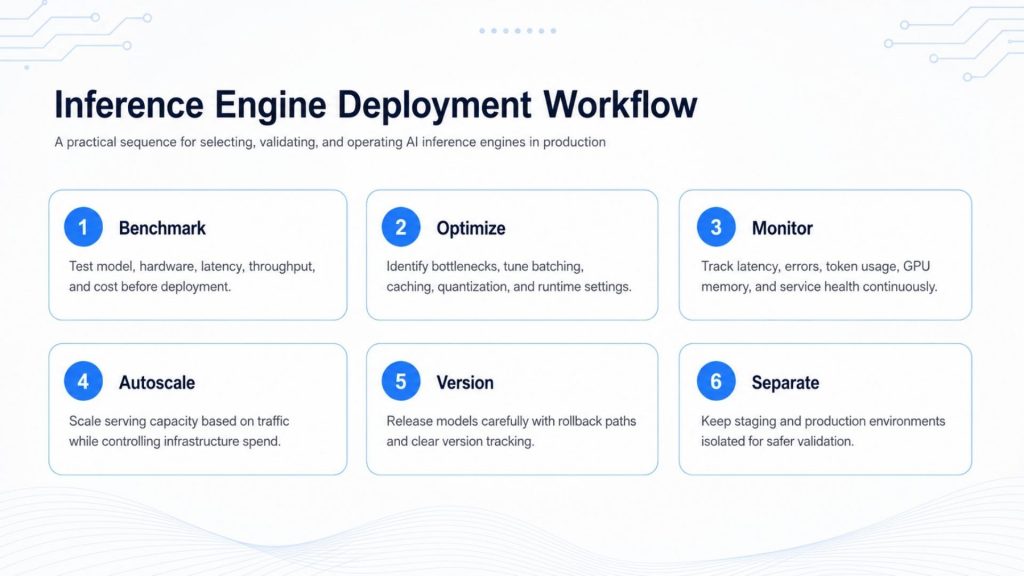
Practical workflow for deploying an inference engine from benchmarking to production monitoring.
8. FAQ
8.1 What is the fastest Inference Engine for LLMs?
There is no single fastest inference engine for every LLM workload. vLLM is widely used for high-throughput LLM serving, TensorRT-LLM is optimized for NVIDIA GPU inference, and ONNX Runtime can be useful when teams need cross-platform model execution. The best choice depends on the model, hardware, batch size, latency target, and deployment environment.
8.2 Is TensorRT better than ONNX Runtime?
TensorRT-LLM and ONNX Runtime serve different needs. TensorRT-LLM is designed to optimize LLM inference on NVIDIA GPUs, while ONNX Runtime supports cross-platform execution for models from multiple frameworks. TensorRT-LLM may be stronger for NVIDIA-based LLM serving, while ONNX Runtime can be more flexible for broader deployment scenarios.
8.3 Do I need a separate Inference Engine for production?
Most production AI systems benefit from a dedicated inference engine or serving layer. A separate inference engine or serving layer helps manage APIs, scaling, monitoring, optimization, and reliability. For simple prototypes, direct model execution may be enough, but production applications usually need a dedicated inference workflow. Teams can also review how to deploy AI model to understand the broader deployment process.
An inference engine is the layer that helps trained AI models run efficiently in real applications. It processes inputs, executes models, applies optimization techniques, and returns outputs that users or systems can act on. As AI workloads become larger and more interactive, choosing the right inference engine becomes essential for balancing speed, cost, scalability, and reliability.
With FPT AI Factory, businesses can build and deploy AI workloads using GPU infrastructure, AI development tools, and Serverless Inference for production model access. For customized deployments or large-scale infrastructure needs, please contact the FPT AI Factory team through the official contact form.
Contact Information:
- Hotline: 1900 638 399
- Email: support@fptcloud.com
Explore Related Articles:
What is AI inference? How it works, types, and use cases
AI Inference vs Training: What’s the Difference?
What Is Model Serving? From AI Research to Real-World Deployment