
What are AI infrastructure solutions, and why have they become essential for deploying AI at scale? As enterprises move AI from experimentation to production, they need infrastructure that supports scalable compute, efficient model deployment, and reliable operations. In this article, FPT AI Factory examines the essential components of AI infrastructure, best practices for building scalable AI systems, and the key considerations organizations should address when deploying AI at scale.
|
Key Takeaways As AI adoption accelerates, enterprises need infrastructure that can support the entire AI lifecycle, from model development to production deployment and ongoing operations. The following takeaways highlight the essential factors businesses should consider when building scalable AI infrastructure solutions.
|
Whether you’re building RAG applications, fine-tuned models, or hybrid AI systems, FPT AI Factory provides an end-to-end platform with AI development tools, scalable GPU infrastructure, and deployment services to accelerate enterprise AI adoption. For customized AI solutions, large-scale deployments, or enterprise integration, contact FPT AI Factory for tailored consultation and implementation support.
1. Why businesses need AI infrastructure solutions?
As AI adoption moves from experimentation to production, infrastructure has become a critical success factor. Organizations are deploying AI across customer service, software development, and business operations, creating growing demands for performance, reliability, and scalability.
At the same time, AI workloads require significantly more computing power than traditional applications. Training and serving AI models depend on GPU computing resources, high-performance storage, and low-latency networking to support large datasets and real-time inference.
Because traditional IT infrastructure was not designed for AI-intensive workloads, many organizations face scalability and performance challenges. AI infrastructure solutions provide the foundation needed to develop, deploy, and scale AI applications efficiently throughout the AI lifecycle.

Traditional IT infrastructure struggles to support the performance and scalability demands of modern AI workloads
2. What makes a complete AI infrastructure solution?
A complete AI infrastructure solution combines scalable computing, development tools, and deployment capabilities to support the entire AI lifecycle. By integrating these components into a unified platform, organizations can accelerate AI adoption while improving performance and operational efficiency.
2.1 Scalable AI compute
AI workloads require flexible GPU compute, high-performance storage, and scalable infrastructure to support model training and real-time inference. These resources help organizations meet growing demand while optimizing performance and cost.
2.2 AI development environment
An effective AI development environment provides the tools and resources needed to build, train, and test AI models efficiently. Integrated notebook environments, pre-configured AI frameworks, and access to GPU resources simplify development workflows while reducing setup time. AI development platforms provide the tools needed to build, train, and test models efficiently. Features such as integrated notebooks, AI frameworks, and GPU access help accelerate experimentation and streamline development workflows.
2.3 AI Deployment and Inference Platform
Understand how to deploying AI models into production requires infrastructure that delivers reliable performance under varying workloads. AI deployment platforms enable organizations to serve models reliably in production with low latency, high availability, and automatic scaling. These capabilities are essential for AI applications that require consistent real-time performance.

AI inference platforms deliver low-latency, scalable, and highly available AI services in production
2.4 AI operations and workload management
Managing AI in production requires continuous monitoring and resource optimization. By tracking system performance and GPU utilization, organizations can improve reliability, reduce operational complexity, and keep AI workloads running efficiently. MLOps supports this process through ongoing monitoring, maintenance, and optimization.
3. Types of AI Infrastructure solutions
AI infrastructure requirements vary depending on how organizations build and deploy AI applications. Development environments prioritize model training and experimentation, while production systems focus on reliable inference and scalability. Generative AI applications require even greater computing power to support large language models (LLMs) and multimodal workloads. Understanding these infrastructure types helps businesses select the right architecture for their AI initiatives.
3.1 AI Infrastructure for AI Development
AI infrastructure for development supports data scientists and AI engineers during model training, testing, and validation. These environments require scalable GPU resources, high-throughput storage, and distributed computing to process massive datasets efficiently.
Autonomous driving is one of the most compute-intensive AI development use cases, requiring the processing of massive volumes of real-world driving data. To train its Full Self-Driving (FSD) models, Tesla deployed an AI supercomputing cluster with 10,000 NVIDIA H100 GPUs in 2023, alongside its custom Dojo architecture. This high-performance infrastructure enables parallel processing of hundreds of thousands of hours of driving videos, significantly accelerating model training and supporting more frequent improvements to FSD capabilities.
Industry: Automotive and mobility technology
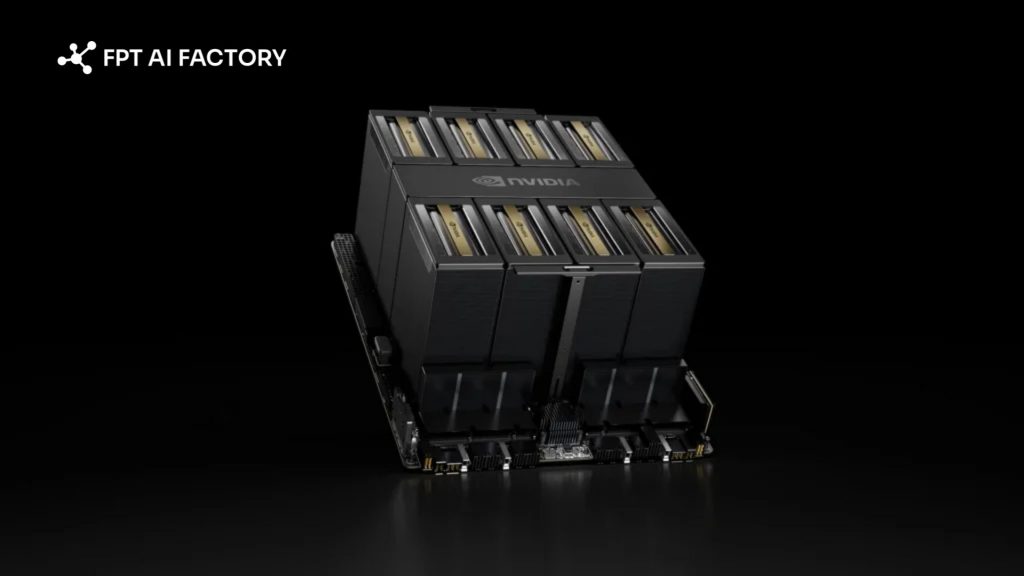
Scalable AI infrastructure enables efficient model training, testing, and validation with high-performance computing and storage.
3.2 AI Infrastructure for AI Production
Production AI infrastructure is designed to deploy trained models into real-world environments where they must deliver reliable, low-latency AI inference at scale . These platforms prioritize high availability, automatic resource scaling, and consistent inference performance under heavy workloads.
A practical example of AI production infrastructure is Mastercard’s Decision Intelligence platform, which analyzes millions of data points in real time to assess fraud risk before a payment is approved. According to Mastercard, the platform has improved fraud detection by 20% to 300% in high-risk scenarios while reducing false declines. This demonstrates how scalable AI infrastructure enables low-latency inference for mission-critical financial applications.
Industry: Banking, financial services, and fintech

Scalable AI infrastructure enables real-time fraud detection with low-latency inference
3.3 AI Infrastructure for Generative AI Applications
Generative AI applications require significantly more computing resources than traditional AI systems. Running large language models (LLMs) at scale demands GPU-accelerated infrastructure capable of supporting high-concurrency inference, low latency, and continuous availability. In enterprise deployments, Retrieval Augmented Generation (RAG) is commonly used to connect LLMs with knowledge bases and business applications, enabling more accurate and context-aware responses in real time.
A notable example is Air India, which modernized its customer service using Microsoft Azure AI. The airline’s AI assistant now manages 4 million customer queries, with 97% of customer sessions fully automated. Supporting this workload requires production-grade AI infrastructure that can scale inference capacity, maintain low response times, and deliver reliable service across millions of interactions without compromising user experience.
Industry: Aviation and travel
4. Cloud AI Infrastructure vs Traditional Infrastructure
Traditional infrastructure supports many business applications effectively, but AI workloads introduce new requirements for compute, scalability, and performance. Cloud AI infrastructure is purpose-built to meet these demands. The following comparison outlines the key differences between the two approaches.
| Criteria | Cloud AI Infrastructure | Traditional Infrastructure |
| Main workload | AI model training, large language models (LLMs), generative AI, real-time inference, and machine learning workloads | Enterprise applications, relational databases, ERP, CRM, web hosting, and general business systems |
| Compute | GPU-accelerated computing with high-performance storage and networking optimized for AI processing | Primarily CPU-based infrastructure designed for sequential business workloads |
| Scaling | Elastic resource scaling that supports distributed AI training and high-concurrency inference as demand grows | Fixed infrastructure that typically requires manual hardware upgrades to increase capacity |
| Optimization | Optimized for parallel computing, GPU utilization, and AI frameworks to improve training and inference performance | Optimized for transaction processing, database performance, and general-purpose business applications |
| Use cases | GitHub Copilot for AI-assisted coding, Adobe Firefly for AI image generation, Spotify personalized music recommendations, Siemens predictive maintenance for smart manufacturing | SAP ERP for enterprise resource planning, Oracle Database for transaction management, Microsoft Exchange for email services, corporate payroll and HR systems |
Cloud AI infrastructure provides the flexibility, performance, and scalability required for modern AI applications. While traditional infrastructure remains well suited for conventional enterprise workloads, organizations developing or deploying AI solutions benefit from infrastructure purpose-built to accelerate model development, simplify deployment, and support production-scale AI operations.
5. How to Choose the Right AI Infrastructure Solution?
Selecting the right AI infrastructure starts with understanding how AI will be used across the business. While enterprise AI chatbots, recommendation systems, and computer vision applications all rely on AI models, they require different levels of computing power, scalability, and deployment capabilities. Evaluating infrastructure based on workload requirements, future growth, deployment strategy, and cost helps organizations build AI environments that deliver reliable performance while supporting long-term business objectives.
5.1. AI workload requirements
Different AI workloads have different infrastructure requirements. For example, an enterprise AI chatbot powered by a large language model (LLM) must process large volumes of real-time requests while maintaining low response latency. During the development and testing phase, organizations need dedicated GPU resources to build, fine-tune, and validate AI models efficiently. A GPU Virtual Machine provides a flexible environment for these workloads without requiring investment in on-premises GPU infrastructure.
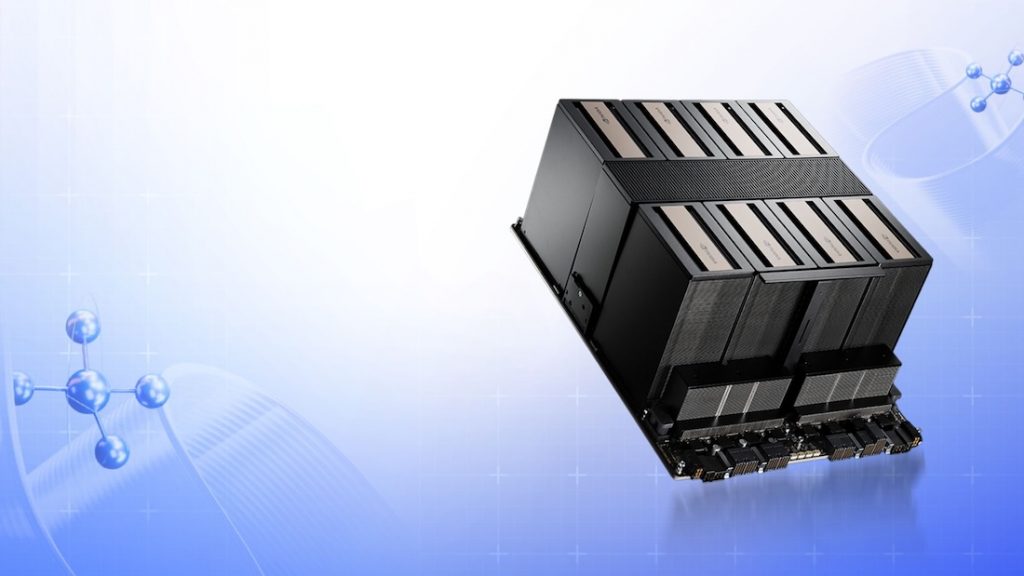
Dedicated GPU Virtual Machines provide the performance and flexibility required for enterprise AI applications
5.2. Scalability needs
AI workloads rarely remain static. As more users interact with AI applications and models continue to grow in size, infrastructure must scale without affecting performance. Choosing solutions that can dynamically allocate computing resources enables organizations to support increasing demand, maintain fast response times, and deliver consistent user experiences as AI applications move from pilot projects to production.
5.3. Deployment requirements
Production AI applications require infrastructure that supports reliable model serving, high availability, and efficient resource management. Modern AI workloads are increasingly deployed using containerized architectures to simplify updates and ensure consistent performance across environments. For these scenarios, GPU Container provides an efficient way to package and deploy GPU-accelerated AI applications while streamlining operations from development to production.
5.4. Cost efficiency
Cost efficiency is not about minimizing infrastructure spending but about matching computing resources to actual workload requirements. Organizations can begin with smaller environments during development and expand resources as AI adoption grows. For large-scale AI workloads such as foundation model training or enterprise AI services with high user demand, GPU Cluster enables distributed computing across multiple GPUs, improving resource utilization while delivering the performance needed for compute-intensive applications.
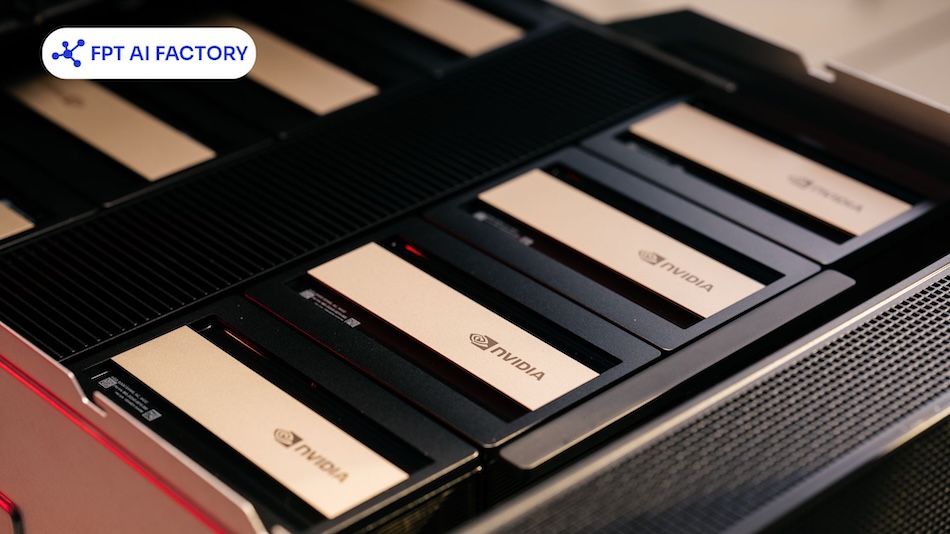
GPU clusters provide scalable computing resources for cost-efficient AI training and inference
Choosing the right AI infrastructure solutions is essential for organizations looking to build, deploy, and scale AI applications successfully. As AI workloads become more complex, businesses need infrastructure that delivers the right balance of performance, scalability, and cost efficiency. By selecting AI infrastructure solutions that align with workload requirements and business goals, organizations can accelerate AI adoption, improve operational efficiency, and maximize the value of their AI investments.
Ready to explore AI infrastructure for your projects? Once your account is set up, you can start using FPT AI Factory services immediately to experience scalable and high-performance AI infrastructure in action. For enterprises and organizations with customized AI infrastructure requirements or large-scale AI workloads, please contact the FPT AI Factory team via the Contact Form to discuss a solution tailored to your business needs.
Contact information:
- Hotline: 1900 638 399
- Email: support@fptcloud.com
Explore related articles:
What Is an AI Cloud Platform? Top 10 AI Platforms 2026