
PyTorch vs TensorFlow are the two most dominant deep learning frameworks shaping modern AI development. Understanding the key differences in architecture, ease of use, and production readiness helps developers and businesses make smarter technology decisions. At FPT AI Factory, we provide cutting-edge AI infrastructure and expertise to help organizations build and deploy powerful models using whichever framework best suits their needs.
Quick summary
- PyTorch and TensorFlow are the two leading deep learning frameworks, each designed for different AI development needs.
- PyTorch is preferred for research, rapid prototyping, LLMs, and generative AI due to its flexibility and developer-friendly workflow.
- TensorFlow excels in production environments with strong support for enterprise deployment, mobile applications, and Google Cloud infrastructure.
- Performance differences are generally minor, with workload requirements and infrastructure often having a greater impact than framework choice.
- Choose PyTorch for innovation and experimentation, and TensorFlow for scalable production and deployment.
1. What are PyTorch and TensorFlow?
When it comes to building AI and deep learning models, two frameworks dominate the conversation: PyTorch and TensorFlow. Understanding what each framework is and how it came to be is a good starting point before diving into the deeper comparison.
1.1. What is PyTorch?
PyTorch is an open-source deep learning framework created by Meta AI in 2016. It was built with one main goal, which was to make AI research faster, more flexible, and easier to iterate on. The framework was made publicly available in 2017 and has been under the stewardship of the PyTorch Foundation since 2022.
What sets PyTorch apart is how it handles computation. PyTorch uses dynamic computation graphs, which allow developers to make on-the-fly adjustments and real-time model updates during training. This makes the debugging process much more intuitive. You write code, run it, and see results immediately, just like regular Python. It’s no surprise that PyTorch quickly became the go-to choice in academic and research environments.

PyTorch is an open-source deep learning framework created by Meta AI
1.2. What is TensorFlow?
TensorFlow is an open-source library initially developed by the Google Brain Team, designed for building and deploying state-of-the-art machine learning algorithms. Google first released TensorFlow in 2015 under the Apache 2.0 license, making it one of the earliest major deep learning frameworks available to the public.
Unlike PyTorch’s dynamic approach, TensorFlow uses static computation graphs that are compiled before execution – a design that prioritizes performance optimization, especially in production environments. This architecture makes TensorFlow particularly well-suited for large-scale deployments that require speed, efficiency, and stability. TensorFlow also has extensive support for both GPUs and Google’s own TPUs, which helps accelerate training and inference for complex models.
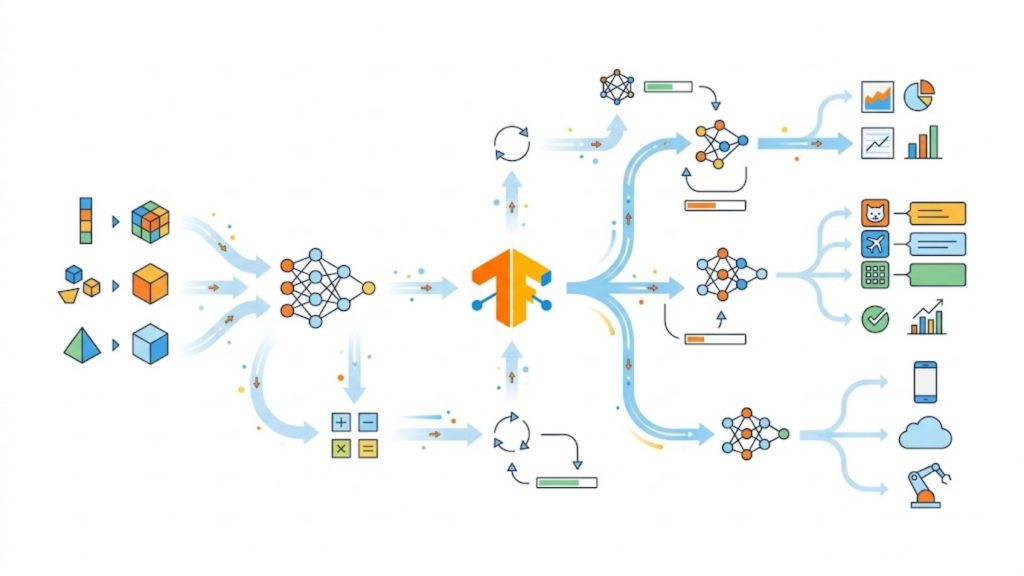
TensorFlow is an open-source library initially developed by the Google Brain Team
2. PyTorch vs TensorFlow: Key differences
Both PyTorch and TensorFlow are powerful deep learning frameworks, but they were built with different philosophies in mind. Here’s a side-by-side breakdown of the most important dimensions.
| Aspect | PyTorch | TensorFlow |
| Ease of use | Beginner-friendly, making it more intuitive for developers familiar with scientific computing | More accessible since Keras was integrated as a high-level API, though it may still feel more complex initially |
| Computation graph | Dynamic (“define-by-run”) graph: Code runs line by line, just like standard Python | Primarily static graphs compiled before execution, TensorFlow 2.x also supports eager execution for more flexibility |
| Debugging experience | Allows standard Python debugging tools like pdb to work seamlessly, making it easy to inspect values and trace execution | Offers its own tools like tf.debugging, but the process can feel less direct compared to PyTorch’s native Python workflow |
| Training workflow | PyTorch 2.x introduced torch.compile(), a JIT compiler that fuses operations and optimizes performance with minimal code change | Static graph execution and XLA compiler give TensorFlow an edge in large-scale distributed training, especially on TPUs |
| Deployment ecosystem | Offers TorchServe and TorchScript for deployment, with ONNX support for cross-framework compatibility | Has a clear edge with battle-tested tools: TensorFlow Serving for servers, TFLite for edge/mobile, and TensorFlow.js for browsers |
| Mobile & edge support | PyTorch Mobile is available but relatively newer, with fewer optimization tools for on-device deployment | TensorFlow Lite is used in over 80% of on-device ML deployments, particularly on Android |
| Community & ecosystem | Dominant in academia and research – around 85% of deep learning papers use PyTorch | Backed by Google, TensorFlow has a larger and more established community with extensive documentation and enterprise adoption |
| Ecosystem maturity | Rapidly growing: Strong in GenAI, LLMs, and computer vision research | More mature tooling overall: TensorFlow Serving and TFLite offer a clear, battle-tested path to production |
| Production readiness | Increasingly production-ready, especially for LLM and generative AI workloads, which suits teams that need rapid innovation | Strong choice for enterprise scalability and reliable deployment at scale with proven production systems |
| Best fit | Research, prototyping, generative AI, LLMs, and teams that prioritize flexibility and iteration speed | Large-scale production, mobile/edge deployment, and enterprise environments requiring end-to-end ML pipelines |
3. PyTorch vs TensorFlow performance
Actually, neither TensorFlow nor PyTorch can claim a universal performance win, notable nuances depend on workload and setup. With that context in mind, here’s how the two stack up across the key performance dimensions.
| Aspect | PyTorch | TensorFlow |
| Training speed | Often faster for smaller models thanks to lower overhead, torch.compile() in PyTorch 2.x delivers significant additional speedups | Static graph execution can yield better GPU utilization and memory efficiency for larger models and longer training runs |
| GPU acceleration | Supports NVIDIA CUDA and AMD ROCm: Provides fine-grained control over mixed-precision training on Tensor Core GPUs | Also supports CUDA and ROCm: Additionally integrates natively with Google’s TPUs, enabling highly efficient large-scale computation with minimal code changes |
| Distributed training | PyTorch’s Distributed Data Parallel (DDP) scales linearly across multiple GPUs and now supports multi-node training natively | TensorFlow’s graph compilation can achieve slightly better GPU utilization in some multi-GPU scenarios, though the gap with PyTorch has narrowed considerably |
| Model optimization | torch.compile() traces computation graphs and generates optimized GPU kernels, delivering 30–60% speedups on many workloads with a single line of code | XLA compiler applies whole-program optimization, delivering 15–20% gains on standard GPU benchmarks and stronger results on TPUs |
| Hardware compatibility | Strong on NVIDIA GPUs, growing support for AMD and Intel hardware. TPU support exists, but is not native | Runs natively on CPUs, GPUs, and Google TPUs: TPU integration typically requires minimal code changes, making it a natural fit for Google Cloud infrastructure |
Training speed depends heavily on model architecture, dataset size, and hardware configuration. Benchmarks are mixed, with each framework outperforming the other in different scenarios.
For most standard workloads on NVIDIA GPUs, the performance gap between the two is minimal. Where TensorFlow holds a clear edge is in TPU-based infrastructure and highly optimized production inference pipelines. Where PyTorch shines is in research-heavy workflows and large-model training, particularly for LLMs.
To put these performance differences in concrete terms: on standard workloads like ResNet-50 or BERT-Large training on a single high-end GPU, eager-mode PyTorch and TensorFlow typically land within about 5% of each other, too close to be a deciding factor on its own. Once compilation is enabled (torch.compile() for PyTorch, XLA for TensorFlow), both frameworks gain meaningfully, often in the 20-40% range, with PyTorch tending to pull slightly ahead on large transformer training thanks to fused attention kernels. Skipping the compiler step altogether, regardless of framework, tends to leave that performance gain on the table entirely, so the choice of compiler often matters more than the choice of framework.
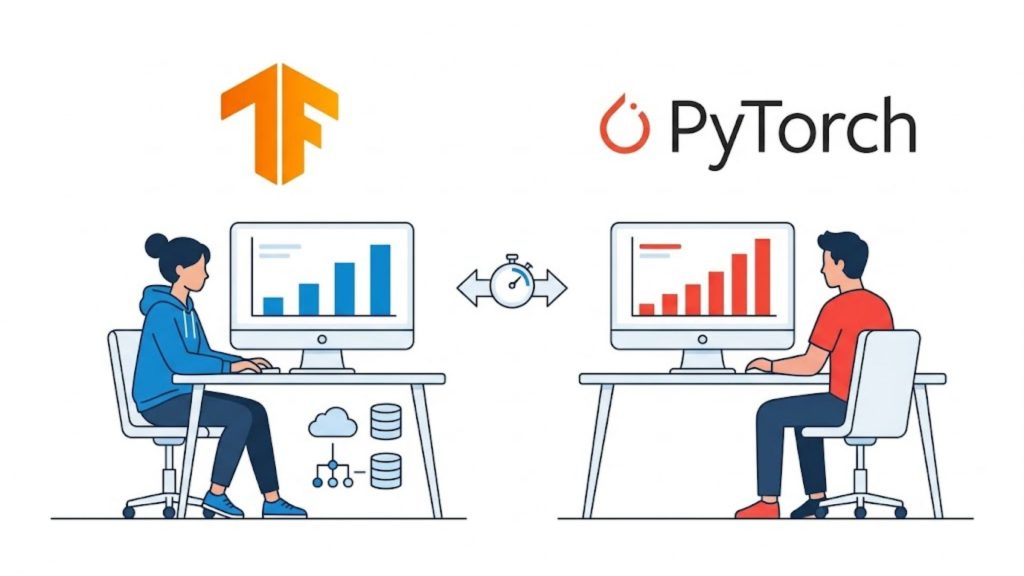
Neither TensorFlow nor PyTorch can claim a universal performance win
4. When to use PyTorch vs TensorFlow?
Choosing between PyTorch and TensorFlow isn’t about picking the “better” framework, it’s about picking the right one for your situation. The decision guide below maps common scenarios to the framework that will serve you best.
| Scenario | Best Fit |
Why It Works |
| Research and rapid prototyping | PyTorch | PyTorch’s dynamic computation graph and intuitive design make it the framework of choice for academic research, allowing researchers to modify architectures dynamically and debug with ease |
| Python-first experimentation | PyTorch | PyTorch runs line by line just like regular Python. You can use print(), pdb, or any Python debugger mid-computation, making model development and iteration fast and familiar |
| NLP, LLMs, and generative AI | PyTorch | The Hugging Face Transformers library, the de facto standard for language models, started as PyTorch-only. When fine-tuning transformers or experimenting with novel architectures, PyTorch’s flexibility accelerates iteration decisively |
| Large-scale production ML systems | TensorFlow | Tools like TensorFlow Serving and TFX create a well-defined, robust path from training to serving. Especially valuable when the goal is high-throughput, low-latency inference at scale |
| Mobile and edge deployment | TensorFlow | TensorFlow’s cross-platform deployment options, including TF Lite and TF.js, make it the standard choice for mobile, browser, and edge ML applications |
| Deep learning education and debugging | PyTorch | PyTorch is more appealing for beginners and researchers focused on experimentation and learning, thanks to its Pythonic style and transparent execution model |
| Enterprise deployment with a mature serving stack | TensorFlow | When you need to serve models at scale with uptime SLAs, gRPC, request batching, and monitoring as first-class citizens. TF Serving is the enterprise-ready, battle-tested choice |
| Google Cloud / TPU infrastructure | TensorFlow | TensorFlow integrates tightly with tools like Vertex AI and has native TPU support, making it the natural fit for teams already operating within the Google Cloud ecosystem |
In conclusion, if you’re developing AI for research, NLP, or generative AI, start with PyTorch. It’s the leading choice in academic and open-source communities. If you’re targeting production, mobile, or Google Cloud workflows, lean toward TensorFlow, as its ecosystem is built for operational scalability.
>> Read more: Top best AI tools need to know for researchers in 2026
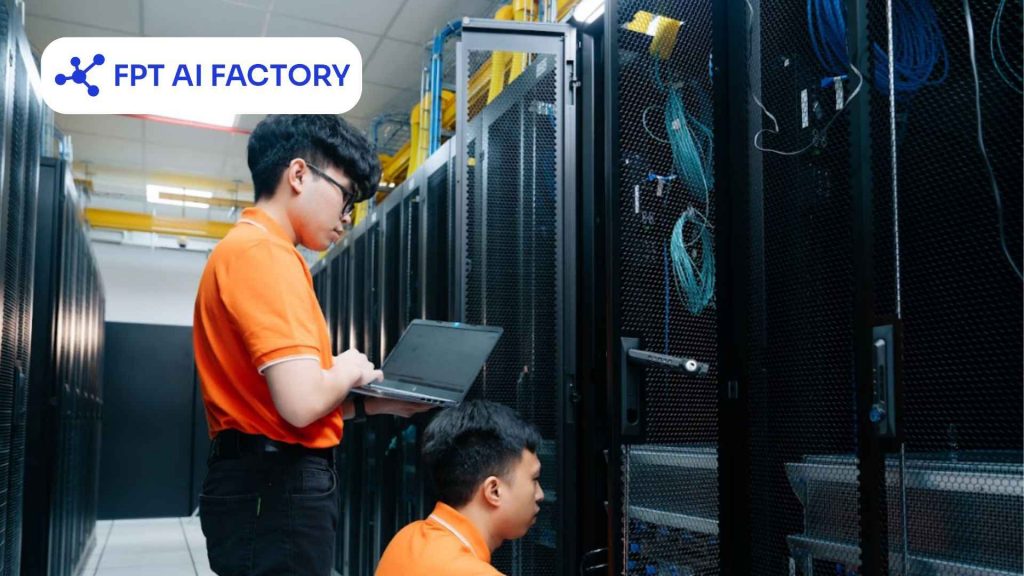
Choosing between PyTorch and TensorFlow (Source: FPT AI Factory)
5. PyTorch and TensorFlow in AI development platforms
Choosing the right framework is only half of the equation, the infrastructure you run it on matters just as much. A well-configured AI development platform needs to support both frameworks equally, from experimentation all the way through to production deployment. Here’s what to look for:
- Framework compatibility: A capable AI platform should support both PyTorch and TensorFlow out of the box, without requiring teams to reconfigure their environments or rewrite existing pipelines.The ability to switch between or run both frameworks side by side is becoming a key requirement for modern AI teams.
- GPU-based training and fine-tuning: Both frameworks support GPU and TPU acceleration and distributed training. Access to high-performance GPU compute is a non-negotiable foundation for serious model training and fine-tuning work, regardless of which framework your team uses.
- Experimentation and model iteration: The bigger factor in day-to-day AI development is developer velocity – how fast your team can iterate on model architecture and training logic. Platforms that offer flexible, pre-configured GPU environments allow researchers and engineers to spin up workloads quickly, run experiments in parallel, and move from idea to result without infrastructure bottlenecks.
- Deployment and inference support: TensorFlow offers a mature, production-oriented ecosystem with features such as static graph optimization, cross-platform deployment options, and a rich set of integrated tools. PyTorch’s deployment capabilities have also matured significantly with TorchScript, ONNX support, and TorchServe, closing the gap for many production use cases.
For teams that need reliable GPU compute to power PyTorch or TensorFlow workloads, whether for model training, fine-tuning, or scalable AI experimentation, FPT AI Factory’s GPU Virtual Machine provides on-demand GPU infrastructure purpose-built for AI development. It gives your team the flexibility to run any framework, scale compute as needed, and focus on building models rather than managing hardware.
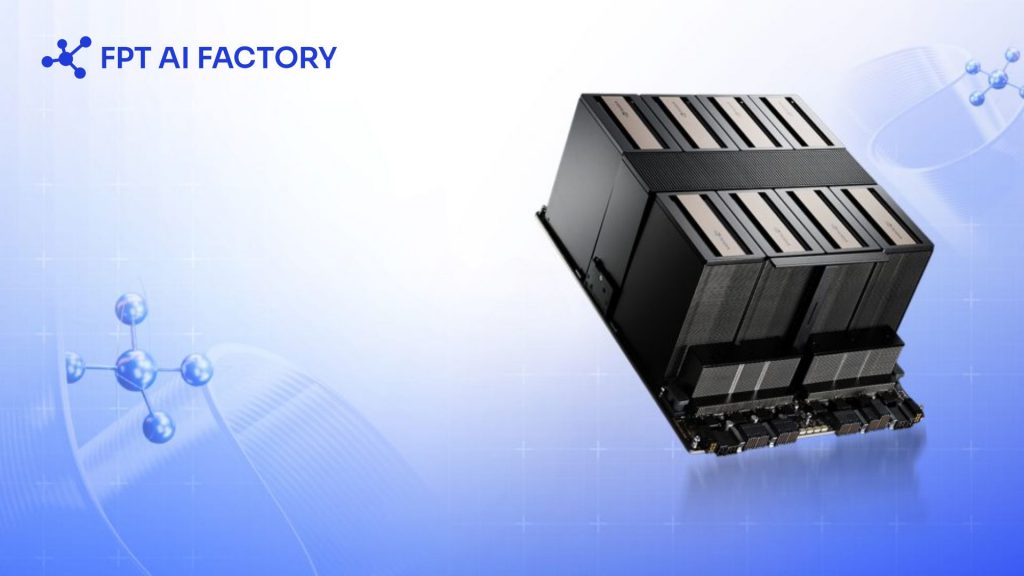
FPT AI Factory’s GPU Virtual Machine provides on-demand GPU infrastructure purpose-built (Source: FPT AI Factory)
6. PyTorch vs TensorFlow in Modern LLM Development
The rise of large language models has fundamentally reshaped how developers and researchers evaluate deep learning frameworks. While both PyTorch and TensorFlow remain production-grade tools, their trajectories in the LLM era have diverged sharply. This section examines how each framework performs across the dimensions that matter most in modern LLM development.
6.1 LLM Training
PyTorch has become the de facto standard for large-scale LLM pre-training and fine-tuning. Its dynamic computation graph and tight integration with distributed training frameworks like DeepSpeed, FSDP, and Megatron-LM make it the preferred choice for frontier labs.
TensorFlow, while capable, is primarily competitive in Google-native infrastructure through TPU training via tf.distribute – a meaningful advantage for teams deeply embedded in Google Cloud but rarely the default elsewhere.
Example: Meta trained Llama 3 using PyTorch with FSDP across thousands of GPUs. On the TensorFlow side, Google trained Flan-T5 using TPU pods via tf.distribute.TPUStrategy, achieving strong throughput on Google Cloud infrastructure.
6.2 Hugging Face Support
The Hugging Face ecosystem – Transformers, PEFT, TRL, Datasets – is built natively on PyTorch. Every major API ( Trainer, AutoModel, pipeline) defaults to PyTorch tensors. TensorFlow models are available but frequently lag in new releases, and many models on the Hub are marked “PyTorch only.” Conversion via from_pt=True exists, but it remains a workaround rather than a first-class experience.
For example, Running AutoModelForCausalLM.from_pretrained(“meta-llama/Llama-3-8B”)loads a PyTorch model out of the box. To use the same model in TensorFlow, you would need TFAutoModelForCausalLM.from_pretrained(…, from_pt=True) – an extra conversion step that is not always supported for newer architectures.
6.3 LoRA / QLoRA Support
Parameter-efficient fine-tuning is almost entirely a PyTorch story. The PEFT library, QLoRA with bitsandbytes 4-bit quantization, and the broader adapter ecosystem are all PyTorch-native. TensorFlow has no official LoRA library, and community ports lack the tooling depth needed for production use. For anyone doing efficient fine-tuning of large models, PyTorch is the only practical choice.
Example: Fine-tuning Mistral 7B with QLoRA on a single consumer GPU is a well-documented, reproducible workflow using peft, bitsandbytes, and trl – all PyTorch libraries. An equivalent TensorFlow workflow does not exist out of the box and would require significant custom implementation.
6.4 Open-Source Model Support
The vast majority of open-source LLMs ship PyTorch weights natively, including OpenAI GPT-style architectures, Meta’s Llama 2, Llama 3, and Llama 3.1, Mistral AI’s Mistral 7B and Mixtral, and Anthropic’s Claude-style transformer architectures. TensorFlow’s open-source footprint is narrower, centered on Google-originated models such as Gemma, Flan-T5, T5, and the original BERT. Third-party open models are generally only available in TF as post-hoc conversions.
Example: Downloading mistralai/Mistral-7B-v0.1or meta-llama/Llama-3.1-70B from the Hugging Face Hub gives you .safetensors PyTorch weights immediately. Gemma 2, by contrast, ships with both PyTorch and Keras (TF-backend) checkpoints – a rare case where TensorFlow receives first-class support at release.
6.5 GenAI Research
PyTorch dominates academic and industrial AI research. Most code releases accompanying papers at NeurIPS, ICML, and ICLR default to PyTorch, and it is the framework of choice at virtually every major AI lab outside Google.
TensorFlow retains a presence in internal Google research, though even within Google, JAX has largely overtaken it as the preferred research framework. TF 2.x eager mode narrowed the usability gap, but momentum in the research community never recovered.
The original “Attention Is All You Need” transformer paper was later reproduced most widely in PyTorch via the annotated-transformerproject. Flash Attention, RoPE, and GQA, three of the most influential architectural innovations in recent LLMs, all have PyTorch reference implementations released alongside their papers.
6.6 Inference Ecosystem
PyTorch powers the modern LLM inference stack: vLLM, Text Generation Inference (TGI), ExLlamaV2, and TensorRT-LLM all target PyTorch weights, while GGUF quantization via llama. cpp originates from PyTorch models. On the mobile and edge side, Meta’s ExecuTorch is rapidly closing the gap with TensorFlow Lite for on-device PyTorch model deployment, though TF Lite remains the more battle-tested option for large-scale Android rollouts as of 2026.
TensorFlow counters with proven production tooling, TF Serving for high-throughput APIs, TensorFlow Lite for on-device inference, and TF.js for browser deployment, making it competitive in enterprise and edge contexts where serving infrastructure maturity matters more than model variety.
Deploying Llama 3 with vLLM for high-throughput batched inference requires only a few lines of Python and a PyTorch checkpoint. For edge deployment, TensorFlow Lite enables running a quantized BERT-based classifier on Android without any server dependency – a use case where TF’s mobile toolchain still has a clear advantage.
6.7 Community Momentum
PyTorch’s community momentum is self-reinforcing. GitHub activity, Stack Overflow traffic, and Hugging Face model uploads all skew heavily toward PyTorch, and new open-source contributors default to it without a second thought.
TensorFlow maintains a large installed base in industry and benefits from Google’s sustained investment – the Keras 3 relaunch being the most notable recent effort – but its growth in the LLM-specific community has visibly slowed compared to the PyTorch ecosystem.
As of 2024, over 90% of models on the Hugging Face Hub are listed with PyTorch as the primary framework. Meanwhile, Keras 3’s support for multiple backends (PyTorch, JAX, TensorFlow) signals that even TensorFlow’s own team is hedging toward framework agnosticism rather than doubling down on TF-exclusive development.
7. Pros and cons of PyTorch and TensorFlow
Both PyTorch and TensorFlow come with genuine strengths, and real trade-offs that teams should weigh carefully before committing to one. Here’s an honest breakdown of where each framework shines and where it falls short.
7.1 PyTorch
| Pros | Cons |
| Intuitive and Pythonic: PyTorch’s dynamic computation graph lets developers make changes on the fly, simplifying debugging and rewriting neural networks as needed | No built-in visualization: PyTorch lacks a native visual interface, developers must rely on command-line tools, custom scripts, or third-party libraries to monitor training progress |
| Best-in-class debugging: Because the graph is built dynamically, you can drop standard Python debuggers or print() statements anywhere in your code to inspect tensors in real time. | Production deployment requires extra setup: Deploying models at scale requires additional tools like TorchServe or ONNX, and some advanced features like distributed training still have a steeper learning curve |
| Dominant in research: PyTorch’s use in implementing ML and DL research papers grew from 51% in 2020 to 59% in 2024 – the go-to choice for researchers and academics worldwide | Weaker mobile support: PyTorch Mobile is less comprehensive than TensorFlow Lite, still requiring more manual configuration for mobile and edge deployment |
| Strong LLM and GenAI ecosystem: Most large-scale LLM training, including GPT, LLaMA, and Mistral, uses PyTorch, with tools like FSDP, DeepSpeed, and Hugging Face Transformers built around it | Less structured MLOps path: Teams that need end-to-end pipelines from training to production serving may find PyTorch requires more manual assembly compared to TensorFlow’s integrated tooling |
7.2 TensorFlow
| Pros | Cons |
| Battle-tested production ecosystem: TensorFlow Serving and TFX offer a mature, integrated MLOps path, ideal for teams that need high-availability serving with monitoring, versioning, and scalability built in | Steeper learning curve: Despite improvements with Keras, TensorFlow still has a higher initial complexity. Understanding its broader ecosystem takes time, especially for beginners |
| Excellent visualization with TensorBoard: TensorBoard provides a powerful graphical interface for reviewing model structure, monitoring training metrics, and debugging | Less flexible for rapid experimentation: Teams often start prototyping in PyTorch and only switch to TensorFlow once a trusted model is ready, because TensorFlow is less agile for iterative research |
| Superior mobile and edge deployment: TensorFlow Lite is the industry standard for on-device ML, enabling optimized deployment across Android, iOS, and embedded systems | Frequent updates can cause friction: TensorFlow releases updates every few months, which can increase overhead for teams that need to continuously re-align their existing systems with new versions |
| Google-backed with strong cross-platform support: Backed by Google, TensorFlow benefits from frequent updates, hardware compatibility across CPUs, GPUs, and TPUs, and deep integration with Google Cloud infrastructure | Inconsistent naming conventions: TensorFlow’s API contains similar-sounding functions with different implementations, which can create confusion and slow down development, especially for newer users |
| Performance and scalability at enterprise scale: TensorFlow is optimized for large-scale applications, with strong support for distributed training and graph-level optimizations that shine in high-throughput production pipelines | Slower for research workflows: TensorFlow’s share of ML research paper implementations fell from 10% in 2020 to just 2% in 2024, reflecting its weaker foothold in cutting-edge experimentation |
8. FAQs
8.1. Is PyTorch better than TensorFlow?
PyTorch is not universally “better” than TensorFlow, it depends on your goals. PyTorch is generally preferred for research and experimentation because of its flexible, Python-like syntax and dynamic computation graphs, which make debugging and iteration easier. However, TensorFlow is often stronger for large-scale production systems thanks to its mature ecosystem and deployment tools.
8.2. Is TensorFlow faster than PyTorch?
TensorFlow used to have a performance advantage, especially in production, due to its optimized static computation graphs. However, recent updates like PyTorch 2.x with torch.compile have largely closed the performance gap. Today, both frameworks offer very similar speed in most real-world scenarios, and performance differences usually depend more on implementation details than the framework itself.
8.3. Do companies use PyTorch or TensorFlow?
Companies use both PyTorch and TensorFlow widely. TensorFlow still has a strong presence in enterprise environments, with tens of thousands of companies using it for production systems. Meanwhile, PyTorch is extremely popular in research and is increasingly adopted in industry as well, appearing frequently in job postings and modern AI projects. In practice, many organizations choose based on their specific needs rather than sticking to one framework exclusively.
8.4. Which is better for beginners: PyTorch or TensorFlow?
PyTorch is generally considered better for beginners because it feels more like standard Python and is easier to understand and debug. Its intuitive design allows learners to experiment quickly without dealing with complex abstractions. Although TensorFlow has become more beginner-friendly with Keras, it can still feel more structured and less intuitive compared to PyTorch for those just starting.
8.5. Can I use both PyTorch and TensorFlow?
Yes, you can absolutely use both PyTorch and TensorFlow, and many developers do. In fact, modern tools and frameworks can even run on multiple backends, including both PyTorch and TensorFlow. Learning both can be beneficial because it gives you flexibility to choose the right tool for different projects, such as using PyTorch for experimentation and TensorFlow for deployment.
8.6. Is TensorFlow dying?
No, but its share of research and new open-source projects has declined sharply in favor of PyTorch. TensorFlow remains widely used in production, particularly for mobile inference (TensorFlow Lite), browser-based ML (TensorFlow.js), and TPU-based training on Google Cloud. Rather than dying, TensorFlow has become more specialized, strong in well-defined niches instead of being the default choice across the board.
Ready to put your framework knowledge into practice? New users can get started with a Starter Plan – $100 in free credits to explore the full FPT AI Factory ecosystem for 30 days. Credits are available immediately upon registration with no setup, no approval process, and no strings attached. Whether you’re running your first PyTorch experiment or deploying a TensorFlow model at scale, you can start building right away.
In conclusion, navigating the PyTorch vs TensorFlow decision is ultimately about understanding your team’s workflow, your deployment environment, and the kind of AI you’re building. Whether you prioritize research flexibility or production reliability, having the right compute infrastructure underneath makes all the difference. For organizations looking to scale their AI development with expert guidance and enterprise-ready GPU infrastructure, contact FPT AI Factory today for a personalized consultation!
Contact information
- Hotline: 1900 638 399
- Email: support@fptcloud.com
Explore Related Articles: