

For the past decade, the dominant story in artificial intelligence has been one of scale. More data. More parameters. More compute. And it worked. Large language models trained on vast amounts of human-generated text became capable of writing, reasoning, diagnosing, coding, and summarizing at a level that surprised even the researchers who built them.
But that story is reaching its limits. And the researchers who know this best are the ones who built the systems that defined it.
In April 2025, David Silver and Richard Sutton, two of the most influential AI scientists in the world, published a paper titled “Welcome to the Era of Experience.” Their argument is straightforward: human data has taken AI as far as it can go. What comes next is something different.
The Ceiling on Human Data
The paper makes a point that is easy to overlook in the day-to-day excitement around new model releases. In domains like mathematics, coding, and science, the pool of high-quality human-generated data that can meaningfully improve a strong model is not infinite. Most of it has already been used. The rest will be soon.
This is not a critique of current AI systems. It is an observation about physics. There is only so much high-quality human-generated text in the world. Once you have trained on it, training on it again does not make you smarter. It makes you more of the same.
The deeper problem is that genuine breakthroughs, new theorems, new technologies, new scientific discoveries, exist beyond the boundaries of what humans have already written down. A model that learns only from existing human knowledge can get very good at recombining what we already know. It cannot discover what we do not.
What Comes After Human Data
Silver and Sutton describe this transition as moving from the Era of Human Data into the Era of Experience. Rather than learning by imitating what humans have produced, AI agents in this new era learn by doing. They take actions in the world, observe the outcomes, and update their behaviors accordingly, the same way a child learns to walk not by reading about it, but by falling down and trying again.
The structure of how these agents operate shifts fundamentally. Instead of short, isolated interactions, they inhabit continuous streams of experience over time. Their rewards come not from human feedback and ratings, but from signals in the environment itself. And their reasoning is grounded not just in language, but in what they actually observe happening around them.
The paper points to AlphaProof as an early indicator of what this looks like in practice. Initially trained on around 100,000 formal mathematical proofs created by human mathematicians over many years, AlphaProof’s reinforcement learning system then generated 100 million more through its own interaction with a formal proving environment. The result was a system that reached silver medal standard at the International Mathematical Olympiad, a level that purely human-data approaches could not reach.
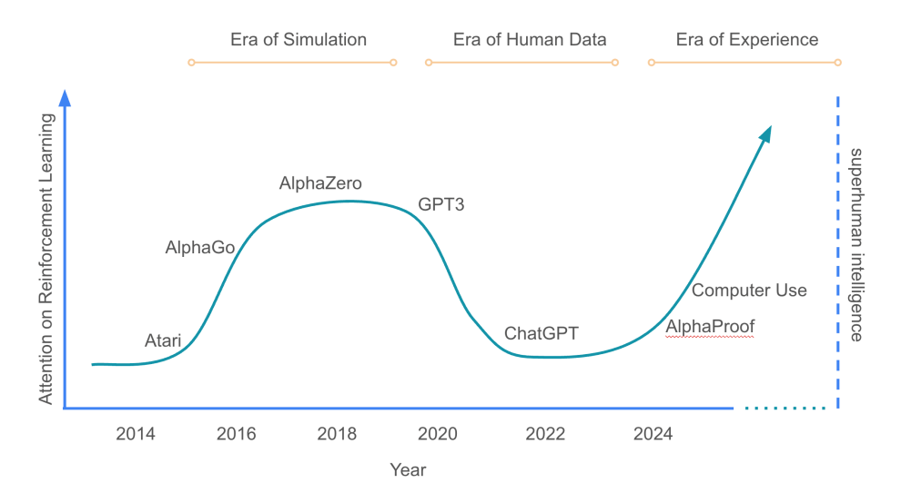
Figure 1: A sketch chronology of dominant AI paradigms, from the Era of Simulation through the Era of Human Data and into the Era of Experience
What This Means for Enterprise AI
The Era of Experience is not a distant concept. It is already shaping how enterprise AI systems are being designed and deployed.
Today’s AI assistants respond to requests. They answer a question, complete a task, then reset. The next generation will do something more ambitious: operate in continuous streams of activity, learning and adapting over months rather than resetting after every conversation.
And this is already happening. In April 2026, AutoAgent became the first fully self-improving AI agent to rewrite its own instructions through trial and error, reaching #1 on SpreadsheetBench with 96.5% accuracy, beating every hand-engineered system in the benchmark. In drug discovery, a landmark study published in Drug Discovery Today in March 2026 documented AI agents autonomously running experiments, refining hypotheses, and managing the full discovery pipeline, with early results showing substantial gains in both speed and reproducibility.
For enterprises investing in AI infrastructure today, this trajectory has a practical implication. The shift from static models to continuously learning agents will place much higher demands on compute, on data infrastructure, and on the platforms that connect AI systems to real-world signals and environments.
FPT AI Factory is built for exactly this kind of workload. The GPU infrastructure, the flexible compute architecture, and the capacity to support long-running, high-throughput AI workloads are already in place. What the Era of Experience describes as the future of AI is, in infrastructure terms, something we are ready to support today.
The question for enterprises is not whether this transition will happen. It is whether they will be in a position to take advantage of it when it does.