
Artificial intelligence is rapidly changing how software is built. From code generation and debugging to documentation and testing, AI coding agents are becoming an essential part of modern development workflows. As enterprises embrace AI-native software engineering, they are also facing new challenges around infrastructure, cost, scalability, and data privacy.
To address these challenges, organizations are increasingly adopting open-source large language models (LLMs) and AI coding agents to accelerate software development. However, unlocking their full potential requires more than powerful models; it demands enterprise-ready infrastructure that delivers high-performance compute, scalability, security, and cost efficiency.
This tech blog explores how AI coding agents, open-source LLMs, and accelerated infrastructure are coming together to help enterprises build and scale AI applications more efficiently.
The Rise of Open LLMs for AI Development
Open-source LLMs have evolved far beyond experimental projects. Today, models such as Llama, Qwen, and Gemma deliver impressive coding capabilities that are sufficient for many day-to-day development tasks, including:
- Code generation and completion
- Bug detection and debugging
- Code review
- Test case generation
- Documentation creation
Instead of relying exclusively on premium proprietary models for every request, many organizations are now adopting a hybrid AI strategy – using closed models only when necessary while leveraging open models for the majority of development workloads.
This approach provides several important advantages:
- Lower inference costs at scale
- Greater control over AI infrastructure
- Improved protection for proprietary source code and internal data
- Flexibility to customize models for organization-specific frameworks, APIs, and coding standards
For industries such as finance, healthcare, insurance, and government, where privacy and compliance are critical, self-hosted or private inference powered by open LLMs has become an increasingly attractive option.
AI Coding Agents Are Changing the Developer Workflow
The role of AI in software engineering has expanded dramatically. Not long ago, developers primarily used AI for simple code suggestions or answering technical questions. Today, autonomous coding agents can:
- Understand entire repositories
- Analyze project architecture
- Modify multiple files
- Execute tests
- Debug issues
- Generate documentation
- Prepare commits and pull requests
Rather than acting as autocomplete assistants, these AI agents are becoming collaborative development partners. However, this shift introduces a new challenge: token consumption. Unlike traditional chat interactions, coding agents repeatedly call language models throughout an entire workflow. A single development task may generate hundreds or even thousands of inference requests before completion. As AI-assisted development becomes standard practice, organizations must rethink how they manage both infrastructure and AI operating costs.
The Token Economy of AI-Native Development
As enterprises scale AI development, these infrastructure challenges become increasingly evident in real-world deployment. During AI DevTalk #2, one of the key discussions focused on the token economy and how organizations can optimize inference for AI coding agents.
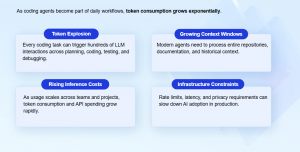
As coding agents process larger repositories, longer conversations, and increasingly complex reasoning tasks, enterprises commonly encounter four major challenges:
- Rapid growth in token consumption
- Expanding context window requirements
- Rising inference costs
- Infrastructure bottlenecks caused by latency and API rate limits
Simply increasing API usage is no longer a sustainable strategy. Instead, organizations need smarter inference architectures that optimize model selection based on workload complexity. One example highlighted during the session is NVIDIA’s routing approach, where lightweight models first classify requests before directing them to the most appropriate LLM. Simple conversations can be handled by smaller models, while complex reasoning or coding tasks are routed to larger, more capable models. This intelligent routing significantly improves token efficiency without sacrificing developer productivity.
Infrastructure Matters More Than Ever
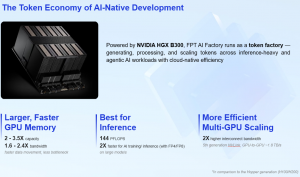
As AI workloads become increasingly agentic, infrastructure is emerging as a key competitive advantage. The session highlighted how FPT AI Factory, powered by NVIDIA technologies, delivers the high-performance compute foundation enterprises need to build, scale, and deploy AI.
The platform is built on NVIDIA-certified architecture featuring:
- NVIDIA AI infrastructure powered by Hopper (H200, H100) and Blackwell GPUs (B300)
- High-speed InfiniBand networking
- NVIDIA DPUs for accelerated performance
- NVIDIA AI Enterprise software AI frameworks, NVIDIA NIM microservices, and pre-trained models
Together, these technologies enable organizations to build, deploy, and scale production-ready AI applications with confidence. We also introduced the latest NVIDIA HGX B300, designed specifically for AI reasoning, agentic AI systems, large-scale inference, and demanding enterprise workloads. As AI coding agents continue generating massive volumes of inference requests, scalable GPU infrastructure becomes essential for maintaining performance while controlling operational costs.
Connecting AI Coding Agents to FPT AI Factory
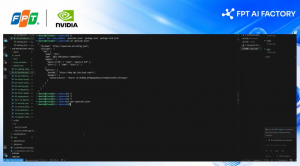
To put these concepts into practice, our recent AI DevTalk #2 webinar included a live demonstration showing how developers can integrate popular coding agents with FPT AI Factory.
The session demonstrated how tools such as OpenCode and Claude Code CLI can be configured to use FPT AI Factory as their inference provider through OpenAI-compatible APIs. With only minimal configuration, updating API endpoints, provider settings, and authentication keys, developers can redirect their coding agents to FPT AI Factory and immediately begin building using scalable AI infrastructure.
This flexibility allows development teams to continue using their preferred AI tools while benefiting from private, enterprise-ready inference services.
From Experimentation to Production Deployment
Enterprise AI projects often begin with testing and benchmarking before moving into full-scale deployment. To support this journey, FPT AI Factory provides GPU Virtual Machine that allow organizations to:
- Deploy private inference endpoints
- Evaluate different AI models
- Benchmark GPU performance
- Optimize memory utilization
- Validate security configurations
- Test API serving performance
Once validation is complete, organizations can seamlessly transition to dedicated Inference Endpoint, providing:
- Stable production performance
- Dedicated traffic isolation
- Enhanced security
- Better operational control
- Scalable enterprise deployment
This progression enables teams to move confidently from experimentation to production without rebuilding their AI infrastructure
Building the Future of AI Development
The AI development landscape is evolving rapidly. Open-source LLMs, intelligent coding agents, and enterprise AI infrastructure are reshaping how software is designed, developed, and deployed.
Rather than replacing developers, AI is becoming a force multiplier—automating repetitive work, accelerating delivery, and enabling engineering teams to focus on higher-value problem solving.
At FPT AI Factory, our mission is to provide developers and enterprises with the infrastructure, AI services, and tools needed to build this next generation of AI applications securely and efficiently.
Watch the Full Webinar
If you missed the live session or would like to revisit the key insights, watch the full webinar recording to explore the complete discussion, live demonstrations, and technical insights from our experts.
🎥 Webinar Recording: https://short.factory.fpt.ai/8FZ5a
To learn more about FPT AI Factory’s AI infrastructure, GPU Cloud, AI Inference, and enterprise AI solutions, visit https://factory.fpt.ai.
Stay connected with FPT AI Factory for upcoming AI DevTalk sessions, technical blogs, product updates, and hands-on learning opportunities.