

What are world models is an important question for understanding how advanced AI systems move beyond simple pattern recognition. World models in AI help systems build internal representations of their environment, predict future states, and plan better actions. In this article, FPT AI Factory explains how world models work, where they are used, and why scalable AI infrastructure matters for training and simulation.
1. What are world models?
World models are internal representations that AI systems use to understand their environment and predict what might happen next. This concept is widely used in reinforcement learning and autonomous AI systems. Instead of reacting directly to input data, world models allow systems to:
- Understand environment structure: The model learns patterns and relationships in data (e.g., how objects move or interact), rather than treating each input independently
- Predict future states: It can estimate what the environment will look like after a sequence of actions, which is critical for planning
- Support decision-making: By simulating different outcomes, the system can choose actions that lead to better results
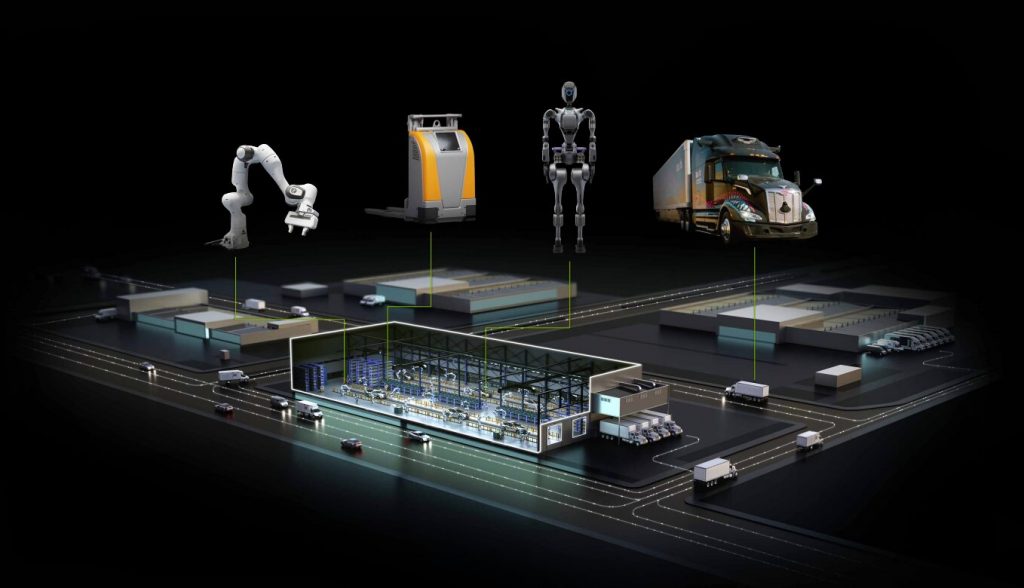
World models help AI systems understand the contextual environment and predict the next action
2. How do world models in AI work?
World models in AI work by converting raw observations into internal representations, predicting how the environment may evolve, and using those predictions to support planning or decision-making. The process usually follows a perception-to-action loop.
| Stage | What happens | Purpose |
| Perception | The system receives inputs such as images, sensor data, text, or state information | Understand the current environment |
| Representation learning | Raw data is encoded into a compact latent representation | Capture important features and reduce complexity |
| Dynamics prediction | The model predicts how the environment may change over time | Simulate future states |
| Planning | The system compares possible future outcomes | Select better actions |
| Action | The selected action is executed in the environment | Complete the decision loop |
This workflow allows AI systems to move from reactive behavior toward predictive and planning-based intelligence. Instead of only responding to what is happening now, the system can evaluate what may happen next.
3. What are the key components of world models?
World models are built from several core components that handle perception, memory, and prediction. The main components of word models includes:
- Encoder (Perception model): Transforms raw inputs (such as images or text) into compact latent representations. This step reduces noise and focuses on the most important features of the environment.
- Dynamics model (Transition model): Predicts how the environment changes over time. Given a current state and an action, it estimates the next state, enabling simulation and planning.
- Decoder (Reconstruction model): Converts latent representations back into interpretable outputs. This helps validate whether the model has learned meaningful representations of the environment.
Each component plays a role in helping the system simulate and understand its environment.
4. Where are world models used in AI?
World models in AI are used in applications where systems need to understand dynamic environments, predict future states, and make decisions across multiple steps. These use cases often involve planning, simulation, and interaction with physical or digital environments.
| Use case | How world models help |
| Robotics | Help robots predict how movement or manipulation will affect surrounding objects |
| Autonomous vehicles | Simulate traffic, pedestrians, and road conditions before making driving decisions |
| AI agents | Support multi-step planning instead of reacting to each instruction independently |
| Reinforcement learning | Reduce the need for costly real-world interaction by simulating environments |
| Simulation systems | Test different scenarios before deploying AI systems in real environments |
| Physical AI | Help AI systems understand and interact with the physical world more safely |
These use cases often involve large-scale training and complex simulations. In practice, infrastructure platforms like FPT AI Factory support this by providing GPU resources to handle compute-intensive model training, including GPU Virtual Machine and GPU Container. These infrastructures offer businesses with scalable environments for running simulations and flexible deployment options for production AI systems.
5. How are world models different from traditional AI?
World models differ from traditional AI models because they focus on understanding how an environment changes over time. Traditional AI models are often designed to map inputs directly to outputs, while world models support prediction, simulation, and planning.
| Aspect | Traditional AI models | World models |
| Main approach | Learn direct patterns from input to output | Learn how an environment behaves over time |
| Decision style | Often reactive | Predictive and planning-based |
| Use of future states | Limited or absent | Simulates possible future outcomes |
| Adaptability | Lower in dynamic environments | Higher when the learned environment model is accurate |
| Common use cases | Classification, prediction, recommendation | Robotics, autonomous systems, AI agents, model-based RL |
| Key limitation | May struggle with long-term planning | Requires high-quality data and significant compute |
Traditional AI models remain effective for many prediction tasks. However, world models are better suited for AI systems that need to reason about actions, consequences, and changing environments.
6. What challenges do world models face?
World models are powerful, but they are difficult to build and deploy effectively. Their performance depends on how accurately they can represent the environment and predict future states. Common challenges include:
- Modeling uncertainty: Real-world environments are complex, noisy, and difficult to predict perfectly.
- High compute requirements: Training world models can require significant GPU resources, especially for visual or simulation-heavy tasks.
- Data quality and coverage: The model needs diverse data to understand different states, actions, and outcomes.
- Error accumulation: Small prediction errors can compound over multiple simulated steps.
- Scalability: More complex environments require larger models, more simulations, and stronger infrastructure.
- Evaluation difficulty: It can be hard to measure whether a world model truly understands the environment or only memorizes patterns.
These challenges make infrastructure planning, dataset quality, monitoring, and evaluation essential for teams developing world models in production-oriented AI systems.
7. Frequently asked questions
7.1. Are world models the same as large language models?
No. A large language model mainly learns patterns in language, while a world model learns how an environment changes over time. However, an LLM can be part of an AI agent system that uses a world model for planning, prediction, or decision-making.
7.2. Do world models need real-world data to work?
World models usually need data that reflects the environment they are expected to model. This can include real-world data, simulated data, or a combination of both. The more diverse and representative the data is, the better the model can predict future states.
7.3. Why are world models difficult to build?
World models are difficult to build because real environments are complex, uncertain, and constantly changing. They require high-quality data, strong compute resources, and careful evaluation to ensure predictions remain accurate over multiple simulated steps.
7.4. What infrastructure is needed to train world models?
Training world models often requires GPU infrastructure, scalable storage, simulation environments, and reproducible deployment workflows. For complex use cases such as robotics, physical AI, or autonomous systems, teams also need enough compute capacity to train models and run repeated simulations efficiently.
In conclusion, what are world models is a key question for understanding how AI systems can predict, plan, and interact with complex environments. World models in AI help systems build internal representations, simulate future states, and make better decisions across robotics, autonomous systems, reinforcement learning, and AI agents.
With FPT AI Factory, teams can access GPU infrastructure such as GPU Virtual Machine and GPU Container to support compute-intensive training, simulation, and deployment workflows. New users can receive $100 in credits and start using the service immediately after logging in. For enterprises with customization needs or large-scale deployment requirements, please contact FPT AI Factory through the contact form for dedicated support.
Contact information
- Hotline: 1900 638 399
- Email: support@fptcloud.com
Explore more articles: