
Across industries, a shift is underway. AI is no longer a pilot project or a boardroom talking point; it has become core infrastructure. According to NVIDIA’s annual State of AI report, which gathered over 3,200 responses from enterprise leaders across financial services, retail, healthcare, telecommunications, and manufacturing, the message is consistent: AI adoption is accelerating, and it is delivering measurable returns.
AI Adoption Has Crossed a Tipping Point
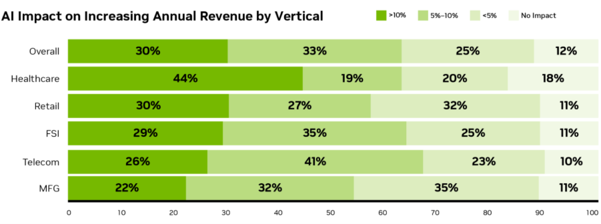
For the first time, the majority of surveyed enterprises report that they are actively using AI in their operations. Sixty-four percent of respondents said their organizations have moved beyond the assessment stage, with adoption highest in North America at 70% and growing steadily across the Asia-Pacific region at 63%.
Perhaps more telling is the trajectory. Organizations that were in the pilot phase last year are now in production. The share of respondents still in the assessment stage declined across nearly every industry vertical. The window for “evaluating AI” is closing, and companies that delay risk falling behind peers who are already compounding the benefits of early deployment.
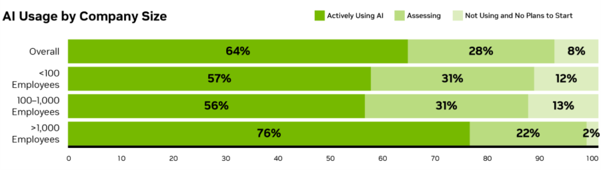
Larger organizations are leading the charge. More than three-quarters of respondents from companies with over 1,000 employees reported active AI usage. This reflects the structural advantage that larger enterprises have: more capital for infrastructure, more data to train on, and dedicated AI talent to move projects from concept to production.
The Business Case Is No Longer in Question
One of the most significant findings from this year’s report is how decisively the ROI debate has been settled.
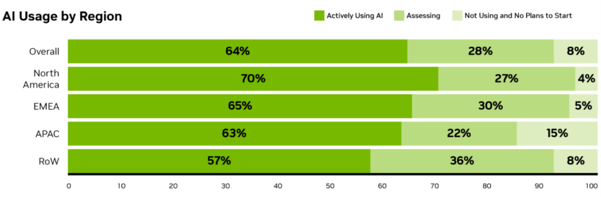
Eighty-eight percent of respondents said AI has had a positive impact on annual revenue. Nearly a third reported revenue increases exceeding 10%, while 33% saw gains in the 5 to 10% range. At the same time, 87% said AI helped reduce annual costs, with retail and consumer packaged goods companies leading the way, 37% in that sector reported cost reductions greater than 10%.
These are not theoretical projections. Lowe’s, for example, used AI to build digital twins of over 1,750 stores, enabling them to streamline operations and generate 3D product models at a cost of under one dollar per model. Siemens, working with PepsiCo, deployed physics-accurate digital twins of manufacturing facilities that identified up to 90% of potential issues before any physical changes were made, driving a 20% increase in throughput and reducing capital expenditure by 10 to 15%.
AI Is Boosting Productivity Across Every Industry
The top three AI goals cited by survey respondents were operational efficiency, improved employee productivity, and new business opportunities. What is notable is how interconnected these outcomes turn out to be in practice.
More than half of all respondents reported that improved employee productivity was one of the biggest impacts AI had on their operations. In telecommunications, 99% of respondents said AI improved employee productivity, with a quarter describing the impact as major or significant. When employees accomplish more in less time, the effects ripple outward, 42% of respondents said AI created operational efficiencies, and 34% said it opened new business and revenue opportunities that would not otherwise have existed.
The Rise of Agentic AI
If 2025 was the year of the AI agent proof of concept, 2026 is the year it becomes an operational reality. Last year, 44% of companies were either deploying or assessing AI agents, autonomous systems capable of reasoning, planning, and executing complex tasks. Today, those experiments have graduated into production deployments across code development, legal and financial workflows, administrative functions, and clinical care.
Telecommunications led all industries in agentic AI adoption at 48%, followed closely by retail and consumer packaged goods at 47%. In healthcare, AI medical assistant Mona by Clinomic demonstrated what this looks like in practice: a system that consolidates and visualizes patient data in real time, reducing documentation errors by 68% and cutting perceived clinical workload by 33%.
AI Budgets Are Growing
The financial commitment to AI is accelerating. Eighty-six percent of respondents said their AI budgets will increase in 2026, with nearly 40% projecting increases of 10% or more. North American organizations are especially aggressive, with 48% expecting budgets to grow by more than 10%.
The top spending priority for 42% of respondents is optimizing existing AI workflows and production cycles, followed by finding new use cases and expanding AI infrastructure. This signals that organizations are not just consolidating gains but actively looking for the next layer of value.
What This Means for Enterprises in the Region
The enterprises achieving the most from AI share a few common characteristics. They have invested in scalable infrastructure, they are working with models fine-tuned on their own data, and they are moving fast from pilot to production.
For organizations in Southeast Asia and beyond, building that foundation now is critical. FPT AI Factory provides the infrastructure to support exactly this kind of AI journey, from GPU Cloud environments that power model training and fine-tuning, to AI Studio tools for rapid development and testing, to inference infrastructure for deploying models at scale. As enterprises across every industry move from assessment to action, having the right platform underneath their AI ambitions makes all the difference.
The state of AI in 2026 is strong. The question is no longer whether AI delivers results; it is whether your organization will move fast enough to capture them.
Source: NVIDIA