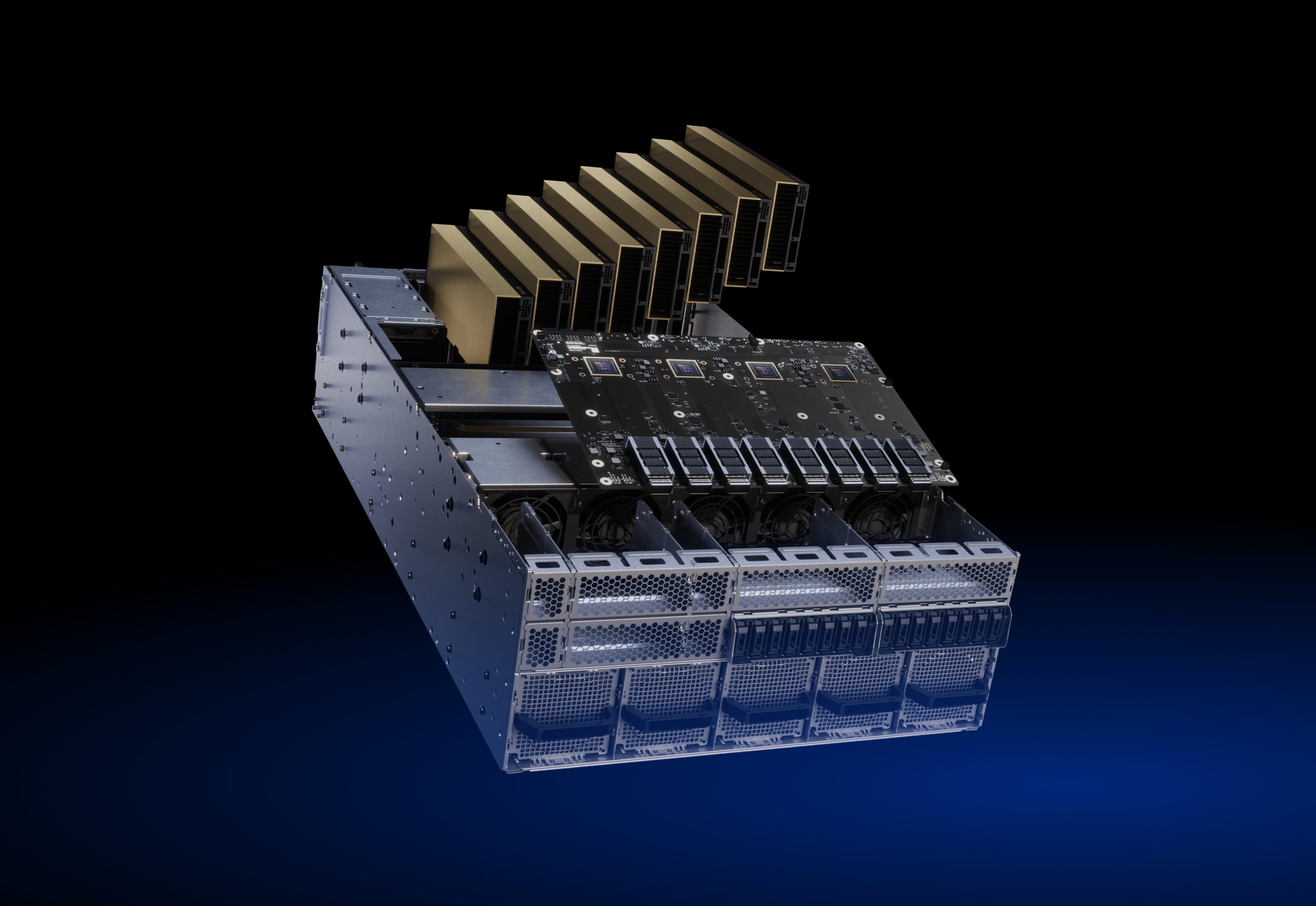

Bare metal vs virtual machine is a common comparison when teams evaluate cloud infrastructure for AI, HPC, and data-intensive workloads. While bare metal servers provide dedicated hardware resources and stronger infrastructure control, virtual machines offer faster provisioning and more flexible scaling. In this article, FPT AI Factor explains the difference between bare metal servers and virtual machines, when to use each model, and how to choose the right infrastructure for your workload.
1. What is a bare metal server?
A bare metal server is a physical server dedicated to a single tenant or workload. Unlike virtualized environments, bare metal does not use a hypervisor layer to divide resources across multiple users. This allows workloads to access CPU, GPU, memory, storage, and network resources more directly.
Bare metal servers are often used when teams need predictable performance, stronger isolation, and deeper infrastructure control. For AI and data-intensive workloads, this can be useful when performance depends on GPU utilization, memory bandwidth, storage throughput, or network stability. In practice, bare metal infrastructure is commonly used for:
- Large-scale AI model training
- High-performance computing workloads
- Long-running data processing pipelines
- Latency-sensitive applications
- Regulated or data-sensitive workloads
- Custom OS, driver, storage, or networking setups
As a result, bare metal is usually a better fit for workloads that require consistent performance and dedicated resources over a longer period.
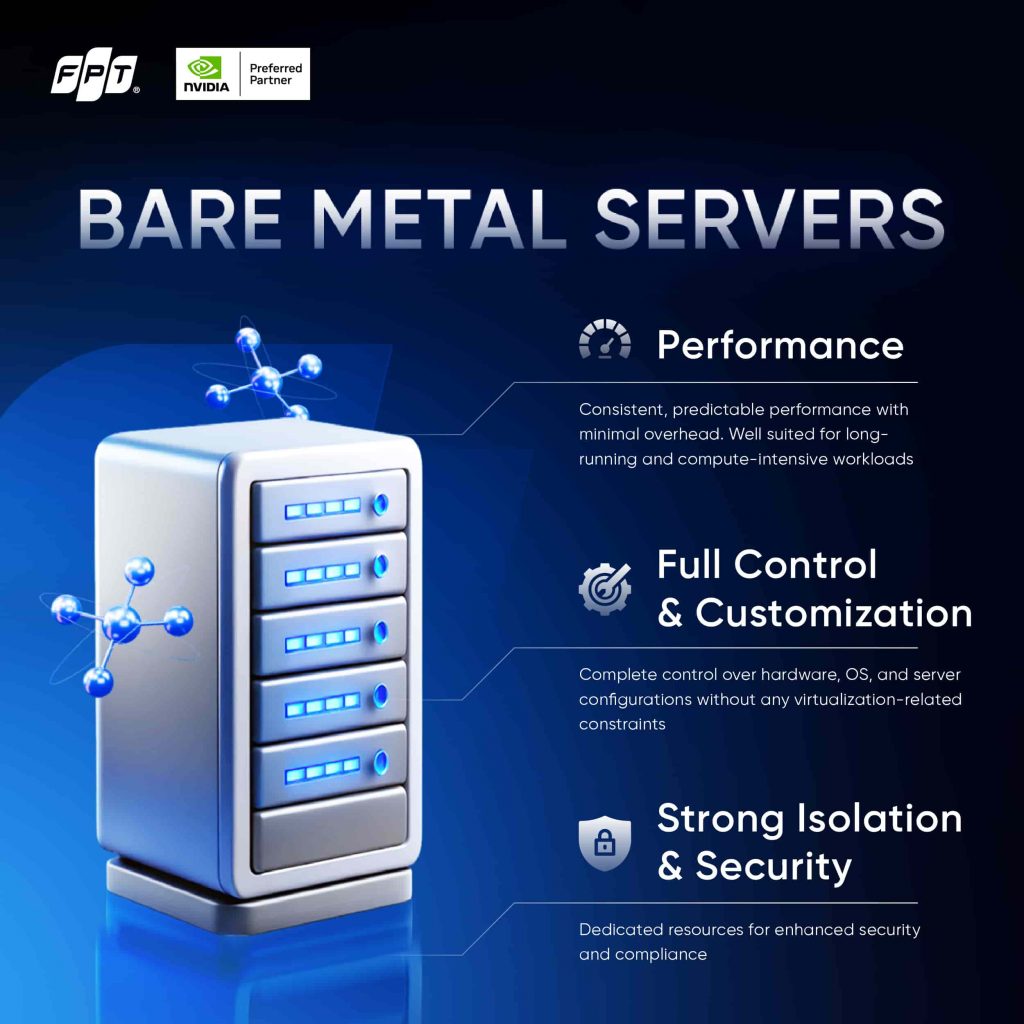
Bare metal servers provide dedicated hardware resources, predictable performance, and deeper infrastructure control for demanding AI and HPC workloads (Source: FPT AI Factory)
2. What is a virtual machine?
A virtual machine is a software-defined computing environment created on top of physical hardware. Through a hypervisor, one physical server can be divided into multiple virtual machines, each with its own operating system, allocated resources, and isolated runtime environment.
Virtual machines are designed for flexibility and faster deployment. Instead of configuring physical hardware directly, teams can provision virtual servers quickly, adjust resources based on demand, and manage multiple environments more easily. For AI teams, virtual machines are commonly used for:
- Development and testing environments
- AI experimentation and proof-of-concept workloads
- Model inference with changing traffic patterns
- Short-lived or bursty compute tasks
- Multiple isolated environments for different teams or projects
- Workloads that need fast deployment without full hardware customization
Virtual machines are often practical when workload requirements are still evolving and teams need infrastructure that can scale or change quickly.
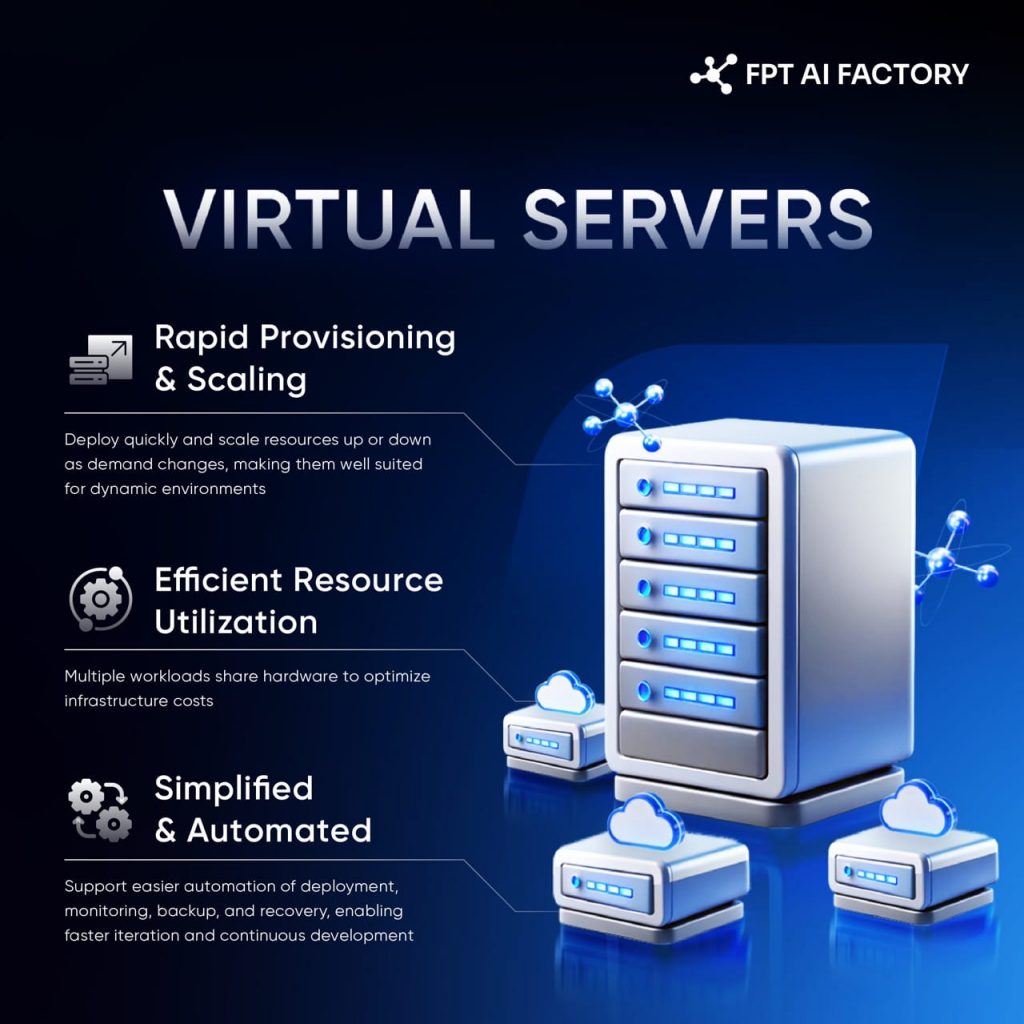
Virtual servers support faster provisioning, flexible scaling, and efficient resource utilization for dynamic AI development and deployment needs (Source: FPT AI Factory)
3. Bare metal vs virtual machine: Key differences
The core difference between bare metal and virtual machine comes down to the presence or absence of a virtualization layer. Bare metal gives direct access to physical hardware; VMs abstract that hardware through a hypervisor. This single architectural difference cascades into meaningful distinctions across performance, control, cost, and flexibility.
| Aspect | Bare Metal Server | Virtual Machine (VM) |
| Architecture | Direct OS-to-hardware, no hypervisor | Hypervisor sits between OS and hardware |
| Performance | Maximum – no virtualization overhead | Slightly lower due to hypervisor layer (10–15% overhead) |
| Isolation | Full physical isolation (single tenant) | Software isolation (shared physical hardware) |
| Provisioning speed | Hours to days (hardware configuration) | Minutes (software-defined) |
| Scalability | Requires adding physical hardware | Instant – resize or add VMs on demand |
| Customization | Full control over OS, drivers, hardware config | OS-level control; hardware managed by provider |
| Cost model | Fixed monthly cost; pay for full machine | Pay-as-you-go; pay only for resources used |
| Security | Physical isolation, no noisy neighbor risk | Strong software isolation; shared hardware |
| Best for | HPC, AI training, low-latency production workloads | Development, testing, variable workloads, lightweight inference |
In practice, neither option is universally better. The right choice depends on the specific workload, budget constraints, and how predictable the resource demand is over time.
4. Bare Metal vs Virtual Machine for AI Workloads
AI systems cover a wide range of workload types — from exploratory experimentation to large-scale production inference. The right infrastructure choice differs at each stage. Understanding where bare metal and VMs each perform best prevents both over-spending on resources you do not need and under-provisioning for workloads that cannot afford performance variability.
4.1. When Bare Metal Is the Better Choice
Bare metal servers are the stronger option when workload performance cannot be compromised and resource predictability is critical. Specific scenarios include:
- Large-scale AI model training: Training LLMs with billions of parameters requires sustained GPU throughput over extended periods. Bare metal ensures that no virtualization overhead accumulates across long training runs.
- Real-time AI inference at scale: Applications like fraud detection, voice recognition, and real-time recommendation systems require consistently low latency. Bare metal eliminates the “noisy neighbor” effect that can introduce latency spikes in shared VM environments.
- Regulated data environments: Industries such as finance and healthcare where data cannot be co-located with other tenants benefit from the physical isolation that only bare metal provides.
- High-performance computing (HPC): Scientific modeling, fluid simulations, and genomics workloads that demand maximum CPU and GPU bandwidth with minimal overhead.
4.2. When Virtual Machines Are the Better Choice
VMs are often the more practical option when flexibility, speed of deployment, and cost efficiency matter more than peak performance:
- Development and experimentation: AI teams iterating on model architectures, testing new frameworks, or running small-scale training experiments benefit from VMs they can provision quickly and shut down when not in use.
- Variable or unpredictable workloads: Applications whose compute demand fluctuates – such as batch inference jobs, data preprocessing pipelines, or scheduled reporting – benefit from the elastic scaling that VMs support.
- Lightweight inference endpoints: Smaller models or internal APIs serving modest traffic volumes do not require the performance ceiling of bare metal and are well-served by appropriately sized VMs.
- Multi-environment deployments: Teams that need to replicate development, staging, and production environments benefit from the portability and snapshot capabilities of VMs.
4.3. When to Use Both: Hybrid Infrastructure
In many production AI systems, the optimal approach is not either/or – it is a hybrid architecture that combines bare metal and virtual machines. A common pattern: bare metal servers handle compute-intensive training and high-throughput inference, while VMs manage preprocessing pipelines, API gateways, orchestration logic, and non-critical services.
This hybrid model allows organizations to optimize cost without sacrificing performance where it matters most. Teams can also use VMs for initial prototyping and move proven workloads to bare metal when they reach production scale – reducing risk while maintaining flexibility during development.
5. How FPT AI Factory Supports Both Bare Metal and VM Workloads
For AI teams that need flexible, high-performance infrastructure without the overhead of managing physical data centers, FPT AI Factory provides GPU-accelerated options for both bare metal and virtual machine deployments.
- Metal Cloud offers dedicated bare metal servers with direct access to high-performance GPUs such as NVIDIA H100 and H200. This option is designed for teams running large-scale AI training, distributed workloads, or latency-sensitive production inference where virtualization overhead is not acceptable. Metal Cloud gives teams full control over their compute environment without managing physical infrastructure from scratch.
- GPU Virtual Machine provides flexible GPU-enabled compute with faster provisioning and greater elasticity. It is well-suited for teams experimenting with model architectures, running variable AI workloads, or deploying lightweight inference endpoints. GPU Virtual Machine allows teams to scale resources up or down based on actual demand, making it a cost-effective option for workloads that do not require sustained peak performance.
- GPU Container supports containerized AI workloads with consistent, portable environments across development and production. For teams using frameworks like Docker or Kubernetes, GPU Container provides a streamlined path from experimentation to deployment without environment configuration overhead.
Together, these services allow businesses to match their infrastructure choice to their specific workload requirements – whether that means dedicated bare metal performance for production training or VM flexibility for development and testing – without investing in on-premises hardware.
6. Frequently Asked Questions
6.1. Is bare metal faster than a virtual machine?
Yes, in most cases. Bare metal servers deliver native hardware performance with no virtualization overhead. According to Oracle Cloud Infrastructure, hypervisors typically introduce a 10 – 15% performance overhead compared to bare metal. For compute-intensive AI workloads, this difference is measurable and can translate directly into longer training times or higher inference latency in VM environments.
6.2. Is bare metal more secure than a virtual machine?
Bare metal provides physical isolation – the server hardware is dedicated to one tenant, eliminating the risk of cross-tenant vulnerabilities or “noisy neighbor” interference. VMs offer strong software-level isolation, but the underlying physical machine is still shared. For workloads with strict data residency or compliance requirements, bare metal provides a higher level of assurance.
6.3. Can a virtual machine run on a bare metal server?
Yes. Bare metal servers can host virtual machines by installing a Type-1 hypervisor directly on the hardware. This is common in private cloud and enterprise data center environments where organizations want both the performance of dedicated hardware and the flexibility of running multiple isolated workloads on the same machine.
6.4. Which is more cost-effective: bare metal or VM?
It depends on workload characteristics. VMs are generally more cost-effective for variable or lightweight workloads because you pay only for the resources you use. Bare metal becomes more cost-effective at scale when workloads are sustained and resource utilization is consistently high – in those cases, the fixed cost of a dedicated machine can be lower than the equivalent VM cost over time.
The bare metal vs virtual machine decision is ultimately a workload question, not a technology preference. The more useful approach is to map infrastructure to workload stage: VMs for development and variable demand, bare metal for production training and latency-critical inference, and a hybrid architecture when both are in play simultaneously. With FPT AI Factory, new users can access $100 in free credits and start using GPU infrastructure immediately after logging in – no hardware setup required. For enterprises with large-scale or customized deployment needs, please contact us for dedicated support.
Contact Information:
- Hotline: 1900 638 399
- Email: support@fptcloud.com