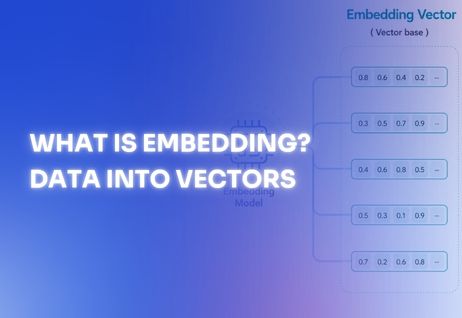

RAG vs Fine-Tuning are two core approaches used to optimize large language models (LLMs) in enterprise AI systems. While RAG focuses on retrieving external knowledge in real time, Fine-Tuning adapts model behavior using domain-specific data. In this article, FPT AI Factory compares RAG and fine-tuning to help enterprises choose the right approach for their AI applications.
|
Key Takeaways RAG and Fine-Tuning are two key approaches used to improve the performance of large language models (LLMs) in enterprise AI systems. They differ in how they handle knowledge and model adaptation, but both are essential in building effective AI applications
|
Create semantic search, RAG, and AI assistant applications with FPT AI Factory. Our platform enables teams to experiment, deploy, and scale AI workloads efficiently. Contact us to discuss your AI infrastructure and deployment requirements.
1. RAG vs Fine-Tuning: A Quick Overview
Retrieval-Augmented Generation (RAG) and fine-tuning are two common approaches used to improve the performance of large language models (LLMs), but they work in fundamentally different ways.
RAG enhances an LLM by connecting it to an external knowledge source at inference time, allowing the model to retrieve and use up-to-date, context-specific information without changing its internal parameters. In contrast, fine-tuning modifies the model itself by training it further on a domain-specific dataset, embedding new knowledge directly into its weights.
Organizations often compare these two approaches because they represent different trade-offs between flexibility, cost, and control. RAG is typically preferred for dynamic or frequently changing data, while fine-tuning is used when consistent behavior, specialization, and deeper domain adaptation are required. Choosing between them directly impacts system architecture, maintenance effort, and long-term scalability of AI applications. To better understand how fine-tuning relates to transfer learning, see our guide to Transfer Learning vs. Fine-Tuning.
2. What is RAG?
Retrieval-Augmented Generation (RAG) is an AI framework that enables large language models (LLMs) to generate responses using both their pre-trained knowledge and information retrieved from external data sources. Before answering a query, the system searches a knowledge base for relevant content and supplies it to the model as context.
Since knowledge is stored outside the model, new documents can be added or updated without retraining the LLM. This makes RAG an efficient choice for AI applications that require accurate responses based on the latest information. Organizations deploying RAG at scale should also consider the underlying AI infrastructure that supports embedding generation, vector retrieval, LLM inference, and GPU-accelerated workloads.
Example : Intuit, the company behind TurboTax and QuickBooks, integrated a RAG framework into its GenOS platform to answer complex tax questions. It retrieves information from thousands of pages of updated tax codes and compliance documents to provide accurate, context-grounded responses. The system now handles millions of tax-related queries with high precision while improving engineering productivity across the ecosystem.
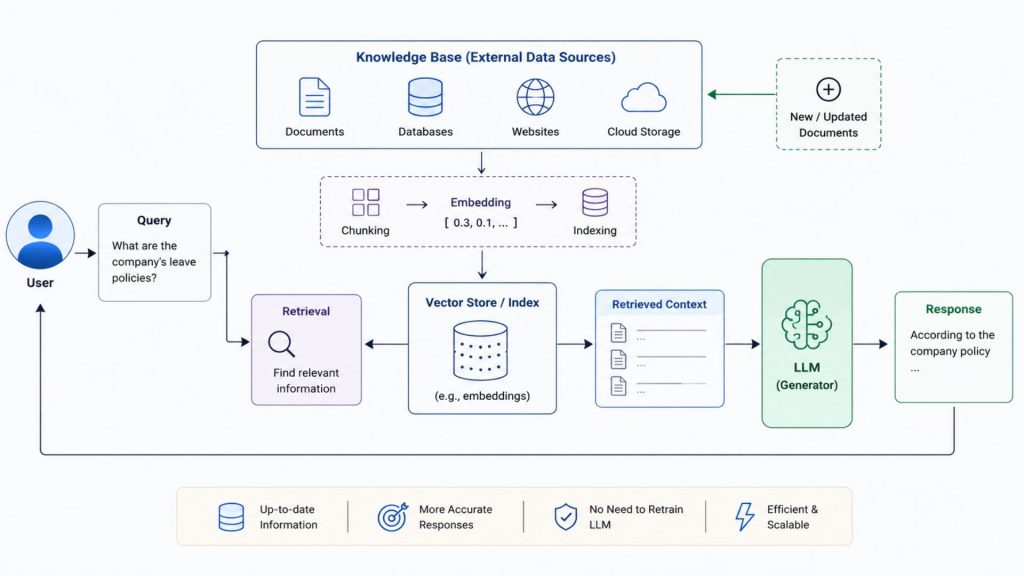
Retrieving external knowledge at inference time to ground LLM outputs with up-to-date context without retraining
3. What is Fine-Tuning?
Fine-tuning is the process of continuing the training of a pre-trained large language model (LLM) on a task- or domain-specific dataset. Instead of training a model from scratch, fine-tuning adapts existing knowledge by updating the model’s internal parameters, enabling it to perform specialized tasks more effectively.
Because the learned knowledge is stored directly in the model, fine-tuning produces more consistent responses and domain-specific behavior. However, incorporating new information requires additional training rather than simply updating an external knowledge base. Among the various fine-tuning techniques, supervised fine-tuning (SFT) is one of the most widely adopted approaches for adapting foundation models to enterprise-specific tasks and datasets.
Example: Meta applies instruction fine-tuning to its LLaMA models to improve instruction following, reasoning, and output consistency across downstream tasks. The approach trains models on curated instruction datasets, enabling better alignment with user intent and more reliable performance in structured and enterprise applications. Compared to base models, instruction-tuned versions show stronger controllability and improved generalization across tasks.
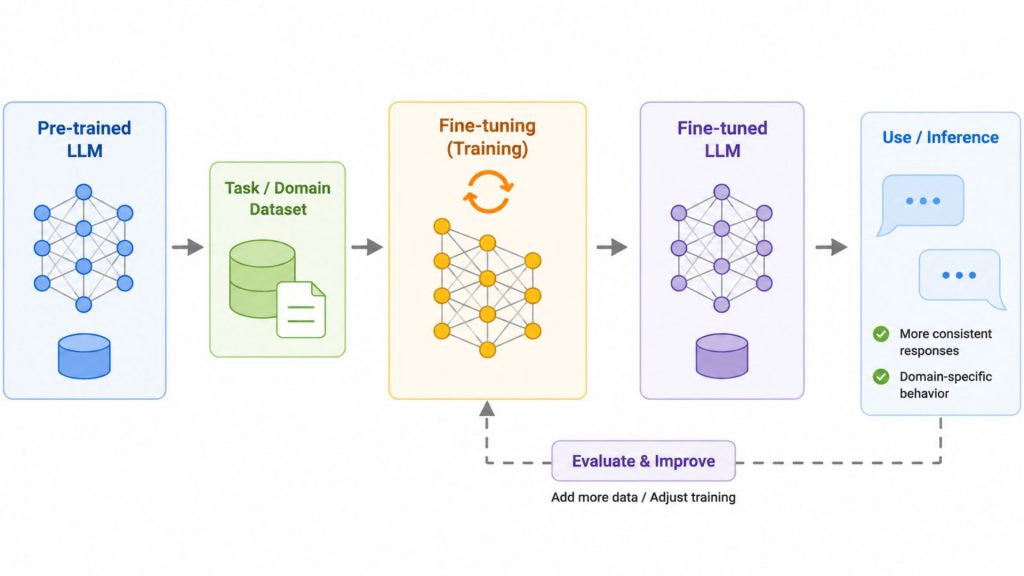
Fine-tuning adapts a pre-trained LLM to specific tasks using targeted data to improve specialization and consistency
4. RAG vs Fine-Tuning: key differences
RAG and fine-tuning both enhance the capabilities of large language models (LLMs), but they improve performance in different ways. RAG extends an LLM by retrieving relevant information from external knowledge sources, whereas fine-tuning modifies the model itself through additional training. Understanding these differences helps organizations select the right approach based on their data strategy, infrastructure, and business requirements.
4.1. Knowledge updates
One of the biggest differences between RAG and fine-tuning is how they handle new information. RAG retrieves knowledge from external sources, so newly added documents become available after they are processed and indexed. This makes it suitable for environments where information changes regularly.
Fine-tuning integrates knowledge into the model’s parameters during training. To reflect new information, the model must be trained again with updated datasets, making the update process more time-consuming.
4.2. Training requirements
RAG uses an existing pre-trained model and enriches its responses through a retrieval pipeline. While documents must be prepared, embedded, and indexed, the language model itself does not require additional training.
Fine-tuning requires a curated dataset and extra training to adapt a pre-trained model for a specific domain or task. The quality of the training data directly affects the model’s performance after deployment. An efficient data pipeline supports the collection, preparation, and transformation of training data, helping organizations build more accurate and reliable AI models.
4.3. Cost and resource requirements
RAG generally reduces upfront training costs because it reuses an existing model. However, organizations still need supporting infrastructure for document indexing, embedding generation, vector search, and knowledge base management.
Fine-tuning typically requires greater initial investment due to GPU resources, training time, and model deployment. In return, it can deliver a specialized model without relying on a retrieval pipeline during inference. After training, model serving enables the fine-tuned model to be deployed as a scalable inference service for production AI applications.
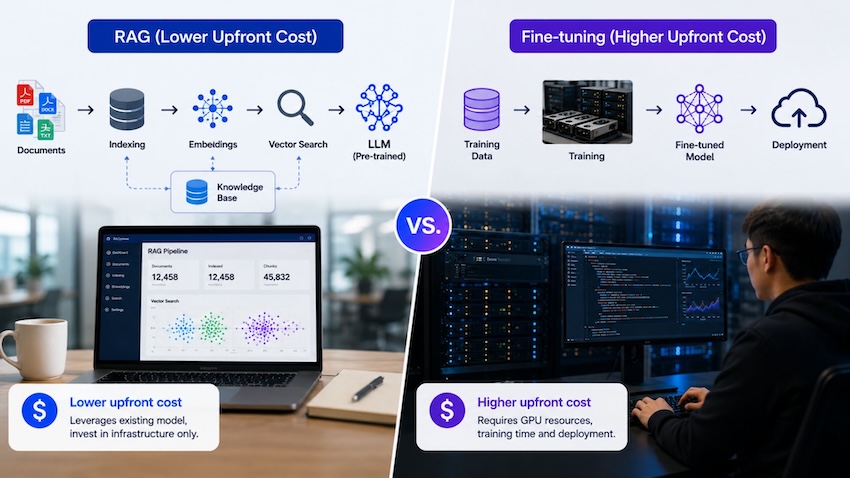
RAG reduces upfront cost via retrieval, while fine-tuning requires higher training investment for specialized models
4.4. Accuracy and response quality
RAG is particularly effective for answering questions that depend on current or verifiable information because responses are generated using retrieved documents as context. The overall quality, however, depends on how accurately the retrieval system identifies relevant content.
Fine-tuning is better suited for tasks that require consistent outputs, domain-specific expertise, or a particular communication style. Since knowledge is learned during training, the model can produce more predictable responses but may not reflect information introduced after the training process.
4.5. Scalability
As organizational knowledge grows, RAG can scale by expanding the knowledge base without modifying the underlying model. This allows new content to be incorporated with minimal disruption.
Fine-tuning is more suitable when domain knowledge remains relatively stable. Expanding the model’s knowledge usually involves preparing new datasets, retraining the model, and deploying an updated version.
4.6. Maintenance effort
Maintaining a RAG system primarily involves keeping documents up to date, refreshing embeddings when needed, and monitoring retrieval quality to ensure relevant information is returned.
Maintaining a fine-tuned model focuses on managing training data, evaluating model performance, and scheduling retraining whenever business requirements or domain knowledge evolve.
4.7. Data privacy and security
RAG keeps sensitive information within an external knowledge base, enabling organizations to manage access permissions and update protected content without modifying the language model. It also allows responses to be linked to retrieved documents, improving transparency in knowledge-based applications.
Fine-tuning may require proprietary or confidential data during the training process. Organizations should therefore implement strong data governance practices to protect training data, reduce bias, and meet security or regulatory requirements.
RAG vs. Fine-Tuning Comparison
| Comparison Criteria | RAG | Fine-Tuning |
| Knowledge Updates | Uses an external knowledge base that can be updated independently of the model. | Requires retraining to incorporate new knowledge. |
| Training Requirements | Uses a pre-trained model with a retrieval pipeline instead of additional model training. | Requires supervised training on a domain-specific dataset. |
| Cost & Resource Requirements | Lower training cost but requires infrastructure for retrieval, embeddings, and vector search. | Higher upfront investment in training, compute resources, and deployment. |
| Accuracy & Response Quality | Best for applications that rely on current or verifiable information. | Best for specialized tasks requiring consistent behavior and domain expertise. |
| Scalability | Expands by indexing new content without modifying the model. | Scaling knowledge typically requires retraining and redeployment. |
| Maintenance Effort | Maintain documents, embeddings, and retrieval performance. | Maintain training datasets, model versions, and retraining workflows. |
| Data Privacy & Security | Keeps sensitive data in controlled external storage with configurable access. | Requires careful governance of proprietary data used during model training. |
5. When should you use RAG?
RAG is the right choice for AI applications that rely on current, reliable, or organization-specific knowledge. Instead of embedding information into the model, RAG retrieves relevant content from external data sources at inference time, making it easier to keep responses accurate as information evolves.
5.1. Frequently updated knowledge bases
RAG is particularly effective when information changes frequently and needs to be reflected immediately in AI responses. Examples include product documentation, technical manuals, company policies, pricing information, and internal knowledge bases. Since new content only needs to be indexed rather than retrained into the model, organizations can keep AI systems aligned with the latest information while reducing maintenance effort.
A real-world example comes from Vodafone, which deployed a RAG-powered AI assistant called SuperAgent to support its customer service teams in the telecommunications industry. By retrieving information from frequently updated contracts, pricing plans, and device manuals, the system provided agents with accurate information in real time. As a result, Vodafone reduced information retrieval time by 26% and improved response accuracy by 54%, helping prevent outdated product or pricing information from being shared with customers.
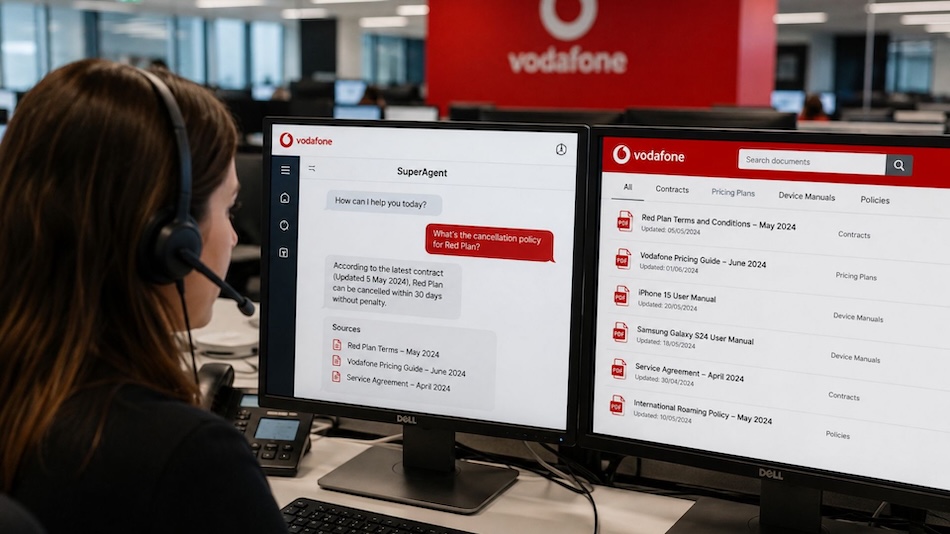
RAG enables customer service agents to retrieve accurate, up-to-date information instantly
5.2. Enterprise search and internal knowledge systems
Many organizations use RAG to build AI-powered enterprise search systems that help employees quickly find information across documents, wikis, knowledge bases, and other internal repositories. Instead of searching through multiple files, users can ask questions in natural language and receive answers based on the most relevant documents.
Organizations managing enterprise content across multiple repositories can further improve retrieval quality with Data Hub, which centralizes documents and knowledge sources before they are indexed for RAG applications. Maintaining a well-organized data catalog also helps teams discover, classify, and govern enterprise data more effectively, making it easier to identify high-quality knowledge sources for RAG systems.
McKinsey’s enterprise AI platform, Lilli, shows how RAG can transform knowledge search at scale. It retrieves information from over 100,000 internal documents across multiple curated sources, helping consultants quickly find relevant insights and experts. Since deployment, Lilli has handled over 500,000 prompts per month, reduced information gathering time by up to 30%, and improved content quality and accuracy by 20%, demonstrating significant productivity gains from enterprise RAG systems.
5.3. Regulatory and compliance information
Industries such as healthcare, finance, insurance, and legal services often rely on regulations that are updated over time. RAG allows AI applications to retrieve the latest policies, standards, or compliance documents when generating responses, helping reduce the risk of using outdated information. Because responses can be linked to the retrieved source documents, RAG also improves transparency and supports organizations that require traceable, evidence-based answers.
Powered by GPT-4 and Retrieval-Augmented Generation (RAG), Morgan Stanley Assistant retrieves information directly from the firm’s proprietary knowledge base instead of relying solely on the LLM’s internal knowledge. Every response is grounded in verified internal documents with source citations, enabling financial advisors to provide compliant, accurate, and consistent guidance while significantly reducing time spent on manual document searches.
5.4. Customer support applications
RAG is widely used in customer support solutions that rely on extensive product documentation, FAQs, troubleshooting guides, and service manuals. By retrieving the most relevant support content for each customer inquiry, AI assistants can provide accurate and context-aware responses without requiring frequent model retraining. As customer support becomes more autonomous, many organizations are also adopting AI agents that combine retrieval, reasoning, and task execution to resolve customer requests more efficiently.
Klarna, a global buy-now-pay-later fintech, deployed a RAG-powered AI assistant to handle multilingual customer queries using up-to-date internal documentation on refunds, payments, and disputes. It processed 2.3 million conversations in its first month (equivalent to 700 agents), reduced repeat inquiries by 25%, and generated an estimated $40M annual profit uplift.

RAG improves customer support by providing fast, accurate answers from up-to-date document
6. When should you use Fine-Tuning?
Fine-tuning is the preferred approach when an AI application requires consistent behavior rather than continuously updated knowledge. By training a pre-trained model on domain-specific examples, organizations can adapt how the model responds, follows instructions, and performs specialized tasks without relying solely on prompt engineering.
6.1. Domain-specific expertise
Fine-tuning is well suited for applications that require a deep, nuanced understanding of industry-specific terminology, specialized workflows, or strict business rules. Training the model on curated domain data helps it produce high-fidelity responses that accurately reflect the professional language and practices of a particular field. The effectiveness of this training process also depends on factors such as learning rate, which influences how quickly and accurately a model adapts to new domain-specific data.
Google Research developed Med-PaLM 2, a specialized medical large language model fine-tuned on curated clinical datasets, expert demonstrations, and healthcare question-answering data to improve clinical reasoning rather than relying solely on raw web retrieval. In benchmark evaluations, Med-PaLM 2 achieved 86.5% accuracy on USMLE-style questions (MedQA), representing expert-level performance, and reduced medically unsafe or inaccurate responses by more than 9× compared to baseline foundation models.
6.2. Custom tone and behavior
When AI responses must strictly adhere to a specific brand voice, unique communication style, or safe behavioral guidelines, fine-tuning provides far greater control than prompt engineering alone. The model internalizes these stylistic patterns during training, ensuring consistent behavior across diverse production environments and user conversations.
Canva fine-tuned LLMs using a proprietary dataset of brand communication guidelines and marketing copy templates to power its “Magic Write” AI assistant, ensuring all generated content follows a friendly, inspiring, and design-centric tone. As a result, fine-tuning reduced style-related output rejections by over 35%, minimized reliance on long system prompts, lowered token costs, and enabled millions of users to generate consistent on-brand marketing copy in seconds.

Fine-tuning helps AI generate consistent, on-brand content at scale
6.3. Structured outputs
Applications that depend on standardized outputs, such as JSON objects, predefined templates, reports, or data extraction formats, can benefit from fine-tuning. By learning the expected output structure during training, the model is more likely to generate responses that match production requirements with greater consistency.
Anyscale conducted benchmarking on fine-tuning open-source base models (such as Llama-3) for complex JSON extraction and programmatic API calling tasks. Fine-tuned models achieved a 99.6% format compliance rate for highly structured JSON outputs, matching the reliability of much larger frontier models while reducing inference latency by up to 3x and significantly lowering API token costs.
6.4. Specialized AI applications
Fine-tuning is well suited for specialized AI applications that require domain adaptation, structured behavior, and strict output control. By training models on task-specific or proprietary datasets, organizations can improve consistency, accuracy, and alignment with internal rules without relying solely on prompting or external retrieval systems. This makes fine-tuning a strong choice for enterprise-grade AI use cases that demand reliability and governance.
With Model Fine-Tuning, businesses can easily build and deploy customized models through an end-to-end pipeline that includes data preparation, training, evaluation, and deployment. The platform supports scalable GPU infrastructure and multiple fine-tuning methods, helping organizations accelerate model development and create production-ready AI tailored to their specific needs.
7. Can you use RAG and Fine-Tuning together?
Rather than choosing between RAG and fine-tuning, many organizations combine both approaches to build more capable AI applications. In a hybrid architecture, each technique serves a different purpose: fine-tuning adapts the model’s behavior, domain expertise, and output patterns, while RAG continuously retrieves relevant information from external knowledge sources. By working together, they enable AI systems to deliver responses that are both specialized and based on the latest available information.
7.1. Hybrid approach
A hybrid approach is most effective when an AI application requires both consistent model behavior and continuously updated knowledge. Fine-tuning helps the model understand domain-specific terminology, follow business rules, and generate responses in a preferred format. RAG complements these capabilities by supplying current information during LLM inference, eliminating the need to retrain the model whenever documents or business knowledge change. Understanding how LLM inference works also helps organizations optimize response latency, throughput, and deployment efficiency in production AI systems.
7.2. Evolving from RAG to Fine-Tuning
Many organizations initially adopt RAG because it is faster to implement and allows existing enterprise knowledge to be integrated without additional model training. As the system matures and recurring user queries become easier to identify, fine-tuning can be introduced to improve response consistency, specialized reasoning, or structured outputs for high-value workflows. This staged adoption strategy allows AI capabilities to evolve alongside business requirements.
A real-world example is Shorthills AI’s legal research platform built on IBM watsonx.data. By combining hybrid retrieval with domain-adapted AI capabilities, the system achieved over 60% improvement in recall and precision, generated 4× more comprehensive responses, and increased the diversity of legal reasoning by 9×. This demonstrates how combining retrieval with model adaptation can significantly improve both factual grounding and response quality in regulated industries.
For many production AI systems, the most effective strategy is not choosing between RAG and fine-tuning, but using both where they add the greatest value. Fine-tuning strengthens the model’s expertise and consistency, while RAG ensures responses remain accurate as knowledge evolves. This combination helps organizations build AI applications that are scalable, maintainable, and better suited for enterprise environments.
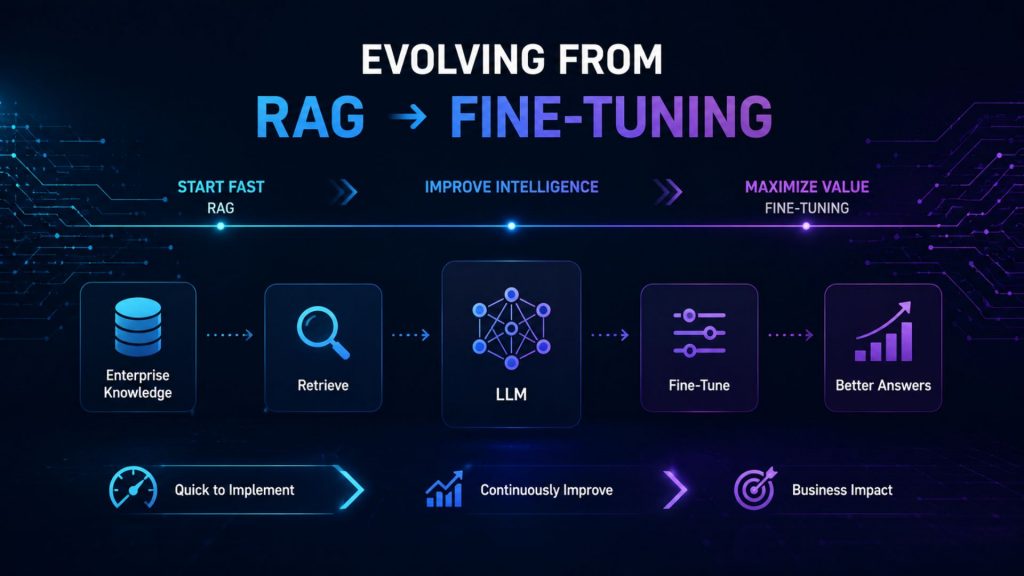
From fast knowledge retrieval to domain-specific intelligence
8. FAQs
8.1. Is RAG better than fine-tuning for LLMs?
Neither approach is universally better. RAG is ideal for applications that require access to up-to-date or frequently changing information, while fine-tuning is better for adapting a model’s behavior, domain expertise, or response style. In many production AI systems, combining both approaches delivers the best balance of factual accuracy, consistency, and scalability.
8.2. How much data do I need to fine-tune an LLM?
The amount of data needed to fine-tune an LLM depends on the task and the desired outcome. Simple use cases may only require a few hundred high-quality examples, especially when using parameter-efficient techniques like LoRA, while more specialized applications typically benefit from larger, carefully curated datasets. In general, data quality matters more than dataset size.
8.3. Does RAG work with any LLM?
RAG is compatible with most modern LLMs, including both open-source and proprietary models. Its effectiveness depends on how well relevant information is retrieved and provided to the model, making the quality of the retrieval pipeline and knowledge base just as important as the LLM itself.
RAG and Fine-Tuning are two complementary approaches in enterprise AI. RAG retrieves external knowledge in real time, making it suitable for frequently updated information, while Fine-Tuning adjusts the model itself to improve domain-specific behavior and consistency. Choosing between them depends on data freshness, cost, and use case, and many systems combine both for better performance.
Whether you’re building RAG applications, fine-tuned models, or hybrid AI systems, FPT AI Factory provides an end-to-end platform with AI development tools, scalable GPU infrastructure, and deployment services to accelerate enterprise AI adoption. For customized AI solutions, large-scale deployments, or enterprise integration, contact FPT AI Factory for tailored consultation and implementation support.
Contact information
- Hotline: 1900 638 399
- Email: support@fptcloud.com
Explore related articles:
Prompt Engineering vs Fine-tuning: A Guide to better LLM