
Cloud computing has become the foundation of modern digital infrastructure, enabling businesses to scale faster and innovate more efficiently. In the era of rapid digital transformation, selecting the right cloud infrastructure is no longer just a technical decision – it is a strategic business pivot. In this article, FPT AI Factory helps you understand the differences between Public, Private, and Hybrid Cloud and how to choose the right one for your needs.
1. What is Cloud Computing?
Cloud computing is the on-demand delivery of computing power, database storage, applications, and other IT resources via the internet with pay-as-you-go pricing. Instead of managing physical servers and data centers, businesses access technology services as needed, allowing for rapid experimentation and global scaling.
1.1. What is a Public Cloud?
Public cloud services are delivered over the public internet and shared across different organizations (tenants). Resources like servers and storage are owned and operated by a third-party cloud service provider, offering maximum scalability without the need for hardware investment.
For example, an e-commerce company may use a public cloud to host its website, product database, and customer-facing application. During major sales campaigns, the company can quickly scale resources to handle higher traffic, then reduce capacity after the campaign ends. This makes public cloud suitable for businesses that need fast deployment, flexible scaling, and lower upfront infrastructure investment.

Public cloud delivers shared computing resources over the internet, enabling scalable and cost-efficient deployment
1.2. What is a Private Cloud?
A private cloud consists of computing resources used exclusively by one business or organization. It can be physically located at your on-site data center or hosted by a third-party provider. It offers the highest level of control and security, making it a preferred choice for industries with stringent regulatory requirements.
For example, a bank may use a private cloud to run internal banking systems, manage transaction data, and control access to sensitive customer records. This model is suitable because financial services often require strict security policies, data governance, and compliance controls that are easier to manage in a dedicated environment.
1.3. What is a Hybrid Cloud?
Hybrid cloud is a computing environment that combines public and private cloud resources, allowing data and applications to move between them for greater flexibility and optimized deployment. This approach helps businesses improve continuity, scale efficiently, and reduce costs by using the public cloud for non-sensitive workloads while keeping critical assets secure. However, hybrid cloud requires more complex management and strong networking, integration capabilities to operate efficiently.
For example, an enterprise may keep customer records, payment data, or core business systems in a private cloud while using public cloud resources for website traffic, analytics, testing, or temporary computing demand. This approach helps the business protect critical data while still using public cloud scalability for workloads that need flexibility.

Hybrid cloud connects public and private environments, allowing data and applications to move seamlessly between them
2. Public, Private vs Hybrid Cloud: Side-by-Side Comparison
To better understand the differences between public, private, and hybrid cloud, the table below compares these models across key aspects such as cost, security, scalability, and flexibility:
| Criteria | Public Cloud | Private Cloud | Hybrid Cloud |
| Cost | Low upfront, pay-as-you-go | High upfront investment | Optimized cost balance |
| Security | Moderate (shared environment) | High (dedicated resources) | High (controlled + flexible) |
| Scalability | Very high | Limited | High |
| Control | Low | Very high | Medium – high |
| Compliance | Limited control | Strong compliance support | Flexible compliance |
| Flexibility | High | Medium | Very high |
| Management complexity | Low | Medium | High |
| Best for | Startups, scalable apps | Sensitive data workloads | Enterprises with mixed needs |
Overall, public cloud is best for scalability and cost efficiency, private cloud is ideal for security and control. For enterprises that need both flexibility and compliance, hybrid cloud offers the most balanced approach.
3. How to Choose the Right Cloud Model for AI Workloads
When selecting between public, private, and hybrid cloud for AI, businesses should evaluate factors such as AI workload requirements, data security, GPU scalability, and long-term AI infrastructure strategy. The best choice depends on how organizations plan to develop, deploy, and scale their AI applications.
- AI workload type: Public cloud is suitable for AI experimentation, model training, and scalable inference workloads. Private cloud is often preferred for mission-critical AI systems or workloads requiring dedicated GPU resources. Hybrid cloud works well for organizations running both sensitive AI workloads and large-scale public AI services.
- AI data sensitivity: AI projects involving proprietary datasets, customer information, or regulated data may require private or hybrid cloud environments to ensure stronger security and governance. Public cloud is more suitable for less sensitive AI applications or open-data training workloads.
- GPU scalability and performance: AI workloads often require high-performance GPU infrastructure. Public cloud allows businesses to scale GPU resources quickly for model training or inference spikes, while hybrid cloud enables organizations to combine on-premises AI infrastructure with elastic cloud GPU capacity.
- Model deployment and inference needs: Real-time AI applications such as chatbots, recommendation systems, or AI copilots require low-latency infrastructure and scalable inference capabilities. Businesses should choose cloud environments that can efficiently support AI serving and deployment pipelines.
- Compliance and AI governance: Industries with strict regulations may need stronger control over AI data processing, model access, and infrastructure governance. Private and hybrid cloud models can help meet compliance, residency, and security requirements for enterprise AI deployments.
- Budget and AI infrastructure costs: Public cloud reduces upfront investment and supports pay-as-you-go AI experimentation. Private cloud provides predictable performance and dedicated resources but requires higher infrastructure investment. Hybrid cloud helps optimize AI costs by balancing fixed and scalable resources.
- AI operations and technical expertise: Public cloud simplifies AI infrastructure management through managed AI and MLOps services. Private and hybrid cloud environments require more advanced expertise in GPU management, networking, AI orchestration, and security operations.
- Long-term AI strategy: Organizations planning rapid AI innovation may benefit from the flexibility of public cloud. Enterprises building proprietary AI platforms or sovereign AI capabilities may prefer private or hybrid cloud strategies for greater control and customization.
In summary, choosing the right cloud model for AI depends on balancing scalability, performance, security, and operational control. Public cloud supports fast AI adoption, private cloud enables dedicated and secure AI environments, while hybrid cloud provides flexibility for evolving enterprise AI strategies
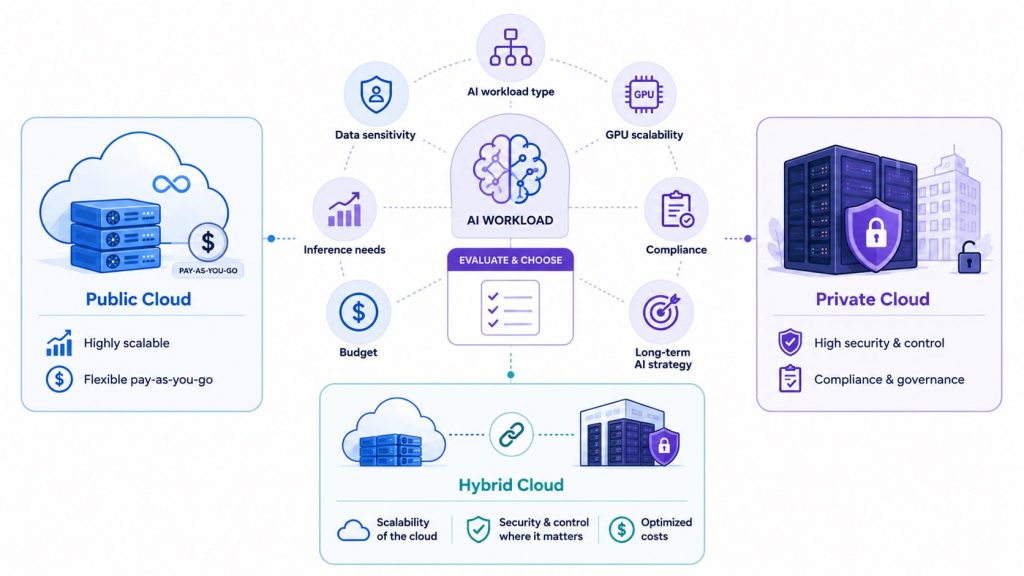
Choosing the right AI cloud model depends on workload type, data sensitivity, GPU scalability, compliance, budget, and long-term infrastructure strategy
4. Which Cloud Model is Right for AI Workloads?
4.1. Choose Public Cloud
Public cloud is a strong choice for businesses that need fast access to AI infrastructure, scalable GPU resources, and flexible experimentation environments. AI teams can quickly provision computing power for model training, inference, and development without investing in physical infrastructure.
| AI use case | Example | Why public cloud fits |
| AI model experimentation | A data science team tests multiple LLMs or machine learning models | Teams can access GPU resources on demand without long-term hardware commitment |
| AI startups and SaaS platforms | An AI startup launches a generative AI application | Public cloud supports rapid scaling and faster time-to-market |
| AI development and testing | Developers create temporary environments for AI pipelines | Resources can be deployed quickly and shut down when no longer needed |
| AI inference with changing demand | An AI chatbot experiences traffic spikes during campaigns | Public cloud can scale inference infrastructure dynamically |
| Training large AI models | A company trains foundation models using cloud GPU clusters | Public cloud provides high-performance compute capacity without upfront investment |
This makes public cloud suitable for organizations prioritizing scalability, flexibility, and faster AI innovation.
4.2. Choose Private Cloud
Private cloud is more suitable for organizations that require stronger control over AI infrastructure, sensitive datasets, and governance policies. Dedicated environments help businesses manage security, compliance, and performance more consistently for enterprise AI workloads.
| AI use case | Example | Why private cloud fits |
| Sensitive AI training data | A financial institution trains AI models on confidential customer data | Dedicated infrastructure improves data security and access control |
| Regulated AI workloads | A healthcare organization uses AI for medical image analysis | Private cloud helps support stricter compliance and governance requirements |
| Enterprise AI platforms | A corporation builds an internal AI assistant using proprietary data | The business maintains tighter control over AI systems and data pipelines |
| Mission-critical AI operations | A government agency deploys AI for cybersecurity monitoring | Private cloud reduces exposure to shared environments |
| Custom AI infrastructure | An enterprise requires specialized GPU, networking, or storage architecture | Private cloud allows deeper infrastructure customization |
This makes private cloud a better fit when AI security, governance, and infrastructure control are higher priorities than rapid scalability.
4.3. Choose Hybrid Cloud
Hybrid cloud is a practical option for organizations that need both scalable AI compute resources and stronger control over sensitive systems. Businesses can keep confidential AI workloads in private environments while using public cloud resources for high-performance AI processing.
| AI use case | Example | Why hybrid cloud fits |
| AI workloads with sensitive data | A company stores proprietary datasets privately but uses public GPUs for model training | Sensitive data remains controlled while compute resources scale flexibly |
| Generative AI and LLM deployment | An enterprise runs internal AI systems while scaling inference through public cloud | Hybrid cloud balances performance and governance |
| AI burst computing | A business uses additional cloud GPUs during large AI training jobs | Public cloud provides temporary high-performance capacity |
| Gradual AI infrastructure modernization | An enterprise integrates cloud AI services while keeping legacy systems on-premises | Hybrid cloud supports phased AI transformation |
| AI disaster recovery and resilience | A company backs up AI workloads to public cloud environments | Hybrid cloud improves operational continuity and flexibility |
This makes hybrid cloud suitable for enterprises that need to balance AI scalability, security, compliance, and long-term infrastructure flexibility.
FPT AI Factory provides flexible AI cloud infrastructure that can be deployed across public, private, or hybrid models depending on your business needs. Enterprises can receive tailored consulting via the contact form to design scalable and cost-efficient solutions. You can explore services such as GPU container and GPU Virtual Machine to support different AI workloads.
GPU Container is a containerized environment with integrated GPU resources (Source: FPT AI Factory)
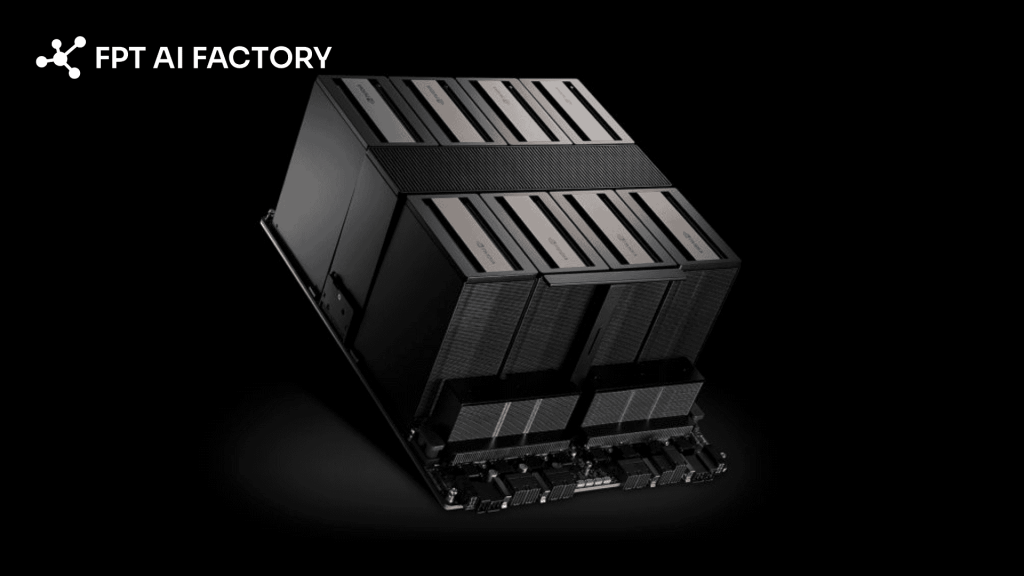
In the near future, FPT AI Factory will also introduce GPU HGX B300, enabling even more powerful AI performance. Businesses can pre-order or leave their information for further consultation.
5. Common Hybrid Cloud Architectures for AI Workloads
Different industries often manage both sensitive and non-sensitive workloads simultaneously, making hybrid cloud an effective solution for AI deployment. The following table presents common hybrid cloud AI use cases and why this architecture fits these organizations:
| Use case | Example | Why hybrid cloud fits |
| Enterprise AI training architecture | A company stores proprietary datasets and internal business records in a private cloud while using public cloud GPU clusters for AI model training | Sensitive enterprise data remains secure while scalable computing resources support intensive AI training workloads |
| Financial services hybrid AI architecture | A bank keeps customer transactions and financial records in a private cloud but uses public cloud AI services for fraud detection and risk analytics | Regulatory and sensitive financial data stay protected while AI systems can scale for real-time analysis |
| Healthcare AI architecture | A hospital stores patient records and medical imaging data in a private cloud while using public cloud AI tools for disease prediction and medical image analysis | Patient privacy and compliance are maintained while healthcare organizations gain access to advanced AI computing capabilities |
| Retail and e-commerce AI scaling architecture | An e-commerce company stores customer purchase histories and payment data privately but uses public cloud AI systems for recommendation engines and demand forecasting | Sensitive retail data stays controlled while public cloud infrastructure supports scalable personalization and peak shopping traffic |
Overall, hybrid cloud architectures provide a balanced approach to AI adoption by combining private cloud security with public cloud scalability and computing power. Organizations that handle sensitive data while requiring scalable and high-performance AI processing should adopt this model to grow business demands.
6. Frequently Asked Questions
6.1. Is hybrid cloud more expensive?
While it requires investment in integration and management tools, it often saves money long-term by preventing “over-provisioning” in a private cloud and avoiding the high costs of storing massive, stagnant datasets in a public cloud.
6.2. What’s the most secure cloud model?
The private cloud is traditionally seen as the most secure due to physical isolation. However, security is largely a matter of implementation; a well-managed hybrid or public cloud with zero-trust architecture can be just as resilient.
6.3. Do most enterprises use hybrid cloud?
Currently, most enterprises tend to use hybrid cloud. Modern enterprise strategy has shifted toward “Multi-cloud” and “Hybrid-cloud” to avoid vendor lock-in and to maximize the specific strengths of different providers.
In summary, while generative AI focuses on creating content from prompts, agentic AI extends those capabilities by planning tasks, using tools, and executing workflows toward specific goals. The right choice depends on the business objective: generative AI is often sufficient for content creation and knowledge work, while agentic AI is better suited for automation and complex, multi-step processes. Key takeaways include:
- Generative AI creates text, images, code, summaries, and other content from user prompts.
- Agentic AI can plan, reason, use tools, and complete tasks across multiple workflow steps.
- The main difference is content generation vs. goal execution.
- Generative AI is ideal for writing, summarization, translation, and coding assistance.
- Agentic AI is better suited for customer support automation, workflow orchestration, and AI-powered business operations.
- Agentic AI does not replace generative AI; it builds on top of it to enable greater autonomy.
- Many modern AI solutions combine both approaches to balance creativity, efficiency, and automation.
With FPT AI Factory’s Serverless Inference, businesses can deploy and run AI models in production more efficiently while reducing operational complexity. For enterprises with customization or large-scale needs, please contact the FPT AI Factory team via the official contact form for dedicated support.
Contact Information:
- Hotline: 1900 638 399
- Email: support@fptcloud.com
Explore Related Articles:
What is Physical AI? How it works, use cases and challenges
Agentic AI vs AI agents: Key differences and how to choose
What is AI inference? How it works, types, and use cases
What is AI governance? Principles, framework and practices