
AI cloud platform is revolutionizing the way businesses build, deploy, and scale artificial intelligence solutions. As AI adoption grows rapidly across industries, choosing the right cloud infrastructure becomes a critical factor in determining competitive advantage. At FPT AI Factory, we provide cutting-edge AI cloud solutions designed to help organizations harness the full potential of AI with confidence and efficiency.
1. What is an AI Cloud platform?
An AI cloud platform is a cloud-based infrastructure that provides the tools, computing resources, and services businesses need to build, train, and deploy artificial intelligence applications. Think of it as a fully equipped digital workspace that combines powerful computing infrastructure with specialized software tools, data management services, and pre-built frameworks.
To make this concrete, consider how you search for information on Google. When you type a query, Google’s AI cloud platform instantly processes your request using machine learning models trained on vast amounts of data, all running on infrastructure you never see or manage. You simply get a smart, ranked list of results in milliseconds. That seamless experience, from data processing to intelligent output, is exactly what an AI cloud platform enables behind the scenes.
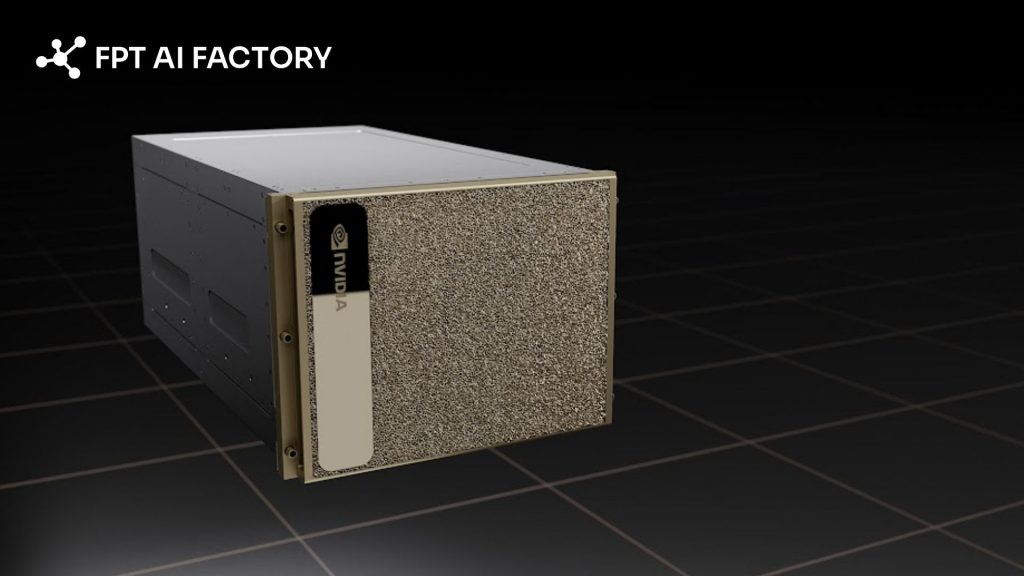
An AI cloud platform provides the tools deploy artificial intelligence applications (Source: FPT AI Factory)
2. Types of AI Cloud platforms
Understanding the different categories of AI cloud platforms helps businesses choose the right level of technical control. Generally, the market categorizes these enterprise solutions into four primary types:
- AI Infrastructure-as-a-Service (IaaS): This is the foundational layer, providing raw, high-performance computing power like advanced GPUs. It offers maximum flexibility for custom architectures, but it requires deep in-house expertise to manage the underlying servers, networking, and security protocols.
- AI Platform-as-a-Service (PaaS): This type delivers fully managed environments purpose-built for AI/ML workflows, integrating optimized MLOps tooling, collaborative development workspaces, and streamlined deployment capabilities. By abstracting away infrastructure concerns, these platforms enable data scientists and ML engineers to focus entirely on model development, experimentation, and production rollout, without managing underlying hardware or cluster configurations.
- Inference and Model Serving Platforms: This category encompasses platforms that deliver pre-trained, production-ready AI capabilities directly to enterprise applications, either through high-level SaaS interfaces or optimized inference API endpoints. Developers can integrate intelligent features such as natural language processing, computer vision, or generative AI into their products via simple API calls, with no model training required.
- Integrated AI Infrastructure Platforms: This emerging category bridges the gap between raw compute and managed development environments, combining GPU infrastructure with AI development environments, interactive notebooks, inference services, and end-to-end deployment tooling into a unified ecosystem. FPT AI Factory is a representative example, providing both the underlying GPU compute fabric and the higher-level AI development and deployment capabilities within a single integrated platform.
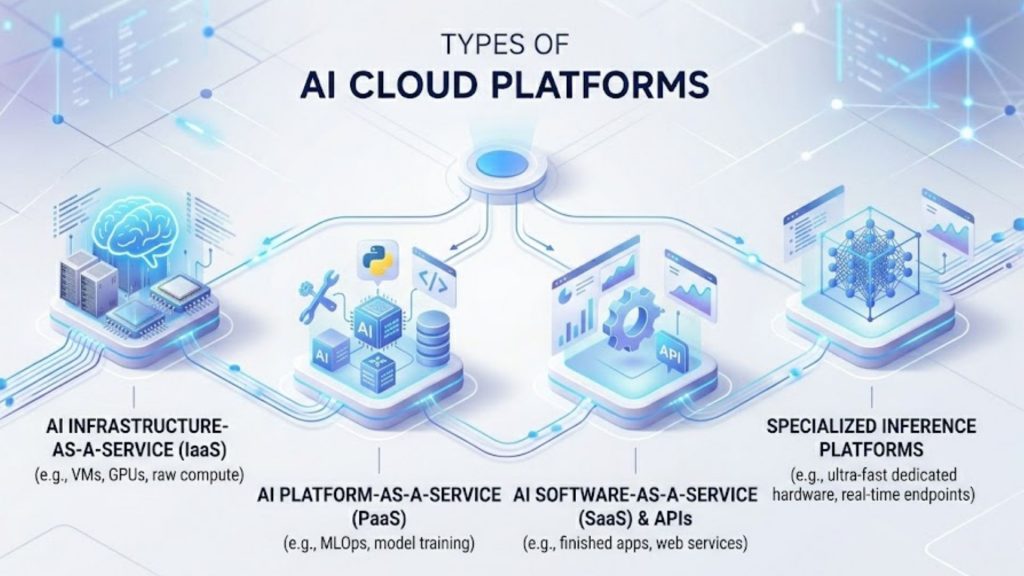
Understanding the different categories of AI cloud platforms helps businesses choose the right level of technical control
3. How do AI Cloud platforms work?
AI cloud platforms function as centralized digital factories where raw data is transformed into intelligent applications. First, businesses securely upload their datasets into the platform’s protected storage ecosystem.
Then, the system dynamically allocates powerful computing resources to process this information and train machine learning models efficiently. Finally, built-in frameworks help developers package these trained models and deploy them, making it easy to integrate smart features into everyday business operations.
Take retail as a real-world example. A fashion e-commerce brand uploads millions of customer browsing and purchase records onto the platform. The platform then automatically allocates computing resources to train a recommendation model on that data, and once deployed, the model powers the “You might also like” feature customers see while shopping, all without the brand needing to manage a single server.
4. Why are businesses moving AI workloads to the Cloud?
Today, the landscape has shifted, with companies rapidly migrating their intelligent workloads to fully managed cloud environments. This strategic transition is driven by the urgent need for business agility, predictable cost management, and immediate access to cutting-edge technologies.
4.1. Scalability Without Infrastructure Investment
One of the greatest advantages of cloud platforms is the ability to scale computing resources dynamically based on real-time business needs. Instead of purchasing expensive servers that might sit idle during slow periods, companies adopt a highly flexible, pay-as-you-go financial model.
If an AI project suddenly requires massive computational power for a few days, the cloud instantly allocates those specific resources. This approach eliminates heavy capital expenditures, allowing your enterprise to invest its budget directly into product innovation.
According to Accenture’s analysis, based on its work with hundreds of clients, migrating to the public cloud delivers total cost of ownership (TCO) savings of 30–40%, driven by greater workload flexibility, better server utilization rates, and more energy-efficient infrastructure.
4.2. Access to Specialized AI Hardware (GPUs, TPUs)
Training modern artificial intelligence models requires immense processing power, typically driven by advanced graphics processing units (GPUs). However, acquiring the latest enterprise-grade hardware is incredibly expensive and frequently hindered by global supply chain delays.
Cloud platforms solve this problem by providing instant, on-demand access to clusters of the world’s most powerful AI processors. This ensures your data science teams always have the reliable computational muscle they need to train complex models rapidly.
A single NVIDIA H100 GPU costs between $25,000 and $40,000 to purchase, with a complete 8-GPU server system reaching $200,000 to $400,000 including infrastructure – plus procurement lead times of 6 to 12 months. Through a cloud platform, that same hardware is available on-demand at roughly $2.10 per GPU-hour, with no upfront capital expenditure and immediate access.
4.3. Built-In MLOps and Developer Tools
Raw computing power is only one piece of the puzzle; technical teams also need the right software to build and manage models efficiently. AI cloud ecosystems come pre-loaded with Machine Learning Operations (MLOps) tools that automate the entire project lifecycle, from data preparation to commercial deployment.
These integrated software suites streamline team collaboration, track model performance, and ensure enterprise-grade security protocols are actively enforced. Ultimately, these tools allow your developers to focus on creating brilliant algorithms rather than managing complicated backend infrastructure.
The company built automated data pipelines using Apache Kafka and Airflow for real-time ingestion, adopted MLflow for model versioning and experiment tracking, and deployed its deep learning models as microservices through Kubernetes. The cumulative effect of this MLOps infrastructure was substantial: with 50 ML teams operating on the platform, Spotify trained over 30,000 models and reported a 700% increase in overall ML productivity compared to 2020.
Strategic transition is driven by the urgent need for business agility
5. Top 10 AI Cloud platforms in 2026
Choosing the right AI platform isn’t just about features, it’s about finding a solution that aligns with your technical needs, scalability requirements, and budget. From global cloud providers to specialized AI platforms, each option offers a different balance of performance, flexibility, and ease of use. Below is a curated list of the top 10 AI platforms to help you compare and identify the best fit for your projects.
Note: Where available, GPU pricing is normalized to a single NVIDIA H100 80GB GPU on-demand, to enable consistent comparison across providers. Studio and inference pricing reflects each provider’s standard published rates for those third party services. All prices are approximate and subject to change by region and configuration.
5.1 Integrated AI Infrastructure Platforms
FPT AI Factory
FPT AI Factory provides a comprehensive, end-to-end AI development ecosystem designed to accelerate enterprise AI initiatives globally. Operating as an NVIDIA Preferred Partner, it delivers top-tier cloud infrastructure by combining massive GPU computing power with fully integrated software tools.
With established AI factories in Japan and Vietnam, and a new facility coming soon to Malaysia, FPT AI Factory ensures global support and premium technological performance. This strategic regional presence allows the platform to maintain highly competitive pricing while empowering businesses to seamlessly scale from initial AI experimentation to real-world commercial deployment.
FPT AI Factory key features:
- High-Performance GPU Cloud: FPT AI Factory provides instant, on-demand access to thousands of cutting-edge NVIDIA GPUs, including H100 and H200 systems, and the upcoming launch of HGX B300. Users can flexibly launch GPU containers, virtual machines, or dedicated bare-metal servers for intensive AI training workloads.
- Integrated AI Studio: A fully managed, ready-to-use environment that eliminates infrastructure setup so teams can start training and fine-tuning models from day one, without provisioning resources, configuring dependencies, or switching between disparate platforms. GPU-powered Notebooks, data management, model fine-tuning pipelines, and automated testing are all pre-configured within a single unified workspace, reducing setup overhead by up to 10–15 minutes per session and lowering operational costs across the entire ML lifecycle.
- Serverless Inference and Agents: FPT AI Factory accelerates deployment by providing instant access to a marketplace of nearly 30 advanced AI models, including leading open-source models such as Llama 4, Qwen 3, and DeepSeek. Delivered via serverless APIs, this infrastructure ensures intelligent applications like customer service chatbots or autonomous AI agents operate at ultra-low latency, scaling seamlessly with demand.
FPT AI Factory pricing:
| Service | Detail | Price |
| GPU Virtual Machine | 1× NVIDIA H100 SXM5, Southeast Asia | $2.54/hour |
| GPU Container | 1× NVIDIA H100 SXM5, Southeast Asia | $2.54/hour |
| AI Notebook | Free CPU-based setup; GPU usage follows selected GPU resources | From $2.54/hour for 1× H100 SXM5 |
| AI Inference | Serverless inference pricing varies by model type and usage volume | From $0.011 per million tokens |
FPT AI Factory provides a comprehensive, end-to-end AI development ecosystem (Source: FPT AI Factory)
Amazon Web Services
AWS provides robust support for AI workloads through its worldwide cloud infrastructure, including GPU-powered instances on Amazon EC2 and scalable storage via Amazon S3, along with a broad range of specialized AI tools. With Amazon SageMaker, users can take advantage of capabilities such as serverless model tuning, training without checkpoints, integrated MLflow for streamlined experimentation, and built-in pipeline orchestration.
Key AWS AI capabilities:
- Amazon Bedrock: A unified marketplace that enables access to multiple third-party foundation models such as Anthropic Claude, Meta Llama, Mistral, and Stability AI= within a single platform.
- Dual-chip strategy: AWS has developed its own AI chips, including Trainium for model training and Inferentia for inference workloads. This strategy is designed to deliver approximately 30–40% better price-performance compared to traditional solutions.
- Massive scale: AWS infrastructure supports extremely large deployments, with Amazon EKS capable of scaling up to 100,000 nodes per cluster. In addition, AWS provides access to extensive compute resources, including large-scale Trainium accelerators and up to hundreds of thousands of NVIDIA GPUs.
- Market share and ecosystem: AWS leads the cloud market with approximately 31–32% share, followed by Azure at 20–23% and Google Cloud at 11–13%. It also maintains the most mature ecosystem, with extensive integrations, partners, and services.
AWS AI pricing overview:
| Third-party service | Detail | Price |
| GPU Infrastructure | 1× H100 SXM (P5 instance, on-demand) | $3.90/GPU/hr |
| Studio / Notebook | SageMaker Studio (ml.t3.medium, 2 vCPU / 4GB RAM) | from $0.05/hr |
| Inference (Serverless) | Amazon Bedrock, varies by model | From $0.0008/1K tokens |
Google Cloud
The AI ecosystem of Google Cloud Platform is primarily built around Vertex AI, which provides an end-to-end environment for developing, training, and deploying machine learning models. These services operate on Google’s global cloud infrastructure, featuring GPU- and TPU-powered computing, scalable storage systems, and container orchestration through Kubernetes.
Key features of Google Cloud Platform AI:
- Deepest vertical AI stack in the market: Google has built a fully integrated AI stack that spans from custom silicon (TPUs) to infrastructure, foundation models, and orchestration layers. All components are co-designed to deliver end-to-end performance optimization.
- Continuous TPU innovation: Google consistently advances its TPU lineup, with newer generations tailored for specific workloads. For example, inference-optimized TPUs can be interconnected at large scale, up to over a thousand chips within a single pod—while offering significantly improved cost-efficiency.
- Vertex AI — an all-in-one generative media platform: Vertex AI stands out by bringing together a complete suite of generative media capabilities, including models for video, images, speech, and music, all accessible within a single unified platform.
- AI-native data ecosystem: Google’s data infrastructure is built with AI at its core, combining technologies such as vector search, semantic indexing, multimodal processing, and services like BigQuery, AlloyDB, Firestore, and Spanner—creating a highly competitive hyperscale data environment.
- Strong foundation in AI research: With roots in Google DeepMind and Google Brain, Google provides customers with direct access to cutting-edge innovations and breakthroughs, including technologies like AlphaFold.
Google Cloud Platform pricing:
| Third-party service | Detail | Price |
| GPU Infrastructure | 1× H100 80GB (A3 instance, on-demand) | $3.00/GPU/hr |
| Studio / Notebook | Vertex AI Workbench (managed notebook) | from $0.077/hr |
| Inference (Serverless) | Vertex AI Model Garden, varies by model | from $0.0005/1K tokens |
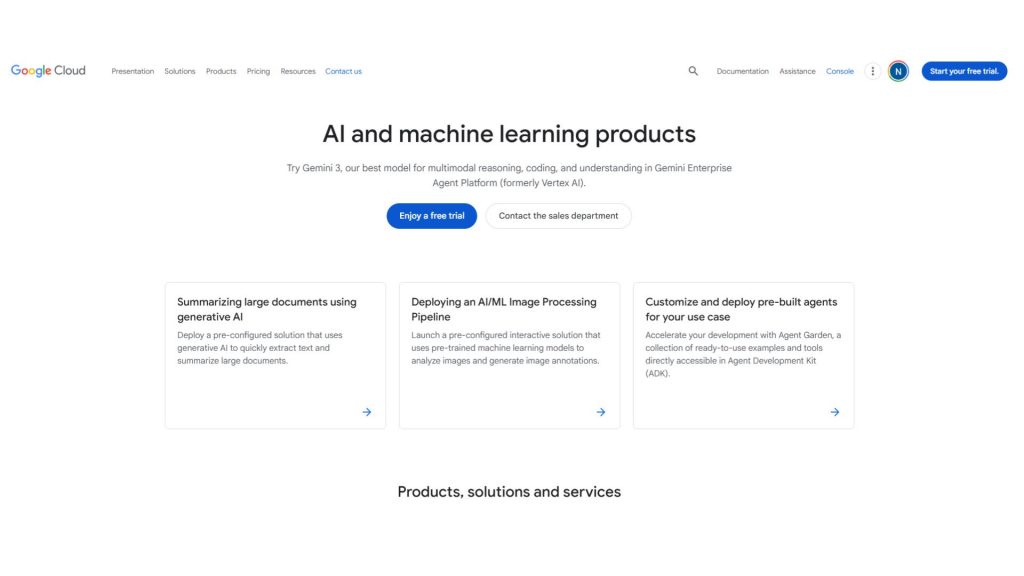
The AI ecosystem of Google Cloud Platform is primarily built around Vertex AI
Microsoft Azure
Microsoft Azure delivers its AI capabilities through an integrated ecosystem designed to support the full lifecycle of machine learning and generative AI applications. This includes GPU-powered virtual machines, scalable storage solutions like Azure Blob Storage, and container orchestration via Azure Kubernetes Service. Together, these services enable large-scale model training, experiment management, and deployment of inference endpoints in production.
Key features of Microsoft Azure AI:
- Seamless integration with the Microsoft ecosystem: Azure connects tightly with Microsoft 365, Dynamics, the Power Platform, and GitHub, making it especially attractive for organizations already operating within Microsoft’s enterprise environment.
- Azure AI Foundry: A unified AI development workflow that links tools such as GitHub, Visual Studio, and Copilot Studio, enabling teams to build, manage, and deploy AI solutions more efficiently from a single ecosystem.
- Hybrid cloud for regulated sectors: With Azure Arc and edge AI capabilities, Azure supports hybrid and distributed environments, helping industries like finance, healthcare, and government meet strict compliance and regulatory requirements.
- Extensive global footprint: Azure operates across more than 60 regions worldwide and maintains over 185 network points of presence, providing broad coverage and reliable connectivity at scale.
Microsoft Azure pricing:
| Third-party service | Detail | Price |
| GPU Infrastructure | 1× H100 80GB (NC H100 v5, on-demand) | $6.98/GPU/hr |
| Studio / Notebook | Azure Machine Learning compute instance | from $0.1119/hr |
| Inference (Serverless) | Azure OpenAI Service — varies by model | from $0.001/1K tokens |
Alibaba Cloud AI
Alibaba Cloud AI is a comprehensive suite of artificial intelligence and machine learning services designed to help organizations build, deploy, and scale intelligent applications. At the core of its ecosystem is the Platform for AI (PAI), which provides a full-stack environment covering data preparation, model development, training, and deployment.
Alibaba Cloud AI key features:
- Largest open-source AI ecosystem: Alibaba has released more than 300 AI models, including the Qwen and Wan series, generating over 600 million downloads and inspiring 170,000+ derivative models. This makes it one of the most widely adopted open-source AI ecosystems globally.
- Qwen3-Max – trillion-parameter flagship: With around one trillion parameters, Qwen3-Max delivers performance comparable to leading closed-source models on benchmarks like SWE-Bench, showing particular strength in code generation and agent-based tasks.
- E-commerce-driven advantage: Unlike other providers, Alibaba’s AI is deeply integrated into its own platforms such as Taobao, Tmall, and Lazada, enabling large-scale real-world validation in retail and e-commerce environments.
- HPN 8.0 – AI-optimized networking: This dedicated network infrastructure is designed to handle large-scale AI workloads, supporting training, inference, and reinforcement learning across mixed environments.
- Rapid growth in AI revenue: AI-related services now account for over 20% of revenue from external customers, with triple-digit growth sustained over eight consecutive quarters.
Alibaba Cloud AI pricing:
| Third-party service | Detail | Price |
| GPU Infrastructure | 1× A100 80GB (PAI-DSW instance, on-demand) | ~$4.80/GPU/hr |
| Studio / Notebook | PAI-DSW (Data Science Workshop) managed notebook | Included with compute |
| Inference (Serverless) | Alibaba Model Studio — varies by model | from $0.0004/1K tokens |
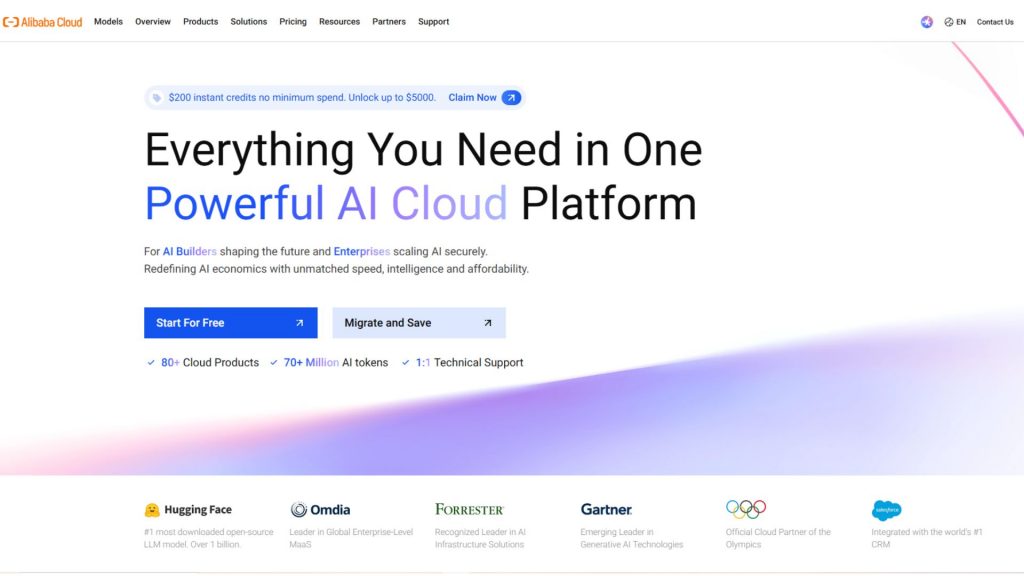
Alibaba Cloud AI is a comprehensive suite of artificial intelligence
5.2 AI Infrastructure-as-a-Service (IaaS)
Lambda Labs
Lambda Labs provides GPU computing solutions through offerings like 1-Click Clusters, Superclusters, and individual instances. The 1-Click Clusters enable rapid deployment with ready-to-use access to powerful hardware such as NVIDIA H100 and HGX B200, making them suitable for large-scale AI training, fine-tuning, and inference tasks. For more demanding workloads, Superclusters deliver high-density, liquid-cooled infrastructure designed for dedicated, single-tenant deployments.
Lambda Labs key features:
- AI-first design with no legacy constraints: Lambda is built exclusively for AI workloads, without traditional enterprise IT systems or general-purpose SaaS. Its entire stack, from hardware to cooling and networking, is optimized for high-density training and inference.
- Transparent, cost-efficient pricing: The platform offers competitive rates with clear pricing and no egress fees. It also comes with preconfigured environments like the Lambda Stack, including PyTorch, CUDA, and other essential ML tools.
- Strong NVIDIA partnership: Lambda provides early access to the latest NVIDIA GPUs at scale, often ahead of many competitors, enabling users to leverage cutting-edge hardware for demanding AI workloads.
- Rapid GPU cluster deployment: With 1-click clusters, users can launch interconnected GPU clusters ranging from 16 to over 2,000 GPUs within minutes, avoiding the complex provisioning processes typical of hyperscalers.
Lambda Labs pricing:
| Third-party service | Detail | Price |
| GPU Infrastructure | 1× H100 SXM (on-demand) | $3.99/GPU/hr |
| Studio / Notebook | Not offered as a managed service | N / A |
| Inference (Serverless) | Not offered natively | N / A |
Huawei Cloud AI
Huawei Cloud AI is a comprehensive artificial intelligence platform developed by Huawei, designed to support the full lifecycle of AI model development and deployment. The platform provides both pre-built AI services and customizable tools, allowing developers to accelerate development while maintaining flexibility. Huawei Cloud AI is widely applied across industries such as smart cities, healthcare, and finance, enabling use cases like traffic optimization, medical image analysis, and predictive analytics.
Huawei Cloud AI key features:
- CloudMatrix proprietary computing architecture: Huawei’s CloudMatrix384 supernode integrates compute, memory, and storage into a unified system. It transforms traditionally sequential workloads into highly parallel distributed processes, delivering inference speeds roughly 3–4 times higher than H20 GPUs.
- Pangu Models for industry-specific AI: The Pangu model family is tailored for vertical applications and has been deployed across more than 500 use cases in over 30 industries, including government, finance, manufacturing, healthcare, mining, steel, rail, and meteorology.
- AI Token Service for simplified access: Huawei provides an AI Token Service that allows end users to consume AI capabilities without needing to manage or understand the underlying infrastructure.
- Geographic advantage and expansion: In 2024, Huawei Cloud recorded over 50% growth outside China and now partners with more than 140 telecom operators and 500 financial institutions, with particularly strong presence in Asia, the Middle East, and Africa.
Huawei Cloud AI pricing:
| Third-party service | Detail | Price |
| GPU Infrastructure | 1× GPU node (ModelArts, on-demand) | $0.15–$1.32/node/hr (CPU), GPU nodes vary, contact for pricing |
| Studio / Notebook | ModelArts Notebook | Pay-per-use |
| Inference (Serverless) | AI Token Service | Pay-per-token |
5.3 AI Platform-as-a-Service (PaaS)
IBM Cloud
IBM Cloud delivers enterprise-grade cloud and AI capabilities centered around the IBM watsonx ecosystem. Within this suite, watsonx.ai enables users to build, train, and deploy machine learning and generative AI models, while watsonx.data handles large-scale data storage and processing, and watsonx.governance provides oversight and compliance features. These tools operate on IBM Cloud’s infrastructure, which includes GPU-enabled computing, container orchestration, and managed data services.
IBM Cloud key features:
- Strongest hybrid cloud, vendor-neutral approach: IBM enables deployment across virtually any environment—including major hyperscalers, over a thousand cloud providers, and on-premises systems. This flexibility is a key differentiator compared to hyperscalers that primarily prioritize public cloud ecosystems.
- Granite models – “small is the new smart”: IBM’s Granite model family focuses on efficiency and enterprise usability, with a strong emphasis on inference performance rather than competing solely on model size. This approach helps organizations achieve practical AI outcomes without relying on massive models.
- Watsonx.governance – advanced AI governance: This platform embeds risk management, regulatory compliance, and explainability directly into the model development lifecycle, offering an integrated approach to responsible AI that few competitors match.
- Broad enterprise integrations: Watsonx Orchestrate connects natively with more than 80 enterprise applications, including Salesforce, Microsoft, Adobe, ServiceNow, and Oracle, enabling seamless multi-agent workflows across major business platforms.
- z17 mainframe + AI capabilities: IBM’s z17 mainframe can handle up to 450 billion AI inference operations per day with millisecond-level latency, allowing AI to run directly on transactional workloads without requiring external infrastructure.
IBM Cloud pricing: IBM watsonx is offered as a managed PaaS with subscription-based access. Entry plans start at approximately $1,050/month under a pay-as-you-go model, including the Playground interface, inference capabilities, open-source model access, RAG support, and synthetic data generation. GPU infrastructure is not offered directly, compute is fully managed and abstracted within the platform.
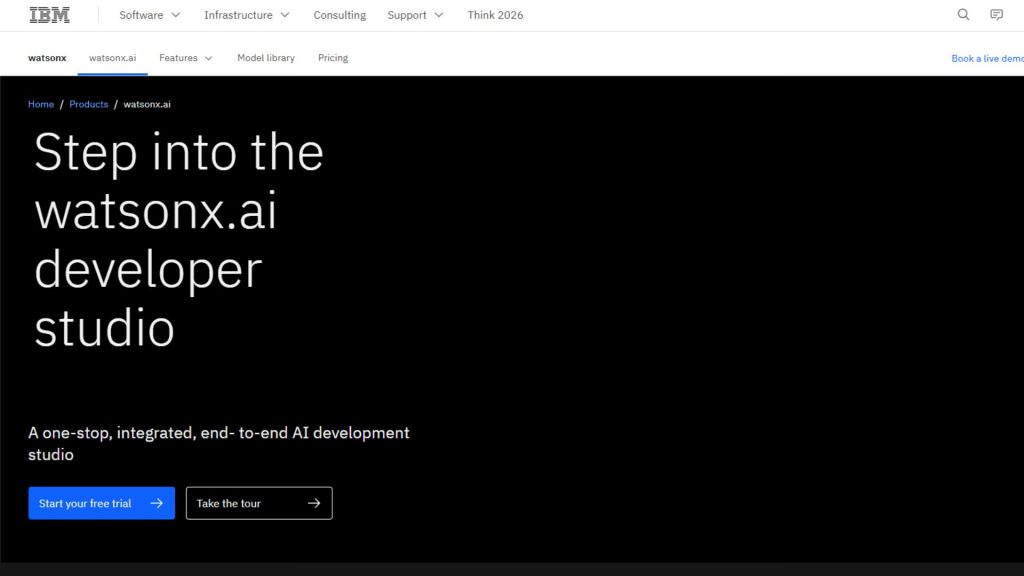
IBM Cloud delivers enterprise-grade cloud and AI capabilities centered around the IBM watsonx ecosystem
DataRobot
DataRobot is an end-to-end enterprise AI platform designed to help organizations build, deploy, and manage machine learning and generative AI solutions at scale. It combines automated machine learning (AutoML), MLOps, and generative AI capabilities into a unified environment, enabling data scientists, engineers, and business users to collaborate efficiently.
DataRobot key features:
- Best-in-class AutoML capabilities: DataRobot stands out for its highly automated machine learning workflows, intuitive user interface, wide range of algorithm options, and strong model interpretability, often outperforming platforms like H2O.ai and Google AutoML in these areas.
- Leadership in AI governance: The platform is recognized for its strengths in governance-focused use cases, offering robust tools for monitoring, compliance, and responsible AI deployment compared to other solutions in the same category.
- Recognized as a Gartner Leader: DataRobot has been named a Leader in the Gartner Magic Quadrant for Data Science and Machine Learning Platforms 2025, highlighting its strong position in the market.
- Agentic AI partnership with SAP: DataRobot serves as the exclusive agentic AI partner for SAP, enabling advanced AI-driven capabilities within SAP’s ecosystem.
DataRobot pricing: DataRobot operates as a managed PaaS with annual subscription-based pricing. No public pricing is listed – all plans require contacting sales for a quote. Market-observed rates suggest entry-level deployments starting around $2,500–$7,500/month. GPU infrastructure is fully abstracted, users do not provision or pay for compute directly.
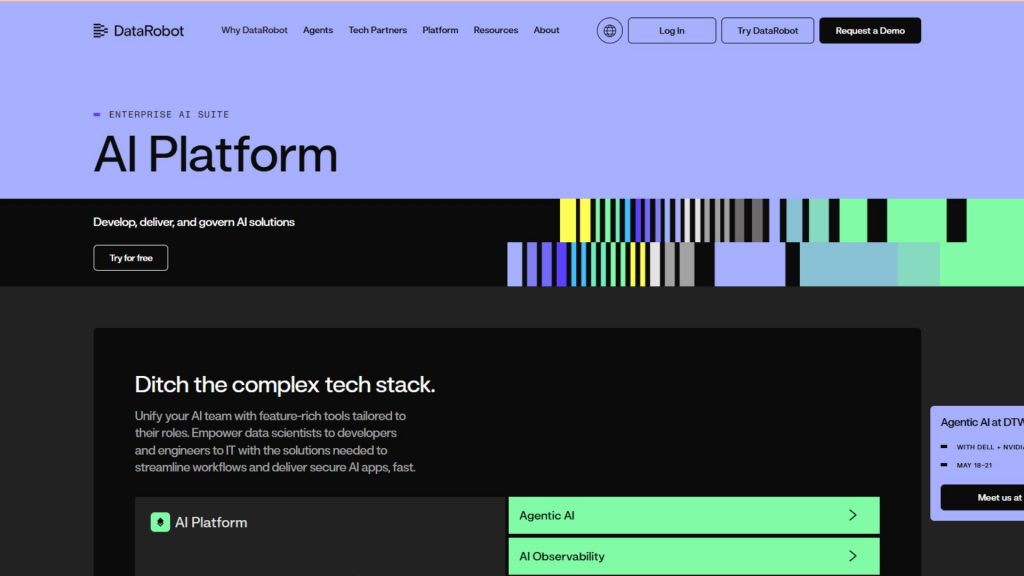
DataRobot is an end-to-end enterprise AI platform designed to help organizations build machine learning
5.4 Inference and Model Serving Platforms
Wipro Holmes
Wipro Holmes is an advanced AI and automation platform designed to help enterprises accelerate digital transformation through a unified ecosystem of cognitive technologies. It brings together capabilities such as machine learning, natural language processing, robotics, and analytics into a single platform, enabling organizations to design, deploy, and scale intelligent solutions efficiently.
Wipro Holmes key features:
- “Applied AI” bridge: Wipro HOLMES acts as a foundation for applied AI by providing core algorithm-building capabilities. It supports the full lifecycle of AI solutions, including development, publishing, governance, and monetization.
- Focus on hyper-automation: The platform enables organizations to automate processes at scale, reshape operations, and enhance customer journeys, while integrating smoothly with third-party AI, machine learning, and RPA ecosystems.
- IT services + AI approach: Unlike standalone AI platforms, HOLMES is deeply embedded within Wipro’s consulting and outsourcing services, making it a strong fit for enterprises aiming to combine AI adoption with broader IT transformation initiatives.
Wipro Holmes pricing: Wipro Holmes does not publish standard public pricing. As a platform delivered through Wipro’s professional services model, costs are scoped per engagement and vary by deployment scale, integration complexity, and service tier. Interested organizations should contact Wipro directly for a tailored quote.
6. What to Look for When Choosing an AI Cloud Platform?
Choosing the right AI cloud platform is a critical business decision that directly impacts your product’s time-to-market and overall operational costs. Here are the most essential factors to consider when evaluating an enterprise-grade AI cloud provider.
6.1. GPU and Compute Availability
The core engine of any artificial intelligence initiative is pure computational power, making hardware availability your first major checkpoint. You need a provider that guarantees instant access to the latest, high-performance processors without forcing you to endure long waitlists.
In practice, compute needs vary significantly by stage. A solo fine researcher-tuning an open-source model like Llama may only need 1-2 GPUs for a few hours. A startup training a custom recommendation engine might require a cluster of 8 GPUs running continuously for several days. An enterprise deploying a large language model across users, however, may need hundreds of GPUs on-demand, with the ability to scale back down once training is complete.
6.2. End-to-End ML Pipeline Support
Raw hardware is essentially useless if your team has to spend months building the software architecture to manage it. Look for platforms that offer built-in Machine Learning Operations (MLOps) tools to streamline the entire development lifecycle.
The value of this becomes clear when you compare workflows. An individual developer working on a personal project can get a model into production in days using a platform with built-in experiment tracking and one-click deployment. A startup without a dedicated MLOps engineer can automate retraining pipelines rather than rebuilding them manually each sprint.
6.3. Data Security and Compliance
When training AI models, you are frequently working with your company’s most sensitive data and proprietary intellectual property. Therefore, uncompromising enterprise-grade security must be a non-negotiable feature of your chosen cloud environment.
A personal project using public datasets may have minimal security requirements. A startup building a fintech application, however, needs to ensure customer transaction data never leaves a compliant environment. An enterprise in healthcare or banking operating under HIPAA or PCI-DSS must verify that the platform holds the relevant certifications, supports data residency controls, and provides full audit trails before a single line of training code is written.
6.4. Regional Availability and Latency
The physical location of your cloud provider’s data centers significantly affects the performance of your live AI applications. If your servers are located too far from your end-users, it can cause frustrating delays and slow response times, known as latency. Furthermore, many industries require data to be stored within specific geographical borders to comply with local data residency laws.
This matters differently at each scale. An individual developer building a personal chatbot may not notice a 200ms latency difference. A startup launching a real-time product recommendation feature for Southeast Asian users, however, will see direct impact on conversion rates if inference is routed through servers in Europe. For a large enterprise serving millions of users across multiple countries, regional data centers are not optional, they are a legal and operational requirement.
6.5. Pricing Transparency
AI development can quickly become expensive, so predictable and transparent billing is essential for long-term project sustainability. Avoid platforms with hidden data transfer fees or complex pricing structures that make it impossible to forecast your monthly expenses accurately.
The right pricing model depends heavily on your situation. An individual experimenting with a side project benefits most from pure pay-as-you-go, paying only for the hours used, with no monthly minimums. A startup with predictable training schedules can reduce costs significantly through reserved instances, locking in a lower rate in exchange for a commitment.
An enterprise running sustained, high-volume workloads needs volume discounts, committed-use agreements, and a dedicated account team to model total cost of ownership, since even a 10% pricing inefficiency at scale can translate into millions of dollars annually.

Predictable and transparent billing is essential for long-term project sustainability
7. Frequently Asked Questions
7.1. What’s the difference between AI platform and ML platform?
An AI platform is broader than a machine learning (ML) platform. It typically includes everything needed to build intelligent systems, such as data processing, machine learning, deep learning, generative AI, and even AI agents. In contrast, an ML platform focuses specifically on the machine learning lifecycle, including data preparation, model training, evaluation, deployment, and monitoring.
7.2. Do I need a full AI platform or just GPU cloud?
It depends on your use case and level of experience. If you only need raw computing power for training models and already know how to manage infrastructure, a GPU cloud is often enough. However, if you want faster development, built-in tools, automation, and easier deployment, a full AI platform is more suitable because it provides an integrated environment for the entire workflow
7.3. Which AI cloud platform is best for startups?
There is no single “best” AI cloud platform for every startup, as the right choice depends on budget, technical expertise, and product goals. Regional solutions like FPT AI Factory are becoming attractive choices, thanks to competitive pricing, localized support, and services tailored for businesses in the region. Overall, startups should prioritize platforms that offer a good balance of cost, ease of use, and deployment speed.
Get started with FPT AI Factory and experience a complete AI cloud platform built for modern teams. New users receive a free $100 credit, available immediately upon login with no setup required. The credit is valid for 30 days and covers:
- $10 for GPU Container and $10 for GPU Virtual Machine
- $10 for AI Notebook and $70 for AI Inference & AI Studio
- Access to up to 5M tokens with Llama-3.3 and 20+ state-of-the-art models
For enterprises or teams with more complex requirements, including large-scale deployment, custom integrations, or dedicated infrastructure, contact FPT AI Factory directly to receive tailored AI cloud platform solutions and dedicated support.
Contact Information:
- Hotline: 1900 638 399
- Email: support@fptcloud.com
Explore Related Articles: