
Agentic AI vs Generative AI is becoming an important topic as businesses move from simple AI content generation to autonomous workflows. While Generative AI creates outputs such as text, images, code or summaries, agentic AI can plan steps, use tools, and take actions toward a defined goal. At FPT AI Factory, teams can access an all-in-one AI developer cloud that supports the AI lifecycle from GPU infrastructure to model building, testing, and inference deployment.
1. What is Generative AI?
Generative AI is a type of artificial intelligence that creates new content based on a user’s prompt. This content can include text, images, audio, video, software code, summaries, translations or product descriptions. Generative AI is defined as AI that can create original content such as text, images, video, audio or software code in response to a prompt or request.
For example, a marketing team can use generative AI to draft blog posts, create email subject lines or summarize customer feedback. A developer can use it to generate code snippets or explain technical documentation. In these cases, the AI mainly responds to a specific instruction and produces a direct output.
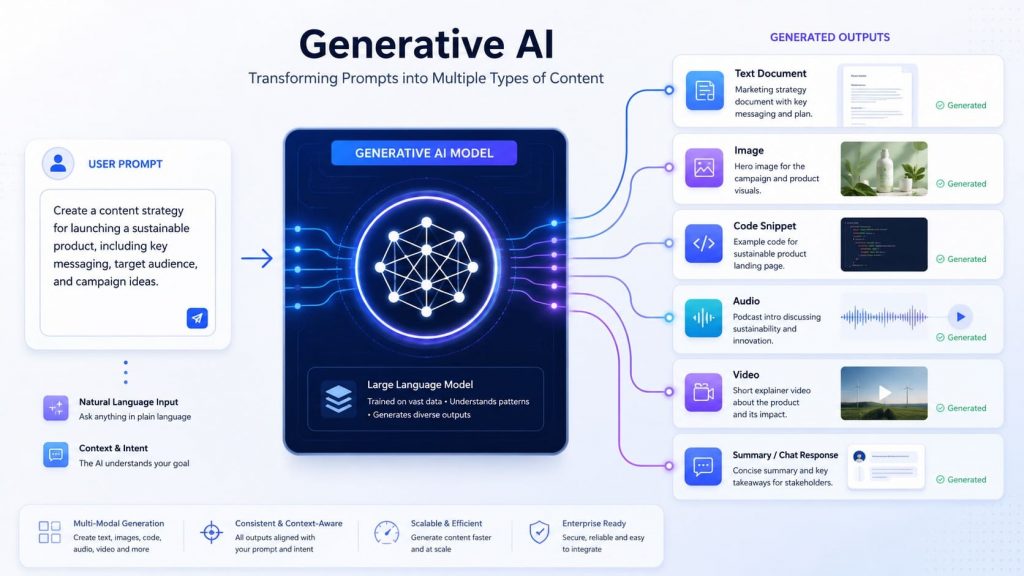
Generative AI creates new content such as text, images, code and summaries from user prompts, supporting faster content creation and knowledge work
>> Explore more: Top best AI tools need to know for researchers in 2026
2. What is Agentic AI?
Agentic AI refers to AI systems that can work toward a defined goal with a higher level of autonomy. Instead of only responding to one prompt, agentic AI can plan tasks, decide next steps, use tools, call APIs, retrieve memory, and complete multi-step workflows with limited human supervision.
For example, in customer service, an agentic AI system may receive a complaint, check the customer’s order history, classify the issue, retrieve refund rules, draft a response, and create a support ticket. The system does not only generate a message; it coordinates several steps to complete a business workflow.
A typical Agentic AI workflow may start with a user goal, then move through planning, tool selection, API calls, memory retrieval, reflection, and final action. However, not every workflow that uses tools is fully agentic. In practice, many systems still rely on predefined rules, structured workflows, and human supervision, especially for sensitive or customer-facing tasks.
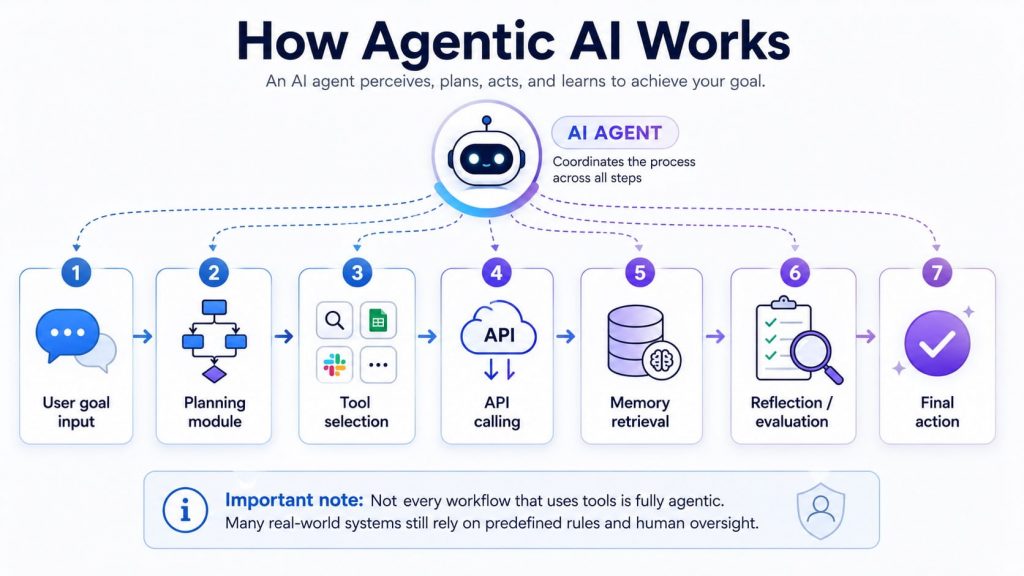
Agentic AI systems can plan, select tools, call APIs, use memory, evaluate outcomes, and complete final actions with human oversight where needed
3. Agentic AI vs Generative AI: Key differences
The main difference between agentic AI and generative AI is the level of autonomy. Generative AI is usually output-focused, while agentic AI is goal-focused. Generative AI helps users create content or answers, while agentic AI helps users execute workflows, make decisions, and interact with external systems.
| Criteria | Generative AI | Agentic AI |
| Core purpose | Create content or responses from prompts | Complete goals through multi-step workflows |
| Primary output | Text, image, code, audio, summary or recommendation | Actions, decisions, completed tasks or workflow outcomes |
| Level of autonomy | Low to medium | Medium to high |
| Planning ability | Limited, usually prompt-based | Stronger planning across multiple steps |
| Tool usage | May use tools if connected | Often designed to use APIs, databases, apps, and external tools |
| Memory / context handling | Usually depends on current prompt or session context | Can use memory, task history, and workflow context |
| Workflow type | Single-turn or short multi-turn interaction | Multi-step, task-oriented workflow |
| Task complexity | Best for content generation and knowledge tasks | Best for complex processes that require actions |
| Human involvement | User gives prompts and reviews output | User sets goals, monitors and approves key actions |
Example: same user request, different AI behavior
User request: “Help me prepare a customer follow-up email and update the sales record.”
- With generative AI, the system may draft a professional follow-up email based on the user’s prompt. It can suggest the tone, rewrite the message and create several email versions. However, the user still needs to copy the email, send it manually and update the CRM by themselves.
- With agentic AI, the system can handle a broader workflow. It may draft the email, check the customer’s previous conversation, pull order or meeting details from the CRM, suggest the next action, update the sales record and prepare the email for approval. In this case, the AI is not only generating content; it is planning steps, using tools and helping complete the task.
In simple terms, generative AI is useful when the main goal is to create something. Agentic AI is more suitable when the goal is to get something done. Many real-world AI systems combine both: a generative model produces language, while an agentic layer plans actions, calls tools, and manages the workflow.
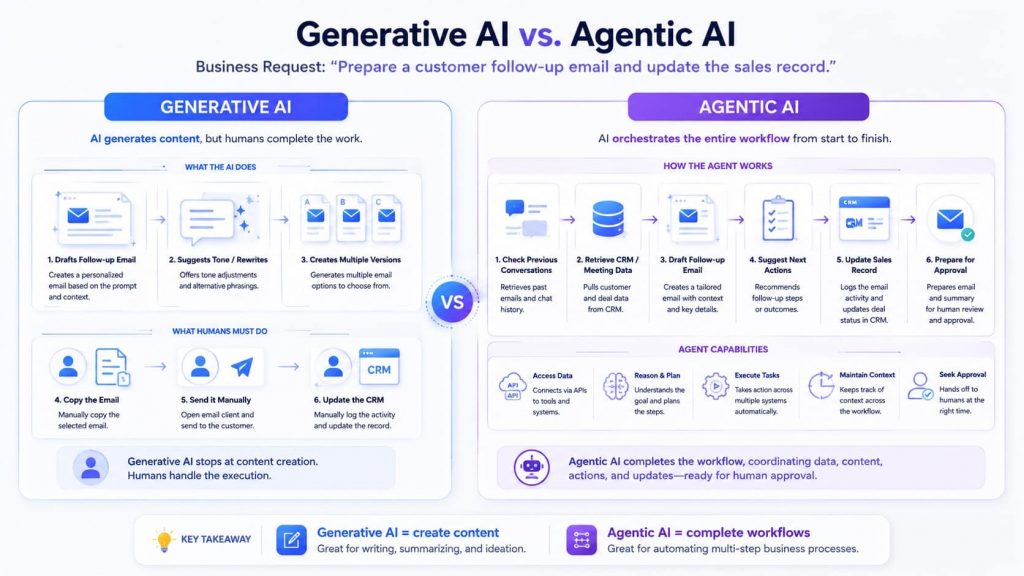
Generative AI creates content, while agentic AI helps execute workflows and complete tasks
4. Use cases: When to use Generative AI vs Agentic AI
Choosing between generative AI and agentic AI depends on the business objective. If the task requires content creation, summarization or idea generation, generative AI may be enough. If the task requires planning, decision-making, tool usage or workflow execution, agentic AI is usually more suitable.
4.1 When Generative AI is enough
Content creation
Generative AI is enough when the goal is to create content quickly. Marketing teams can use it to draft blogs, product descriptions, social captions or email campaigns. For example, an e-commerce company can generate multiple product descriptions from a short list of features, then have the content team review and localize the final copy.
A real-world example is Canva’s Magic Switch, which uses OpenAI’s API and vision technology to understand design content and convert one design into different formats. According to OpenAI, Magic Switch can summarize, translate, rearrange or transform content into formats such as emails, helping users move faster from one idea to multiple content outputs. This shows how generative AI is useful when the main goal is to create, adapt or repurpose content quickly.
Summarization
Generative AI works well for summarizing long documents, reports, meeting notes or customer feedback. For example, a business team can upload a long market research report and ask the model to summarize key trends, risks and opportunities. The output helps users understand information faster without manually reading every page.
Translation and rewriting
Generative AI can support translation, tone adjustment, and rewriting. A customer support team may use it to rewrite technical responses into simpler language for end users. A global company may also use it to create first-draft translations before human review.
Code assistance
Developers can use generative AI to generate code snippets, explain errors or write documentation. For example, an engineer can ask the model to draft a Python function, then test and refine it before production use. This use case improves speed but still requires human validation.
4.2 When you need Agentic AI
Customer support automation
Agentic AI is useful when customer support requires more than answering questions. An agent can check customer records, identify the issue, retrieve policy information, suggest a solution, and update the ticketing system. For example, a telecom company can use an AI agent to handle billing questions while escalating complex cases to human agents.
A clear example is Klarna’s AI assistant. Klarna reported that its OpenAI-powered AI assistant handled 2.3 million conversations in its first month, covering two-thirds of customer service chats and doing work equivalent to 700 full-time agents. Klarna also reported a 25% drop in repeat inquiries and faster resolution, with customers resolving errands in less than two minutes compared with 11 minutes previously.
Enterprise workflow automation
Agentic AI is suitable for workflows that involve multiple tools and decisions. For example, a procurement team may use an AI agent to compare supplier quotes, check contract terms, summarize risks and prepare approval notes. The system helps reduce manual work while keeping humans involved in final decisions.
Data analysis and reporting
Agentic AI can help business teams analyze data across multiple sources. For example, a sales operations agent can pull CRM data, compare monthly performance, detect unusual changes, and prepare a short report for managers. This requires planning, tool access, and context handling, not just text generation.
AI applications with API integration
Agentic AI often needs fast and scalable model access through APIs. FPT AI Factory’s Serverless Inference supports integration into agents and applications via API, offers 20+ diverse AI models, and uses OpenAI-compatible APIs for easier migration from closed-source solutions. This makes it relevant for teams building chatbots, virtual assistants, document processing systems and other AI-powered applications.
Agentic AI can power assistants that manage tasks across calendars, documents, emails, databases or internal systems. For example, an operations assistant can collect updates from different departments, summarize blockers, and generate a follow-up task list. This type of use case requires memory, planning, and tool orchestration.

Generative AI is useful for fast content creation, summarization, translation, rewriting and code assistance, helping teams save time on knowledge tasks
5. Is Agentic AI replacing Generative AI?
Agentic AI is not replacing generative AI. Instead, it builds on top of generative AI to support more advanced workflows. Generative AI remains essential for creating text, images, code, summaries, and other outputs, while agentic AI adds planning, tool usage, memory, and action-taking capabilities. In many systems, agentic AI still depends on generative models to understand instructions, generate responses, reason through tasks, and communicate results.
| Opportunities of agentic AI | Challenges of agentic AI |
| Multi-step workflow automation: Agentic AI can plan tasks, break goals into smaller steps, and coordinate actions across a process. | Reliability risks: Performance may drop when tasks are ambiguous, external tools fail, or workflow conditions change. |
| Tool and system integration: It can interact with APIs, databases, applications, and enterprise systems to complete tasks beyond simple content generation. | Hallucination risk: Like generative AI, agentic AI can still make incorrect assumptions or take actions based on flawed reasoning. |
| Higher automation potential: It can support workflow execution, task orchestration, and business process automation with less manual intervention. | Higher operating cost: Multi-step reasoning, tool usage, infrastructure, and monitoring can increase deployment and maintenance costs. |
| More complex task handling: It is better suited for tasks that require planning, memory, decision-making, and context across multiple steps. | Evaluation complexity: Success depends on the full workflow, not only the quality of one generated response. |
| Reduced manual effort: It can assist with repetitive operational tasks, process coordination, and follow-up actions. | Security and governance requirements: Access to internal systems, customer data, or business tools requires permission controls, monitoring, and human oversight. |
For businesses, the key question is not whether agentic AI is better than generative AI, but whether the task truly requires more autonomy. Generative AI is often enough for content-focused tasks such as drafting, summarizing, translating, rewriting, and coding support. Agentic AI is more suitable for complex workflows that need planning, tool usage, system integration, and clear human approval checkpoints.
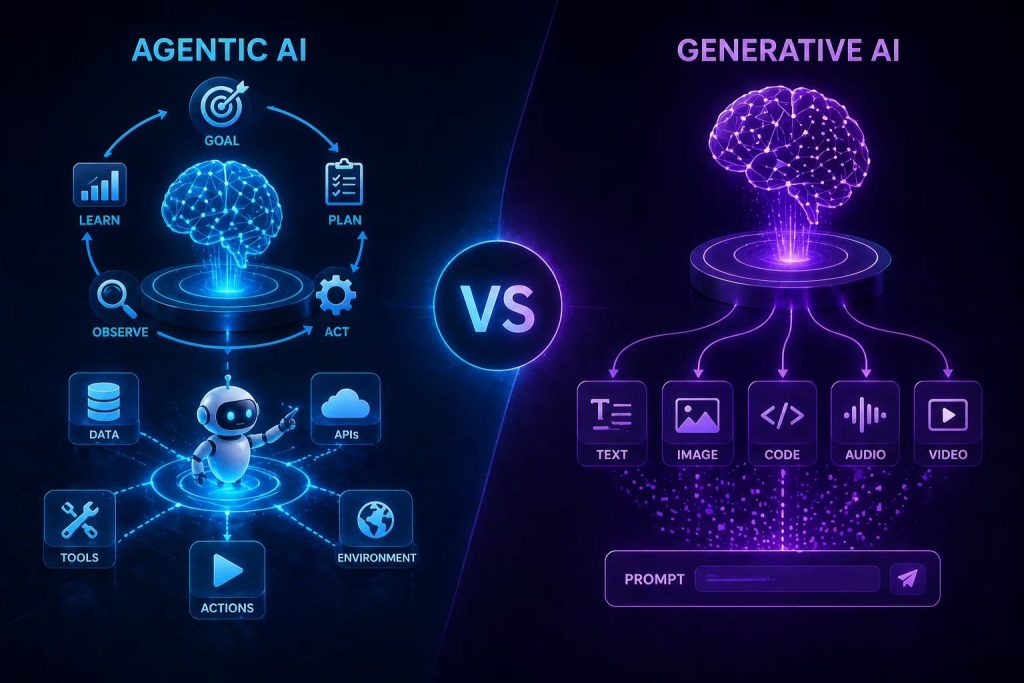
Agentic AI does not replace generative AI; it extends generative outputs with planning, tool usage and workflow execution for more complex business tasks
6. Future of Agentic AI vs Generative AI
The future of AI will likely combine both generative and agentic capabilities. Businesses will continue using generative AI for content, coding, summarization, and knowledge work. At the same time, more companies will explore agentic AI to automate workflows, improve productivity, and connect AI models with business systems.
Key trends include:
- More AI agents in enterprise operations: Businesses may use agents for customer service, sales operations, IT support, finance workflows and supply chain coordination.
- Stronger AI governance and monitoring: As AI systems become more autonomous, companies will need clearer rules, evaluation metrics, audit trails and human approval points.
- API-first AI deployment: AI teams will need flexible APIs to connect models with applications, agents and internal tools.
- More focus on context and memory: Agentic AI will depend on reliable data, long-context handling and secure access to business knowledge.
- Human-AI collaboration: Humans will still define goals, review sensitive outputs and make final decisions in high-risk tasks.
FPT AI Factory positions its ecosystem around the AI development lifecycle, including GPU AI infrastructure, AI Studio tools and AI Inference services. Its website highlights use cases such as compute-intensive AI workloads, fine-tuning, real-time inference, autonomous assistants, AI ops and pipeline orchestration.
7. FAQs
7.1. Is ChatGPT Agentic AI or Generative AI?
ChatGPT is mainly a generative AI application because it creates text responses from user prompts. However, when connected with tools, memory, APIs or task automation features, it can support more agentic workflows. The classification depends on how the system is designed and what actions it can perform.
7.2. Is Agentic AI considered Generative AI?
Agentic AI can use Generative AI, but they are not the same. Generative AI focuses on creating outputs, while agentic AI focuses on completing goals through planning, tool usage, and actions. In many modern systems, generative AI acts as the reasoning or language layer inside an agentic AI workflow.
7.3. What is the main difference between Agentic AI and Generative AI?
The main difference is autonomy. Generative AI responds to prompts and creates content, while agentic AI can plan, decide, use tools, and complete multi-step tasks. Generative AI is output-oriented, while agentic AI is goal-oriented.
In summary, understanding the differences between agentic AI vs generative AI helps organizations choose the right approach for their AI initiatives:
- Generative AI focuses on creating content such as text, images, code, and summaries from user prompts.
- Agentic AI goes beyond content generation by planning tasks, using tools, accessing data, and executing multi-step workflows.
- Generative AI is ideal for content creation, summarization, translation, and coding assistance, while agentic AI is better suited for workflow automation and complex business processes.
- Rather than replacing generative AI, agentic AI builds on it to deliver higher levels of automation and operational efficiency.
As AI continues to evolve, many organizations will combine both technologies to create intelligent systems that can not only generate information but also take meaningful actions toward business goals.
Individuals can explore many AI on the FPT AI Factory platform with $100 credits when logging in. For businesses or organizations that need customized AI solutions, large-scale deployment or expert consultation, contact FPT AI Factory through the official contact form.
Contact information:
- Hotline: 1900 638 399
- Email: support@fptcloud.com
Explore more articles