
A New Phase of Complexity for Telecom Providers
Telecommunications companies are entering a new phase of growth and complexity. The expansion of 5G, the rise of edge computing, and the explosion of connected devices are transforming how networks are built and managed.
At the same time, customer expectations continue to increase. Users expect seamless connectivity, minimal downtime, and highly responsive digital services. Meeting these demands while keeping costs under control is becoming increasingly challenging.
Artificial intelligence is emerging as a key enabler in this environment. By analyzing vast amounts of network data and automating critical processes, AI is helping telecom providers operate more efficiently and respond faster to changing conditions.
Insights into this transformation are highlighted in NVIDIA’s State of AI in Telecommunications 2026 survey, which reflects how organizations across the industry are moving from experimentation to large-scale AI deployment.
From Experimentation to Core Strategy
AI is no longer confined to isolated pilot projects. Telecom providers are increasingly embedding AI into their core operations, treating it as a strategic capability rather than a supporting tool.
This shift is driven by necessity. Modern telecom networks generate enormous volumes of real-time data, far beyond what traditional systems can efficiently process. AI allows organizations to extract value from this data, whether by predicting network issues, optimizing traffic flows, or identifying opportunities for service improvement.
Where AI Is Making the Biggest Impact
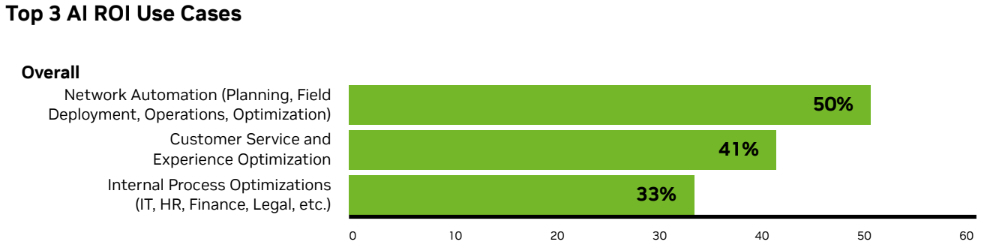
Graphic 1: Top AI Use Cases in Telecommunications
Smarter, More Resilient Networks
One of the most significant applications of AI in telecom is network optimization. AI systems can continuously monitor network performance, detect anomalies, and predict potential failures before they occur.
This enables a more proactive approach to network management. Instead of reacting to outages, telecom providers can prevent them, improving reliability and reducing downtime for customers.
Transforming Customer Interactions
Customer experience is another area undergoing rapid change. AI-powered virtual assistants and intelligent support systems are helping telecom companies deliver faster, more personalized services.
These tools can handle routine inquiries, guide users through troubleshooting steps, and provide tailored recommendations. As a result, customers benefit from quicker resolutions, while companies can scale their support operations more efficiently.
Driving Efficiency Through Automation
Operational efficiency remains a major priority across the telecom sector. AI is being used to automate repetitive tasks, optimize workflows, and improve resource allocation.
This reduces manual workload and allows teams to focus on higher-value activities. Over time, these efficiencies translate into lower operational costs and more agile organizations.
Moving Toward AI-Native Networks
Beyond current applications, telecom providers are preparing for a broader transformation of network architecture. According to NVIDIA’s survey, 77% of respondents expect AI-native networks to be deployed before 6G, indicating that AI will be embedded directly into the foundation of future network systems rather than added as a separate layer.
This shift is closely tied to how companies are building and scaling their AI capabilities. Flexibility is becoming increasingly important, with 89% of respondents highlighting open-source models and software as a key part of their AI strategy. This reflects the need to adapt AI solutions across different environments while supporting more complex and distributed network architectures.
From Network Transformation to Operational Impact
The impact of AI is not limited to network design. It is also becoming visible across day-to-day operations, where telecom organizations are seeing measurable improvements in productivity. Nearly all respondents report efficiency gains, with 26% citing significant improvements in their ability to complete tasks faster and with higher quality.
These gains are largely driven by the growing use of generative and agentic AI across different parts of the business. From internal workflows to network management, AI is helping reduce manual effort and enable faster, more informed decision-making. This directly connects technological transformation with improved operational performance.
Enabling AI at Scale
As AI becomes more deeply integrated into both networks and operations, the ability to scale these systems becomes increasingly important. Telecom providers require substantial computing power to process large volumes of data and deploy AI effectively across complex environments.
To support this, companies like FPT are investing in advanced AI infrastructure such as FPT AI Factory. These platforms provide the high-performance computing capabilities needed to accelerate development and enable organizations to expand AI use cases beyond initial deployments.
Conclusion
The NVIDIA survey shows that AI is evolving from a supporting technology into a central driver of value in telecommunications. Its role now spans network transformation, operational efficiency, and business performance, supported by strong investment and increasing adoption across the industry.
As telecom providers continue to scale their AI initiatives, the focus is shifting toward deeper integration across both infrastructure and operations, shaping how future networks are built and managed.
Source: NVIDIA