
What is bare metal server and how is it different from virtual machines or containers? A bare metal server is a physical server dedicated entirely to one user, with no virtualization layer in between. Understanding this model helps businesses make smarter infrastructure decisions, especially for AI and compute-heavy workloads. At FPT AI Factory, we provide GPU infrastructure and AI development platforms designed to meet the real demands of modern enterprise AI.
1. What Is a Bare Metal Server?
A bare metal server is a single-tenant physical machine where your workload runs directly on the hardware — no hypervisor, no shared resources with other users. You get full access to every CPU core, all RAM, storage, and any GPUs installed on that machine.
This setup matters most when performance, hardware-level control, or strict data isolation is a requirement. Common use cases include large-scale AI training, financial systems, healthcare data processing, and scientific computing. In each of these, unpredictable performance from a shared environment is not acceptable.
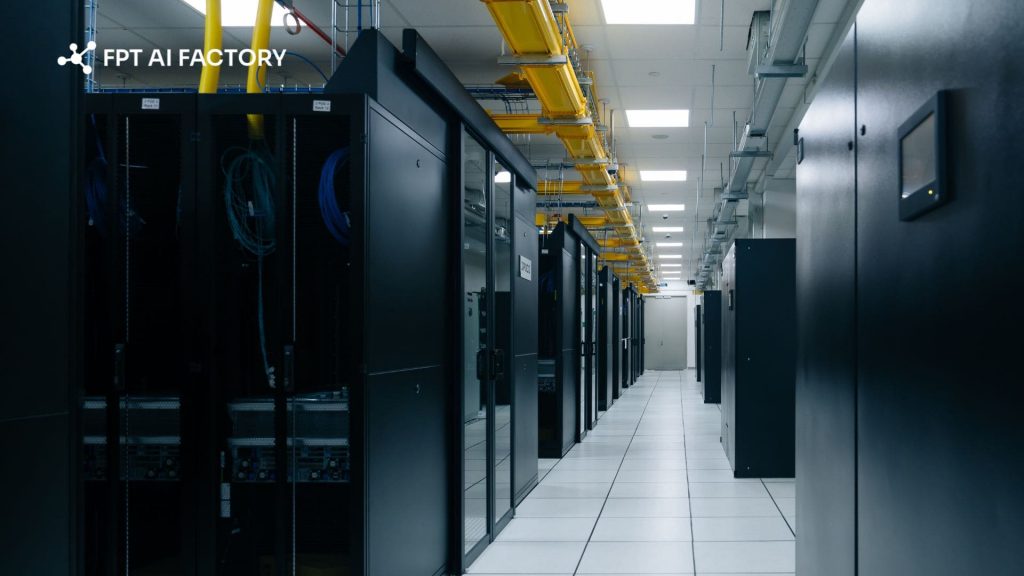
A bare metal server is a single-tenant physical machine (Source: FPT AI Factory)
2. Bare Metal vs Virtual Machine vs Container for AI Workloads
The right compute layer depends on how much overhead you can tolerate, how fast you need to scale, and how much isolation your workload demands.
| Criteria | Bare Metal | Virtual Machine | Container |
| Abstraction Layer | None – direct hardware access | Hypervisor (KVM, VMware) | OS-level – shares host kernel |
| GPU Access Method | Direct PCIe passthrough | PCIe passthrough or vGPU | Via host GPU driver + container runtime |
| Typical GPU Overhead | Near zero | 5-15% | Minimal when configured correctly |
| Multi-tenancy | No – single tenant | Yes | Yes |
| Isolation Level | Full hardware isolation | Strong (hypervisor-enforced) | Process-level only |
| Provisioning Speed | Slow – minutes to hours | Fast – seconds to minutes | Very fast – sub-second |
| Best For | Long training runs, compliance workloads | Flexible scaling, dev/test environments | Model serving, CI/CD pipelines |
For large AI training jobs, bare metal offers the cleanest path to hardware performance. Containers and VMs trade some performance for speed and flexibility, which suits different stages of the development lifecycle.
3. Use Cases of Bare Metal Servers
Large-Scale AI Model Training
Training large language models or foundation models requires sustained, high-bandwidth communication across multiple GPUs. On bare metal, GPUs communicate via NVLink or PCIe without hypervisor interference, keeping inter-GPU latency low across long training runs. This is why most serious AI training workloads run on bare metal rather than shared virtual infrastructure.
High-Performance Inference
Real-time AI inference recommendation engines, speech recognition, and fraud detection require consistent, low-latency responses. Bare metal eliminates the jitter that virtualization can introduce, making it a reliable choice when SLA requirements are strict and response time variation is costly.
Regulated Industries
Healthcare, finance, and government workloads often have compliance requirements around data residency and hardware isolation. Bare metal guarantees that no other tenant ever shares the same physical machine, which is difficult to achieve on multi-tenant virtual infrastructure.
Scientific Computing
Genomics pipelines and physics simulations are memory- and CPU-bound workloads that benefit from direct NUMA control and uncontested cache access. Bare metal allows kernel-level tuning that simply is not possible inside a VM.
When Bare Metal Is Not the Right Fit
Bare metal provisioning is slow, scaling requires lead time, and managing physical hardware adds operational complexity. For many AI workloads particularly those needing strong GPU performance but also faster deployment and flexible scaling a GPU Virtual Machine is a practical alternative worth considering.
GPU Virtual Machine from FPT AI Factory gives you access to high-performance GPUs with near-bare-metal throughput, faster provisioning, and the ability to scale resources based on actual workload demand. It is well-suited for teams that need serious GPU compute without the management overhead of physical infrastructure.
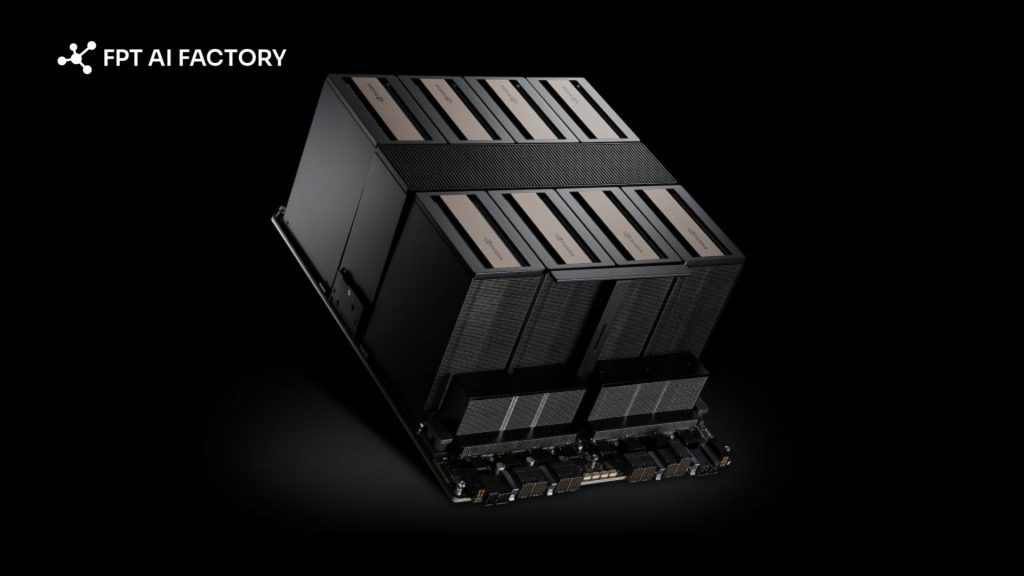
GPU Virtual Machine from FPT AI Factory (Source: FPT AI Factory)
4. Bare Metal Server Cost Considerations
Bare metal servers cost more than shared virtual instances, and the cost structure is different. Here is where that cost actually comes from:
- Hardware exclusivity: You pay for the full machine regardless of how much of it you use. A server sitting at 40% utilization is expensive idle capacity.
- Provisioning time: Because setup takes longer than spinning up a VM, failed workloads or misconfigurations translate directly into billable idle time.
- Operational overhead: Managing OS configuration, GPU drivers, firmware updates, and security patches on physical hardware requires either internal expertise or a managed service – both have real costs.
- Scaling limitations: Unlike cloud VMs, you cannot instantly add or remove capacity. Bare metal makes the most financial sense for workloads with consistently high and predictable hardware utilization.
For workloads that do not justify full bare metal, a GPU Virtual Machine typically offers a better cost-to-performance ratio, with the option to move to dedicated hardware as demand grows.
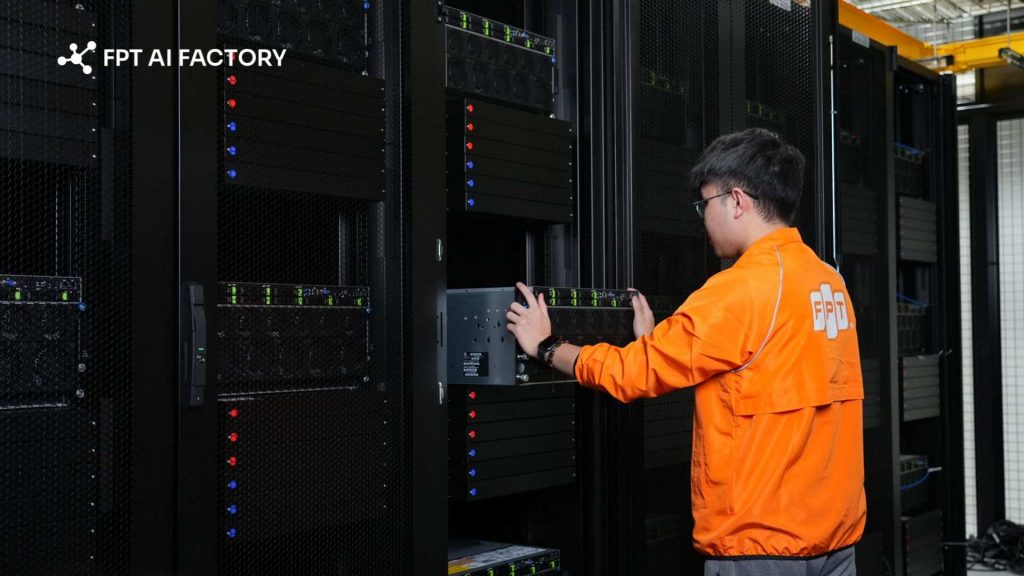
Bare Metal Server Cost Considerations (Source: FPT AI Factory)
5. FAQs
5.1. What is the difference between a bare metal server and a virtual machine?
A bare metal server is a physical machine used by one tenant only, with no virtualization layer. A virtual machine runs on a hypervisor that abstracts the hardware, allowing multiple VMs to share one physical host. Bare metal gives you raw performance and full hardware control; VMs offer faster provisioning and easier scaling.
5.2. Can I use containers on bare metal servers?
Yes. Containers run on top of an operating system, not directly on hardware, so you can run Docker or Kubernetes on a bare metal server. This combination is common in AI platforms that need low-level hardware access alongside containerized deployment flexibility.
5.3. Why choose a bare metal server over cloud hosting?
Standard cloud hosting means shared virtual infrastructure. Bare metal gives you dedicated hardware, no performance interference from other tenants, and full control over the OS and drivers. For workloads where consistency and hardware isolation matter — such as large model training or compliance-regulated processing — bare metal justifies the additional cost.
5.4. Is a bare metal server the same as a dedicated server?
Mostly yes. Both refer to physical servers used by a single tenant. The difference is context: “dedicated server” is a traditional hosting term, while “bare metal server” is more commonly used by cloud providers that offer on-demand provisioning and API-based management alongside the physical hardware.
In summary, a bare metal server is the right choice for workloads that demand maximum hardware performance, isolation, and control, while a GPU Virtual Machine offers stronger flexibility and faster deployment for teams that want a more practical starting point. FPT AI Factory supports both approaches, providing infrastructure options including GPU Virtual Machines to cover a wide range of AI and compute workloads.
You can begin quickly with the Starter Plan, which grants $100 in free credits. These credits are available immediately after you sign up, so you can log in and start using the platform without any delay giving you enough capacity to explore and test your compute workloads without any upfront cost. If your business or organization is looking for tailored infrastructure solutions or planning deployment at a larger scale, please reach out to FPT AI Factory via the contact form. Our team will work with you to provide consultation and support aligned with your specific requirements.
Contact Information:
- Hotline: 1900 638 399
- Email: support@fptcloud.com