
Transfer learning vs Fine tuning are crucial techniques in AI development, helping businesses adapt pre-trained models to new tasks efficiently. At FPT AI Factory, we provide solutions that streamline these processes, enabling organizations to deploy AI models faster and more accurately.
1. What is Transfer Learning?
Transfer Learning (TL) is a machine learning technique where a model pre-trained on one task is repurposed for a new, related task. Traditional model training is resource-intensive, requiring large datasets, high computational power, and multiple iterations. TL breaks these barriers by enabling organizations to reuse existing models and train them on smaller, task-specific datasets.
Key Benefits of Transfer Learning:
- Enhanced Efficiency: Pre-trained models retain fundamental knowledge, allowing faster adaptation to new tasks with less data.
- Increased Accessibility: TL reduces costs, enabling organizations to apply AI to niche use cases like medical imaging or environmental monitoring.
- Improved Performance: Exposure to diverse scenarios during initial training makes TL models more robust in real-world conditions.
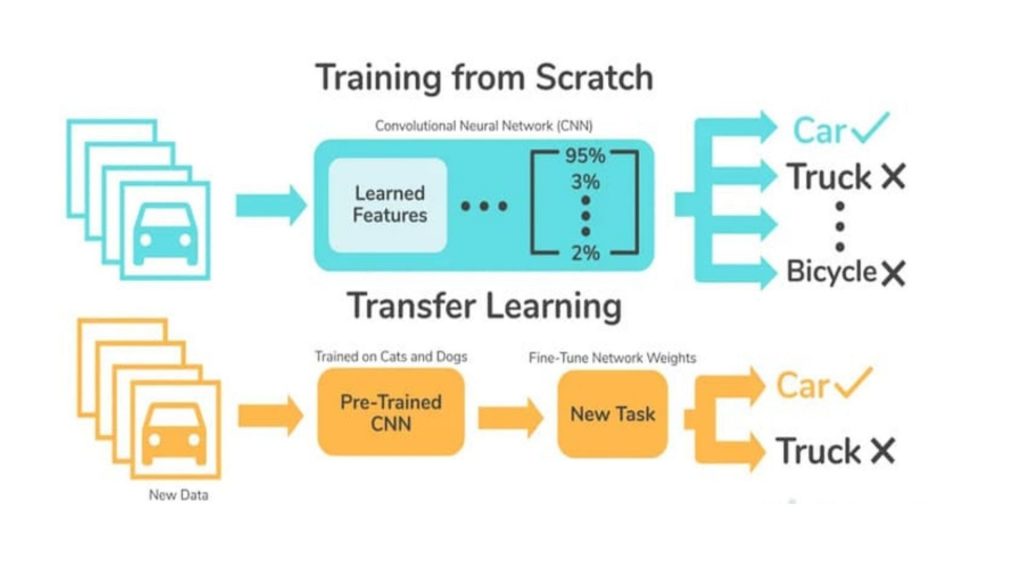
Transfer Learning lets pre-trained models tackle new tasks efficiently
2. What is Fine-Tuning?
Fine-Tuning is the process of taking a pre-trained model and continuing training on a smaller, specialized dataset to optimize performance for a specific task. Unlike TL, fine-tuning modifies internal weights to better capture nuances of the target domain.
Core Characteristics of Fine-Tuning:
- Leveraging Foundational Knowledge: Models already understand general patterns; fine-tuning focuses on domain-specific learning.
- Resource Efficiency: Faster and less costly than training from scratch.
- Specialized Adaptability: Enables precise calibration for specific tasks or datasets.
Practical Applications:
- Customer Service Chatbots: Train models to adopt company-specific tone.
- Medical Diagnostics: Adapt vision models for pathology detection.
- Custom Image Generation: Use fine-tuned datasets for proprietary artistic styles.
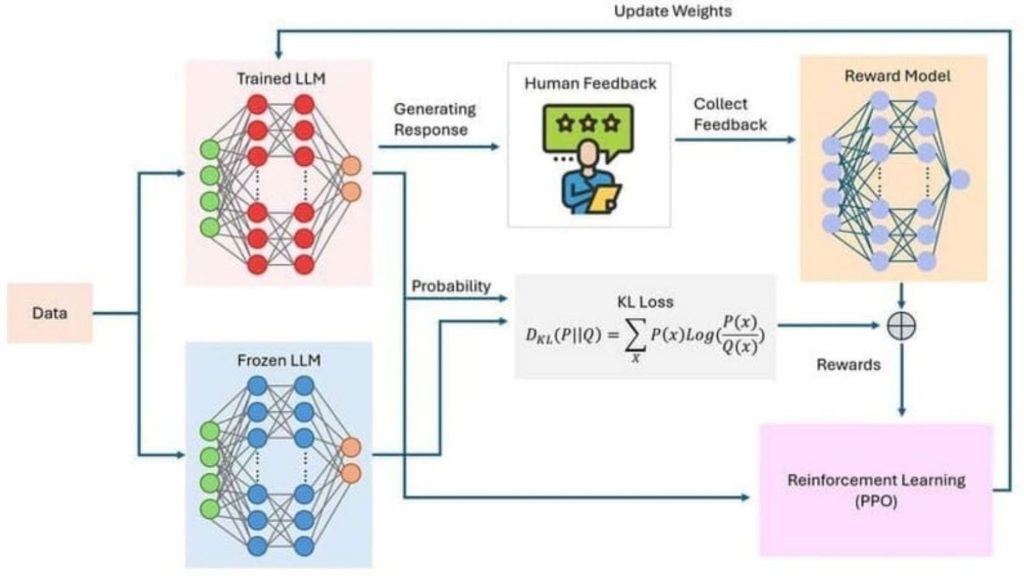
Fine-Tuning refines pre-trained models on specialized data for optimal task performance
3. Differences between Transfer Learning and Fine-Tuning
While people often use these terms interchangeably, in the context of transfer learning vs fine-tuning, transfer learning is the broader concept, while fine-tuning is a specific technique used to implement it.
| Criteria | Transfer Learning | Fine-Tuning |
| Training Layers | Only the final layers are trained, while the rest of the model remains frozen. | Some or all pre-trained layers are retrained, allowing deeper adaptation. |
| Data Requirement | Works well with smaller datasets by leveraging pre-learned features. | Generally benefits from larger datasets as more parameters are updated during training. |
| Computational Cost | Less computationally expensive as only a small portion of the model is trained. | More computationally expensive due to retraining multiple or all layers. |
| Adaptability | Limited adaptability, mainly adjusting task-specific output layers. | Highly adaptable, refining both feature extraction and task-specific layers. |
| Risk of Overfitting | Usually lower risk due to small number of train params (normal used settings) | Higher risk of overfitting if the dataset is small relative to the number of trainable parameters. |
4. When to use Transfer Learning vs. Fine-Tuning?
When deciding between fine tuning vs transfer learning, businesses should carefully evaluate their needs, data availability, and the complexity of the task. Choosing the right approach and platform is essential to optimize AI workflows, ensure resources are used efficiently, and achieve the desired performance.
Use Transfer Learning when:
- Your dataset is limited and insufficient for full model retraining.
- The new task is closely related to the original training objective.
- You need a fast, resource-efficient solution.
Use Fine-Tuning when:
- You have enough data to update more model parameters.
- The task requires deeper adaptation beyond the model’s original capabilities.
- You can allocate additional time and computational resources for higher accuracy.
Given the need for efficient, secure, and scalable AI adaptation, implementing fine-tuning on a reliable platform like Model Fine-Tuning is highly recommended. Fine-tuning with FPT AI Factory is designed to be flexible, scalable, and easy to get started, whether you need full control or a streamlined workflow. Businesses can choose between two powerful options:
- Rent GPU resources, such as GPU Container or GPU Virtual Machine, from FPT AI Factory to unlock high-performance computing for large-scale fine-tuning, giving you full control over model optimization while ensuring cost efficiency.
- Use FPT AI Factory’s AI Notebook for a seamless, all-in-one environment where you can develop, train, and fine-tune models faster, without complex setup or infrastructure management.
With these options, businesses can accelerate AI deployment, reduce operational overhead, and bring customized AI models into production more efficiently than ever.
FPT Model Fine-Tuning enables secure, multi-GPU AI adaptation with no-code setup.
>> Explore: Fine-Tuning OpenFlamingo on NVIDIA H100 GPUs
5. FAQs
5.1. Is Fine-Tuning a type of Transfer Learning?
Yes, fine-tuning is a subset of transfer learning. While transfer learning refers to reusing a pre-trained model for a new task, fine-tuning takes it a step further by updating some or all of the model’s parameters using new data. This allows the model to better adapt to specific requirements and deliver more accurate, task-specific results compared to simply reusing existing features.
5.2. Is Fine-Tuning better than Transfer Learning?
Not necessarily better, but more suitable for certain use cases. Fine-tuning enables deeper model adaptation, which can improve accuracy for complex tasks, while transfer learning remains a more efficient option when data or resources are limited. Choosing between the two depends on the trade-off between performance and efficiency.
5.3. Can you use Transfer Learning without Fine-Tuning?
Yes, transfer learning can be applied without fine-tuning by using a pre-trained model as a fixed feature extractor. In this setup, the model’s original layers remain frozen while the input data is transformed into useful representations, and only a lightweight classifier is trained on top. This approach is computationally efficient and works well when resources or data are limited.
Choosing between transfer learning and fine-tuning depends on your data, task complexity, and business goals. While transfer learning provides a fast, resource-efficient solution for smaller datasets or closely related tasks, fine-tuning allows deeper adaptation and higher accuracy for complex, specialized needs. Platforms like FPT Model Fine-Tuning help businesses implement fine-tuning efficiently, with secure, scalable infrastructure and customizable workflows.
Enjoy benefits like a $100 voucher to kickstart your AI projects. Individuals will receive $100 in credits upon registration, which can be used immediately after logging in, no setup or approval process required, so you can start building and experimenting right away.
For businesses with more advanced needs, such as customized solutions or large-scale deployments, we recommend reaching out via our contact form. Our team will provide tailored consultation and support to match your specific requirements.
Contact information:
Hotline: 1900 638 399
Email: support@fptcloud.com
Explore related article:
Prompt Engineering vs Fine-tuning: A Guide to better LLM
What Is Supervised Fine-Tuning? Process, Use Cases, Benefits