
A100 vs H100 is one of the most important comparisons for businesses investing in AI, as the right GPU can significantly impact performance, scalability, and cost. Understanding how these two powerful GPUs differ will help you make smarter decisions for your AI workloads. At FPT AI Factory, we empower organizations to leverage cutting-edge GPU technologies for efficient and scalable AI deployment.
1. What are A100 and H100 GPUs?
A100 and H100 are high-performance Graphics Processing Units (GPUs) engineered by NVIDIA, specifically designed to accelerate AI workloads within data centers and cloud infrastructures. They are the industry standard for large-scale model training, real-time inference, and High-Performance Computing (HPC).
- A100 GPU (Ampere Architecture): Recognized for its robust performance and flexibility. It features Third-generation Tensor Cores and Multi-Instance GPU (MIG) technology, allowing a single GPU to be partitioned into seven isolated instances. This makes the A100 a reliable and cost-efficient choice for a wide range of enterprise AI applications.
- H100 GPU (Hopper Architecture): The cutting-edge successor designed for advanced, large-scale AI workloads. It introduces Fourth-generation Tensor Cores and a dedicated Transformer Engine, significantly accelerating the training of Large Language Models (LLMs). With higher memory bandwidth and support for newer precision formats, the H100 delivers up to 9x faster training and 30x faster inference compared to previous generations.
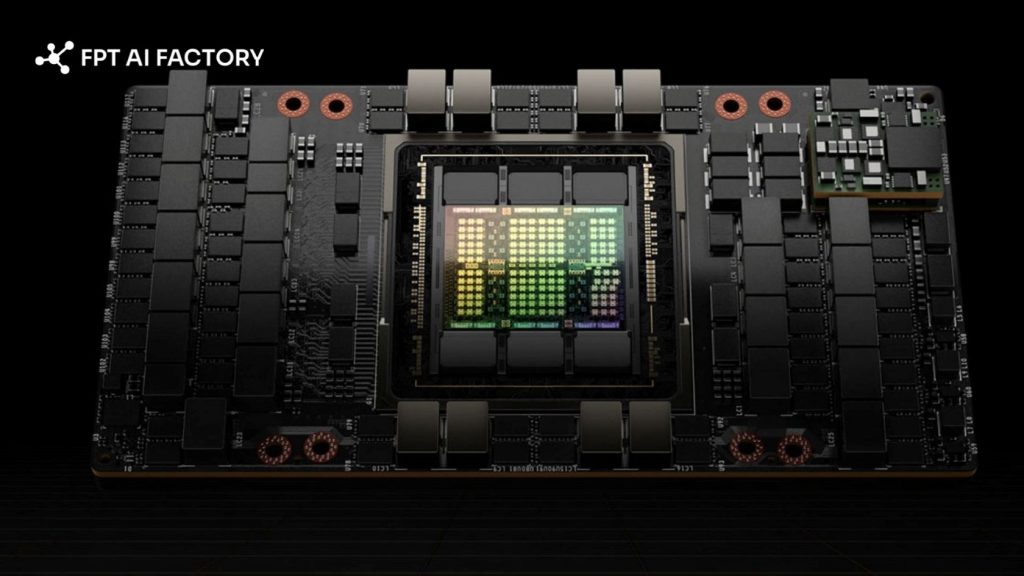
High-speed AI computing powered by NVIDIA H100 Tensor Core GPU (Source: FPT AI Factory)
>>> Explore: What is an LLM Agent? How it works, advantages, and disadvantages
2. A100 vs H100: what is the difference?
Understanding the differences between A100 vs H100 is crucial for choosing the right GPU for your AI workloads. Each GPU is designed with distinct architectures and features to handle specific tasks efficiently. The table below summarizes the key differences:
| Feature | A100 | H100 |
| Architecture | Ampere | Hopper |
| GPU Memory | 40GB / 80GB | 80GB |
| Memory Type | HBM2e | HBM3 |
| Memory Bandwidth | Up to 2 TB/s | Up to 3.35 TB/s |
| Tensor Core Gen | 3rd | 4th |
| FP8 Support | No | Yes |
| MIG Support | Yes | Yes (enhanced) |
| Typical Positioning | Cost-efficient AI | Next-gen LLMs, large-scale AI |
The A100 GPU is widely adopted for reliable and cost-effective AI training and inference, offering strong framework support and stable performance. In contrast, the H100 GPU introduces next-generation features like FP8 support and higher memory bandwidth, making it ideal for large-scale AI models and demanding workloads.
>>> Explore: FPT AI Factory: A Powerful AI SOLUTION Suite with NVIDIA H100 and H200 Superchips
3. A100 vs H100 performance for AI workloads
When comparing A100 vs H100, performance differences are significant depending on training and inference workloads. The H100 introduces generational improvements in speed, memory bandwidth, and precision, while the A100 remains a reliable, cost-effective choice for many AI applications. Understanding these distinctions helps businesses optimize both performance and cost.
3.1 Training Performance
When it comes to training AI models, H100 shows clearer advantages for large-scale and time-sensitive workloads. However, A100 can still be a practical choice for development, experimentation, and projects where cost efficiency matters more than maximum training speed.
| Criteria | H100 | A100 |
| Training speed | Faster training performance, especially for large transformer-based models | Handles large models effectively, but with slower training speed |
| Precision support | FP8 and FP16 support help accelerate training while maintaining accuracy in most cases | Strong FP16 and BF16 support for common AI training workloads |
| Memory bandwidth | Up to 3.35 TB/s with HBM3, reducing data transfer bottlenecks | Around 2 TB/s with HBM2e, suitable for many production and experimentation workloads |
| Multi-GPU scaling | Advanced NVLink enables efficient scaling for very large models | Supports multi-GPU training, but less optimized for extreme-scale workloads |
| Cost efficiency | Best value when training time and scale are key priorities | More cost-efficient for development, experimentation, and budget-conscious workloads |
In short, H100 is better suited for large models and speed-critical training, while A100 remains a solid option when cost efficiency and framework stability matter more.
>>> Explore: Fine-Tuning OpenFlamingo on NVIDIA H100 GPUs
3.2 Inference Performance
For inference workloads, H100 offers clear advantages, especially for large language models and real-time AI applications. Its architecture is designed to deliver higher throughput and lower latency, while both H100 and A100 support efficient workload sharing through Multi-Instance GPU (MIG).
| Criteria | H100 | A100 |
| Throughput | Delivers significantly higher token throughput for large transformer-based models | Provides stable throughput for small to medium models |
| Latency | Lower latency, especially for real-time AI applications | Suitable for batch inference and less latency-sensitive workloads |
| Precision support | FP8 precision helps improve inference efficiency | Strong FP16/BF16 support, but no native FP8 |
| GPU partitioning | Supports MIG for flexible multi-tenant and large-scale deployments | Supports MIG for running multiple inference workloads on one GPU |
| Scalability | NVLink enables efficient multi-GPU inference for very large models | Works well for production workloads that do not require maximum multi-GPU scaling |
| Cost efficiency | Better value when speed, scale, and time efficiency are priorities | More cost-efficient for stable production systems with moderate performance needs |
In practice, H100 is ideal for high-throughput, latency-sensitive, and large-scale inference, while A100 remains a strong and cost-efficient option for many production use cases.
Advanced compute enables fast and scalable AI inference performance (Source: FPT AI Factory)
3.3 Cost-Performance Trade-offs
Cost is an important factor when selecting GPUs for AI workloads, especially when balancing performance requirements with budget constraints. While H100 represents the latest generation with top-tier performance, it also comes at a significantly higher cost compared to A100.
H100
- Premium Pricing: Positioned at the high end, typically used in enterprise environments and advanced AI research
- Performance Efficiency: Higher upfront cost but delivers faster training and inference, reducing time-to-completion for large workloads
- Best for Scale: Ideal for large models and high-demand applications where performance is critical
A100
- Lower Cost: More affordable than H100 while still offering strong performance
- Balanced Value: Suitable for a wide range of AI tasks, from development to production
- Cloud Availability: Widely available across cloud platforms, making it easier to deploy and scale
In practice, H100 is a better fit for performance-critical and large-scale AI workloads, while A100 offers a more balanced option for teams prioritizing cost efficiency and flexibility.
4. When should you choose A100 vs H100?
Choosing between A100 vs H100 depends on your AI workload, project scale, and budget priorities. While both GPUs are powerful, each excels in different scenarios. Understanding when to use A100 or H100 helps businesses maximize efficiency, reduce costs, and ensure optimal training or inference performance.
4.1 When A100 makes more sense
- Ideal for projects with tight budgets, offering lower hourly rates without compromising reliability
- Perfect for experimentation, development, or batch processing where immediate speed is less critical
- Works best with models already fine-tuned for A100, taking advantage of stable optimizations
- Suitable for workloads that fit comfortably within 40GB or 80GB memory, avoiding extra unused capacity
4.2 When H100 is the better choice
- Designed for high-performance inference where low latency directly affects user experience
- Excellent for training large transformer-based models, leveraging FP8 and the Transformer Engine
- Best choice when rapid iteration and shorter training cycles outweigh hourly costs
- Recommended for large-scale AI projects that need higher memory bandwidth and next-generation GPU features
5. Running A100 or H100 workloads efficiently with GPU containers
The most efficient way to run A100 or H100 tasks is through GPU Containers. Unlike heavy virtual machines, containers offer near-native speed and a stable environment for AI tools like PyTorch and CUDA.
| GPU Model | Best For | Key Strengths | Main Use Case |
| H100 | Large companies & researchers | Top power for AI & big data | Training giant AI models, advanced research |
| A100 | Cloud users & shared teams | Great for sharing resources & fast training | Cloud-based AI, efficient resource use for teams |
To maximize these hardware capabilities, GPU Container provides an enterprise-grade environment specifically engineered for high-tier workloads. Part of the FPT AI Factory ecosystem, this solution allows you to deploy, train, and scale AI models efficiently with no setup and no delays.
Key Benefits:
- Built-in Templates: Deploy instantly with pre-configured AI/ML frameworks (vLLM, Ollama, PyTorch, etc.).
- Flexible Environments: Use your own Docker images with ease for maximum portability.
- Persistent Storage: Keep datasets and models always attached with scalable storage volumes.
- Logs & Monitoring: Debug faster using real-time logs and integrated monitoring tools.
- Developer-Centric: Focus entirely on coding and innovation, not on managing infrastructure.

FPT AI Factory’s GPU Container simplifies AI training, deployment, and scaling in one platform (Source: FPT AI Factory)
6. FAQs
6.1. Is A100 better than H100?
Not necessarily. A100 is not universally better than H100 because the right choice depends on workload requirements, budget, time efficiency, and scalability needs. H100 generally offers stronger performance for large-scale AI training and time-sensitive workloads, while A100 can still be a practical option for smaller models or projects where cost efficiency matters more than maximum speed.
6.2. Which is better for inference, A100 or H100?
For inference, H100 generally has the edge. Its FP8 precision and Transformer Engine allow it to process more tokens per second and reduce latency, making it well-suited for real-time AI applications and large models. A100 still performs reliably for smaller models or batch inference, and it can be a more cost-effective choice when ultra-low latency is not required.
6.3. What is the difference between A100 40GB and H100 80GB?
The main difference is memory and compute performance. H100 80GB doubles the VRAM of A100 40GB and uses faster HBM3 memory, nearly doubling memory bandwidth. With the Hopper architecture and fourth-generation Tensor Cores, H100 can handle larger datasets and complex AI models, achieving roughly 3x to 9x faster training and inference, making it ideal for next-generation Large Language Model (LLM) workloads.
Choosing between A100 vs H100 depends on your specific AI workloads, budget, and scalability needs. The A100 remains a reliable and cost-efficient option for standard workloads and model fine-tuning, while the H100 delivers superior performance for large-scale training and high-demand inference scenarios. Selecting the right GPU ensures better efficiency, faster results, and optimized costs for your AI projects.
To fully unlock the power of modern GPUs, organizations need robust infrastructure and an efficient deployment strategy. With FPT AI Factory, you can access high-performance H100 and H200 GPUs, create an account instantly, and join our $100 trial program to experience powerful infrastructure for AI training and deployment.
- Hotline: 1900 638 399
- Email: support@fptcloud.com