
InfiniBand vs Ethernet is a key decision for teams building AI infrastructure that depends on fast GPU communication, low latency, and reliable data transfer. InfiniBand is often used for large-scale AI training and high-performance computing, while Ethernet remains common for enterprise, cloud, and inference workloads. At FPT AI Factory, teams can access GPU infrastructure and AI services for training, fine-tuning, containerized workloads, and production inference.
1. What Is InfiniBand?
InfiniBand is a high-speed networking technology designed for low-latency communication between servers, storage, and compute nodes. It is widely used in high-performance computing, supercomputing, and AI training clusters because it supports fast data transfer and efficient communication across distributed systems. In AI workloads, InfiniBand is especially useful when many GPUs must exchange data frequently during model training.
For example, when a large language model is trained across hundreds or thousands of GPUs, each GPU may need to synchronize gradients with other GPUs after many training steps. If the network is slow, the GPUs spend more time waiting for communication and less time doing computation. InfiniBand helps reduce this delay by providing high bandwidth, low latency, and native support for RDMA-based communication.
2. What Is Ethernet?
Ethernet is the most widely used networking technology in enterprise data centers, cloud environments, and general IT infrastructure. It connects servers, storage, switches, and applications through a mature, flexible, and broadly compatible ecosystem. Ethernet is easier to find, easier to operate for many IT teams, and often more cost-effective than specialized networking systems.
For AI workloads, modern high-speed Ethernet can support many scenarios, including inference serving, cloud infrastructure, storage traffic, and smaller-scale training. For example, an enterprise deploying AI chatbots, recommendation systems or document processing applications may use Ethernet-based infrastructure because these workloads often prioritize scalability, integration and operational simplicity over the lowest possible latency.

Ethernet provides a mature, widely compatible network foundation for enterprise AI infrastructure, cloud connectivity and production inference workloads
3. Why Network Performance Matters for AI Workloads?
Network performance matters because AI workloads are rarely isolated to one server. Modern AI systems often involve large datasets, distributed GPUs, shared storage, model checkpoints, and production applications. In an AI data center, the network connects compute, storage, and software layers so training and inference workloads can run efficiently across distributed environments.
For distributed training, weak networking reduces GPU utilization because GPUs wait for data synchronization instead of continuing computation. For inference, network performance affects response time, throughput, and the ability to serve users reliably. This is why AI infrastructure needs to combine compute, storage, networking, and deployment services into a well-designed system rather than treating networking as a secondary layer.
4. InfiniBand vs Ethernet: Key Differences
The biggest difference between InfiniBand and Ethernet is their design priority. InfiniBand is optimized for high-performance, low-latency communication in tightly coupled clusters. Ethernet is optimized for compatibility, flexibility and broad deployment across enterprise and cloud environments. Both can support AI workloads, but the best choice depends on scale, latency requirements, budget, and existing infrastructure.
| Criteria | InfiniBand | Ethernet |
| Definition | High-speed interconnect designed for HPC, AI clusters, and low-latency communication. | General-purpose networking technology widely used across enterprise, cloud, and data center environments. |
| Latency | Typically lower latency for tightly coupled distributed workloads. | Higher latency than InfiniBand in many AI cluster scenarios, though modern Ethernet is improving. |
| Bandwidth | Designed for high bandwidth between compute nodes and GPUs. | High-speed Ethernet can provide strong bandwidth, especially with 100G, 200G, 400G or higher networks. |
| RDMA support | Native RDMA support is built into the architecture, making it suitable for latency-sensitive GPU communication and tightly coupled AI clusters. | Traditional Ethernet does not provide the same RDMA experience by default. However, RoCE (RDMA over Converged Ethernet) enables low-latency RDMA communication over carefully configured Ethernet networks, making AI-optimized Ethernet more competitive for modern AI workloads. |
| Scalability | Strong for large GPU clusters and HPC environments. | Strong for enterprise, cloud and hybrid environments due to broad ecosystem support. |
| Network reliability | Designed for predictable performance in performance-sensitive clusters. | Reliability depends on network design, congestion management and operational practices. |
| Deployment complexity | Requires specialized hardware and expertise. | Usually easier for existing IT and cloud teams to deploy and manage. |
| Cost | Often higher due to specialized equipment and skills. | Often more cost-effective, especially when reusing existing infrastructure. |
| Ecosystem compatibility | Strong in HPC and GPU cluster ecosystems. | Broad compatibility across enterprise software, cloud services and network tools. |
| Best use case | Large-scale training, HPC and latency-sensitive distributed workloads. | Enterprise AI, cloud environments, inference and cost-sensitive deployments. |
Ethernet can replace InfiniBand in some AI environments, but it is not a universal replacement for every workload. Traditional Ethernet is widely used across enterprise IT, cloud infrastructure and AI inference because it is flexible, cost-effective and easy to integrate with existing systems. However, large-scale distributed AI training often requires extremely fast and predictable communication between GPUs, where InfiniBand has traditionally held an advantage.
The gap has narrowed with the emergence of AI-optimized Ethernet. High-speed Ethernet combined with technologies such as RoCE (RDMA over Converged Ethernet), congestion control and intelligent switching can support demanding GPU clusters and large AI deployments. RoCE enables direct memory-to-memory data transfers with minimal CPU involvement, reducing latency and communication overhead during distributed training.
This makes Ethernet an increasingly attractive option for organizations that need both strong AI performance and compatibility with existing cloud and data center environments. However, achieving consistent results often requires careful network design and congestion management, while InfiniBand may still be preferred for highly latency-sensitive training environments where maximum performance predictability is critical.
5. When Should You Use InfiniBand?
InfiniBand is usually the better choice when performance is the top priority, and the workload requires fast communication between many compute nodes. It is especially relevant for large training clusters, HPC simulations, and distributed workloads that are sensitive to latency and network congestion
5.1. Large-scale AI training clusters
Use InfiniBand when training large AI models across many GPUs or many nodes. In this setup, GPUs exchange gradients, parameters, and intermediate data frequently, so network latency and bandwidth directly affect training efficiency. For teams studying GPU cluster design, the network is a core part of the cluster architecture because compute nodes must behave like one coordinated system.
Example: NVIDIA DGX SuperPOD uses InfiniBand-based compute fabric for large-scale AI training environments. NVIDIA describes DGX SuperPOD as an architecture designed for state-of-the-art model training and exaflops-scale performance. Its reference architecture includes NVIDIA Quantum-X800 InfiniBand as the compute fabric, with InfiniBand positioned as a high-performance, low-latency and RDMA-capable networking technology for inter-node performance.
5.2. High-performance computing workloads
InfiniBand is also suitable for high-performance computing (HPC) workloads such as scientific simulation, molecular modeling, weather forecasting, climate modeling and complex engineering analysis. These workloads often split one large problem across many compute nodes, so the nodes must exchange data quickly and consistently. When the network is slow, the whole simulation can be delayed because some nodes must wait for others to finish communication.
Example: NASA’s climate and weather research workloads provide a clear example. A NASA technical document describes its Discover computational cluster as using a DDR/QDR/FDR InfiniBand backbone and supporting workloads such as high-fidelity cloud and hurricane simulations, long-term weather and climate reanalysis, and climate change projection studies. In this type of environment, InfiniBand helps compute nodes exchange simulation data with lower communication delay, which is important when researchers run large-scale weather or climate models across many nodes.
5.3. Latency-sensitive distributed workloads
Some distributed workloads are highly sensitive to latency because each training step depends on fast communication between nodes. In synchronous AI training, GPUs usually compute gradients locally, then exchange and synchronize those gradients before the model can move to the next step. If the network introduces delays, GPUs may sit idle while waiting for synchronization, which reduces overall training speed and GPU utilization.
Example: In large-scale deep learning research, the FireCaffe project showed that distributed DNN training is often limited by communication overhead between servers. The researchers noted that high-bandwidth network hardware such as InfiniBand is ideal for reducing this communication cost, and their system achieved strong scaling results when training models such as GoogLeNet across a 128-GPU cluster.
5.4. Workloads with heavy east-west traffic
East-west traffic refers to data moving between servers inside a data center, rather than from users to applications. AI training clusters often generate heavy east-west traffic because GPUs, storage systems and compute nodes constantly exchange gradients, parameters, activations and training data. If this internal communication is slow or congested, GPUs may spend more time waiting for data instead of processing it, which can reduce overall training efficiency.
Example: NVIDIA DGX SuperPOD is a clear example of infrastructure designed for heavy east-west AI traffic. In NVIDIA’s DGX SuperPOD reference architecture, the compute fabric connects DGX systems through NVIDIA InfiniBand, allowing traffic within a group of nodes to move efficiently across the cluster. NVIDIA also notes that poorly managed east-west traffic can create bottlenecks, slow down training and reduce the efficiency of the AI pipeline.
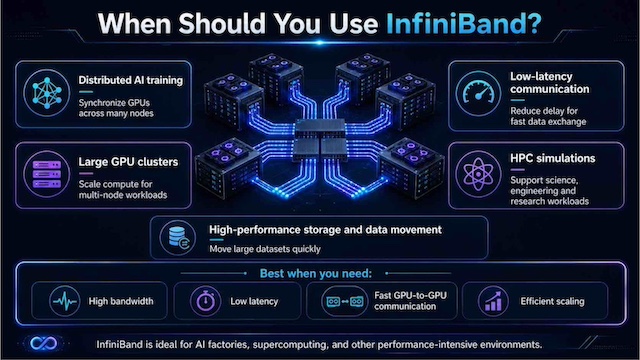
InfiniBand is ideal for large GPU clusters, distributed AI training and HPC workloads that require high bandwidth, low latency and fast GPU-to-GPU communication
6. When Should You Use Ethernet?
Ethernet is usually the better choice when businesses need flexibility, compatibility, and cost efficiency. It is especially practical for enterprise AI infrastructure, cloud environments, inference workloads, and organizations that already operate Ethernet-based data centers.
6.1. Enterprise AI infrastructure
Ethernet is often a practical choice for enterprise AI infrastructure because most organizations already use Ethernet-based networks in their data centers, cloud environments, and office systems. It is easier for IT teams to deploy, monitor, and maintain because it works with familiar tools, existing switches, and standard network operations. For many enterprise AI workloads, such as model serving, analytics, data pipelines, internal copilots, and moderate fine-tuning, Ethernet can provide a strong balance between performance, compatibility, and cost.
Example: Microsoft is using next-generation NVIDIA Spectrum-X Ethernet switches in its Fairwater AI data center to connect large-scale AI infrastructure for OpenAI workloads. NVIDIA describes this deployment as designed to deliver the performance, scale, and efficiency needed for large AI models and applications. This shows that Ethernet is no longer limited to traditional enterprise networking; modern high-speed Ethernet can also support advanced AI infrastructure when designed for high throughput, scalability, and production reliability.
6.2. Cloud and hybrid cloud environments
Ethernet is often a strong choice for cloud and hybrid cloud environments because it is widely supported across enterprise data centers, public cloud platforms and existing IT networks. When businesses run AI workloads across on-premises systems and cloud infrastructure, Ethernet makes it easier to connect compute, storage, applications and monitoring tools without rebuilding the entire network architecture.
Example: Microsoft’s Fairwater AI data center is a clear example of Ethernet being used for large-scale AI infrastructure. NVIDIA states that Microsoft is deploying next-generation NVIDIA Spectrum-X Ethernet switches in its Fairwater AI data center to deliver the performance, scale and efficiency required for OpenAI’s large-scale AI models and applications. This shows that modern Ethernet is no longer only for traditional enterprise networking; with AI-optimized Ethernet platforms, it can support large cloud AI environments
6.3 AI inference workloads
Ethernet is often suitable for AI inference workloads because inference usually focuses on serving real-time requests from applications, users or APIs. Unlike large-scale distributed training, many inference systems do not need constant GPU-to-GPU synchronization after every training step. Instead, they need stable throughput, low response time, easy scaling and strong compatibility with existing cloud or enterprise networks.
Example: Microsoft’s Fairwater AI data center shows how modern Ethernet can support large-scale AI model applications. NVIDIA states that Microsoft is deploying next-generation NVIDIA Spectrum-X Ethernet switches in its Fairwater AI data center to deliver the performance, scale and efficiency required for OpenAI to run large-scale AI models and applications. This is relevant for AI inference because production applications need to serve many real-time model requests reliably, and high-speed Ethernet can help connect compute, storage and application layers without requiring every workload to use an InfiniBand-style training fabric
6.4. Modern high-speed Ethernet for AI
Modern high-speed Ethernet can support many AI workloads when it is designed with enough bandwidth, congestion control and operational visibility. It is especially useful for organizations that want to balance AI performance with existing network compatibility. Compared with traditional Ethernet, AI-optimized Ethernet platforms are built to handle heavier AI traffic, reduce bottlenecks and support large-scale compute environments more effectively.
Example: Microsoft is using next-generation NVIDIA Spectrum-X Ethernet switches in its Fairwater AI data center, which is designed to support OpenAI’s large-scale AI models and applications. NVIDIA describes Spectrum-X Ethernet as an Ethernet-based AI fabric built for high-performance AI workloads, combining switches, SuperNICs, telemetry, and intelligent fabric control to improve throughput, scale, and operational visibility.
6.5. Cost-sensitive deployments
Ethernet is often a practical option for cost-sensitive AI deployments, especially when the workload does not require the lowest possible latency of a dedicated InfiniBand training fabric. For many teams, inference services, internal AI applications, data pipelines, analytics jobs and moderate model development can run effectively on Ethernet-based infrastructure. The main advantage is that Ethernet is widely supported, easier for IT teams to manage and more compatible with existing data center or cloud environments.
Example: An AI startup that fine-tunes models only a few times per month may not want to buy and maintain a permanent InfiniBand-based GPU cluster. Instead, it can run demanding jobs on cloud GPU instances with high-performance networking, then scale resources down when the job is finished. AWS Elastic Fabric Adapter is one example: AWS describes EFA as a network interface for Amazon EC2 that supports applications needing high levels of inter-node communication at scale, including HPC and machine learning workloads.
6.6. Existing data center networks
Ethernet is also practical when an organization already has mature data center networking in place. Many IT teams already understand Ethernet switching, routing, monitoring, and troubleshooting, so using Ethernet can reduce deployment time and operational complexity. Instead of rebuilding the entire network around a specialized fabric from day one, a company can start with Ethernet-based AI deployments and reserve InfiniBand or other specialized cluster networks only for workloads that clearly require ultra-low latency and tightly coupled GPU communication.
Example: Microsoft’s Fairwater AI data center shows how modern Ethernet can support large-scale AI infrastructure. NVIDIA states that Microsoft is deploying NVIDIA Spectrum-X Ethernet switches in Fairwater to deliver the performance, scale and efficiency required for large AI models and applications. For a company modernizing an existing data center, Ethernet can be a practical first step for AI inference, internal AI applications, and moderate training workloads.
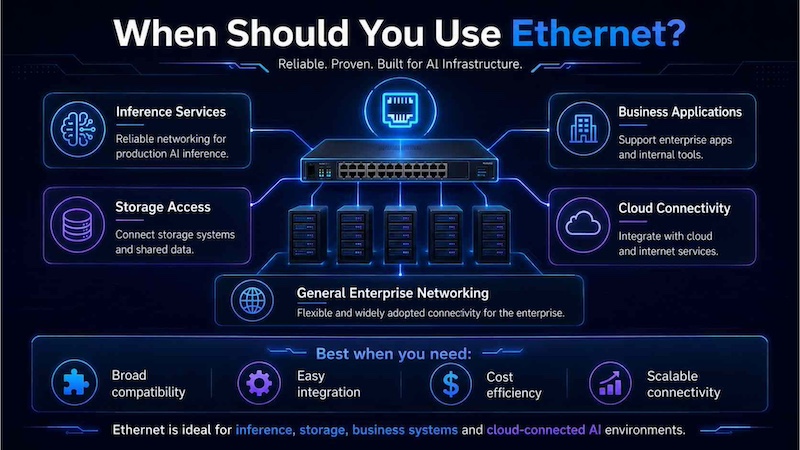
Ethernet connects inference services, storage systems, business applications, and cloud environments with flexible, cost-efficient networking.
7. Cost and Operational Considerations
Cost is not only about the price of switches and adapters. The real cost includes deployment complexity, team expertise, monitoring, maintenance, scalability and how efficiently the network supports the workload over time.
| Aspect | InfiniBand | Ethernet |
| Hardware and infrastructure costs | Usually higher because it requires specialized adapters, switches and cluster design. | Often lower when businesses can reuse existing data center infrastructure. |
| Deployment complexity | More complex, especially for teams without HPC or AI cluster networking experience. | Usually easier for enterprise and cloud teams familiar with Ethernet operations. |
| Operations and maintenance | Requires specialized monitoring, tuning and troubleshooting knowledge. | Supported by a broad ecosystem of network tools and operational talent. |
| Scalability and future upgrades | Excellent for high-performance cluster scaling but may require dedicated architecture planning. | Flexible for mixed workloads, hybrid cloud and application-level scaling. |
| Team expertise required | Higher expertise requirement for AI/HPC networking. | More common skills available across IT and cloud teams. |
| Vendor ecosystem | Strong in HPC and GPU cluster markets. | Very broad across enterprise, cloud, security and SaaS ecosystems. |
| Long-term cost efficiency | Efficient when the workload fully uses low-latency cluster performance. | Efficient when compatibility, operations and mixed workloads matter more. |
8. Networking Requirements for Distributed AI Training
Distributed AI training places heavy demands on networking because multiple GPUs and servers must work together as one training system. The network must support fast synchronization, reliable data movement, and stable performance under heavy traffic
8.1. GPU communication and synchronization
During distributed training, GPUs need to exchange gradients, model parameters, and training state. If communication is slow, the training job may spend too much time waiting for synchronization. This reduces GPU utilization and increases training time.
For this reason, high-performance networking is a core part of AI data center architecture. Compute, storage, and networking
8.2. Network bottlenecks in large AI workloads
A network bottleneck happens when data cannot move fast enough between compute nodes, storage systems or applications. In large AI workloads, this can cause idle GPUs, slower training, and inconsistent performance. Bottlenecks may come from insufficient bandwidth, congestion, storage delays or poor topology design.
Example: If a model training job uses many GPUs but the network cannot handle synchronization traffic, the GPUs may wait for each other instead of continuing computation. In this case, adding more GPUs may not improve performance unless the network is also upgraded.
8.3. Balancing performance and infrastructure cost
The best network is not always the fastest network. Businesses should match the network to the workload. Large training clusters may justify InfiniBand, while inference, SaaS, cloud and mixed enterprise workloads may run efficiently on modern Ethernet.
This is similar to broader AI infrastructure planning: teams need to balance compute, storage, network, deployment and cost. FPT AI Factory’s AI development platforms content highlights the need for integrated environments that support compute infrastructure, data management, training frameworks, deployment pipelines and monitoring.
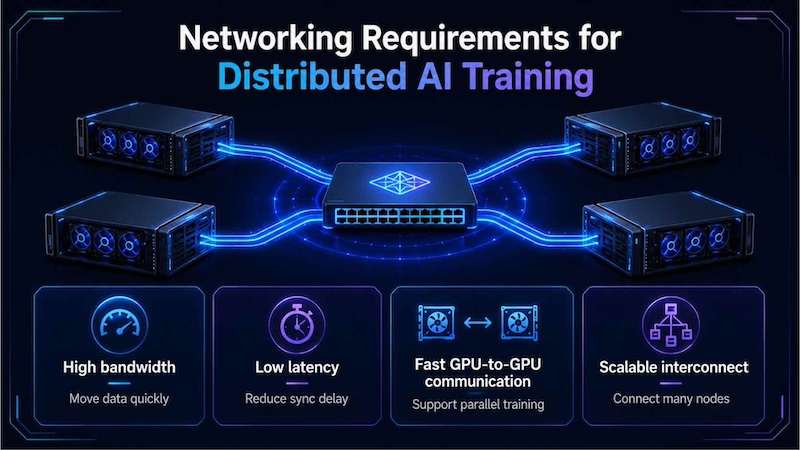
Networking infrastructure connects multiple GPU nodes through high-speed, low-latency communication to support efficient distributed training and AI workloads
9. Choosing the Right Network for AI Infrastructure
Choosing between InfiniBand and Ethernet depends on workload type, GPU scale, latency requirements, budget and existing infrastructure. The right decision should start from the AI use case: training large models, running containerized workloads or deploying inference into production applications.
9.1. For training large AI models
For training large AI models, network performance directly affects training efficiency because GPUs must communicate frequently. When businesses need scalable GPU compute for model training, fine-tuning or compute-intensive workloads, GPU Virtual Machine can provide dedicated GPU resources and control over the compute environment. In these scenarios, the network layer should be designed to keep GPUs busy instead of waiting for data movement.
Example: A team fine-tuning a large model on multiple GPUs may focus on compute capacity, memory, storage throughput, and network performance together to avoid wasting expensive GPU resources
9.2. For Enterprise AI Applications
For enterprise AI applications, Ethernet is often a practical network choice because it supports broad compatibility with cloud services, data platforms, APIs and existing business systems. Applications such as internal copilots, document processing tools, customer support assistants and analytics platforms usually need reliable connectivity, flexible scaling and easier integration rather than the ultra-low-latency communication required by large distributed training clusters.
Modern high-speed Ethernet can help enterprises deploy and operate AI applications while reusing familiar network infrastructure and management practices. When AI workloads become more demanding, AI-optimized Ethernet with technologies such as RoCE can further improve data transfer and support higher-performance environments.
Example: An enterprise deploying an AI document processing system may use Ethernet to connect uploaded documents, storage services, inference endpoints and ERP software. The application can extract invoice data, return structured fields and update business records through connected systems, while the organization maintains an infrastructure approach that is easier to integrate and scale for production use.
9.3. For model inference and AI application deployment
For model inference and AI application deployment, the main priorities are fast integration, flexible scaling, and reliable API serving. Unlike large-scale training clusters, inference workloads do not always require a dedicated InfiniBand network. In many cases, teams need a production-ready way to serve models through APIs, handle changing request volumes, and keep operations simple.
This is where Serverless Inference can be suitable. It allows teams to deploy AI models through API endpoints, scale based on request demand and reduce the need to manage the full networking and serving layer by themselves. This approach is especially useful for teams building AI applications that need speed, stability and easier production deployment.
Example: A customer support chatbot, document processing application or AI assistant may not need a large InfiniBand-based training cluster. Instead, it needs scalable API endpoints, low-latency responses and reliable production monitoring so users can receive model outputs quickly and consistently.
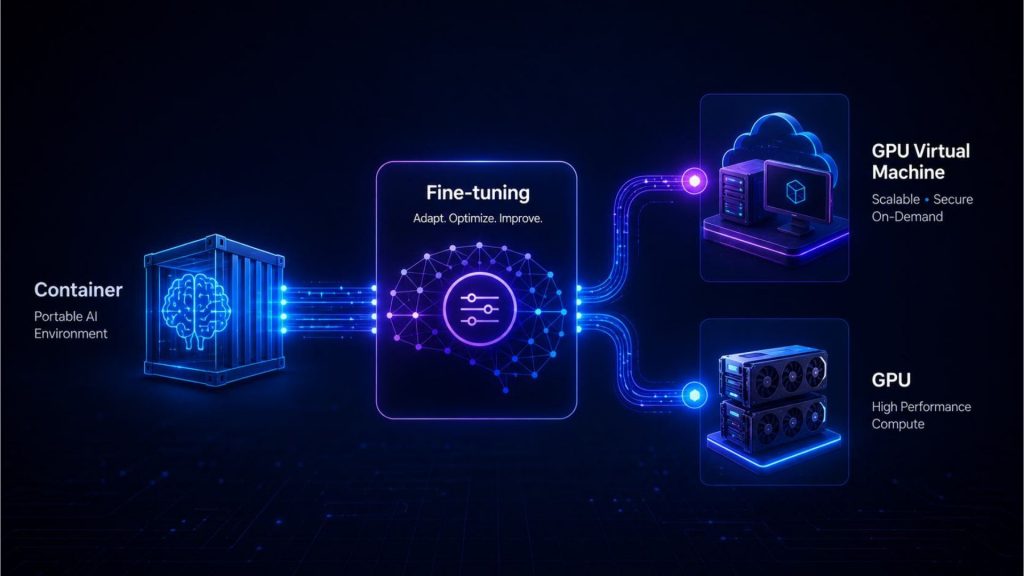
Fine-tuning infrastructure uses containers and GPU resources to create flexible, high-performance environments for adapting AI models.
10. Hybrid AI Networking Architectures
Many organizations do not need to choose only one network approach forever. A hybrid architecture can use InfiniBand where ultra-low latency is critical and Ethernet where flexibility, compatibility ,and cost efficiency matter more.
10.1. InfiniBand for training clusters
In a hybrid AI networking architecture, InfiniBand is often used for large-scale training clusters where GPUs must communicate quickly across multiple nodes. It helps reduce synchronization delays, improve GPU utilization and keep distributed training jobs running efficiently.
10.2. Ethernet for inference and storage
In a hybrid AI networking architecture, Ethernet can be used for inference services, storage access, business applications and cloud connectivity. It offers stable performance, broad compatibility and easier integration with existing enterprise systems. This allows teams to reserve InfiniBand for large training clusters while using Ethernet for everyday AI operations and production workloads.
10.3 Balancing performance and cost
A hybrid approach helps organizations balance performance and cost. Instead of overbuilding the entire environment, teams can invest in high-performance networking where training requires it and use Ethernet for broader application and infrastructure needs.
InfiniBand vs Ethernet is not a one-size-fits-all decision. InfiniBand is often the stronger choice for large-scale AI training clusters, HPC workloads, and latency-sensitive distributed systems. Ethernet is often more practical for enterprise AI infrastructure, cloud environments, inference workloads, and cost-sensitive deployments.
The best approach is to match the network to the workload. Training large models may require high-performance interconnects, while production applications may benefit more from scalable inference APIs and easier operations. FPT AI Factory supports teams across the AI lifecycle through GPU infrastructure, AI Studio tools and FPT AI Inference services.
FPT offers a $100 free trial credit program for users to explore the platform. For businesses or organizations that need customized AI solutions, large-scale deployment or expert consultation, contact FPT AI Factory through the official contact form.
Contact Information:
- Hotline: 1900 638 399
- Email: support@fptcloud.com
Explore more articles
What is an AI Cloud Platform? Top 10 AI Platforms 2026?
Best GPU for AI Training: From Personal to Business Project
Best GPUs for AI in 2026: Use Case and Performance